Jamal Carter stood in front of the cracked bathroom mirror at St. Anne’s Shelter, adjusting the second-hand white shirt he had ironed the night before with a damp towel and the weight of his own body.
The collar was a little too tight, and the sleeves stopped just shy of his wrists, but he figured it was passable. He tugged at the navy blue tie, a clip-on he had borrowed from Pastor Reggie, and gave himself a final once-over.
His eyes hesitated when they fell to his shoes.
The leather was peeling. The stitching at the toe had unraveled long ago. The soles flapped slightly when he walked, and the laces had been replaced with a length of old telephone wire.
These shoes had carried him through job fairs, community college hallways, and long walks home in the dark.
They were all he had.
Jamal sighed, then forced his gaze upward, past the imperfections.
Today was important.
His first real job interview.
He was twenty-three, freshly graduated with a degree in economics from Chicago Community College, the only one from his group at St. Anne’s to make it out without a police record or a broken dream.
He could not afford to focus on his shoes now, not when he was this close.
Jamal was twenty-three.
He had grown up in foster care after losing both parents before his seventh birthday.
For years, he had bounced between group homes, juvenile shelters, and short-term placements. But somehow, despite the fights, the hunger, the statistics, he had survived.
More than that, he had tried.
He studied. He stayed clean. He got a scholarship for kids aging out of the system and put himself through community college, graduating with a degree in economics.
No one had handed him anything.
He had built his future on scraps.
He stepped out into the biting January air.
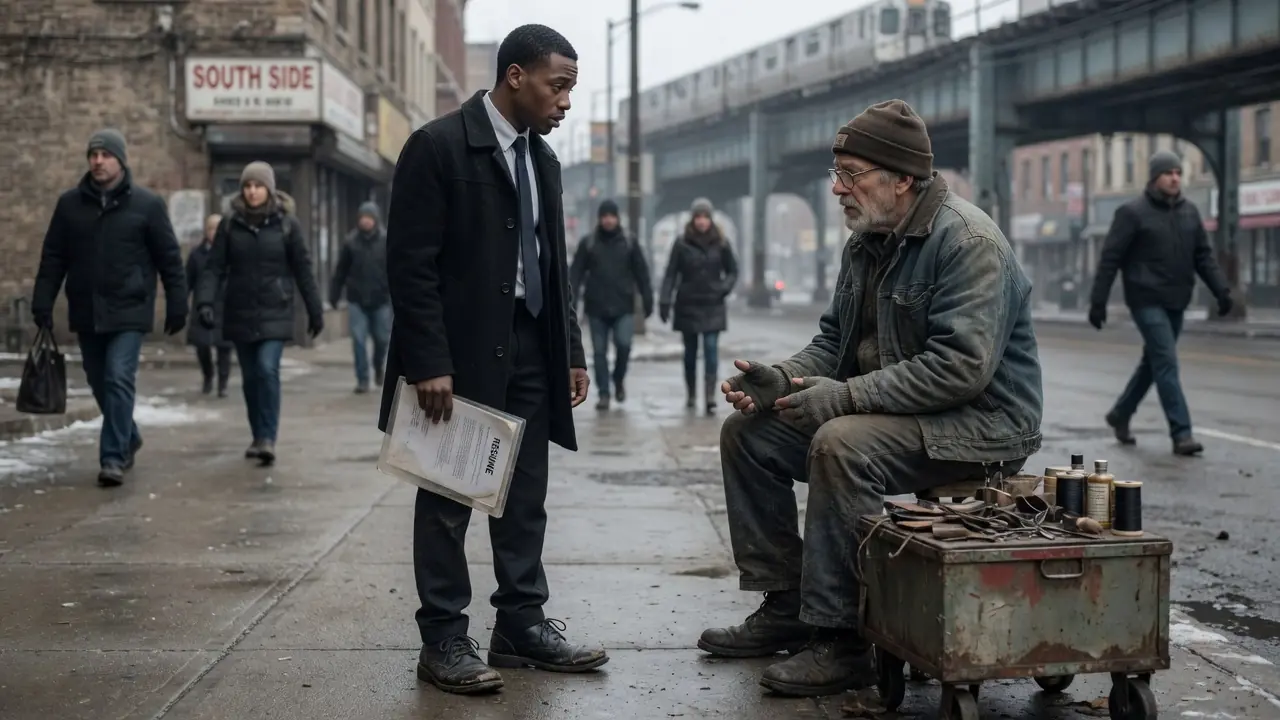
Wind curled through the South Side streets like a warning. Jamal hunched into his coat and kept walking, clutching the plastic folder holding his resume and one printed recommendation letter like it was made of glass.
The city buzzed ahead of him. Rushed commuters, honking cars, the metallic shriek of the L train passing overhead.
But in his world, everything was quiet.
Every step felt too loud, too revealing, as if the city could hear the story his shoes were telling.
He was halfway to the station when he heard it.
“Nah, you can’t walk into your future like that, kid.”
The voice was rough, but not unkind.
Jamal turned his head.
Sitting on a folding stool next to a beat-up rolling cart was a white man, maybe sixty, dressed in layers of canvas and denim. His hands were gloved in fingerless wool, and in them he held a worn leather boot he was mending.
A small handmade sign leaned against his cart.
Walter Green. Repairs. Pay if you can.
“Nah, those things are crying out. You hear that? That’s not leather squeaking. That’s your future asking for mercy.”
He grinned, then patted the crate in front of him.
“Come here. I won’t charge you. Ain’t right to let someone head toward hope on a busted sole.”
Jamal hesitated.
He looked around. People were passing them without pause. His instinct told him to keep walking, but something in the man’s voice, sharp, sincere, strangely familiar, made him stop.
He walked over cautiously and sat on the upside-down milk crate Walter nudged toward him.
The older man leaned in, pulling out a curved needle, some waxed thread, and a small metal clamp. His movements were precise, practiced.
Jamal watched in silence as the man cleaned the toe cap, pressed the leather back into place, and began to stitch.
“Interview?” Walter asked, not looking up.
Jamal nodded.
“Yeah. Entry-level gig at a shoe company, believe it or not.”
Walter snorted.
“Funny how life lines up sometimes. Shoes carry us through everything, but we never thank them until they fall apart.”
The man’s hands moved like water over the shoe.
Jamal noticed the deep lines in his face, the nicotine-stained beard, the burn marks on the sleeve of his jacket.
A man used to heat and pressure, he thought.
A man who understood both.
“You from around here?” Jamal finally asked.
Walter shrugged.
“Everywhere and nowhere, really. Used to have a shop on 63rd Street. Lost it when the rents went up, long before anyone cared about old leather and good soles. So now I fix what I can, when I can.”
He tied off the last stitch, then lifted the shoe gently.
“All right, let’s see if she walks again.”
He slid the shoe back on Jamal’s foot, tightened the makeshift laces, then tapped the heel.
Jamal stood, stepped forward, then backward.
The shoe held.
Walter smiled, a slow, satisfied thing that seemed to lift the weight from his weathered shoulders. He looked up at Jamal, eyes clearer than before, and said, “Don’t let those shoes stop you from walking the right road. You keep going. The rest of your life will meet you there.”
Jamal stood still for a moment, letting the words settle in his chest like warm tea.
He nodded slowly.
“Thank you,” he said quietly.
Walter just waved a hand.
“Get going. You got places to be. Dreams don’t wait forever.”
Jamal turned and began walking again, shoes quiet now, heart just a little louder.
He did not look back.
But he felt something shift, as if a part of his story had just been stitched together.
And this time, it would hold.
Jamal arrived at the Wexford Footwear headquarters with four minutes to spare.
The building loomed above him like something out of a different world, glass and steel, perfectly polished, glowing against the cold morning.
He paused at the revolving doors, checked his reflection in the glass, then looked down at his shoes.
The stitching was visible, but solid.
The sole held.
They looked honest, and for once, he did not feel the need to apologize for them.
Inside, the lobby was silent and clinical. The floor gleamed like water. People walked with purpose, wearing expensive shoes that clicked like clockwork.
Jamal stepped forward, quieter but no less certain, and gave his name at the reception desk.
The woman behind the counter barely looked at him, but she motioned him toward a row of leather chairs near the elevator bank.
He sat stiffly, hands resting on the plastic folder in his lap.
Around him were three other applicants, two men and one woman. They looked older, smoother, each dressed in tailored jackets and polished loafers.
One of the men glanced at Jamal’s shoes and smirked, then went back to scrolling on his phone.
Jamal ignored it.
He had no time for someone else’s comfort to decide his worth.
He adjusted his tie, exhaled slowly, and waited.
When his name was finally called, he stood with a quiet kind of certainty and followed the HR assistant through a maze of glass hallways into a small window-lined conference room.
There were three people already seated, two women and one man, all in business attire, mid-forties, sharp, clean smiles.
The woman in the center leaned forward, extending a hand.
“Mr. Carter, thanks for coming in today.”
“Thank you for the opportunity,” Jamal said, shaking each hand in turn.
The interview began with the usual.
Background, education, skills, previous work experience.
Jamal answered clearly, sticking to what he knew, his degree, the warehouse jobs he took to cover meals, his work ethic, the fact that he graduated with no family, no safety net, and no excuses.
Then came the harder part.
“Why Wexford?” the man on the panel asked. “We get hundreds of applicants every month. What makes you the right fit?”
Jamal hesitated.
His hands tightened slightly around the folder, then relaxed.
He could lie, say something about brand alignment, long-term growth potential, or upward mobility.
Or he could say the truth, the full, raw, unfiltered version.
So he looked them in the eyes and said, “Because I know what it’s like to walk through life with your shoes falling apart.”
A pause followed.
The panel exchanged glances.
“I don’t just mean literally,” he continued, “though mine were until about an hour ago. A man on the street, Walter, fixed them for free. Didn’t ask for anything. He just told me, ‘Don’t let your shoes stop you from walking the right road.’”
He swallowed.
“I’m here because I want to build shoes that carry people forward, not hold them back. People like me, who’ve never had a comfortable step in their life. I know what a good pair of shoes can mean when you’ve got nothing else.”
The room was still.
The woman in the center tapped her pen slowly against the table.
Then she asked, “You’re talking about empathy, then?”
Jamal nodded.
“I’m talking about purpose. If I’m working in the back, stacking boxes or tracking inventory, I want to do it knowing that the products we make aren’t just for people who can afford $500 sneakers. I want to be part of something that helps real people stand taller.”
Another silence followed, this time deeper.
Then the man leaned back in his chair.
“Well,” he said quietly, “you’ve given us more than just a resume to consider.”
The rest of the interview continued, but the tone had changed.
The questions became less mechanical, more curious. They asked how he would handle pressure, how he would improve warehouse logistics, what he thought about supply chain ethics.
Jamal answered with calm precision.
He was not trying to impress, only to speak truthfully, to be seen not as a risk, but as someone who knew the value of ground-level work.
By the end, they stood and shook his hand again.
No promises, just professionalism, but something had shifted.
He saw it in their eyes.
He stepped out of the building thirty minutes later. The cold hit him again, but this time it did not sting.
He walked down the same street he had come up that morning, shoes firm against the pavement, shoulders back.
Whatever happened next, call or no call, he knew one thing for certain.
He had not walked in there ashamed, and he had not walked out the same man.
Two weeks passed before the call came.
Jamal was in the shelter’s small computer lab helping an older resident set up an email account when his phone buzzed in his pocket.
Unknown number.
He hesitated, glanced at the man beside him, then excused himself and stepped into the hallway.
The voice on the other end was professional, clipped but warm. Wexford was offering him the position. Logistics assistant, warehouse operations, starting Monday at 8:00 a.m.
The pay was not much, but it came with benefits, transit reimbursement, and most importantly, a foothold.
He did not say much at first. He just listened, blinked, and let the words settle.
Then quietly, he said, “Thank you. I won’t waste it.”
After he hung up, he stood there for a long moment, the old tile floor beneath his feet feeling suddenly steadier, like something had shifted beneath the surface of the world and clicked into place.
On his first day, Jamal showed up fifteen minutes early, dressed in a button-down shirt and slacks he had bought from a second-hand store over the weekend.
The shoes, still Walter’s work, had been cleaned and polished with a borrowed rag and a little coconut oil someone at the shelter had sworn worked better than any store-bought shine.
He walked through the employee entrance with quiet confidence, nodded at the security guard, and made his way to the back offices.
The warehouse was a world of movement.
Forklifts buzzing, crates stacked high, labels flying through machines like ticker tape.
Jamal was assigned to a supervisor named Maria Vasquez, a no-nonsense woman in her fifties who did not have time for pleasantries, but knew her systems cold.
She showed him how to scan packages, track shipments, and process returns. It was detailed physical work, the kind that made your back ache and your mind sharpen at the same time.
Jamal listened, asked the right questions, and took notes on everything.
By the end of the week, Maria pulled him aside and muttered, “You’re not just doing this for the paycheck, huh?”
He smiled.
“No, ma’am. I’m doing it so I never have to come back to where I came from.”
He stayed late when others clocked out.
He organized shelves no one asked him to. He fixed labeling errors that had gone unnoticed. When a delivery was delayed, he rerouted it through a smaller regional center without being told.
Small things, but they added up.
He learned names. He remembered birthdays. He asked the cleaning staff how their kids were doing.
He did not do it for praise.
He did it because every minute on that floor felt like it meant something, like he was earning the right to keep walking.
Six months in, he pitched an idea during a team huddle.
The company had been throwing out damaged returns, shoes that were slightly scuffed or had misprinted logos, but were otherwise perfectly wearable.
Jamal proposed creating a reclaim rack where employees could volunteer to clean and sort salvageable pairs and donate them to local shelters and youth programs.
He even offered to run it himself on weekends.
The idea was met with polite nods, then silence.
Two days later, he was called into a meeting with an executive he had never met before.
Ms. Andrea Whitaker, head of community development.
She asked him to explain his plan again.
He did.
She listened, leaned back in her chair, and said, “Let’s pilot it. You get three months.”
Jamal worked nights to build the program.
He partnered with local nonprofits, recruited volunteers, set up a simple database, and got corporate to approve transportation for donated goods.
By the end of the quarter, over seven hundred pairs of shoes had been redistributed across the city.
The impact was real, visible, measured, and suddenly people started noticing Jamal not just as the new guy, but as someone with ideas worth hearing.
Promotions did not come overnight, but they came.
Logistics coordinator. Inventory lead. Assistant manager.
With each new title, Jamal brought the same grit, the same drive to serve both the business and the people it touched.
He suggested changes to the tracking software that shaved days off supply turnaround times. He rewrote the onboarding handbook for new hires to be clearer and fairer.
He advocated for a bilingual signage system in the warehouse to support Spanish-speaking workers, and he never stopped wearing his first pair of repaired shoes on Fridays, a quiet promise to himself.
Years passed, the company changed, and so did Jamal.
He got his own apartment, then a better one. He started mentoring interns, most of them kids who reminded him of the boys from St. Anne’s.
He went back to school at night for an MBA. He kept a photograph of his graduation day in his locker, him alone on stage holding the diploma like it was a living thing.
Then, ten years to the day after he had first stepped into that interview room, Wexford launched a new product line, Foundation Soul, a durable, affordable, stylish line of shoes designed specifically for working-class communities, school districts, and disaster relief efforts.
Jamal had led the team that designed it, built the distribution network, and secured the outreach partnerships.
At the product launch, the CEO called him one of the clearest examples of what this company stood for.
Cameras flashed. People clapped.
But Jamal’s mind was elsewhere.
All he could think about was the man with the cart, the needle, and the words that never left him.
Don’t let those shoes stop you from walking the right road.
Now he was walking it.
Stronger. Further. Steadier.
And it was time to turn around and find the one who had helped him take that first real step.
For weeks after the launch of Foundation Soul, Jamal could not shake the weight that had settled behind his ribs, the kind of quiet, unfinished echo that kept him up at night.
The speeches were done, the photos published, the praise humbling but fleeting.
What lingered was the face he had not seen in a decade, the voice that had lived inside his head like a compass.
Don’t let those shoes stop you from walking the right road.
He had tried again and again to find Walter in the early years, back when his title still read coordinator and his bank balance barely held.
But leads had dried up, names turned fuzzy. The corner on 53rd had been swallowed by a new organic grocer. The stoop where Walter once patched soles was now blocked off by scaffolding and city permits.
At the time, it had felt like trying to chase smoke, and life kept moving.
But now, ten years in, something in Jamal refused to let it go.
He cleared his schedule on a Saturday and started over, tracing the city with his feet like a map etched in memory.
He returned to 53rd and Ellis, stood there in the early light, and waited.
No one appeared.
He walked two blocks east and asked around.
At a barber shop, an old man vaguely remembered a white guy who used to sew leather by hand, kept tools in a beat-up laundry cart, polite as hell, disappeared a while back.
At the bus terminal, someone recalled seeing him hand out shoes to a teenager during the winter, said he might have been connected to a shelter downtown.
Jamal followed the thread.
He stopped at shelters, churches, warming centers, asking for any records under the name Walter Green.
No one had a full answer, but someone at a soup kitchen on 63rd finally gave him a direction.
“Try the outreach clinic on Halsted. They work with folks like that, quiet ones. Used to have pride, but lost the structure.”
Jamal went and waited and asked again.
It took three more weekends of walking, of scanning weathered faces and talking to case managers with overstuffed files and tired eyes, until one afternoon, just as he was about to leave the community center on Halsted, a staffer called out behind him.
“Wait. You looking for Walter? Old guy, about sixty, well, now probably seventy, used to fix shoes?”
Jamal turned slowly, his heart pushing against his ribs like it remembered before his brain could.
“Yeah,” he said. “Him.”
The staffer nodded.
“He volunteers on Thursdays. Teaches a trade workshop for the guys reentering. Real quiet, real precise. You’d never guess he was living on the street a few years ago.”
Jamal came back that Thursday.
The room smelled like leather and coffee. There were six folding tables, three men at each, hunched over shoes, boots, scraps of fabric.
And there, at the far end, stood a man in a tan work jacket with silver hair tied back at the nape of his neck, bent over a cracked pair of boots, threading a curved needle with the same practiced patience Jamal had watched ten years ago.
He walked across the room slowly, like he was moving through water.
Walter looked up mid-stitch, eyes squinting through the soft fluorescent light, and stared.
For a moment, there was nothing.
No smile, no recognition.
Then the needle dropped from his fingers.
“Kid.”
Jamal almost laughed at that.
“I’m not a kid anymore,” he said softly. “But yeah, it’s me.”
Walter blinked, his face changing not with age, but with realization.
“You walked in those shoes,” he said. “Didn’t you?”
Jamal nodded.
“All the way.”
They stepped outside after the class ended, the sun beginning to dip behind a line of gray buildings.
Walter leaned on the railing, his hands in his coat pockets. He looked older, yes, but not diminished. Still steady. Still quiet.
“I looked for you,” Jamal said. “For years. I wanted to thank you.”
Walter shrugged.
“You just did.”
“No.”
Jamal shook his head.
“That’s not enough.”
He told Walter everything.
About the job, the promotions, the program they had built, the new line of shoes with purpose stitched into every seam.
And when he mentioned the name Foundation Soul, Walter let out a quiet breath, one hand covering his mouth like something sacred had been spoken.
“You built all that?” he murmured.
Jamal smiled.
“No. I built it because someone believed in me when I couldn’t afford to believe in myself.”
Walter was silent for a long time.
Then he turned and said, “I don’t have family, Jamal. Never did. Never stuck long enough anywhere to make one.”
Jamal did not hesitate.
“You do now,” he said.
He invited Walter to dinner that night.
Nothing fancy. Just a warm place, a full plate, and two men who did not need to speak much to understand what the moment meant.
Afterward, Jamal drove him home to his own apartment, a second bedroom already made up.
He did not ask Walter to move in.
He told him he was welcome.
And Walter, after a long, stunned silence, said the only thing that mattered.
“All right then. Let’s walk the road together.”
Walter never left.
He never needed to.
What began as a simple offer, a couch for a night, a warm meal, a thank you overdue, evolved into something neither of them dared name at first, but both came to understand fully.
The second bedroom became his.
A quiet space, half workshop, half retreat. His tools returned to daily use. Jamal set up proper lighting, ordered the finest leather he could source, and made sure the radio always had static-free jazz playing in the background.
There was no ceremony, no announcement, only a natural, quiet folding of one life into another.
They built their days around a rhythm.
Mornings with coffee and folded newspapers, afternoons with slow walks or visits to the neighborhood shelters, evenings spent elbow-deep in rubber soles and old memories.
Walter found purpose again, not just in patching shoes, but in patching people’s dignity, one stitch at a time.
Word of his work spread.
Teachers sent in bags of student sneakers. A firefighter brought in a pair of boots his father had worn in the seventies.
As Walter fixed them all, Jamal made sure they kept coming.
And then, one night, no music, no audience, just the two of them sharing leftover stew in the kitchen, Jamal looked across the table and said, “I want to make it official. I want you to be my father.”
Walter blinked.
His spoon paused midair.
He did not speak for a long time.
Then, in a voice low and almost shaking, he said, “You sure about that, son?”
Jamal just nodded.
“Already is. Paper just catches the truth.”
A week later, the paperwork was done.
Legal, notarized, sealed.
Jamal Carter, son of Walter Green.
From that day on, Walter introduced him not as the kid who found me or my friend from the city, but as my boy.
With Walter by his side, Jamal moved forward with a new vision, not just for shoes, but for change.
He founded Walter’s Bench, a nonprofit initiative in Walter’s name, a network of community stations in underserved neighborhoods where anyone could come to receive free shoes or learn the craft of shoe repair.
At each bench, there would be a volunteer trained by Walter himself, or trained by someone Walter had mentored, passing down the skills and, more importantly, the message.
No one is too broken to stand tall again.
The launch of Foundation Soul, Wexford’s new shoe line designed for working-class families and those facing hardship, became a moment Jamal never forgot.
At the press event, he stood in front of a crowd of investors, press, and community leaders.
Not in a suit, but in the same shirt he wore to his very first interview and the same pair of shoes Walter had repaired a decade ago.
He held them up and said, “The day these shoes were stitched back together was the day I realized it wasn’t just the leather that needed fixing. I didn’t just need a job. I needed someone to believe I was worth keeping together. Walter didn’t give me a handout. He gave me a reason to keep walking.”
The room was silent.
Then the applause began.
Not polite, but full, real, rippling with something deeper than brand loyalty.
That evening, Jamal skipped the after-party.
Instead, he went home.
Walter was sitting outside on the wooden bench Jamal had built for him from old warehouse pallets, a mug of coffee in hand, watching the kids from the neighborhood play near the sidewalk.
Jamal knelt beside a small group, showing one of the boys how to loop his laces and tie them tight.
Walter watched him with a quiet smile.
The same smile he had worn when he first pulled that curved needle through a split sole.
He did not say a word.
He did not need to.
He sat back on the bench, light spilling onto his face, and sipped his coffee.
Not a father by blood, but the father of a turning point.
The kind you never forget.
The kind you walk with forever.