On Christmas Eve, a lonely sixty-year-old man sat in his luxurious penthouse, fifteen years without celebrating since his wife passed. Unable to bear the silence, he wandered into a small diner.
That was where he saw them.
A young mother counting coins for her daughter’s hot chocolate while she skipped her own meal. He quietly paid, thinking that was it.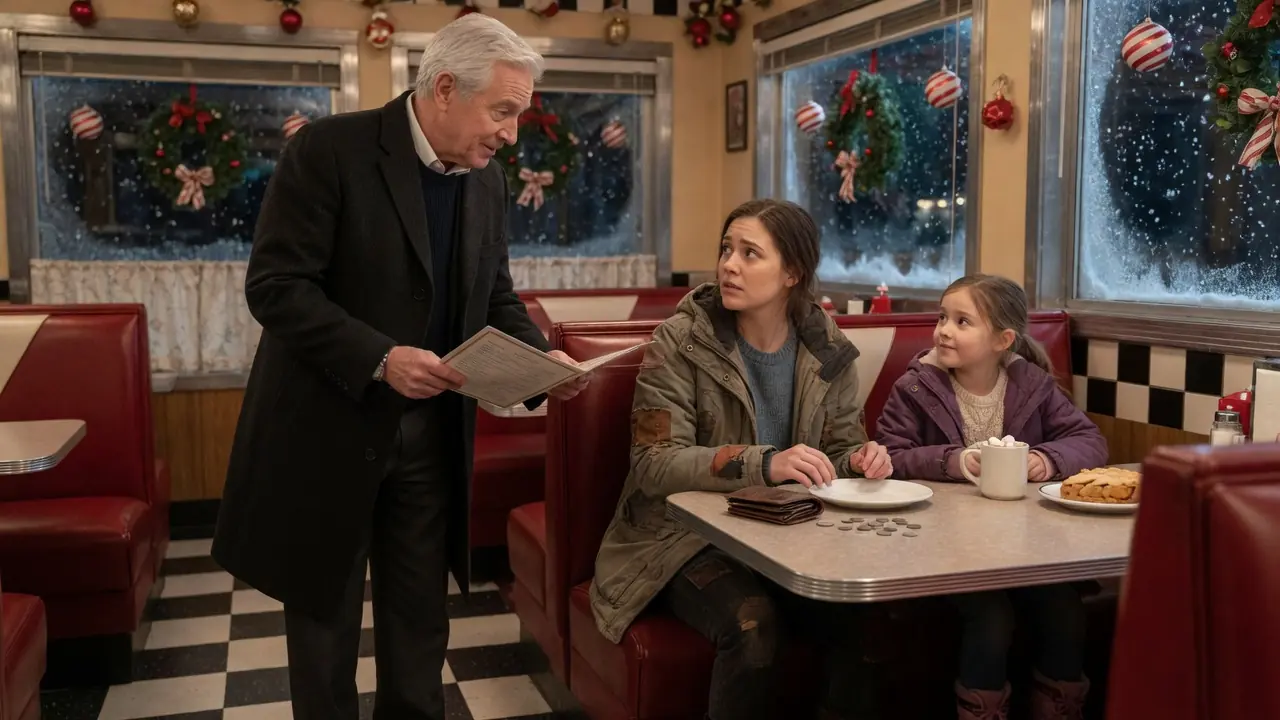
But the seven-year-old looked at him and asked, “Are you eating Christmas dinner all by yourself?”
What happened next changed all three of their lives forever.
Ellis Warren stood at the floor-to-ceiling windows of his penthouse, a glass of bourbon in his hand, watching the city of Cedarbrook sprawl below him like a galaxy of Christmas lights.
He was sixty years old, successful beyond measure, and more alone than he had ever been in his life.
The ice clinked against the crystal as he raised the glass to his lips. Outside, families gathered in warm living rooms. He could see them through windows across the street.
Mothers setting tables. Fathers carrying children on their shoulders. Grandparents settling into armchairs. The whole world seemed to pulse with connection, with belonging.
Everyone except him.
His phone buzzed on the marble counter. Another email from the Horizon Dynamics board. Even though he had supposedly retired six months ago, they still treated him like he was running the company, still expected him to solve every crisis.
He had spent thirty-five years building that tech empire from nothing, pouring everything he had into circuits and code and quarterly reports.
And what did he have to show for it?
A penthouse that echoed when he walked through it. A bank account he would never spend. A reputation that meant nothing when he came home to silence every night.
The phone buzzed again.
This time it was Sarah Mitchell, his old neighbor from the house he used to share with his wife.
Ellis, it’s Christmas Eve. Come have dinner with us. Tom’s making his famous prime rib, and the grandkids are here. There’s always room for one more.
He typed back quickly.
Thanks, Sarah, but I’m fine. Enjoy your family.
The lie came easily now.
He had been telling it for fifteen years.
Fifteen years since that Christmas Eve when Margaret had driven to the store for eggnog because Ellis had forgotten to pick it up.
Fifteen years since the drunk driver had run the red light on Main Street.
Fifteen years since the police had knocked on his door at 11:30 at night, their faces grave, their words careful and devastating.
Margaret had died on impact.
They told him she had not suffered, but Ellis had every single day since.
He drained the bourbon and poured another, heavier this time.
The penthouse suddenly felt suffocating despite its three thousand square feet. The silence pressed against his eardrums like water pressure. He could not stand it anymore.
Ellis grabbed his coat, a wool overcoat that cost more than most people’s monthly rent, and headed for the elevator.
He did not know where he was going.
He just knew he could not stay in that expensive tomb for another minute.
The cold hit him like a slap when he stepped outside.
December in Pennsylvania did not mess around. He pulled his collar up and started walking. No destination in mind, just moving to feel something other than the hollow ache in his chest.
The streets of Cedarbrook were decorated like a greeting card. Garland wrapped around lampposts. Lights strung across storefronts. Inflatable snowmen wobbled in front yards.
He passed house after house, each one glowing with warmth.
Through one window, he saw a father helping his daughter hang an ornament. Through another, a grandmother laughing as a toddler tried to steal cookies off a cooling rack.
The loneliness crashed over him in waves.
He had had that once.
He and Margaret had talked about children. They had picked out names. They had started looking at houses with good school districts. But his career had taken off, and they decided to wait.
Just a few more years, they had said.
Just until the company was stable.
And then she was gone, and all those plans died with her.
Ellis found himself on Main Street, standing in front of a place he vaguely recognized.
Maple and Main Diner.
It was one of those old-fashioned spots with vinyl booths and a checkerboard floor, the kind of place that probably had not changed its menu since 1970.
Warm light spilled from the windows, and he could see a handful of people inside.
He pushed through the door just to hear human voices, just to not be alone for a little while longer.
The diner was nearly empty.
A waitress who looked to be in her sixties wiped down the counter, humming along to “Silent Night,” playing softly from a radio behind the register.
She looked up when Ellis entered, her face brightening.
“Merry Christmas, hon. Sit anywhere you like.”
Ellis chose a booth in the corner, sliding onto the cracked vinyl seat.
The waitress, her name tag said Donna, brought him a laminated menu and a glass of water.
“Coffee?” she asked.
“Please.”
She returned a moment later with a steaming mug. Ellis wrapped his hands around it, grateful for the warmth.
He was not planning to order anything. He just wanted to sit somewhere that did not echo, somewhere he could pretend he was part of the world instead of just observing it from a distance.
The bell above the door chimed, and a gust of cold air swept through the diner.
Ellis looked up.
A young woman stood in the doorway, her hand resting on the shoulder of a little girl.
The woman could not have been more than her late twenties. She wore a coat that had seen better days, thin and patched at the elbows. Her face was drawn with exhaustion, the kind that came from working too many hours for too little pay.
But her eyes were determined, sharp, with the kind of strength Ellis recognized from his early years building Horizon.
The little girl beside her was maybe seven years old, bundled in a purple jacket that was a size too small. Her eyes went wide when she saw the Christmas lights strung across the diner’s windows, and her whole face lit up like she had just walked into Disneyland.
“Mama, look. They have lights shaped like candy canes.”
The woman smiled, but it was tired.
“I see them, baby. Come on, let’s sit down.”
They slid into a booth three down from Ellis.
He watched out of the corner of his eye as the woman, Maya, he heard the little girl call her, pulled out a worn wallet and began counting coins on the table.
Quarters. Dimes. Nickels.
She counted them twice, her lips moving silently, her expression growing more worried with each pass.
Donna came over with her notepad.
“What can I get you ladies?”
Maya looked at her daughter, then back at the coins.
“One hot chocolate and one slice of the apple pie, please.”
The little girl, Lily, Maya called her, looked up at her mother.
“Mama, aren’t you getting anything?”
“I’m not hungry, sweetheart.”
“I had a big breakfast.”
Another lie, Ellis thought.
He recognized those too.
Donna nodded and walked away.
Lily swung her legs under the table, humming the same Christmas song that had been playing when Ellis walked in. Maya stared at the coins she had carefully stacked, and Ellis saw her throat work as she swallowed hard.
He had seen that look before.
It was the look of someone doing math in their head, trying to figure out how to make five dollars stretch for three more days.
It was the look of someone who would skip meals so their child could eat.
It was the look of every choice Margaret had said he would never have to make because he had worked so hard to build something that would take care of them forever.
Ellis looked away.
This was not his business.
He did not know these people. He had come here to escape his own loneliness, not to get tangled up in someone else’s problems.
But then Lily said something that stopped him cold.
“Mama, do you think Santa knows we moved? I’m scared he won’t find our new apartment.”
Maya’s voice was gentle when she answered.
“Baby, Santa always knows where to find good kids. You don’t have to worry about that.”
“But what if he thinks I’ve been bad because I cried when Daddy left?”
Ellis saw Maya’s jaw tighten. He saw her hand reach across the table to take her daughter’s.
“You weren’t bad, Lily. You were sad. There’s a big difference. And none of what happened with your daddy was your fault. You hear me?”
“Yes, Mama.”
Donna returned with the hot chocolate and pie.
Lily’s eyes went wide again, and she picked up the fork with both hands like she was holding treasure.
Maya watched her daughter with an expression Ellis recognized.
Love mixed with guilt.
The desperate hope that this small thing might be enough to make up for everything that was not.
Ellis stood up before he could talk himself out of it.
He walked over to the counter where Donna was refilling coffee pots.
“The woman and the little girl in that booth,” he said quietly. “I’d like to pay for their meal. And can you bring them the full dinner menu? Whatever they want.”
Donna looked at him, then over at Maya and Lily, then back at Ellis. Her expression softened.
“That’s real kind of you, hon.”
“But don’t tell them it’s from me. Say it’s a Christmas promotion or something. The house is treating them.”
“You sure?”
Ellis pulled out his wallet.
“I’m sure. And bring them seconds if they want. Dessert too.”
He handed her two hundred-dollar bills.
Donna’s eyes widened.
“This is way more than—”
“Keep the rest. Merry Christmas.”
He started to turn back to his booth, but Donna caught his arm.
“You want me to bring you anything, hon?”
Ellis shook his head.
“Just the coffee is fine.”
But when he sat back down, he found he could not stop watching them.
Donna went over and delivered the news about the Christmas special, free dinner for families with children. Her improvisation was smooth as butter.
Maya’s first reaction was suspicion, but Lily was already bouncing in her seat, and eventually Maya’s resistance crumbled.
They ordered real food. Chicken, mashed potatoes, vegetables.
Lily talked nonstop, telling her mother about school, about her friend Emma who had a puppy, about the Christmas pageant she had been in last week.
Maya ate slowly, like she was trying to make every bite last, and Ellis recognized that too.
The way you ate when you did not know when your next real meal would be.
He was finishing his third cup of coffee when Lily suddenly turned in her seat and looked right at him.
Her eyes were bright and curious.
“Mister, are you eating Christmas dinner by yourself?”
Ellis froze.
Maya immediately started to apologize, but Ellis waved her off.
“I am,” he said simply.
Lily’s face scrunched up with concern that seemed too old for a seven-year-old.
“That’s really sad. Nobody should eat Christmas dinner alone.”
“Lily,” Maya said sharply, embarrassment coloring her cheeks. “That’s not polite.”
“But it’s true, Mama. Remember what you said? That Christmas is about family and being together.”
Ellis felt something crack in his chest.
This little girl, who probably had less than anyone in this diner, was worried about him.
“You’re right,” he said, his voice rougher than he intended. “It is sad.”
Lily looked at her mother. Some unspoken communication passed between them. Then she turned back to Ellis.
“Do you want to eat with us? We have lots of food now because of the Christmas special.”
“Lily, I don’t think—” Maya started.
But Ellis was already standing up, his coffee cup in hand.
“If you don’t mind the company, I’d be honored.”
Maya looked like she wanted to object, but something in Ellis’s face must have stopped her.
Maybe she recognized the loneliness.
Maybe she just did not have the heart to say no on Christmas Eve.
Either way, she nodded.
“Of course. Please sit down.”
Ellis slid into the booth across from them.
And for the first time in fifteen years, he did not spend Christmas Eve alone.
Donna brought Ellis a plate without him even asking. The same chicken dinner Maya and Lily were having. She gave him a knowing look as she set it down, and Ellis nodded his thanks.
“So,” Lily said, swinging her legs under the table again. “What’s your name, mister?”
“Ellis. Ellis Warren.”
“I’m Lily Carter, and this is my mama, Maya.”
She said it with the formal pride of a child who had been taught to introduce herself properly.
“It’s nice to meet you both,” Ellis said.
Maya was studying him carefully, and he could see her taking in the expensive coat draped over the booth’s edge, the watch on his wrist, the way he carried himself.
She was trying to figure out if he was a threat or just a lonely old man.
Ellis could not blame her.
A single mother had to be cautious.
“Are you from Cedarbrook?” she asked.
“I am. Lived here most of my life. You?”
“We moved here about six months ago from Pittsburgh.”
She did not elaborate, and Ellis did not push.
Lily, meanwhile, had no such reservations.
“We moved because Mama got a job at the hospital. She cleans the offices at night, and sometimes she helps at the bakery on Fourth Street, and she does other stuff too.”
“Lily,” Maya said gently.
“What? It’s true. You work really hard, Mama.”
“I do what I need to do,” Maya said.
But Ellis heard the exhaustion underneath the words.
He took a bite of the chicken. It was simple food, nothing fancy, but it tasted better than the expensive meals he usually ate alone in restaurants where the waiters knew his name and his order by heart.
“What about you, Mr. Warren?” Maya asked. “What do you do?”
“Please call me Ellis. And I’m mostly retired now. I used to run a tech company.”
“Oh.” Maya’s expression shifted slightly. “Horizon Dynamics?”
Ellis raised his eyebrows.
“You’ve heard of it?”
“Everyone’s heard of it. You make computer chips or something.”
“Semiconductors, processors, that sort of thing.” He waved his hand dismissively. “Not very exciting dinner conversation, I’m afraid.”
“I think it’s cool,” Lily piped up. “My friend Emma’s dad works with computers. He fixed our TV once when it broke.”
Ellis smiled despite himself.
“I used to fix things like that too when I was younger. Before I spent all my time in meetings.”
“Do you miss it?” Lily asked.
“Fixing things?”
The question caught him off guard.
Did he miss it?
He had been so focused on building, on growing, on succeeding, that he had forgotten what it felt like to actually make something with his hands, to solve a problem that mattered.
“Yeah,” he said quietly. “I think I do.”
They ate in comfortable silence for a while.
The diner’s radio had switched to “Have Yourself a Merry Little Christmas,” and Ellis felt the familiar ache in his chest.
This had been Margaret’s favorite song. She would play it every year starting December first, humming it while she decorated the house, singing it softly while they cooked dinner together.
“Are you okay?” Lily asked.
Ellis realized his eyes had gone distant.
“I’m fine, sweetheart. Just remembering.”
“Remembering what?”
“Lily,” Maya warned.
But Ellis shook his head.
“It’s all right. I was remembering my wife. She loved Christmas. She would have loved this song.”
“Where is she?” Lily asked with the innocent directness of a child who did not yet understand that some questions hurt.
“She passed away a long time ago.”
Lily’s face fell.
“Oh. I’m sorry.”
“Me too,” Maya said softly.
Something in her tone told Ellis she understood loss too.
They finished their meal, and Donna brought dessert. Three slices of pie, warm and topped with vanilla ice cream.
Lily talked between bites, telling Ellis about her school, about her teacher, Mrs. Henderson, who had a funny laugh, about the book she was reading, about a girl who found a magic garden.
Ellis listened.
Really listened.
And something strange happened.
The tightness in his chest began to ease. The hollow ache that had driven him out of his penthouse into the cold night started to fill with something warm.
He could not remember the last time he had listened to a child talk about her day.
The last time he had been part of something as simple as a shared meal.
When they finished, Maya started gathering their coats.
“We should get going. It’s late, and tomorrow’s Christmas.”
Lily’s face fell.
“But Mama, Mr. Ellis is going to go back to being alone.”
“Lily, I’m sure Mr. Ellis has plans.”
“I don’t, actually,” Ellis heard himself say.
Maya looked at him, surprise and something else, maybe sympathy, crossing her face.
“You’re going home to an empty house on Christmas Eve?” Lily asked, her voice small.
“I’ve done it for a long time,” Ellis said, trying to make it sound normal, like it did not tear him apart every year.
Lily looked at her mother with those big, pleading eyes.
“Mama, can Mr. Ellis come home with us? Just so nobody has to be alone on Christmas?”
“Lily, that’s not... I mean, we couldn’t.”
Maya was flustered, clearly torn between her daughter’s kind heart and the reality of inviting a stranger into their home.
“Please, Mrs. Carter,” Ellis said, and he heard the raw need in his own voice. “I promise I’m harmless. I just haven’t had Christmas dinner with people in a very long time. If it wouldn’t be too much trouble.”
Maya studied him for a long moment.
Ellis could see her weighing the risk, the impropriety, against the genuine loneliness in his face and her daughter’s earnest hope.
Finally, she sighed.
“We don’t have much. Our apartment is small, and I can’t offer you anything fancy.”
“I don’t need fancy,” Ellis said. “I need...”
He trailed off, not sure how to finish that sentence.
“Company,” Maya finished for him.
And when their eyes met, Ellis saw that she understood.
“Yeah,” he said. “Company.”
Lily beamed.
“This is going to be the best Christmas ever.”
They bundled up and headed out into the cold.
Snow had started falling while they were inside, light flakes that caught the streetlights and turned the world into something magical.
Ellis walked beside them, and when Lily reached up and took his hand like it was the most natural thing in the world, he felt tears sting his eyes.
“Come on, Mr. Ellis,” she said, tugging him forward. “Our apartment isn’t far, and Mama made paper snowflakes. We can show you.”
Ellis let himself be pulled along, this little girl’s hand warm in his.
And for the first time in fifteen years, Christmas did not feel like a wound.
It felt like maybe, just maybe, a beginning.
The apartment building was old, the kind of place where the radiators clanked and the hallways smelled like cooking oil and old carpet.
Maya led them up three flights of stairs to unit 312, fumbling with her keys in the dim hallway light.
“Sorry about the mess,” she said as she pushed the door open. “I’ve been working doubles all week.”
Ellis stepped inside and stopped.
The apartment was tiny. Living room, kitchenette, and a bedroom he could see through a half-open door, all probably smaller than his penthouse’s master bathroom.
The furniture was secondhand. The carpet was worn thin in paths between the rooms.
But everywhere he looked, he saw warmth.
Paper snowflakes hung from the ceiling, each one cut with obvious care. Drawings covered the refrigerator, crayon masterpieces signed Lily in wobbly letters.
In the corner stood a small Christmas tree, maybe four feet tall, leaning slightly to one side. It was decorated with handmade ornaments, salt dough painted in bright colors, paper chains, popcorn strings.
It was the most beautiful Christmas tree Ellis had seen in fifteen years.
“I know it’s not much,” Maya said, following his gaze. “The tree was on sale because it’s crooked, and most of the decorations we made ourselves, but—”
“It’s perfect,” Ellis interrupted.
And he meant it.
Lily had already kicked off her shoes and was pulling Ellis toward the tree.
“Look, Mr. Ellis. I made this angel out of a paper plate, and this one is supposed to be a reindeer, but Mama says it looks more like a dog.”
“It’s a very dignified reindeer,” Ellis said seriously.
Lily giggled.
Maya hung up their coats and moved to the kitchenette.
“I can make hot chocolate. It’s just the instant kind, but—”
“That sounds wonderful.”
She filled a pot with water while Lily dragged Ellis to the couch, a sagging thing that had probably been nice in 1980, and proceeded to show him every single drawing she had done in the past month.
Ellis listened, really listened, as she explained each one.
This was her school. That was her friend Emma. This one was supposed to be snow, but the blue crayon broke, so she had to use purple.
Maya brought over three mismatched mugs of hot chocolate. She put marshmallows in Lily’s, and Ellis noticed that her own mug had the fewest.
Still dividing resources.
Still making sure her daughter got the best of what little they had.
“Can we watch a Christmas movie?” Lily asked.
“Baby, we don’t have any Christmas movies.”
“What about the one on Channel 7? They play the old Rudolph one every year.”
Maya turned on the small TV. The picture was fuzzy and the sound crackled, but Lily did not seem to notice. She settled between her mother and Ellis on the couch, her hot chocolate clutched in both hands, completely absorbed in the stop-motion animation.
Ellis felt something he had not felt in years.
He felt like he was part of something.
Not performing. Not maintaining an image. Not filling a role.
Just there.
Present.
Belonging.
Halfway through the movie, Lily’s head started to droop. Maya smiled and brushed her daughter’s hair back.
“Someone’s tired.”
“I’m not tired,” Lily mumbled, even as her eyes closed.
“Uh-huh. Come on, baby girl. Let’s get you to bed.”
“But the movie.”
“I’ll tell you how it ends tomorrow.”
Maya scooped Lily up. The little girl was already mostly asleep, and carried her to the bedroom. Ellis heard gentle murmurs, the soft sounds of tucking in, a whispered “I love you” that made his throat tight.
When Maya came back out, she looked exhausted. She sat on the opposite end of the couch, curling her legs under her, and for a moment neither of them spoke.
“Thank you,” she finally said. “For dinner. I know it was you who paid.”
Ellis started to deny it, but she held up a hand.
“Donna’s a terrible liar, and you’re a terrible secret gift giver. You left her a huge tip, didn’t you?”
“Maybe.”
“Why?”
“Because you were counting change to buy your daughter dinner on Christmas Eve. And because I could help. And because...”
He trailed off.
“Because?”
“Because I think my wife would have wanted me to.”
Maya was quiet for a moment.
“Tell me about her, if you want to.”
And Ellis did.
He told her about Margaret, about how they had met at a coffee shop when he was a broke engineer and she was a graduate student in literature.
About how she had believed in him when he had nothing but ideas and determination.
About how she had made him laugh. How she had kept him grounded when success started to change him. How she had planned to teach part-time and write novels and grow tomatoes in a garden she never got to plant.
“It was Christmas Eve,” he said, his voice rough. “Fifteen years ago. I’d forgotten to pick up eggnog for her family’s party. She said she’d run out and get it. I told her it could wait, that we’d just make do without it, but she insisted. She was always like that, wanting everything to be perfect.”
Maya reached over and took his hand.
She did not say anything.
She just held on.
“A drunk driver ran a red light on Main Street. Killed her instantly.” Ellis’s voice cracked. “I spent every Christmas after that alone because I couldn’t stand to be around happy families. Couldn’t stand the reminders of what I’d lost. I buried myself in work, built an empire, made more money than I could ever spend, and came home every night to an empty penthouse.”
“I’m so sorry,” Maya whispered.
“What about you?” Ellis asked, needing to talk about something else. “Lily mentioned her father left.”
Maya’s jaw tightened.
“Derek. We got married young. I was twenty. He was twenty-two. Had Lily when I was twenty-one. He said he wanted a family. Said he was ready. But when the reality hit, when it wasn’t just fun and games anymore, when it was diapers and crying and being exhausted all the time, he left. Lily was three.”
“Does he see her?”
“He sends a card on her birthday sometimes. That’s it.”
“I’m sorry.”
“She deserves better.”
“She does.”
“So I make sure she gets it. Even if that means working three jobs and living in a five-hundred-square-foot apartment, she’s happy. That’s what matters.”
Ellis looked around the small space again.
“You’ve done a beautiful job.”
“Thank you for saying that.”
They talked for another hour.
Two people who had both lost something essential found comfort in sharing their stories.
When Ellis finally checked his watch, it was past midnight.
“I should go,” he said. “Let you get some sleep.”
“You could stay,” Maya said. “I mean, just sleep on the couch. It’s Christmas, and it’s late.”
Then she paused.
“And honestly, it’s been nice having someone to talk to. An adult conversation that isn’t about work schedules and bills.”
“Are you sure?”
“Yeah. I’m sure.”
Maya brought him a pillow and a blanket that smelled like laundry detergent and home.
Ellis settled onto the sagging couch. As he closed his eyes, he heard the soft sounds of Maya moving around the apartment, checking on Lily, turning off lights.
For the first time in fifteen years, Ellis Warren did not spend Christmas alone.
And for the first time in fifteen years, he slept through the night without waking up to an empty bed and an emptier heart.
Ellis woke to the sound of something clattering in the kitchen and a child’s giggle quickly shushed.
He opened his eyes to morning light filtering through thin curtains and the smell of something burning.
He sat up, his back protesting the unfamiliar sleeping arrangement, and looked toward the kitchenette.
Maya stood at the stove, waving a dish towel at a smoking pan, while Lily perched on a chair nearby, covering her mouth to hold in her laughter.
“Mama, the pancakes are black.”
“I know they’re black, baby. I’m working on it.”
Ellis cleared his throat, and they both jumped.
“Oh, you’re awake,” Maya said, looking embarrassed. “Sorry if we woke you. I was trying to make breakfast, but apparently I’m worse at cooking than I remembered.”
“The smoke alarm almost went off,” Lily said helpfully.
Ellis stood up, folding the blanket Maya had given him.
“Need some help?”
Maya looked at the smoking pan, then at him.
“Can you cook?”
“I spent ten years living alone after my wife died. I learned, or I starved.”
“In that case, yes. Please take over before I burn the building down.”
Ellis moved to the stove, examining the damage.
“Okay. First problem, the heat’s too high. Second problem, you’re trying to flip them too soon.”
“I told you, Mama,” Lily said.
Maya laughed, the sound light and genuine.
“All right. All right. The seven-year-old and the retired tech executive both think I’m a terrible cook. Point taken.”
Ellis scraped the burned pancakes into the trash and started fresh. Maya found ingredients that had seen better days: flour, eggs, milk that was close to its expiration date.
Ellis worked with what she had.
Lily appointed herself his sous-chef, carefully measuring ingredients with intense concentration.
“Two teaspoons of vanilla, right?” she asked.
“Perfect. Now, can you stir this while I get the pan ready?”
They worked together, the three of them, in the tiny kitchen.
Maya made coffee in an old percolator. Lily set the table with mismatched plates and forks. Ellis flipped pancakes, making sure to give Lily the best ones, golden and perfectly round.
When they sat down to eat, Ellis realized he could not remember the last time he had had a meal like this.
Not fancy.
Not expensive.
Just warm and simple and shared.
Lily drowned her pancakes in syrup and talked between bites about what she wanted to do that day.
Watch more Christmas movies. Maybe build a snowman if enough snow had fallen. Definitely eat more chocolate.
“You’re going to make yourself sick,” Maya warned.
But she was smiling.
“Mama, it’s Christmas. You can’t get sick on Christmas.”
“Pretty sure that’s not how it works, baby.”
Ellis found himself smiling too.
Really smiling.
Not the polite expression he wore in board meetings, but genuine amusement.
He had forgotten this feeling. The warmth of family breakfast. The chaos of a child’s energy. The comfortable back and forth of people who cared about each other.
After breakfast, Maya insisted on cleaning up. Ellis tried to help, but she shooed him away.
“You cooked. I’ll clean. That’s the rule.”
So Ellis sat on the couch with Lily, who showed him how to make paper snowflakes. His attempts were clumsy, the scissors awkward in his large hands. But Lily praised every crooked cut like he had created a masterpiece.
“This one looks like a star,” she said, holding up his third attempt.
“It looks like a blob.”
“A beautiful blob.”
The morning passed in a haze of simple pleasures.
They watched the parade on TV, the picture still fuzzy, but nobody cared. Maya made sandwiches for lunch with the same careful rationing Ellis had noticed at the diner, bigger portions for Lily, smaller for herself.
He made a mental note.
Around two in the afternoon, Ellis checked his phone.
Seventeen missed calls from the Horizon board. Twelve emails marked urgent. A voicemail from Sarah asking if he was okay.
He looked at Lily, who was currently trying to teach him how to play Go Fish with a deck of cards missing the three of hearts. He looked at Maya, who was curled up in the armchair with a book she had probably read ten times because she could not afford new ones.
He turned his phone off.
“Mr. Ellis, it’s your turn,” Lily said.
“Right, sorry. Do you have any sixes?”
“Go fish.”
When evening came, Ellis knew he should leave. He had imposed enough, stayed too long, crossed too many boundaries for a stranger who had met this family less than twenty-four hours ago.
But when he stood up and reached for his coat, Lily’s face fell.
“Do you have to go?”
“I should get back. You’ve been very kind to let me stay this long.”
“Will we see you again?”
The question was innocent, but Ellis heard the fear underneath it.
The fear of another person leaving, another promise broken.
He looked at Maya, asking permission with his eyes.
She nodded slowly.
“I’d like that,” Ellis said. “If it’s all right with your mother.”
“Can he come back next week, Mama? Please?”
“We’ll see,” Maya said, but she was looking at Ellis with something like understanding. “You’re welcome anytime, Ellis. For what it’s worth.”
Ellis put on his coat, the expensive wool feeling foreign after a day in jeans and a sweater.
Lily gave him a hug at the door, her small arms wrapped around his waist.
“Merry Christmas, Mr. Ellis.”
“Merry Christmas, Lily.”
He took a cab back to his penthouse.
The ride was only fifteen minutes, but it felt like traveling between two different worlds.
The cab pulled up to the gleaming tower. The doorman greeted him by name. The elevator lifted him smoothly to the thirty-eighth floor.
He stepped into his penthouse, and the silence hit him like a physical force.
It was exactly as he had left it.
Perfect. Spotless. Empty.
The view was spectacular. The furniture was expensive. The art on the walls was worth more than most people made in a year.
And it felt like a mausoleum.
Ellis walked to the window and looked out at the city.
Somewhere out there, in a tiny apartment with a crooked Christmas tree and mismatched dishes, there was more warmth than he had felt in fifteen years.
His phone buzzed. He had turned it back on in the cab.
A text from an unknown number.
Thank you for making this the best Christmas we’ve had in a long time.
Maya.
P.S. Lily wanted me to send you this.
The next message was a photo.
A drawing of three people standing in front of a lopsided Christmas tree.
One tall figure in a fancy coat. One medium figure with long hair. One small figure with a big smile.
Above them, in Lily’s careful handwriting, were the words:
Our Christmas family.
Ellis saved the photo.
Then he sat down on his expensive leather couch in his expensive, empty penthouse.
And for the second time in two days, he cried.
But this time, it was not just from grief.
It was from hope.
The next week, Ellis texted Maya.
Just a simple message.
How are you both doing?
Her response came an hour later.
Good. Lily asks about you every day. Says we should invite you to dinner.
I wouldn’t want to impose.
You’re not imposing if you’re invited. Come Thursday. Nothing fancy, just spaghetti.
Ellis showed up Thursday with groceries. Good pasta, fresh vegetables, garlic bread, ingredients for a real salad.
Maya tried to refuse, but he insisted.
“Consider it payment for your hospitality.”
They fell into a rhythm after that.
Ellis would visit once or twice a week, always bringing something. Groceries, a book Lily had mentioned wanting, a game they could play together.
Never cash, because he had learned that Maya’s pride would not accept that.
But practical things she could not refuse, because refusing would mean depriving Lily.
He started picking Lily up from school on days when Maya had to work her evening shift at the hospital.
The first time, Maya had been hesitant.
“Are you sure? I don’t want to take advantage.”
“Maya, I have nothing but time. And I...” He paused, searching for the right words. “I like being useful again. I like having someone who needs me.”
So two afternoons a week, Ellis would be waiting outside Cedarbrook Elementary when the bell rang.
Lily would run to him, her backpack bouncing, full of stories about her day. They would walk to the library or get hot chocolate at the coffee shop, or just go back to the apartment where Ellis would help her with homework.
He fixed things around the apartment too.
The leaky faucet that Maya had been trying to patch with duct tape. The electrical outlet that sparked. The shelf in Lily’s closet that had been broken for months.
He did it when Maya was at work, leaving the repairs done with no fanfare, no expectation of thanks.
One Saturday, he taught Lily how to ride a bike. He bought it at a yard sale and fixed it up. Nothing fancy, but it worked.
Maya watched from the apartment window as Ellis ran alongside Lily in the parking lot, one hand on the seat, encouraging her.
“You’ve got it. Just keep pedaling.”
“I’m scared.”
“I’m right here. I won’t let you fall.”
And he did not.
Not once.
That evening, Sarah called him.
“Ellis Warren, what has gotten into you? You’ve been turning down board meetings. You’re smiling again. You actually answered my Christmas invitation last week. What’s going on?”
Ellis looked over at Lily, who was showing Maya her scraped knee from the bike practice with the pride of a battle wound.
“I’m just living again, for the first time in a long time.”
“Does this have anything to do with a certain young woman and her daughter?”
Ellis sighed.
“Sarah, it’s not what you think.”
“What do I think? That it’s romantic?”
“It’s not. Maya is young enough to be my daughter, and that’s not what this is. She’s...” He struggled for words.
“Family,” Sarah finished for him. “They’re family.”
“Yeah,” Ellis said quietly. “They are.”
He started having dinner with them more often. Not dates, not formal dinners, just the chaotic normality of family meals.
Spaghetti that Lily insisted on helping cook, even though it meant sauce everywhere. Grilled cheese sandwiches and tomato soup when money was tight. Cheap pizza on Friday nights with a movie.
One night, after Lily had gone to bed, Maya sat across from Ellis at the small kitchen table.
“Can I ask you something?”
“Of course.”
“Why are you doing this? And please don’t say because you want to. I need to understand. You’re a successful man, Ellis. You could be anywhere doing anything. Why are you spending your time with us?”
Ellis was quiet for a long moment.
“Do you know what the worst part of losing Margaret was?”
Maya waited.
“It wasn’t the grief, though that was awful. It wasn’t the loneliness, though that was crushing. It was the feeling that I no longer mattered to anyone, that I could disappear and the world would keep spinning and no one would really notice.”
Maya reached across the table and took his hand.
“I built this company,” Ellis continued. “Made millions of dollars, employed thousands of people, won awards, got my name on buildings, and at the end of every day, I went home to silence. No one cared if I was happy or sad. No one noticed if I ate dinner or skipped it. No one waited for me or missed me when I was gone.”
“Ellis.”
“You and Lily changed that. When I’m here, I matter. Not because of my money or my company or my reputation. I matter because Lily wants to show me her drawings. Because you trust me to pick her up from school. Because I’m part of something again. I have people who count on me, who want me around.”
“We do,” Maya said softly. “We really do. You’ve become important to us. To both of us.”
“You’ve saved my life,” Ellis said.
And he meant it.
They sat in comfortable silence, hands still clasped across the table.
Not romantic.
Just two people who understood loss and loneliness, who had found unexpected comfort in each other’s company.
“Thank you, Maya,” he finally said. “For everything.”
“For being here. For caring about Lily. For helping without making me feel small.” She squeezed his hand. “You’re a good man, Ellis Warren.”
“I’m trying to be,” he said. “For the first time in a long time, I’m really trying.”
The call came on a Tuesday afternoon while Ellis was helping Lily build a volcano for her science project.
His phone rang with the tone he had assigned to the Horizon board chairman.
“I need to take this,” he told Lily. “Keep working on the papier-mache.”
He stepped into the hallway.
“Richard, what’s up?”
“Ellis, we have a situation. The merger with TerraCorp is falling apart. Chen is threatening to pull out entirely, and the stock is already dropping. We need you back.”
“You have a perfectly capable CEO.”
“Chen doesn’t trust him. You built the relationships with TerraCorp. Ellis, Chen will only negotiate with you. Please, just temporarily. Six weeks, maybe two months. Come back and save this deal.”
Ellis looked back into the apartment where Lily was carefully layering newspaper strips, her tongue sticking out in concentration.
“I’m retired, Richard.”
“I know, but we’re talking about three thousand jobs if this merger doesn’t happen. The Pennsylvania facility alone would have to close. Ellis, those are people we’ve known for decades. Their families depend on us.”
Ellis closed his eyes.
“Let me think about it.”
“We need an answer by Friday.”
He agreed to consider it, but his stomach was already churning.
He went back inside, helped Lily finish her volcano, and said nothing about the call.
That night, he barely slept.
The old familiar pull of work, of being needed, of solving problems that actually had solutions. It was intoxicating. He had forgotten how good it felt to be essential, to be the person everyone turned to in a crisis.
But he had also forgotten how it consumed everything else.
He started missing dinners.
First one, then two, then three in a row, as he got pulled into emergency calls with the board.
He missed Lily’s school play rehearsal where she had specifically asked him to come watch. He made it ten minutes late to her soccer game and missed her only goal.
Lily tried to hide her disappointment, but Ellis saw it in the way her smile did not quite reach her eyes when she talked about the goal he had missed.
One evening, when he finally made it to their apartment for dinner, Lily presented him with a drawing.
It was another family picture like the first one she had done at Christmas: Maya, Lily, and Ellis.
But this time, Ellis was drawn in lighter colors, almost translucent, like he was fading away.
“What’s this?” he asked, though he knew.
“That’s us,” Lily said. “But you’re getting see-through because you’re not around as much.”
The words hit him like a punch to the gut.
Later, after Lily had gone to bed, Maya made them both tea and sat down across from him.
“She’s not trying to make you feel guilty,” Maya said carefully.
“I know.”
“She’s just... She’s had people leave before, Ellis. Her father promised he’d always be there, and then he wasn’t. She’s scared you’re doing the same thing.”
“I’m not leaving.”
“Aren’t you?” Maya’s voice was gentle but firm. “Because from where I’m sitting, it looks a lot like you’re choosing work over us. And that’s okay. You don’t owe us anything. You’re not her father. You’re not my husband. You’re a friend who has been incredibly generous with your time. If you need to focus on your work, we understand.”
“Maya.”
“But if you’re going to drift away, Ellis, I need you to do it now, while Lily is young enough to bounce back. Because if you become more important to her and then you leave, it’s going to break her heart, and I can’t let that happen.”
“I won’t.”
Ellis sat with that for a long moment. The weight of it pressed on his chest.
“I don’t want to leave,” he said finally.
“Then don’t,” Maya met his eyes. “But also don’t be that person who is half here and half somewhere else. Lily needs consistency, not promises. She needs someone who shows up, not someone who means well but doesn’t follow through.”
“You’re right.”
“I know I am.” She said it without arrogance. Just simple truth. “I’ve been that person who didn’t show up enough when I was working four jobs after Derek left, trying to keep us afloat. I was so busy surviving that I wasn’t present, and Lily paid the price. I won’t watch someone else do that to her, even someone I care about.”
The message was clear.
Ellis had a choice to make.
The crisis at Horizon escalated.
The board was insistent. Chen was threatening to walk away from the merger by the end of the month if Ellis did not personally oversee the negotiations.
Richard called every day, sometimes twice a day.
“We need you in Stockholm, Ellis. Next week. Chen won’t meet anyone else.”
“I can’t just drop everything.”
“We’re talking about saving the company. Your company. Everything you built.”
And that was the trap, wasn’t it?
The thing Ellis had spent thirty-five years building was threatening to collapse, and they were telling him only he could save it.
It was intoxicating and terrifying in equal measure.
The Stockholm trip fell on the same weekend as Lily’s school play.
She had been cast as Dorothy in The Wizard of Oz, and she had been practicing her lines with Ellis for weeks. He had promised, actually promised, that he would be there opening night.
Maya did not say anything when he told her about the trip. She just nodded, her face carefully neutral.
“I understand your work is important.”
“I’ll be back by closing night,” Ellis said. “I promise I’ll see the Saturday show.”
“Lily really wanted you there for opening night. She told all her friends her grandpa was coming.”
The word hit Ellis hard.
Grandpa.
When had Lily started calling him that?
“I know. I’m sorry, but this is important.”
“The company is always going to be there, Ellis,” Maya said quietly. “Moments like this, they only happen once.”
But Ellis got on the plane anyway.
Old habits. Old priorities. Old patterns that had governed his life for so long, he did not know how to break them.
Stockholm was cold and rainy.
The negotiations were brutal. Chen was impossible to please, constantly finding new problems, new demands. The merger documents grew more complex by the hour.
Ellis spent three days in windowless conference rooms arguing over terms and percentages and contract language that all started to blur together.
And then, on the night of Lily’s opening performance, Sarah sent him a video.
Ellis was in his hotel room, exhausted, about to order room service and review another stack of documents. He almost did not open the message, but something made him click on it.
The video showed the elementary school auditorium. The curtain was up. The stage was decorated like Kansas. The narrator was explaining that Dorothy was an ordinary girl who wanted more from life.
And then Lily stepped onto the stage in her blue gingham dress and ruby slippers.
She looked out at the audience, and Ellis saw her eyes searching, looking for him.
He watched as her smile faltered just for a second. Watched as she scanned the seats one more time, hope fading from her face, and then, with the resilience of a seven-year-old who had learned to push through disappointment, she took a breath and started her lines.
She was good.
She remembered every word, hit every mark, sang “Somewhere Over the Rainbow” in a clear, sweet voice.
But Ellis could see it.
The slight stiffness in her movements. The way her eyes kept drifting to the audience between scenes, still looking for a face that was not there.
Sarah had filmed the whole thing. At the end, when the cast took their bows, Lily’s eyes were shiny with unshed tears, even as she smiled and waved.
The video ended.
Ellis sat in his expensive Stockholm hotel room, the merger documents forgotten on the desk, and watched his phone screen go dark.
He had made a lot of mistakes in his sixty years.
He had worked too much, loved too little, let fear and grief drive him into isolation. He had missed moments with Margaret he could never get back, refused opportunities for connection because it felt safer to stay alone.
But this, missing Lily’s performance after he had promised to be there, choosing a corporate merger over a seven-year-old who had started calling him Grandpa.
This was the worst thing he had ever done.
Ellis opened his laptop and booked the next flight to Philadelphia.
He sent a message to Richard.
I’m out. Find someone else. I’m done.
Then he called Maya.
She answered on the third ring, her voice cautious.
“Ellis?”
“I’m so sorry,” he said, and his voice broke. “Maya, I’m so sorry. Is she okay?”
“She cried herself to sleep.” Maya did not sound angry, just tired and sad. “She kept saying, ‘You promised.’”
“I know. I know I did. I’m getting on a plane right now. I’ll be there tomorrow.”
“Ellis, you don’t have to.”
“Yes, I do. This was wrong. I was wrong. I made a choice, and it was the wrong one. And I need to fix it if I can.”
“You can’t fix everything with money and grand gestures,” Maya said, and there was steel in her voice now. “Lily doesn’t need you to swoop in and save the day. She needs you to be consistent. To do what you say you’re going to do. To be there.”
“I know.”
“Do you? Because this isn’t the first time you’ve chosen work over us. It’s been happening for weeks. The missed dinners, the canceled plans, the distracted attention. Even when you are here, Lily sees all of it.”
Ellis closed his eyes.
“You’re right.”
“I need you to understand something, Ellis. I let you into our lives because I thought you genuinely cared. Because Lily needed a stable male figure, and you seemed like you could be that. But if you’re just going to repeat the pattern of every other man who has let her down, then I need you to walk away now. For her sake.”
“I’m not walking away.”
“Then prove it. Not with words. With actions. Show up. Be present. And if you can’t do that, if the work is always going to come first, then we need to end this before Lily gets more attached.”
The call ended.
Ellis stared at his phone, Maya’s words echoing in his head.
He had spent fifteen years building walls to protect himself from ever feeling loss again.
And in doing so, he had forgotten how to be present for the people who actually mattered.
The flight home was the longest eight hours of his life.
Ellis landed at Philadelphia International at six in the morning. He did not go home to change or sleep. He went directly to Maya’s apartment building, stood outside in the February cold, and waited.
He waited for three hours.
Finally, around nine, Maya emerged with Lily, bundled up for the walk to wherever they were going.
Lily saw him first.
“Mr. Ellis.”
She ran toward him, then stopped a few feet away, uncertainty crossing her face.
“You came back.”
“I did.”
Ellis knelt down so he was at her eye level, not caring that the sidewalk was wet and dirty.
“Lily, I need to tell you something, and I need you to really hear me, okay?”
She nodded, her eyes serious.
“I messed up. I promised I would be at your play, and I wasn’t there. I chose to go to Sweden for work instead, and that was the wrong choice. I let you down, and I’m so, so sorry.”
“You had important work,” Lily said quietly, but her lower lip trembled.
“Nothing is more important than you,” Ellis said.
And he meant it with every fiber of his being.
“Nothing. Not work, not money, not any business deal in the world. I should have been there, and I wasn’t. And that’s on me. Not on the work. Not on anyone else. Me.”
A tear slid down Lily’s cheek.
“I looked for you. I thought you’d be in the back or something, and you’d surprise me.”
Ellis felt his own eyes fill.
“I know, sweetheart. I saw the video, and I am more sorry than I know how to say.”
“Did you see me mess up in the third scene? I almost forgot my line.”
“You didn’t mess up. You were perfect. You were the best Dorothy I’ve ever seen.”
“Really?”
“Really. And I’m so angry at myself for missing it.”
Lily looked at her mother, then back at Ellis.
“Are you going to leave again for work?”
“No. I’m not.”
“How do I know?”
It was Maya who had taught her to ask that question, Ellis realized.
Maya, who had learned the hard way that promises without proof were just empty words.
“Because I quit,” Ellis said. “I told them I’m not coming back. Not for this deal, not for the next crisis, not for anything. I’m done choosing work over people I love.”
“You love us?” Lily asked, her voice small.
“Very much.”
She threw her arms around his neck, and Ellis held her tight. This little girl who had somehow become the center of his world.
When Lily pulled back, she was smiling through her tears.
“Can you come to my next play? We’re doing one about planets in May.”
“I’ll be in the front row.”
“And my soccer game next week?”
“I’ll be there.”
“And my birthday party? It’s not until August, but I want to make sure.”
“Lily,” Maya said gently. “Give Mr. Ellis a chance to breathe.”
But Ellis shook his head.
“No, it’s okay. Yes, Lily. I’ll be at your birthday party and your soccer games and your plays and every single thing you want me to be at, as long as you want me there.”
“Promise?”
Ellis looked up at Maya, who was watching them with an expression he could not quite read.
“I promise. And this time, I’m going to keep it.”
Maya stepped forward.
“We need to talk alone.”
She asked a neighbor to watch Lily for a few minutes, and she and Ellis walked to the coffee shop on the corner.
They sat in a booth in the back, two cups of coffee between them that neither of them touched.
“I meant what I said,” Ellis started. “I quit. I’m not going back.”
“Ellis, you don’t have to blow up your whole life for us.”
“I’m not doing it for you. I’m doing it for me.” He leaned forward. “Maya, I spent fifteen years half alive, going through the motions, building things that didn’t matter because I was too scared to build connections with actual people. And then I met you and Lily, and for the first time since Margaret died, I remembered what it felt like to matter to someone, to be needed, to be wanted.”
“You matter to us,” Maya said softly.
“I know. And I threw that away for a merger deal with a guy I don’t even like in a company I don’t even want to run anymore. I made the same mistake I made with Margaret. Putting work first, telling myself I’d make it up later, that there would always be time.”
His voice cracked.
“But there isn’t always time. Sometimes you get one chance, one opening night, one moment to show up. And if you miss it, it’s gone forever.”
“So what are you going to do?”
“I have enough money to live ten lifetimes. I don’t need to work. But I do need to be useful. So I’m going to find something that actually matters. Volunteer work, maybe consulting for nonprofits. I don’t know yet. But what I do know is that from now on, my priority is being there for you, for Lily, for the people who actually want me in their lives.”
Maya reached across the table and took his hand.
“That’s a big change.”
“I’m sixty years old. If I don’t make it now, when will I?”
She smiled, and it was genuine.
“Okay. But I need you to understand something. We’re not your do-over family. We’re not a replacement for what you lost. We’re ourselves. Messy and complicated and imperfect.”
“I know.”
“And Lily needs consistency. She needs to know that when you say you’ll be there, you’ll be there. No matter what. Can you do that?”
Ellis thought about the board calling, the crises that would inevitably arise, the pull of old habits and old patterns. He thought about how easy it would be to slip back into the person he had been.
Then he thought about Lily’s face when she had looked for him in that audience. About the drawing where he was fading away. About Maya’s quiet strength as she raised her daughter alone, never asking for help, but accepting it when it was freely given.
“Yes,” he said. “I can do that. I will do that.”
Maya studied him for a long moment, then nodded.
“Okay, then. Welcome to the family, Ellis Warren. For real this time.”
They walked back to the apartment together.
Lily was waiting on the stoop, bouncing with barely contained energy.
“So, are you staying?”
“I’m staying,” Ellis said.
He looked at Maya, who nodded.
“Forever,” he confirmed.
Lily grabbed his hand and pulled him toward the door.
“Good, because we’re decorating cookies today, and Mama’s terrible at it, and we need you to make the icing not too runny.”
And just like that, Ellis Warren stepped into his new life.
No board meetings.
No crisis calls.
No empty penthouse.
Just a tiny apartment with a crooked Christmas tree, a single mother who had let him in, and a seven-year-old girl who had started calling him Grandpa.
It was everything he had never known he needed.
One year later, Christmas Eve again, Ellis stood outside Maple and Main Diner, the same place where everything had changed.
Beside him were Maya and Lily, both bundled against the cold.
Lily was taller now, missing two front teeth from where the permanent ones were coming in. Maya looked less tired, her face softer, some of the constant worry eased by the stability Ellis had helped provide.
Not just through money, though he had helped with that too.
But through presence.
Through showing up.
“This is where we met Mr. Ellis,” Lily told Maya, even though Maya obviously knew. “A whole year ago.”
“I remember,” Maya said, smiling.
They pushed through the door.
Donna was behind the counter, older by a year but still wearing the same friendly smile. Her eyes lit up when she saw them.
“Well, if it isn’t my favorite Christmas miracle. Look at you three.”
They slid into the same booth where Ellis had sat alone that first night, where he had watched Maya count change and Lily’s eyes light up at candy cane lights.
“So much has changed,” Ellis said, looking around the familiar diner.
“So much has stayed the same,” Maya countered. “We’re still here. Still together.”
They ordered dinner, real dinner this time, not counting coins, not worrying about whether they could afford it.
Lily chattered about school, about her new friend Marcus who could do a backflip, about the book she was reading about a girl who talked to animals.
Ellis listened, soaking in every word.
This was his life now.
Not board meetings and stock reports, but elementary school drama and lost teeth and Christmas cookies.
He had started working with a nonprofit that taught coding to underprivileged kids. Three days a week, he went to community centers and libraries, teaching children how to build websites and program simple games.
It was not running a billion-dollar company, but it mattered.
The kids looked at him with respect, not because of his money, but because he could help them learn something new.
He had sold the penthouse and bought a modest three-bedroom house in Cedarbrook.
Two bedrooms were for him, one to sleep in and one for an office. The third bedroom was for Lily, for the nights when Maya worked late or when Lily just wanted to have sleepovers with Grandpa Ellis.
They had fallen into rhythms, routines.
Sunday dinners at his house. Wednesday afternoons helping with homework. Soccer games and school plays and parent-teacher conferences that Ellis attended like he was actually Lily’s grandfather.
After dinner, when they had finished their pie and Donna had brought them coffee and hot chocolate, Ellis stood up.
His hands were shaking slightly, and Maya noticed.
“You okay?”
“Yeah, I just... I have something I want to say.”
Lily looked up at him, hot chocolate mustache on her upper lip.
“A speech?”
“Kind of.”
Ellis took a breath.
“A year ago tonight, I walked into this diner more alone than I had been in my entire life. I had lost my wife. I had lost my purpose. I had lost the ability to connect with anyone or anything. I was just existing, going through the motions of a life that didn’t really mean anything anymore.”
Maya reached over and took his hand.
“And then I saw you two. Maya, you were counting change, trying to buy your daughter dinner. And Lily, you were so excited about those Christmas lights.”
He smiled at the memory.
“I paid for your meal thinking it would be this one-time thing, a good deed to make myself feel less terrible. But you invited me into your lives. You let me be part of your Christmas, part of your family, and you saved me.”
“You saved yourself,” Maya said quietly.
“Maybe. But you gave me a reason to. You gave me a purpose again. Not building companies or making money, but something real, something that actually matters.”
He looked at Lily.
“Sweetheart, you asked me a year ago if I was going to be alone, and you invited me to your home so I wouldn’t have to be. That invitation changed everything. You gave me back my life.”
Lily was crying now, and so was Ellis.
“I know I’m not your grandfather by blood. I know I’m just some guy who happened to be in a diner on Christmas Eve. But if you’ll have me, I’d like to be your family for real. Not just someone who visits. Not just a friend who helps out. But family.”
“You already are family,” Lily said, sliding out of the booth to wrap her arms around him. “You’re my grandpa, Ellis. That’s never going to change.”
Ellis hugged her tight.
This little girl who had given him back his heart.
When they left the diner, snow was falling.
Soft, perfect flakes caught in their hair and landed on their eyelashes.
They walked back to Maya’s apartment, the three of them, their breath making clouds in the cold air.
The apartment was exactly as Ellis remembered it. Small, worn, but filled with warmth.
The crooked Christmas tree was up again, decorated with new ornaments Ellis and Lily had made together. Paper snowflakes hung from the ceiling. Some were Lily’s. Some were Ellis’s clumsy attempts.
They made hot chocolate, Lily insisting she was old enough to do it herself now. They watched Rudolph on the fuzzy TV. They sat together on the sagging couch, Lily in the middle, Ellis and Maya on either side.
And it felt like coming home.
When Lily finally fell asleep, her head on Ellis’s shoulder, Maya carefully picked her up and carried her to bed.
Ellis could hear her through the thin walls. The soft sounds of tucking in. Whispered “I love yous.”
Maya came back out and sat beside him.
They were quiet for a moment, listening to the sound of snow against the windows.
“Thank you,” Maya said finally. “For everything. For showing up. For staying. For loving her.”
“Thank you for letting me.”
They sat in comfortable silence, two people who had both lost so much and found unexpected healing in each other’s presence.
Outside, the snow continued to fall, blanketing Cedarbrook in white.
And inside a tiny apartment with a crooked Christmas tree and mismatched furniture, three people who were not related by blood had become something more important.
They had become a family.
Ellis Warren had spent fifteen years alone, convinced that his capacity for connection had died with his wife.
He had been wrong.
Sometimes family is not the one you are born into.
Sometimes it is the one you find in a diner on Christmas Eve.
Sometimes it is a struggling mother and her seven-year-old daughter who teach you that love is not about grand gestures or perfect moments.
It is about showing up, being present, and choosing people over everything else.
Ellis looked at the drawing on the refrigerator. A new one Lily had made last week. Three people holding hands in front of a house.
Our family, written in crayon across the top.
He smiled.
He was home.