Arthur counted his coins twice before he even opened the door.
He stood beneath the green awning outside The Willowmere, his shoulders hunched against the November wind, one hand resting on the curved handle of his cane while the other held three quarters, four dimes, and a small stack of folded bills he had counted so many times that the paper had softened at the edges.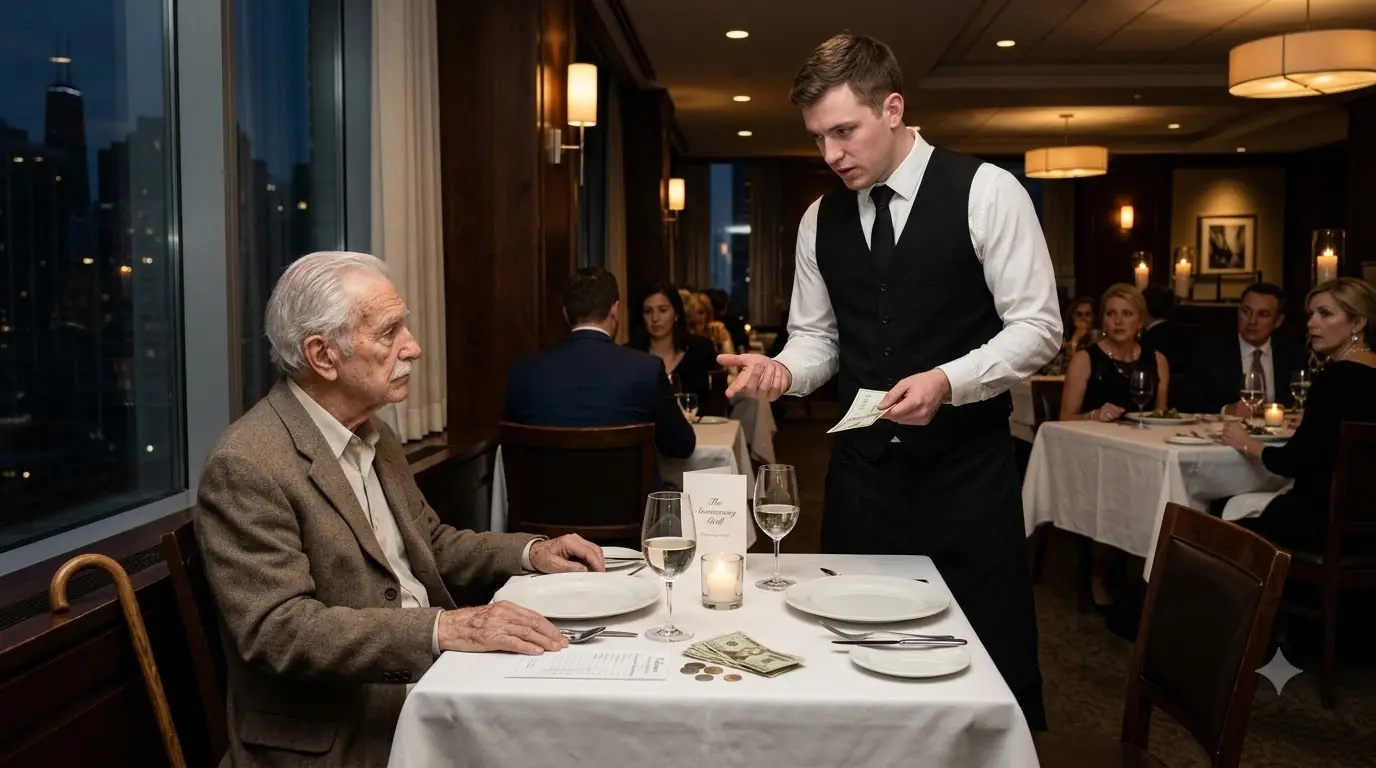
Rain had fallen earlier, leaving the sidewalk slick and shining under the restaurant’s brass lanterns. Through the tall front windows, Arthur could see candlelight, white tablecloths, polished wineglasses, and people dressed as if life had never asked them to choose between dinner and heating oil.
To anyone walking past, he looked like just another old man who did not belong somewhere this nice.
His coat was clean but old, the brown wool thinned at the cuffs and carefully patched near one pocket. His shoes had been polished that afternoon with the same discipline he had used all his life, but no amount of polish could hide the cracks in the leather. His gray hair was combed back neatly, his face was lined by age and grief, and his hands shook slightly from the cold.
Arthur was not thinking about how he looked.
He was thinking about a promise he had made eleven years ago.
Tonight was the anniversary.
And like every year, he had come back to the one table by the window.
He stood outside for another moment, looking through the glass at the corner table near the rain-streaked window. From there, a person could see the old sycamore tree across the street, the theater marquee two doors down, and the little bakery that had once belonged to his wife, Eleanor.
The bakery was a boutique now, selling expensive candles and handmade soaps, but Arthur could still see it as it had been. He could still see Eleanor turning the sign from Closed to Open at six every morning, dusting flour from her hands onto her apron, smiling at the first customer like she had been waiting all night just for them.
He closed his fingers around the coins.
“Eleven years, Ellie,” he whispered. “I’m here.”
Then he opened the door.
The smell of butter, roasted garlic, seared fish, and expensive wine drifted over him. The soft murmur of conversation wrapped around the room. A jazz trio played near the bar, the pianist’s fingers moving gently over the keys. The Willowmere had always been elegant, but years of new ownership had made it colder somehow. More polished. More expensive. Less forgiving.
Arthur stepped inside carefully.
The hostess was busy with another couple, so Arthur waited near the stand, both hands on his cane. A young waiter named Derek noticed him instantly from across the dining room.
The coat.
The cane.
The way Arthur shuffled instead of walked.
Derek was twenty-four years old, handsome in the sharp, careless way young men sometimes are when they have not yet been taught by failure. His white shirt was pressed, his black vest fitted, and his hair styled with the confidence of someone who believed youth was a credential. He had been working at The Willowmere for only five months, long enough to learn the menu and the tone of wealthy guests, but not long enough to understand what the restaurant had once meant to the town.
He crossed toward the host stand, holding two menus.
“Table for one, sir?” Derek asked.
His eyes moved over Arthur’s coat.
Then his shoes.
Then the cloth coin purse in his hand.
Derek’s polite smile tightened.
“We do have a dress code, you know.”
The hostess glanced up, startled.
Arthur did not flinch.
He had heard worse in eleven years of coming back here.
He had heard quiet whispers, impatient sighs, jokes about senior discounts, questions about whether he was lost, and comments made just loudly enough to sting. The first few years, the staff had remembered him. They had known who he was and why he came. They had treated the empty chair across from him with a kind of reverence.
But restaurants changed.
Managers changed.
Servers left.
Stories got lost.
The people who once knew Eleanor’s favorite table had retired, moved away, or passed on.
Arthur remained.
“Just that table, please,” he said, voice calm. “The one by the window.”
Derek looked toward the corner table.
It was set for two.
A small reserved card sat near the folded napkins, though Arthur had not been the one to place it there. Every year, someone in the reservation system still blocked that table under the name A. Bennett, anniversary dinner. No one seemed to know why. No one had bothered to erase it.
Derek frowned.
“That table is usually for two.”
“Yes,” Arthur said.
“Are you expecting someone?”
Arthur’s hand tightened around his cane.
“In a manner of speaking.”
Derek gave a short breath through his nose, not quite a laugh.
The hostess, a young woman named Claire, looked uncomfortable.
“Derek, the reservation is there. We can seat him.”
Derek shot her a look.
Then he turned back to Arthur.
“Fine. Follow me.”
Arthur walked slowly behind him through the dining room.
The other diners barely noticed, but one busboy did.
His name was Mateo Rivera, and he was seventeen years old. He had been working at The Willowmere after school for two months, saving money for community college and helping his mother with rent. He noticed things other people missed because people often looked through him too.
He noticed the way Derek walked too fast for Arthur’s cane.
He noticed the way Arthur kept his eyes on the window table like a man approaching a grave and a home at the same time.
And he noticed the look on Arthur’s face when he sat down.
Not embarrassment.
Not pride.
Grief.
Arthur lowered himself into the chair slowly and rested his cane against the table. He looked across at the empty seat.
For eleven years, that seat had stayed empty.
For eleven years, Arthur had ordered the same two meals anyway.
Pan-roasted chicken with rosemary potatoes for himself.
Lemon sole with asparagus for Eleanor.
A cup of black coffee at the end for him.
Chamomile tea for her.
He never ate her meal. He let it sit there across from him, fragrant and untouched, while he spoke softly about the year she had missed. Sometimes, when staff members knew him, they packed the second meal afterward and sent it home with him, and Arthur would eat it the next day at his kitchen table, not because he wanted leftovers, but because Eleanor had hated waste.
He used to tip generously when he could.
Back when his pension was stronger, back when the small savings account still had more than emergency money in it, back before the medical bills, the house repairs, the pharmacy receipts, and the slow humiliation of choosing which bills could wait. He had once been known as a man who left folded twenties under coffee cups and thanked dishwashers by name.
Things had changed for Arthur.
Not for the better.
What nobody in that restaurant knew was the price he had quietly paid to keep coming back every single year. He had sold Eleanor’s bakery after she died, but most of the money went toward debts from her long illness. He sold his truck the year after that. He sold his wedding watch three years later when the roof leaked. He gave up cable, then meat most weeks, then the little garden club membership Eleanor had loved because the annual fee began to feel irresponsible.
But every year, on the anniversary of her death, Arthur came back to The Willowmere.
Even when it meant saving coins in a jar for months.
Even when it meant skipping his own birthday dinner.
Even when his neighbor Mrs. Donnelly told him Eleanor would understand if he stayed home.
Arthur knew she would understand.
That was not the point.
The point was that he had promised.
The year Eleanor became sick, they came to The Willowmere for what would become their final anniversary dinner. She had worn a blue scarf because chemotherapy had taken her hair, and Arthur had told her she looked like the most beautiful woman in the city. She had laughed and said he was a terrible liar, but she held his hand under the table the entire meal.
At the end of that night, as rain streaked the window, Eleanor looked across at him and said, “When I’m gone, don’t turn into one of those men who stops living.”
Arthur had gripped her hand.
“Don’t say that.”
“I’m serious.”
“So am I.”
She had smiled sadly.
“Come here every year. Sit by the window. Order something good. Tell me what happened.”
“I won’t come without you.”
“Yes, you will,” she said. “Because I’ll be here if you remember me properly.”
He had not answered.
She squeezed his fingers.
“Promise me, Arthur.”
So he promised.
And Arthur Bennett was a man who kept promises.
Derek returned with a menu and placed it in front of him.
“Are you actually ordering two meals tonight,” he asked, “or just taking up a whole table for yourself?”
A woman at the next table looked up, uncomfortable.
Her husband glanced at Derek, then back down at his wine.
No one said anything.
Arthur kept his voice steady.
“Two meals, please. The same as always.”
Derek looked at him.
“The same as always?”
“Pan-roasted chicken. Lemon sole. Coffee and chamomile tea after.”
Derek did not write it down.
“You know the lemon sole is market price tonight.”
“I know.”
“And you still want it?”
“Yes.”
Derek’s eyes dropped to Arthur’s coat again.
“Fine.”
He walked away shaking his head, muttering just loudly enough for Arthur to hear.
“Unbelievable.”
Arthur looked toward the empty seat.
“Don’t mind him,” he whispered. “You never liked rude boys anyway.”
Across the room, Mateo the busboy heard.
He was carrying a tray of water glasses when Arthur spoke, and something in his chest tightened. His grandmother talked to his late grandfather sometimes, especially when cooking beans the way he had liked. Mateo had once thought it was strange. Now, watching Arthur sit across from an empty chair with quiet tenderness, he understood it differently.
Love, he realized, did not always leave when someone died.
Sometimes it just changed chairs.
What Derek did not know was that someone else was walking toward that same restaurant.
Someone who would change everything.
His name was David Whitmore.
Three weeks earlier, he had signed the papers that made him the new owner of the entire Willowmere restaurant chain. There were nine locations now, though the original downtown restaurant remained the most respected, the one food magazines still mentioned when writing about old elegance in a changing city. Tonight was not supposed to be a big announcement. There were no cameras, no press, no staff meeting, no champagne toast planned for his arrival.
David wanted to walk in unnoticed, the way he always did with a new location.
He preferred to see places before they knew they were being watched.
But he had a reason for choosing this particular restaurant first.
A reason that went back almost twenty years.
Twenty years ago, David Whitmore was not wearing a tailored charcoal suit beneath a cashmere overcoat. He did not have a driver waiting two blocks away. He did not own restaurants, commercial properties, or the logistics company that had made his first fortune. He was not called Mr. Whitmore by people who wanted five minutes of his time.
Twenty years ago, he was sleeping outside three blocks from where he now stood.
He had lost his job first.
Then his apartment.
Then most of his friends, though later he realized they had only been friends with the version of him who could still buy his own drinks and pretend things were fine.