“That’s junk, old man—are you too senile to recognize scrap?”
Frank Dawson shouted the insult across the dusty auction yard, loud enough for nearly every farmer in Logan County, Kansas, to hear. Laughter moved through the crowd as Henry Cole stood beside a rusted steel crate that had just been sold to him for seventy-five dollars. At eighty-two, Henry was accustomed to people mistaking his slow movements for a slow mind.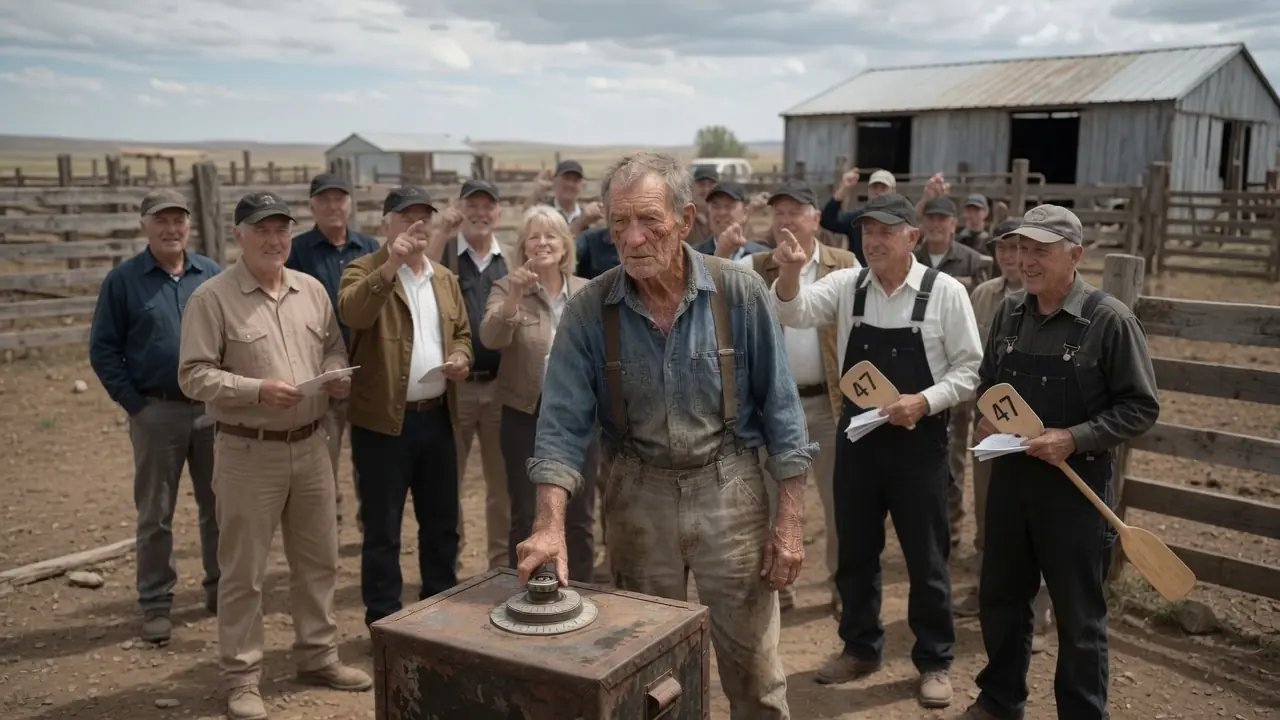
The crate was waist-high, square, and heavy enough that the auction workers had needed a tractor to drag it from the back of an abandoned machine shed. Rust covered its corners, mouse nests filled the spaces beneath it, and a circular metal dial protruded from the lid like part of an old bank safe. No keyhole was visible, and nobody at the auction knew what had once been stored inside.
Henry knew only that he had seen the faded serial mark before.
Beneath the rust, nearly erased by time, were the letters LANTERN-7B followed by a nine-digit military inventory number. Henry had last seen that code in 1971 inside a restricted repair facility at Fort Riley. He had been twenty-seven then, serving as a civilian mechanic beside his younger brother, Daniel.
Frank stepped closer, still enjoying the crowd’s attention. At fifty-six, he had inherited both the Dawson auction business and his father’s confidence that every object could be valued by appearance alone. He pointed toward the steel box as though Henry had bought a dead animal.
“You paid seventy-five dollars for a rusted coffin,” Frank said. “Take it home before it buries what’s left of your reputation.”
Henry ran one oil-darkened finger over the hidden military stamp. “Only fools call something worthless before learning what it is.”
That answer silenced a few men, but Frank laughed harder.
Henry turned the dial slowly. It resisted at first, then moved with a faint internal click. The sound was too precise for an empty piece of scrap, and Henry felt an old memory return with enough force to tighten his chest.
“Load it carefully,” he said. “One phone call tonight will make every man here choke on that laughter.”
The crowd reacted with another wave of amusement. Someone joked that Henry planned to call a museum, while another man offered to buy the box back for ten dollars after Henry admitted defeat. Henry did not respond.
He watched the auction workers lower the crate onto his trailer.
The estate being sold had belonged to retired Colonel Wade Mercer, who died three months earlier at the age of ninety-four. Mercer had owned several hundred acres, three barns, military memorabilia, and enough forgotten equipment to fill a two-day auction. Most buyers came for tractors, firearms, tools, and antique signs.
Henry had come only because he recognized Mercer’s name.
Fifty-three years earlier, Colonel Wade Mercer had commanded the restricted logistics unit where Henry and Daniel repaired experimental military communications equipment. Mercer had also been the last officer known to have seen Daniel alive before Daniel disappeared. The official report claimed Daniel stole classified components, deserted his position, and fled the country.
Henry never believed it.
Daniel was twenty-three, recently married, and expecting his first child. He had no passport, no money hidden away, and no reason to abandon his family. Two days before vanishing, he told Henry he had discovered equipment records that did not match the items inside the military warehouse.
“You think someone is stealing from the Army?” Henry had asked.
Daniel looked toward Mercer’s office before answering. “I think someone is selling things that officially never existed.”
Henry told him to be careful.
The following morning, Daniel failed to report for work.
Military investigators searched his apartment and found a small radio component wrapped inside one of his work shirts. It carried a classified inventory code, and Mercer testified that he had seen Daniel behaving nervously near the warehouse. Within days, Daniel was branded a thief and deserter.
His wife, Rebecca, gave birth to their daughter six weeks later.
She waited years for him to return.
Henry spent half a century searching for an answer. He wrote to military records offices, contacted former workers, and visited every address connected to the old unit. Files were missing, witnesses claimed they remembered nothing, and Colonel Mercer refused every request for a meeting.
Eventually, people told Henry to let the past remain buried.
Now a military crate from Mercer’s estate sat on Henry’s trailer.
Henry drove home before sunset, taking the county roads slowly so the load would not shift. His garage stood behind the small farmhouse where he had lived since marrying his late wife, Margaret. The building contained tools collected across six decades, an engine hoist, two unfinished tractors, and an old workbench scarred by thousands of repairs.
He backed the trailer inside and closed the garage doors.
For several minutes, Henry simply stared at the crate.
Part of him feared opening it. He had spent fifty-three years imagining evidence that could clear Daniel’s name, but hope had become dangerous with age. Every false lead had forced him to lose his brother again.
Henry switched on the work lights and began cleaning the lid.
He used a wire brush gently, removing rust without damaging the markings beneath it. More lettering appeared near the dial: AUTHORIZED SIGNAL MAINTENANCE PERSONNEL ONLY. Below that warning was a manufacturer’s symbol Henry recognized from encrypted field systems developed during the Cold War.
The crate had never been ordinary storage.
Henry found three recessed latches hidden beneath layers of corrosion. None had keyholes because the circular dial controlled an internal locking mechanism. He remembered technicians using similar containers, though he had never been shown the combination.
Daniel had.
His younger brother remembered numbers by turning them into dates. Henry considered birthdays, enlistment dates, and unit numbers before recalling something Daniel once said while repairing a coded receiver.
“Lantern uses the day they first tested the signal,” Daniel had explained. “November 14, 1968. Mercer thinks nobody knows.”
Henry placed his fingers on the dial.
He turned it to eleven, then fourteen, then sixty-eight.
A metal bolt shifted inside the lid.
Henry stopped breathing.
He released the latches and lifted, but the lid remained sealed by decades of dirt around the gasket. Using a pry bar, he worked around the edges until the hardened rubber broke loose with a low tearing sound.
Cold, stale air escaped from inside.
The crate contained no gold, weapons, or expensive antique machinery. Instead, Henry found a compact military communications recorder, several sealed magnetic tape reels, a weatherproof maintenance ledger, and a canvas document pouch tied with wire. Everything had been protected from moisture by layers of waxed wrapping.
On top of the recorder lay a pair of dog tags.
Henry recognized the name before lifting them.
COLE, DANIEL ROBERT.
His knees weakened.
Henry sat on the concrete floor with the tags resting in his palm. Daniel’s military identification number, blood type, and denomination remained stamped into the darkened metal. Rebecca had been told Daniel took his tags when he fled.
He had not.
Henry stayed there until the garage became cold. Then he stood, carried the dog tags to the workbench, and opened the maintenance ledger. Most pages contained technical notes written by Daniel in his familiar narrow handwriting.
The final entries were different.
Daniel had documented missing equipment, altered shipment records, and unauthorized transfers signed by Colonel Mercer. According to the ledger, Mercer had been selling experimental radio components through private contractors and replacing them with rejected parts. Because the equipment belonged to a classified program, ordinary auditors could not access complete records.
Daniel had discovered the pattern while tracing a defective transmitter.
The final page was dated two days before his disappearance.
Mercer knows I copied the records. I placed one set with the recorder in Lantern Crate 7B. If anything happens, Henry will understand the code.
Henry read the sentence repeatedly.
He had understood it fifty-three years too late.
The document pouch contained invoices, shipping manifests, photographs, and copies of Mercer’s signatures. One photograph showed military crates being loaded into a civilian Dawson Freight truck after midnight. Frank Dawson’s father, Raymond, stood beside Mercer.
Henry looked toward the closed garage doors, remembering the crowd laughing at the auction.
The Dawson family had been connected to the secret from the beginning.
The final object inside the crate was a sealed envelope marked in Daniel’s handwriting.
FOR HENRY.
Henry’s hands trembled as he opened it.
The letter was only one page.
Daniel explained that Mercer had ordered him to alter repair reports and approve defective equipment for military field tests. When Daniel refused, Mercer threatened to accuse him of stealing classified parts. Daniel planned to meet an investigator from Washington and provide the copied records.
“If I disappear,” Daniel wrote, “do not believe that I ran. Tell Rebecca I was trying to come home clean.”
The final sentence nearly broke Henry.
You always said machines tell the truth if a man is patient enough to listen. I hope someday this box does the same.
Henry pressed the letter against the workbench and closed his eyes.
For decades, Daniel’s name had existed in military records beside the words theft, desertion, and fugitive. His daughter grew up believing strangers who whispered that her father abandoned her. Rebecca died without receiving an answer.
The crate could clear Daniel’s reputation.
It still did not explain where he had gone.
Henry examined the recorder. It was a portable monitoring unit designed to capture encrypted radio traffic and maintenance conversations. The power cord had deteriorated, but the internal components appeared protected.
He spent the next hour rebuilding the electrical connection.
Henry replaced two cracked wires, cleaned the terminals, and installed a fuse from an old communications set stored beneath his bench. When he connected the unit to power, a small amber light flickered on.
One tape reel remained mounted inside.
Henry pressed the playback switch.
Static filled the garage.
Then Daniel’s voice emerged.
“Testing Lantern recorder seven. October nineteenth, 1971.”
Henry gripped the edge of the bench.
His brother sounded young, tired, and frightened. Daniel described the altered shipments and named Mercer, Raymond Dawson, and two defense contractors. He said he had arranged to meet investigator Thomas Vale at a closed fuel station north of Junction City.
The recording paused.
A door opened somewhere in the background.
Mercer’s voice followed.
“You should have handed me the ledger when I asked.”
Daniel answered, “You put defective radios into field units. Men could die because of you.”
“They were prototypes. Failure was expected.”
“You sold the working components and replaced them with rejects.”
Mercer’s voice moved closer to the recorder. “You have a wife and a child coming. Think carefully about what you are doing.”
“I am.”
The sound of a struggle interrupted the conversation. Metal struck the floor, someone cursed, and the recording became distorted. Daniel shouted that copies had already been sent to an investigator.
Mercer laughed.
“Thomas Vale works for me.”
The tape ended seconds later.
Henry stood alone inside the garage, listening to the empty reel turn.
He now knew Daniel had been betrayed by the person he planned to trust. Whether Vale had helped kill him or merely surrendered him to Mercer remained uncertain.
Henry remembered the promise he made at the auction.
One phone call.
He found an old address book inside his desk. For more than forty years, he had kept the number of Evelyn Vale, daughter of the investigator Daniel had intended to meet. Henry contacted her once in 1993, but she insisted her father never discussed classified work and died without leaving relevant papers.
She was now seventy-six and living in Colorado.
Henry called.
A woman answered after five rings.
“Mrs. Vale, this is Henry Cole from Kansas.”
Silence followed.
“I remember your name,” she said carefully.
“I found Daniel’s recorder.”
Her breathing changed.
Henry described the crate, the ledger, and the recorded conversation. Evelyn did not interrupt until he mentioned Thomas Vale working for Mercer.
“My father confessed something before he died,” she whispered.
Henry’s grip tightened around the phone. “What?”
“He said he failed a young mechanic in Kansas.”
Evelyn explained that Thomas Vale had not willingly worked for Mercer. Mercer possessed evidence linking him to unauthorized intelligence operations and used it to control him. When Daniel requested a meeting, Vale informed Mercer under pressure.
He regretted it immediately.
The next day, Vale drove to the meeting location and found blood near an abandoned truck, but Daniel was gone. Mercer ordered him to classify the disappearance as desertion and threatened his family if he refused.
“Did your father know where they took Daniel?” Henry asked.
“He believed Raymond Dawson drove him to an abandoned missile-support property.”
“Where?”
Evelyn gave him a location twelve miles from Mercer’s former farm.
The property had been sealed for decades and later sold to the Dawson family.
Henry looked toward the photograph of Raymond Dawson loading military crates. Frank now owned that land.
“Mrs. Vale, will you tell this to investigators?”
“I have been waiting most of my life for someone to ask.”
Henry’s phone call did more than reopen a buried secret.
It started a federal investigation.
Agents from the Department of Defense arrived at Henry’s garage the following morning. They photographed the crate, secured the recorder, and examined every document. A military historian confirmed the serial number belonged to Project Lantern, a communications program whose official inventory listed Crate 7B as destroyed in 1972.
Colonel Mercer had hidden it instead.
Investigators questioned Frank Dawson during the final hours of his family’s auction. He initially denied knowing anything about military property, but agents found old maps and storage records inside Mercer’s office. Several documents showed that Mercer had transferred land to Raymond Dawson shortly after Daniel disappeared.
Frank’s confidence vanished.
He admitted his father once warned him never to excavate near an old concrete maintenance pit on the property. Frank assumed illegal chemicals had been buried there and avoided the area to protect the farm’s value.
Ground-penetrating equipment detected a vehicle beneath the filled pit.
Two days later, investigators uncovered the remains of a military utility truck. Inside were tools bearing Daniel’s initials, fragments of his clothing, and human remains later confirmed through family DNA.
Daniel Cole had never deserted.
He had been killed and buried less than fifteen miles from home.
Evidence suggested Mercer struck Daniel during the struggle, then ordered Raymond Dawson to conceal the body and truck. Thomas Vale created the false report under threat, while military officials accepted the convenient explanation because investigating the classified warehouse would have exposed embarrassing security failures.
Mercer and Raymond were dead.
Justice could no longer place them in a courtroom.
But truth could still restore what they had stolen.
The Army formally corrected Daniel’s record. Every accusation of theft and desertion was removed, and he received posthumous recognition for exposing corruption that endangered military personnel.
A memorial service was held in the same Kansas county where people once whispered that he had run away.
Daniel’s daughter, Laura, traveled from Oregon with her husband and two grown sons. She was fifty-two and had spent her entire life without knowing whether her father had chosen to leave her.
Henry met her at the cemetery.
He placed Daniel’s dog tags into her hands.
“My father wanted to come home?” she asked.
“With everything he had.”
Laura began crying. “My mother waited for him until the day she died.”
Henry showed her the final letter.
She read the line about Daniel trying to return home clean, then pressed the paper to her chest. For the first time, Laura possessed her father’s own words instead of a government accusation.
Hundreds attended the service, including farmers who had laughed when Henry bought the crate.
Frank Dawson stood near the back.
His family had not participated directly in Daniel’s death, but his father had helped conceal it, and Frank understood that his auction had unknowingly returned the evidence to the one man capable of recognizing it.
After the service, Frank approached Henry.
“I owe you an apology.”
Henry looked at him.
“That day at the auction,” Frank continued, “I called you senile. I made everyone laugh because you saw value where I saw rust.”
“The insult doesn’t matter.”
“It matters to me.”
Frank removed an envelope from his pocket. Inside was the seventy-five dollars Henry paid for the crate.
Henry refused it.
“You sold me exactly what I bought.”
“I sold you evidence connected to your own family.”
“You didn’t know.”
Frank lowered his eyes. “My father did.”
“That debt isn’t yours unless you choose to carry his silence.”
Frank looked toward Daniel’s grave. “What should I do?”
“Tell the truth whenever someone asks.”
Over the next year, the Project Lantern records revealed a wider network of stolen military components. Some defective replacement radios had reached training units, causing failures that investigators had never properly explained. Families of two soldiers killed during a communications breakdown received amended reports acknowledging equipment corruption as a contributing factor.
Henry’s discovery reached newspapers across the country.
Reporters wanted to interview the old mechanic who purchased a rusted crate for seventy-five dollars and solved a fifty-year mystery. Henry agreed to speak only once, standing inside the garage where he had opened it.
A journalist asked how he recognized the box.
“The serial number.”
“How did you remember it after so many years?”
“Because it belonged to the last project my brother worked on.”
“Did you believe the crate contained evidence?”
“I believed it deserved to be understood.”
The reporter glanced toward Henry’s shelves of old parts. “Most people at the auction thought it was worthless.”
“Most people decide what something is before taking time to look.”
“What did you really buy for seventy-five dollars?”
Henry considered the question.
“Not the crate,” he said. “I bought my brother’s name back.”
The rusted steel box was eventually transferred to a military museum. Its exterior remained untouched, including the faded serial number and the deep corrosion around its edges. Inside the display case sat copies of Daniel’s ledger, his letter, and a photograph of the two brothers as young mechanics.
The museum offered Henry an honored place at the opening ceremony.
He declined.
Instead, Henry stayed home and repaired an old tractor belonging to a young farmer who could not afford dealership prices. Machines remained easier for him than crowds, and justice did not change the person he had become during the years of waiting.
Daniel was buried beside Rebecca beneath a new headstone.
The inscription did not mention the accusations once attached to his record. It simply read:
DANIEL ROBERT COLE
HUSBAND. FATHER. MECHANIC.
HE TOLD THE TRUTH.
Henry visited every Sunday.
Sometimes he carried coffee and sat beside the grave without speaking. Other times, he described the machines he was repairing, the weather moving across the wheat fields, or the latest trouble with his garage heater.
One autumn afternoon, Laura joined him.
“Do you regret not finding the crate sooner?” she asked.
“Every day.”
“But you found it.”
Henry looked across the cemetery. “Your father found a way to leave it where someone might eventually listen.”
Laura smiled through tears. “Machines tell the truth if a man is patient enough?”
Henry recognized Daniel’s final written words.
“Yes,” he said. “Sometimes people do too. They just take longer.”
Years later, the story of Henry’s auction purchase was still repeated across Logan County. Farmers told it whenever someone dismissed an old machine, a forgotten tool, or an elderly person whose experience did not arrive in polished packaging.
The details changed with each telling.
Some claimed the crate contained millions of dollars. Others said Henry opened it with one touch or recognized Daniel’s voice before the recorder even started. Those versions missed what truly mattered.
Henry had not discovered treasure.
He had discovered proof that a good man had been buried beneath a lie.
The crowd laughed because the crate looked ruined, Henry looked old, and seventy-five dollars seemed foolish to spend on rust. They believed value had to shine before it deserved attention.
Henry knew better.
He had spent his life repairing machines everyone else considered finished. He understood that rust could hide markings, silence could hide voices, and time could hide truth without destroying it.
The old mechanic carried the crate into his garage.
Then one phone call brought his brother home.