When seventy-two-year-old Ruth Gallagher heard the thunderous rumble of thirty heavy cruisers tearing up her muddy gravel driveway in the dead of a torrential Oregon night, she truly believed her final moments had arrived.
She stood frozen in the middle of her kitchen, one trembling hand gripping the back of a chair, the other pressed against her chest. The old farmhouse shook beneath her feet as headlights flashed across the walls like lightning made by machines.
Outside, the rain was falling so hard it blurred the world into silver and black.
The engines growled louder as the riders came up the forgotten logging road. Tires ripped through mud, gravel scattered against the porch steps, and the sound rolled through the lonely house like an approaching army.
Ruth was alone.
She lived miles from the nearest town, deep in the Cascade Mountains of Oregon, in a house that was slowly collapsing around her. The phone worked only when the weather allowed it, the power had already gone out, and no neighbor was close enough to hear her call for help.
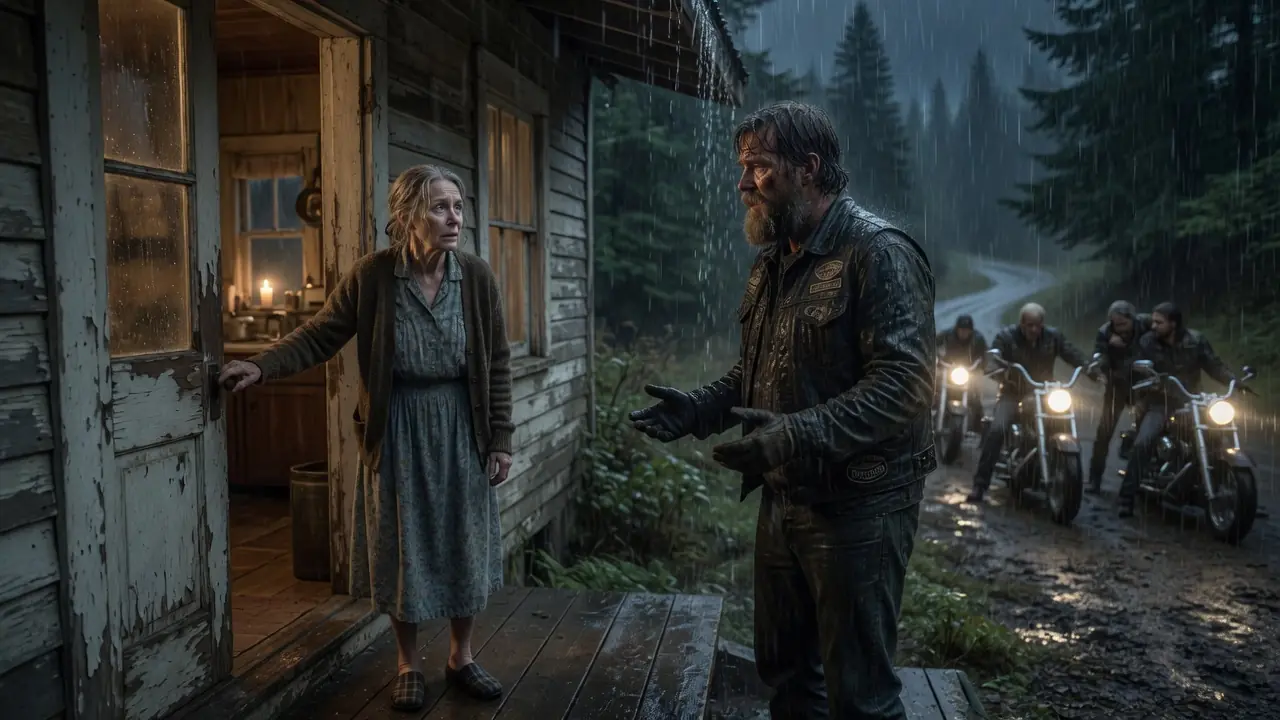
When the first riders dismounted in the freezing rain, Ruth saw only shadows at first.
Then the porch light flickered from a flash of lightning, and she saw them clearly.
They were massive men in soaked leather vests, heavy boots, denim jackets, and club patches darkened by rain. Several had long beards. Some had tattooed hands. Others stood with the hard stillness of men who had spent too much of life being feared before they ever opened their mouths.
To Ruth, they looked like every warning story she had ever heard about lonely roads and women living alone.
But what happened next was not a nightmare.
It was a miracle.
A single desperate act of kindness from a hungry widow would summon a response so powerful that people along Route 138 would talk about it for years. Before the month was over, eight hundred bikers, mechanics, roofers, carpenters, truck drivers, and strangers would return to her land.
They would come not to take anything from Ruth Gallagher.
They would come to give her back everything she was about to lose.
Route 138 winds through the unforgiving wilderness of the Oregon Cascades.
It is a rugged stretch of asphalt bordered by towering Douglas firs, steep ravines, and deep forest that seems ready to swallow anything mankind forgets to maintain. In good weather, the road can look beautiful enough to make travelers slow down just to breathe it in.
In a storm, it becomes something else.
Rain turns the shoulders into mud. Wind throws branches across blind curves. Fog rises from the river until headlights become useless white circles. Far from town, far from service, and far from help, even strong people can begin to feel small.
For more than forty years, Ruth Gallagher had called a small two-story farmhouse off that road her home.
In her younger years, the house had been a sanctuary. Her late husband, Robert, had built the wraparound porch with his own hands, sanding every board smooth before painting the trim a cheerful white.
They had planted tomatoes behind the kitchen.
They had raised chickens near the shed.
They had spent winter evenings beside the cast-iron wood stove, drinking coffee while the snow pressed against the windows.
Robert had loved that house as if it were alive. Ruth used to tease him that he spent more time fixing porch rails than fixing his own knees.
He would laugh and say, “A house takes care of you only if you take care of it first.”
For decades, that had been true.
The house held birthdays, quiet anniversaries, Sunday stews, arguments that ended before bedtime, and the ordinary tenderness of two people who did not need much to feel rich.
Then Robert died.
It happened seven years earlier beside the woodshed, just before dusk. One moment he was stacking split cedar for winter. The next, he was on the ground, one hand still resting on a piece of firewood.
A massive stroke took him before the ambulance arrived.
After Robert was buried, the house began losing strength in ways Ruth could not stop.
At first, she tried.
She patched boards. She sealed windows. She climbed ladders when she should not have, balancing carefully with one hand on the gutter and the other holding tools Robert had left behind.
But age is patient.
Rheumatoid arthritis stiffened her fingers until opening jars became painful. Her knees swelled in damp weather. Her shoulders ached when she carried firewood, and her balance grew worse with every passing year.
The cheerful white porch trim Robert had painted began peeling away in gray strips.
The garden grew smaller.
The chicken coop leaned.
Blackberry vines crept closer to the back steps, as if the forest knew Robert was no longer there to fight it back.
The roof became the worst problem.
Two winters earlier, a pine branch fell during a windstorm and tore away dozens of shingles above the laundry room and back hallway. Ruth covered the worst spots with tarps, old boards, and prayers, but Oregon rain is patient too.
Water found every weakness.
It stained the floral wallpaper in the living room with dark rings. It dripped into buckets beside the sofa. It ran down the inside of one wall in thin lines that made the paint bubble and curl.
The foundation had begun settling unevenly too.
The floorboards groaned beneath Ruth’s steps, and on cold mornings, the back door refused to close unless she lifted it with both hands.
But the house falling apart was only one kind of danger.
On her scarred kitchen table sat the danger that truly kept her awake.
A stack of letters.
They were printed on official cardstock, heavy and cold beneath her fingers. Notices of tax delinquency. Property seizure warnings. Final demand letters.
The amount was written in bold numbers on the last page.
$14,240.
That was what Ruth owed.
That was what stood between her and losing the only home she had left.
The county bank had begun aggressively pursuing rural properties with unpaid taxes and old liens. The man leading the pressure was Walter Higgins, a loan officer with polished shoes, thin lips, and a voice that made cruelty sound like procedure.
He had come to the farmhouse twice.
Both times, he stepped around mud puddles as if the property already disgusted him. He told Ruth the bank was only following policy, but his eyes kept drifting toward the timberland behind her home.
Commercial logging interests wanted parcels along the mountain road.
Ruth knew it.
Higgins knew she knew it.
“If payment is not made in full by the end of the month,” he had told her, “the process will move forward.”
Ruth had asked what that meant, though she already understood.
Higgins adjusted his coat and said the sheriff would come. Her belongings would be removed. The house would be cleared. The land would be sold.
He did not say Robert’s porch would be torn down.
He did not say her garden would be buried.
He did not say forty years of marriage would be reduced to a line item on a bank report.
He did not need to.
Ruth heard it anyway.
She survived on a small survivor’s pension and what little she saved from selling eggs. Her medicine cost more than it should have. Heating oil cost more every winter. Food had become something she measured carefully, not something she enjoyed.
In an envelope marked TAXES, Ruth had managed to save $412.
She knew it was not enough.
By mid-October, the sky above the Cascades had turned a deep, bruised purple. The radio had warned all afternoon about a severe storm front pulling heavy moisture from the Pacific and driving it straight into the mountains.
Ruth listened while standing in the pantry, counting what remained.
Four cans of beef stew.
A half-empty sack of flour.
A dozen eggs from her three remaining chickens.
A block of sharp cheddar.
A large bag of coffee she had bought on sale because Robert always said coffee was not a luxury. It was courage in a cup.
She had been eating one full meal a day, sometimes less, trying to save money for the impossible debt.
That evening, she planned to make tea and maybe toast. If her hands were not hurting too badly, she might cut a small slice of cheese.
Then the rain began.
By six o’clock, it was no longer falling.
It was crashing.
Sheets of water slammed into the roof and ran down the windows. Wind screamed through the canyon, high and mournful, shaking the old farmhouse on its failing foundation.
Ruth moved through the living room with slow, painful steps, placing galvanized buckets beneath the worst leaks.
Ping.
Ping.
Splash.
The sound filled the room like a cruel little song.
Every drop reminded her that the house was losing the fight.
At 8:15 p.m., lightning struck somewhere down the mountain with a sound like the sky splitting open. The weak yellow bulb above the kitchen table flickered once, flashed twice, then popped.
Darkness swallowed the farmhouse.
Ruth stood still in the blackness, her breath caught in her throat.
The storm roared outside. The wind pressed against the walls. Somewhere above her, rainwater dripped through the ceiling and struck metal.
Ping.
Ping.
Splash.
She felt along the counter until her fingers found a box of matches and a thick emergency candle. Her arthritic hands made the first match snap in half.
The second one lit.
The small flame flared bright enough to reveal the exhaustion in Ruth’s face, the deep lines around her mouth, and the damp shine of fear in her eyes.
She lit the candle and carried it to the table.
The foreclosure letters waited there.
Ruth turned them facedown.
Then she sat in her worn armchair and wrapped a patched quilt around her shoulders. The temperature inside the house was dropping fast. Outside, the old logging road was turning into a river of mud.
She closed her eyes.
“Lord,” she whispered, “just let the roof hold one more night.”
She did not know that miles down the mountain, the storm had already trapped thirty men on Route 138.
A mudslide had wiped out the only reinforced concrete bridge over a swollen branch of the Umpqua River. Behind them, fallen trees and sliding rock had blocked the road back down the pass.
The riders were boxed in.
They were members of a large motorcycle club traveling north for a rally in the Pacific Northwest. They were not casual weekend riders. They knew roads, machines, weather, and risk.
But that night, the mountain did not care who they were.
Their heavy cruisers and custom V-twin baggers were built for long highways and open road, not flooded mountain passes and waist-deep mud. Rain froze on their gloves. Wind pushed against the bikes so hard that several riders struggled to keep them upright.
At the front of the pack rode Jonathan Miller, known to everyone as Bear.
He stood six feet five and weighed nearly three hundred pounds. His beard was thick and soaked. His face carried scars from hard years, bad choices, and rough roads.
But Bear was not reckless.
He was a road captain because men trusted him when panic would get them killed.
Beside him was Cooper Evans, wiry, sharp-eyed, and shivering so hard he could barely hold his handlebars. Behind them rode Bradley Jenkins, a broad-shouldered former roofer and mechanic who had not complained once, which told Bear he was colder than he wanted to admit.
“Bridge is gone!” Cooper shouted over the engines and the storm. “Road’s washed out clean!”
Bear wiped freezing rain from his goggles and leaned forward, trying to see through the darkness.
The bridge was not damaged.
It was gone.
The river had swallowed it.
“We can’t go back down the pass either,” Cooper yelled. “Mud’s sliding behind us.”
Bradley killed his engine and shouted, “We stay out here much longer, somebody’s going down.”
Bear knew he was right.
The temperature had dropped near freezing. The rain acted like liquid ice. Several men near the back had gone quiet, and quiet men in weather like that were a bad sign.
Bear scanned the tree line.
Through the rain, he saw a narrow side road almost hidden by brush. It climbed into the woods, muddy and steep. Far above, between black fir trunks, a faint light flickered.
Maybe a cabin.
Maybe a barn.
Maybe nothing useful at all.
Bear pointed.
“There.”
Cooper followed his gaze.
“That road’s mud soup.”
Bear started his engine again.
“Better than dying on pavement.”
The pack moved slowly, one bike at a time.
Tires slid. Engines growled. Mud sprayed up over fenders and boots. Twice, riders had to dismount and push machines through deep ruts while the wind shoved rain sideways into their faces.
The logging road twisted through thick firs and flooded ditches.
At last, the farmhouse appeared.
Small.
Old.
Leaning slightly in the storm.
One weak candle glowed in the front window.
Ruth heard the engines before she saw the headlights.
The sound rolled up the road like thunder under the ground. Then white light swept across her windows, across the ceiling stains, across the buckets, across Robert’s coat still hanging near the back door.
Her heart pounded so hard she felt dizzy.
She moved toward the hallway with the candle in one hand.
The first knock hit the door like a blow.
Ruth flinched.
The second knock was slower.
Then came a voice, deep and strained.
“Ma’am! We don’t want trouble. We’re stranded. We got men freezing out here.”
Ruth did not answer.
She looked through the side window.
At first, all she saw were enormous shapes in rain and leather. Men stood in her yard, soaked and hunched against the wind. Several held their hands under their arms for warmth.
One man leaned heavily against another.
The man on the porch stepped back from the door and lifted both hands where she could see them.
“Please,” he called. “Just somewhere out of the wind.”
Ruth stood with her hand on the lock.
Every sensible part of her told her not to open the door.
She was an old woman alone in the mountains.
They were strangers.
Thirty of them.
But then one rider near the driveway staggered and nearly fell. Another grabbed him under the arm and held him up.
Ruth thought of Robert.
She thought of every lost hunter he had invited in for coffee. Every truck driver who had knocked during snow. Every neighbor who had come to their porch hungry, cold, embarrassed, or afraid.
Robert had never once asked whether kindness was convenient.
Ruth unlocked the door.
When it opened, rain blew into the hallway.
The man on the porch was even larger up close. Water ran from his beard onto his vest. His boots were thick with mud, and his face looked hard enough to frighten most people without effort.
But his eyes were careful.
“My name’s Bear,” he said. “We got trapped by the washout. We’ll stay in the barn if you got one. We just need cover until the storm breaks.”
Ruth looked past him.
“How many?”
“Thirty.”
Her stomach dropped.
Bear saw her hesitation.
“We can pay. We don’t need much.”
Ruth looked at the riders in her yard.
Then she looked back into her house, at the buckets, the candle, the dying fire, and the pantry with almost nothing in it.
“I don’t have a barn that will hold you,” she said. “Roof gave in last winter.”
Bear nodded once, preparing to accept refusal.
Then Ruth opened the door wider.
“But I have a kitchen, a living room, and coffee.”
Bear stared at her.
“You sure?”
“No,” Ruth said. “But come in before one of you falls over.”
They entered carefully.
Not all at once.
Bear brought them in five at a time, making them wipe boots as best they could and hang soaked jackets on porch hooks that groaned under the weight. Men who had looked terrifying outside became awkward giants inside Ruth’s narrow hallway.
One apologized for dripping on the floor.
Another asked before moving a chair.
A third noticed a bucket missing a ceiling drip and nudged it into place with his boot.
Ruth pointed toward the living room.
“Boots by the door. Wet gloves near the stove. Nobody goes into the back bedroom. That was my husband’s.”
Bear turned to the riders.
“You heard Ruth.”
No one argued.
That surprised her more than anything.
Within minutes, the farmhouse filled with steam, wet leather, cold breath, and the low murmur of exhausted men trying to be respectful in a fragile old woman’s home.
Cooper crouched by the wood stove and coaxed the fire back to life.
Bradley carried split logs from the back porch without being asked.
A younger rider named Jesse found a towel near the laundry room and began wiping mud from the floor. When Ruth saw him, he looked guilty, as if he expected to be scolded.
“Good,” Ruth said. “Start near the door. Mud travels if you let it.”
Jesse nodded solemnly.
“Yes, ma’am.”
“Ruth,” she corrected.
“Yes, Ruth.”
She went to the pantry.
The shelves looked cruelly bare under candlelight.
Four cans of beef stew.
A dozen eggs.
Flour.
Cheddar.
Coffee.
If she cooked it all, she would have almost nothing left.
If she did not, thirty freezing men would sit in her house hungry after she had opened the door.
Ruth stood still for a moment, one hand against the pantry shelf.
Then she took everything down.
She stretched the beef stew with water, onions from a basket, and the last jar of canned tomatoes from the cellar shelf. She mixed flour, salt, water, and a little shortening into rough skillet biscuits.
She scrambled the eggs with thin shavings of cheddar, then cut the biscuits into small pieces so every man could get some.
It was not enough to fill thirty stomachs.
But it was enough to make them warm.
Bear stood at the kitchen doorway, watching her stir the pot with swollen fingers.
“Ruth,” he said quietly, “you don’t have to feed all of us.”
She did not look up.
“Don’t hover in my doorway unless you plan to help.”
Bear blinked.
Then Cooper laughed from the stove.
“Road captain just got assigned kitchen duty.”
A few men chuckled.
Ruth pointed to the cabinet.
“Mugs are up there. Coffee tin is on the counter. If you can lift a motorcycle, you can pour coffee.”
Bear obeyed.
The men ate in shifts because the kitchen was too small.
Some sat on the floor. Some sat on the stairs. Some stood near the walls holding chipped bowls and mismatched mugs. Ruth moved carefully among them, giving each man stew, eggs, biscuits, or coffee.
Several tried to give her money.
She refused every time.
“I’m not running a diner,” she said.
One rider held out a folded bill.
“Then call it thanks.”
Ruth pushed his hand back.
“Keep your thanks until morning. I may need help clearing that road.”
That made the room laugh.
But Bear did not laugh for long.
He had begun to see the house.
Not just as shelter.
As a wound.
The stained ceiling. The leaking buckets. The rotting porch. The patched window. The foreclosure letters on the kitchen table that Ruth had turned facedown too late.
He noticed the red words on one page.
FINAL NOTICE.
He said nothing.
But he saw.
Near midnight, the storm became worse.
Wind drove rain under the porch roof. The windows rattled in their frames. Somewhere outside, a tree cracked loudly enough to make half the men look toward the door.
Ruth handed out every blanket she owned.
Robert’s old wool truck blanket.
The quilt her mother had sewn.
A faded green afghan from the church bazaar.
Several riders refused at first, but Ruth fixed them with a look that made stronger men than them reconsider.
“I’ve spent seventy-two years arguing with stubborn men,” she said. “You are not special.”
Cooper nearly choked on his coffee laughing.
Bradley noticed Ruth struggling to lift a full bucket under one of the ceiling leaks. He took it from her gently and carried it outside to dump the water.
When he returned, he looked up at the ceiling.
“How long’s it been leaking?”
Ruth shrugged.
“Depends which leak you mean.”
“You got roof damage?”
“I got a roof with ambitions of becoming a skylight.”
Bradley smiled faintly, then grew serious.
“I was a roofer once.”
“Were you good?”
“Good enough to know this ceiling is bad news.”
“Then don’t look too hard,” Ruth said. “Bad news charges by the hour.”
By one in the morning, the house settled into an unlikely peace.
Huge men slept wherever they could, curled beneath quilts, jackets, and spare towels. Boots lined the hallway. Gloves hung near the stove. Coffee steamed in the kitchen.
Bear remained awake at Ruth’s table, drinking black coffee from a chipped mug with a faded blue flower on it.
Ruth sat across from him because pain kept her from sleeping.
Also, though she would not have admitted it, she no longer felt afraid of him.
“You live out here alone?” Bear asked.
“Yes.”
“No family close?”
“No living family that claims the title.”
Bear nodded.
That nod told Ruth he understood more than she had said.
“My husband built this place,” Ruth continued. “Not the whole house, but enough of it to make it ours. Porch, pantry shelves, chicken coop, half the kitchen cabinets.”
Bear looked around.
“Looks like it remembers him.”
Ruth’s eyes softened.
“It does. That’s why losing it feels like burying him twice.”
Bear lowered his gaze to the table.
To the letters.
“How much?”
Ruth stiffened.
“That is not your business.”
“No disrespect meant.”
“Then don’t ask questions that make a woman feel poor in her own kitchen.”
Bear accepted that with a slow nod.
“Fair.”
Silence returned.
Rain tapped the windows.
Water dripped into buckets.
After several minutes, Ruth sighed. She was tired, hungry, cold, and too worn down to guard her pride properly.
“Fourteen thousand two hundred forty dollars,” she said.
Bear looked at her.
“By when?”
“End of the month.”
His jaw tightened.
“Bank?”
“County bank. Man named Walter Higgins.”
Bear’s expression changed slightly.
Ruth noticed.
“You know him?”
“Know the type.”
Ruth stared into her coffee.
“He wants the land. Says it’s procedure, but I know hunger when I see it. Men get hungry for money same as they get hungry for stew.”
Bear looked toward the room full of sleeping riders.
“And you fed us anyway.”
Ruth’s eyes shone in the candlelight.
“You were at my door.”
That was all she said.
By morning, the storm had weakened to a steady gray rain.
The logging road was still ugly, but the worst of the flooding had pulled away from the higher ground. The riders woke stiff, cold, and grateful.
No one needed to be told to help.
They cleaned.
Men wiped floors, emptied buckets, stacked firewood, and carried soaked rugs onto the porch rail. Cooper cleared branches from the driveway. Bradley and two others inspected the porch steps and braced the weakest board before Ruth could protest.
A rider named Owen repaired the loose latch on the back door.
Another man tightened the handle on the kitchen cabinet.
Jesse swept the mud from the hallway three times because, as he said, “Ruth sees everything.”
She pretended not to be pleased.
Bradley climbed partway onto the roof despite Ruth scolding him from below. He checked the missing shingles, the torn tarp, and the rotted flashing near the laundry room.
When he came down, his face was grim.
Bear stepped close.
“How bad?”
“One bad storm away from opening up.”
Bear looked toward Ruth.
She was feeding her chickens, pretending not to listen.
Before leaving, the riders gathered in the muddy driveway.
Their bikes were coated in brown sludge. Their faces were tired and drawn. Their leather was still damp, but the danger of the night had passed.
Ruth stood on the porch wrapped in Robert’s old sweater, looking smaller in daylight than she had in candlelight.
Bear walked up the steps and handed her a folded piece of paper with a phone number.
“If you ever need anything,” he said, “you call.”
Ruth took the paper.
“I don’t even have reliable phone service.”
“Then write a letter.”
She almost smiled.
Cooper placed a small stack of cash on the porch rail.
Ruth immediately shook her head.
“No.”
Bear held up one hand.
“Not payment.”
“Then what is it?”
“Road tax.”
“Road tax?”
“For clearing your driveway. You said you might need help.”
Ruth looked past him and saw the work they had done. The worst ruts had been filled with gravel. Branches had been cleared. Mud had been shoveled away from the porch steps.
The cash sat on the rail, impossible to ignore.
Pride rose in her.
Then hunger answered.
She took the money slowly.
“Thank you.”
Bear looked at her.
“No, Ruth. Thank you.”
One by one, the engines started.
The riders moved carefully down the logging road, disappearing into mist and fir trees. Ruth stood on the porch until the last taillight vanished.
Then the quiet returned.
It felt larger than before.
For three days, Ruth heard nothing.
She used the cash to buy groceries from the small market in Glide. Flour. Beans. Chicken feed. Oatmeal. Apples. A small roast she almost put back twice before deciding she was allowed one decent meal.
She told no one about the bikers.
Who would believe her?
An old widow alone in the mountains.
Thirty patched riders.
A storm.
Stew.
Coffee.
And not one thing stolen.
People would either call her foolish or accuse her of exaggerating.
On the fourth day, Bear called from a repair shop payphone because Ruth’s landline worked only when the weather felt generous.
He did not ask how she was politely.
He asked whether the roof was still leaking.
Whether the road was passable.
Whether she had eaten breakfast.
Whether Walter Higgins had come back.
Ruth sat at the kitchen table, irritated by how much concern sounded like being cornered.
“I am not a project,” she said.
“No,” Bear replied. “You’re a woman who fed thirty men with four cans of stew.”
“That does not make me helpless.”
“No,” Bear said. “It makes you family.”
Ruth did not answer.
She did not know how.
Bear waited.
Then he asked, “What was the exact amount again?”
“Bear.”
“Exact amount.”
Ruth closed her eyes.
“Fourteen thousand two hundred forty dollars.”
“End of the month?”
“Yes.”
“Understood.”
The line clicked dead.
Ruth stared at the receiver.
“What does that mean?” she whispered to the empty kitchen.
Over the next two weeks, something began moving through the rider network in ways Ruth could not see.
Bear called Cooper.
Cooper called men in Medford.
Bradley called every roofer, framer, mechanic, welder, and truck driver he knew. Some owed him favors. Some did not. It did not matter.
The story traveled from garage to clubhouse, from diner to repair shop, from roadside motel to gas station.
An old widow in the Cascades opened her door in a storm.
She fed thirty freezing riders with the last food in her pantry.
The bank was taking her house.
By the end of the first week, riders from Oregon, Washington, Idaho, and Northern California had heard Ruth’s name.
By the second week, donations were moving in coffee cans, envelopes, online transfers, and folded bills passed hand to hand.
Some gave twenty dollars.
Some gave five hundred.
A retired contractor offered lumber.
A roofer offered shingles.
A mechanic offered a generator.
A church group from Roseburg sent canned food.
A woman who owned a diner offered to feed volunteers if they ever gathered at Ruth’s place.
The number grew.
Fourteen thousand two hundred forty dollars.
Then more.
Much more.
Ruth knew none of this.
She spent those days preparing to lose the house.
She wrapped Robert’s tools in old towels. She sorted photographs into shoeboxes. She labeled jars of screws because even grief did not excuse disorder.
At night, she sat at the kitchen table with the foreclosure notices and tried to imagine leaving.
Where would she go?
A senior apartment in town if she could get approved.
A church shelter if not.
Maybe a room in someone’s house if pride did not kill her first.
But none of those places had Robert’s porch.
None of them had the window where he used to stand drinking coffee.
None of them had the kitchen wall with the pencil mark from the year he measured her height as a joke and wrote “still stubborn” beside it.
Walter Higgins came on a Tuesday morning in a clean SUV with mud guards that had never met honest mud.
He wore a charcoal coat and carried a leather folder. His shoes were polished so brightly they looked absurd beside Ruth’s chicken yard.
Ruth opened the door before he knocked twice.
She did not invite him in.
“Mrs. Gallagher,” Higgins said. “I wanted to remind you that the deadline remains firm.”
“I can read dates.”
His smile thinned.
“I understand this is emotional.”
“No, Mr. Higgins. You understand that this is profitable.”
His eyes hardened for half a second.
Then the mask returned.
“If payment is not made in full, proceedings move forward. I hope you have begun making arrangements.”
Ruth looked past him at the wet yard.
At the porch Robert built.
At the fir trees beyond the house.
“I have lived here forty years,” she said. “Every arrangement I have is already here.”
Higgins closed the folder.
“Sentiment does not satisfy debt.”
“No,” Ruth said. “But it outlives men who think debt is all that matters.”
He left without answering.
Ruth watched his SUV disappear down the road.
Then she closed the door and leaned her forehead against the wood.
She did not cry.
She had cried enough into that house.
Instead, she made coffee.
Robert had been right.
Coffee was courage.
The deadline arrived on a cold Saturday morning under a pale, washed-out sky.
Ruth woke before dawn.
She dressed in her best blue dress, the one she had worn to Robert’s funeral and only once since. She pinned her gray hair carefully and put on the pearl earrings Robert had bought her for their thirtieth anniversary.
If men were coming to take her house, she would not meet them in a housecoat.
She made one egg, one piece of toast, and coffee strong enough to steady her hands.
At 8:30, the first engine sounded.
Ruth froze.
Then another engine answered.
Then ten.
Then fifty.
Then so many that the mountain itself seemed to growl.
Ruth stepped onto the porch, one hand gripping the railing.
The sound rolled up the logging road like thunder made of metal and purpose. Around the bend came headlights, not thirty this time, but a river of them stretching farther than Ruth’s old eyes could measure.
Motorcycles filled the road.
Behind them came pickup trucks, flatbeds, vans, trailers, work rigs, and box trucks loaded with lumber, shingles, tools, ladders, generators, food, gravel, and paint.
Ruth covered her mouth.
They kept coming.
Men and women in leather.
Roofers in work jackets.
Carpenters with tool belts.
Mechanics.
Truck drivers.
Cooks.
Riders from cities Ruth had never visited and towns she had never heard of.
Some wore patches. Some did not. Some were simply friends of friends who had heard about a widow with a leaking roof and a bank deadline.
By ten o’clock, nearly eight hundred people had gathered along the road, in the field, around the driveway, and near the edge of the woods.
Ruth could not move.
Bear parked at the front.
He removed his helmet and walked toward the porch with Cooper and Bradley beside him. Behind them, two men carried a metal cash box, and a woman in a red rain jacket carried a folder.
Ruth’s voice came out in a whisper.
“What did you do?”
Bear looked back at the crowd.
“Called family.”
At 10:15, Walter Higgins arrived with a county representative and two deputies.
His SUV slowed when he saw the motorcycles lining both sides of the road. His face lost all its polish.
He stepped out carefully, trying to maintain authority while staring at a crowd large enough to make his paperwork look very small.
Bear walked to meet him in the driveway.
Ruth followed slowly, leaning on her cane.
Bradley stayed near her elbow, not touching her unless she needed it.
The crowd quieted.
No one shouted.
No one threatened.
The silence was more powerful than noise.
Higgins cleared his throat.
“Mrs. Gallagher, this is highly irregular.”
Ruth looked at the riders.
Then at him.
“Yes,” she said. “It is.”
Bear handed the folder to the county representative.
Inside was a cashier’s check for $14,240, made payable for Ruth’s outstanding tax debt. There were receipts, copies, and legal confirmation prepared by a retired attorney who had ridden in from Eugene.
The woman in the red jacket explained everything calmly.
Line by line.
Document by document.
Higgins stood stiffly, his jaw tight.
The county representative reviewed the papers twice.
Then he nodded.
“The delinquency is satisfied.”
For a moment, nobody moved.
Then a sound passed through the crowd.
Not quite a cheer at first.
A release.
Hundreds of people breathing out at once.
Ruth gripped her cane with both hands.
The words entered her slowly.
The delinquency is satisfied.
Her house was not gone.
Robert’s porch was not gone.
Her life had not been reduced to a bank’s opportunity.
Higgins looked at Bear with irritation sharpening his face.
“This does not address future maintenance, structural concerns, or ongoing viability of the property.”
Bradley stepped forward with a clipboard.
“Roof crew starts in twenty minutes. Foundation inspection at noon. Electrician’s already checking the panel. We have licensed people here for every repair.”
Cooper lifted a hand from the crowd.
“Food crew’s setting up in the field.”
A woman near the trucks shouted, “Coffee’s ready too.”
The crowd laughed.
Ruth began crying before she could stop herself.
Higgins closed his folder with a sharp motion.
“I see.”
Bear smiled without warmth.
“Do you?”
Higgins looked around at eight hundred people standing on Ruth’s land.
Not threatening him.
Not blocking him.
Just standing there.
The bank had counted on Ruth being alone.
That had been the whole strategy.
Now every person in that yard was proof that she was not.
Higgins left soon after.
This time, Ruth did not watch him go with fear.
The work began immediately.
The property transformed into organized chaos.
Roofers climbed ladders and stripped damaged shingles. Carpenters braced the porch, replaced rotted posts, and repaired sagging steps. Electricians checked the wiring and installed safer outlets.
A mechanic from Salem connected a donated generator.
A crew cleared the drainage ditch near the road so future storms would not turn the driveway into a river.
Truckloads of gravel arrived.
Chainsaws cleared fallen branches.
Someone repaired the chicken coop.
Someone else fixed the pantry door.
Ruth tried to help until three different women gently ordered her into a chair.
Someone placed a blanket over her lap.
Someone brought coffee.
Someone brought eggs, biscuits, sausage, and warm apples.
A nurse from Portland checked Ruth’s blood pressure, frowned, and told her she was under strict orders to eat full meals for the next week.
Ruth said, “Are you a doctor?”
The nurse said, “Worse. I’m a mother.”
Ruth laughed for the first time in days.
Everywhere she looked, strangers were treating her home as if it mattered.
Not as a charity case.
Not as a sad story.
As a place worth saving.
Bradley repaired the worst section of the roof himself.
Cooper led a team clearing the chicken yard.
Bear carried lumber until Ruth threatened to make him sit down.
“You are not twenty-five,” she told him.
“Neither are you.”
“That is why I’m sitting.”
Bear laughed, deep and loud enough to make several people turn.
By evening, the roof was watertight.
By the next day, the porch stood level for the first time in years.
By the third day, the farmhouse had reinforced steps, sealed windows, repaired gutters, stocked firewood, and a full pantry.
By the fourth day, they painted the porch trim white.
Not just any white.
Robert’s white.
Ruth had kept an old paint can in the shed, its label partly readable. One of the riders took it into town and had the color matched.
When the first brushstroke went onto the railing, Ruth stood in the yard and pressed a hand over her mouth.
Bear stood beside her.
“That was his color,” she whispered.
“I know.”
She looked at him.
“How?”
“You told me that first night. You thought I wasn’t listening.”
Ruth wiped her eyes.
“Men usually don’t.”
Bear smiled faintly.
“Some of us learn late.”
At the end of the week, the riders gathered for a meal in Ruth’s field.
Long tables made from plywood and sawhorses held chili, stew, biscuits, coffee, pies, and enough food to feed everyone who had come to work. Someone had strung lights from the porch to the trees.
For the first time in years, Ruth’s land sounded alive.
Laughter moved through the field.
Engines cooled near the road.
Children of some volunteers chased each other between parked trucks.
A few of Ruth’s neighbors came too, embarrassed that strangers had known her trouble before they did. Ruth did not shame them. Loneliness had taught her that people often fail quietly, then regret loudly.
Bear gently guided Ruth toward the porch.
She resisted.
“I am not giving a speech.”
“You fed thirty bikers with four cans of stew. You can survive a speech.”
“That was easier.”
He smiled.
“Maybe.”
Ruth stood at the porch rail Robert had built.
Eight hundred faces turned toward her.
She held the rail with both hands.
“I was afraid of you,” she said.
A ripple of laughter moved through the crowd.
“I was,” Ruth continued. “I heard those engines in the storm, and I thought trouble had found me.”
The laughter faded.
“But trouble had already found me before you came. It was in those letters on my table. It was in the leaks in my roof. It was in the silence of this house after my husband died.”
The crowd grew completely still.
“You came to my door cold and hungry,” Ruth said. “I gave you what I had, which was not much.”
Her voice broke.
“You came back and gave me back my home, which is more than I know how to carry.”
Bear lowered his head.
Ruth looked across the field.
At Cooper.
At Bradley.
At the women who stocked her pantry.
At the men who repaired Robert’s porch.
At the strangers who no longer felt strange.
“My husband used to say a house remembers the hands that care for it,” Ruth said. “This house will remember all of yours.”
For one moment, there was silence.
Then the applause began.
Deep.
Rolling.
Thunderous.
It spread across the field until it sounded like another storm.
But this storm did not frighten Ruth.
This one warmed her.
After that week, Ruth Gallagher’s life did not become easy.
But it became held.
A rotating group of riders checked on her every month. Some brought groceries. Some repaired things before she noticed they were broken. Some simply sat in her kitchen and drank coffee because they knew loneliness could leak into a house too.
The local church added Ruth to its winter assistance list.
The county quietly reviewed several aggressive foreclosure actions after Ruth’s story began spreading.
Walter Higgins left the bank the following spring.
Nobody on Route 138 seemed sorry.
Ruth’s farmhouse became a stopping place again.
Not a clubhouse.
Not a spectacle.
Not a charity case.
A home.
Riders passing through sometimes left firewood without knocking. Truck drivers dropped off canned goods. A retired roofer visited every autumn to inspect the shingles and always accepted one slice of Ruth’s apple cake as payment.
Bear came most often.
Sometimes alone.
Sometimes with Cooper.
Sometimes with Bradley when something needed fixing and Ruth pretended she had not noticed.
Bear parked his bike near the porch, wiped his boots without being told, and sat at the kitchen table with coffee in the chipped blue-flower mug.
One afternoon, Ruth asked him why he had done all of it.
Bear looked out the kitchen window toward the white porch trim glowing in the sun.
For a long time, he said nothing.
Then he answered.
“My mother died alone.”
Ruth’s face softened.
“Not because nobody loved her,” Bear continued. “Because nobody checked in time.”
He looked down at his hands.
“When you opened that door in the storm, you reminded me what I wish somebody had done for her.”
Ruth reached across the table and placed her hand over his.
“Then we both got something back.”
Bear nodded.
He did not trust his voice.
A year after the storm, riders returned to Ruth’s farm.
Not eight hundred this time, but enough to fill the field with engines, tents, laughter, coffee, and stories.
They brought a cedar sign, carved and polished by Bradley’s nephew.
Ruth had refused anything dramatic, so the words were simple.
Gallagher House
If you arrive cold, coffee is inside.
They set the sign at the head of the driveway between two cedar posts.
Ruth stood beside Bear while the last screw went in.
The house behind her had a strong roof, fresh trim, solid steps, stocked firewood, and warm light in the windows. Robert’s porch had become what he had always meant it to be.
A place where people could arrive tired and leave less alone.
That evening, Ruth made stew in the largest pot she owned.
This time, she had enough.
She watched men and women eat in the yard under strings of lights. She watched Bear pour coffee for an elderly neighbor who had come to see what the noise was about. She watched Cooper tell a story so badly that three people corrected him at once.
She watched Bradley check the roofline again because roofers apparently could not relax near roofs.
Later, when the fire burned low and the engines were quiet, Ruth sat on the porch alone for a few minutes.
The mountain air smelled of rain, pine, coffee, and woodsmoke. The repaired steps felt solid beneath her feet. From inside the house came the murmur of voices and the clink of dishes.
She looked up at the sky.
Clouds moved slowly past the moon.
“I kept it, Robert,” she whispered.
Then she smiled through tears.
“No,” she corrected softly. “We kept it.”
Years would pass, and people would tell the story in different ways.
Some would say a widow saved thirty bikers in a storm.
Others would say eight hundred riders saved a widow’s home.
Some would focus on the motorcycles, the patches, the mud, the cashier’s check, or Walter Higgins’s face when the foreclosure failed.
But the people who had been there knew the real story was simpler.
Thirty freezing men knocked on a door.
One frightened woman opened it.
She gave what little she had.
And because she did, the world became a little less lonely for everyone who heard the engines return.