Late in the afternoon in New Orleans, when the sky had turned the color of faded brass and the air smelled of rain, frying oil, river dampness, and old brick, Emily Carter walked down a cracked sidewalk with the slow, careful steps of a woman who had run out of strength days ago but could not afford to fall.
She was thirty-one years old, though hunger and fear had carved years into her face.
Her blonde hair hung in tangled strands beneath the hood of a coat too thin for the wind pushing through the narrow street.
Her cheeks were hollow. Her lips were dry. Every few steps, she swallowed hard, fighting the dizziness climbing up her spine.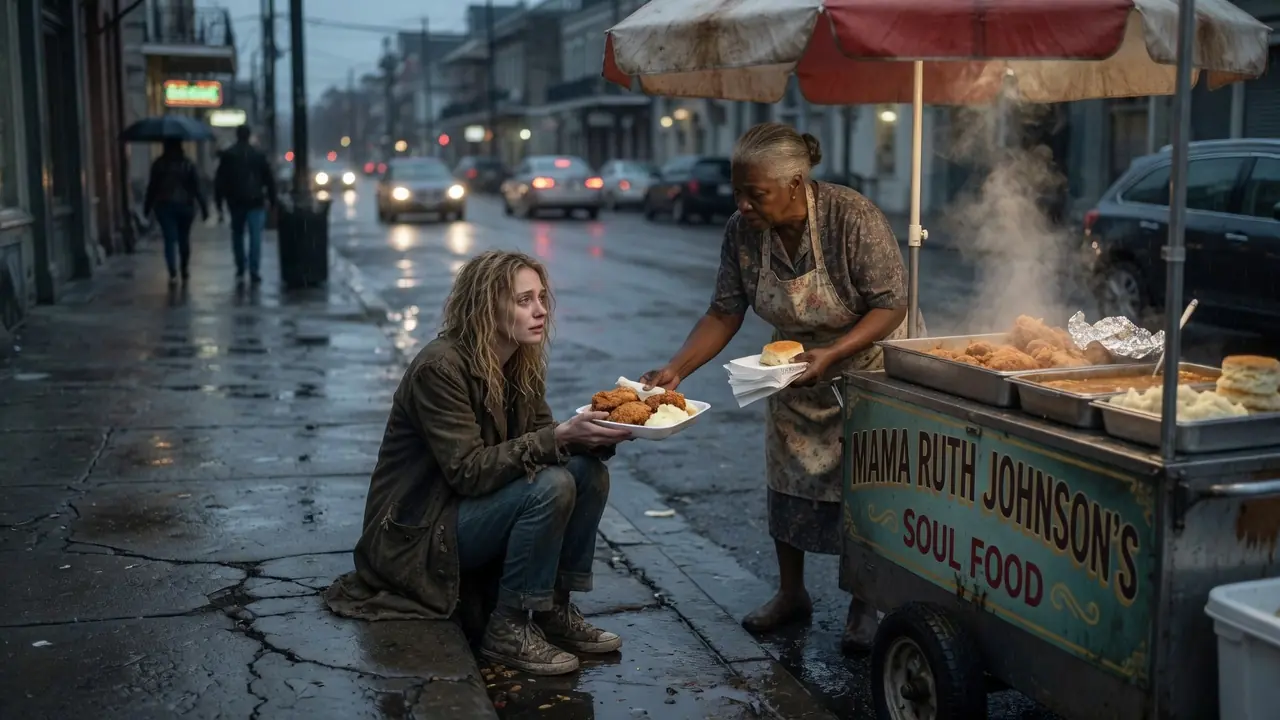
She had not eaten since yesterday morning.
Even then, it had only been two crackers and the last spoonful of peanut butter scraped from the bottom of a plastic jar.
She had tried to find work.
God knew she had tried.
She had started before sunrise, slipping out of the abandoned motel while her daughter, Amara, slept beneath a thin blanket in room 12. Emily had tucked the corners around the little girl’s shoulders, pressed a kiss to her warm forehead, and whispered, “I’ll be back with something good today, baby. I promise.”
Promises had become dangerous things.
But mothers made them anyway.
At seven-thirty that morning, Emily stood outside a diner on Elysian Fields Avenue, hands clasped in front of her, asking the manager if he needed help washing dishes, mopping floors, or taking out trash.
The man behind the counter looked her up and down.
He saw the messy hair.
The dark circles.
The faded backpack clutched tightly against her side.
The shoes with worn soles.
He did not see the mother who had once worked double shifts in clean blue scrubs at St. Anne’s Medical Center. He did not see the woman who had once memorized medication schedules for elderly patients and comforted families in waiting rooms. He did not see someone who would have worked until her hands cracked if it meant bringing home a meal.
He saw trouble.
“We don’t hire people who look unstable,” he said.
Emily stood very still.
The humiliation entered quietly, like cold water.
“I can wash dishes,” she said. “I used to work in a hospital. I’m dependable.”
The manager wiped the counter without looking at her.
“Everybody’s dependable until payday.”
Then he turned away.
Emily left without arguing.
Arguing burned energy.
Energy was food.
Food was Amara.
At a motel on Claiborne Avenue, Emily asked for cleaning work. The front desk clerk barely lifted his eyes from his phone.
“You got ID?”
“It was stolen with my wallet,” Emily said. “I’m trying to replace it. I can give you my name, my old employer, anything you need.”
“No address?”
“I’m between places.”
The clerk leaned back in his chair.
“No ID, no address. I can’t help you.”
“I can work today and come back with the paperwork.”
“No.”
He said it as if the conversation had become inconvenient to his afternoon.
At a small cafe near the corner, Emily asked if she could bus tables for tips only. The owner, a woman with tired eyes and a tight bun, looked at Emily’s coat and shook her head.
“You need to get yourself together first.”
Emily almost laughed.
Not because anything was funny.
Because that was the cruel circle people never noticed.
You needed work to get yourself together.
But no one would give you work until you already looked like you were together.
By noon, she was no longer begging for money.
She was begging for work.
By two, her voice had grown hoarse from explaining herself.
By four, her legs trembled.
By five, she had stopped believing the day would give her anything at all.
And still, she kept walking.
She did not want food for herself.
She wanted something to carry back to Amara.
One little meal.
One piece of chicken.
One bowl of soup.
One reason for her daughter to smile.
Amara had not smiled properly in days. The sickness had stolen that first, before strength, before appetite, before sleep. The doctors called it kidney failure in careful voices that tried to sound practical. Emily called it a thief.
It had stolen Amara’s energy.
It had stolen Emily’s job.
It had stolen their apartment.
It had stolen every illusion Emily ever had that hard work was enough.
Outside a gas station, she approached a man climbing into a pickup truck.
“Sir,” she said, her voice thin. “Do you have anything? Anything at all? My little girl is sick. I’m just trying to bring something home for her.”
The man recoiled as if she carried disease.
“Get away from me.”
He shut the truck door hard.
A woman passing with a toddler pulled the child closer.
“Don’t look, honey,” she whispered.
As if Emily were something shameful on the sidewalk.
A teenage boy near the bus stop muttered, “Get a job.”
Emily stopped walking for one second.
She wanted to turn and tell him she had tried.
She wanted to tell him she had walked miles that day looking for work until her knees shook. She wanted to tell him that poverty was not laziness, that hunger was not a character flaw, that a woman could lose everything one bill at a time and still wake up every morning ready to fight.
But her voice was gone.
So she kept walking.
The shame of it burned in her throat.
The sun dropped lower. The city’s music seemed to come from somewhere too far away to comfort her. New Orleans was famous for joy, for brass bands and bright beads and food that made strangers close their eyes. But there were streets beneath that joy where people disappeared quietly, where mothers counted pills, where children slept under coats, where the smell of someone else’s dinner could feel like punishment.
Emily pressed one hand to her stomach.
Not because it helped.
Because she needed to remind her body to stay upright.
When she turned onto a smaller street lined with old lamps and cracked pavement, she saw a food cart under a fading red-and-white striped umbrella.
Smoke drifted from a small fryer.
The smell hit her first.
Fried chicken.
Warm gravy.
Buttery biscuits.
Collard greens simmered with onion and pepper.
It was not just food.
It was memory.
It was Sundays before the bills.
Hospital cafeteria lunches with coworkers.
Amara at four years old, sitting at a kitchen table with sauce on her chin, laughing because she had dropped mashed potatoes into her lap.
Emily stopped walking.
The cart was old but clean, its metal sides polished from years of wiping. A handwritten sign hung from the front.
Mama Ruth’s Soul Plates
Chicken, Greens, Gravy, Biscuits
Pay What You Can When You Can
Pay what you can when you can.
That kind of sentence felt too kind to trust.
She moved closer, then stopped again, afraid to ask. Afraid to be told no in front of another stranger. Afraid that if one more person looked at her like she was nothing, something inside her might finally collapse.
So she did not ask.
She moved to the side of the cart and lowered herself onto the curb.
Her shoulders shook.
Her hands curled into her sleeves to hide the trembling.
She stared at the ground.
From behind the cart, Mama Ruth Johnson watched.
Mama Ruth was seventy years old, with deep brown skin, silver hair tied in a neat bun, and hands shaped by decades of chopping, stirring, scrubbing, serving, carrying, lifting, and surviving. She wore a faded green apron over a thick sweater, and her knees had been complaining since ten that morning.
She had been on that corner for fourteen years.
Before that, she worked in a hotel kitchen.
Before that, a school cafeteria.
Before that, a laundry room at a hospital.
She had fed people in one form or another nearly her entire life, though few had ever asked whether she herself had eaten.
Her cart was not famous.
It was not on travel blogs.
Tourists did not line up for it.
But neighborhood people knew.
The bus drivers knew.
The warehouse men knew.
The single mothers stretching one meal into two knew.
The old men on fixed income knew.
And the children knew.
Mama Ruth always kept a little extra for children.
She had seen hungry people before. New Orleans produced hunger quietly, beneath music and murals and restaurant windows. She had seen people ask loudly, manipulate poorly, curse when refused, weep when helped. Hunger wore many faces.
But something about the woman on the curb caught her.
The stillness.
Not lazy stillness.
Not performance.
The stillness of a person using the last pieces of herself just to remain in one place.
Mama Ruth wiped her hands on her apron and stepped around the cart. Her knees ached as she bent slightly to see the woman’s face.
“Baby,” she said gently, “have you had anything to eat today?”
Emily shook her head once.
Just once.
Her lips parted, but no words came out.
Then tears filled her eyes without permission.
She turned her face away, ashamed of being seen at the exact moment she had no strength left to make herself look better.
Mama Ruth did not ask for her name.
She did not ask why she was out there.
She did not ask what had gone wrong.
Those questions could wait.
Food could not.
She went back to the cart, took the plate she had been saving for herself, and filled it until the lid barely closed. Fried chicken, mashed potatoes, gravy, collard greens, and a biscuit wrapped in foil to keep it warm.
Then she placed it in Emily’s trembling hands.
“Here,” Mama Ruth said. “Eat and listen to me, sugar. You don’t have to apologize for being hungry.”
Emily clutched the warm plate with both hands.
Steam rose against her face like mercy.
For one fragile second, she almost brought the food to her own mouth.
Then Amara’s face appeared in her mind.
Pale lips.
Thin wrists.
Wide eyes asking, “Mommy, is there anything today?”
Emily looked up at Mama Ruth, gratitude and panic mixing in her expression.
“Thank you,” she whispered. “Thank you so much.”
Before Mama Ruth could answer, Emily stood so quickly she nearly fell. She pressed the plate against her chest as if protecting it from the wind.
Then she ran.
Not gracefully.
Not strongly.
She ran like someone carrying a life.
Mama Ruth blinked, startled.
“Baby?”
But Emily was already halfway down the street, stumbling around the corner, disappearing into the dying light with the warm meal held close.
Mama Ruth stood beside the cart, one hand lifted in the air, watching until the woman vanished.
Then she lowered her hand slowly.
“That food ain’t for her,” she murmured.
She knew it then.
The woman had someone waiting.
Someone hungrier.
Someone loved.
Emily walked fast, though her body protested every step.
The plate from Mama Ruth warmed her hands through the thin container. She held it inside her coat, shielding it from the wind as she crossed the empty lot behind the abandoned gas station. The sky had turned the color of old bruises, and the streetlights flickered like tired eyes fighting sleep.
“Hold on, baby,” she whispered. “Mommy’s coming.”
She said it again and again, not because Amara could hear her, but because Emily needed to hear herself still promising.
When she reached the old Blue Cypress Motel, her stomach twisted.
The building had once been painted turquoise. Now the paint peeled in long strips from the walls. Half the windows were cracked or boarded. The old sign flickered only when the wiring felt generous. People avoided the place during the day and crossed the street from it at night.
Emily slipped through the broken side entrance.
The hallway smelled of mildew, wet carpet, and old smoke. The floor creaked beneath her shoes. Somewhere upstairs, water dripped in slow, steady rhythm. A rat skittered behind the vending machine that had not worked in years.
Room 12 was at the back.
Emily pushed open the door gently.
The air inside was colder than outside.
A thin mattress lay on the floor with a faded blanket thrown over it. A flashlight sat beside two empty pill bottles near the wall. In the corner, two trash bags held everything they owned.
On the wall above the mattress were pencil marks.
Amara’s height.
Year by year.
A crooked little line at age four.
A slightly higher one at five.
A proud one at six.
Then one at seven.
Then one that stopped.
That was the year the sickness came.
Amara lay curled beneath the blanket, her brown curls pressed damply against her forehead. Her skin looked too pale, almost gray beneath the room’s weak light. Her breaths were shallow, careful, as if each one cost her something.
When Emily knelt beside her, Amara opened her eyes just enough to whisper, “Mommy.”
“I’m here, sweetheart.”
Emily brushed her fingers across her daughter’s cheek.
“Look what I brought.”
At first, Amara did not react. She blinked slowly, trapped in the heavy fog of exhaustion.
Then the smell of fried chicken and gravy reached her.
Her eyes widened.
Not much.
Just enough to break Emily’s heart.
“Mommy,” Amara whispered, “is that real food?”
Emily smiled, though tears burned behind her eyes.
“Yes, baby. Warm food.”
Amara pushed herself up on her elbows, slow and shaky, driven by a joy too large for her fragile body. Her lips parted in a small gasp.
“It smells so good,” she said.
Then she looked frightened.
“Can I really eat it?”
The question cut through Emily deeper than any insult from the day.
Can I really eat it?
As if food had become something too precious to assume.
Emily nodded quickly.
“Of course you can. Here.”
She scooped a small bite of mashed potatoes and lifted the spoon.
Amara leaned forward eagerly.
The moment the food touched her tongue, she closed her eyes.
“It’s warm,” she whispered.
As if warmth itself were a miracle.
“I forgot what warm food tastes like.”
Emily turned her face away for half a second.
When she looked back, she was smiling again.
“There’s more. Eat slow, okay?”
Amara took another bite.
Then another.
After the third, she stopped and looked up.
“Did you eat, Mommy?”
Emily had lied about many things since becoming poor, but only to protect her daughter.
“Yes,” she said gently. “I ate earlier.”
Amara studied her.
The child was sick, not foolish.
But she was too tired to argue.
She nodded and ate another small bite.
As Emily watched her daughter eat, the walls of room 12 changed for a moment. The peeling wallpaper did not disappear. The mold did not vanish. The cold did not warm. But a glow entered the room anyway.
A plate of food.
A child’s smile.
A mother breathing again.
For ten minutes, despair had to stand outside the door.
When Amara finished half the meal, Emily saved the rest for later. Then she helped her drink water, tucked the blanket around her shoulders, and sat beside her as her eyes grew heavy.
“Who gave it to you?” Amara whispered.
“A lady named Mama Ruth.”
“Is she nice?”
Emily brushed hair from her daughter’s forehead.
“She was kind.”
Amara’s eyes drifted closed.
“Kind is better than nice.”
Emily laughed softly.
It came out broken, but it was a laugh.
“Yes, baby,” she said. “It is.”
After Amara slept, Emily sat against the wall and let the memories come.
She had not always been this woman counting breaths in a ruined motel.
She had once worn clean scrubs and clipped her name badge neatly to her pocket.
Emily Carter
Patient Care Tech
She loved the steady rhythm of hospital work: rolling carts, beeping monitors, soft hallway conversations at three in the morning, the quiet gratitude of patients who needed someone to adjust a pillow or hold a cup of water.
She was not rich then, but she paid rent. She bought groceries. She kept Amara’s baby clothes folded in drawers. She had a small kitchen table, two chairs, and curtains with yellow flowers.
Back then, before Amara, before the sickness, before every door closed, Emily had loved Marcus Reed.
Marcus was tall, calm, and soft-spoken, with warm brown eyes and a mind always racing ahead of the world around him. He studied computer engineering at a community college and filled notebooks with ideas for medical technology, diagnostic tools, and software that could help hospitals find problems faster.
Emily believed in him before anyone else did.
She worked extra shifts to help him buy a refurbished laptop. She saved tip money from weekend home-care jobs to help pay the application fee for a California internship. She packed sandwiches for him when he stayed late in the library.
The night before he left for Oakland, they sat on the fire escape outside her apartment while New Orleans hummed below them.
Emily tied a braided bracelet around his wrist, pink, white, and gray threads woven together.
“So you don’t forget me,” she whispered.
Marcus kissed her fingers.
“When I make it,” he said, “I’m coming back for you. I’ll build us a life.”
Two weeks after he left, the calls stopped.
At first, Emily was irritated.
Then worried.
Then terrified.
She called his number until it disconnected. She emailed. She messaged. She contacted the program office and received polite, useless answers. She called his old roommate, who had heard nothing. She waited through nights, mornings, afternoons.
Nothing.
She did not know Marcus had been mugged behind a bus depot during his second week in Oakland. She did not know his phone had been smashed, his wallet stolen, his backpack taken, and with it the small notebook where he had written addresses and numbers he thought he would never lose.
She only knew he was gone.
Then she found out she was pregnant.
She stood in the bathroom of her apartment, holding the test in both hands, crying so hard her knees shook.
For weeks, she imagined telling him.
Then months passed.
Still nothing.
By the time Amara was born, Emily had stopped waiting by the phone.
She named her daughter Amara because the name sounded like love that could survive.
And for years, it did.
Amara was bright, curious, talkative, and full of questions. She loved music from street performers, hated carrots, and believed pigeons were secretly fancy birds who had fallen on hard times. She drew pictures on napkins, sang to her dolls, and once told Emily she planned to become a doctor who gave every child stickers even if they did not cry.
Then the swelling started.
At first, Emily thought it was a virus.
Then came the headaches.
Then vomiting.
Then the exhaustion.
The doctor’s face turned careful during the appointment. Careful faces in hospitals were worse than sad ones.
“Her kidneys are failing,” he explained. “She needs ongoing treatment. Eventually, she may need a transplant.”
Emily nodded.
She asked questions.
She wrote things down.
She did not cry until she reached the parking lot.
Then she slid down beside her car and sobbed into her hands while Amara slept in the backseat.
After that, life became bills.
Hospital bills.
Medication bills.
Specialist bills.
Rent.
Utilities.
Transportation.
Food.
Emily worked double shifts until her body stopped cooperating. She sold furniture. She pawned jewelry. She borrowed from people who did not have enough to lend. She begged her landlord for more time.
Medical debt did not care.
Poverty did not care.
Illness did not care how much a mother loved her child.
One afternoon, after a missed payment and a week of warnings, Emily came home from the clinic to find the locks changed. Two trash bags of belongings sat near the door.
Amara asked, “Are we moving?”
Emily smiled the smile mothers use when the truth would crush a child.
“Yes, baby,” she said. “Just for a little while.”
That was how they ended up in room 12.
A little while became months.
And now, in the cold motel room, Emily watched Amara sleep and thought about the woman at the food cart.
Mama Ruth.
Kindness had arrived in a foil container.
Emily did not know yet that it would change everything.
Across the city, Mama Ruth locked her cart long after the last customer left.
The day had been decent, though not enough to make her knees forgive her. She wiped down the counter, folded the umbrella, secured the cash box, and saved the last biscuit in a paper towel for breakfast.
Then she began the slow walk home, pushing the cart down broken sidewalks beneath dim porch lights.
Her neighborhood was quiet at that hour. Shotgun houses with peeling paint. Front steps worn smooth. A dog barking somewhere behind a fence. The distant sound of music from a bar three streets over.
When Mama Ruth reached her little house, she paused before unlocking the door.
She always paused.
Not because she expected anyone to be inside.
Because once, long ago, someone had been.
Leonard Johnson had been tall, gentle, and patient. He worked at the shipyard and came home smelling of salt, sweat, and metal. He could make Mama Ruth laugh by lifting one eyebrow, and he sang badly while washing dishes just to make her threaten him with a towel.
They had been married eleven years when the accident took him.
A crane malfunction.
A report.
A knock at the door.
A sentence that split her life into before and after.
They had wanted children. They had tried. They had prayed. They had chosen names they never used.
After Leonard died, no babies came.
No one came.
Decades passed.
Mama Ruth learned how to live alone without letting loneliness kill her. She cooked. Worked. Saved change in a jar. Grew herbs in coffee cans near the kitchen window. Spoke to Leonard’s photograph when the silence got too heavy.
Inside, she set her bag on the table and pulled out her wallet. The old photograph was tucked in the front pocket, protected by tape along the edges.
Leonard smiled back at her.
“You’d tell me I gave away my dinner again,” she murmured.
She touched the picture with her thumb.
“You’d be right.”
Then she placed two quarters and three dimes into the pickle jar on the counter. Her just-in-case savings. It was not much, but it was hers.
She thought of Emily running with that plate.
Not for herself.
For someone waiting.
Mama Ruth sat at the table, hands folded, and stared at the empty chair across from her.
“It’s been a long time since anybody needed me, Leonard.”
The house gave no answer.
But the next morning, before sunrise, Mama Ruth woke with purpose.
She tied her headscarf.
Turned on the kitchen light.
Seasoned chicken.
Mixed biscuit dough.
Packed two extra containers before she packed anything else.
One for the woman.
One for whoever she had run to feed.
As she stirred gravy in her cast-iron pan, she whispered, “Lord, let me find her again today.”
She was not sure why she said it.
Only that she meant it.
Emily came back the next morning.
Not to ask for food.
To say thank you.
She walked toward the cart with small, careful steps, rehearsing the words in her head.
Thank you.
You helped us.
I don’t know how to repay you.
But when she reached the corner, Mama Ruth was not standing upright behind the cart.
She was gripping the metal counter with one hand, the other pressed to her forehead. Her eyes were unfocused. Her breathing was shallow.
Emily forgot her speech.
“Mama Ruth?”
The older woman tried to smile.
“Morning, baby.”
Then her knees buckled.
Emily rushed forward and caught her under the arms.
“Sit down. Please. Sit.”
“I’m fine.”
“You are not fine.”
Emily lowered her onto a plastic crate beside the cart. She grabbed a bottle of water from the cooler and pressed it into her hands.
“Slow sips.”
Mama Ruth obeyed, too dizzy to argue properly.
Emily wiped her forehead with a napkin.
“Do you have someone I can call?”
Mama Ruth gave a weak little laugh.
“Baby, closest thing I got to family is this cart.”
Emily’s chest tightened.
“No children?”
“No children. Lost my husband a long time ago.”
The words were simple, but the loneliness inside them was not.
Emily looked at the food waiting to be served.
“Let me help today.”
“Oh, honey, I can’t ask you to.”
“You didn’t ask. I’m offering.”
Mama Ruth studied her.
Something passed between them.
Not pity.
Recognition.
“All right,” Mama Ruth said softly. “Just for today.”
Emily tied on an apron.
At first, she moved awkwardly, nervous with customers. But hospital work had taught her how to stay calm under pressure. Soon she was taking orders, wrapping plates, making change, wiping the counter, and remembering who had asked for extra gravy.
Customers noticed.
A bus driver named Jerome grinned.
“Mama Ruth, you got yourself an assistant?”
“Temporary,” Emily said quickly.
Mama Ruth looked at her.
“We’ll see.”
By late afternoon, the rush had slowed. Emily sat beside Mama Ruth on an overturned crate, exhausted but strangely steadier than she had felt in months.
“You did good,” Mama Ruth said.
“You helped me yesterday.”
“That plate wasn’t for you, was it?”
Emily looked down.
“No.”
“Tell me about her.”
The words were gentle enough to break her.
Emily told her everything.
Amara’s sickness.
The motel.
The bills.
The jobs.
Marcus.
The disappearance.
The pregnancy.
The years alone.
Mama Ruth listened without interrupting. She did not gasp in the wrong places. She did not offer shallow encouragement. She simply stayed present, which was rarer than advice and more useful.
Then Mama Ruth told Emily about Leonard.
The shipyard.
The accident.
The empty house.
Forty years of going home to silence.
When evening settled around them, they sat shoulder to shoulder beside the cart, two women from different generations, each carrying a grief the other understood without needing to compare.
Before Emily left, Mama Ruth packed two warm containers.
“From now on,” she said, “I’m putting aside two meals. One for you. One for that baby girl.”
Emily shook her head, tears rising.
“I can’t let you do that.”
“You can, and you will.”
“Mama Ruth, you barely have enough.”
“I have enough to know a child shouldn’t go hungry.”
Emily covered her mouth.
“I don’t know what to say.”
“Say you’ll come tomorrow.”
Emily nodded.
“I’ll come tomorrow.”
The day after that, Mama Ruth said, “Baby, I want to meet her.”
Emily froze.
The motel.
The mold.
The shame.
“It’s not a good place.”
“If she’s part of your heart,” Mama Ruth said, “then she’s part of mine now.”
Emily hesitated for a long time.
Then she nodded.
They walked to the Blue Cypress Motel in silence. Mama Ruth pushed her cart slowly along broken sidewalks while Emily carried the food bag. When the old woman saw the building, she stopped.
“You live here?”
Emily’s face burned.
“It’s all we have.”
Mama Ruth did not judge.
That almost made it worse.
Inside room 12, Amara lay curled beneath the blanket. The air smelled damp. The walls peeled. A bucket near the corner held water from a ceiling leak.
When Mama Ruth saw the child, she froze.
Not from shock alone.
From heartbreak.
“Lord have mercy,” she whispered. “This baby shouldn’t be breathing air like this.”
Amara opened her eyes.
Emily knelt beside her.
“Sweetheart, this is Mama Ruth. She’s the lady who helped us.”
Amara blinked up at the older woman.
“Hi.”
Mama Ruth’s entire face softened.
She lowered herself beside the mattress, knees cracking, and held out a paper bag.
“I brought something for you, sugar.”
Amara reached inside and pulled out a container of strawberries and grapes. Bright, fresh fruit. The kind Emily had not been able to afford in weeks.
“For me?”
“For you.”
Amara smiled.
It was small, but it transformed her face.
As she ate, Mama Ruth looked around the room again. The growth marks on the wall. The empty pill bottles. The thin blanket. The mother sitting too straight because if she relaxed, she might collapse.
“You’ve been fighting a whole war alone,” Mama Ruth said.
Emily looked down.
“I’m trying.”
“I know. That’s what makes it hurt.”
After eating half the fruit, Amara leaned toward Mama Ruth.
“Are you Grandma?”
The room went still.
Emily pressed a hand to her mouth.
Mama Ruth’s lips trembled. She looked at the child, then at Emily, as if asking permission for a gift she had waited forty years to receive.
“If you want me to be, baby,” Mama Ruth whispered, “then yes. I can be your grandma.”
Amara rested her head against Mama Ruth’s arm.
The older woman froze for a second, then placed her hand on the child’s back with a tenderness she thought life had buried with Leonard.
When Mama Ruth left that evening, she stood outside the motel door and wiped her eyes with her apron.
“My girls deserve better,” she whispered.
Across New Orleans, high above the clouds, a private jet began descending toward the city.
Inside sat Marcus Reed, a man the world knew as brilliant, wealthy, and impossible to schedule.
He was the founder of Reed Biotech, a company that had revolutionized early kidney disease detection and portable treatment systems. Magazines called him the man changing American healthcare. Investors called him a visionary. Hospitals called him a partner. Reporters called him the miracle mind.
Marcus called himself late.
Late to understand what mattered.
Late to return.
Late to find the woman whose absence had followed him longer than any success.
He stared out the oval window at the blurred lights below. His reflection looked older than he felt. A neatly trimmed beard. Expensive jacket. Eyes that had not rested in years.
From his coat pocket, he pulled a small velvet pouch.
Inside was a braided bracelet.
Pink.
White.
Gray.
Emily had made it the night before he left for California.
“So you don’t forget me,” she had said.
He had not forgotten.
He had lost the phone.
Lost the numbers.
Lost the apartment address when his backpack was stolen.
Lost his way trying to rebuild contact from memory and fragments.
But he had not forgotten.
After the mugging in Oakland, he spent weeks trying to find her. He called the apartment complex, but no one would give information. He wrote letters that came back undelivered. He emailed accounts that stopped responding. He messaged names online, but Emily Carter was common enough to disappear behind hundreds of strangers.
Then poverty did what poverty did.
It erased forwarding addresses.
Changed phone numbers.
Closed accounts.
Moved people without leaving tracks.
Marcus had told himself for years that Emily must have hated him, moved on, chosen silence.
It was easier than believing he had failed to find her.
It was also a lie.
Now, after a medical conference in Atlanta, after years of avoiding New Orleans because every street in the city felt like accusation, Marcus had come back.
Not for business.
For truth.
When the jet landed, his driver met him at the stairs.
“Welcome back, sir.”
Marcus nodded and slid into the SUV.
“Claiborne Avenue,” he said.
The driver pulled away from the airport. Rain tapped lightly against the windows. The city slid by in reflections and shadows.
Marcus barely recognized parts of it.
New buildings. Painted storefronts. Empty lots where restaurants used to be. But when they turned onto the streets of his old life, memory rose sharp and merciless.
The apartment complex had faded green paint and a rusted gate. An elderly woman sat outside under a small awning, wrapped in a cardigan.
Marcus stepped out into the rain.
“Ma’am,” he said respectfully, “I’m looking for someone who used to live here. Emily Carter.”
The woman looked up slowly.
“Emily Carter.”
Her face shifted.
“You the boy went off to California?”
Marcus’s throat tightened.
“Yes, ma’am.”
She studied him.
“Well. Took you long enough.”
He accepted the blow because he deserved it.
“Do you know where she went?”
The woman sighed.
“She stayed a while after you left. Had a baby girl.”
Marcus stopped breathing.
“What?”
“Beautiful little thing. Brown skin, curls, big eyes. Amara. That was her name.”
The bracelet slipped from his fingers and landed in a shallow puddle.
The world lost sound.
A child.
Emily had a child.
Amara.
The woman kept talking.
“Something happened with the little girl’s health. Kidneys, I think. Emily worked herself half to death trying to pay. Then they lost the apartment. Last I heard, somebody saw her near those old motels past the gas station.”
Marcus bent and picked up the bracelet with shaking fingers.
“How old?”
The woman frowned.
“The child? Must be nine by now.”
Nine.
Marcus felt the number enter him like judgment.
Nine birthdays.
Nine years of scraped knees, fevers, school mornings, questions, lullabies, bills, fear.
Nine years Emily had carried alone.
He returned to the SUV without feeling the rain.
“Find every motel,” he told the driver. “Every shelter. Every clinic. Every place a mother with a sick nine-year-old might go.”
“Yes, sir.”
“And call Dr. Hayes. I need pediatric kidney failure data for New Orleans. Tonight.”
The driver glanced at him through the mirror.
“Sir?”
Marcus’s voice broke.
“She may be my daughter.”
He did not sleep that night.
He searched until dawn. Motels. Shelters. Clinics. Empty offices. Old addresses. People shook their heads. Some tried to help. Some did not care. By sunrise, he returned to his hotel soaked, exhausted, and carrying guilt so heavy it seemed to sit in his bones.
The penthouse suite was obscene.
Marble floors.
Soft lighting.
Fresh towels.
Fruit waiting under glass.
Marcus stood in the middle of the room and hated all of it.
He opened his laptop and searched pediatric kidney failure New Orleans.
The results filled the screen.
Names.
Ages.
Clinic reports.
Community health articles.
Families holding fundraisers.
Children waiting for treatment.
Children needing transplants.
Children whose parents could not pay.
He saw Amara in all of them.
His company had built tools that saved lives, but they still reached the wealthy first, the insured first, the hospitals with connections first. He had spent years telling himself scale would solve access eventually.
Eventually was a cruel word to a child who needed help now.
Marcus opened a document and typed:
If I find Emily and Amara, I will not fail them again.
Then he added:
Until I do, I will protect every child like her.
At five-thirty in the morning, he called Dr. Adrian Hayes, Reed Biotech’s chief medical director.
“Marcus?” the doctor answered groggily. “It’s early.”
“I need pediatric kidney failure data for New Orleans. Last five years. Low-income neighborhoods first. I need clinic contacts, community health workers, free treatment sites, and portable unit availability.”
“Is this for a program?”
Marcus looked out at the rain streaking the window.
“It is now.”
Two days later, a small convoy of medical vans rolled through one of New Orleans’ forgotten neighborhoods.
Portable diagnostic equipment.
Dialysis support units.
Nurses.
A social worker.
Two pediatric specialists.
No cameras.
No press.
Marcus sat in the front van wearing a plain gray shirt and dark jacket. Nothing about him suggested billionaire if someone did not already know his face.
As they drove past cracked sidewalks and faded shotgun houses, his chest tightened.
This was where Emily had tried to survive.
This was where Amara might be.
The van turned a corner and passed Mama Ruth’s food cart.
Marcus looked out, then froze.
He could not explain it.
The cart was ordinary. Old metal. Fading umbrella. Handwritten menu. An older woman moving behind it with steady hands.
But something about the corner pulled at him.
“Stop,” Marcus said.
The van stopped.
Then the SUVs behind it arrived, turning the quiet street suddenly alert.
People looked up.
Conversation faded.
Mama Ruth narrowed her eyes as polished vehicles lined the curb.
Emily had just arrived to help at the cart after leaving Amara resting at the motel. She stiffened immediately.
“Mama Ruth,” she whispered, “who are they?”
“Don’t move, baby,” Mama Ruth said, stepping slightly in front of her. “Let’s see.”
The back door of the first SUV opened.
Marcus stepped out.
Mama Ruth saw a man with grief in his shoulders before she saw wealth.
“Morning, ma’am,” he said gently.
She held a container in one hand.
“Morning. What can I get you?”
“Whatever you recommend.”
Mama Ruth prepared a plate, still watching him carefully.
“You with the medical people?”
“Yes.”
“You charging?”
“No.”
That softened something in her face.
“Good. Folks around here have been charged enough.”
Marcus looked at the cart, then at Mama Ruth, then at the blonde woman working behind the side counter with her head down.
His gaze lingered.
He could not see her face.
But his chest tightened.
“You run this cart alone?” he asked.
“Most days. Got some help now.”
Mama Ruth looked toward Emily.
“A good woman. Been through more than anybody should.”
Emily kept washing trays, shoulders tense.
Marcus heard himself ask, “Does she have a child?”
Mama Ruth hesitated.
Emily dropped the tray.
Metal clattered against pavement.
Everyone turned.
Emily froze.
Marcus saw her face.
The city vanished.
The cart.
The street.
The medical vans.
The years.
“Emily,” he whispered.
She stepped back.
“No.”
Mama Ruth moved between them instantly.
“Sir, you slow down.”
Marcus raised both hands.
“I’m not here to hurt her. Please.”
Emily’s eyes were wide with disbelief, terror, and old pain.
“Marcus?”
His name came out like something she did not trust herself to say.
Marcus took one step, then stopped when Mama Ruth’s expression warned him not to move closer.
“I’ve been looking for you.”
Emily shook her head.
“You left.”
“I lost everything. I tried to find you.”
“You left,” she repeated, voice cracking. “I waited.”
Marcus closed his eyes briefly.
“I know.”
Mama Ruth looked between them.
The truth began forming in her face before anyone said it.
Marcus swallowed.
“The little girl. Amara.”
Emily went still.
“How do you know her name?”
His voice broke.
“Because I think she’s mine.”
Emily’s knees buckled.
Mama Ruth caught her.
Gasps moved through the small crowd that had gathered near the cart.
Emily pressed a hand over her mouth, sobbing without sound.
Marcus stood frozen, helpless for the first time in years.
The man who gave orders to boards, labs, investors, and medical teams could do nothing but wait while the woman he had loved tried to breathe.
Finally, Emily whispered, “She’s sick.”
Marcus’s face changed.
“Where is she?”
“At the motel.”
“Take me to her.”
The SUV drove too fast through the streets.
Emily sat beside Marcus, arms wrapped around herself, staring forward. He tried to explain in broken pieces. Oakland. The mugging. Lost phone. Lost numbers. Returned letters. Years of searching badly and then hiding behind work because failure was easier to bury than grief.
Emily did not respond.
Finally, she said, “We can talk later. Right now, she needs help.”
Marcus nodded.
“Yes.”
When they reached the Blue Cypress Motel, Marcus stepped out before the vehicle fully stopped.
The building made him physically ill.
Not because he was too good for it.
Because his child had been living there.
Emily opened the door to room 12.
“Baby,” she whispered. “Mommy’s here.”
Amara lay on the mattress, too pale, breathing too lightly.
Marcus entered slowly.
The moment he saw her, his entire life divided again.
Before Amara.
After Amara.
She had Emily’s mouth.
His sister’s curls.
His mother’s hands.
His own eyes.
He dropped to his knees beside the mattress.
“My God.”
Amara blinked at him.
Emily sat beside her.
“Baby, this is...” Her voice broke. “This is your father.”
Amara stared for a long moment.
“Daddy?”
Marcus covered his mouth with one hand, but the tears came anyway.
“Yes, sweetheart,” he whispered. “I’m here now.”
He reached for her hand, and when her tiny fingers curled weakly around his, something inside him broke open so completely that guilt had no place to hide.
“We need to move her,” he said. “Now.”
The medical team was already ready.
Within minutes, Amara was wrapped in a warm blanket and carried carefully to the SUV. Emily stayed at her side. Marcus rode across from them, never taking his eyes off the child.
At the hospital, everything moved fast.
Doctors.
Labs.
Scans.
Pediatric nephrology.
Nurses.
A private room, not because Marcus demanded luxury, but because Amara needed clean air, quiet, and immediate care.
The diagnosis was severe.
Late-stage kidney failure.
She needed a transplant urgently.
Marcus did not hesitate.
“Test me.”
The doctor looked at him.
“Mr. Reed, donor compatibility requires several steps.”
“Then start all of them.”
Emily stood near the window, arms folded tightly, staring at the child in the hospital bed.
“You don’t get to buy forgiveness.”
Marcus turned to her.
“I know.”
“You don’t get to walk in with money and erase nine years.”
“I know.”
“You don’t get to call her your daughter and think that makes you her father.”
The words hit hard.
He accepted every one.
“You’re right.”
That stopped her.
He stepped closer, not too close.
“I can’t erase anything. I can’t take back the nights you stayed awake alone or the bills or the motel or the fear. I can only stand here now and offer everything I have. My money. My time. My body. My kidney if I’m a match. My life, if you let me spend it trying to earn what I should have been there for from the beginning.”
Emily looked away first.
Not because she forgave him.
Because she wanted to.
The testing took hours.
Then a day.
Then another.
Mama Ruth came every morning carrying food, blankets, and authority.
The first time hospital security tried to stop her because she was not family, Amara opened her eyes and said, “That’s my grandma.”
Security stepped aside.
Marcus did not argue.
He arranged a chair for Mama Ruth beside Amara’s bed and said, “Ma’am, anything you need.”
Mama Ruth looked at him.
“What I need is for you not to break their hearts again.”
“I won’t.”
“You might mean that today.”
“I mean it for the rest of my life.”
She studied him for a long moment.
“We’ll see.”
The transplant match came back on the third day.
Marcus was compatible.
The doctor delivered the news gently, but Marcus barely heard the medical details after the word match.
Emily burst into tears.
Not dramatic tears.
Not relieved laughter yet.
Just the exhausted collapse of a mother who had held one hope too long and was afraid to trust it.
Marcus sat beside her.
“Let me do this.”
Her hands trembled around the consent forms.
“What if something happens to you?”
“Then at least I finally showed up.”
“Don’t say that.”
“I’m sorry.”
She looked at him then, truly looked.
Billionaire.
Lost love.
Stranger.
Father.
The same man, somehow all of them.
Finally, she signed.
The night before surgery, Marcus sat beside Amara’s bed while Emily slept in a chair and Mama Ruth dozed with her chin tucked to her chest.
Amara opened her eyes.
“Are you scared?”
Marcus smiled faintly.
“Yes.”
“Me too.”
“I know.”
“Will it hurt?”
“Some. But doctors will help.”
She studied him.
“Were you really lost?”
His throat tightened.
“Yes.”
“Mommy was sad when she talked about you.”
“I made her sad.”
“Are you going to make her sad again?”
Marcus looked at Emily sleeping in the chair, her face exhausted even in rest.
“I’m going to spend the rest of my life trying not to.”
Amara nodded, as if that was acceptable for now.
Then she reached for his hand.
He held it until she slept.
The surgeries lasted for hours.
Emily waited with Mama Ruth in the family area, unable to sit still. She walked to the vending machine and back. Sat. Stood. Pressed her palms together. Prayed. Bargained. Remembered. Feared.
Mama Ruth held her when the fear became too much.
“Breathe, baby.”
“What if I lose them both?”
“You won’t.”
“You don’t know that.”
“No,” Mama Ruth said. “But I know we don’t borrow grief before it’s due.”
Finally, the surgeon came.
“Both surgeries went well. The kidney is functioning. Amara is stable. Mr. Reed is stable.”
Emily’s knees gave out.
Mama Ruth caught her before she fell.
In recovery, Amara and Marcus lay in beds near each other, both pale, both bandaged, both alive.
Amara woke first.
Her eyes moved across the room until she found Marcus.
“Daddy?”
Marcus woke enough to turn his head.
“Right here.”
“Does it hurt?”
“A little.”
“Mine too.”
“We match then.”
She smiled faintly.
Then she reached across the space between them.
Marcus reached back.
Their fingertips touched.
Emily stood at the foot of the beds and finally allowed herself to cry without hiding.
Not because everything was fixed.
Because something had begun.
Recovery was slow.
Amara had good days and difficult ones. Marcus moved like an old man for the first week and hated every minute he could not sit up fast enough when his daughter called him. Emily became a bridge between them, helping Amara drink water, adjusting Marcus’s pillows, learning medications, asking doctors questions until they smiled at her with respect.
“You were a hospital tech?” one nurse asked.
“Yes.”
“It shows.”
The words restored a part of Emily she thought had been lost.
Mama Ruth visited daily with soup, socks, prayers, and criticism.
“You call this hospital cornbread? No, baby. That’s a sponge with confidence.”
Amara laughed so hard her side hurt.
Marcus watched from his bed and felt something inside him settle.
This was family.
Not the elegant loneliness of his old dining table.
Not charity galas.
Not boardrooms.
This.
A sick child laughing.
An exhausted mother smiling.
An old woman complaining about cornbread like it was a public emergency.
When Amara was discharged weeks later, Marcus insisted they leave together.
Emily hesitated when the SUV pulled through the gates of his large home in the Garden District.
The house was beautiful, with white columns, green shutters, wide porches, and oak trees bending over the lawn. It looked like another world.
“Marcus,” Emily said quietly, “this is too much.”
“No,” he said. “The motel was too much.”
She flinched.
He softened his voice.
“I’m not buying forgiveness. I’m giving our daughter clean air, a real bed, and safety. You can hate me from a guest room if you need to. But please don’t take her back to that place.”
Emily looked at Amara, who was asleep against a pillow in the back seat.
Then she nodded.
“For her.”
Marcus accepted that.
“For her.”
At first, Emily treated the house like a hospital room she was not sure she had permission to enter. She kept her belongings in one bag. She asked before opening cabinets. She apologized when Amara spilled juice.
Marcus noticed.
So did Mama Ruth.
One afternoon, Mama Ruth found Emily folding towels in the laundry room.
“Baby, why are you acting like a visitor in your own rescue?”
Emily laughed weakly.
“This isn’t mine.”
Mama Ruth leaned against the doorframe.
“Maybe not yet. But don’t shrink yourself just because the room got bigger.”
Emily stopped folding.
Tears filled her eyes.
“I don’t know how to stop being afraid.”
Mama Ruth’s voice softened.
“Then be afraid in a clean house with people helping you. Fear don’t need moldy walls to be real.”
Weeks became months.
Amara grew stronger.
Color returned to her cheeks. She began walking farther, then playing longer, then asking too many questions, which Marcus declared the best medical sign anyone could request.
She started tutoring because she had missed so much school. Marcus attended every appointment. Emily started working part-time with a patient advocacy group funded quietly by Reed Biotech. Not because Marcus gave her a title, but because she knew what families needed, and people listened when she spoke.
She helped mothers fill out forms.
She explained medication schedules.
She sat with parents while doctors delivered difficult news.
She became the person she had once needed.
Marcus created a foundation for pediatric kidney care access across Louisiana. Portable units were deployed. Low-income families received transportation support, grants, and legal aid for medical debt. Dr. Hayes ran the clinical side. Emily helped shape the patient side.
No press release mentioned Amara.
That was Emily’s condition.
Marcus agreed immediately.
One morning, Marcus drove Emily and Mama Ruth to a quiet neighborhood with older houses, oak trees, and porches wide enough for rocking chairs.
They stopped in front of a small yellow house with white shutters.
Mama Ruth frowned.
“Why we stopping here?”
Marcus handed her an envelope.
She eyed him suspiciously.
“If this is paperwork, I don’t trust it.”
“It is paperwork,” Marcus said. “But the good kind.”
She opened it.
The deed was in her name.
Mama Ruth’s hands began to shake.
“No.”
“Yes.”
“Marcus Reed, don’t you play with an old woman’s heart.”
“I wouldn’t dare.”
Emily stood beside her, crying already.
Marcus stepped closer.
“You saved them before I found them. You fed Emily when the world refused to see her. You loved Amara before you knew her story. You became family without being asked. This house is not payment. Nothing could pay that back. It is rest.”
Mama Ruth covered her face.
For forty years, she had gone home to silence.
Now she had a porch, a garden, a spare bedroom for Amara, and a kitchen big enough for all the love she still had left to cook.
“Leonard would fuss at me for crying in public,” she whispered.
Emily hugged her.
“Let him fuss.”
That evening, Marcus took them to a brick building on a corner near Mama Ruth’s new home. The windows were freshly cleaned. Inside, the kitchen gleamed. New tables lined the dining room. A sign outside was covered with a tarp.
Mama Ruth looked at him.
“What did you do?”
Marcus smiled.
“Something overdue.”
He pulled the rope.
The tarp fell.
The sign read:
Mama Ruth’s Kitchen
Warm Meals. Open Doors. Chosen Family.
Mama Ruth stared.
Then sat down hard on the nearest chair.
“I can’t run a restaurant.”
“You won’t have to run it alone,” Emily said.
Marcus nodded.
“You own the name. You guide the heart. We hired staff. Local people. Good wages. Meal program in the afternoons. Training program in the mornings. Free dinners for families referred by clinics and shelters.”
Mama Ruth wiped her face with her apron.
“Why?”
Marcus looked at the sign.
“Because one plate of food saved my family.”
The restaurant opened six weeks later.
The line stretched down the block.
People came for fried chicken, greens, biscuits, gumbo, red beans, cornbread, peach cobbler, and the kind of hospitality that made a person stand taller when leaving than when they arrived.
Emily managed outreach.
Mama Ruth ruled the kitchen like a queen with a wooden spoon.
Amara sat at a corner table after school, doing homework and occasionally telling customers, “That’s my grandma. She saved my life before my dad did.”
Marcus came in almost every evening, sometimes in a suit, sometimes in simple clothes, always washing his hands and asking where he was needed.
One year after the day Emily sat on the curb starving, Mama Ruth’s Kitchen hosted its first Christmas meal.
No one paid.
Families filled every table. Children laughed. Volunteers moved between chairs with full plates. A jazz trio played near the front window. The air smelled of gravy, cinnamon, roasted chicken, and hope.
At the end of the night, after the last guest left, Marcus stepped outside with Emily under the glowing sign.
Amara stood beside Mama Ruth, bundled in a red coat, cheeks round again, eyes bright.
Marcus took Emily’s hands.
“I lost you once because life was cruel and I was young. Then I stayed lost because guilt made me ashamed to keep searching harder. I cannot undo that.”
Emily’s eyes filled.
“I know.”
“But I can spend every day choosing you. Choosing Amara. Choosing this family. Not because I deserve it, but because love without action is just regret.”
He lowered to one knee.
Mama Ruth gasped.
Amara whispered loudly, “This is the part, Grandma.”
Marcus opened a small velvet box.
“Emily Carter, will you marry me?”
Emily covered her mouth.
For a moment, all she could see was the boy from the fire escape, the man in the hospital, the father holding Amara’s hand, the person who had come too late but stayed completely.
“Yes,” she whispered.
Amara cheered.
Mama Ruth cried openly and did not care who saw.
Marcus slipped the ring onto Emily’s finger, then stood and pulled her into his arms.
Under the sign of Mama Ruth’s Kitchen, on a street where people had once looked away from hunger, a family held each other while the city moved around them.
Everything had begun with a woman sitting on a curb.
With an older vendor asking, “Have you eaten, baby?”
With one warm plate.
One chosen grandmother.
One lost father finally coming home.
Kindness had not fixed everything in a day.
It had done something better.
It had stayed.
It had moved from hand to hand, from plate to child, from stranger to family, from guilt to purpose, from survival to home.
Years later, when Amara was old enough to tell the story herself, she never began with her father’s wealth or the hospital or the transplant.
She began with Mama Ruth.
“My grandma fed my mama when nobody else would,” she would say. “That’s how our family started.”
And she was right.
Because before the mansion, before the foundation, before the restaurant, before the miracle, there was a hungry mother on a sidewalk and a lonely woman behind a food cart who understood one simple truth.
Nobody should have to apologize for being hungry.
And sometimes, the smallest plate of food becomes the first brick in a home no storm can tear down.