At 10:17 on a clear Thursday morning in Rochester, Minnesota, Caleb Mercer heard an eighty-four-year-old woman speak four words that made six nurses stop moving.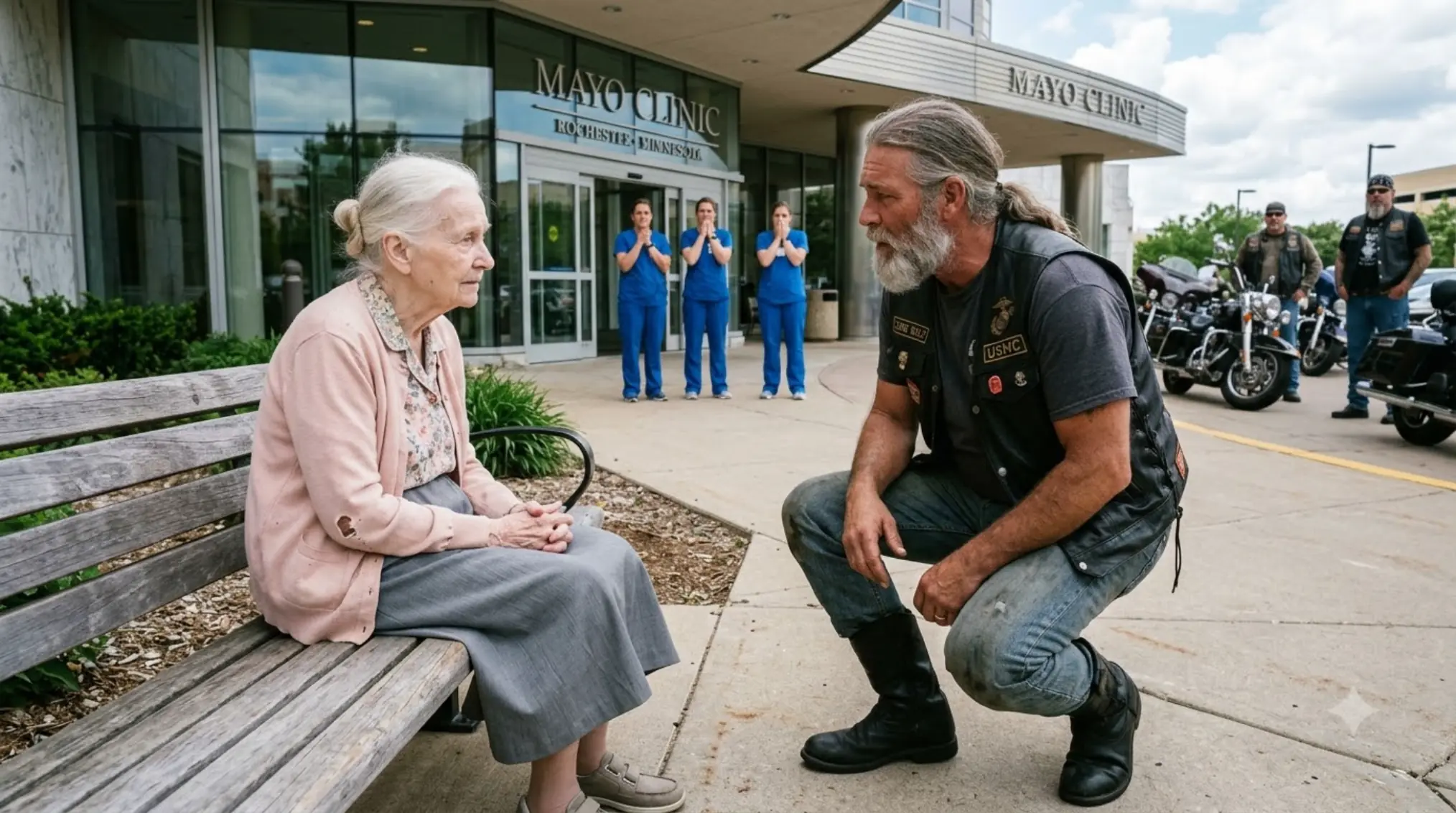
“You sound like my boy.”
Caleb had been kneeling beside the wooden bench outside the main entrance of Mayo Clinic, one tattooed hand resting gently against the weathered slat behind her shoulder.
He did not touch the woman.
Not yet.
He had learned a long time ago that frightened people deserved room before they deserved comfort.
The woman’s name was Eleanor Whitmore.
She was tiny beneath a slightly torn light-pink cardigan, a faded floral blouse, and a long gray skirt that covered her thin knees.
Her white hair had been gathered into a small bun.
Her hands rested together in her lap.
For most of the morning, those hands had barely moved.
Neither had her mouth.
One of the nurses standing near the hospital entrance covered her lips with both hands.
Another whispered, “Oh my God.”
Caleb slowly lowered himself onto the bench.
His leather vest creaked softly.
He was fifty-six years old, broad through the shoulders, with long gray-streaked hair tied behind his neck and a thick beard reaching nearly to his chest.
Black ink covered both forearms.
Motorcycle club patches filled the front and back of his worn vest.
To strangers, he looked like the sort of man mothers might warn their children not to approach.
Eleanor looked at him as though she had been waiting years for exactly that face.
Caleb spoke softly.
“Your boy?”
Eleanor’s lips trembled.
Nothing came out.
The nurses waited.
Caleb did not.
He looked toward the parking area instead, where four black motorcycles stood beneath the midday light and three of his brothers from the Bakersfield Road Saints waited at a respectful distance.
“Mine used to say I talked too much,” Caleb said.
Eleanor blinked.
A tiny movement appeared at one corner of her mouth.
Not quite a smile.
Caleb noticed.
“So if your boy sounded like me, I’m guessing he was trouble.”
Her eyes brightened.
The nurse closest to them, Megan Price, took one careful step forward.
“Eleanor?”
The old woman flinched.
The smile disappeared.
Caleb looked toward Megan.
“Give her a second.”
Megan immediately stopped.
She had been Eleanor’s primary nurse during the latest neurological evaluation, and she knew better than anyone how extraordinary the morning had become.
Eleanor had not been physically incapable of speech.
Doctors had confirmed that repeatedly.
Her vocal cords worked.
Her neurological pathways remained mostly intact despite age-related decline.
She understood language.
She answered questions with nods, gestures, written words when she felt safe enough, and occasionally by touching pictures on a communication tablet.
But spoken language had vanished from her life nearly seven years earlier.
The hospital file used phrases like severe psychological withdrawal, trauma-associated mutism, and prolonged grief response.
Megan called it something simpler.
Eleanor had stopped believing anyone needed to hear her.
Nobody knew precisely why.
Her husband had died thirteen years earlier.
She had no children listed in her current medical records.
No nearby relatives.
A county-appointed advocate handled most paperwork.
Sunridge Care Center had brought her to Mayo Clinic because her refusal to speak had become more complete over the previous year.
Then Caleb Mercer sat down.
And she spoke.
He leaned slightly toward her.
“You don’t have to say anything else.”
Eleanor looked into his face.
Caleb tapped his own chest.
“I’m Caleb.”
Her eyes moved downward.
Not toward his hand.
Toward his vest.
More specifically, toward a faded red-and-gold patch stitched above his heart.
A winged wheel.
The words beneath it read:
BAKERSFIELD ROAD SAINTS
Eleanor’s breathing changed.
Her fingers tightened together.
Caleb noticed immediately.
“Do you know that?”
She stared at the patch.
Then slowly raised one hand.
Her fingers trembled badly.
Caleb stayed motionless while she touched the edge of the embroidered wing.
Her voice came again.
Barely.
“Thomas.”
Caleb stopped breathing.
Behind him, one of the bikers swore quietly.
Caleb turned his head.
“Ray.”
The oldest man standing near the motorcycles looked shaken.
Raymond Cutter was sixty-eight and had belonged to the Road Saints longer than anyone present.
He walked closer.
“What did she say?”
Caleb looked back toward Eleanor.
“Thomas.”
Ray’s expression changed.
Not confusion.
Recognition.
Caleb saw it immediately.
“You know something.”
Ray did not answer.
His eyes had landed on Eleanor’s face.
The old biker stared at her.
Then at the cardigan.
Then back at her eyes.
“Ma’am,” he said carefully, “was your son’s name Thomas?”
Eleanor began trembling.
Not violently.
Just enough that Caleb saw it move through her shoulders.
Megan hurried forward.
Caleb lifted one hand.
Not to stop her entirely.
To keep the moment gentle.
Megan crouched beside the bench.
“Eleanor, you’re safe.”
The old woman’s eyes filled with tears.
Her mouth opened.
The sound that came out was more breath than voice.
“Tommy.”
Raymond Cutter stepped backward as though somebody had struck him.
Caleb stood.
“Ray.”
The older biker stared at Eleanor.
“Her last name.”
“What?”
Ray’s voice dropped.
“What’s her last name?”
Megan looked uncertain.
Caleb answered because he had heard the nurses say it earlier.
“Whitmore.”
Ray closed his eyes.
“Jesus Christ.”
Caleb grabbed his shoulder.
“What?”
Ray looked directly at him.
“Thomas Whitmore.”
The name meant nothing to Caleb.
But the way Ray said it did.
“Who was he?”
Ray looked toward the Road Saints patch on Caleb’s chest.
“One of us.”
Thirty-four years earlier, before Caleb Mercer owned a repair shop and before gray invaded his beard, the Bakersfield Road Saints had been a much smaller motorcycle club.
Not criminals.
Not saints either.
Mostly mechanics, oil-field workers, truck drivers, machinists, veterans, and men who hated spending Saturdays indoors.
Thomas Whitmore had joined in 1986.
Everybody called him Tommy White because bikers were apparently incapable of leaving a surname alone.
Ray had been twenty-nine.
Tommy was twenty-seven.
“He could rebuild a carburetor blindfolded,” Ray said later that morning inside an unused family consultation room.
Caleb sat across from him.
Megan remained near the door.
Eleanor had been taken inside after the emotional shock left her exhausted.
“She really his mother?” Caleb asked.
Ray rubbed both hands across his face.
“I only met her once.”
“When?”
“Nineteen eighty-eight.”
“That’s almost forty years.”
“I know.”
“What happened to him?”
Ray went quiet.
Caleb’s stomach tightened.
“You know, don’t you?”
Ray nodded.
“Tommy died.”
Megan lowered her eyes.
Caleb leaned back.
“When?”
“1991.”
Eleanor had been silent only seven years.
Something did not fit.
Caleb asked:
“She knows?”
Ray shook his head slowly.
“I don’t know.”
“What does that mean?”
Ray stared at the floor.
“Tommy left Bakersfield before he died.”
“Where?”
“Montana first.”
“Then maybe Washington.”
“He was running from something.”
“Police?”
“No.”
“Debt?”
“No.”
“Then what?”
Ray looked toward the closed door leading back toward the patient wing.
“His father.”
Caleb waited.
Ray continued.
“Tommy’s old man was hard.”
“Controlling.”
“Religious in the kind of way that made everything somebody enjoyed look sinful.”
“He hated the motorcycle.”
“Hated us.”
“Hated Tommy working in a garage.”
“Wanted him back in Minnesota running the family hardware business.”
Caleb nodded slowly.
“And Eleanor?”
“Different.”
Ray’s voice softened.
“She loved the kid.”
“But she never stood up to her husband.”
“That was Tommy’s version.”
Megan asked:
“What happened before he left?”
Ray took a breath.
“Tommy came home after his younger sister died in a car accident.”
“His father blamed him for not being there.”
“Tommy blamed himself too.”
“Started drinking harder.”
“Then one night he got into a fight with his old man.”
“He left.”
“Never went back.”
Caleb frowned.
“But why would his mother think he’s alive?”
Ray shook his head.
“I don’t know that she does.”
“Maybe she just heard the name and remembered him.”
Megan looked toward the medical record tablet.
“There’s no son documented anywhere.”
Ray stared.
“That’s impossible.”
Caleb asked:
“Could somebody have removed him?”
Megan shook her head.
“Medical records depend on what patients or facilities provide.”
“If she stopped discussing him decades ago, the care center might never have known.”
Caleb stood.
“We need to find out what Eleanor believes.”
Megan looked at him.
“She just spoke for the first time in years.”
“I know.”
“We cannot interrogate her.”
“I’m not asking to.”
Caleb looked toward the hallway.
“I’m asking to sit beside her again.”
Eleanor slept for nearly three hours.
Caleb stayed.
His friends expected him to leave.
He did not.
The Road Saints had originally come to Mayo Clinic because one of their longtime members was undergoing cardiac surgery.
They had planned to visit for an hour.
By early afternoon, three bikers had canceled motel reservations in Wisconsin and booked rooms in Rochester instead.
Nobody asked Caleb why.
Some things did not need discussion.
At 2:46, Megan found him beside the vending machines.
“She’s awake.”
Caleb put down his coffee.
“Can I see her?”
“She asked for you.”
Those words stopped him.
“How?”
Megan smiled.
“She pointed at a picture of a motorcycle.”
Caleb laughed softly.
“Good enough.”
Eleanor sat beside a window when he entered her room.
The pink cardigan had been folded over the chair.
Without it, she looked even smaller.