At seventy-nine years old, Eleanor Lawson still kept the porch light on every night.
Her neighbors in Asheville, North Carolina, often teased her about it when they passed her small white house at the edge of Willow Creek Road.
“Eleanor, nobody’s coming by after nine,” old Mr. Pelham would call from across the fence.
Eleanor would only smile, lift one hand, and say, “A light doesn’t hurt anybody.”
But the truth was, the porch light had never really been her habit.
It had belonged to Henry.
Henry Lawson had turned on that small yellow light every evening before dinner, even when Eleanor was already home, even when their children were grown, even when no guests were expected. He used to say a lit porch made a house look forgiving.
Eleanor had never known exactly what he meant by that.
She only knew that after he died, the house felt too dark without it.
So every evening at dusk, no matter how tired her knees were, no matter how stiff her fingers felt, she walked to the front door and flipped the switch. The light beside the door blinked once, then glowed softly against the porch boards.
It made the house feel less empty.
Eleanor had been a seamstress for most of her life, though calling her only a seamstress was like calling a cathedral only a building. She had sewn wedding dresses, curtains, school costumes, church banners, baby quilts, Sunday suits, mourning dresses, kitchen aprons, and once, a tiny blue coat for her first grandchild.
Her hands were narrow, scarred, and permanently marked by years of needles, thread, fabric, buttons, steam, and work. Even now, with age tightening her knuckles and arthritis settling into her wrists, she could still tell by touch whether fabric was good.
She could run one thumb along a piece of cotton and know whether it would hold.
Her own house was full of things she had made.
The curtains in the kitchen, faded yellow but still cheerful.
The quilt on the back of the sofa.
The table runner Henry used to pretend was too pretty for ordinary dinners.
The embroidered pillows in the guest room.
The old sewing chair in the corner of her workroom, the one Henry had repaired three times because Eleanor refused to throw it away.
Eleanor’s daughter, Linda, lived in Raleigh with her husband and two busy teenagers. Her son, Paul, lived in Arizona, where the weather was dry and, according to Eleanor, “too proud of itself.”
They called.
They visited when they could.
They worried.
Linda especially worried.
“Mom, that house is too much for you,” she told her every few months.
“It’s one story,” Eleanor said. “How much house can one story be?”
“The gutters need cleaning. The porch boards are loose. You should not be on step stools anymore.”
“I have lived seventy-nine years without being bossed by my own daughter.”
“You raised me to be bossy.”
“That was your father’s side.”
Linda always laughed, but Eleanor heard the fear beneath it.
She understood.
Aging turned ordinary things into arguments. Stairs, bathtubs, icy sidewalks, light bulbs too high to reach, jars too tight to open. Children saw those things and imagined danger. Parents saw those things and remembered independence.
Eleanor refused to leave.
“This house still has good bones,” she always said.
She did not add what she thought afterward.
So do I.
One rainy October evening, Eleanor was in her sewing room behind the kitchen, mending the hem of a little floral dress that belonged to Mrs. Pelham’s granddaughter. Rain tapped on the windows and ran down the glass in silver lines. The small electric heater hummed near her feet, and the smell of lavender soap, old fabric, and hot tea filled the room.
The dress was supposed to be finished by Sunday, though Mrs. Pelham did not know Eleanor had also added a tiny embroidered bird near the pocket.
“Child needs something pretty,” Eleanor had muttered.
Then she began sewing.
She had just threaded a fresh needle when she heard something near the back shed.
At first, she thought it was a raccoon.
Raccoons had no respect for property lines, garbage cans, or anything left drying on a line.
Then she heard it again.
A cough.
Not an animal cough.
A child’s cough.
Eleanor set down the needle and listened.
There it was again, small and wet, swallowed quickly as if the child had tried to hide it.
She stood slowly, one hand pressing against the sewing table until her knee settled under her. Then she opened the back door and looked into the rain.
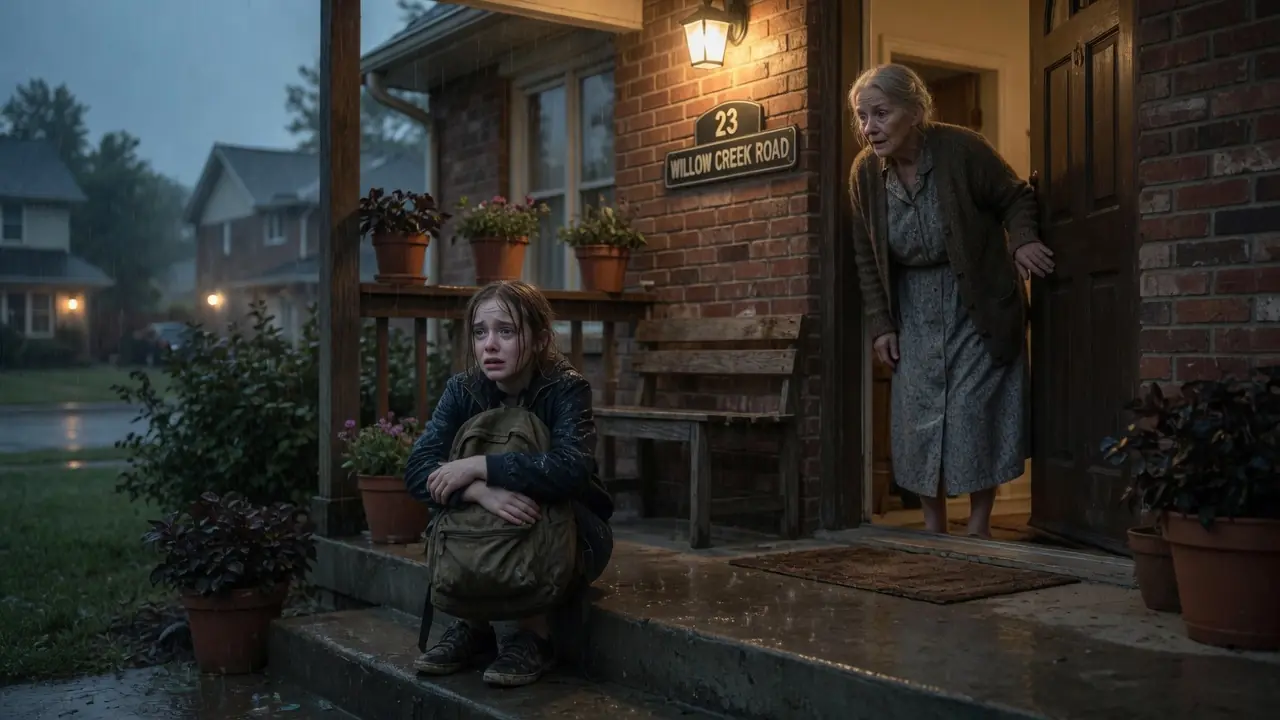
A girl was crouched beneath the narrow roof overhang of the shed, trying to stay dry.
She looked about eleven years old, with dark blond hair flattened by rain, pale cheeks, and a backpack hugged tightly against her chest. Her jacket was soaked across the shoulders. Her sneakers were muddy, and one lace dragged through the wet grass.
When the girl saw Eleanor, she jumped to her feet.
“I’m sorry,” she said quickly. “I was just waiting for the rain to stop.”
Eleanor stood in the doorway, rain misting her face.
“In my shed?”
“I didn’t go inside.”
“I can see that.”
“I wasn’t stealing anything.”
“I didn’t say you were.”
The girl looked toward the road.
Eleanor knew that look.
She had seen it in stray cats, frightened children, tired mothers at charity drives, and once in the mirror after Henry’s funeral. It was the look of something preparing to run because staying had never been safe.
Eleanor softened her voice.
“What’s your name?”
The girl hesitated.
“Clara.”
“Clara what?”
“Clara Turner.”
“I’m Eleanor Lawson.”
The girl nodded toward the house.
“I know. Your mailbox says Lawson.”
“So it does.”
Rain fell harder, drumming against the shed roof and splashing in puddles along the narrow path. Clara shivered, then straightened quickly as if she had not.
Eleanor noticed.
“You live nearby, Clara?”
“Not far.”
“That’s not an address.”
The girl’s jaw tightened.
“I’m fine.”
Eleanor gave a small sigh.
“Sweetheart, I have been alive seventy-nine years. I’m fine usually means the opposite.”
Clara looked down.
Eleanor stepped aside and opened the back door wider.
“Come inside. You can stand near the heater while the rain lets up.”
Clara shook her head.
“I can’t.”
“Why not?”
“I don’t have money.”
Eleanor almost laughed.
Not because it was funny.
Because the sentence broke something tender in her.
“I don’t charge admission to my kitchen.”
“I shouldn’t be here.”
“Probably not,” Eleanor said. “But here you are.”
The girl stared at her, unsure what to do with an adult who did not shout.
Eleanor pointed toward the small electric heater near the sewing table.
“Five minutes. Door stays open if that makes you feel better.”
Clara hesitated.
Then she stepped inside.
The sewing room smelled of lavender, cotton, thread, rain-damp clothes, and old wood. Clara stood near the heater, still clutching her backpack. Her eyes moved across the spools of thread lined by color, the folded fabric on the shelves, the dress on the table, the scissors, the pincushion shaped like a tomato, and the old black sewing machine near the window.
“You make things?” she asked quietly.
“When the thread cooperates.”
“Does it?”
“Not often.”
For the first time, Clara almost smiled.
Eleanor took a clean towel from a shelf and held it out.
“For your hair.”
Clara took it carefully.
“Thank you.”
“Hungry?”
The girl’s face closed immediately.
“No.”
Her stomach growled loud enough to answer for her.
Eleanor lifted one eyebrow.
Clara’s cheeks turned red.
“I have soup in the kitchen,” Eleanor said. “And cornbread, unless the old woman who lives here ate it all.”
“You live alone.”
Eleanor paused.
“Yes.”
“So there’s no old woman who ate it?”
“I am the old woman,” Eleanor said. “Sometimes I blame myself for missing food.”
Clara stared at her.
Then a surprised little laugh slipped out before she could stop it.
Eleanor smiled.
“Come on.”
Clara stayed frozen.
“I can’t go in your house.”
“That is a smart rule,” Eleanor said. “Here is what we’ll do. I’ll call someone safe first. Your mother, father, whoever is looking for you. Then you can decide whether to sit at my kitchen table or keep negotiating with your stomach.”
At the word mother, Clara’s face changed.
Eleanor saw it immediately.
“Clara,” she said gently, “who is looking for you?”
The girl lowered her eyes.
“My mom.”
“Does she know where you are?”
“No.”
“Where is she?”
“At the hospital.”
Eleanor went still.
“Is she sick?”
Clara shook her head quickly.
“No. She works there. Laundry department.”
“And why aren’t you home?”
The girl swallowed.
“We had to leave.”
“Leave where?”
“Our apartment.”
Eleanor waited.
She had learned through decades of sewing that if you pulled too hard too quickly, even good fabric could tear.
Clara rubbed the towel between her hands.
“The landlord changed the locks this morning. Mom said he wasn’t supposed to, but he did. She had to go to work because if she missed another shift, she’d lose the job. She told me to stay with Mrs. Allen downstairs until she got off.”
“What happened?”
“Mrs. Allen’s daughter came over with her kids. There wasn’t room anymore. They said I could wait in the hallway, but the landlord came back and told me to get out.”
Eleanor’s jaw tightened.
“What time does your mother finish work?”
“Midnight.”
It was not even seven.
“You were going to stay outside until midnight?”
Clara said nothing.
Eleanor looked at the soaked jacket, the thin shoulders, the backpack held like the last piece of home.
This child was not fully homeless.
Not yet.
But the world had pushed her outside for one dangerous night.
One night could change a child.
One night could teach her nobody was coming.
Eleanor reached for the old landline mounted near the kitchen doorway.
“Do you know your mother’s phone number?”
Clara nodded.
Eleanor handed her the phone.
The girl dialed with shaking fingers.
No answer.
She tried again.
No answer.
“She can’t keep her phone on during shift,” Clara said quickly. “But she checks it on break.”
Eleanor nodded.
“Then we leave a message.”
She took the phone gently when the voicemail beep sounded.
“Ms. Turner, my name is Eleanor Lawson. Your daughter Clara is safe at my house on Willow Creek Road. She is cold, but she is all right. I will keep her here until you can call or come. My number is…”
When she hung up, Clara stared at the floor.
“She’ll be mad.”
“No,” Eleanor said. “She’ll be scared.”
“I shouldn’t have left Mrs. Allen’s.”
“You were told to leave.”
“I should’ve found somewhere better.”
“You are eleven.”
“Almost twelve.”
“Still not old enough to outthink a bad landlord in the rain.”
Clara looked away, but her eyes had gone wet.
Eleanor pretended not to notice.
Pride had bones, too.
And children’s pride broke differently.
She led Clara from the sewing room into the kitchen. The porch light glowed yellow through the front window, shining across the steps and the wet walkway beyond the glass. Clara glanced at it as they passed.
“Why is that on?”
“My husband liked it that way.”
“Where is he?”
Eleanor opened the kitchen cabinet.
“Gone.”
Clara understood enough not to ask more.
The kitchen was warm and simple. A round wooden table sat near the window. A pot of vegetable beef soup rested on the stove, and the smell filled the room, rich and steady. A blue dish towel hung over the oven handle. Henry’s old mug sat near the sink, though Eleanor had not used it for years.
Clara stood just inside the doorway, dripping onto the mat.
Eleanor pointed to a chair.
“Sit.”
“I’ll get it wet.”
“Chairs dry.”
Clara sat carefully, still holding her backpack.
Eleanor gave her soup, cornbread, a glass of milk, and a folded napkin. The girl stared at the bowl as though it might disappear if she looked too hungry.
“That’s too much.”
“No,” Eleanor said. “Too much would be dessert before soup.”
Clara looked up.
“There’s dessert?”
“Depends how well you behave around cornbread.”
The girl almost smiled again.
She ate slowly at first.
Then faster.
Eleanor turned toward the sink and washed a clean mug that did not need washing, giving Clara the dignity of not being watched while hunger took over. When the bowl was empty, Eleanor filled it again without asking.
Clara whispered, “Thank you.”
“You’re welcome.”
After dinner, Eleanor gave her dry socks and one of her old flannel shirts. It hung loose on Clara’s small frame, sleeves rolled several times. She placed Clara’s shoes near the heater and set her wet jacket over a chair to dry.
Clara returned to the kitchen table with her backpack still on her lap.
“You can put that down,” Eleanor said.
“It has our papers.”
“What kind of papers?”
“Birth certificate. Mom’s work stuff. Lease. Some pictures. She told me not to lose them.”
Eleanor looked at the backpack differently.
Not a school bag.
A family archive.
A little girl carrying proof that her life existed.
“You did well keeping it safe,” Eleanor said.
Clara blinked.
“I did?”
“You did.”
The girl’s shoulders lowered a little.
At 8:15, the phone rang.
Eleanor answered.
A woman’s voice came through, frantic and breathless.
“Mrs. Lawson? This is Rachel Turner. Is Clara there? Is she okay?”
“She is safe.”
A broken sob came through the phone.
“Oh God. Clara.”
Eleanor handed the phone to the girl.
“Mom?”
The moment Clara heard her mother’s voice, her face crumpled.
“I’m sorry,” she whispered. “Mrs. Allen couldn’t keep me. I didn’t know where to go. I didn’t lose the papers.”
Eleanor stepped into the living room to give her privacy.
She stood beneath the framed photograph of Henry on the wall. He was smiling in that picture, standing on the porch in a brown sweater with one hand resting on the railing he had repaired the summer before he died.
Eleanor looked at the picture and murmured, “You always did say the light was for somebody.”
Rachel Turner arrived just after midnight.
She came in a faded hospital laundry uniform beneath a thin coat, her hair pulled into a messy bun, her face pale with exhaustion and fear. The moment Clara opened the door, Rachel dropped to her knees and pulled her daughter into her arms.
“I’m sorry,” she cried. “I’m so sorry, baby.”
Clara clung to her.
“I kept the papers.”
“I don’t care about the papers.”
“You said they were important.”
“You are important.”
Eleanor stood quietly in the hallway.
Rachel looked up at her with tears running down her face.
“Mrs. Lawson, thank you. I don’t know what would have happened if you hadn’t…”
“Don’t finish that sentence,” Eleanor said softly. “She’s safe.”
Rachel tried to stand, but exhaustion made her sway. Eleanor reached for a chair and pulled it close.
“Sit down before you fall down.”
“I can’t stay. We need to figure out where to go.”
“You already have.”
Rachel looked confused.
“You and Clara can stay here tonight,” Eleanor said.
“No. Ma’am, we can’t.”
“You can.”
“I can’t pay you.”
“I didn’t ask.”
“We’re not homeless,” Rachel said quickly, shame rising in her voice. “I mean, we have money coming. I have a job. The landlord wasn’t supposed to lock us out. I just need a few days to fix it.”
Eleanor’s face softened.
“I believe you.”
Rachel stopped.
“You do?”
“Yes.”
That simple answer nearly broke her.
She covered her mouth and cried.
Not loudly.
Not theatrically.
Just the silent, shaking cry of someone who had been holding herself upright too long because a child needed her to.
Eleanor gave Rachel soup. She tried to refuse twice, then ate as if her body had finally overruled her pride. Clara sat beside her, leaning against her arm, heavy with relief.
The house felt different that night.
Eleanor did not say it.
But she felt it.
There were voices in the kitchen again.
Small sounds upstairs.
The careful creak of someone else using the hallway.
The old house seemed to breathe deeper.
She put Rachel in her daughter’s old room and Clara in her son’s. Before bed, she left towels on the dresser and placed the wet backpack near a heating vent where it would dry without being out of reach.
Clara stood in the doorway of the guest room.
“Mrs. Lawson?”
“Yes?”
“Do I lock the door?”
Eleanor paused.
“If it helps you sleep, yes.”
Clara nodded.
“Will you be mad?”
“No.”
The girl closed the door.
Eleanor heard the lock click.
She stood in the hall for a moment, one hand on the wall.
Then she went downstairs and turned off every light except the porch light.
One night became five.
Then two weeks.
Eleanor helped Rachel call a tenant advocate. She drove her to the county office when she needed forms printed. She made copies of her lease and pay stubs. She contacted a retired attorney named Gloria Benton, who owed her a favor after Eleanor altered all three bridesmaid dresses for Gloria’s daughter’s wedding ten years earlier.
Gloria came to Eleanor’s kitchen with a red coat, a leather folder, and the brisk authority of a woman who had spent her life making dishonest people uncomfortable.
She read Rachel’s lease at the kitchen table while Clara did homework nearby.
“Illegal lockout,” Gloria said. “Clear as day.”
Rachel’s hands trembled around her coffee.
“He said I owed rent.”
“You may have owed rent,” Gloria replied. “That does not give him the right to change the locks without a court order.”
“I didn’t know what to do.”
“That is why men like him count on women like you being too tired to fight.”
Eleanor nodded toward Gloria.
“She’s like this all the time.”
Gloria ignored her.
“Good news is, Ms. Turner, you have documents. You have pay stubs. You have a witness that your daughter was forced out. That matters.”
Rachel glanced toward Clara.
“I told her to keep the papers safe.”
Clara sat a little straighter.
Gloria looked at her over her glasses.
“You did excellent work, young lady.”
Clara looked down, trying not to smile.
Eleanor noticed.
She had not known until that moment how starved the girl was for someone to tell her she had done something right.
Within a week, Gloria had filed a complaint. The landlord, Victor Harlan, who had expected a tired laundry worker to disappear quietly, suddenly received legal letters, calls from the housing office, and a visit from a city inspector.
He did not become kind.
Men like that rarely changed quickly.
But he became nervous.
That was enough.
Rachel recovered some belongings he had tried to keep. A community housing fund helped with a deposit for a small apartment. The hospital connected her to an employee emergency assistance program no one had told her about until Gloria began asking questions in the correct tone.
Rachel did not need rescue from laziness.
She needed time, witnesses, and someone who knew which doors to knock on.
Eleanor gave her those.
Clara stayed in the small guest room that had once belonged to Eleanor’s son during summer visits. At first, she kept her backpack on the bed beside her. Then, on the third night, she placed it on the chair. By the seventh night, she put her schoolbooks on the desk.
Eleanor noticed.
She said nothing.
Every morning, Rachel left before sunrise for her shift at the hospital laundry. Eleanor made Clara oatmeal, packed her a lunch, and drove her to school in the old blue sedan that Henry had refused to replace because “a car with a working engine still has manners.”
The first morning, Clara kept her hands folded tightly in her lap.
“You don’t have to drive me,” she said.
“Bus stop is three blocks out.”
“I can walk.”
“In the rain?”
“I’ve walked in rain.”
“That is not an argument for doing it again.”
Clara looked out the window.
“People will ask questions.”
“People ask questions because silence makes them itch.”
At school drop-off, Clara opened the car door, then paused.
“Mrs. Lawson?”
“Yes?”
“If my mom finds somewhere, we won’t bother you anymore.”
Eleanor looked at the girl.
“You have not been bothering me.”
Clara swallowed.
“Okay.”
The word was small, but it was a beginning.
In the afternoons, Clara sat in Eleanor’s sewing room while her mother worked extra hours. At first, she did homework at the old desk by the window and said very little. Then she began asking questions.
“What’s that?”
“A seam ripper.”
“What does it do?”
“Undo mistakes.”
“Why don’t you just cut the fabric?”
“Because not everything with a mistake deserves to be destroyed.”
Clara frowned.
“You always talk like that?”
“Unfortunately.”
Soon she asked to try sewing. Eleanor gave her scrap cotton, a needle, and blue thread.
“Small stitches,” Eleanor said. “Don’t rush.”
“What happens if I rush?”
“You make a mess you then have to spend twice as long fixing.”
Clara stared at the fabric.
“Still talking about sewing?”
“Mostly.”
By the second week, Clara was folding fabric without being asked. By the third, she helped Eleanor mend one of Rachel’s torn uniform pockets.
Eleanor showed her how to knot thread, how to guide fabric, how to fix a hem, how to sew on a button strong enough to survive a hard life.
Clara watched everything.
She learned quickly.
Carefully.
As if every skill might one day be needed.
Rachel moved into the new apartment near the end of November.
It was small, but clean. Two rooms, working locks, a landlord who answered the phone, and a bus stop close enough for Rachel to reach the hospital without walking alone in the dark. Clara had her own corner in the bedroom with a narrow bed, a desk Eleanor had found at a yard sale and polished, and a lamp Henry once used for reading.
On moving day, Rachel stood in Eleanor’s kitchen unable to speak.
She had packed their few things into boxes Eleanor found behind the hardware store. Clara held her backpack in one hand, though it was no longer stuffed with every important paper they owned.
“I don’t know how to thank you,” Rachel said.
Eleanor reached for her coat.
“You can start by not crying on my clean floor.”
That made her laugh through tears.
Clara stood in the sewing room doorway later, looking at the spools of thread lined neatly by color.
“You’ll forget us,” she said.
Eleanor looked at her.
“No.”
“People say things.”
“I sew things,” Eleanor replied. “I know the difference between words and stitches.”
Clara looked down.
Eleanor opened her hand.
In her palm lay a small fabric keychain shaped like a house. She had sewn it from blue cotton and stitched the word HOME across one side in white thread.
“Put your new key on it,” Eleanor said.
Clara took it carefully.
“I’ll pay you back one day.”
Eleanor smiled.
“For soup?”
“For not making me feel like we were nothing.”
Eleanor’s throat tightened.
“You were never nothing, sweetheart.”
Clara and Rachel did not disappear.
Every Saturday, Clara came to Eleanor’s sewing room. Sometimes Rachel dropped her off before her shift. Sometimes Clara rode her bike after she saved enough money from helping a neighbor carry groceries. Eleanor taught her how to mend first, then how to sew straight seams, then how to alter clothes, then how to design small things of her own.
“Needles are not dangerous because they’re sharp,” Eleanor told her. “They’re dangerous because people stop paying attention.”
Clara nodded seriously.
She took rules seriously when they made sense.
At thirteen, she made a pillowcase.
It was slightly crooked, but the seams held.
At fourteen, she altered one of Rachel’s old dresses into a skirt.
At fifteen, she made a quilt from fabric scraps Eleanor had saved for years. She worked on it for months, arranging small pieces of old cotton, denim, flannel, and faded floral cloth into a pattern that looked random until you stepped back and saw how every piece belonged.
At seventeen, she made Rachel a winter coat.
The coat took months.
She saved money for the lining.
She made three mistakes on the collar and started over twice.
When Rachel saw it in Eleanor’s sewing room, finished and hanging near the window, she pressed both hands over her mouth.
“You made this?”
Clara nodded.
“Mrs. Lawson helped.”
Eleanor grunted.
“Barely. She’s getting bossy.”
Rachel ran her hands over the wool.
“You made me something that will last.”
Clara’s eyes softened.
“You kept us alive. I figured you deserved something warm.”
Rachel cried then.
Eleanor turned away and pretended to adjust a spool of thread.
Years passed.
Clara grew tall, thoughtful, and quiet. Her hair darkened. Her shoulders straightened. She remained serious in the way children become when life teaches them early that adults are not always dependable.
But the sewing room gave her steadiness.
Fabric made sense.
Measurements mattered.
A seam either held or it did not.
A cut was either clean or needed correction.
Problems did not disappear because someone ignored them. They waited until a person came back with the right tool, the right thread, and enough patience.
That idea stayed with her.
In high school, Clara became interested in fashion design, textile work, and housing advocacy. Not luxury gowns for celebrities. Not runway costumes nobody could wear. She wanted to make practical clothing for women rebuilding their lives. Warm coats. Work uniforms. School clothes. Interview outfits. Clothes that helped people walk into hard rooms with dignity.
Edward Lawson had built things with wood in another kind of story.
Eleanor Lawson built things with fabric.
And Clara learned that cloth, like shelter, could change how a person carried herself.
When Clara graduated high school, Eleanor sat in the front row beside Rachel. Linda had driven in from Raleigh to attend because, as she put it, “any girl Mom talks about this much must be family whether she admits it or not.”
Clara walked across the stage in her cap and gown, receiving not only her diploma but a scholarship to study design and nonprofit management at North Carolina State.
Rachel cried openly.
Eleanor wiped one eye and claimed the auditorium lighting was aggressive.
After the ceremony, Clara handed her a small wrapped box.
Inside was the original blue fabric keychain, worn soft from years of use.
Eleanor ran her thumb over it.
“You kept it all this time?”
Clara pulled a new keychain from beneath her collar, one she had sewn herself from dark green fabric with golden thread.
“I replaced it,” she said. “But I wanted you to have the first one back.”
“Why?”
Clara looked toward Rachel, then back at Eleanor.
“It reminded me there was always a door somewhere that would open.”
Eleanor looked down quickly.
“Go make more doors,” she said.
Clara did.
College changed her, but it did not erase her. She learned design, budgeting, nonprofit administration, textile sourcing, grant writing, housing policy, and the language officials used when they wanted struggling families to sound like problems instead of people.
She worked part-time in the campus costume shop and sent Eleanor pictures of every project.
Eleanor responded with critiques.
Your hem is uneven.
Good color choice.
Press the seam before you judge it, girl.
Clara called every Sunday evening.
Sometimes they talked for an hour.
Sometimes Clara was exhausted and Eleanor simply listened while she ate instant noodles or complained about professors who used too many words to describe obvious things.
After college, Clara returned to Asheville and took a job with a nonprofit that supported working families facing housing instability. She worked first as a program assistant, then volunteer coordinator, then director of family support.
By twenty-eight, she had created a program that provided emergency clothing, document storage, tenant referrals, and after-school safe waiting spaces for children whose parents worked late shifts.
She insisted on details other organizations ignored.
Lockable file folders.
Clean socks.
Laundry vouchers.
Warm coats in multiple sizes.
Backpacks with waterproof pockets for birth certificates and leases.
A quiet room where a child could sit with a snack and homework until a parent arrived.
“If a child has to carry proof that her life exists,” Clara once told a city board, “then the least we can do is give her something dry to carry it in.”
Eleanor saw the video online because Linda sent it to her.
She watched Clara stand before the board in a navy dress she had sewn herself, steady and clear, and felt a pride so sharp it almost hurt.
“That girl still measures three times,” Eleanor told Henry’s photograph.
She was eighty-six by then.
The years had done what years do.
Eleanor’s hands shook when holding needles. Her knees resisted cold mornings. She could no longer spend all day in the sewing room without needing a chair by noon. She had stopped climbing step stools after Linda made her sign a paper, which she called “a ridiculous daughter contract.”
Still, she refused to move.
The house had good bones.
But houses with good bones still needed care.
The porch sagged slightly at the left corner. The sewing room roof leaked after heavy storms. The gutters pulled away from the fascia. The property taxes rose. Insurance grew more expensive. A developer began buying older lots along Willow Creek Road, offering elderly homeowners cash prices that sounded generous until you understood what was being taken.
Eleanor ignored the letters at first.
Then came the storm.
A late spring thunderstorm rolled over Asheville with heavy rain and strong wind. Eleanor woke at 3:00 a.m. to the sound of something tearing. By morning, a section of the sewing room roof had peeled back, water dripping onto the table where she had taught Clara to stitch slowly.
Eleanor stood in the doorway, cane in hand, and felt something inside her sink.
She could repair small things.
This was not small.
The first estimate was too high.
The second was worse.
The third man told her gently, “Mrs. Lawson, honestly, with your age and the taxes on this place, you might consider selling.”
Eleanor closed the door before the man finished.
For the first time, she imagined the porch light turned off forever.
She did not tell Clara.
Rachel did.
Mothers, Eleanor decided, had been placed on earth specifically to betray old women’s secrets for their own good.
One week later, Clara arrived at Eleanor’s porch carrying rolled plans, a leather folder, and the expression of someone who had already made decisions.
Eleanor opened the door and sighed.
“Your mother talks too much.”
“She learned from the best.”
“That sounds like an insult.”
“It’s a compliment.”
Clara stepped inside and glanced around the house.
Eleanor saw her eyes catch everything. The water stain near the hallway ceiling. The uneven porch board. The stack of unpaid estimates on the kitchen counter. The way Eleanor leaned too hard on her cane when turning.
“Don’t start,” Eleanor said.
“I haven’t said anything.”
“You’re thinking loudly.”
Clara smiled faintly.
“You used to say that to me.”
“I was usually right.”
At the kitchen table, Clara unrolled the plans.
Eleanor saw her own house drawn in careful lines.
But restored.
The porch rebuilt, not replaced beyond recognition.
The sewing room roof repaired and reinforced.
The spare rooms updated.
The bathroom modified with safety bars Eleanor immediately disliked on principle.
The backyard cleared and made accessible.
The sewing room expanded with better lighting, safer storage, a large cutting table, and a ramp.
Then Clara unrolled another page.
Eleanor stared at it.
It was not just a renovation plan.
It was a purpose.
The sewing room would become a community sewing and family support center. Teenagers from unstable housing situations would learn sewing, mending, clothing repair, and basic design. Families facing illegal lockouts or sudden displacement could receive referrals, help organizing documents, and emergency guidance. A supervised temporary room would be available for children who needed a safe place to wait while a parent finished work or while an advocate arranged help.
At the top of the design was a sign.
The Eleanor Lawson LightHouse Sewing Room
Open Doors. Strong Stitches.
Eleanor stared at the words for a long time.
“No.”
Clara sat across from her.
“Yes.”
“I don’t need my name on a sign.”
“I know. That’s why it belongs there.”
“I just let you stay a few nights.”
Clara’s face changed.
All the adult polish fell away, and for a moment Eleanor saw the eleven-year-old girl standing in her sewing room with rain in her hair and a backpack full of papers.
“You did not just let me stay,” Clara said quietly. “You believed my mother. You made calls when no one else would. You gave me a room where I could lock the door. You taught me that torn things can still be mended.”
Eleanor looked away.
“I’m old, Clara.”
“I know.”
“I can’t run something like this.”
“You won’t run it alone. The nonprofit will administer the programs. Rachel has agreed to help with family intake twice a week after she retires next year. Gloria Benton already said she would train volunteers on tenant document basics.”
“You talked to Gloria?”
“Yes.”
“She is worse than your mother.”
“I needed the best.”
Eleanor shook her head.
“And what exactly am I supposed to do?”
Clara smiled.
“Sit in the sewing room and tell teenagers when their stitches are crooked.”
Eleanor considered that.
“That I can do.”
The renovation began in July.
Eleanor complained immediately.
She complained about the noise.
The dust.
The workers moving her thread.
The new porch supports.
The safety rails.
The ramp.
The way everyone acted like a woman with a cane could not step over extension cords when she had been stepping over things for seventy years.
Clara ignored every complaint related to safety.
She did, however, preserve what mattered.
Henry’s porch light stayed exactly where it was.
The kitchen table remained.
The old sewing chair was repaired instead of replaced.
The original sewing machine stayed in the room, polished but not moved.
The blue fabric keychain Clara had returned was framed near the entrance.
Below it, Clara placed a small brass plaque.
The first door that opened.
Eleanor saw it and had to sit down.
On opening day, the late afternoon sun poured across Willow Creek Road. The house looked like itself, only steadier. Fresh paint. Rebuilt porch. Sewing room doors open wide. The porch light glowed even though it was not yet dark because Eleanor had turned it on early.
A crowd gathered on the lawn.
Neighbors.
Families.
Teenagers from local shelters.
Volunteers.
Linda and Paul.
Rachel, standing beside Eleanor with tears already in her eyes.
Gloria Benton, wearing a red jacket and looking ready to file legal action against anyone who failed to clap properly.
Clara stood in front of the sewing room.
She had become a woman with calm eyes and steady hands, but when she looked at Eleanor, her voice caught.
“When I was eleven,” Clara began, “my mother and I were locked out of our apartment illegally. She had to work or lose her job. I had nowhere to go for one night.”
The crowd quieted.
“I ended up in the rain behind this house. Eleanor Lawson found me under the shed roof. She asked if I was hungry, and I lied. Then my stomach told the truth.”
Laughter moved gently through the crowd.
Eleanor lowered her head.
“She gave me soup. She called my mother. She gave us a safe place to sleep. Then she helped my mother fight for our home, our documents, and our dignity.”
Clara looked toward Rachel.
“My mother kept us alive. Eleanor gave us a place to breathe.”
Rachel wiped her eyes.
Clara continued.
“She taught me sewing, but more than that, she taught me repair. She taught me that good stitches matter. She taught me that a door can change a life if the right person opens it.”
Her voice grew steadier.
“This place will now do for others what Eleanor did for us. It will teach skills. It will protect families. It will help children wait somewhere safe until the adults who love them can come.”
She turned toward Eleanor.
“And every evening, the porch light will stay on.”
Eleanor cried then.
Not much.
But enough that Linda took her hand and did not say a word.
The first class began the following week.
Eight teenagers showed up.
Only three wanted to be there.
One girl named Maya rolled her eyes at every instruction. A boy named Jamal refused to touch the needle because he said sewing was “not for him.” Another girl named Peteria kept checking the door as if expecting someone to come drag her away.
Eleanor sat at the table and watched them ruin three pieces of scrap cotton before clearing her throat.
“You all sewing fabric or attacking it?”
Maya looked up.
“What’s the difference?”
“Come here and find out.”
By the end of the hour, Maya had learned to stitch in a straight line. Jamal had discovered sewing a button was useful if you hated losing buttons. Peteria had stopped looking at the door.
Eleanor went to bed exhausted that night and slept better than she had in years.
The LightHouse Sewing Room grew.
Teenagers learned basic repairs, measuring, mending, hemming, and patience. Families met with volunteers to organize papers. A local church donated meals twice a week. Gloria trained advocates to recognize illegal lockouts and predatory leases. Rachel became one of the most trusted intake volunteers because she never spoke to desperate mothers like they were foolish for being desperate.
Clara came every Thursday.
Sometimes in work clothes.
Sometimes in a suit.
Always with thread on her by the time she left.
Eleanor’s children stopped asking her to move.
Linda admitted the house was safer now than before.
Paul flew in from Arizona twice that year and helped build storage shelves for fabric donations.
One rainy evening in November, Eleanor sat by the sewing room window, threading a needle while Clara reviewed paperwork at the desk. The porch light glowed through the wet glass.
A knock came at the open sewing room door.
A girl stood there, maybe ten years old, soaked through, backpack in her arms. Beside her stood a little boy of about six, his hand tucked into her sleeve.
The girl’s voice shook.
“My mom’s at work,” she whispered. “We got locked out.”
The room went still.
Clara slowly stood.
For one second, Eleanor saw the past standing in the doorway with different faces.
Then Clara looked at Eleanor.
Eleanor nodded.
Clara walked to the door and crouched so she would not tower over the children.
“What’s your name?”
“Isaiah,” the girl said.
“And your brother?”
“Milo.”
Clara’s voice was gentle.
“I’m Clara Turner. This is Mrs. Lawson. You’re safe here.”
Isaiah looked down.
“We don’t have money.”
Eleanor pushed herself up with her cane.
The words came back to her from years ago, but this time they landed differently.
“I didn’t ask for money.”
The girl began to cry.
Clara brought them inside.
Rachel was called.
Gloria was called.
Their mother was reached at the nursing home where she worked the late shift.
The children sat at the kitchen table with soup, cornbread, dry socks, and warm towels. Milo fell asleep against Rachel’s side while Isaiah kept one hand on her backpack.
Eleanor noticed.
She said nothing at first.
Then she reached into the drawer and pulled out a small blue fabric keychain shaped like a house.
She placed it beside Isaiah’s bowl.
“For when you get your door back.”
Isaiah stared at it.
“Will we?”
Clara stood behind Eleanor, one hand resting on the back of the chair.
“Yes,” Clara said. “We know how to fight for doors around here.”
Outside, rain continued to fall.
Inside, the house held.
Years later, the Eleanor Lawson LightHouse Sewing Room became one of the most trusted places in Asheville. Teenagers learned sewing there. Families received housing guidance there. Children in temporary crisis found a safe chair, a warm meal, and a phone call there.
Eleanor came every morning until her legs no longer allowed daily visits.
Then Clara brought her on Sundays.
She sat at the old sewing table, ran her fingers over the fabric, and told any teenager within hearing distance that rushing was the enemy of good work.
When Eleanor passed away at ninety-one, the porch light stayed on that night.
And the next.
And every night after.
Clara stood on the porch after the funeral, now a grown woman with gray beginning at her temples, holding the original blue fabric keychain in her palm. Rachel stood beside her. Linda and Paul stood nearby. Inside the house, teenagers, volunteers, neighbors, and families moved quietly through rooms that had once held only silence.
Clara looked at the glowing porch light.
“She said a light doesn’t hurt anybody,” Linda whispered.
Clara smiled through tears.
“No,” she said. “But sometimes it saves somebody.”
Long ago, Eleanor Lawson thought she was sheltering one little girl for one rainy night.
She thought it was soup, dry socks, and a phone call.
But kindness, like a strong stitch, holds long after the needle leaves the cloth.
One porch light became a signal.
One open door became trust.
Trust became family.
Family became purpose.
And the little girl who once had nowhere to go returned years later to make sure Eleanor’s door stayed open for every child who needed one safe night before morning.
Every evening at dusk, the light still glowed on Willow Creek Road.
Small.
Yellow.
Forgiving.
Waiting for whoever needed to find it.