On a freezing winter night, an eighty-year-old woman opened her cabin door and found two shivering puppies curled together on the porch.
She brought them inside.
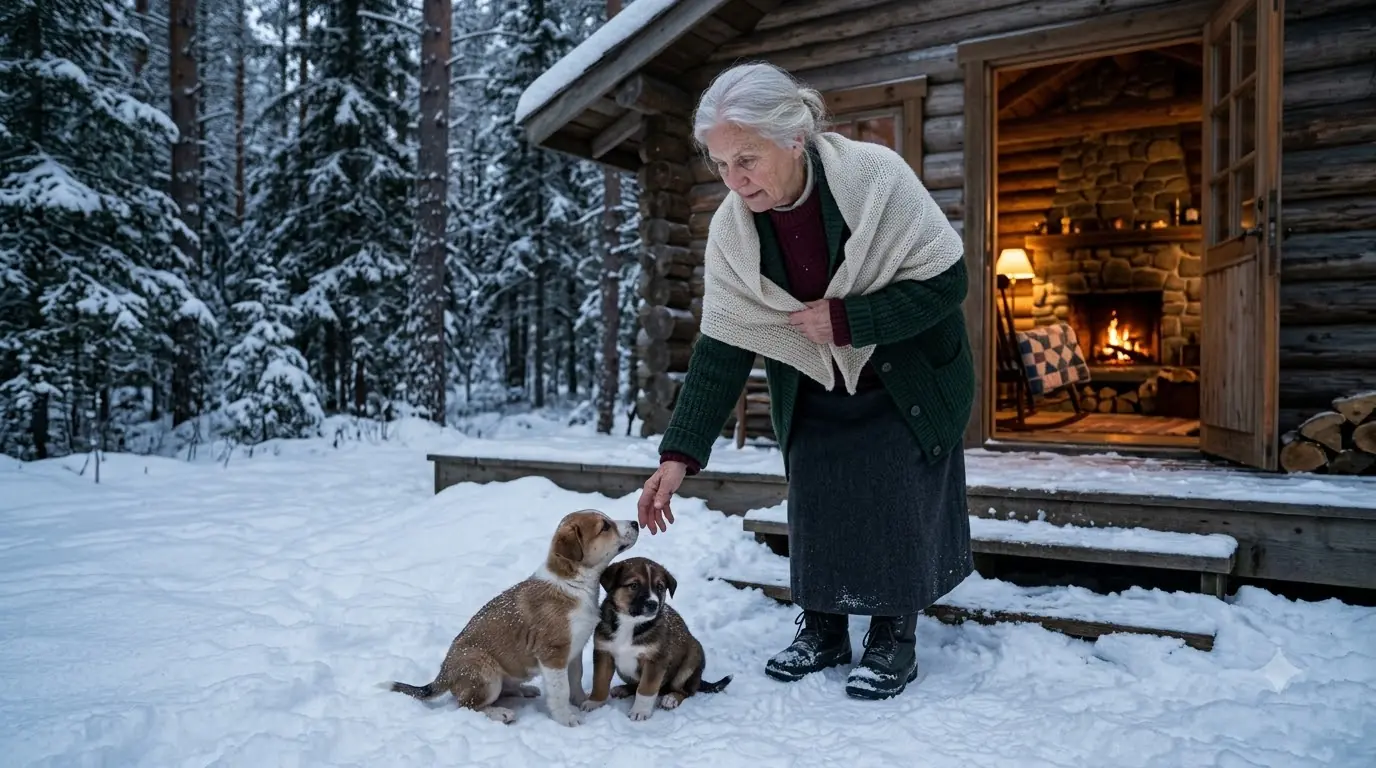
Wrapped them in an old quilt.
Warmed milk for them by the fire.
And went to sleep believing she had done nothing more extraordinary than rescue two helpless animals from the cold.
By morning, her quiet cabin deep in the forest was surrounded by police vehicles.
Red and blue lights flashed through the snow.
Deputies spread between the pine trees.
A sheriff stood outside her door asking whether anyone had come near the house during the night.
And the two puppies Martha had saved were suddenly the most important witnesses in a case that had terrified the town for almost twelve hours.
What Martha did not yet understand was that the puppies had not wandered randomly to her cabin.
They had been running from something.
And sometime after midnight, that something had followed them straight to her porch.
Martha Caldwell had lived alone in the woods for nineteen years.
The cabin sat seven miles outside the little mountain town of Bellweather, tucked beyond a narrow county road that disappeared beneath snow every winter.
Her husband, Walter, had built most of it himself.
Not elegantly.
Walter had never been elegant about anything.
The porch leaned slightly toward the east.
One kitchen cabinet never closed properly.
The fireplace chimney had required repairs three separate times during their marriage.
But the cabin was solid.
Warm.
And theirs.
They moved there after Walter retired from the county road department.
At the time, Martha had been sixty-one and convinced she would hate being so far from town.
Within six months, she could not imagine living anywhere else.
Walter planted two apple trees that deer destroyed almost immediately.
Martha started a garden that worked better.
They kept chickens for seven years.
Fed every bird that appeared near the porch.
Spent summers complaining about mosquitoes.
Spent winters complaining about snow.
And somehow considered both complaints evidence that they had chosen correctly.
Walter died eleven years after they moved in.
Heart failure.
Unexpected enough to shock Martha.
Slow enough that she had time to hold his hand.
The night after the funeral, everyone tried convincing her to sleep somewhere else.
Her daughter wanted her to stay in town.
Her nephew offered a guest room.
A neighbor said the cabin would feel too empty.
Martha thanked them.
Then stayed.
The cabin did feel empty.
Almost unbearably so.
Walter’s boots remained near the mudroom door for six months.
His coffee mug stayed beside the sink for nearly a year.
His rocking chair sat across from hers and gradually became the place where Martha folded blankets.
People expected loneliness to frighten her.
It did sometimes.
But solitude was different.
Solitude could be chosen.
Loneliness usually arrived without permission.
Martha learned how to live with both.
She woke early.
Kept the fireplace clean.
Read library books.
Made soup in quantities suitable for six people and froze most of it because she had never learned to cook small.
Every Wednesday, when weather allowed, her neighbor Ben Harper drove over from three miles away with groceries or mail.
Ben was sixty-four, loud, dependable, and incapable of leaving any house without inspecting at least one thing that did not belong to him.
He checked Martha’s generator.
Her propane tank.
The porch steps.
The roof.
One winter he replaced a loose hinge without asking.
Martha told him if he continued repairing her house, she would begin charging rent.
He told her she could deduct it from what she owed him for shoveling snow.
They considered this friendship.
Her daughter Emily lived four hours away with two teenagers and a nursing job that seemed to consume every waking hour.
Emily called every evening at seven.
Almost exactly.
Martha teased her about it.
“You checking whether I’m still alive?”
“Yes.”
“Well, I am.”
“Call me if that changes.”
“I’ll make a note.”
Martha was not unhappy.
That was important.
People often assumed an old widow living alone in the forest must be tragically waiting for life to end.
Martha was not.
She still laughed.
Still argued.
Still looked forward to spring.
But there were moments.
Usually at night.
Usually after the fire burned low.
She would look at Walter’s empty chair and feel the strange weight of being the only remaining person who remembered certain things.
A joke from 1974.
The night their first child had a fever.
The way Walter sang badly while replacing brake pads.
Memories become heavier when nobody else carries copies.
That Tuesday night in December was colder than most.
The temperature had fallen throughout the afternoon.
By seven, it was twelve degrees.
By nine, six.
The forecast said it would drop below zero before morning.
Snow began shortly after sunset.
Not a violent blizzard.
Steady.
Fine.
The kind that erased the world quietly.
Martha sat near the fireplace wearing a faded blue wool sweater Walter had given her years earlier.
A brown blanket covered her knees.