The neon sign above Lila’s Diner flickered like it was tired of staying alive.
Lila Carter noticed it every morning when she unlocked the front door at 5:30 a.m. in Cedar Hollow, Ohio. The sign buzzed weakly in the dark, the red letters blinking in uneven rhythm, as if even electricity had begun to lose faith in the place.
Once, the sign had been bright enough to guide truckers off the county road before sunrise.
Once, people said you could see it from the bridge.
Once, the words Carter’s Family Diner had meant warm coffee, full plates, and a place where everyone knew who needed extra gravy without asking.
Now half the letters were dead.
The sign simply read:
Lila’s Diner
Not because Lila had wanted her name up there.
Because everything else had slowly disappeared.
Her father was gone.
Her mother had been gone even longer.
Her brother had moved to Columbus and called twice a year, usually around tax season or Thanksgiving.
The town had changed, too. Cedar Hollow was one of those small Ohio towns where businesses did not close all at once. They just slowly forgot how to grow. First the shoe store became a storage space. Then the movie theater shut its doors. Then the florist moved online. The hardware store stayed open only because Mr. Bennett, the owner, said retirement sounded like “waiting indoors to die.”
Lila’s Diner remained.
Barely.
Inside, the diner smelled of coffee grounds, fryer oil, old wood, and decades of conversations soaked into the walls. Red vinyl booths lined the windows. The counter had tiny scratches from elbows, coffee mugs, restless nights, impatient spoons, and one small burn mark from the time a teenager tried to impress his date with a lighter trick and nearly lost an eyebrow.
A faded mural of a sunrise stretched across one wall.
Lila’s father had painted it thirty-two years earlier, back when he opened the diner with more optimism than money. He was not a trained artist. The sun was too orange, the hills too round, and the clouds looked more like mashed potatoes than clouds. But to Lila, it was beautiful because he had painted it after closing every night for two weeks, standing on a ladder with paint on his nose, humming along to old country songs.
Her father, Thomas Carter, used to say, “A diner should feel like morning, even at midnight.”
That was why he painted the sunrise.
He wanted people to walk in tired and leave believing the day might still turn out decent.
Lila had believed that too, once.
Now she stood behind the counter, counting receipts for the third time that morning even though she already knew the number would not change.
It never did.
The math was simple, brutal, and repetitive.
Rent overdue.
Supplier debt increasing.
Electric bill behind.
Insurance due.
Three employees reduced to one part-time cook.
And a bank letter sitting in her office drawer, unopened since yesterday because reading it again would not make it less final.
Loan foreclosure notice.
If she did not catch up in thirty days, the diner would be seized.
Her father’s diner.
Her whole life.
Gone.
Lila pressed two fingers against her forehead and closed her eyes.
“You’re thinking too loud again,” Marcus called from the grill.
Marcus Hayes was sixty-five years old, wore a faded Cleveland baseball cap every day, and claimed he never smiled unless something was burning. He had worked for Lila’s father before Lila was old enough to see over the counter. He knew every sound the grill made, every pipe that groaned in winter, and every secret Lila tried to hide with sarcasm.
“I don’t have the luxury not to think,” Lila said.
Marcus flipped an egg.
“That’s how people get wrinkles and wisdom at the same time.”
“I already have both.”
“Then you’re ahead of schedule.”
Lila gave a tired laugh, but it did not last.
She looked toward the office door.
The letter waited in there like a second heartbeat.
She had known trouble was coming for months. First, the breakfast crowd thinned. Then the lunch crowd started splitting sandwiches instead of ordering full meals. Then the factory outside town cut shifts, and the men who used to come in covered in dust and joking too loudly began making coffee at home.
People still loved the diner.
Love did not pay invoices.
Some regulars left bigger tips than they could afford. Some told Lila she should start a fundraiser. Some said she should sell before the bank forced her. Some said she should modernize, add online ordering, put up string lights, sell espresso, make the place “Instagram-friendly.”
Lila hated that phrase.
Her father had not built the diner for photographs.
He built it because people needed somewhere to sit.
The bell above the door rang.
It was early.
Too early for regulars.
Lila looked up automatically and froze.
A woman stood in the doorway.
She looked like she had been walking for a long time.
Her coat was too thin for the weather, the kind of coat that might have been warm once but had lost the battle years ago. Her dark hair was pulled back messily, as if mirrors had become a luxury she no longer used. Her shoes were soaked through. Mud clung to the hems of her jeans.
In her arms, she held a small child.
A boy, maybe three years old.
He was wrapped in a faded blanket with cartoon animals on it. His head rested against her shoulder, eyes half-closed with exhaustion. One little hand clutched the front of her coat, not tightly, but with the instinctive grip of a child who had learned not to let go.
The woman hesitated before stepping inside.
Not because she was unsure about the diner.
Because she was unsure whether she was allowed to be inside anything at all.
“Sorry,” the woman said quickly. “I just need warmth for a minute. I’ll leave if…”
Lila interrupted gently.
“Sit down.”
The woman blinked.
“I don’t have money.”
“I didn’t ask.”
Marcus turned slightly from the grill, watching quietly.
The woman stepped farther inside, slowly, as if expecting the floor to reject her. The bell above the door rang again behind her, sealing the moment.
Lila pulled out a booth near the heater.
“Over there,” she said. “You can stay there.”
The woman hesitated again.
“That’s a paying booth.”
Lila shrugged.
“Not today it isn’t.”
The woman crossed the diner carefully, adjusting the child in her arms. The boy did not wake. When she sat, she did it with the fragile precision of someone whose whole body hurt but who could not afford to drop what she carried.
Up close, Lila saw more.
Bruises of exhaustion beneath the woman’s eyes.
Hands cracked from cold.
A split on one knuckle.
Shoes that had long given up on structure.
But the most painful thing was not any of that.
It was how quietly she carried it all.
There were people who complained loudly when life disappointed them. Then there were people like this woman, people who had been hit by so many ordinary disasters that they stopped expecting rescue and simply moved through the world trying not to take up space.
Lila brought over a glass of water.
The woman took it with shaking hands.
“Thank you.”
“What’s your name?” Lila asked.
The woman hesitated, like even her name might cost something.
“Anna,” she said finally. “Anna Miller.”
“And him?”
“My son. Eli.”
Lila nodded softly.
Marcus placed a mug of coffee on the counter, then slid it toward Lila without a word.
Lila carried it over.
Anna looked at the coffee but did not drink immediately.
Kindness had clearly taught her caution.
“You been on the road long?” Lila asked.
Anna wrapped one hand around the mug.
“Since last night.”
Lila did not push.
She had learned long ago that survival stories came out in pieces, not paragraphs. Her father used to say people told the truth only after their bodies believed they were safe.
Anna glanced toward the window.
Outside, morning was still gray. Cold rain streaked the glass and turned the parking lot into dark puddles and reflected neon. The road beyond the diner looked empty except for one passing pickup and a flock of birds lifting from the power lines.
Anna finally spoke again, voice low.
“My husband left three months ago.”
Lila remained still.
“Said he needed a reset,” Anna continued. “I thought that meant a weekend away, maybe sleeping on his friend’s couch. I didn’t think it meant disappearing with rent money and shutting off our bank account.”
Marcus muttered from the grill, “That’s not a reset.”
Anna gave a faint, broken smile.
“No.”
She looked down at Eli.
“He was always restless. Peter. That was my husband. He hated anything that felt like responsibility. I just kept thinking he would grow into being a father. Some men don’t. Some men just grow better excuses.”
Lila leaned against the booth.
“Where were you staying?”
“An apartment in Akron. Nothing fancy, but it was ours. At least, I thought it was. Then the rent bounced. Then the landlord told me Peter had already been late twice before he left. I picked up extra shifts cleaning rooms, but Eli got sick, and I missed two days.”
She swallowed.
“We got evicted two days ago.”
The words were plain.
That made them worse.
Lila looked at the little boy.
Eli shifted in his sleep, his mouth opening slightly before settling again.
“I thought I could get to my sister in Dayton,” Anna said. “Her name is Rachel. We haven’t been close in years, but she said once, if things ever got bad, I should call. My phone died before I could. The bus station closed early. I used the last cash on a ticket that only got us halfway because I counted wrong.”
She looked ashamed of that.
As if the world had given her a test in desperation and she had failed the math.
“I’ve just been walking between places that stay open,” she whispered. “Gas station. Church steps. Laundromat until a man told us we had to leave. Then I saw your light.”
Lila felt the words settle inside her.
Then she looked at Eli again.
“He hasn’t eaten?”
Anna’s face changed quickly.
Defensive.
Embarrassed.
Afraid.
“I gave him the last granola bar this morning.”
“What about you?”
Anna looked into her coffee.
“I’m not hungry.”
Marcus snorted from the grill.
Lila glanced at him.
He did not apologize.
Lila turned back to Anna.
“That’s the oldest lie in motherhood.”
Anna’s eyes filled instantly, though she blinked hard to keep the tears from falling.
Lila moved before the moment could become too delicate.
She walked to the kitchen window.
“Marcus.”
“Yeah?”
“Make soup.”
He reached for the pot.
“That kind?”
“The good kind.”
Marcus nodded once.
Anna stood halfway.
“I can’t accept that.”
Lila turned back.
“You already did when you walked in here with a child in your arms.”
Anna froze.
That sentence landed somewhere deep.
Not sentimental.
Factual.
Lila’s father had been like that. He could sound gentle and firm at the same time, like a chair pushed under someone just before their legs gave out.
Marcus made potato soup with chicken, carrots, and enough black pepper to make him proud. He toasted bread with butter, scrambled eggs for Eli, and added a small bowl of applesauce without asking permission. Lila brought everything to the booth on a tray.
Anna stared at the food.
“I don’t know how to repay this.”
“You don’t need to repay it.”
Anna shook her head slightly.
“People always want something later.”
Lila looked around the diner.
At the cracked counter.
The flickering sign outside.
The old mural.
The empty tables.
“I do too,” she said honestly. “Just not from you.”
Anna looked confused.
Lila continued softly.
“I want this place to stay open. I want Marcus paid. I want the supplier to stop calling me like I stole something from him instead of buying potatoes on credit. I want my father’s diner to survive the year.”
Anna looked down.
“That sounds like a lot.”
“It is.”
Marcus added from the grill without turning around, “And she’s losing.”
Lila shot him a look.
He shrugged.
“Truth cooks faster than pride.”
Anna held the spoon but did not eat yet.
“Then why help me?”
Lila hesitated.
She was not sure how to explain it without sounding foolish.
But Anna was waiting.
So Lila answered honestly.
“Because I’ve been watching people turn away from each other for so long that I forgot what it looks like when someone doesn’t.”
Silence.
Then Anna took a bite of soup.
Something in her face changed.
Not happiness.
Relief.
The kind that comes when the body remembers it is still allowed to be alive.
She tried to eat slowly, but hunger defeated manners. After the first few bites, her hand began to tremble, and she lowered the spoon, embarrassed.
“Take your time,” Lila said.
Anna nodded.
Eli woke when the smell reached him.
His eyes opened slowly, unfocused at first, then alert in the startled way of a child who had learned that waking up in strange places required caution. He tightened his hand in Anna’s coat.
“It’s okay, baby,” Anna whispered. “We’re inside.”
Eli looked at Lila.
Lila smiled gently.
“Hi there.”
He did not answer.
That was all right.
She slid the plate of eggs closer.
“Hungry?”
Eli looked at his mother first.
Anna nodded.
Only then did he reach for the fork.
Lila noticed that too.
Children who asked permission to eat had already learned too much.
For the next hour, the diner filled slowly.
A delivery driver came in for coffee.
Two nurses from the night shift at Mercy County Hospital sat near the window.
Mr. Bennett from the hardware store ordered toast and complained about the weather as if weather listened to him personally.
Everyone looked at Anna and Eli.
No one said anything.
That was one of the few things Lila still loved about Cedar Hollow. People gossiped, yes. They noticed everything. But the decent ones knew when noticing should remain quiet.
Anna kept her head down.
Eli ate every bite of his eggs, half the toast, and three spoonfuls of applesauce before he fell asleep again against his mother’s side.
When Lila came by with more water, Anna whispered, “I’ll leave after this.”
Lila shook her head.
“Not tonight.”
Anna looked toward the windows.
“It’s morning.”
“Then not today.”
“I don’t want to be a burden.”
“You’re not.”
“I can’t stay.”
“You can,” Lila said. “Just for now.”
Anna’s eyes filled, but she blinked it away.
“Why are you doing this?”
Lila looked toward the sunrise mural.
“My father used to let truck drivers sleep in the back booth when they missed buses or got stranded in storms. He said a diner that can’t keep someone warm isn’t a diner at all.”
Marcus added, “He also said unpaid coffee builds character.”
Lila smiled faintly.
“My father said a lot of things Marcus pretends to mock and secretly believes.”
“I believe in coffee being paid for,” Marcus said.
“No, you don’t.”
“No, I don’t.”
Anna looked down at her hands.
“I don’t even have a plan.”
Lila replied gently, “Then borrow today first. Plans come after.”
That afternoon, Lila called three places.
The first was a local church that sometimes helped families with emergency shelter. No room. No funds until the next month. They were sorry.
The second was a women’s shelter two towns over. Full.
The third was a county family assistance office. A recorded message. Then another. Then a tired woman who said Anna would need identification, paperwork, proof of hardship, and an appointment.
“When?” Lila asked.
“Earliest is next Tuesday.”
“It’s Thursday.”
“I understand.”
Lila looked at Anna sitting in the booth, one hand resting on Eli’s back.
“No,” she said into the phone. “I don’t think you do.”
She hung up before she said something that would not help anyone.
Marcus came out of the kitchen carrying a box of canned goods.
“What are you doing?” Lila asked.
“Rotating stock.”
“You hate rotating stock.”
“I hate many things. Move.”
He placed cans of soup, crackers, peanut butter packets, two apples, and a wrapped muffin in a paper bag. Then he added a small envelope with cash from his pocket.
Lila saw it.
“Marcus.”
“Didn’t ask you.”
“You need that.”
“So do they.”
Anna watched from the booth, eyes wide.
“You can’t,” she said.
Marcus folded the bag closed.
“Already did.”
“I can’t pay you back.”
He looked at her with the closest thing to tenderness he ever allowed on his face.
“Good. I charge interest.”
Anna froze.
Then he added, “One day, when you see somebody hungry, don’t walk past.”
Her face softened.
“I can do that.”
“Then we’re even.”
By evening, the rain had stopped, but the cold remained. Lila made a decision before fear could talk her out of it.
She turned the back room into a resting space.
It was not much.
Two old chairs pushed together.
Clean blankets from storage.
A space heater turned low.
A pillow from the office sofa.
A lamp that flickered if the cord bent wrong.
Anna stood in the doorway, holding Eli.
“This is too much.”
Lila shook her head.
“It’s just enough.”
Anna looked around the room.
“This is your storage room.”
“Tonight it’s a room.”
“What about tomorrow?”
“Tomorrow can introduce itself when it gets here.”
Anna laughed once through tears.
Eli was asleep before she laid him down fully.
Anna sat beside him, one hand hovering near his chest as if she needed proof he was still breathing. Lila recognized that look. She had seen it on mothers whose children were sick, exhausted, feverish, hungry, or simply too precious for the world they had been handed.
After a while, Anna whispered, “I used to think people like you didn’t exist.”
“What kind?”
Anna looked at her.
“The kind who don’t ask you to prove you deserve to be helped.”
Lila did not respond immediately.
She did not know how to take that without feeling something shift inside her.
Later that night, after closing, Lila sat alone in the front booth with the bank letter open in front of her.
Thirty days.
Actually, twenty-seven now.
The diner was quiet. Marcus had gone home after telling her not to do anything dramatic, which in Marcus language meant he was worried. The rainwater outside reflected the dying neon sign. The back room door was slightly open, and Lila could hear Anna’s soft cough, then Eli’s little sleeping sigh.
She looked at the foreclosure notice again.
A terrible thought came to her.
Maybe it was ridiculous to keep trying.
Maybe she should let the diner go.
Maybe her father’s dream had become a weight that kept her from building any dream of her own.
But then she looked at the booth where Anna had sat that morning.
A woman had walked in with nothing.
And for a few hours, the diner had still been exactly what her father meant it to be.
Warm.
Open.
Useful.
Lila folded the letter and placed it in her apron pocket.
“Not yet, Dad,” she whispered.
The next morning, Lila found Anna awake in the booth before sunrise.
Eli was still sleeping in the back room.
Anna sat with a cup of coffee between her hands, shoulders hunched, eyes red from a night of not trusting rest.
“I need to go,” Anna said quietly.
“Where?”
“I don’t know yet.”
That was the first truly honest thing Anna had said.
Lila placed a folded paper on the table.
Anna looked at it.
“What’s this?”
“Bus schedule. Route to Dayton. It runs every morning at 9:40 from the stop by the pharmacy.”
Anna stared at it.
“I didn’t ask for that.”
“I know.”
Anna looked up slowly.
“I can’t keep taking things.”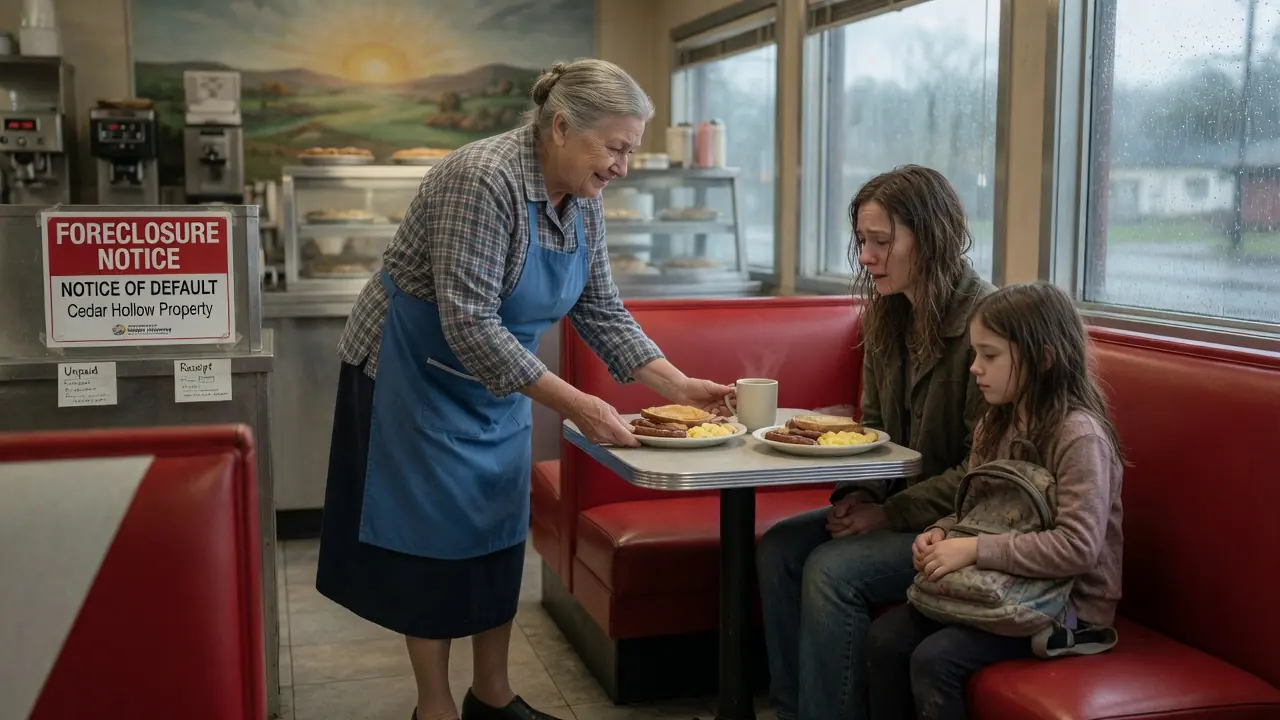
Lila nodded.
“Then don’t think of it as taking.”
“What is it then?”
Lila paused.
“A starting point.”
Anna swallowed hard.
“I don’t know if I can get back up from this.”
Lila looked at her directly.
“You already did.”
Anna frowned.
“You walked in here,” Lila said.
Anna’s eyes filled.
She still tried to resist the tears.
“I have nothing to give back.”
“Then don’t give it back to me.”
A pause.
“Give it forward.”
That line stayed in the air longer than anything else.
At 9:05, Lila drove Anna and Eli to the bus stop herself.
Marcus argued that he should drive because Lila had the sense of direction of a squirrel in a parking lot, but she told him to watch the diner and not insult squirrels. He packed two more sandwiches anyway.
Anna stood beside the bus sign, holding Eli’s hand.
She had washed her face in the diner bathroom and tied her hair back neatly. She wore the same thin coat, the same tired shoes, but something about her posture had changed.
Not confidence.
Not yet.
But direction.
Before she boarded, she turned back to Lila.
“What’s your last name?”
“Carter.”
“Lila Carter,” Anna said softly, like she was memorizing it.
“That’s me.”
“I’ll remember.”
Lila almost smiled.
“That’s enough.”
Anna stepped onto the bus.
Eli pressed his small hand to the window.
Lila waved.
The bus pulled away toward Dayton, carrying a homeless mother, a little boy, two sandwiches, one bus ticket, and the smallest possible beginning of hope.
Life did not change immediately after Anna left.
That is important.
Kindness did not magically repair the freezer.
The bank did not tear up the foreclosure notice because Lila had fed a stranger.
The neon sign still flickered.
The supplier still called.
Marcus still complained.
The breakfast crowd was still thin.
Bills remained bills, and good deeds rarely came with receipts that banks accept.
But something in Lila changed.
Not enough to save the diner.
Enough to keep opening the door.
She tried everything over the next two years.
She added a senior breakfast special.
She started Friday pie nights.
She let the high school art club repaint part of the back hallway, even though Marcus said teenagers and paint were a threat to civilization.
She created a bulletin board for job postings, church events, lost pets, and rides needed.
She served free soup during two winter storms and pretended not to notice when people put money in the tip jar afterward.
The diner survived.
Barely.
There were weeks when it looked hopeful.
A local article brought in visitors for a month.
A road crew rented the back room for lunches during summer.
A new teacher from the elementary school started bringing her class in once a semester to learn about small businesses.
Then the freezer broke.
Then Marcus had a minor health scare and retired.
He claimed it was temporary.
Then permanent.
Then temporary again because he became bored after ten days.
Lila hired two young workers, trained them, lost one to college and one to a warehouse job with health insurance.
By the second year, her hair had more gray in it. Her hands ached constantly. Her shoulders had begun to hold tension like a permanent coat.
The final letter came on a Tuesday.
Seven days remaining.
Final foreclosure action pending.
Lila read it in silence.
For the first time, she did not argue with it.
She placed it on the counter and looked around the empty diner.
The sunrise mural.
The red booths.
The scratched counter.
The pie case.
The coffee machine her father had bought used and treated like a family member.
Marcus was visiting that day, supposedly just for coffee, though he had already criticized the hash browns twice.
He picked up the letter, read it, and set it down.
“It was a good run,” he said.
“Don’t say that.”
“Why not? It’s true.”
“Because I’m not done yet.”
He raised an eyebrow.
“With what money?”
Lila did not answer.
Because she did not have one.
That night, she stayed late.
Cleaning.
Turning off lights one by one.
Talking to the diner like it might respond.
“I tried,” she whispered near the counter.
The room held her words gently.
That made it worse.
She wiped the coffee station.
Checked the locks.
Turned off the grill.
She was about to switch off the last row of lights when the bell rang.
Lila froze.
It was late.
Too late for anyone.
The door opened.
A woman stood there.
At first, Lila did not recognize her.
The woman wore a navy coat, simple but good quality. Her hair was pulled back neatly. Her face was fuller now, healthier. She stood straighter, with a leather folder tucked beneath one arm and a calm certainty in her eyes that had not existed before.
Behind her stood two men in suits and a woman carrying a laptop bag.
Lila stepped back slightly.
Then the woman smiled.
“Hi, Lila.”
Lila’s hand went to her chest.
“Anna?”
Anna Miller nodded.
“Yes.”
For a moment, neither woman moved.
Then Anna looked around the diner slowly.
“The sunrise is still here.”
Lila turned toward the mural.
“It would take a bulldozer to move that thing.”
Anna smiled.
“I hoped so.”
Lila looked between her and the people behind her.
“What is this?”
Anna took a breath.
“I told you I didn’t have anything to give back.”
Lila remembered the booth.
The soup.
The bus schedule.
The words at the door.
“I remember.”
Anna placed the folder on the counter.
“Then I found something else.”
Lila opened it.
Inside were documents.
A debt acquisition proposal.
A nonprofit partnership plan.
A community kitchen initiative.
A business restructuring agreement.
And one name repeated across several pages.
Anna Miller — Family Stability Outreach Coordinator
Harbor Road Community Investment Group
Lila looked up.
“I don’t understand.”
Anna nodded toward the people behind her.
“This is Calvin Ross, our finance director. This is Meera Patel, legal counsel. And this is Joanne Whitfield, director of community placement.”
The woman with the laptop smiled warmly.
“We have heard a great deal about you, Ms. Carter.”
Lila looked at Anna.
“What is happening?”
Anna’s voice was steady.
“I work now with a housing and family recovery foundation. They help rebuild stability for displaced families. I started as a receptionist. Then outreach. Then family intake. Now I help identify community anchors.”
“Community anchors?”
“Places that keep people from falling all the way through,” Anna said.
Lila said nothing.
Anna’s eyes softened.
“I told them about a diner that fed me when I had nothing. About a woman who didn’t ask questions when I couldn’t answer them. About a place that gave me one night when I needed a year.”
Lila looked down at the folder again.
Calvin Ross stepped forward.
“We have been reviewing the financials for several weeks with permission from the bank. Harbor Road is prepared to acquire the diner’s debt, restructure it under a community preservation trust, and provide operational funding for three years.”
Lila gripped the edge of the counter.
“You’re buying the diner?”
“No,” Anna said quickly. “Not from you.”
Meera Patel added, “The ownership structure can remain with you, if you choose. The debt would be absorbed through a nonprofit partnership. In exchange, the diner would serve as a designated community meal and emergency support site for families in crisis.”
Lila stared at her.
“Emergency support?”
“Warm meals,” Joanne said. “Temporary safe waiting space. Referral coordination. Transportation vouchers. Local employment postings. Nothing that turns you into a shelter. Just a supported point of contact.”
Anna smiled faintly.
“Basically, what you already did. But with help. And funding.”
Lila felt the room tilt slightly.
She looked at Marcus, who had been standing silently near the kitchen door after arriving late to check on her. His mouth was open.
For once, he had no comment.
That alone almost made Lila cry.
“You did this?” Lila whispered.
Anna nodded.
“But not alone.”
“Why?”
Anna stepped closer.
“Because you told me to give it forward.”
Lila shook her head.
“I say a lot of things.”
“I know.” Anna smiled through tears. “That one built my life.”
The words struck something tender.
Anna continued.
“When Eli and I got to Dayton, my sister took us in. It wasn’t easy. I was ashamed, angry, tired. I almost gave up a dozen times. But I kept thinking about this place. About the soup. About you telling me I had already started getting back up because I walked through the door.”
Lila’s eyes burned.
“I didn’t do much.”
“You did the first thing,” Anna said. “Sometimes the first thing is the thing that keeps someone alive long enough for everything else.”
Calvin slid another paper forward.
“If you agree tonight, we can notify the bank in the morning that foreclosure action is suspended pending acquisition. The diner will not close next week.”
Lila looked at the paper.
Then at the sunrise mural.
Then at Anna.
Her hands trembled slightly.
“I thought it was over.”
Anna’s voice softened.
“So did I when I walked in here.”
Lila closed her eyes.
For the first time in months, maybe years, she exhaled without fear.
The diner stayed open.
Not just open.
Alive.
The first month was chaos.
Good chaos, but chaos.
Contractors came in to repair the roof.
An electrician fixed the wiring and replaced the failing neon transformer. When the sign came back on fully for the first time in years, half the regulars stood outside in the parking lot clapping like fools.
Marcus pretended he had dust in his eye.
The sign once again read:
Carter’s Family Diner
Lila cried when she saw it.
Anna stood beside her in the parking lot, Eli’s hand in hers.
“Your father’s name came back,” Anna said.
Lila wiped her face.
“It never left. It just got dim.”
The freezer was replaced.
The kitchen was updated.
The back room became a clean, organized resource corner with shelves of emergency food bags, phone chargers, bus schedules, community service contacts, diapers, blankets, and a small desk where visiting outreach workers came twice a week.
The booths remained.
The counter remained.
The sunrise mural remained.
Lila insisted on that.
“This place does not need to become something else,” she told Joanne.
Joanne smiled.
“No. It needs help remaining itself.”
Marcus came back part-time.
Then more than part-time.
Then pretended nobody had noticed.
“I’m not returning,” he told Lila while tying on an apron.
“You’re wearing an apron.”
“I am supervising.”
“With a spatula?”
“Tools of supervision vary.”
Eli, now five, sometimes sat in the same booth where he had once slept against Anna’s side. He had grown sturdy and bright-eyed, with a laugh that arrived suddenly and filled whatever room it entered. He loved pancakes shaped like bears, though Marcus refused to admit he knew how to make them.
Anna visited often.
Sometimes for meetings.
Sometimes for coffee.
Sometimes just to sit at the counter after a long day and remember how far she had come.
One afternoon, she brought Rachel, her sister from Dayton. Rachel hugged Lila so tightly that Lila nearly spilled coffee down both their coats.
“You gave my sister back to us,” Rachel whispered.
Lila shook her head.
“She walked in herself.”
“Yes,” Rachel said. “But you opened the door.”
The new program was named The Sunrise Table.
Lila resisted at first.
“That sounds like a cereal brand.”
Anna laughed.
“It sounds like your father’s mural.”
That ended the argument.
The Sunrise Table began modestly. Ten meal vouchers a week for displaced families. Then twenty. Then transportation partnerships with a church van and a local cab company. Then job boards and training referrals. Then a small emergency fund for mothers who needed one night in a motel, one bus ticket, one prescription filled, one lock changed.
People came in embarrassed at first.
That was something Lila understood.
Embarrassment was often hunger wearing nicer clothes.
She learned to say, “Sit anywhere,” before people could explain why they did not belong.
She learned to give coffee first, paperwork second.
She learned that some mothers cried when given diapers because diapers meant one less impossible choice.
She learned that some children ate quickly, guarding their plates with one arm.
She learned to place extra napkins nearby and not stare.
The diner became busier than it had been in years.
Not rich.
Not easy.
But alive.
Truckers came back because the coffee was still strong.
Nurses came after night shifts.
Factory workers returned when the new warehouse opened outside town.
Families came on Sundays.
And sometimes, someone walked in with the look Anna once carried, the look of a person who was not sure whether warmth had rules.
Lila always noticed.
One winter evening, almost three years after Anna first walked through the door, snow began falling over Cedar Hollow.
The neon sign glowed steady now.
Inside, the diner was full enough to sound like life. Forks tapped plates. Coffee poured. Eli sat at the counter coloring a picture of the sunrise mural while Marcus criticized his use of purple.
“Sunrises can be purple,” Eli said.
“Not that purple.”
“You don’t know all sunrises.”
Marcus looked offended.
“I know enough sunrises to have opinions.”
Anna sat in the booth near the heater with a stack of files beside her. She wore reading glasses now when she worked, which Lila teased her about because Anna had once insisted she had “young eyes.” Anna said motherhood and paperwork had aged her vision.
The bell rang.
Everyone looked up automatically.
A young man stood in the doorway with a backpack and a little girl beside him. His jacket was thin. Her cheeks were red from cold. He looked no older than twenty-two, but his eyes were older than that.
“Sorry,” he said quickly. “We just need to get warm for a minute.”
Lila did not hesitate.
“Sit down.”
The young man blinked.
“I don’t have money.”
“I didn’t ask.”
Anna looked up from her files.
Their eyes met across the diner.
No words were needed.
Marcus reached for the soup pot.
Eli looked from Lila to Anna to the strangers at the door.
Then he whispered to Marcus, “The good soup?”
Marcus nodded.
“The good kind.”
Lila led the young man and little girl to a booth near the heater. She brought water, then hot chocolate, then food. Anna joined them with a calm voice and a folder of resources only after they had eaten enough to breathe.
That night, after closing, Lila stood beneath the sunrise mural with Anna beside her.
The diner was quiet.
The neon sign hummed steadily outside.
“I used to think saving this place meant keeping my father’s dream alive,” Lila said.
Anna looked at the mural.
“And now?”
Lila smiled faintly.
“Now I think maybe his dream was never the building. Maybe it was what happened inside it.”
Anna nodded.
“He would like The Sunrise Table.”
“He would complain about the paperwork.”
“Probably.”
“He would love Eli.”
“Definitely.”
They stood in silence for a while.
Then Anna said, “Do you ever think about that morning?”
“Which one?”
“The morning I walked in.”
Lila smiled.
“Every time someone says they don’t have money.”
Anna laughed softly.
“I was so afraid you would ask me to leave.”
“I was afraid I couldn’t afford to let you stay.”
Anna turned toward her.
“But you did.”
“Yes.”
“Why?”
Lila thought of her father.
The flickering sign.
The bank letter.
Anna’s cracked hands.
Eli asleep in the faded blanket.
The moment one person’s ruin had walked into another person’s ruin, and somehow neither had been the end of the story.
“Because sometimes,” Lila said, “you do the right thing before you can afford it.”
Anna wiped at her eyes.
“That sounds expensive.”
“It was.”
“Worth it?”
Lila looked around the diner.
At the booths.
The counter.
The mural.
The new resource shelves.
Eli’s purple sunrise drawing drying near the register.
The good soup cooling in the kitchen.
The steady glow of the sign outside.
“Yes,” she said. “Worth it.”
Years later, people in Cedar Hollow would tell the story differently depending on who told it.
Some said a homeless mother saved a diner.
Some said a diner saved a homeless mother.
Some said a foundation saved a business.
Some said Lila Carter had been foolish to give away food when she was already drowning.
Those people missed the point.
It had never been only about soup.
It was about a woman with almost nothing choosing not to become hard just because life had been hard to her.
It was about another woman taking one warm meal and turning it into a life rebuilt.
It was about a child who grew up remembering not hunger, but the first place that ended it.
It was about a diner with a faded sunrise on the wall proving that morning could still come, even after a long night.
Lila never became rich.
The diner never became perfect.
The floor still creaked near booth four.
The counter still carried scratches.
Marcus still complained about teenagers, weather, health codes, weak coffee, strong coffee, and any customer who asked for egg whites.
But the diner lived.
And every morning, when Lila unlocked the front door at 5:30 a.m., the neon sign above her glowed bright and steady.
Carter’s Family Diner.
Warm light spilled onto the sidewalk.
Coffee began to brew.
Soup waited in the kitchen.
And somewhere on the wall, beneath the painted sunrise her father had made with untrained hands and stubborn hope, hung a small framed note written in Anna’s careful handwriting.
You told me to give it forward.
So I did.
Lila read it often.
Not because she needed reminding of what she had done.
But because everyone, even the person opening the door, needs reminding that kindness can travel farther than fear.
Sometimes it leaves on a bus with a mother and child.
Sometimes it returns years later with a folder, a plan, and a promise.
And sometimes, when a woman is about to lose everything, the person who saves her walks in carrying nothing at all.