“You’re going to freeze out here,” he said. “All of you. Unless you come inside right now.”
He was eight years old. He weighed maybe fifty pounds. And he was the only thing standing between six grown men and a blizzard that had already decided to kill them.
Real courage does not always wear a leather vest. Sometimes it wears a threadbare coat two sizes too small and holds a candle in a storm.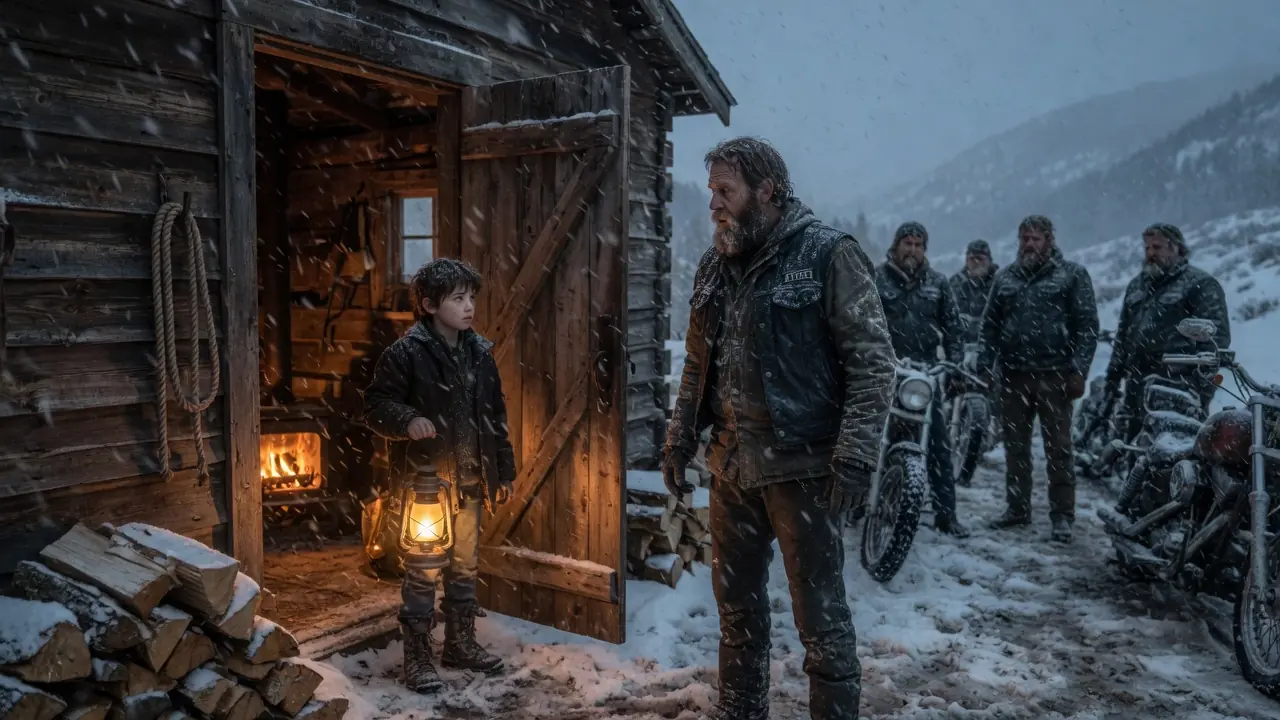
The wind did not blow that night. It attacked.
Ryder Callahan felt it hit him like a fist to the sternum, the kind of cold that did not just steal your warmth. It reached inside and started dismantling you from the core outward.
He had ridden through forty-three winters. He had crossed the Rockies in October sleet and pushed through Nebraska tornado warnings with nothing but nerve and throttle. He had never once pulled over and admitted the road had beaten him.
He pulled over.
“Church!” he shouted into the white wall where his crew had been riding thirty seconds ago.
The word came out and died immediately, swallowed whole by the blizzard.
“Church, where are you?”
A shape materialized on his left. Danny “Church” Kowalski, his road captain, stumbled forward with his arm locked over his face like he was trying to fistfight the wind.
Behind him came Marco Reyes, then Big Earl Donahue, then the two prospects, Tommy Briggs and Jake “Nails” Callaway. All of them lurched through the snow like men walking through wet concrete.
Six of them.
Six men who, between them, had survived bar fights, prison yards, rival club ambushes, and enough miles of American highway to circle the earth twice.
And right now, not a single one of them could feel his hands.
“What happened?” Church had to press his mouth directly against Ryder’s ear to be heard.
“The GPS is dead. Both phones are dead. The emergency radio isn’t picking up anything.”
“Gear’s compromised,” Ryder said.
He already knew it. He had known it for the last forty minutes, since the moment everything electronic they had went dark inside ten minutes. Too systematic, too complete to be coincidence.
Somebody had gotten to their equipment before they left the last stop.
He would think about who and why later. Right now, later was a luxury he was not sure they had.
“How far back was that junction?” Marco called out, his voice shredded by the gust.
“Three miles, maybe four.”
“We can’t make three miles in this.”
Ryder knew that too.
The temperature had been dropping since midafternoon. Up here in the San Juan range of Colorado, a November blizzard was not a weather event. It was a reckoning.
The snow was past his boot tops now. Big Earl, who was six-foot-four and built like a refrigerator someone had taught to throw punches, was hugging himself and shaking. When Earl shook, you listened.
“We keep moving,” Ryder said.
“Moving where?” Tommy Briggs, the younger prospect, had a raw edge in his voice that Ryder did not hold against him. The kid was twenty-two. This was the first time he had seen the man he had pledged to follow look genuinely uncertain.
“Away from stopped,” Ryder said. “Stopped is dead. Pick a direction and keep your feet moving.”
They moved. Or they tried to.
The wind made every step cost twice what it should have, and the snow was the wet, heavy kind that stuck to leather and added weight with every yard. Ryder could not feel his toes inside his boots. He could feel his ears, which was worse. They burned with a specific, nasty intensity that he knew from experience was the early stage of frostbite introducing itself.
Church grabbed his arm.
“Ryder, I see it.”
He did not see it so much as perceive it. A faint amber smear in the white dark ahead. Not strong enough to be a building. Not moving enough to be a vehicle. Just a small, stubborn warmth holding on against everything the storm was throwing at it.
“Could be anything,” Marco said.
“Could be shelter,” Church said.
Ryder was already moving toward it.
The closer they got, the more it resolved.
A window.
A single small window with something burning behind it, the light jumping and inconsistent. A candle maybe, or a kerosene lamp.
The structure around it was low and dark, and Ryder’s first thought was abandoned.
His second thought was that it had four walls and a roof, which put it ahead of everything else available.
He reached the door first. It was rough-cut wood with a rope handle instead of a knob. He grabbed the rope and pulled.
The door opened six inches and stopped.
“Hello?” Ryder put his face to the gap.
The warmth that hit him was modest, barely above the temperature in his lungs right now. But it was real, and his body registered it like a man dying of thirst registers the smell of water.
“Anybody in there? We need help. We’ve got injured men.”
Nobody was injured yet exactly, but they were four minutes from it.
Silence came from inside.
Then a sound. Something scraping across the floor. Something being dragged away from the door.
The door swung open.
He was standing in the middle of the doorway with a candle held up at shoulder height, and for half a second, Ryder Callahan, who had stared down men with weapons and bad intentions for twenty-five years, was completely frozen.
He was a child. Eight years old, maybe. Small even for that, the kind of small that came from not having enough, from stretching meals and wearing coats that did not quite fit and sleeping under everything you owned because the heat did not work.
He had dark hair plastered to his forehead, pale skin, and eyes the color of winter creek water, gray-green and absolutely clear.
He looked at Ryder with an assessment that was startlingly adult. Then he looked past him at the five other large, frost-covered, leather-clad men barely standing in the blizzard.
Then he looked back at him.
“You’re going to die out here,” he said. “All of you. Unless you come inside right now.”
Ryder opened his mouth.
The boy was already stepping back.
“I don’t have much room. And I’m going to need two of you to carry more wood from the back. Can you do that?”
“Yeah,” Ryder said, because it was the only word he had. “Yeah, we can do that.”
“Then come in. Hurry. You’re letting the cold in.”
They came in.
The inside of the shack was not much. Ryder took it in fast. One room, roughly fifteen by twenty feet, with a plank floor and walls insulated in ways both creative and desperate. Old blankets, flattened cardboard, and what looked like pages from magazines layered and pinned.
In the center of the room was a small iron stove, the source of what warmth existed, though it was clearly burning low.
Against the far wall was a cot with a sleeping bag on it. Near the stove was a small wooden chair and a crate being used as a table. On the crate were the candle and a single tin cup.
That was it.
That was the whole inventory of this child’s life.
Church looked at Ryder. Ryder looked at Church.
Neither of them said anything.
“The wood is through the back,” the boy said.
He pointed to a low door Ryder had missed, more of a hatch really, leading to what he guessed was a lean-to attached to the back wall.
“There should be some dry pieces in the far corner. Maybe enough. Bring all of it.”
Big Earl was already moving, cramming his enormous frame through the low hatch with surprising urgency. Tommy followed him.
“What’s your name?” Ryder asked.
“Eli Carter.”
He was already crouching in front of the stove, opening the small iron door with a cloth around his hand because he did not have gloves.
“What happened to you?”
“Storm caught us wrong,” Ryder said. He unzipped his leather vest. The layers underneath were soaked through, and he started wringing what water he could out of his gloves. “Our navigation equipment failed.”
“Failed how?”
The question was direct and without softening, the way a child asks things when he has not learned yet to soften questions for the comfort of adults.
Ryder looked at him sideways.
“Somebody may have messed with it before we left.”
Eli turned his head and looked at him with those clear creek-water eyes.
“You have enemies.”
“I have people who’d like to see me not arrive somewhere.”
He nodded once, as if this was a kind of information he already knew how to process.
“Okay,” he said, and turned back to the stove.
Earl and Tommy came back through the hatch carrying armloads of wood, their breath coming in hard bursts. Eli took the first piece without ceremony and fed it into the stove.
“Close it,” he said, nodding at the hatch. “You’re pulling cold air.”
Tommy pulled it shut.
The fire began to recover almost immediately, the crackle deepening, the iron sides of the stove ticking as they expanded.
Marco and Jake had their backs against one wall, side by side, rubbing their hands together in slow mechanical motions. Church was sitting on the floor with his knees up and his head back, eyes closed.
Ryder stood because sitting felt too much like giving up on something, though he was not sure what.
“How long have you been out here?” he asked Eli.
The boy was adding a second piece of wood, judging its size before placing it with care.
“Since April.”
Ryder did not say anything right away.
April was seven months ago.
“Alone?” he asked.
“Since June.”
Eli closed the stove door.
“My dad went to get help. He didn’t come back.”
He said it the way you say it when you have already done all the crying available to you for that particular fact. It lived in him now like a stone, heavy and permanent, no longer sharp.
“And before June, my mom died in April. That’s why my dad went for help. There was nobody to call.”
He stood up and wiped his hands on his jeans.
“Are any of you hurt? Like actually hurt, not just cold?”
“Church might have the start of frostbite on his fingers,” Ryder said. “The big guy, Earl, I’m worried about his ears.”
“Okay.”
Eli moved to the crate beside his cot and opened the small wooden box sitting on top of it.
Inside was a first aid kit. The drugstore kind, red plastic, the kind that cost four dollars and had twenty bandages and a pamphlet. He had supplemented it. Ryder could see small plastic bags of things labeled in a child’s block handwriting. Dried herbs. Some kind of salve in a jar. A folded cloth.
“Where did you get that stuff?” Ryder asked.
“I learned.”
He brought it over and crouched in front of Church, taking his hands and turning them over with matter-of-fact efficiency.
“There’s a book,” he said. “About plants. It was my mom’s. I’ve read it a lot.”
He looked at Church’s fingertips, white and slightly waxy.
“These aren’t frostbitten yet. They will be if you go back outside.”
“Don’t go back outside.”
Church, who had a reputation in four states for not taking direction from anyone who had not earned it in blood or years, said, “Yes, sir.”
Marco made a sound that was almost a laugh. It died fast, but it had been there.
Eli stood and moved to Big Earl, who had to bend almost in half for him to reach his ears. He examined them briefly, then applied something from one of the small jars, his small fingers moving with confidence.
Earl sat completely still.
This was remarkable, given that Earl did not typically sit still for anything short of a direct order from Ryder.
“You’re going to be okay,” Eli told Earl.
“Thank you, little man,” Earl said.
The boy did not correct the name.
He moved on to the next man.
Ryder watched him work his way around the room, this eight-year-old boy who had been alone in a mountain shack since June, who had survived a Colorado summer and fall by himself, who had read his dead mother’s plant book until he knew it well enough to treat frostbite.
Something was happening in Ryder’s chest that he did not have a name for immediately, and that he was not entirely comfortable with. He had not cried since his mother’s funeral twenty years ago, and he was not going to start now. But whatever the feeling was, it was sitting right next to the place where that kind of thing happened.
He moved to the back wall and crouched there, partly to be useful and partly to get hold of himself.
“You’ve been eating,” he said.
“Well enough.”
It was a careful answer. The kind of answer that meant no, but said it with dignity.
“How well enough?”
Eli finished with Jake and stood, tucking the jar back into the wooden box.
“I have seven cans left,” he said. “I had twelve in October, but a raccoon got into the lean-to. I’ve been going slower since then.”
Seven cans for a mountain winter that had not even really started.
“What’s in the cans?” Ryder asked.
The boy looked at him steadily.
“One soup. One corn. Two beans. One peaches. Two tomatoes.”
He paused.
“I was going to make the soup tonight anyway. I can share it.”
He said it straightforwardly, without performance. No look how generous I am. Just a plain statement of what he was going to do.
Church had opened his eyes. Marco had stopped rubbing his hands. Earl was looking at the floor.
“Eli,” Ryder said carefully. “That soup is yours.”
“There are six of you,” Eli said. “You’re bigger than me, and you’ve been outside longer. You need it more right now.”
He picked up the tin can from the shelf above the stove and held it out like it was settled.
“Do any of you know how to use a can opener?”
Jake made a sound. He covered it with a cough that did not fool anyone.
Church stood, took the can from him with both hands like it was something he needed to handle carefully, and said quietly, “I got it.”
The boy found a small pot somewhere. Ryder did not see where. Church opened the can, poured it in, and set it on top of the stove.
Nobody said anything for a while.
The fire had recovered enough that warmth was actually moving through the room now, slow and deliberate, pushing back against the cold in the walls. Outside, the blizzard had no opinion about any of this. It continued at full intensity, wind driving snow against the thin walls, the whole structure groaning at intervals.
The soup heated.
Eli sat on the floor near the stove with his knees pulled to his chest and watched it with the patience of someone accustomed to watching things slowly become what they needed to be.
“Who owned this land before?” Ryder asked.
It was not an idle question. Something had been turning in the back of his mind since he walked through that door.
“My parents,” Eli said. “Their names are on the deed. Mom kept it in a metal box under the floor.”
He tilted his head.
“Why?”
“Because I’m trying to understand your situation.”
“My situation is that I’m alone and it’s winter,” he said without bitterness, without self-pity, with just the flat accuracy of a child who had learned that facts were facts, and feeling bad about them cost energy he did not have. “And that I had six unexpected visitors tonight.”
“Seven unexpected visitors,” Marco said from the wall. “Don’t forget the blizzard.”
Eli looked at him, and something shifted at the corner of his mouth. Not quite a smile, but the memory of one.
Ryder filed that away. If this kid could still find the edge of a smile after seven months alone, he was not broken. He was something else. Something Ryder did not have a word for yet, but recognized.
The soup was ready.
Eli found two tin cups and a bowl, and Church portioned it out across all seven of them in amounts so small they were more gesture than sustenance. They passed the containers around and drank from them.
Every single person in that room was quiet.
“This is good,” Tommy said.
“It’s tomato soup from a can,” Eli said.
“My yeah,” Tommy said. “It’s still good.”
The boy looked at him for a moment, and this time the not-quite-smile became a little more.
Ryder drank his portion, three swallows, maybe four, and held the warm tin between his palms while he thought. The feeling in his fingers was returning, which meant the pain was returning, which was actually a good sign. Pain meant circulation. Circulation meant he still had fingers.
He cataloged his crew.
Church was sitting against the wall with his eyes open and color coming back. Marco had stopped shaking. Earl was enormous and still, which was his version of recovering. Tommy and Jake were young and tough, and they would be fine.
Six men who should have died out there.
Six men sitting in a child’s living space eating his food.
He looked at Eli, who had taken his small portion last and was sipping it with the careful deliberation of someone who had learned to make small amounts last.
“You said your mom kept the deed in a metal box,” Ryder said.
“Under the third plank from the left of the stove,” Eli said. “I’ve checked it a lot to make sure it’s still there.”
“Why would you worry about it not being there?”
He looked at Ryder with those clear eyes.
“Because men have come,” he said. “Before the snow got too bad. Men in trucks. They walked around the land and took pictures, and they wrote things in notebooks. And one of them, the one in the suit, not the work clothes, he came to the door.”
His jaw set in a way that looked inherited, the stubbornness of someone who had watched his parents do it.
“He told me the land didn’t belong to my family anymore. That there was paperwork. He wanted me to show him where I’d been sleeping so I could pack my things.”
Ryder was very still.
“What did you tell him?”
“I told him to get off my family’s property,” Eli said. “And I shut the door.”
Church looked at Ryder. Ryder looked at the stove.
“How old did he look? The one in the suit.”
“I don’t know. Old. Maybe sixty.”
“Did he give you a name?”
Eli shook his head.
“Did he come back?”
“Once,” he said. “He brought another man that time. The second man was wearing a uniform, like a deputy’s uniform, and he was the one talking then, not the suit. He said they were going to come back with papers.”
He set his tin cup down.
“I didn’t let them in.”
Outside, the blizzard shook the walls. The fire ticked and breathed.
Ryder sat with the information settling into him and tried to calculate what he was looking at. An eight-year-old boy alone on a piece of land somebody wanted, with no family, no phone, no way to call for help, and two grown men who had already come to the door once with legal language and a uniform.
He looked at the hatch in the back wall. He looked at the small wooden box with the first aid supplies. He looked at the third plank from the left of the stove.
“Eli,” he said. “We’re not going anywhere until this storm passes.”
He paused.
“And I don’t think those men are going to like what happens next time they come to your door.”
The boy looked at him carefully.
“What does that mean?”
Ryder put the empty tin cup down on the floor beside him and let his hands rest on his knees.
“It means,” he said, “that you saved our lives tonight, all six of us. And that’s not something we forget.”
The fire burned. The storm pressed.
Eli Carter looked at the largest, most road-worn, most quietly furious man he had ever seen. And for the first time in seven months, something behind his eyes relaxed by a fraction.
Just a fraction.
The way a door opens one inch before someone decides whether to open it all the way.
He did not say anything. He picked up his cup and finished the last of his soup.
Outside, the snow piled against the only door between him and everything that wanted to take what little he had left.
But for the first time since June, he was not facing it alone.
Nobody slept much.
The storm did not permit it.
Every hour or so, the wind would find a new angle on the shack and hit it from there. The whole structure would shudder like something alive, trying to hold itself together by will alone.
The fire needed feeding every forty minutes. Eli had explained this before he finally lay down on his cot, tucked under the sleeping bag with his coat still on. The men took turns without being asked, passing their responsibility around in the dark like a watch rotation.
Ryder did not sleep at all.
He sat with his back against the wall nearest the stove and listened to the blizzard work. He thought about sabotaged equipment, men in suits, and a deputy with paperwork.
Church settled in beside him sometime past midnight, close enough to talk without waking the others.
“He’s been out here since June,” Church said.
Not a question. He had been turning it over the same way Ryder had.
“June,” Ryder confirmed.
“Alone.”
“Alone.”
Church was quiet for a moment.
Outside, something, a branch maybe, or a piece of something torn loose, hit the wall hard enough to make Tommy jerk awake on the other side of the room. Tommy looked around, registered the situation, and lay back down.
“The men who came,” Church said. “The suit and the deputy.”
“Yeah.”
“That’s not a one-time thing. That’s a campaign.”
“That’s what I’m thinking.”
Church pulled his knees up and rested his forearms across them.
“An eight-year-old boy on a piece of land somebody wants bad enough to send a deputy to intimidate him in November. The suit came before the snow got heavy. He knew the window was closing.”
“He wanted him out before winter locked him in.”
“Locked him in,” Church repeated quietly. “Or locked him out.”
That landed between them, and neither man touched it for a while.
Ryder had been in enough situations in his life to recognize the specific shape of premeditated cruelty. The way it organized itself. The way it moved in sequence, patient and systematic.
What had been done to Eli Carter was not random.
It was a plan.
And plans had architects.
He would find out who.
Eli woke before any of them.
Ryder heard him moving and opened his eyes to find him already at the stove, adding wood with the quiet efficiency of someone for whom this was the first action of every day. No thought required.
The gray light coming through the single window was the gray of very early morning. The storm had reduced its intensity overnight. Not stopped, just pulled back to a steady fall rather than the assault of the previous night.
“You don’t have to do that,” Ryder said.
“I know,” Eli said without turning around. “But if I don’t, the fire goes cold, and then it takes twenty minutes to get it back. I don’t like being cold in the morning.”
Ryder sat up straight. His back objected strongly. He was fifty-one years old, and he had spent the night on a plank floor. His body had several detailed opinions about that.
“How do you do this every day?” he said.
Eli looked at him over his shoulder.
“What else would I do?”
It was not defiant. It was not even rhetorical. It was exactly what it sounded like, a genuine question from someone who genuinely did not understand the alternative.
Ryder got to his feet and crossed to where he was.
“Let me do that.”
The boy stepped aside without argument, which told Ryder he was tired even if he would not say so, and went to the wooden crate and opened the box on top of it.
Ryder heard him counting quietly, checking the inventory he already knew by heart.
“How long do you think the storm will hold?” Ryder asked.
“Today it’ll slow down. Tomorrow may be clear.”
He paused in his counting.
“You’ll be able to leave tomorrow if the temperature comes up.”
“We’re not leaving tomorrow.”
Eli turned around.
“Your bikes are out there,” he said. “In the storm.”
“I know where my bikes are.”
“I thought bikers were serious about their bikes.”
“We’re more serious about other things.”
He held the boy’s gaze for a moment.
“Sit down, Eli. Eat something.”
“I’m not hungry yet.”
“Sit down anyway.”
He sat, not because Ryder told him to. Ryder understood that immediately. He sat because he had made the calculation that this was a moment to let someone else run the next few minutes, and he was choosing to allow it.
That distinction mattered.
This kid did not do anything he had not decided to do.
The others woke gradually, in the way men wake up when they have slept badly and have not had coffee. Careful. Slightly raw. Assessing.
Marco stretched his back with a sound like a tree branch cracking and said something in Spanish under his breath.
Big Earl sat up, looked at the ceiling, looked at Eli, and said, “Good morning, young man.”
Eli said good morning back to him in the same register, as if this were a routine they had established over years rather than hours.
Tommy and Jake were up and moving before Ryder had to say anything, which was what he expected from them. The storm had knocked something real into them last night, and they were running on the practical instinct that comes after you have genuinely been scared.
They found their way to the wood hatch and started bringing in more without being asked.
“Careful,” Eli called toward them. “The second stack on the left is wet. Don’t bring those.”
“How do you tell?” Tommy called back.
“They’re heavier,” he said. “And they smell different. Bring the ones from the right corner.”
Tommy’s face appeared back through the hatch with an expression Ryder recognized, the expression of a twenty-two-year-old man who had just been instructed by someone one-third his age and was not sure what to do with that.
He brought the right ones.
Church had found a small bag of oatmeal on the shelf near the stove and was looking at it the way you look at someone else’s groceries.
“Eli, is this for anything specific?”
“It was going to be breakfast eventually,” the boy said.
“Can I make it?”
He looked at Church.
“You know how to make oatmeal on a wood stove?”
“My grandmother had one,” Church said. “I’m not completely useless in a kitchen.”
“The pot’s on the hook on the left side.” Eli paused. “There’s not much water. The bucket out back should have some, but it might be frozen.”
Jake was already moving.
“I’ll get it.”
The sound of the shack that morning was not what Ryder expected. It was not quiet or solemn. It was occupied, full in a way the thin walls seemed to notice, the way an old house changes character when there are people in every room.
Church and Jake fussed with the oatmeal. Marco found a loose board in the back wall and spent forty minutes locating a nail in his jacket pocket and tapping it back in with the heel of his boot.
Earl sat with his long legs folded under him and talked to Eli in a low, rumbling voice. After a while, Eli was talking back. Actually talking, not just answering.
Ryder moved to where he could hear without making it a thing.
“My dad built most of it himself,” Eli was telling Earl. “He wasn’t a carpenter. He said so. He said if you looked at the corners, you could tell.”
“I’ve seen worse corners,” Earl said.
“Have you built things?”
“Some. Mostly I’ve torn things down. I was in demolition for a while.”
Eli considered this.
“That sounds easier.”
“It is and it isn’t,” Earl said. “The swinging is easy. Knowing what to swing at, that’s harder.”
The boy absorbed that with the seriousness he gave everything.
“My dad worked at a mill. Before we came up here, he said he wanted land that was ours. That nobody could make decisions about.”
Earl nodded slowly.
“Smart man.”
“He was,” Eli said.
Then he corrected himself fast, but not fast enough.
“And then he is.”
The slip. The catch. The way his jaw set after it.
“He went to get help. He could still be trying to get back.”
The room did not change. Nobody moved or made a sound. But the quality of the silence shifted, became careful and gentle in the way silence gets when everyone in a space is doing the work of holding something fragile from the outside.
Earl said, “Yeah, he could.”
He did not say more than that.
And that was exactly right.
Church put the oatmeal out in divided portions, small but warm. For the second meal in a row, they ate what belonged to Eli Carter.
Ryder noticed that Church had given Eli slightly more than the equal share. He noticed that Eli noticed and chose not to comment.
They were finishing when Eli said, “Can I ask you something?”
“Anything,” Ryder said.
“What do you do? I know you ride motorcycles, but that’s not what I mean. What do you actually do?”
His eyes moved across Ryder with that assessment that kept catching him off guard.
Ryder set his bowl down.
“We look out for people.”
“Which people?”
“People who need it.”
Eli thought about this.
“How do you decide who needs it?”
“Usually, it’s obvious,” Ryder said. “Usually, you find out because someone’s in trouble and the people who should be helping aren’t.”
He was quiet for a moment.
“Like a little boy alone on a mountain.”
“Like that,” Ryder said.
Eli looked at the stove, then looked at his hands.
“The man in the suit,” he said. “He said the land was going to be developed. He used that word. Developed.”
He said it with a child’s precise contempt for a word he had identified as dishonest.
“He said it like I should be happy about it.”
“Do you know what the land would be developed into?”
“He said a resort. I had to look that word up. I found a dictionary on the shelf.”
He paused.
“It means a place where rich people go to feel like they’re somewhere special.”
Marco snorted.
“Yeah,” Ryder said. “That’s about right.”
“My family’s land,” Eli said, “is worth money to someone.”
“A lot of money,” Ryder said.
He did not see the point of softening it.
The boy looked at him directly.
“And they thought they could just take it because I’m small.”
The word small, he said it like he had been chewing on it for a long time and had finally decided to spit it out.
“They thought wrong,” Ryder said.
Church had been quiet for several minutes now.
“Ryder,” he said.
He said it in the tone that meant there was something Ryder needed to know and it was not going to wait.
Ryder looked at him.
Church tilted his head toward the front door.
“Eli,” Ryder said, “we need to step outside for one minute.”
“It’s cold,” the boy said.
“I know.”
Ryder pulled his coat on.
“Don’t let the fire down.”
He and Church went out the front door and pulled it shut behind them.
The storm had thinned to a steady, heavy snowfall. The wind had reduced to something negotiable. Cold hit them immediately, but it was manageable cold, the kind that reminded you that you were alive rather than the kind that discussed ending that.
Church said, “The equipment.”
“What about it?”
“I’ve been thinking about the timing.” Church crossed his arms tight against the temperature. “We were coming through this area on the way to the chapter meet in Durango. Same route we’ve taken for three years. Whoever got to our gear would have to know our route, our timeline, and have access to our bikes before we left Alamosa.”
Ryder had thought about it. He had not wanted to say it yet.
“Somebody local,” he said.
“Somebody who didn’t want us arriving in Durango, and also knew we’d come through this stretch of road.”
Church paused.
“Or somebody who didn’t want us passing through this specific area.”
That was the part Ryder had been sitting on.
“We’re two miles from Eli’s land,” he said. “I measured it in my head. About that.”
“They couldn’t have known we’d find him.”
“No,” Church said. “They just wanted us dead in the storm. That was enough.”
He paused.
“They’re clearing the board, Ryder. Anyone who might complicate what they’re doing to that little boy’s land, they’re removing them.”
Ryder stood in the snow and felt something settle in his chest. It was not anger exactly. Anger was too hot and too small for what this was. This was something older and quieter and more absolute.
It was the feeling he got when a line was crossed, a line he had drawn twenty years ago about what he would and would not allow to happen in his presence.
“Get me everything you can remember about the suit he described,” he said. “Age, build, anything.”
“He already went over it twice in my head,” Church said. “Sixtyish. Suit, not work clothes, so money or at least the performance of it. Came back with a deputy, not a sheriff. A deputy, which means local jurisdiction, not countywide authority. Had paperwork, or said he did.”
“A developer with local political cover,” Ryder said.
“And enough juice to get a deputy to run his errands.”
“Middle management corrupt,” Church said. “Not sophisticated. Somebody who’s done this before in smaller ways and thinks this is the same thing.”
“He’s wrong,” Ryder said.
They went back inside.
Eli was where they had left him, sitting near the stove, his hands wrapped around the tin cup with nothing in it, just holding the warmth the metal still carried. He watched them come back in and read the air between them with that uncanny efficiency of his.
“You figured something out,” he said.
“We’re working on it,” Ryder said.
“Tell me.”
Ryder sat down across from him.
He had briefly considered protecting the boy from the details, but Eli had been out here seven months. He had opened the door to two men who came to take his land. He had told them to leave and shut the door.
He did not need protecting from information. He needed information treated as what it was, something that helped you decide.
“I think the people who want your land may have been the same people who messed with our equipment,” Ryder said.
Eli did not flinch.
“They wanted you dead.”
“They wanted us gone,” Ryder said. “Dead, lost, it doesn’t matter. Gone was the point.”
“Why? You weren’t involved.”
“We weren’t yet,” Ryder said. “But we were in the area, and maybe somebody got nervous.”
Eli thought about this.
“Or maybe they didn’t know about you at all. Maybe they just didn’t want anyone passing through who might find me.”
Ryder stopped. He had not thought of it from that angle.
He looked at Church, who had the expression of a man recalibrating.
“They were isolating you,” Church said slowly. “Not just the weather. They were keeping people away from this road, making sure nobody stumbled onto the fact that a child was living out here alone.”
Eli said, “If someone found me, someone might help me.”
The room was completely quiet.
“And if you had help,” Ryder said, “the land gets a lot harder to take.”
The boy nodded once, matter-of-fact.
“That’s what I figured. That’s why I stopped going to the road when I heard cars.”
“How long ago did you stop?”
“September,” he said. “After the second time they came.”
That was when it hit Ryder fully, not in pieces, but all at once, the complete picture of what had been done to this child.
He had been out here since June, and by September, he had understood enough about his situation to go to ground. To stop showing himself. To trust no one who came down that road.
An eight-year-old boy had taught himself to be invisible on his own land because he had figured out the danger before any adult had shown up to explain it to him.
“Eli,” Ryder said.
His voice came out with an edge. He had not intended it, but pressure was controlling something that needed containing.
“I want you to listen to me.”
The boy looked at him steadily.
“You did everything right,” Ryder said. “All of it. Everything you did to survive, to protect yourself, to hold on to what’s yours. You did it exactly right. But you don’t have to do it alone anymore. You understand?”
Eli looked at him for a long moment. Something moved behind those creek-water eyes. Something that had been locked down for a long time, pressurized by months of holding everything on its own.
“You don’t know the whole situation yet,” he said carefully.
“Then tell me.”
He got up and crossed to the stove. He went to the third plank from the left and worked it up with his fingers. It was loose at one end, a hinge made of a bent nail.
From the space beneath it, he lifted a metal box.
He brought it to Ryder and set it in his hands.
The box was old and scratched. It had been opened and closed many times in recent months. Ryder could tell by the wear on the latch.
Inside was a folded document, the deed he assumed, and beneath it, a small collection of papers.
He opened the deed first. It was legitimate. The land was registered to Daniel and Margaret Carter, filed in the county record, signed and notarized.
Below the deed were the other papers, a handwritten letter, and beneath that, three photographs.
The letter was from Eli’s father. It was addressed to Eli, and it was dated in late May, two weeks before he had gone for help.
Ryder read it once.
Then he read it again.
He looked up at Eli.
“Your father knew,” he said. “Before he left.”
“He’d been watching them for two weeks,” Eli said. “Men on the land with equipment. He wrote down what he saw.”
He pointed to the bottom of the letter.
“The names.”
Ryder looked.
Two names were written in a man’s careful handwriting. One of them he did not recognize. The other one he had seen on a sign on the way through town, the sign outside the county office building.
The name of the county official whose office it was.
Fletcher Sterling.
“Your father documented this,” Church said from behind Ryder’s shoulder.
“He was going to the state,” Eli said. “He said he was going to get someone who couldn’t be paid by the same people. He said…”
He stopped.
“He said if he didn’t come back, I should keep the box safe. That the box was proof.”
Ryder folded the letter carefully and placed it back in the box. He looked at the photographs, three of them taken with a disposable camera, by the look of the print quality.
Men on the land. One of them in a suit. One of them in a deputy’s uniform.
He closed the box. He held it in both hands for a moment, feeling the weight of it.
It was not heavy. It was exactly as heavy as a metal box and some papers.
But what it contained had gotten Eli’s father to leave his son alone on a mountain in late May. And it had kept a little boy hiding from cars on a road for three months.
“I’m going to make some calls,” Ryder said. “When the storm gives us enough break to get signal.”
“Who are you calling?” Eli asked.
“People,” Ryder said. “A lot of people.”
He looked at him.
“And Eli, I need you to trust me with this box. Not give it to me. Trust me with it. There’s a difference. You keep it. You know where it is, but I need to know what’s in it so I can make the right calls.”
Eli looked at the box in his hands. Then he looked at him.
“You came in out of the storm,” he said slowly. “I didn’t know you. You could have been anybody.”
“Yeah.”
“But I let you in anyway.”
“You did.”
He was quiet for a moment.
“Then I think that’s called trusting your instincts.”
“That’s exactly what it’s called,” Ryder said.
Eli reached out and took the box back from him, crossed to the floor hatch, and tucked it back into its space beneath the plank. He replaced the board, pressed it flat, and stood.
“Okay,” he said. “Make your calls.”
Outside, the storm continued to pull back by degrees, the snow thinning, the wind dropping its shoulder. By afternoon, pale light was pressing through the clouds. By evening, the first stars appeared in a gap to the northwest, hard, cold, and absolutely clear.
Ryder stood in the doorway of the shack with his phone in his hand.
Signal.
Finally, one bar that appeared and held.
He looked at the contact he had pulled up. He stood there for a moment before pressing call. Not because he was uncertain, but because he understood that what happened next was not a small thing.
It was not a simple call.
It was the first stone dropped into a lake, and he could already see the ripple spreading outward in every direction, fast and unstoppable.
He pressed call.
It rang twice.
Then a voice, gravel and road and thirty years of everything that mattered.
“Ryder, where are you?”
“Colorado mountains,” Ryder said. “And I need you to put out the word.”
A pause.
“How many?”
Ryder looked back through the open door at Eli Carter, sitting near the stove with his tin cup in his hands, the metal box three feet below the floor at his feet, and seven months of alone stored somewhere behind those creek-water eyes.
“All of them,” Ryder said. “Everyone you can reach. Tell them to come ready.”
He hung up.
The stars held. The temperature dropped. And somewhere on the road down the mountain, the machinery of something enormous and unstoppable had just been set into motion.
The morning the storm finally broke, Eli made a decision.
He did not announce it. He did not ask permission. He simply got up before the light was full, worked the plank up from the floor, took the metal box out, opened it, and began laying the contents on the floor beside the stove in a careful row.
The deed. The letter. The three photographs. And two other documents Ryder had not noticed the first time because they had been folded small and tucked beneath everything else.
Ryder was already awake. He watched him from across the room without speaking.
Eli arranged everything with the precision of someone who had looked at these papers many times and knew exactly what each one was and where it belonged.
Then he sat back on his heels and looked at the row.
“My dad made copies,” he said. “Before he left. These are the copies. The originals he took with him.”
He paused.
“I didn’t tell you that last night.”
“Why not?”
“Because I wasn’t sure yet,” Eli said. “Now I am.”
Ryder got up and crossed the room, crouching beside him. He picked up the two documents he had not seen before.
The first was a handwritten log. Dates, times, descriptions of activity on the land. Daniel Carter had been meticulous. Every entry had the time of day, the number of men, what equipment they had brought, what direction they had come from.
Six weeks of documentation starting in mid-April, two weeks before Margaret Carter died.
He had started watching them before his wife was gone. He had seen this coming while he was still sitting at her bedside.
Ryder set that paper down and picked up the second one.
It was different from the rest. Not handwritten, but printed from what looked like an old inkjet printer. It was a partial copy of a county zoning amendment. The header had been torn, so the date was missing, but the content was clear enough.
A reclassification of a specific land parcel. The coordinates matched the deed, from residential and agricultural use to commercial development zone. Signed at the bottom by a county commissioner.
The signature was Fletcher Sterling.
“Where did he get this?” Ryder asked.
“He drove to the county office,” Eli said. “In March, before the men started coming. He said he heard something at the feed store. Men talking about a resort project. He went to look at the public records.”
He touched the corner of the printed page.
“This is what he found. He said it was filed two months before anyone told us anything. Before anyone came to our door. Before Mom got sick.”
He stopped.
“He thought maybe it wasn’t a coincidence.”
Ryder looked at him.
“That your mother got sick?”
“He didn’t say it out loud,” Eli said. “He just said he thought it wasn’t a coincidence, and then he stopped saying it.”
The room had gone quiet.
Church was awake, sitting still against the far wall, listening. Marco and Earl were up. Tommy and Jake had not moved, but by their breathing, they were not asleep.
Ryder set the paper down in the row beside the others.
“Eli,” he said, “I need to make more calls this morning. And I need to tell you something first.”
The boy looked at him.
“The people I called last night,” Ryder said. “They’re coming. More of them than you’ve ever seen in one place. And when they get here, things are going to move fast and get loud and look like something you’ve never seen before. I need to know you’re ready for that.”
Eli considered it with the gravity he gave everything.
“Are they good people?”
“They’re my people,” Ryder said. “Which means they’re complicated. But yes, for this, they’re good people.”
“Okay,” he said.
“That’s it?”
“Okay. You came in out of my door when I told you to. You ate my soup and you didn’t take the box. That’s more than I can say for the men in the truck.”
He began refolding the papers with care.
“Okay.”
Church stood and pulled his coat on.
“I’m going to check the bikes.”
“Take Tommy,” Ryder said.
They went out, and the cold that came through the open door for those few seconds was the cold of a clearing morning, sharp but clean, not the killing cold of two nights before.
The sky through the gap before the door closed was pale blue.
Marco said, “Ryder, signal is going to be better this morning.”
“I know.”
Ryder was already moving toward the door with his phone.
He stepped outside.
The landscape had changed completely from what they had ridden through. He did not spend time on it. He pulled up the contact he needed and called.
It rang three times.
Then, “Ryder, I’ve been waiting.”
The voice on the other end was a woman’s, low and professional, with the clipped efficiency of someone who billed by the hour and considered every word an expenditure.
Evelyn Fitzgerald.
Twelve years ago, she had defended three of his brothers in a case that should have put them away for a decade. She had walked them out of the courthouse on a Tuesday afternoon like she had never had any doubt about the outcome.
“I need you to look up a name,” Ryder said. “Fletcher Sterling. County Commissioner. San Juan County, Colorado. I need everything. Public record filings, zoning amendments, campaign finance, property transactions in the last three years.”
A pause.
“Timeline?”
“I need a picture by end of day.”
“That’s aggressive.”
“I have a child living alone on a mountain because of this man,” Ryder said. “Aggressive is the right word for this.”
Another pause, longer.
“Send me what you have.”
“Sending now.”
He took photos of the documents through the window. Eli had laid them out flat where the light hit them and sent them.
“There’s a deputy named Barney Cross who’s been doing Sterling’s groundwork. He’s come to the property twice with implied legal authority he may not actually have.”
“Implied authority is a pressure tactic,” Evelyn said. “If he showed documentation and it was fabricated, that’s a different charge. I want to know which one it is.”
“I’ll find out.”
She paused.
“How many are coming?”
Word traveled fast in their world.
“Enough,” Ryder said.
“Don’t do anything I’d have to undo.”
“We’re not starting anything,” he said. “We’re finishing something somebody else started.”
He hung up and stood in the cold for a moment, looking down the valley.
The road was visible now, the mountain road that wound down through the trees toward town, currently buried under two days of snowfall but discernible as a depression in the white.
He studied it the way you study something you know is going to be used against you.
Then he went back inside.
Eli had put the box away and was at the stove with his hands wrapped around the tin cup. It was the same position he defaulted to when he was thinking hard.
Tommy and Church came back through the door behind him, stamping snow off their boots.
“Bikes are okay,” Church said. “Covered in snow, but okay. The tarp held on four of them. Jake’s rear fender is going to need work.”
“Jake’s rear fender always needs work,” Marco said.
“True. Road’s going to be passable by this afternoon,” Church added, looking at Ryder. “If the temperature keeps coming up.”
Ryder nodded. He sat down and looked at Eli.
“Tell me about the man in the suit. Everything you remember. Not just what he looked like. How he talked. What exactly he said.”
Eli set his cup down. When he recalled things, he went still, and his eyes moved slightly to the left as if reading from something written in the air.
“He said, ‘This land has been zoned for commercial development under county ordinance 14-7. Your family’s residential claim has been superseded.’ He used the word superseded.”
He said it in a careful imitation of the register he had heard it in. Smooth. Practiced. The voice of someone used to making legal language sound like settled fact in front of people who did not know better.
“And then he said, ‘There are relocation resources available through the county office for displaced residents.’”
“Relocation resources,” Marco repeated flatly.
“I told him we weren’t displaced,” Eli said. “I told him we lived here.”
“He said?”
“He said, ‘Young man, the legal reality of the situation is—’ and I shut the door.”
“Good,” Earl said.
“He knocked again,” Eli said. “Three times. Then I heard him talking outside on a phone, I think. And then the truck left.”
He paused.
“The second time he came, Deputy Cross did most of the talking. He said they would return with an eviction order. He said I had fourteen days.”
“When was that?” Ryder asked.
“October nineteenth,” Eli said without hesitation.
He had the date stored like a fact burned into himself because it mattered.
“So the fourteen days were up November second,” Church said. “It’s November fourteenth.”
“I know,” Eli said. “They haven’t come back. I think the road got bad enough.”
He paused.
“Or they were waiting for something.”
“Waiting for what?” Tommy asked.
The boy looked at the door.
“Waiting for me to give up. Or run out of food. Or just…”
He stopped, recalibrated.
“I don’t know. Waiting for me to not be here anymore.”
The words landed in the room with the specific weight of what they actually meant, and nobody touched them.
Then Church’s phone buzzed. He looked at it, then looked at Ryder.
“They’re moving.”
“How many?”
“Forty confirmed so far. More calling in.”
He looked at the screen again.
“Donovan’s chapter is coming from Pueblo. The Mesa Verde crew is already on their way. Durango chapter said they have been sitting on it since your call last night. They were already halfway here.”
Ryder felt something release in his chest, the particular release that comes when the weight of a thing stops being only yours to carry.
“How long?”
“At the pace the road is clearing this afternoon? Maybe four.”
Eli was watching the exchange with the focused attention he gave anything that affected his situation directly.
“How many is forty?” he asked.
“More than enough,” Ryder said.
“For what?”
“For whatever comes next,” he said.
The boy absorbed this.
“Deputy Cross drives a white county truck. Dark blue stripe on the side. He usually comes from the south road, not the north. He has a radio, not a phone. I could hear the static when he was outside.”
He looked at Ryder steadily.
“I thought that information might be useful.”
Marco made a sound.
“What?” Eli said.
“Nothing,” Marco said. “You’re just something else, kid. That’s all.”
He did not respond to that, but something in his posture shifted, the microscopic shift of someone who had been told something true and was deciding where to put it.
The morning moved.
Church coordinated on the phone, managing the incoming convoys with the logistics efficiency that had made him road captain. Tommy and Jake cleared snow away from the bikes and got three of them running. The sound of the engines when they finally turned over was the most normal sound Ryder had heard in two days, and he felt something in his shoulders drop at it.
Marco repaired two more gaps in the shack’s walls that he had identified overnight, finding materials in the lean-to with the instinct of a man who had always known how to make do.
Earl stayed near Eli. Not hovering. Not obvious about it. Just present. He found things to do in the boy’s orbit. He fixed the hinge on the wooden box so it closed cleanly. He carried water in without being asked. He talked when Eli wanted to talk and was quiet when he did not.
At one point, Ryder looked over and saw Eli showing Earl something in the plant book, his mother’s book, pointing to a page and explaining something. Earl was bent over the page with his enormous frame folded in on itself, listening like what the boy was saying was the most important information he had received all year.
Ryder turned away from that. He had a lump in his throat that he was not going to examine right now.
At eleven thirty, Evelyn called back.
“Fletcher Sterling,” she said, and he could hear in her voice the particular tone of a lawyer who had found what she was looking for and was organizing it for maximum damage. “Sixty-three years old. County commissioner for eleven years. Prior to that, private commercial development, primarily land acquisition in rural Colorado. In the last three years, he has been associated with a development group called Summit Ridge Properties. Not publicly. The connection is through a shell company, but it’s there if you know where to look, and I know where to look.”
“What’s the project?”
“A four-hundred-acre luxury resort development,” Evelyn said. “Total projected value, three hundred forty million dollars, anchored by a parcel of land currently listed in county records as disputed residential, which matches the coordinates you sent me.”
“Eli’s land.”
“Eli’s land,” Evelyn confirmed. “The zoning amendment your contact filed was done procedurally but incorrectly. There are three violations of the public notice requirement alone. The family was never formally notified. The comment period was never opened. If this had gone to challenge, it would have been thrown out.”
“They were counting on no challenge,” Ryder said.
“They were counting on an eight-year-old with no legal representation and no family. That appears to be the strategy, yes.”
A pause.
“Ryder. Deputy Cross. I ran him too. He is a commissioned deputy. His authority is real. But the eviction documentation he brought to the property, I need to see it. Based on what you’re describing, it almost certainly was not filed through proper judicial process. A valid eviction order requires a court filing. A deputy can’t generate one on a commissioner’s authority.”
“So he was bluffing.”
“He was representing a legal document that may not exist,” Evelyn said carefully. “Which is a different thing from bluffing in terms of what it costs him.”
“Are you coming?”
“I’m already in my car,” she said.
Ryder stood in the snow for a moment after he hung up. Then he went back inside and told Eli everything, all of it in plain language, the way the boy had asked to be treated.
Eli listened without interrupting. When Ryder finished, he was quiet for twenty seconds.
“They made up paperwork,” he said.
“Probably to scare you off your own land.”
“Yes.”
He looked at the floor. His jaw worked once, then he looked up.
“My dad documented everything from the beginning. He knew.”
“He knew,” Ryder said. “And he made sure you’d have what you needed.”
“He went to get help,” Eli said.
Then he stopped. His voice had thinned by a fraction. He pulled it back.
“He didn’t know I’d be getting this kind of help.”
“No,” Ryder said quietly. “He couldn’t have known that.”
Eli pressed his lips together. He nodded once, the nod of someone filing a thing away where he could deal with it later, when the current situation was handled.
“What happens this afternoon?” he asked.
Ryder started to answer.
Then Church’s voice cut through from outside, sharp and carrying.
“Ryder. South road.”
Ryder was through the door in four seconds.
He stood in the cold and looked where Church was looking.
Down the valley, on the south road, a white county truck with a dark blue stripe was moving slowly through the snow, still a distance away but absolutely recognizable.
Behind it, barely visible, was a second vehicle. Something larger. Something with a diesel engine sound that carried even this far. A truck with equipment on it.
Eli had come out behind him. He stood at his shoulder. Ryder had not heard him come through the door. The boy moved that quietly.
He looked at the south road, and Ryder felt rather than saw the way he went still.
“That’s his truck,” Eli said, flat and certain. “I know.”
“He brought something with him this time.”
His voice did not waver, but his hands, small and cold without gloves, found the sleeve of Ryder’s leather vest and held it. Not clutching, just contact. The way you reach for something solid when the ground shifts.
Ryder put his hand over the boy’s for one second. Then he straightened.
“Church,” he said.
“Yeah.”
“How far out are our people?”
Church was already on the phone. He held up three fingers without looking up from the screen.
Three hours.
Ryder did the math.
Cross was twenty minutes away. Their backup was three hours out, which meant for the next three hours, it was just them.
“Get the bikes running,” Ryder said. “All of them. And get Eli back inside.”
“I’m not going inside,” Eli said.
“Eli.”
“It’s my land,” he said. His voice was eight years old and forty years old at the same time. “I’m not going inside.”
Ryder looked at him.
He looked at the white truck coming up the south road.
“Stay behind me,” Ryder said.
“Okay,” Eli said.
He meant it as a tactic, not a concession.
The truck kept coming. The diesel sound behind it grew louder. Ryder Callahan stood in the snow on an eight-year-old boy’s land with five of his brothers behind him and three hours between now and the moment everything would change.
He planted his feet and did not move an inch.
Deputy Barney Cross stepped out of the white truck like a man who had practiced looking certain and had gotten pretty good at it.
He was somewhere in his mid-forties, thick through the middle, with the kind of face that had probably been unremarkable even when it was young. He wore his uniform like it was the most important thing about him, which Ryder suspected it was.
Behind him, the diesel engine cut off, and two men climbed down from the cab of the equipment truck. Laborers. Hired men. The kind of men who show up and do a job and do not ask what they are building on top of.
The bulldozer on the trailer behind them was yellow and new.
Cross looked at Ryder. He looked at Church, Marco, Earl, Tommy, and Jake. All of them lined up. All of them still. All of them watching him with the specific quality of attention that six men who had nothing to prove gave to a situation they had already decided how to handle.
He looked at the three bikes idling, exhaust rising in the cold air.
Then he looked at Eli, standing behind Ryder’s left shoulder exactly where he had said he would be, and something in his expression shifted, a recalibration fast and not quite hidden.
He had not expected the boy to have company.
He covered it. He put on a flat official expression and walked forward until he was fifteen feet away. Then he stopped.
“I’m Deputy Cross, San Juan County Sheriff’s Department.”
He pulled a folded document from his jacket.
“I have an eviction and demolition order for this property filed under county ordinance.”
“What court?” Ryder said.
Cross stopped.
“Excuse me?”
“Which court filed that order?” Ryder’s voice was level and quiet. Not hostile. Just precise. “A valid eviction order requires a judicial filing. I’m asking which court and which judge signed it.”
Cross’s jaw moved once.
“This is a county administrative order.”
“That’s not a court,” Ryder said.
“Sir, I don’t know who you are, but this is a legal proceeding, and I am a commissioned law enforcement officer.”
“And this is private property belonging to Eli Carter, whose parents’ names are on the deed registered with this county,” Ryder said, crossing his arms. “So unless you have a court order signed by a judge, you’re trespassing.”
The word landed.
Cross’s face went through several things in quick succession. Surprise. Calculation. Anger. Then the particular flatness of a man deciding to push anyway because backing down in front of witnesses cost him something he could not afford.
“The child does not have legal standing to—”
“I do.”
The voice came from behind Ryder, from the direction of the road.
Everyone turned.
Evelyn Fitzgerald was walking through the snow in heeled boots with the confidence of a woman who had walked into harder rooms than this and had not lost yet. She was sixty, trim, gray-haired, and she carried a briefcase like it was a weapon she was comfortable using.
She had made better time than Ryder expected.
She stopped beside Ryder and looked at Cross with the expression of a lawyer who had already read the file.
“Evelyn Fitzgerald,” she said to Cross. “I’m representing Eli Carter’s interests in this matter. I’d like to see the filing documentation for that order.”
Cross looked at her. He looked at Ryder. Then he held out the folded document.
Evelyn took it, opened it, and read it.
She read it for thirty seconds, which was longer than it should have taken for a single page. The length of that silence was itself a communication.
She looked up.
“This is a county administrative notice,” she said. “It references ordinance 14-7, which was itself improperly filed. The public notice requirements were not met, and the affected landowner was never formally served.”
She folded it and held it back out toward Cross. The gesture was as clean a dismissal as Ryder had ever seen.
“This document has no legal force. You have no authority to demolish or evict on this property today.”
Cross did not take the document back.
“Ma’am—”
“Attorney,” Evelyn said pleasantly.
“Attorney, this matter has been resolved at the county level. My authority—”
“Your authority derives from the sheriff’s department, not from Commissioner Sterling’s office,” she said. “And I would strongly recommend you consider carefully what you’re doing here before you take another step forward, because the documentation I have in this case includes evidence of systematic fraudulent misrepresentation of legal authority, witness intimidation of a minor, and improper zoning amendments that will be in front of a federal judge within seventy-two hours.”
That last word, federal, hit Cross like a change in air pressure.
Ryder watched his face and saw the moment the man understood that what he had walked into today was not what he had been told it would be.
“I’m going to need to make a call,” Cross said.
“Make as many as you like,” Evelyn said.
Cross retreated to his truck.
The two laborers stood by the equipment trailer, looked at each other, looked at the ground, and said nothing.
Eli had moved up from behind Ryder’s shoulder to beside him. He was watching Cross with the steady attention of someone keeping track of something.
“That’s his tell,” he said quietly to Ryder.
“What is?”
“When he doesn’t know what to do, he goes to the truck,” Eli said. “He did it both times before. He gets in and makes a call, then comes back different. Whatever the person on the phone says is what he does next.”
Ryder looked at him.
“You watched him that carefully?”
“I had nothing else to do,” the boy said simply.
Church was at Ryder’s other shoulder.
“Sterling’s going to tell him to push through anyway,” Church said under his breath. “He’s committed too much. He can’t pull back now.”
“I know,” Ryder said. “Our people are two hours out.”
Two hours was a long time with a bulldozer on a trailer twenty feet away and a deputy on the phone with a corrupt county commissioner.
Evelyn stepped in close.
“I’ve already filed an emergency injunction request with the federal district court in Denver. I called it in from the car. It won’t be granted for hours, but the filing is on record.”
She lowered her voice.
“Which means anything he does to this property from this moment forward is happening after his principals had legal notice.”
“Will that stop him?”
“No,” she said. “But it will bury them.”
She paused.
“Ryder, I need to tell you something. When I was pulling Sterling’s records this morning, I found something I didn’t expect.”
She opened her briefcase, took out a single printed page, and held it where he could see it without handing it over.
“There’s a missing person’s report in the county system. Filed in June. A man named Daniel Carter, reported missing by a gas station attendant in Pagosa Springs who said a man matching his description left his truck at the station and never came back for it.”
Everything stopped.
Ryder heard it. Processed it. Looked at Evelyn, who looked back at him with the careful expression of a person delivering information that had a sharp edge on one side.
“The report was filed,” she said. “But the investigation, such as it was, was handled by the county sheriff’s office.”
She paused deliberately.
“The same office Deputy Cross works for.”
Ryder was completely still.
“The investigation was closed in three weeks,” Evelyn said. “Classified as a voluntary disappearance. No follow-up.”
She folded the page.
“I’ve already sent this to the FBI field office in Denver, along with the rest of the package.”
“Eli,” Ryder said.
The boy looked up at him.
“Your father,” he said, then stopped because there was no clean way to say the next part and no version of it that did not change what he was carrying.
“They found his truck,” Eli said.
His voice was absolutely level.
Ryder stared at him.
“I heard you talking to someone this morning,” Eli said. “On the phone. You said Pagosa Springs. My dad talked about a gas station there. He said he’d stop there first if he could make it to the main road.”
He looked at the middle distance.
“I’ve known since June that if he was okay, he would have found a way to get word back. He would have sent someone.”
He came back to Ryder’s face.
“I’ve known for a long time.”
There was nothing Ryder could say to that. He did not try.
He put his hand on the boy’s shoulder, just set it there steady, and Eli stood straight under it and did not pull away.
Cross got back out of his truck.
He walked forward. He had the expression of a man who had received his orders and was committed to them, and was not going to think about it any harder than that.
“I’ve been instructed that this eviction proceeds today under county authority,” Cross said. “I’m asking you to step away from the property.”
“You’re making a serious mistake,” Evelyn said.
“Ma’am—”
“Attorney,” she said, the same pleasant tone as before.
“Attorney, step away from the property or I’ll be forced to detain you for obstruction.”
The two men by the equipment truck exchanged another look. The older one started moving toward the trailer and reached for the tie-down on the bulldozer.
What happened next happened fast.
Earl said, “No,” and stepped forward.
The laborer stopped, and the tone of that single word from a man Earl’s size in a moment like that required no elaboration.
The laborer stepped back.
Cross’s hand moved toward his radio.
“Go ahead,” Ryder said. “Call whoever you need to call.”
Cross keyed the radio. He said his badge number, gave the address, and requested backup. His voice was steady, but his eyes were moving too much. Checking the bikes. Checking the men. Checking the road.
Ryder looked at the road too.
He heard it before he saw it.
A sound that started as a low, building vibration, felt in the sternum before the ears caught it fully. The specific layered rumble of many engines working together.
Not the random sound of traffic, but the organized sound of formation. A single moving thing made of many parts, all of them synchronous, all of them pointed in the same direction.
Cross heard it too.
He stopped talking into his radio.
The first riders came over the ridge to the north.
Not forty. Not sixty.
The count had been climbing all morning through Church’s phone. Chapters calling in individuals. Men hearing through the network that Ryder Callahan was on a mountain with a child who needed help, and he had said, “Come ready.”
They came in formation, headlights on in the midmorning light, the column stretching back over the ridge.
And still coming.
Still coming.
The sound of it filled the valley from wall to wall.
One hundred and fifty riders.
They came down the road and fanned out along the perimeter of Eli’s land without being directed, organizing by instinct and experience into a line that curved around the property like a wall.
Bikes lined up. Engines idling. Men sitting still and watching.
The sound when they all cut engines simultaneously was a silence louder than the engines had been.
Men in leather vests. Road miles. Gray beards. Young faces. Every kind of American face in between.
All of them looking at Cross, the white truck, and the yellow bulldozer on the trailer.
Cross had not moved. He stood with his radio in his hand and his mouth slightly open, in the expression of a man doing rapid arithmetic and not liking the answer.
A rider broke from the formation and came forward. Ryder recognized him before he got close.
Donovan Briggs, president of the Pueblo chapter. Sixty years old, earned gray hair, a face like a topographical map of every hard decision he had ever made.
He stopped his bike ten feet from Ryder, cut the engine, and swung off.
“Ryder,” he said.
“Donovan.”
Donovan looked at Cross. He looked at the bulldozer. He looked at Eli standing at Ryder’s side. Then he looked back at Ryder with a question in his expression.
“Eight years old,” Ryder said. “Alone out here since June. His father’s missing. This man came to tear down his house.”
Donovan turned his head and looked at Cross for a long, unhurried moment.
“Deputy,” Donovan said, his voice conversational and absolutely without threat, which was somehow more effective than threat would have been. “You should call your boss.”
Cross was already on the phone. He had stopped using the radio.
Evelyn was beside Ryder.
“That call,” she said quietly, “is going to Sterling. And Sterling is going to realize in approximately the next sixty seconds that a federal attorney has filed documentation in Denver on this case. The two things together…”
She left it there.
“Will he run?” Ryder asked.
“If he’s smart,” she said. “But if he were smart, he wouldn’t have done any of this.”
Eli had been watching the riders, all one hundred and fifty of them spread along his land in a line that said mine as clearly as any deed could.
He was quiet for a long time.
Then he said to no one in particular, “They all came.”
Earl was close enough to hear it.
“Everyone.”
The boy turned and looked at him.
“Because of me.”
“Because of you,” Earl said.
Cross came back.
He looked diminished. Not smaller exactly, but the performance of certainty he had arrived with had dissolved. What was left was a middle-aged man in a uniform standing in the snow, realizing the ground had shifted in every direction at once.
He looked at Ryder. He looked at Evelyn.
“I’ve been instructed to…”
He stopped. Started again.
“I’m going to need to consult further with…”
He stopped again.
“Deputy,” Evelyn said, and her voice had changed now. No longer pleasant. Entirely professional, with the weight of someone who had counted her cards and knew she had them all. “I need you to understand your situation clearly. The documentation I filed contains evidence linking Commissioner Sterling to a fraudulent zoning amendment, improper use of county law enforcement resources for private commercial purposes, and this is the part you should pay particular attention to, potential obstruction of a missing person’s investigation involving the father of this child.”
She let that land.
“Every action you take from this moment forward is being observed by one hundred and fifty witnesses. I would recommend very strongly that you stand down.”
Cross looked at the bulldozer.
He looked at the two laborers, who had quietly moved away from the equipment trailer and were standing near the cab of the truck in the posture of men who had decided they were done with today.
He looked at Eli.
Whatever happened in his face when he looked at him, it was not readable. But when he looked away from him, something had changed.
“I’m standing down,” he said. “Pending further consultation.”
He walked back to his truck and got in. The laborers got in without being told.
The truck turned around slowly in the snow, with the equipment trailer and the yellow bulldozer behind it. They drove back down the south road.
Nobody cheered.
Nobody said anything for a moment.
Eli watched the truck until it was gone.
Then he looked at the line of riders along his land. All of them still there, engines cold, watching.
He looked at the shack behind him, the thin walls that had held through a mountain winter, the single window with the wavy glass his father had put in himself even though he was not a carpenter.
He turned and looked at Ryder.
“Is it over?” he asked.
“This part,” Ryder said.
He understood what that meant.
“There’s more.”
“Sterling isn’t going to go quietly,” Ryder said. “He has too much at stake. He’s going to try something else.”
He paused.
“But he’s going to have to try it against a federal filing, one hundred and fifty witnesses, and an attorney who has been watching his paperwork fall apart all morning.”
He looked at Eli.
“You have a stronger hand than he does now.”
The boy absorbed this. Turned it over.
“Because of the box,” he said.
“Because your father kept records,” Ryder said. “Because you kept them safe. Because you stayed.”
Eli looked at the shack again, at the plank floor he had lifted every few days to make sure the box was still there. At the third plank from the left of the stove.
“I told myself if I left, there’d be nothing left to come back to,” he said. “My dad knew where we were. If he came back…”
He stopped.
He had said before that he knew. He did know, but knowing something and releasing it were different operations, and they happened on different timelines.
“I wanted there to be something to come back to.”
Ryder did not say anything.
Donovan had come to stand on Ryder’s other side, and the three of them, the boy, the enforcer, and the chapter president, stood looking at the shack that should not have survived and had anyway because an eight-year-old boy with a dead mother, a missing father, seven cans of food, his mother’s plant book, and a metal box under the third plank from the left had decided it was going to.
Church’s phone buzzed. He answered it, listened, then looked up.
“Evelyn,” he said. “Your contact in Denver.”
Evelyn took the phone and walked several steps away. She listened. She said three words.
“All of them, yes.”
Then she came back with the expression of someone receiving news she expected and was glad about, but was too professional to celebrate loudly.
“The FBI field office has opened a formal investigation,” she said. “Based on the package I sent, they’re issuing a hold on all county administrative actions affecting this property pending review.”
She looked at Eli.
“Nobody is touching this land.”
The boy’s face did not break open. He did not cry or collapse or make a sound. He just closed his eyes for one single second.
In that second, Ryder saw what seven months of holding everything upright cost a person, even an eight-year-old person with more spine than most men he had known.
Eli opened his eyes.
“Okay,” he said.
Then quieter, almost to himself, “Okay, Dad.”
Somewhere down the south road, a white county truck was driving toward a phone call that Fletcher Sterling was not going to enjoy.
In the valley, one hundred and fifty men sat on their bikes in the mountain cold and held the line around a piece of land that belonged to a boy who had earned it the hardest way there was.
Ryder looked at Donovan.
Donovan looked at the shack.
“He needs a real roof,” Donovan said.
“I know,” Ryder said.
“We’ve got people who can do that.”
“I know that too.”
Donovan nodded once, the nod of a thing decided. He turned and walked back toward the riders.
Ryder heard him talking, his voice carrying without effort over the cold air, and he did not need to hear the specific words to know what was being organized.
Eli looked up at Ryder.
“What are they doing?”
“Deciding what comes next,” he said.
The boy looked at the riders, at the formation that had come over the ridge an hour ago and had not left.
“Nobody ever came before,” he said.
Not an accusation. Not even sadness. Just a plain statement of a fact he had been carrying alone for a long time.
“When I needed help, nobody came.”
Ryder looked at him.
“We came,” he said.
Eli looked up at him with those creek-water eyes. And this time, what was in them was not the locked-down assessment of a child who had learned to trust nothing.
This time, there was something else. Fragile, real, and exactly the size of the hope that survives in a person when everything else has been stripped away and they have held on anyway.
“You came in out of a blizzard,” he said.
“That’s how it usually starts,” Ryder said.
Donovan came back twenty minutes later with a list in his head and a look on his face that Ryder recognized, the look of a man who had converted a problem into a project and was already three steps into execution.
“We’ve got four guys with construction background,” he said. “Two carpenters, one electrician, one who spent eight years doing roofing in Wyoming. Sal’s got a truck with tools. Mesa Verde crew stopped at the hardware store in town on the way up. Church called ahead.”
He looked at the shack.
“We can have a real roof on that by tomorrow afternoon. Insulation in the walls by nightfall. He won’t be burning furniture to stay warm.”
“He was burning furniture?” Tommy said from behind Ryder.
Nobody answered that.
Eli was standing close enough to hear all of it. He was doing the things he did when information was coming too fast and too big, going very still, processing from the inside out, his face neutral while his eyes worked.
“You don’t have to do that,” he said to Donovan.
“I know,” Donovan said.
He looked at him the way Earl had been looking at him since the first morning, like something that required a particular kind of care, the kind you give things that have survived on their own for too long and do not know yet how to let someone else carry part of the weight.
“We want to.”
Eli looked at the shack, the walls his father had built badly on purpose, he had said, because he was not a carpenter, and if you looked at the corners, you could tell.
He looked at them for a long moment.
“Don’t change the corners,” he said.
Donovan looked at him.
“My dad built it,” Eli said. “I want it to still be the thing my dad built. Just warmer.”
Donovan said, “We’ll work around the corners.”
The boy nodded once, settled.
Ryder’s phone rang. He stepped away to take it.
The voice on the other end was a man named Reyes, not Marco, a different Reyes, who worked with a contact at the Colorado Bureau of Investigation and called Ryder once every few years when something needed to be said off the record.
“Your attorney friend lit a fire,” Reyes said without greeting. “FBI opened formally this morning like she told you. But there’s more. Sterling moved money this morning. Wire transfer, account in the Caymans, triggered a flag.”
Ryder stopped walking.
“He’s running.”
“He’s trying to. Colorado State Police have been looped in. I don’t think he makes it to the airport.”
A pause.
“And there’s one more thing. Cross, the deputy. He went back to the county office this morning and spent forty minutes in the records room. Security camera caught him removing files. Destroying evidence. Attempting to.”
“The FBI was already pulling digital records from the county server remotely,” Reyes continued. “Hard copies were the only thing left that could have helped him.”
A pause with weight in it.
“They picked him up in the parking lot. He’s in custody.”
Ryder stood in the snow and let that settle.
“Then the missing person’s file on Daniel Carter?”
A longer pause.
“That’s the part I wanted to tell you carefully,” Reyes said. “The FBI pulled the original file. The investigation, what there was of it, was closed by Cross personally. He signed the closure form. The basis he cited was that Carter had a history of abandoning family obligations.”
Another pause.
“There was no such history. Cross manufactured the justification.”
Ryder turned and looked at Eli, who was twenty feet away, watching the first group of riders designated for construction work begin unloading tools from Sal’s truck.
The boy was watching them with his arms folded across his chest and his chin slightly up, the posture he used when something was happening around him that he was deciding how to feel about.
“Is there anything on where Carter actually is?” Ryder said into the phone.
“The truck was found at the Pagosa Springs station like the report said. No other physical evidence, but…”
Reyes chose his words.
“There’s a storage unit in Pagosa Springs registered to a name that’s a shell, rented in late May. The FBI is executing a search warrant on it this afternoon.”
A pause.
“Whatever he found and documented before he left, he may have sent copies somewhere safe before his truck ended up at that gas station. We’ll know more by tonight.”
Ryder thanked him and hung up.
He stood still for a moment, calculating what to carry to Eli right now and what to hold until there was something more solid to hand him.
The storage unit. The search warrant. The possibility, small but real, that Daniel Carter had been more prepared than even his metal box under the floor revealed.
He decided to tell the boy all of it because he had earned it, and because withholding things from him had never once been the right call.
He walked back to where Eli was standing and said, “I need to tell you some things. Some of them are good, and some of them I don’t know yet.”
Eli turned from the construction activity and looked at him.
He told him about Cross, the custody, the records room, the manufactured closure on his father’s case. He watched the boy’s face when he said Cross had falsified the investigation.
Eli’s jaw tightened, and color came into his face. Not grief, but anger. Clean, clear anger from someone who had suspected the worst and was receiving confirmation.
“He lied,” Eli said, “about my dad.”
“Yes.”
“So no one looked for him because Cross said not to.”
“Yes.”
He was quiet for six full seconds.
“And now the FBI is looking,” Ryder said. “There’s a storage unit in Pagosa Springs that may have more of what your father documented. They’re searching it today.”
He watched him process that, the fragile and dangerous hope of it, the thing that could be a door or a wall depending on what was behind it, and there was no way to know yet.
“He was careful,” Eli said finally. “My dad. He was always more careful than he seemed.”
He paused.
“He would have made copies. More copies than the box. He would have… he would have left a trail.”
He said it like he was convincing himself and succeeding.
“He was careful.”
“The FBI thinks so too,” Ryder said. “Or they wouldn’t have the warrant.”
The boy nodded. The nod was controlled, and what it was controlling was something large and barely contained. He turned back to the construction activity because he needed somewhere to put his eyes that was not Ryder’s face right now.
“Okay,” he said. “Okay.”
Ryder gave him the space of it and went to find Evelyn.
Evelyn was on her phone, as she had been on and off all morning, building the legal framework around Eli’s situation with the systematic efficiency of a person laying a foundation. Each call another stone. Each piece of documentation another layer.
She held up one finger when she saw Ryder coming and finished her call before she spoke.
“Sterling’s in custody,” she said before he could tell her. “My contact at the U.S. Attorney’s office called ten minutes ago. The wire transfer was the nail they had been looking for. A financial move, and he handed it to them.”
She allowed herself a small, precise smile.
“He’s being charged federally. The county charges will layer on top. His legal team is going to be busy for a long time.”
“What does Eli’s situation look like legally right now?” Ryder said.
Evelyn opened her briefcase and took out a legal pad covered in her handwriting.
“The federal injunction protecting the property is holding. The fraudulent zoning amendment will be officially voided within seventy-two hours. I have confirmation from the county attorney’s office, who is very eager to cooperate now that Sterling is not in a position to make their life difficult.”
She paused.
“Eli’s ownership of the land is not in question. The deed is clean. The title is clear. What he needs now is legal guardianship while his father’s situation is being investigated.”
“I was going to ask about that.”
“I’ve already started the paperwork,” Evelyn said. “There’s a woman in Durango, Maria Sandoval. She does child welfare advocacy. I’ve worked with her before. She can be appointed emergency guardian in the interim. She’s good. Eli will be safe, and he won’t be moved from the property.”
Evelyn met his eyes.
“I want to be clear about that last part. Nobody is taking Eli off that land.”
“He’ll want to hear that himself,” Ryder said.
“Then let’s tell him.”
They walked back to where Eli was.
The construction team was already at work. Ryder could hear the sound of it, purposeful and organized, the thunk of tools and the low directive voices of men who knew what they were doing.
Eli was watching from a few feet away, and beside him, Earl had resumed his position. Present. Steady. Not quite hovering.
Evelyn crouched down to Eli’s level, which Ryder noticed, and which was the right instinct.
“Eli,” she said, “we want to tell you exactly where things stand. Is that okay?”
The boy looked at her.
“Yes.”
“Your land is safe,” Evelyn said. “The men who tried to take it are being arrested today. The legal order that said they could demolish this property is being thrown out. Nobody can touch this land.”
She paused.
“Your dad’s name is on the deed. Your mom’s name is on the deed. And until your dad comes home, your name will be on it too. I’m going to make sure of that personally.”
Eli was very still.
“Until he comes home,” he said.
“Until he comes home,” Evelyn said without flinching and without false comfort.
The words meant exactly what they said, a possibility held open, not a promise beyond what the evidence allowed.
Eli looked at the land around him. At the riders who were still there, many of them, though some had been organized into the work crew. At the shack his father’s hands had made. At the third plank from the left of the stove, invisible from here but exactly where it had always been.
“My mom is buried here,” Eli said.
It was the first time he had said it to anyone.
“On the east side. My dad made a marker.”
He paused.
“That’s the other reason I couldn’t leave.”
Nobody said anything for a moment.
Then Evelyn said quietly, “Nobody’s going to touch that either.”
Eli closed his eyes, then opened them.
“Okay,” he said.
This time, the word had a different quality than all the previous times he had said it. Not the braced okay of someone absorbing bad news. Not the tactical okay of someone accepting a plan.
This was a different weight entirely.
The okay of someone who had been holding a door shut against everything that wanted in, and was for the first time considering the possibility of letting go of the handle.
The afternoon moved fast after that.
Church coordinated the construction with Donovan, and Ryder stayed close to Eli without making it surveillance. He was near. The boy knew he was near. That was enough.
Evelyn made calls. The FBI called Evelyn. The county attorney’s office called Evelyn twice. Maria Sandoval in Durango called, and Evelyn handed the phone to Eli.
Ryder watched Eli talk to a woman he had never met with the careful assessment he gave everything, listening, measuring, asking one direct question he could not hear from where he was standing. When he handed the phone back to Evelyn, his expression had settled.
“She sounds okay,” Eli said.
“She is,” Evelyn said. “She’s going to come meet you tomorrow.”
“Okay.”
At three fifteen in the afternoon, Reyes called back. Ryder took it ten steps from the group.
“Tell me,” he said.
“Storage unit in Pagosa Springs,” Reyes said. “FBI executed the warrant an hour ago. Inside, they found a fireproof lockbox. Inside the lockbox, documents. A lot of documents. Original signed copies of everything in that metal box under the floor, plus more communications between Sterling and Summit Ridge Properties going back two years, including two emails that are going to be significant in the federal case.”
A pause.
“And a letter addressed to Eli dated June third.”
Ryder’s hand tightened on the phone.
“Daniel Carter left that unit stocked and locked before he went to the gas station,” Reyes said. “He knew he was walking into something dangerous. He documented everything he had, locked it somewhere it couldn’t be touched, and then he went anyway.”
The pause that followed had the weight of a man choosing how to say the next part.
“He didn’t come back from that gas station, Ryder. I think you and I both know what that probably means.”
Ryder stood in the cold with the phone against his ear and looked at Eli across the distance between them, small, straight-backed, watching the men work on his father’s shack with his arms at his sides and his chin level.
“The letter,” he said.
“FBI will release it to his guardian as soon as guardianship is established. Shouldn’t be more than twenty-four hours.”
A pause.
“He was trying to protect him, Ryder. Right up to the end. He walked straight into whatever was waiting for him, and he made sure his son would have everything he needed before he did.”
“I know,” Ryder said.
“He’s going to be okay.”
Ryder watched Eli.
“Yeah,” he said. “He’s going to be okay.”
He hung up and stood still for a moment, doing the work of holding what he now knew, what the boy would need to know, and the gap between now and the right time to tell him.
Daniel Carter had known. He had prepared everything and walked forward anyway for his son, for the land, for the woman buried on the east side with a marker he had made himself.
He had been a man who did what needed doing, even when what needed doing was going to cost him everything.
The apple had not fallen far.
Ryder walked back.
The twist of the afternoon came not from Sterling’s camp, but from a phone call Evelyn took at four that changed the shape of what came next.
She listened, said nothing for an unusual length of time, then said, “Hold on,” and came straight to Ryder.
“Summit Ridge Properties,” she said.
Her voice had the controlled electricity of someone delivering information that reorganized everything.
“My contact pulled the full corporate structure. Shell company, shell company, holding company. And at the end of the chain, there’s a silent partner.”
She looked at him.
“A state senator, James Corbin. Third district.”
Ryder went very still.
“This isn’t county corruption,” Evelyn said. “This is a state-level land acquisition operation using county infrastructure as the mechanism. Sterling was the local face, but Corbin was the money and the protection.”
She paused.
“Which means the FBI’s scope just expanded significantly.”
“It also means,” Ryder said slowly, “that Sterling wasn’t just some local developer who got greedy.”
“He was a component,” Evelyn said. “Part of a larger operation. There may be other properties. Other families.”
They looked at each other.
“Eli was not the only one,” Ryder said.
“I don’t think so,” Evelyn said. “But he’s going to be the reason the whole thing comes down.”
He looked at him.
Eight years old, standing in the cold air near the shack where his mother’s plant book was still on the shelf, the metal box was still under the floor, and the corners his father had built badly were still exactly where they had always been.
He walked over to him.
Eli looked up.
“I need to tell you one more thing,” Ryder said.
“Is it bad?”
“Parts of it.”
He straightened his shoulders.
“Tell me.”
Ryder told him about his father, the storage unit, the lockbox, the letter. He told him carefully, the way you tell a person something enormous with all the words in the right order and none of them softened beyond recognition.
He told him that his father had known. That he had prepared everything before he walked into it. That there was a letter with his name on it that he would have in his hands within a day.
Eli listened without moving.
When Ryder finished, he was quiet for a long time.
“He knew he might not come back,” he said.
“Yes.”
“And he went anyway.”
“Yes.”
He looked at the east side of the property, the direction he had said without saying what direction it was.
“He went to protect me,” he said. “And Mom.”
A pause.
“The land.”
“All of it,” Ryder said.
Eli pressed his lips together hard. His eyes went bright, and he held it the way he held everything, with a grip that should have been impossible in someone his size until he decided what to do with it.
Then he let out one long breath, slow and controlled.
“He was brave,” he said.
“He was,” Ryder said.
“Like you,” Eli said. “Coming in out of the storm, even when you didn’t know what it was going to ask.”
Ryder did not have an answer to that.
He sat with it.
The sun dropped behind the ridge by five, and the temperature went with it. But the shack had a new roof by then. Real roofing material, properly secured. The gaps in the walls were packed with insulation that the electrician had sourced from town. One of the carpenter brothers had found the structural weakness in the east wall and reinforced it without changing how it looked from the outside.
The wood stove was burning clean and hot. Somebody Ryder did not see had brought up three boxes of food from the supply run and stacked them inside near the door.
Eli walked through the shack when the crew finished, touching the walls, the ceiling, the new frame around the window. He stopped at the stove and put his hand near it, feeling the heat come off it properly, the way heat was supposed to come off a stove when the walls around it were doing their job.
He went to the third plank from the left. Worked it up.
The box was there.
He put the plank back down and stood.
“It’s still the same house,” he said to the room in general. To Donovan. To Ryder. To the men who had done the work.
“Yes,” Donovan said. “Just better.”
He looked at the corners. Still crooked. Still exactly as his father’s hands had left them.
Just better.
As evening gathered, the riders who had held the perimeter all day began the process of leaving in groups. The Mesa Verde crew first. Then Pueblo. Then the others in rotating departure.
Each group stopped to say something to Eli before they went.
He stood at the door of the shack and received each farewell with the same directness he gave everything else, looking at the person, listening, responding in his own plain language.
An older rider, someone Ryder did not know well, a man from the Durango chapter with forty years on his face, stopped in front of him and took off a vest patch. Not the whole vest, just a small secondary patch, a simple enamel pin.
He held it out to Eli.
“For the bravest person I met this year,” he said.
The boy looked at it, then looked at him.
“I was just surviving,” he said.
“That’s what brave is,” the rider said.
Eli took it. He held it in his palm and looked at it for a moment. Then he closed his fingers around it.
By the time the last of the formation had gone back over the ridge, it was full dark, cold and clear. The valley was quiet in the way valleys get after something large has moved through them, a quality of air that has been changed and knows it.
Ryder, Church, Earl, Marco, Tommy, and Jake stayed.
Nobody had discussed it. It simply was not time to go yet, and everyone understood that.
Eli sat near the stove with the enamel pin in his open palm, looking at it. Earl was beside him, his legs too long for the floor space, not caring.
Evelyn was at the wooden crate, writing on her legal pad by the light of the lamp. Church was near the door, quiet. Marco had found a loose floorboard near the back wall and was fixing it because it was there to fix.
“Evelyn,” Eli said.
Evelyn looked up.
“The other families,” he said. “The ones you think were on other properties. Do you know how to find them?”
Evelyn looked at him for a moment.
“We’re working on it.”
“Because if my dad documented his land,” Eli said, “maybe they documented theirs too.”
He was looking at the enamel pin.
“Maybe they have boxes under their floors.”
The room went quiet enough that the stove ticking was the loudest sound.
“That’s a good thought,” Evelyn said carefully.
“If I can help,” Eli said, “when I’m older, or… I don’t know how legal things work, but if there’s something I can do.”
Evelyn set her pen down.
“Eli, the testimony of the person at the center of this case, even documented testimony even now, is going to be significant in what happens to Sterling and Corbin.”
She paused.
“You’re already helping.”
Eli closed his fingers around the pin again.
Ryder looked at him.
This child who had survived a mountain alone for seven months. Who had opened his door to six frozen strangers and saved their lives with his last can of soup. Who had kept a metal box safe under a floorboard while men came to take everything his family had built. Who had stood outside his own shack and watched a bulldozer arrive and not moved one inch from the ground he was standing on.
He looked at him and felt the thing in his chest he had never found the right name for.
He understood now that it did not need a name.
Some things you just carried.
“Ryder,” Eli said without looking up.
“Yeah.”
“Will you come back?”
He said it plainly, the way he asked everything. No manipulation. No performance. Just the direct question of someone who had learned that asking plainly was the most efficient way to find out what he needed to know.
Ryder thought about all the right careful answers, all the honest hedges about distance and road and the nature of the life he lived.
“Yes,” he said.
Eli looked up at him then, creek-water eyes clear as the first night he had held the candle up in the storm, looked at six men he did not know, and made a decision.
“Okay,” he said.
This time, there was no weight in it. No bracing. No controlled calculation.
Just a simple okay from a child who had decided to believe something and meant it.
At dawn the next morning, the remaining bikes lined up for departure.
Eli stood in the doorway of the shack and watched them get ready. The air was cold and clean, and the sky to the east was going pink at the edge, the kind of morning that announces itself.
Ryder stopped in front of him last.
“Maria Sandoval will be here by noon,” he said. “Evelyn will be back by the end of the week with paperwork. The FBI will call when they have news.”
He paused.
“You’re not alone in any of this. You understand that? Not one piece of it.”
Eli looked up at him.
“I know,” he said.
“Do you actually know, or are you saying it?”
The corner of his mouth moved.
“I actually know.”
Ryder held out his hand.
Eli looked at it, then shook it. Formal. Firm. The grip of someone who understood exactly what the gesture meant.
Ryder walked to his bike, swung on, and looked back once.
Eli was still in the doorway, the pink morning light behind him, the enamel pin in his hand, standing straight on the land that belonged to his family and always had and always would.
The engines turned over.
The formation rolled down the north road, away from the valley, back toward the world that was waiting for them.
Eli Carter stood on his land and watched them go.
He did not look small.
He was not afraid.
He was not alone.
He had survived the storm. He had held the line. He had saved six men who came back and saved him right back.
He had kept the box safe, the land safe, his mother’s grave safe, and his father’s memory alive in the crooked corners his father had built with his own hands.
And the world now knew his name.
He was eight years old, and he had already done the hardest thing he would ever do.
He had done it without flinching.
The land beneath his feet was his.
And nobody, not Sterling, not Cross, not any man with a suit, a bulldozer, and manufactured paperwork, was ever going to take it from him.