The auction master raised his gavel above the platform in Covenant Creek, Wyoming Territory, and Eleanor Hayes understood that thirty seconds stood between her children and a lifetime of separation. Seven small bodies crowded around her black mourning dress while the January wind tore across the settlement and drove frozen dust against their faces. Her youngest son, Edward, clung to the heavy folds of her skirt, and her oldest daughter, Sarah, held Eleanor’s gloved hand with a grip that revealed how frightened she truly was. The officials waiting behind the platform already carried the papers that would divide the family among orphanages, farms, and distant households.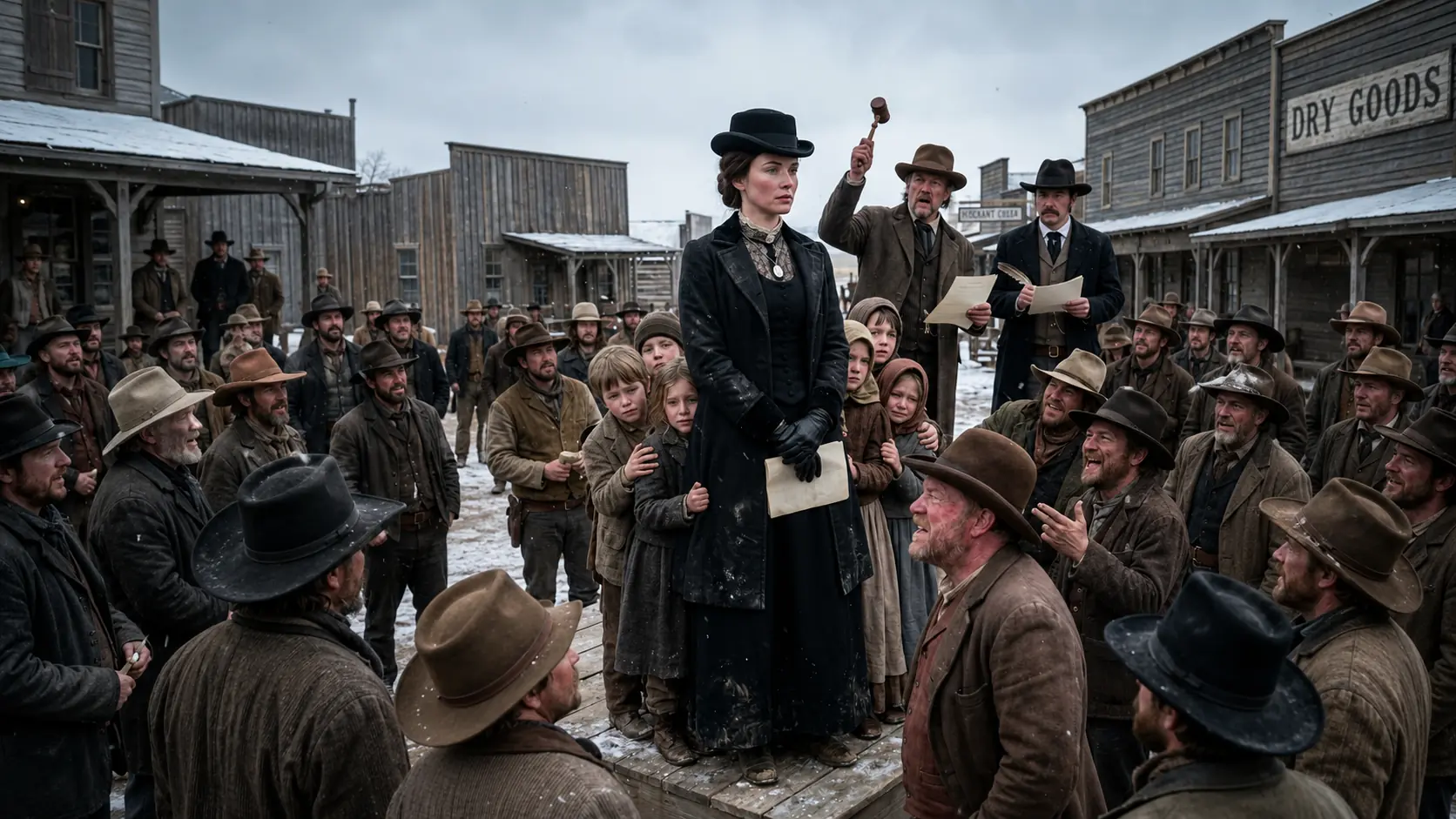
Eleanor was thirty-two years old, widowed, and far more beautiful than the men in the crowd expected a desperate mother to be. Long dark-brown hair fell in loose waves beneath her black felt frontier hat, and her green eyes remained steady despite the exhaustion hollowing her face. She wore a fitted black wool dress with a high lace collar, a weathered mourning coat, and the silver locket her late husband had given her before illness took him. The settlement saw her beauty, but all the men appeared to notice more was the cost of seven children.
“Lot seventeen,” the auction master announced. “Eleanor Hayes, widow, age thirty-two, with seven children ranging from three to thirteen.”
A few men laughed as if the family were an unfortunate piece of livestock. Others studied Eleanor openly, measuring her body, her clothing, and the number of mouths that would arrive beneath their roof. A man in a beaver hat spat into the frozen mud and called the children a plague. Eleanor did not lower her eyes because her sons were watching how she responded.
The journey west had consumed the last of the money she possessed. After her husband died, factory wages in Philadelphia could not cover rent, food, and the debts left by his final illness. Eleanor sold their furniture one piece at a time, then signed with a bride-placement society that promised land, security, and a husband willing to accept children. Only after reaching Covenant Creek did she discover that the promise depended on whether any man considered her family worth purchasing.
“Opening bid, seventy-five dollars,” the auction master called.
No one answered.
He dropped the amount to fifty dollars, yet the silence remained. Sarah began crying without making a sound, while eleven-year-old Thomas clenched his fists and tried to stand like the man of the family. James and William watched the officials behind the platform, already understanding that those papers represented something worse than hunger.
“If no bid is received,” the auction master declared, “the children will be remanded to territorial custody under the Orphan Placement Act.”
Edward looked up at Eleanor.
“Mama?”
Eleanor bent despite the cold stiffness in her knees and touched his red cheek. She told him to be brave a little longer, though she did not know whether courage could protect him from the law. When she rose again, she looked across the crowd and saw most of the men turning away before the gavel fell.
“Going once.”
Eleanor counted seven children behind her.
“Going twice.”
She promised herself that if the officials reached for them, they would have to drag her across the platform first.
“Gone.”
“I’ll take her.”
The voice came from the back of the crowd, deep and rough enough to silence every whisper. A tall man in buckskin and fur stepped forward, leaving heavy boot prints in the half-frozen mud. Dark hair reached his shoulders, streaked with gray, and his broad face carried the hard lines of someone accustomed to winter, hunger, and solitude.
The townspeople moved aside without being asked.
Eleanor heard his name whispered around her.
Caleb Roar.
Stories had reached her before she ever saw him. Caleb lived alone in the high country, rarely entered town, and carried scars from a war no one described clearly. Some claimed he had killed men and disappeared into the mountains to escape judgment, while others said he simply hated civilization enough to avoid it.
The auction master stared at him.
“You understand she has seven children?”
“All seven,” Caleb replied.
“The current offer is fifty dollars.”
Caleb looked at Eleanor, then at the children pressed around her.
“Three hundred.”
The crowd reacted with a collective gasp. Three hundred dollars could purchase livestock, tools, provisions, and enough seed to begin a respectable farm. No sensible man would spend that amount on a widow accompanied by seven frightened children unless he expected something valuable in return.
The auction master brought the gavel down.
Eleanor felt both relief and dread move through her at once.
Caleb approached without smiling.
“Mrs. Hayes, you understand what this is?”
“A marriage contract,” Eleanor answered. “Shelter and food in exchange for work. A roof for my children.”
“I have a homestead in the high country. Two days by wagon in decent weather, longer if the mountain turns against us. Winters are hard, and everyone works.”
Eleanor studied his pale winter-gray eyes.
“What do you expect from me?”
“Keep the house. Manage supplies. Help me run the place.”
“And my children?”
“They eat at my table, sleep under my roof, and work according to their age. No one takes them from you.”
Eleanor looked toward the officials carrying the placement papers. The children had no safer option waiting beyond that platform, only separation disguised as law. She turned back to the mountain man and held her head high.
“I accept.”
Within an hour, the marriage documents were signed, the settlement fees paid, and Eleanor Hayes legally became Eleanor Roar. Mrs. Cromwell from the bride society pulled her aside while Caleb loaded supplies into a sturdy wagon. The official warned Eleanor that people believed Caleb had blood on his hands and had come west to hide from justice.
“There are stories about me too,” Eleanor replied. “They say I’m a burden and my children are worthless. Stories can be crueler than truth.”
Caleb lifted the younger children into the wagon as carefully as if they were fragile cargo. He gave Thomas responsibility for checking the blanket rolls and asked Sarah to count the food sacks. Eleanor noticed that he spoke to the older children as capable people rather than inconveniences. When he offered Eleanor his hand, his palm was scarred and warm.
The settlement disappeared behind them beneath a flat gray sky. Eleanor did not look back, although Margaret and Catherine watched the town until the buildings vanished. The wide Wyoming land stretched around them in frozen grass, dark pine, and rising stone. Caleb drove without conversation, his hands steady on the reins.
After several miles, he glanced toward Eleanor.
“You warm enough?”
“Yes.”
“The children?”
“For now.”
“More blankets are beneath the flour sacks.”
It was not tenderness, but it was consideration. Eleanor wrapped another blanket around Edward and felt the fear inside her loosen by a small degree. A cruel man would not have noticed whether children were cold.
As the trail climbed into the foothills, she asked the question that had followed them from Covenant Creek.
“Why did you pay three hundred dollars?”
“I needed help.”
“That does not explain the price.”
Caleb kept his gaze on the trail.
“I don’t leave children to be torn apart by paper men.”
“You knew the town would mock you.”
“I don’t care what the town thinks. I care what I can build.”
The answer stayed with Eleanor after darkness covered the mountains. Caleb did not promise affection, comfort, or an easy future. He offered survival, work, and the possibility of building something no official could divide. For a woman who had lost nearly everything, honesty held more value than charm.
The storm struck before sunrise on the second day. Snow swept down from the mountains so suddenly that the road disappeared beneath the horses’ hooves. Wind hammered the wagon cover, and drifts grew around the turning wheels. Eleanor gathered the children beneath blankets while Caleb fought to keep the team moving.
“We need shelter,” he said. “There’s an old trapper’s cabin ahead.”
“How far?”
“Half a mile, if I can still read the land.”
The wagon slid sideways on ice, and the children cried out. Caleb steadied the horses without shouting, speaking to them in the same calm voice he had used with Edward. Eleanor watched him guide the frightened animals and realized how different patience looked when it came from such a hard man.
The cabin appeared only after they were nearly upon it. Caleb carried the youngest children inside, gathered wood, and coaxed a fire into the neglected stone hearth. Eleanor and Sarah cleared dust from the floor while Thomas helped block the cracked window with folded cloth. Within an hour, the children were huddled around flames instead of freezing in the wagon.
“You and the children sleep near the fire,” Caleb said.
“And you?”
“I’ll keep watch.”
“You have driven for two days.”
“I don’t need much rest.”
Eleanor saw there would be no changing his mind. She arranged the children beneath blankets while Caleb sat near the door, listening to the storm with an old rifle across his knees. Sarah read from a worn copy of Robinson Crusoe until the younger children fell asleep.
When the cabin grew quiet, Eleanor sat beside the hearth and studied Caleb in the moving firelight.
“You saved us today.”
“I did what needed doing.”
“Most men in Covenant Creek would have left us on that platform.”
“They weren’t men worth measuring yourself against.”
His answer startled her.
For years, relatives and employers had described Eleanor as slow, soft, or too burdened to be useful. Caleb had watched her keep seven children calm through a mountain storm and judged her by what she had done. His approval warmed her more deeply than the fire.
“You didn’t break,” he said. “People break in weather like this.”
“I could not. They depend on me.”
“You’re stronger than you think.”
No one had ever said that to her.
The storm buried the cabin through the night. At dawn, Caleb handed Eleanor a tin cup of hot coffee and prepared to clear the roof before the weight of the snow collapsed it. Thomas volunteered to help, his jaw set with determination.
Caleb studied the boy.
“Can you follow instructions?”
“Yes, sir.”
“Then you work beside me. No showing off.”
Outside, Caleb taught Thomas how to lift snow without exhausting himself. Eleanor watched through the window as the mountain man corrected the boy patiently, never insulting him for being small or inexperienced. When they returned, Caleb told Thomas he had done well, and the boy’s face shone with pride.
The storm passed that afternoon. By evening, the cabin felt almost peaceful, with clothing drying near the hearth and the children playing quiet games on the floor. Eleanor repaired a tear in Sarah’s skirt while Caleb sharpened a hunting knife beside the door.
“Why did you attend the bride auction?” Eleanor asked.
“Needed supplies in town.”
“That isn’t what I asked.”
Caleb continued drawing the blade across the stone.
“I wanted company.”
He admitted he had lived alone for ten years. The mountain homestead was strong, productive, and silent enough to wear down even a man accustomed to solitude. He had not intended to purchase a wife, but he wanted to know whether any woman at the auction looked capable of surviving his life.
“And did they?” Eleanor asked.
Caleb met her eyes.
“Only one.”
The next morning, they resumed their journey beneath a pale sky. The land glittered with fresh snow, and the wagon climbed through increasingly narrow trails. Eleanor began allowing herself to imagine Caleb’s homestead, though she remained careful not to call it home.
After an hour, Caleb raised one hand.
“Quiet.”
The children obeyed instantly.
“Someone’s following us,” he said.
Three riders emerged through the trees, their horses moving quickly across the snow. Caleb’s posture changed as he recognized the man leading them. His jaw hardened, and he moved the rifle within reach.
“Who is he?” Eleanor whispered.
“Crowley. A man who wants what belongs to others.”
The riders cut across the trail and forced the wagon to stop. Crowley wore a battered brown hat and a long dark coat, with a scar running across one side of his face. He looked at Eleanor and the children the way the men at the auction had looked at them.
“Well, Roar,” he said. “Heard you bought yourself a ready-made family.”
“State your business.”
“My business is what you’re carrying.”
Caleb’s voice lowered.
“I don’t have anything of yours.”
Crowley leaned in his saddle and examined Eleanor openly.
“A woman like her would last longer with me. I know how to work a wife. And seven children can earn their keep.”
Eleanor felt Sarah’s hand reach for hers. Thomas moved forward, but she held him back with one arm. Caleb rested the rifle across his lap.
“Ride away.”
Crowley laughed.
“You paid three hundred dollars, but that contract won’t mean much in these mountains.”
“We don’t belong to you,” Eleanor said.
Crowley’s smile sharpened.
“Everything out here belongs to whoever is strong enough to take it.”
His two riders moved to opposite sides of the wagon. The children drew closer together, and Eleanor placed herself between them and the men. Caleb warned Crowley one final time.
Crowley reached toward his coat.
The trail exploded into movement. Caleb fired near Crowley’s head, cutting the strap of his hat and sending it tumbling into the snow. The horses reared, the other riders pulled back, and Crowley launched himself from the saddle.
Caleb met him beside the wagon.
The two men crashed into the snow, striking, grappling, and rolling down a shallow embankment. Caleb fought with controlled precision, but Crowley fought like an animal desperate to dominate. Eleanor ordered the children to stay in the wagon while she watched for the other riders.
Thomas attempted to climb over the side.
“He’s alone,” the boy cried.
“He is not alone,” Eleanor said. “He has us.”
Crowley pulled a knife, but Caleb caught his wrist and forced the blade into the snow. The outlaw drove a shoulder into Caleb’s chest, knocked him backward, and pinned him beneath one knee. His hands closed around Caleb’s throat.
Eleanor stopped thinking.
She reached into the wagon and took Caleb’s spare rifle. Its weight dragged at her arms, but fear gave her strength. She stepped into the deep snow and moved toward the fighting men.
Crowley had Caleb pressed against the ground.
“You should have let me take her,” he snarled.
“Get off him,” Eleanor said.
Crowley turned.
The beautiful widow stood several yards away in her black mourning dress, snow caught in her loose dark hair and her green eyes fixed on him. The rifle trembled slightly in her hands, but it did not lower.
Crowley smiled.
“Put that down, woman. You ain’t got the nerve.”
Eleanor tightened her grip.
“I’m a mother. I have more nerve than you’ll ever understand.”
Crowley rose and moved toward her, confident that fear would stop her before he reached the barrel. Eleanor waited until he came close enough to grab the weapon. Then she turned it in her hands and drove the wooden stock against the side of his head.
The outlaw collapsed into the snow.
Caleb rolled onto his side, coughing and struggling for breath. Eleanor hurried to him but kept the rifle ready, placing herself between Crowley and the wagon. The other riders stared at her without advancing.
“You saved my life,” Caleb managed.
“I protected my family.”
The words left her before she considered them.
Caleb heard them.
He pushed himself upright, placed one boot against Crowley’s back, and ordered the remaining riders to carry their leader away. They hesitated until Eleanor raised the rifle again. Then they lifted Crowley across a saddle and disappeared into the trees.
Silence settled over the mountain trail.
Eleanor’s hands began shaking only after the riders vanished. Caleb gently took the rifle from her and inspected her face for injury. His fingers brushed snow from the shoulder of her black coat.
“Courage like that is rare,” he said.
“So is a man willing to save seven children.”
They returned to the wagon. Thomas looked at Eleanor with open admiration, while Sarah silently wrapped her arms around her mother. Edward asked whether the bad man would return.
“No,” Eleanor said. “He knows better now.”
The trail climbed for another hour before opening above a sheltered valley. Caleb’s homestead stood between tall pines and stone walls, protected from the worst mountain winds. A strong log cabin faced a barn, workshop, smokehouse, fenced pasture, and organized stacks of firewood.
The children stared.
It was not a lonely shack built by a dangerous fugitive. It was a carefully constructed life waiting for people to fill it.
Caleb brought the wagon to a stop.
“Welcome home.”
The younger children spilled into the yard, laughing as they ran through the fresh snow. Thomas hurried toward the barn, while Sarah stood beside Eleanor and watched the small ones explore. For the first time since leaving Philadelphia, none of them were waiting for an official to decide where they would sleep.
Caleb offered Eleanor his hand.
She took it and stepped down.
“I meant what I said at the cabin,” he told her. “I didn’t know if I would find a woman who could live this life.”
Eleanor looked toward her children.
“And now?”
“I found one stronger than me.”
Her breath caught.
Caleb explained that he expected no affection from a contract and would force nothing from her. They could build trust slowly, working side by side until both understood what kind of marriage they could create. His only immediate promise was that no one would separate her children while he still lived.
Eleanor touched the silver locket at her throat. She had worn black since her husband’s death because it represented both love and loss. Standing in the mountain valley, she realized mourning did not require her to refuse every future life offered her.
“I choose this,” she said.
Caleb’s stern expression softened.
Not into victory.
Into gratitude.
The first winter tested them. Snow buried fences, wolves circled the livestock, and supplies had to be measured carefully. Eleanor organized the pantry, balanced Caleb’s trading records, taught the younger children, and turned the cabin into a home without erasing the life that had existed before them.
Caleb taught Thomas and James to care for horses. He showed Sarah how to use the workshop tools and treated her intelligence as something valuable rather than improper. The younger children followed him everywhere until the feared mountain man became the person they called for when a toy broke or a nightmare woke them.
Eleanor no longer appeared fragile in her widow’s clothing. She wore the black dress while working, traveling, and standing beside Caleb at the Covenant Creek market months later. The townspeople who once valued her at less than fifty dollars now watched her arrive with healthy children, full supply wagons, and trade accounts maintained more precisely than those of any rancher in the territory.
Mrs. Cromwell approached quietly.
“You look well.”
“I am.”
“And Mr. Roar?”
Eleanor glanced toward Caleb, who was helping Edward choose an apple from a merchant’s basket.
“The stories were wrong.”
Not every story disappeared. Some people still whispered about the mountain man and the widow who struck Crowley down in the snow. Yet Eleanor no longer feared what strangers said, because gossip had never fed her children, protected their home, or measured her strength correctly.
Crowley never returned.
Caleb’s warning had mattered, but Eleanor’s defiance mattered more. Word traveled quickly that the widow on Roar Mountain was no helpless bride and that anyone threatening her children would face her before facing Caleb.
Years later, Eleanor kept the silver locket from her first husband and the auction contract that gave her Caleb’s name. She did not hide either object. One represented the life she had lost, and the other marked the cruel moment that unexpectedly opened the door to a new one.
The $300 had never purchased Eleanor.
It had paid debts, passage, and fees imposed by men who believed desperation could be assigned a price. Caleb understood from the beginning that loyalty, partnership, and love could not be bought.
Those had to be built.
They built them through storms, hunger, work, patience, and the daily choice to protect one another. Eleanor’s seven children grew beneath the safety of the mountain homestead, and none were ever divided by an official’s papers. They learned that family was not determined by blood alone or by the words written inside a marriage contract.
Family was the person who stepped forward when everyone else looked away.
It was the woman who stood between danger and her children.
And it was the man who saw an unwanted widow surrounded by seven frightened faces and chose not to calculate the burden.
He chose what they could build.