“What are you looking at? My dad pays for this whole school.”
Brett Wilson shoved both lunch trays, Aaron’s and Andre’s, off the table.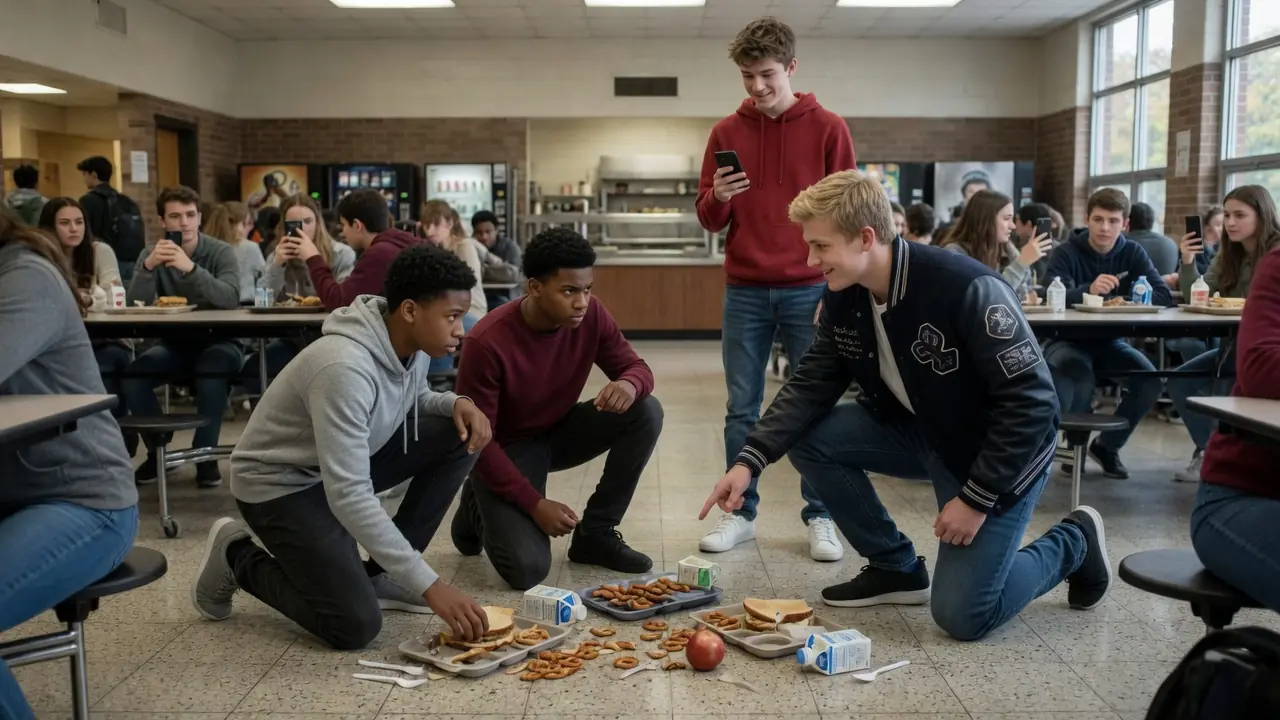
The trays hit the floor. Food scattered across the cafeteria tile.
Then Brett crouched down right in their faces.
“You two are the weakest things in this building. You don’t belong here.”
The cafeteria froze.
Aaron looked down. Andre looked down.
Two twins quietly picked food off the floor while two hundred students watched.
Nobody moved.
Nobody spoke.
Brett laughed and turned to his crew.
“See? Nothing. Absolutely nothing.”
He was right.
For now.
What he did not know was that those two quiet boys had been preparing for years.
And what they were preparing would change everything in that school and far beyond its walls.
Riverside, Ohio, was a town that used to mean something.
The steel plant closed in 2009. Half the storefronts on Main Street never reopened. The people who stayed either stayed because they had nowhere else to go, or because this place was theirs and they refused to let it go without a fight.
Eastside High School sat on the east side of town.
Obviously.
It was the kind of school where the ceiling tiles had water stains and the football field had better lighting than the library.
The student body was mixed: , white, Latino, a handful of others. But the social hierarchy was simple.
Old money sat at the top.
Everyone else figured out their place quickly.
Aaron and Andre Taylor had figured out their place on the first day of freshman year.
Bottom of the ladder.
No argument.
Their mother, Carla Taylor, left for her nursing aide shift at 5:30 every morning. Before she walked out the door, she packed two identical lunches. Same sandwich, same apple, same small bag of pretzels.
She did this every single day without being asked.
On weekends, she worked the breakfast shift at a diner called Patty’s on Route 9. She had been doing both jobs for six years, ever since the twins’ father went to prison.
She never complained about it.
Not once.
Not in front of them.
The apartment was small, above a laundromat. You could hear the machines running through the floor at night, that low rolling hum that somehow made it easier to sleep.
Aaron was the quieter one. He read constantly: history, biology, anything he could find at the school library or in the discount bin at the used bookstore two blocks over.
He got straight A’s without making a show of it.
Teachers liked him, but they underestimated him. They always assumed the quiet ones had nothing going on underneath.
They were wrong about Aaron in ways they could not imagine.
Andre was louder, quicker to laugh, quicker to bristle.
He had Aaron’s same thin frame but carried it differently. Chest out, eyes forward, like he was always ready for something.
Teachers called him reactive.
What they meant was that Andre noticed injustice faster than most people and did not hide it well.
Together, the twins balanced each other perfectly.
Aaron thought three steps ahead.
Andre made sure nobody took a step toward them without knowing it would cost something.
What nobody at Eastside High knew, what they had never told anyone at school, was the mat.
In the corner of their bedroom, rolled out every evening after homework, was a worn wrestling mat. Dark blue, edges frayed, bought secondhand six years ago.
On the wall above it were two sets of patches, competition numbers, regional qualifiers, one state-level certificate, age bracket twelve and under.
Their Uncle Darnell had driven forty minutes twice a week, every week, for eight years to train them.
Darnell was not a loud man.
He had been a collegiate wrestling champion twenty years ago, Division II, two-time All-American, and he trained the way champions train.
Quietly.
Methodically.
Without shortcuts.
He had taught them Brazilian jiu-jitsu first, then wrestling, then how to combine both into something fluid and instinctive.
He made them drill the same takedowns so many times that their bodies stopped thinking and just moved.
“Slow is smooth,” he told them every session without fail. “Smooth is fast.”
By the time Aaron and Andre were sixteen, they had logged over three thousand hours on that mat.
Three thousand hours of preparation.
For what exactly?
Even they were not sure yet.
Brett Wilson, meanwhile, had never once considered that the two quiet twins who picked their food off the cafeteria floor might be the most dangerous people in his school.
That kind of blindness, it turns out, is incredibly expensive.
It started in gym class, a Tuesday morning, third period.
Coach Ray Johnson had stepped out briefly to grab equipment from the storage room.
That was all Brett needed.
Thirty seconds of no supervision, and he was already moving.
The class was running a basic wrestling drill. Simple stance, simple movement.
Brett watched Aaron go through the motions and felt something he always felt around the twins.
Irritation.
Not fear. Never fear.
Just the low, grinding irritation of someone who could not understand why these two did not shrink faster.
He walked over and stopped in front of Aaron.
Laughter came from Brett’s side of the gym.
Owen Davis, Brett’s shadow, always within earshot, was already grinning before the words fully landed.
Aaron looked up, calm and even.
“I’m good, thanks.”
“I didn’t ask if you were good,” Brett said. “I said show us.”
Brett stepped closer.
“Or can’t you?”
The room went quiet the way rooms do when something is about to happen.
Aaron set his feet and said nothing.
Then Brett shoved him.
One hard push to the chest, enough to send the lighter kid stumbling backward two full steps.
Aaron caught his balance, looked at Brett, and did nothing.
That nothing, that absolute stillness, made Brett angrier than any reaction could have.
He shoved him again.
Andre was across the gym in three steps before Aaron raised one hand, just slightly.
A signal.
Andre stopped, fists at his sides, breathing hard.
Coach Johnson walked back in, read the room instantly, and blew his whistle.
What happened next was the part that settled into Aaron’s chest like a stone and stayed there.
Johnson pulled Andre aside.
Not Brett.
Andre.
“I don’t know what’s going on, but you need to calm down.”
Andre stared at him.
“I didn’t do anything.”
“I could see you from across the gym. Cool it.”
That afternoon, Principal Donna Moore called Carla Taylor at work.
The message was polite, careful, and completely backward.
The twins needed to avoid escalating situations.
Brett Wilson received no call.
No warning.
Nothing.
That night, Aaron went home and unrolled the mat.
Brett Wilson had a gift for knowing exactly how far he could push before anyone pushed back.
He had been refining this skill since middle school, and by junior year, it was practically an art form.
After the gym incident, he did not back off.
He accelerated.
It started small.
A shoulder check in the hallway, hard enough to send Aaron’s books scattering, casual enough to look accidental.
An “accidentally” spilled drink on Andre’s homework during study hall.
A loud comment across the lunchroom.
“Hey, somebody tell the twins the scholarship applications are in. Oh, wait, you need grades for that.”
Laughter every time.
Always laughter.
Brett had an audience, and he knew how to work it.
Owen Davis was always nearby, always ready to amplify.
Owen was not cruel the way Brett was cruel. He was the kind of person who laughed because laughing felt safer than silence. He echoed Brett’s comments, spread them further, gave them legs.
Together, they had turned the humiliation of Aaron and Andre Taylor into something that felt, to the rest of Eastside High, almost like entertainment.
Nobody intervened.
Not seriously.
A teacher might glance over and look away.
A hallway monitor might slow down and then keep walking.
The message was clear, and it was institutional.
This is not our problem.
Brett felt it, that invisible permission, and it made him bolder.
Two weeks after the gym incident, he found a new weapon.
Social media.
Owen filmed it on his phone.
Brett walked past Andre in the hallway, flicked Andre’s backpack strap, and said loud enough for the camera, “Careful. Don’t want you to tip over. Wind might get you, string bean.”
Fifteen seconds.
Posted that night with a laughing emoji.
By the next morning, it had been shared across three different school group chats.
Two hundred views.
Then five hundred.
The comments were the worst part.
Kids Aaron and Andre had never spoken to. Kids from other schools. All of them laughing, piling on, competing to write something funnier than the last person.
Andre saw it at 10:00 p.m.
He sat on the edge of his bed and stared at his phone for a long time without moving.
Aaron came in, saw his face, took the phone, and looked at it himself.
Then he put it face down on the dresser.
“Don’t,” Aaron said.
“I’m not doing anything.”
“I know what you’re thinking.”
Andre was quiet for a moment.
Then he asked, “When?”
“Not yet.”
That was the whole conversation.
What neither of them knew was that someone else had seen the video, too.
Tasha Williams, junior year, student newspaper, sharp eyes and sharper instincts, had been watching Brett Wilson for weeks.
Not because she knew what the twins were capable of.
Because she recognized the pattern.
She had seen it before in different hallways, different schools, different faces.
Power performing itself in public.
She opened a new note on her phone and started writing down dates, times, and locations.
She did not know yet why she was doing it.
She just knew she was.
Now here is the part most people never saw.
What was happening on Brett’s side of town.
Brett Wilson lived in a house with four bedrooms and a three-car garage on the north end of Riverside.
His father, Richard Wilson, was a school board member, a man who wore his authority the way other men wear cologne.
Always present.
Slightly too strong.
Richard Wilson had built his son’s immunity carefully over years.
A word here to a principal.
A donation there to the athletics fund.
A quiet reminder delivered over golf or dinner of who kept the budget conversations comfortable.
Brett knew, in the vague and unexamined way protected people always know, that nothing would happen to him.
Not here.
Not in this school.
That Tuesday evening, Richard Wilson sat across from his son at the dinner table and asked how school was going.
Brett told him about the twins, not as a confession, but as an amusing story.
Richard listened, cut his steak, and said, “Just don’t do anything stupid on school property. Keep it where it can’t be documented.”
That was the extent of the moral guidance.
Brett nodded and went back to his food.
The following week, he escalated again.
This time, he did it publicly, deliberately, in a space where it would land hardest.
The announcement came over the intercom on a Wednesday morning between second and third period.
The annual Eastside High Athletic Showcase.
A tradition.
A spectacle.
A chance for the wrestling team to perform in front of the full student body in a room full of parents and local press.
Coach Johnson always used it to recruit interest in the program.
Brett went to Owen the moment the bell rang.
“I’m going to call them out at the showcase,” he said. “In front of everyone. Make it a challenge. Friendly competition, so nobody can say anything.”
Owen hesitated for just a second.
“Are you sure that’s a good idea?”
“They’ll say no, or they’ll embarrass themselves. Either way,” Brett shrugged, “it’s perfect.”
Owen nodded and went back to laughing.
But something in that one-second hesitation stayed with him longer than he expected.
Aaron heard about the showcase challenge through three different people before lunch.
He sat with the information quietly, the way he sat with most things, turning it over and examining it from every side.
That afternoon, he stayed late in the library and wrote something in his notebook.
Not homework.
A list.
Columns.
Scenarios and responses.
What Brett might do.
What the crowd would expect.
What the outcome of each choice would be.
Andre leaned over and looked at the notebook.
“You already know what we’re going to do,” Andre said.
“I know what I want to do,” Aaron said. “I’m making sure it’s right.”
He closed the notebook and picked up his backpack.
The showcase date was now on every bulletin board in the school.
Brett had already started telling people what was going to happen.
He had no idea he was building the stage for his own undoing.
That Friday evening, Uncle Darnell’s car pulled up outside the laundromat at 6:15, same time as always.
Aaron and Andre were already waiting on the front steps with their bags.
Nobody said much on the drive over.
Darnell’s training space was a converted garage behind his house. Rubber flooring, two heavy bags, a wall of mirrors, and that same quiet serious places always have.
He had been watching the situation at Eastside High develop for weeks.
Carla had told him about the gym incident. Aaron had told him about the showcase challenge.
Darnell listened to everything.
Then he spoke.
“You know what you’re capable of. The question is whether you’re going to be smart about it.”
He looked at Andre first.
Andre nodded, jaw tight.
Then he looked at Aaron.
“If he puts his hands on you first, and only then, you respond. Controlled. Minimal. You stop the moment it’s over. Understood?”
“Understood,” Aaron said.
“Because what happens after matters more than what happens during.”
Aaron pulled out his notebook.
He had already contacted Tasha Williams. She had agreed to film from two separate angles.
Their family friend Glenn Anderson, an attorney, had been quietly briefed.
Andre looked at his brother.
“You plan for after.”
“I always plan for after,” Aaron said.
Darnell watched them both and said nothing.
Then he nodded once.
“You’re ready. Let him swing first.”
The day of the Eastside High Athletic Showcase arrived on a Thursday afternoon in late October.
The gymnasium had been set up properly. Bleachers pulled out, the wrestling mat centered on the floor, a folding table for the judges along the far wall.
Parents filed in alongside students.
A reporter from the Riverside Gazette sat in the second row with a notepad.
Coach Johnson stood near the equipment room door, arms crossed, watching the room fill up.
It felt like a regular showcase.
It was not going to be a regular showcase.
Brett Wilson arrived with his crew ten minutes before the start. He was wearing his varsity jacket, the one with the captain’s patch on the chest, and he moved through the gymnasium the way people move through spaces they believe belong to them.
Easy.
Unhurried.
Nodding at people who nodded first.
Owen Davis walked beside him, quieter than usual.
Aaron and Andre Taylor came in through the side door together, backpacks still on. They found two seats near the edge of the bleachers and sat down without drawing attention.
Tasha Williams was already in position, one seat high in the bleachers with her phone angled wide, and her friend Maya stationed near the side wall with a second phone.
Two angles.
Full coverage.
Nobody noticed.
Nobody was looking at them yet.
The showcase ran its normal opening.
Introductions.
A few team demonstrations.
Some applause.
Coach Johnson kept things moving.
And then Brett Wilson stood up.
He did not ask for the microphone. He just stood up, and his voice carried.
“Coach, can we do an open challenge like last year?”
Johnson hesitated.
Open challenges were technically part of the program.
He looked around the room: parents, students, the reporter with the notepad.
Then he nodded slowly.
“Keep it clean,” Johnson said. “Protective gear. Standard rules.”
Brett turned toward the bleachers.
He scanned the faces slowly, performing it, making sure everyone was watching before his eyes landed exactly where he intended them to land.
“Aaron Taylor,” he said, loud and clear. “Let’s see what you’ve got.”
The room reacted immediately.
Whispers.
Nudges.
A few poorly hidden smiles from Brett’s corner of the bleachers.
Someone near the back said, “Oh, no,” in a tone that meant they expected this to be quick and brutal.
Aaron sat still for three full seconds.
Then he stood up, set his backpack on the seat beside Andre, and walked down to the mat without a word.
Andre watched him go, hands flat on his knees, breathing steady.
Aaron stepped onto the mat.
He was wearing jeans and a plain gray hoodie.
No gear.
No warm-up.
He looked at Coach Johnson.
“I’ll need headgear,” he said simply.
Someone in the bleachers laughed.
Brett heard it and smiled.
Johnson handed over the headgear.
Aaron put it on, adjusted the strap, and looked at Brett across the mat.
Brett rolled his neck, cracked his knuckles, and stepped into his wrestling stance.
Wide base.
Arms out.
The posture of someone who had been doing this since he was nine years old and knew it.
He was bigger than Aaron by thirty pounds and four inches.
The room could see it clearly.
What the room could not see was Aaron’s breathing.
Slow.
Even.
Like a person waiting for a bus, not a person about to be charged by someone twice his size.
Brett moved first.
He came in fast, a hard forward lunge, arms reaching for Aaron’s hips, the kind of aggressive double-leg attempt that had taken down every opponent Brett had faced in two years of varsity competition.
It did not work.
Aaron moved left.
Not backward.
Left.
Just enough at exactly the right moment.
Brett’s hands found air instead of hips.
In the same motion, without any visible effort, Aaron’s right arm came over Brett’s back. His left hand found Brett’s wrist, and his hips dropped low.
What happened next took less than four seconds.
Brett Wilson, varsity wrestling captain, seventeen years old, thirty pounds heavier, went from standing to face down on the mat so smoothly and so completely that the gymnasium did not react immediately.
There was a half second of pure silence where two hundred people tried to process what they had just seen.
Then the slap of Brett’s body hitting the mat registered.
Hard.
Clean.
Final.
The silence broke, not into cheering, but into something stranger.
A collective exhale, like the room had been holding its breath without knowing it.
Then one voice somewhere in the upper bleachers said, “What?”
Flat.
Genuine disbelief.
And that cracked it open.
Aaron stood up immediately, stepped back, hands at his sides, and gave Brett space.
Brett scrambled to his feet faster than he should have.
His face was red, not from impact, but from something worse.
He looked at the room, looked at the faces, and could not find a single person wearing the expression he needed to see.
He charged again.
This time, Aaron did not step left.
He stepped inside.
Closer, not farther.
And in one motion that seemed physically impossible given the size difference, his arm hooked Brett’s neck from behind, his hips rotated, and Brett was on the mat again.
Four seconds, maybe less.
Aaron stepped back, both hands up, completely still.
Brett lay on the mat for a moment longer than necessary.
The gymnasium erupted, but not uniformly.
There were parents near the front who looked confused. A few of Brett’s teammates went very quiet.
But from the student section, the noise came up fast and hard.
Phones were already out.
They had been out since the first takedown.
Tasha’s two angles were capturing everything.
The technique.
The crowd.
Brett’s face when he stood up the second time.
The complete and total stillness of Aaron Taylor standing in the center of the mat with his hands raised and his expression unchanged.
Coach Johnson blew his whistle and called it.
The showcase moved on.
But the moment did not move on.
Tasha posted the cleaner of her two angles that night at 9:00 p.m.
Sixteen seconds of video.
Brett’s lunge.
Aaron’s redirect.
The takedown.
The scramble.
The second charge.
The second takedown.
Aaron stepping back with both hands up.
By midnight, it had fifty thousand views.
By the next morning, it had crossed two million.
The comments were a wall of disbelief.
“He moved like water.”
“Thirty pounds lighter and made it look easy.”
“The hands up at the end, that’s the part that got me.”
The phrase “twin takedown” was everywhere by 8:00 a.m.
Aaron found out at breakfast, looked at the number on Tasha’s screen, and said nothing.
Andre looked at the same number and laughed, the first real laugh either of them had allowed themselves in weeks.
It lasted about twelve hours.
Because that evening, across town, Richard Wilson picked up his phone.
And the smile Brett was trying very hard not to show disappeared completely.
The complaint was filed on a Friday morning.
Richard Wilson moved fast, faster than most people could have, which was the point.
By the time Aaron and Andre arrived at school that day, Principal Moore already had a document on her desk.
Formal language.
Legal letterhead.
The words “unprovoked physical assault” appeared in the second paragraph.
The words “civil rights violation” appeared in the fourth.
Richard Wilson had found an attorney who worked quickly when the money was right.
And the money was always right for Richard Wilson.
Principal Moore read it twice.
Then she called the district office.
Then she called her own attorney.
Then she did what people in her position do when pressure comes from above.
She made the easiest decision available to her.
She suspended both twins pending a formal disciplinary investigation.
Aaron and Andre were called to the office during first period.
They sat in the two chairs across from Moore’s desk and listened to her explain the situation in the careful, neutral language of someone who knew she was being recorded by history, if not by anyone in the room.
Aaron looked at her steadily the entire time.
Andre looked at the floor.
When she finished, Aaron asked one question.
“Was Brett Wilson suspended?”
Moore’s pause lasted exactly long enough to answer the question without answering it.
“That’s a separate matter,” she said.
They walked out of the school with their backpacks at 9:40 in the morning.
The hallways were empty.
Their footsteps echoed.
Carla Taylor found out during her break at the hospital.
She was eating a sandwich in the staff room when a colleague touched her arm and pointed at the television mounted in the corner.
A local news segment was running.
A two-minute piece on a violent altercation at Eastside High School involving two students.
The graphic behind the anchor showed a still frame from Tasha’s video, cropped to show only the moment of impact without the context of Brett’s charge.
The segment used the word aggression.
It used the word provocation zero times.
Carla set down her sandwich and did not pick it up again.
The story spread through Riverside the way stories spread in small towns.
Faster than facts.
Slower than corrections.
By Saturday morning, people who had never heard of Aaron and Andre Taylor had opinions about them.
Comment sections filled up.
A local columnist named Gary Briggs published a piece titled “Athletic Showcases or Fight Clubs?”
It did not name Brett Wilson.
It described the twins as students with apparent combat training who targeted a peer in a public setting.
Gary Briggs had gone to high school with Richard Wilson.
Nobody mentioned that part.
Online, the reversal was stunning.
The same video that had generated two million views of astonishment was now being reposted with new captions.
Thug behavior.
Planned attack.
They should be expelled.
The ratio of supportive to hostile comments flipped almost overnight.
Tasha watched it happen from her bedroom, phone in both hands, jaw tight.
She had the full, unedited footage.
Both angles.
Everything.
Brett’s taunt.
The lunge.
The second charge.
Aaron’s hands going up.
She had not released it yet because she had been waiting, the way her journalism teacher had told her to wait.
Verify everything before you publish.
Timing matters.
She was starting to think timing was going to matter more than she had realized.
Now here is what was happening on Brett’s side of town that same weekend.
Brett was not celebrating.
That was the thing nobody would have expected.
He was sitting in the living room of the four-bedroom house on the north end of Riverside, watching his father work the phone, and feeling something he had not felt in a long time.
Uncomfortable.
Not guilty.
Not yet.
But uncomfortable.
The video had not gone the way any of them planned.
He had watched his own face in it seventeen times, trying to find the angle where he looked like the victim.
He could not find it.
The comments from the people who still had the original clip, unedited, knew what they were looking at.
They had seen the lunge.
They had seen him charge a second time at someone who had already stepped back with both hands raised.
He called Owen that Saturday night.
“You think this is going to work?” Brett asked.
He did not specify what this was.
He did not need to.
Owen was quiet for a moment.
Too long of a moment.
“I don’t know,” Owen said.
Brett hung up.
Owen sat with his phone in his hand for a long time after that.
He had been thinking about the moment in the gymnasium.
Not the takedowns. Those were almost beside the point.
But the moment right before the second charge.
When Brett was already on the mat, already beaten, and he got up anyway and went again.
Not because he thought he could win.
Because he could not accept losing in front of people.
Owen had been thinking about what that said about Brett.
About what it said about Owen himself for standing next to Brett for three years and calling it friendship.
He opened his phone.
Started typing a text.
Stopped.
Deleted it.
Not yet.
He was not ready yet.
Meanwhile, Glenn Anderson had taken the case the same day Carla called him.
He was a family friend, had known Carla since before the twins were born, and he was a careful, methodical attorney who had spent twenty years doing civil rights work in Ohio.
He did not panic.
He did not make statements to the press.
He made a records request.
Specifically, all security camera footage from the Eastside High gymnasium on the day of the showcase.
The school’s response came back within forty-eight hours.
Two of the three cameras covering the gymnasium had experienced technical difficulties on that date.
Footage unavailable.
Glenn read the response.
Read it again.
Then he made a note in his legal pad.
Two of three. Not all three.
One camera’s footage exists somewhere.
He filed a second, more specific request.
That same evening, Carla sat at the kitchen table with Aaron and Andre after dinner.
She had been holding herself together for days.
At work.
On the phone with Glenn.
In front of her sons.
But tonight, something broke through.
Her eyes filled.
She did not let the tears spill over, but she could not stop them from showing.
“I can’t afford to fight this the way they can fight it,” she said quietly.
Aaron reached across the table and put his hand over hers.
“You don’t have to,” he said. “We already did.”
She looked at him, then at Andre.
Andre nodded once.
She did not fully understand what they meant.
Not yet.
That night, a plain white envelope appeared in Glenn Anderson’s mailbox.
No return address.
Inside was a USB drive.
Unlabeled.
The size of a thumb.
Glenn stood at his front door in the dark, holding it for a long moment.
Then he went inside and found his laptop.
The disciplinary hearing was scheduled for a Tuesday morning at 9:00 a.m. in the Eastside High School conference room.
A beige, fluorescent-lit space that had hosted a hundred routine meetings and had never once hosted anything like this.
By 8:45, the room was full.
Richard Wilson sat on one side of the long table with his attorney, a man named Craig Foster, who wore a suit that cost more than Carla’s monthly rent.
Brett sat beside his father, shoulders back, jaw set, performing composure.
Owen Davis sat in the back row of chairs along the wall, brought as a witness for Brett’s side.
He had not slept well the night before.
On the other side of the table sat Glenn Anderson, calm and organized, a legal pad in front of him and a laptop to his right.
Aaron and Andre sat beside him, straight-backed and quiet.
Carla sat on Aaron’s other side in her best work clothes, hands folded, eyes forward.
Principal Moore sat at the head of the table, visibly uncomfortable.
Judge Patricia Brown, brought in as an independent hearing officer at Glenn’s formal request, sat beside her with the recorder running and a neutrality so complete it was almost its own kind of pressure.
Craig Foster opened.
He was good at his job.
He spoke for eleven minutes without pause, building a version of events that was technically connected to what had happened while being almost unrecognizable to anyone who had been in that gymnasium.
He used the phrase “premeditated physical aggression” four times.
He used the word “targeting” twice.
He described Aaron and Andre Taylor as students who had cultivated dangerous combat skills in secret and deployed them against an unsuspecting peer.
He said the word unsuspecting with particular emphasis.
Across the table, Andre’s jaw tightened.
Aaron put one hand flat on the table, barely a gesture, almost invisible.
Andre’s jaw loosened.
Glenn let Foster finish.
Then he opened his laptop.
“I’d like to enter three items into the record,” he said. “The first is a formal records request submitted to Eastside High School and the district office requesting all security camera footage from the gymnasium on the date of the showcase.”
He slid a printed copy across the table toward Judge Brown.
“The school’s response indicated that two of three cameras experienced technical difficulties. I’d like to note that this response was provided forty-eight hours after my initial request, and that ‘technical difficulties’ was the entirety of the explanation offered.”
Moore shifted in her seat.
“The second item,” Glenn continued, “is the footage from those two cameras that were allegedly nonfunctional.”
The room went still.
Foster looked up sharply.
“Counsel, that footage was confirmed unavailable.”
“By the school,” Glenn said. “Yes.”
He turned the laptop to face the room.
“Someone else had a copy.”
He pressed play.
The third camera angle, wider than Tasha’s footage, mounted high in the corner of the gymnasium ceiling, showed everything.
Not just the mat.
The entire room.
Brett’s approach to the microphone.
The deliberate scan of the bleachers.
The moment his eyes found Aaron.
The taunt.
The challenge.
And then, frame by frame, undeniable.
Brett’s lunge, unprovoked, before Aaron had moved a single inch.
The timestamp in the corner showed the full sequence.
Three seconds from Brett’s first movement to Aaron’s response.
Craig Foster said nothing.
Richard Wilson looked at the table.
Judge Brown leaned forward and watched the entire clip without speaking.
When it ended, Glenn closed the laptop.
“The third item,” he said quietly, “is a witness who would like to make a statement.”
Everyone looked at Glenn.
Glenn looked at the back row.
Owen Davis stood up.
He did not look at Brett when he stood.
He looked at Judge Brown.
His voice was unsteady at first.
The voice of someone doing something that cost him.
But it steadied as he went.
“Brett charged first, both times. I was standing right there.”
He paused.
“I’ve known Brett for three years. I’ve watched him do this kind of thing for three years. And I’m done. I’m done pretending I didn’t see it.”
The room was absolutely silent.
Brett stared at Owen with an expression that cycled through disbelief, anger, and something that might have been the beginning of understanding.
All in the space of about four seconds.
Richard Wilson’s hand, resting on the table, closed into a fist and then opened again slowly.
Foster leaned over and said something quietly to Richard.
Richard shook his head once.
Judge Brown made a note.
Then she looked at Aaron.
“Would you like to speak?”
Aaron nodded.
He did not stand. He just sat forward slightly and spoke in the same quiet, even voice he used for everything.
“I’ve been training in wrestling and Brazilian jiu-jitsu since I was eight years old,” he said. “Not as a secret. Not as a weapon. Because my uncle believed that discipline and self-control were worth teaching.”
He paused.
“We drilled the same moves thousands of times. The most important thing he taught us wasn’t the technique.”
Another pause.
“It was when not to use it.”
He looked at Judge Brown directly.
“Brett charged me. I redirected him. I stepped back both times the moment it was over. I did not strike him. I did not injure him. I responded to a physical attack with the minimum force necessary to stop it. And then I stopped.”
The room sat with that for a moment.
Craig Foster attempted a rebuttal, something about the inherent danger of trained combatants in civilian settings.
But the energy had left his argument.
You could hear it.
The words were the same, but they landed differently now, in a room that had just watched the footage, heard Owen’s testimony, and listened to a sixteen-year-old explain the difference between violence and self-defense with more precision than most adults manage.
Principal Moore, who had been silent for the better part of an hour, spoke for the first time.
“I want to say, for the record, that the school’s handling of prior incidents involving these students was not adequate.”
She did not look at Richard Wilson when she said it.
She looked at Aaron.
“That should have been addressed earlier. It wasn’t. And I take responsibility for that.”
Richard Wilson stood up abruptly.
“This hearing is being conducted improperly.”
“Sit down, Mr. Wilson,” Judge Brown said.
Not loudly.
Just clearly.
He sat down.
Brown called a thirty-minute recess.
Nobody left the room.
People sat with their phones face down or their hands in their laps, existing in the specific discomfort of a moment that has already been decided but has not been announced yet.
Brett looked at the table in front of him.
At the grain of the wood.
At nothing.
For the first time in his life, in this beige fluorescent room with the recorder running, there was no one who could fix this for him.
He was just a boy who had done something wrong.
And everyone in the room knew it.
Judge Patricia Brown returned to her seat at exactly 10:47 a.m.
She set her notes down, adjusted the recorder, and spoke without preamble.
“Based on the evidence presented, video footage from multiple angles, witness testimony, and the sequence of events as documented, I find no basis for disciplinary action against Aaron or Andre Taylor. The suspension is hereby expunged from both students’ records effective immediately.”
She looked at Principal Moore.
“I further recommend that the district conduct a full review of prior incident reports involving the students in this room, all of them, to determine whether existing disciplinary protocols were applied consistently and fairly.”
Moore nodded.
She looked like someone who had needed someone else to say that out loud for a long time.
Richard Wilson and Craig Foster left without speaking to anyone.
Brett followed his father out the door, one step behind, the way he always had.
But something about the way he walked had changed.
The ease was gone.
That comfortable, unhurried certainty that had carried him through three years of Eastside High was not there anymore.
It did not come back.
Carla Taylor sat in her chair for a moment after the room began to empty.
Aaron put his hand on her shoulder.
She reached up and covered it with hers.
She did not speak.
She did not need to.
That was the moment.
Not the takedowns.
Not the testimony.
Not the verdict.
That quiet hand on the shoulder in a beige conference room was the moment that meant everything.
Tasha Williams published her full documentary edit that afternoon.
Both angles.
Uncut.
With timestamps and context.
She added a title card at the beginning.
What you were told happened.
What actually happened.
She posted it at 2:00 p.m.
By midnight, it had six million views.
By the following morning, eighteen million.
The comments were different this time.
Not just surprise or excitement, but something heavier and more sustained.
People were angry in the specific way people get angry when they realize they were manipulated.
They shared it with that anger attached, which made it spread faster.
The phrase “stand up smart” began trending nationally by Wednesday morning.
By Thursday, it had reached the feeds of two state assembly members, a civil rights organization based in Columbus, and a sports journalist at a national outlet who wrote a piece about Aaron and Andre that ran on Friday under the headline:
They Were Ready. Nobody Bothered To Ask.
Brett Wilson was formally disciplined by the school.
Details were kept private per district policy, as they always are for minors.
Richard Wilson recused himself from all school board decisions involving Eastside High, citing a conflict of interest.
He did not recuse himself voluntarily.
He was asked to by the other board members in writing, which was its own kind of verdict.
Brett transferred to a school in the next county three weeks later.
No announcement.
No goodbye.
One day he was there, and the next day his seat in third period was empty.
Within a week, most people had stopped noticing the absence.
That was the thing about Brett Wilson in the end.
Without the protection and without the audience, there was not much there.
Coach Ray Johnson proposed a new program the week after the hearing.
A formal self-defense and conflict de-escalation curriculum open to all students, built around the same principles Uncle Darnell had been teaching in a converted garage for eight years.
The school board, newly attentive to the optics of its decisions, approved it unanimously.
They named it the Taylor Method.
Uncle Darnell drove to the school on the first day of the program and stood in the gymnasium doorway for a moment before walking in.
He looked at the mat on the floor, at the students sitting in a circle around it, at Aaron and Andre standing at the front of the room ready to demonstrate.
He did not say anything.
He just found a chair and sat down.
The first session ran forty-five minutes.
Aaron demonstrated a basic defensive redirect, the same one he had drilled ten thousand times in a converted garage.
Andre talked about what self-control actually feels like from the inside.
The students asked real questions.
The room was quiet in the good way.
Carla arrived at the end of the session.
She stood in the doorway and watched her sons on the mat: clean, confident, calm, completely themselves.
She did not clap.
She did not cry.
She just stood there and breathed.
Finally.
The story of Aaron and Andre Taylor did not end in that conference room.
It did not end with the video going viral, or the program getting approved, or Brett Wilson’s empty seat in third period.
Those were conclusions, but conclusions are not endings.
Not really.
What actually ended was something harder to name.
The particular kind of silence that surrounds people who are being hurt in plain sight.
The silence of hallway monitors who keep walking.
Teachers who look away.
Classmates who watch and say nothing because saying something feels dangerous and saying nothing feels safe.
That silence had been operating in Eastside High for years before Aaron and Andre Taylor walked into it.
It does not operate there anymore.
The Taylor Method is now in its second year.
Forty-three students enrolled in the first semester.
Ninety-one in the second.
Three youth centers in the surrounding county have requested the curriculum.
A state assembly member mentioned it during a floor speech on school safety policy in March.
It did not get much press coverage, but the people in that room heard it, and some of them are the kind of people who turn heard things into changed things.
Uncle Darnell still drives forty minutes twice a week, same as always.
Aaron is applying to colleges with a full academic record, no suspension, no asterisk, nothing.
He wants to study sports medicine.
Andre wants to coach.
They still train together every evening on the worn blue mat in the corner of their bedroom above the laundromat, while the machines hum through the floor below.
Tasha Williams won a regional student journalism award for her coverage of the case.
She is sixteen years old.
Her acceptance speech was eleven words.
“Document everything. Timing matters. Don’t let anyone tell you otherwise.”
Owen Davis transferred schools the same semester as Brett.
Different school.
Different direction.
He reached out to Aaron once by text about four months after the hearing.
The message was short.
Aaron read it, thought about it for a day, and wrote back two words.
Thank you.
That was the whole exchange.
Sometimes that is enough.
Because Aaron and Andre Taylor are not rare.
What is rare is that their story got recorded.
What is rare is that someone kept the footage.
What is rare is that someone stood up in that conference room and told the truth when it cost him something.
Most of the time, none of those things happen.
Most of the time, the kid picks up his food off the floor and goes home, and nobody ever knows what he was capable of.
That is the story worth thinking about.
The ones we never see.
Staying silent when something is wrong always costs something.
But these twins did not just win a fight.
They showed up prepared, disciplined, and controlled.
They brought the truth.
And in a room like that, those are the only weapons that really matter.
Sometimes justice does not need noise.
It just needs people brave enough to stand up and tell the truth anyway.