“Clean it, stupid Blackey.”
The words landed across the Manhattan hotel lounge louder than the glass Prince Khalid Al-Rashid had deliberately knocked from the gold table. Amber liquid spread across the polished marble while several men surrounding his cream sofa laughed, one raising his phone as though the humiliation deserved to be preserved. Kneeling beside the spill in a fitted black service uniform, Special Agent Camille Bennett lowered her eyes, unfolded a white cloth, and continued cleaning as if she had not understood a single word.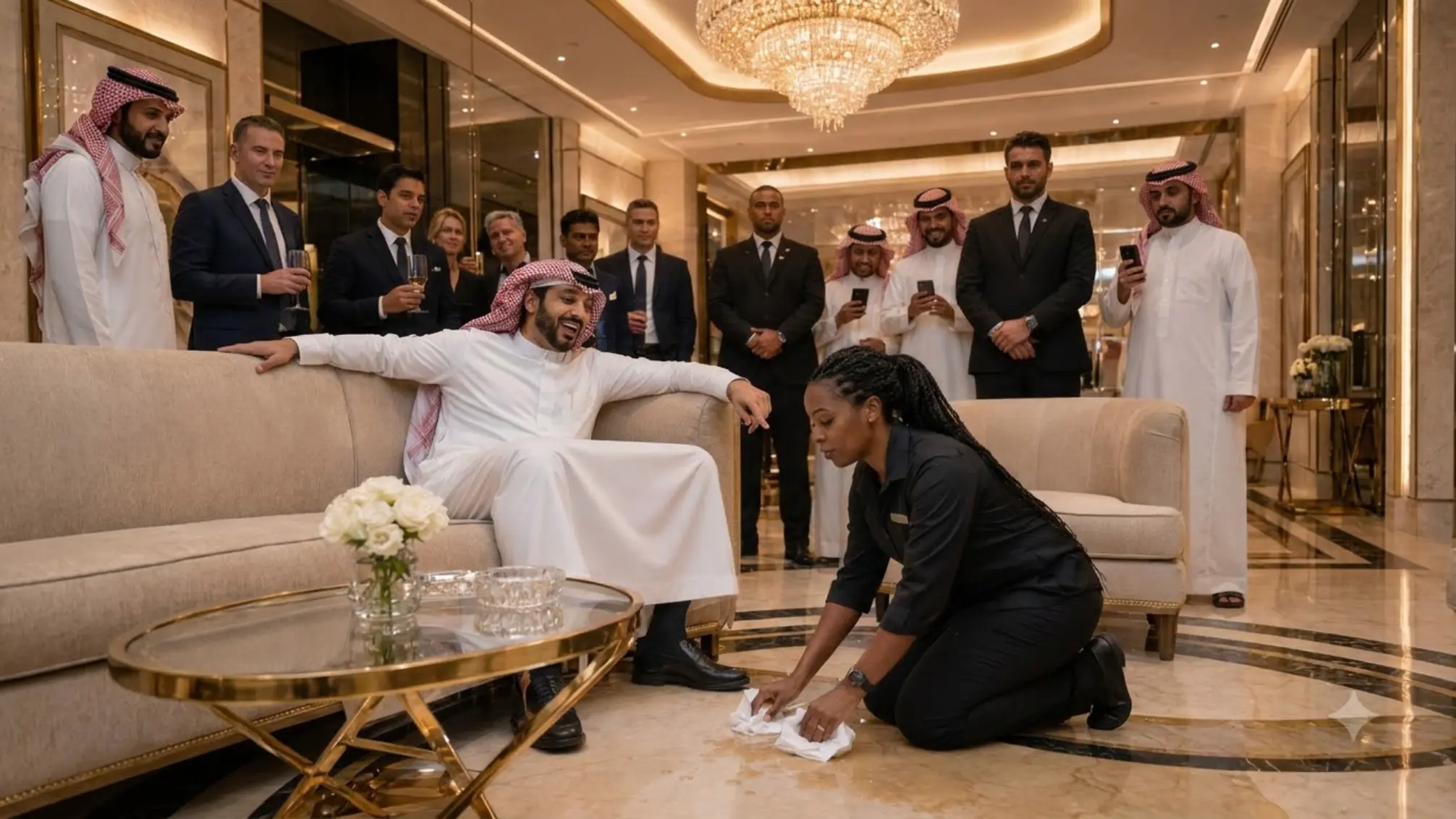
Khalid leaned farther back against the sofa and stretched one arm across the cushions with the lazy confidence of a man accustomed to rooms rearranging themselves around him. He was forty, enormously wealthy, connected to powerful investors across several countries, and surrounded that evening by executives who treated every laugh from him like permission to laugh too. His immaculate white thobe had not collected a single drop from the drink he had spilled, and his red-and-white keffiyeh sat perfectly in place. Camille noticed all of it without appearing to notice anything.
That was what she had been trained to do. For four months, Camille had worked under the identity Camille Brooks, an assistant hospitality supervisor assigned to private suites and international receptions at the Halcyon Grand Hotel. Her actual position was with a federal task force investigating a transnational financial network suspected of moving criminal proceeds through American real-estate purchases, luxury consulting contracts, shell corporations, and high-value art transactions. Khalid was not under investigation because he was Arab or because he was a prince; he was under scrutiny because financial records, cooperating witnesses, and intercepted communications connected several men in his business circle to specific suspicious transactions.
The distinction mattered to Camille. Her job was evidence, not assumptions, and she had spent eleven years learning how quickly an investigation collapsed when prejudice replaced proof. Her team had traced nearly eighty million dollars through six corporations, three jurisdictions, and a collection of fictitious advisory agreements that seemed to exist only long enough to move money. Tonight’s reception was supposed to provide the missing connection between Khalid’s investment office and Faris Nassar, the financier investigators believed coordinated the transfers.
Camille’s uniform concealed a microphone sewn near the inner edge of her collar. Another transmitter rested beneath the hotel name badge pinned to her chest. Two agents occupied a catering van beneath the building, another worked hotel security, and Assistant Special Agent in Charge Daniel Mercer waited in a surveillance room three floors below. Everyone had been instructed not to intervene unless Camille gave the emergency phrase or faced immediate physical danger.
Khalid believed she was invisible. That belief was the reason she had gotten so close.
During the previous hour, Camille had moved around the private lounge carrying glasses and replacing plates while Khalid’s associates spoke Arabic whenever hotel staff came near. Their voices became quieter when American executives approached, but around cleaners and servers they relaxed. Camille understood every sentence.
She had begun studying Arabic in college. Years later the Bureau sent her through advanced language training, and two assignments in international financial investigations had sharpened her fluency until native speakers occasionally assumed she had lived in the region for years. Khalid did not know that because Camille had deliberately answered every Arabic request during the operation with polite English and a confused expression.
Now, kneeling beside his shoes, she heard him say something far more important than the insult. He turned toward Faris and murmured in Arabic, “The second ledger leaves tonight. Rashid has the keys, and the American accounts close before sunrise.” Camille continued wiping the marble.
Faris glanced toward her. “Not here.”
Khalid laughed. “She cannot understand us.”
Camille moved her cloth across another patch of spilled liquor.
Faris lowered his voice. “And the documents?”
“Suite 4708. Black case.”
Camille’s pulse changed.
Four months of work had just become something investigators could act on.
Downstairs, Daniel Mercer heard the exchange through Camille’s microphone and immediately turned toward the financial-crimes attorney sitting beside him. “Did you catch that?” The attorney nodded while already typing notes.
They still needed more. “Second ledger” could mean almost anything without context, and a black case inside a hotel room was not automatically evidence of a crime. Investigators had a limited search authorization tied to previously established facts, but Camille needed the conversation to connect the items clearly.
She stood with the wet cloth in one hand.
Khalid looked down at her. “You missed a spot.”
Camille bent again.
He smiled toward his friends and nudged the edge of the wet area with his shoe, spreading it across the marble. More laughter followed.
One American executive named Paul Dexter looked uncomfortable but remained silent. Another guest lifted his champagne and pretended not to see what was happening. Camille remembered both reactions because good investigations recorded not only crimes but who knew enough to become useful witnesses later.
Khalid said something else in Arabic. “When New York wakes up, the money will be clean.”
Faris immediately answered, “Stop talking.”
Camille’s cloth stopped moving for less than a second.
There it was.
Daniel’s voice came faintly through the receiver concealed beneath Camille’s hair. “We have it. Stay covered.”
She resumed cleaning.
Then Khalid reached forward and deliberately tipped another glass.
This one shattered beside her hand.
Camille pulled back before the broken edge touched her skin. Security men along the wall watched without moving.
“Clean that too,” Khalid said in English.
Camille looked at the broken glass.
For months she had swallowed insults, casual arrogance, and the special cruelty people sometimes displayed toward workers they believed could not respond. She had been careful because the case mattered more than her pride. But the investigative objective had changed.
Daniel spoke in her ear.
“Camille, extraction team is moving. We have probable cause developing. Do not expose until I confirm.”
She picked up the larger glass fragments one by one.
Khalid laughed again. “Perhaps the hotel hires people based on obedience instead of intelligence.”
Camille’s jaw tightened.
Faris was no longer laughing. He seemed increasingly anxious and repeatedly checked his phone.
Then his screen illuminated.
Camille caught a reflection in the glass tabletop.
RASHID: CAR READY. CASE MOVING NOW.
Faris immediately stood.
That could not wait.
Camille touched the side of her hotel badge twice, transmitting the prearranged signal.
Daniel understood.
“Movement. Suite team go now. Lobby team cover exits.”
Two floors below, four agents rose from a private conference room. Another team moved toward the service elevators. Hotel security quietly disabled the private elevator key connected to Suite 4708 while maintaining normal operation elsewhere.
Khalid noticed Camille still kneeling.
“What are you waiting for?”
She looked up.
Something in her expression made him stop smiling.
Camille answered in flawless Arabic.
“Perhaps I was waiting to hear exactly how much you were willing to say while you believed I was too stupid to understand you.”
The room went completely silent.
Khalid’s face changed first.
Not dramatically.
His smile simply vanished.
Faris froze beside the sofa.
One of the men holding a phone slowly lowered it.
Khalid leaned forward. “What did you say?”
Camille rose.
She remained calm, cloth still in one hand.
In Arabic she continued, “Suite 4708. Black case. Rashid has the keys. The American accounts close before sunrise.”
Faris stepped backward.
Khalid stared at her.
“How—”
Camille switched to English.
“You really should be more careful who you call stupid.”
Khalid’s security chief moved toward her.
Camille immediately raised one hand.
“Don’t.”
The single word stopped him less because of its volume than because of what happened behind him.
Three men in suits entered through the lounge doors.
Another pair appeared from the opposite corridor.
Hotel security sealed the private elevator.
Daniel Mercer walked in last.
Khalid stood abruptly.
“What is this?”
Camille reached beneath the edge of her uniform shirt and removed a black credential case.
She opened it.
The gold badge caught the chandelier light.
“Special Agent Camille Bennett, Federal Bureau of Investigation.”
Nobody laughed.
Khalid looked from the badge to the people surrounding the lounge.
Then he looked at Faris.
Faris already understood.
“FBI?” Khalid said.
Camille closed the credential case.
“Yes.”
“You cannot do this.”
“We already are.”
Khalid’s confidence returned in fragments. He pointed toward her. “You infiltrated a private diplomatic reception.”
Camille’s expression remained controlled. “This is a privately booked hotel lounge connected to a commercial investment event, and your title does not automatically turn it into diplomatic territory.”
His attorney, seated near the windows, rose immediately.
“My client will say nothing further.”
Daniel nodded.
“That would be sensible.”
Camille stepped away from the broken glass.
Her role in the undercover operation was finished.
Khalid pointed toward her uniform. “This entire performance is entrapment.”
“No,” Camille replied. “I cleaned tables. You supplied the conversation.”
His attorney touched his arm.
“Do not speak.”
For the first time that evening, Khalid obeyed someone.
Upstairs, the second team reached the forty-seventh floor. Near Suite 4708, agents saw a man later identified as Rashid Kareem pulling a black hard-sided case toward the private elevator. He stopped when the elevator refused his access card.
An agent approached.
“Mr. Kareem?”
Rashid turned.
The case struck the carpet.
He ran.
He made it less than thirty feet before two agents intercepted him near a service corridor. Nobody drew a weapon because he showed none. Once restrained, agents secured the black case but did not open it until confirmation arrived that the existing warrant conditions and newly developed evidence authorized the search.
Inside were two encrypted laptops, handwritten transaction ledgers, several company seals, prepaid phones, and folders containing corporate formation documents. The ledgers alone were not proof of criminality. But investigators already possessed banking records showing unexplained transfers matching several numbers written inside them.
One entry referenced North Bridge Cultural Consulting.
Daniel recognized the company immediately.
North Bridge was supposed to provide cultural advisory services for international development projects. In the previous eighteen months, it had received almost eleven million dollars despite having no employees, no physical office, and no evidence of completing any meaningful consulting work.
Another company appeared repeatedly.
East Meridian Holdings.
That entity had purchased three Manhattan properties through intermediaries.
Camille had spent weeks following those transactions.
The black case connected the previously separate trails.
Khalid’s attorney demanded to know whether he was under arrest.
Daniel answered carefully. “Not at this moment.”
Camille looked toward him.
They had evidence, but investigators were not going to manufacture urgency simply for a dramatic ending. Khalid was a foreign national with complex legal representation and possible diplomatic considerations requiring verification.
Daniel continued.
“But Mr. Nassar is being detained pursuant to a federal warrant already issued in a related matter.”
Faris’s face collapsed.
Khalid turned toward him.
“You said there was no warrant.”
His attorney immediately interrupted.
“Stop.”
Camille almost smiled.
Khalid was beginning to understand that the danger had never been the woman kneeling on the marble.
It was everything she had heard while he thought she did not matter.
Agents separated the guests and collected voluntary witness information. Phones were not automatically confiscated; investigators identified which devices could legally become relevant and pursued proper preservation procedures. The reception’s security video was secured through hotel management.
The man who had filmed Camille cleaning the spill looked terrified when an agent approached.
“You’re not in trouble for recording,” the agent told him.
The man swallowed.
“I recorded everything.”
“From when?”
“Before he spilled the first drink.”
That mattered.
His video captured Khalid deliberately knocking the glass over, using the racial insult, and speaking with Faris afterward. The Arabic portions were later translated independently, preserving an evidentiary record beyond Camille’s own account.
Paul Dexter, the executive who had looked uncomfortable earlier, approached Camille while agents worked.
“I should have said something.”
Camille turned.
He looked embarrassed.
“When he talked to you like that.”
“You’re not under investigation for being silent.”
“I know.”
Paul looked toward the floor.
“That somehow makes it worse.”
Camille did not comfort him.
“Then remember the feeling next time.”
He nodded.
At 2:18 a.m., Camille finally removed the black hotel jacket she had worn for months. Daniel handed her coffee inside an unused conference room converted temporarily into a command area.
“You okay?”
“Yes.”
“That was ugly.”
“I’ve heard worse.”
“That isn’t what I asked.”
Camille looked into the cup.
“I’m angry.”
Daniel waited.
“Not because of the word.”
She looked toward the closed door.
“I’m angry because he thought the uniform meant he could do anything.”
Daniel understood.
Undercover assignments forced agents to live inside other people’s assumptions. Sometimes those assumptions opened doors. Sometimes they revealed what people were willing to say when they believed the person standing beside them had no power.
“You broke cover at the right time,” Daniel said.
“Rashid was moving.”
“Yes.”
“And we had enough?”
“We had enough to act lawfully.”
That answer mattered to Camille.
The investigation accelerated over the next two weeks.
Forensic accountants compared the recovered ledgers with subpoenas already returned from American financial institutions. Investigators identified coded references that corresponded to dates, transaction values, and shell-company accounts.
The pattern was methodical.
Money allegedly derived from bribery, procurement fraud, and other criminal schemes outside the United States moved through intermediary companies before entering legitimate-looking investment vehicles. From there it was used for property, luxury assets, and high-value consulting arrangements.
Khalid’s role remained less obvious than social media assumed after clips from the hotel leaked online.
Some commentators immediately called him the mastermind.
The FBI did not.
Camille refused to.
Evidence linked people in his circle to the network, and his lounge conversation suggested knowledge of at least one important transfer. But proving his exact role required more than a viral confrontation.
Camille hated stories that skipped that distinction.
“You have a billionaire prince insulting an undercover agent and then getting surrounded by the FBI,” Daniel told her when she complained about the coverage. “People are going to simplify it.”
“They can simplify the video.”
She pointed toward the case files.
“We don’t simplify this.”
They did not.
Investigators traced corporate ownership.
They interviewed accountants.
They executed additional warrants.
They compared email metadata, banking records, travel logs, phone contacts, and contracts.
One breakthrough came from an unexpected source.
Leila Haddad, a thirty-two-year-old financial analyst who worked for one of Faris’s companies, contacted federal prosecutors after seeing news of his arrest. She had spent nearly a year questioning transfers she believed had no legitimate business explanation.
Her supervisors repeatedly told her the payments were confidential royal-family matters.
Leila began keeping copies of internal approval emails.
When she learned investigators had recovered the black ledger, she understood that the strange transaction codes she had seen were not isolated mistakes.
Her records transformed suspicion into a much stronger timeline.
One email included Khalid.
It instructed staff to move funds through North Bridge “before American compliance creates unnecessary visibility.”
His attorneys argued the language concerned legitimate privacy.
Prosecutors disagreed.
The dispute would eventually be decided through evidence rather than headlines.
Camille interviewed Leila twice.
During the second meeting, Leila asked about the hotel.
“Did he really say that to you?”
Camille knew exactly what she meant.
“Yes.”
“In English?”
“Yes.”
Leila shook her head.
“He spoke Arabic around staff constantly because he assumed nobody understood.”
“I know.”
Leila looked toward her.
“What did it feel like when you answered?”
Camille thought about it.
“Useful.”
Leila smiled.
“Not satisfying?”
“Maybe for five seconds.”
Camille closed the file.
“Then the work started.”
The investigation eventually reached three continents and more than two dozen bank accounts. American authorities coordinated with foreign counterparts where lawful and appropriate, while prosecutors built the domestic portion around financial crimes committed within United States jurisdiction.
Faris Nassar cooperated after several months.
That surprised everyone except Camille.
Men who acted fearless inside crowded luxury lounges often became more practical when evidence was printed, numbered, and placed in front of them by federal prosecutors.
Faris admitted organizing transfers for multiple clients.
He insisted Khalid was not the architect of the network.
According to him, the prince was a participant who used the system selectively when it benefited certain private investments.
That distinction did not make the conduct harmless.
But it changed how prosecutors structured the case.
Camille appreciated the complexity.
The truth rarely arrived in the dramatic shape people wanted.
Khalid was eventually charged with offenses related to conspiracy, money laundering, and false financial representations based on specific transactions prosecutors believed they could prove. His defense team contested the allegations aggressively.
Camille testified before the grand jury.
She described only what she had personally heard and observed.
No exaggeration.
No guessing.
No conclusions outside her expertise.
When asked about the insult, she repeated it exactly once for the record.
Then she moved on.
The prosecutor later asked whether the racial insult had affected the decision to investigate Khalid.
“No.”
“Did it affect the probable-cause determination?”
“No.”
“Why is it relevant?”
Camille answered carefully.
“It explains why he believed he could speak openly in my presence.”
That was the point.
His prejudice had not made him guilty.
It had made him careless.
Months later, Camille entered federal court wearing a navy suit instead of a hotel uniform. Khalid sat beside three defense attorneys at a long table.
He noticed her immediately.
For a moment, their eyes met.
The arrogance from the hotel was gone.
Camille felt no triumph.
She had learned years earlier that justice was not a facial expression on someone losing power.
It was process.
Evidence introduced lawfully.
Witnesses questioned.
Arguments challenged.
A judge applying rules even when everyone outside already believed they knew the ending.
Several charges involving peripheral defendants were dismissed when prosecutors concluded the evidence was insufficient.
Camille supported those decisions.
Her job was not to produce the maximum number of convictions.
It was to find what could be proved.
The core financial case survived.
Faris pleaded guilty and testified.
Other intermediaries entered agreements.
Khalid’s case ultimately ended in a negotiated plea to several financial offenses carrying substantial penalties and asset forfeiture, while other disputed charges were dismissed.
Media outlets called the outcome a victory for the FBI.
Camille called it an outcome supported by evidence.
Years of financial records were untangled.
Millions in assets connected to unlawful transfers became subject to forfeiture proceedings.
Several American professionals who knowingly helped create sham companies also faced consequences.
That mattered to Camille because the network had never belonged to one nationality or one social class.
Criminal money crossed borders precisely because professionals in multiple countries were willing to help it look legitimate.
One afternoon, long after the hotel operation ended, Camille returned to the Halcyon Grand.
Not undercover.
The hotel’s new security director had invited her to speak privately with management about staff protection and reporting procedures.
She entered the same VIP lounge.
The cream sofas remained.
The gold table had been replaced.
The marble floor shone exactly as it had that night.
A young Black server carried a tray past Camille and smiled politely.
Camille watched her disappear through the doors.
The hotel manager noticed.
“We changed policy after the incident.”
“How?”
“Staff can immediately report abusive guest behavior without going through a supervisor first. Security response is documented. Wealth or status doesn’t override it.”
Camille nodded.
“Good.”
The manager looked uncomfortable.
“We should've had that before.”
“Yes.”
He accepted the answer.
Camille walked toward the spot where she had once knelt cleaning Khalid’s spilled drink.
She remembered the laughter.
The broken glass.
The arrogance.
And then the silence after she answered him in Arabic.
People who heard the story usually loved that moment.
They imagined it as the instant power reversed.
Camille saw it differently.
She had possessed authority before she stood up.
She had known Arabic before she answered.
The evidence existed before the badge appeared.
Khalid simply had not recognized any of it because he believed a Black woman wearing a service uniform could not possibly matter.
That mistake cost him more than embarrassment.
It made him speak freely in front of the one person trained to remember every word.
Later that evening, Daniel called Camille.
“I heard you visited the hotel.”
“Training meeting.”
“You clean anything?”
“Very funny.”
He laughed.
“You still have that uniform?”
“Evidence storage returned it after trial.”
“What did you do with it?”
Camille looked toward the garment bag hanging inside her closet.
“Kept it.”
“Why?”
She thought about the question.
“Reminder.”
“Of him?”
“No.”
Camille smiled slightly.
“Of assumptions.”
The badge had been the least important thing about that night.
Khalid believed expensive clothing proved importance.
He believed service clothing proved the opposite.
He believed Arabic gave him privacy.
He believed money gave him protection.
He believed the woman kneeling beside him was powerless because everything visible encouraged that assumption.
He had been wrong about every part that mattered.
Camille never framed the viral photograph.
She never needed to.
Her favorite evidence from the entire investigation was much less dramatic: a printed spreadsheet prepared by forensic accountants showing dozens of transactions finally connected into one coherent pattern.
Numbers.
Dates.
Accounts.
Companies.
Real proof.
Because the moment she revealed her badge made the story memorable.
But the months of quiet work made the case real.
And years later, whenever younger agents asked Camille what they should learn from the night an arrogant prince insulted her while she worked undercover, she never told them to wait for a dramatic opportunity to reveal who they were.
She told them something simpler.
“Listen longer than the arrogant person thinks you will.”
Then she would pause.
“And never confuse being underestimated with being powerless.”