The night Ronan Mercer found her, the temperature had dropped to eleven degrees, and the motel sign was missing three letters.
She was six years old, hiding behind a dead vending machine, wearing a coat that belonged on a doll. She looked at him the way prey looks at a predator, still calculating, already accepting the worst.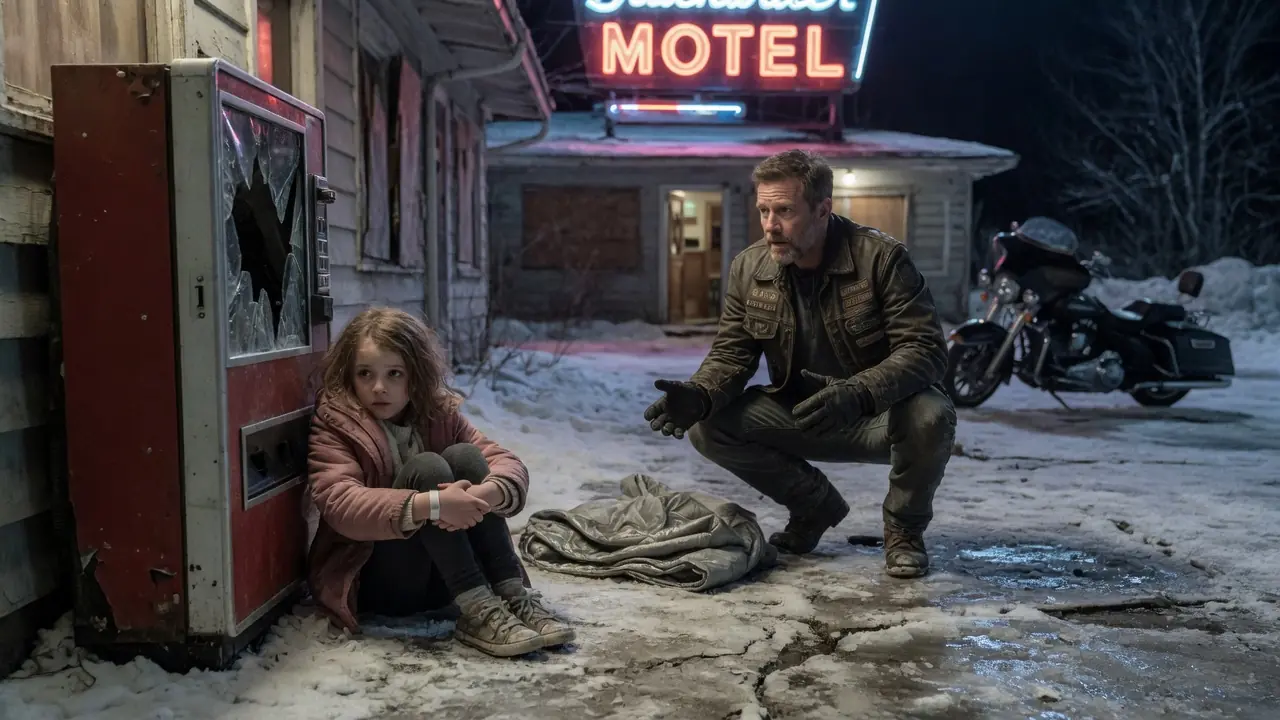
He crouched down in the snow and offered her his hand, and she whispered four words that cracked something open in his chest that had not moved in fifteen years.
“Are you going to kill me?”
Not, “Who are you?”
Not, “I want my mom.”
She asked if he was going to kill her, because somewhere in her six years of living, that had become a reasonable question to ask a stranger.
This was the Guardian Protocol.
The Blackwater Motel had been closed for two winters. Ronan knew this because he had ridden past it every month for two years on his way back from the VA clinic in Traverse City, a route he took deliberately, the long way, burning extra miles into the cold because the ride was the only thing that kept his head quiet.
The motel sat at the edge of Route 31 like a bad tooth in a broken jaw. Its parking lot was cracked and heaving, its pool a rectangle of black ice, its neon vacancy sign flickering one letter at a time in a rhythm that felt almost deliberate.
He had not thought much about it before tonight.
Tonight, the side door was open.
Not broken open. Not kicked in.
Open like someone had a key.
Ronan downshifted, his Harley Road King growling low as he pulled into the lot and cut the engine. He sat for a moment without moving, his breath fogging in the dark, gloved hands resting on the tank.
Fifteen years in the Marines and three tours in places where open doors meant ambushes had wired him in ways no amount of therapy had fully unwired. He looked at that open door and felt the old machinery kick on in the back of his skull.
His kickstand hit frozen asphalt with a sound like a rifle crack.
He walked toward the vending-machine alcove, not because he had seen anything, not because he had heard anything, but because the vending machine, dead and dark and gutted for parts, was throwing a faint reflection off a puddle of melt ice.
Something in that reflection did not look right.
Something was crouched behind the machine, between the wall and the metal casing, in a space barely large enough for a dog.
He stopped six feet away.
He did not reach for the flashlight on his belt.
“Hey,” he said quietly.
Not loud. Not soft. Just even.
Nothing.
“It’s cold.”
He exhaled slowly and watched his breath dissolve.
“Colder behind that machine than out here. Metal pulls heat right out of you.”
Still nothing.
But he could hear breathing now. Shallow, controlled breathing, the breathing of someone who had been practicing being quiet for a very long time.
“I’m not going to move any closer,” he said. “You don’t have to come out.”
A long pause.
Then slowly, a face appeared around the edge of the machine.
Small, pale as birch bark, with eyes too old for the face they lived in. She was wearing a pink coat that might have fit her a year ago and was now straining at the shoulders and barely reached her waist.
No hat.
No gloves.
Her hair was tangled and dirty, and she had a hospital bracelet on her left wrist that caught the faint light from the motel sign.
Ronan crouched, putting himself at her eye level, feeling his knees protest the cold concrete. She studied him the way he had seen Afghan children study American soldiers, with a flat, exhausted intelligence.
Calculating odds.
Measuring threat.
Not crying. Not calling for anyone. Just measuring.
He spread his hands, palms out, the universal language.
She looked at his leather jacket, his road-worn boots, the skull-and-wrench patch on his chest that marked him as road captain of the Iron Shepherd MC, Petoskey chapter. She looked at all of it, and he could see her filing it, processing it, coming to some quiet internal conclusion.
“Are you going to kill me?” she whispered.
Ronan had been to war.
He had carried men out of burning vehicles and held pressure on wounds he could not stop. He had written letters to mothers he had never met. He thought he had reached the bottom of what the world could do to him.
He found out he was wrong.
He kept his hands exactly where they were. He did not flinch. He did not fill the silence with noise.
“No,” he said. “I’m not going to kill you.”
“The other man said that, too.”
The hairs on the back of his neck stood up.
“What other man?”
She disappeared back behind the machine.
Ronan stayed crouched for another thirty seconds, then slowly straightened and pulled out his phone. He called 911 and kept his voice flat and factual.
Abandoned motel. Route 31. Female child, approximate age five to seven. Signs of exposure. Possible prior contact with unknown adult male.
He gave the address twice.
Then he put the phone in his pocket and sat down on the cold concrete with his back against the vending machine.
Not blocking her exit.
Not pressuring her.
Just present.
“My name’s Ronan,” he said to the wall. “People call me that because it’s my name. I ride motorcycles. I’m not good at cooking, but I can make decent coffee.”
Silence.
“You don’t have to tell me your name. You don’t have to tell me anything.”
He heard her shift behind the machine, a small sound like a sleeve dragging on metal.
“It’s Avery,” she said, barely audible.
“That’s a good name.”
She said nothing else.
Neither did he.
The wind moved across the parking lot in a low moan, carrying grit and ice crystals. Somewhere out on Route 31, a semi downshifted through a curve, and the sound of it was like distant thunder.
Ronan pulled his jacket tighter and waited, because waiting was the one thing he had gotten good at in a life that had not given him much else to be proud of.
He did not look at the hospital bracelet again.
He wanted to.
He filed that wanting away.
The cruiser arrived eleven minutes later, which was fast for this part of Emmet County at eleven at night in February, and that told Ronan the dispatcher had flagged it.
Two officers stepped out, neither of them people he recognized. The younger one went wide and approached the alcove with his flashlight. The older one came toward Ronan with that particular walk of men who had decided something before they had heard it.
“Sir, can I get your ID?”
Not a question.
Ronan gave it without comment. He watched the officer’s face when he read the address, the motorcycle club designation on Ronan’s registration, the general shape of a large scarred man in a cut at eleven at night outside an abandoned motel.
The younger officer coaxed Avery out from behind the machine with patient, gentle sounds. When she emerged fully into the flashlight, Ronan heard the older officer pull a breath.
She was smaller than she had seemed and colder. Her lips had gone the color of old bruises, and she was shaking in a way that had nothing to do with fear anymore.
That was the body giving up on maintaining temperature.
“She needs warming up before you do anything else,” Ronan said. “Her core is dropping.”
“Sir—”
“I’m a former combat medic. Her shivering has decreased. Her words are slurring. She needs heat, blankets, and she needs them in the next ten minutes.”
The older officer looked at him for a long moment. Then he keyed his radio and called for EMS.
The paramedics arrived in nine minutes.
Ronan stood at the edge of the parking lot and watched them work, his hands in his jacket pockets, the cold so complete now that even his Harley’s engine had stopped ticking.
Avery let the paramedics wrap her in a mylar blanket and put a warming pack against her chest. But when the female paramedic reached for the hospital bracelet to log the number, Avery grabbed her wrist.
“Don’t,” she said.
Her voice was stronger than it should have been.
“Honey, we just need to—”
“Don’t scan it.”
The paramedic looked at her partner. Her partner looked at the officers. The older officer looked at Ronan as if Ronan somehow had answers.
Ronan looked at the bracelet.
He could read it from eight feet away because his vision was still good, one part of him that had not been scavenged by time and geography.
The bracelet had a standard hospital ID strip, and below the patient number, stamped in blue ink, was a small institutional logo: a torch above an open hand.
He recognized it.
The symbol of the Brightwater Children’s Foundation.
He had written them a check three years ago. Four thousand dollars. His cut of a charity run the Shepherds had organized for a family in Petoskey who had lost everything to a house fire.
The donation had been anonymous, but he remembered the logo because the treasurer had shown it to him and said they vetted every dollar carefully.
Said this was one of the clean ones.
He stood very still in the snow and thought about a six-year-old girl who knew not to let anyone scan her hospital bracelet.
He thought about what that meant.
He thought about the words, “The other man said that, too.”
The emergency room at Northern Michigan Regional was bright in the particular way hospitals are at night. Too bright, a compensation for how dark everything outside had become.
Ronan followed the ambulance in his truck, the Harley too cold now to be sensible, and sat in the waiting room for two hours in a plastic chair designed by someone who had never actually been tired.
A social worker appeared at 11:40. She was a young woman, maybe thirty, wearing a wool coat over hospital scrubs like she had been called in. She had the particular exhaustion of someone who had been called in like this before.
She glanced at Ronan once, clocked his jacket, his size, the motorcycle club patches, and something in her expression went careful and professional.
“Are you family?”
“No. I’m the one who found her.”
“We appreciate that. We’ll take it from here.”
He nodded.
He did not move.
She looked at him again.
“Sir, you’re not going to be able to see her.”
“I know.”
“Then—”
“I’ll wait anyway.”
He leaned back in the chair and looked at the ceiling.
“In case she asks.”
The social worker opened her mouth, thought better of it, and went back through the doors.
Ronan sat in the plastic chair and counted ceiling tiles. He tried to remember the last time he had slept for more than four hours at a stretch and could not.
Her name was Naomi Briggs, he found out later. She had been with Emmet County Child Protective Services for six years. She had a reputation for thoroughness that her supervisors found inconvenient and her colleagues found exhausting.
She was, as it turned out, exactly the kind of person the situation required.
But Ronan did not know any of that yet.
He only knew that a child who asked strangers if they were going to kill her had flinched from a hospital bracelet instead of crying for her mother. Somewhere in the last hour, that had become his problem in a way he did not fully understand yet.
He understood it was his problem because he was still sitting in the chair.
He finally got coffee from the machine at one in the morning. Terrible coffee, the kind that tastes like hot brown memory.
He was staring into the cup when a detective arrived.
Cole Ramsay, according to the badge clipped to his belt, was a compact man in his forties with gray at his temples and the kind of eyes that were always moving, always filing.
He sat down one seat away from Ronan and did not introduce himself immediately, which Ronan noted and appreciated.
“You find many kids in abandoned motels?” Ramsay asked finally.
“First one.”
“Lucky night for somebody.”
Ronan drank his terrible coffee.
“She’s got a Brightwater Foundation bracelet.”
A pause.
“You know what that is?”
“I know the logo. Made a donation.”
Ramsay wrote something in his notebook.
“We know. Anonymous, but not very.”
He looked at Ronan sideways.
“The Iron Shepherds have a charitable giving program. It’s noted.”
Ronan said nothing.
“She wouldn’t tell us where she came from,” Ramsay said. “Wouldn’t tell us if there were other people with her. She asked the nurse twice if the doors locked from the inside.”
Ronan looked down at his coffee.
The word sat between them like something that had fallen off a table.
“She said they moved a lot,” Ramsay added. “Vans. Long drives in the dark. Kids who went to sleep in one place and woke up somewhere else.”
He closed his notebook.
“She’s six years old and she has the situational awareness of a field operative. Someone taught her to be afraid in a very specific, very practiced way.”
Ronan set the coffee down on the seat beside him.
“The bracelet had a case number,” Ramsay said. “We’re running it. But Brightwater’s legal team was on the phone with our supervisor within forty minutes of us logging the bracelet number.”
He paused.
“That’s remarkably fast.”
“Forty minutes,” Ronan repeated.
“Yeah. To get a lawyer on the phone at midnight.”
“That’s what I thought.”
Ronan stood up, rolled his shoulders against the stiffness and the cold that had gotten into him somewhere around hour two.
He looked at Ramsay directly for the first time, and Ramsay looked back without flinching, which was something.
“I’d like to know how she ends up,” Ronan said.
“I can’t—”
“I know you can’t tell me. I’m saying I’d like to know.”
He picked up his cup and threw it away.
“In case that matters to you at some point.”
He walked out of the hospital into a parking lot so cold the air felt structural. His breath came in solid clouds.
He stood beside his truck for a long moment, staring at the dark tree line beyond the hospital perimeter, thinking about a child who had survived something.
He did not know what yet, but he knew something.
She had ended up behind a dead vending machine in an abandoned motel on a night when the temperature was trying to kill everything it touched.
He thought about the forty-minute phone call.
He thought about the word houses.
He got in his truck.
He did not go home.
He drove to the Shepherd compound on the south end of Petoskey, a repurposed machine shop with a gravel lot and a hand-painted sign above the garage doors that read:
Iron Shepherd MC. Petoskey Chapter.
Below it, smaller, in Mac Devo’s particular chicken-scratch handwriting:
We ride. We remember. We don’t leave.
It was close to two in the morning when he knocked.
The light inside was still on. It was always still on.
Mac answered the door in jeans and a thermal shirt, coffee in hand, silver-haired and built like a fire hydrant, with hands that looked like they had been assembled from spare parts.
He looked at Ronan’s face and stepped back to let him in without asking.
Inside, the shop smelled like motor oil and old coffee and the particular dusty warmth of a space that had been lived in for years by people who needed somewhere to be.
Three other Shepherds were around the workbench.
Thiago Cruz, who did the club’s accounts and had a gift for making numbers tell different stories.
Dutch Farrow, who had two prosthetic fingers on his left hand and a laugh that could clear a room.
And Jess Oro, the youngest at thirty-one, who had ridden with them for four years and had never once been asked to be anything other than exactly who she was.
Ronan sat down on a workbench stool and told them what he had found.
He told it straight, no editorializing, the way he had learned to make reports under people who needed facts before feelings.
The hospital bracelet.
The forty minutes.
The word houses.
When he was done, the shop was very quiet.
“Brightwater,” Mac said finally. “You know them?”
“I know of them. Big charity. National.”
“Harrow runs it. Vincent Harrow. He was on the news last fall. Some award for saving children. All of that.”
He set his coffee down.
“He smiled a lot.”
“Men who smile a lot,” Dutch said, not finishing the sentence.
“The girl said there were other kids,” Ronan said. “She talked about vans. Properties. She described being moved.”
“Described?” Jess looked up. “She’s six.”
“Yeah.”
A longer silence.
Thiago pulled his phone out and started typing without being asked because that was Thiago. He processed by doing. His fingers moved with the focused quiet of someone used to finding things other people had tried to keep unfound.
“Brightwater had a fundraising gala in Petoskey last month,” he said, not looking up. “Raised 1.3 million. They operate nine residential facilities across the Upper Midwest. They receive state and federal child welfare contracts in four states.”
He paused.
“Their most recent annual audit was conducted by a firm whose principal donor is a board member of Brightwater.”
Nobody spoke.
“That’s not a smoking gun,” Ronan said.
“No,” Thiago agreed. “But it’s smoke.”
Ronan stood and looked at the wall where they kept the county map under a plastic sheet, push pins marking every run they had done, every stop, every safe house they had ever known about for any reason.
The Upper Peninsula and northern Michigan spread out in front of him like a hand with too many roads crossing the palm.
“The detective, Ramsay, he’s going to run the bracelet number,” Ronan said. “He’ll hit Brightwater’s legal wall inside twenty-four hours. Probably less.”
Mac said, “I want to know what’s in those facilities before that wall goes up.”
Mac looked at him for a long time, long enough that Ronan felt the weight of it, because Mac had known him for eleven years and had seen him climb back from places where climbing back seemed like a category error.
Mac knew what Ronan looked like when he was making a decision that was going to cost him something.
“We stay on the right side of the law,” Mac said finally. “I don’t care how bad this gets. We stay clean.”
“I know.”
“You know, or you’re telling me what I want to hear?”
Ronan met his eyes.
“I know, Mac.”
Another pause.
Mac picked up his coffee.
“Then ride careful,” he said. “And come back in one piece.”
Outside, the wind had picked up and was driving fine ice crystals horizontal across the compound lot, pinging against the garage doors like thrown sand.
Ronan stood in it for a moment before getting in his truck, letting the cold work into him, using it the way he had learned to use discomfort: as something that kept the mind sharp and the body honest.
He thought about Avery asking if the doors locked from the inside. He thought about children waking up somewhere different than where they had fallen asleep. He thought about a charity that had lawyers on the phone within forty minutes of a bracelet being scanned.
He pulled out of the lot and drove north on a road icing over at the edges, the tree line black and absolute on both sides.
Somewhere in the dark ahead of him, a little girl was in a hospital bed, learning whether the world she had landed in was safer than the one she had run from.
She had run from something. That much was clear.
The question, the question that was going to keep him awake for a very long time, was whether she had run toward something worse.
Then his phone buzzed.
A text from a number he did not recognize. No name attached. Just eight words that landed in the dark cab of his truck like a stone through glass.
She’s not the only one they’re looking for.
He stared at the screen for a long moment, the truck idling on the empty road, ice forming in crystals on the windshield at the edges of the defrost zone.
In the faint glow of the dashboard, he looked like what he was.
A man who had walked back into a war he had never asked to fight the first time, and who already knew with bone-deep certainty that walking away now was no longer a thing he was capable of.
He put the truck in drive.
The dark road opened up ahead of him and swallowed him whole.
The text came from a burner.
Ronan knew that before he even tried to call back. Three rings, deadline, number already disconnected. He sat in the dark cab of his truck on an icing road with the heater running and the wipers scraping frost off the edges of the glass. He read the message again as if the second reading might change what it said.
She’s not the only one they’re looking for.
They.
Not he.
Not someone.
They.
He drove back to the Shepherd compound. Mac was still at the workbench when Ronan walked back in, showing the screen without preamble.
Mac read it once. Read it again. Set the phone down on the metal surface with a deliberateness that was its own kind of statement.
“When did this come in?”
“Twenty minutes ago. Burner dead before I could call back.”
Mac looked at Thiago, who was already reaching for the phone. Thiago examined the number, typed something into his laptop, then shook his head once.
“Prepaid. Activated this morning. Made exactly one call before this text.”
He paused.
“To Brightwater Foundation’s main office line.”
The shop went very quiet.
Dutch set down his wrench. Jess stopped moving. Outside, the wind hit the garage door hard enough to make it flex, a low metallic groan that moved through the floor.
“Someone inside Brightwater,” Mac said.
Not a question.
“Someone scared,” Ronan said.
“Or someone setting you up.”
“Also possible.”
Mac looked at him.
The look lasted long enough that Ronan felt the weight of everything it carried. The eleven years between them. The things Mac had seen him survive. The things he had watched Mac bury. The unspoken agreement between men who had been through enough that they no longer needed to explain their instincts, only question them carefully.
“We don’t move on a text from an anonymous burner,” Mac said.
“I’m not asking to move. I’m asking you to know about it.”
“There’s a difference between knowing and being on the hook for what you do next.”
“I know the difference.”
“Do you?”
Mac’s voice did not rise. It did not need to.
“Because the last time you got sideways with something you couldn’t leave alone, you spent four months not sleeping and two more months making the rest of us sorry we had ever met you. That was about a piece of equipment contract. This is a child and a foundation with lawyers who answer phones at midnight.”
Ronan did not answer.
“I’m not saying walk away,” Mac said. “I’m saying don’t run.”
He picked up his coffee.
“There’s a difference between those two things, also. Walk.”
Ronan slept four hours on a cot in the back of the shop because driving home seemed both irresponsible and beside the point.
He dreamed the way he usually dreamed, not in images, but in sounds.
The low wash of a helicopter blade. A radio crackling in a language he did not speak. Someone calling a name that might have been his.
He woke at six in the morning to the smell of Jess’s terrible eggs and the sound of Thiago already on his laptop, the mechanical tapping of someone who had found something and was chasing it down with the focused patience of a man who knew how to follow money.
“Talk to me,” Ronan said, sitting up and putting his boots on.
“Brightwater Foundation,” Thiago said, not looking up. “Incorporated in Delaware, which tells you something and nothing. Operating in Michigan, Wisconsin, Minnesota, and Ohio. Nine residential facilities listed publicly. Those are the licensed ones.”
He paused and made a small adjustment to something on-screen.
“Property records in Emmet, Charlevoix, and Cheboygan counties show four additional properties held by a subsidiary LLC, Clearwater Property Holdings. Not listed anywhere in Brightwater’s public documentation. Not mentioned in any annual report.”
Ronan pulled on his jacket.
“What kind of properties?”
“Residential. Rural. One is listed as a vacation rental. One is agricultural use. One is listed as a rehabilitation facility, licensed, but the license was issued by a state board whose administrator retired abruptly eight months ago.”
He finally looked up.
“The fourth one was listed as vacant as of last March. Property tax records show utility usage consistent with continuous occupation.”
Dutch, who had been eating at the far end of the table, set his fork down.
“A vacant property that’s using electricity,” Jess said.
“Heating, water, and waste removal,” Thiago said. “Consistent monthly usage every month for at least a year.”
Ronan looked at Mac.
Mac looked at his coffee.
“Where?” Ronan asked.
“Twelve miles north of Brutus. Township road. No neighbors within a mile and a half.”
Ronan stood up.
“I’m going to drive past it.”
“Drive past,” Mac repeated, emphasis on both words.
“Drive past,” Ronan confirmed.
“You need company.”
“I need someone who can keep their temper if there’s anyone there.”
Dutch raised a hand.
“Not you,” three people said simultaneously.
Jess drove.
Her truck was newer and quieter than Ronan’s, and she had the particular skill of looking like nothing: an anonymous woman in a gray pickup on a country road in winter, which was something Ronan, in his leather and his size and his patches, could not achieve on his best day.
They took the main road north through Pellston and cut onto the township route at a junction marked only by a split reflector post and a dead mailbox.
The property was set back from the road behind a line of white pine that had been left to grow specifically, Ronan noted, to block sight lines.
The driveway was a gravel lane cleared of snow.
Not plowed.
Cleared regularly.
He noted the tracks. Multiple vehicles. Various tire widths. He noted the electrical line running in from the pole on the road. He noted the smoke coming from the chimney, thin and controlled, the smoke of a house being heated rather than a fireplace being enjoyed.
He noted the camera mounted on the pine at the corner of the driveway.
“Don’t slow down,” he said.
Jess did not slow down. She maintained exactly the speed of someone with somewhere else to go.
They passed the property in nine seconds, and Ronan used every one of them.
White-sided house. Two stories. Detached garage, newer construction than the house. Three vehicles: a white van, a dark blue SUV, and a pickup with Wisconsin plates, from what he could read at that speed. Windows on the upper floor covered with what looked like blackout curtains or plywood inserts.
No children in sight. No obvious adults in sight.
Lights on in every window, even in daylight.
And at the corner of the upper window, for exactly two of those nine seconds, something small and pale pressed against the inside of the glass before disappearing.
A hand too small to belong to an adult.
Jess drove for another half mile before either of them spoke.
“You saw it?” she said.
“Yeah. Upper left window.”
“Yeah.”
She kept driving. Her knuckles on the wheel were the same color as the snow outside.
“Ronan.”
“I know.”
“We can’t.”
“I know, Jess.”
She pulled over on the shoulder of the county road and put the truck in park. Outside, the tree line was dense and dark, and the sky was the flat white of a day refusing to commit to anything.
She stared through the windshield for a long time.
“If we go back,” she said, “and there are children in there and we do something wrong, we blow the whole case. Evidence gets thrown out. People walk. I’ve seen it happen. Everyone has good intentions, and then the right lawyer gets it thrown out, and the person who did the thing goes home, and the kids…”
She stopped.
“I know.”
“Do you? Because you have a particular look right now.”
“What look?”
“The one where you’ve already decided and you’re just waiting for the world to catch up.”
Ronan looked out the passenger window at the tree line. A crow landed on a branch and sent a small avalanche of snow down through the levels, triggering a chain of smaller collapses, white powder drifting in the still air.
“I’m going to call Ramsay,” he said.
“Will he listen?”
“He listened last night.”
“Last night was about one kid in a parking lot. This is about an unlisted property and a hand in a window and a text from a burner.”
“I know what it is.”
“Then you know it’s not enough.”
He pulled out his phone.
He called Ramsay’s direct line, which the detective had written on the back of a card and left at the nurse’s station because Cole Ramsay was, whatever else he was, the kind of man who left his number.
Ramsay answered on the second ring.
“Mercer.”
“I have something.”
“Talk.”
Ronan talked. He kept it tight: the Clearwater LLC, the four unlisted properties, the one twelve miles north of Brutus with cleared tracks and covered windows, and a child’s hand pressed against the glass for two seconds at sixty miles per hour.
Silence on the other end.
Not the silence of disbelief.
The silence of a man riding fast.
“The camera on the driveway,” Ramsay said. “Direction?”
“Pointed at the road. Caught our pass. Make and model of the truck.”
“Jess’s truck is registered to her name, which is not connected to the Shepherds.”
“Okay.”
Another pause.
“I can’t get a warrant on this today. The property records alone, the utility usage, a judge is going to want more. Brightwater’s lawyers are already in motion. We had two calls from their team this morning about the girl.”
“The girl has a name.”
A beat.
“Avery is currently in protective custody. She’s being seen by a specialist. She is…”
Ramsay’s voice shifted very slightly, in a way that told Ronan more than the words themselves did.
“Not doing well. But she’s not not doing well because of us.”
Ronan closed his eyes for a second, then opened them.
“Those kids in that house,” he said. “If someone in that house made a call this morning—”
“I know.”
“Then they know someone found her, which means they know someone might have found them.”
“Mercer—”
“How long does it take to move people?”
The silence this time was different. Longer. Heavier.
“Give me until tonight,” Ramsay said.
“I can give you until tonight.”
“And Mercer, I need you to stay away from that property.”
“Yeah.”
It was not a strong yeah, but it was the yes he had.
He did not go back to the property.
That part was true.
He drove with Jess back toward Petoskey and spent the afternoon in the compound doing what he had done in the military when he could not act.
He cleaned things.
He broke down his road kit and cleaned every component. He changed the oil on his Harley, which did not need changing. He reorganized the first aid supplies in the back of his truck with the systematic precision of a man who had kept his hands busy for years as a substitute for shutting his brain off.
Thiago kept digging.
By three in the afternoon, he had found six Clearwater LLC properties across four states, each with the same pattern: unlisted, rural, utilities active, minimal public documentation.
He had found the board of Brightwater and cross-referenced every member with their professional affiliations. He had found that Vincent Harrow had at various points in his career served on three state-level child welfare advisory committees, including one that directly influenced foster care placement protocols in Michigan and Wisconsin.
He had found that Naomi Briggs, the social worker from last night, had filed a formal complaint with her supervisor eight months ago regarding an anomaly in a Brightwater placement case.
The complaint had been reviewed and closed.
Naomi had been reassigned to a different district.
“She filed a complaint,” Ronan said, reading over Thiago’s shoulder. “And it went nowhere.”
“Does she know it went nowhere?”
“Given that she’s still at CPS and not anywhere near Brightwater cases, I’d guess she knows exactly where it went.”
Thiago pulled up a personnel directory.
“She’s in the Petoskey office now. Different caseload. Nothing touching the foundation.”
Ronan straightened up.
“She was at the hospital last night.”
“She was called in because it was a child welfare case in her district.”
Thiago turned around in his chair and looked at Ronan directly.
“Which means someone reassigned the geographic boundaries after her complaint in a way that put her back in proximity to Brightwater cases. That’s either incompetence or cruelty.”
“In my experience, when you’re not sure which one it is,” Thiago said, “it’s usually both.”
Naomi Briggs lived in a small rental on the east side of Petoskey, in a neighborhood of similar small rentals, the kind of street that never quite made it into the town’s promotional materials.
Ronan drove past twice before stopping, not because he was uncertain about the address, but because he was uncertain about the approach.
A large scarred biker showing up unannounced at a social worker’s home at four in the afternoon was not, by any objective measure, a good idea.
He knocked anyway.
She answered the door in a sweater and reading glasses, a mug in one hand. The look on her face when she saw him went through three stages very quickly: recognition, assessment, and a decision she apparently made before he even spoke.
“Mr. Mercer,” she said.
“Miss Briggs.”
“You shouldn’t be here.”
“I know.”
She looked at him for another moment. Then she stepped back and opened the door wider, which was not what he had expected.
The apartment was small and very organized in the way of someone who needed control of their immediate environment because the wider environment refused to cooperate. Stacks of files sat on the kitchen table. Not Brightwater files, he noted. Nothing with that logo, but the kind of accumulated paperwork that comes from years of a job that follows you home.
A corkboard hung on the wall with index cards and red thread. She had made a visible effort to cover it with a kitchen towel before he got far enough inside to see it clearly.
She caught him looking at the towel.
She did not take it down.
“I need to know about your complaint,” Ronan said. “Eight months ago. The Brightwater case.”
Her face went very still.
“That’s a closed administrative matter.”
“Is it officially?”
“I’m not asking officially.”
She sat down at the kitchen table, set her mug down, and looked at her hands for a long time.
He sat across from her without being invited.
“A placement case,” she said finally. “Boy, seven years old. Placed through Brightwater’s foster facilitation program. Standard paperwork. Standard home study. I did the follow-up visit at ninety days.”
She paused.
“The family didn’t have him.”
Ronan said nothing.
“The family had documentation of his continued placement. Signed forms. Regular check-in logs. Everything looked right.”
She turned her mug in a small circle on the table.
“But he wasn’t there. And the family couldn’t explain where he was in a way that made sense. When I escalated it, the case was reviewed by my supervisor, who reviewed it with regional leadership, who reached out to Brightwater. Within a week, the boy was reestablished in the placement, with documentation showing it had all been an administrative communication error.”
“Was it?”
She looked up at him.
“He had new marks on his arms that he didn’t have at the ninety-day visit. He didn’t make eye contact. He used to make eye contact. I remembered him from the initial placement meeting. He talked about dinosaurs for fifteen minutes straight.”
She stopped.
“He didn’t mention dinosaurs.”
“What happened to him?”
“He’s in a placement in Wisconsin now. I tried to follow the case. I was told it was outside my jurisdiction.”
“And your complaint?”
“Closed. Insufficient evidence of systemic concern.”
She said it like she was reading from the letter.
“I was transferred. My supervisor was promoted.”
She picked up her mug, then put it down without drinking.
“Last night,” she said. “The girl. Avery.”
“Yeah.”
“She has the same look. The same particular…”
She stopped again, and for a moment, her composure cracked along a fault line she had clearly been managing for a long time.
“The same look kids get when they’ve learned that asking for help doesn’t work. Not defeated. Just calibrated. Like they’ve run the math and the math says help is not a reliable input.”
Ronan put his forearms on the table.
“She said there were other children. Houses. Vans.”
“I know. I took her initial statement.”
“Did you file it?”
“I filed everything through proper channels.”
Her voice was careful in a way that said everything her words were not saying.
“Within the framework of my caseload, as required.”
“What does that mean?”
“It means I did what I’m supposed to do, which means it will go where these things go, and someone will review it. And Brightwater’s lawyers will be involved in that review because Brightwater has a formal consultative relationship with the county child welfare office that was established three years ago and has never been audited.”
Ronan sat back.
“They’re inside the system,” he said.
“They are the system,” she said. “Or close enough that the difference doesn’t matter when it counts.”
He looked at the towel covering the corkboard.
She followed his gaze.
A long pause.
She got up, crossed the room, and took the towel down.
The corkboard had twelve index cards on it, names, dates, and case numbers connected by red thread that made a web he could not fully read from across the room. But he could read the name at the center, written in black marker and circled twice.
Vincent Harrow.
“How long?” Ronan asked.
“Since the complaint was closed,” she said. “Eight months. On my own time. With my own resources.”
“Without telling anyone.”
“Because the last time I told someone, I got reassigned.”
He looked at her.
“Why are you telling me?”
She looked at him straight.
“Because you’re not inside the system.”
“What?”
He called Ramsay at six in the evening.
Ramsay’s voice had the particular flat quality of a man who had been in too many conversations with people above his pay grade and was running out of the kind of patience that did not show on the outside.
“The warrant application is stalled,” Ramsay said. “The judge is reviewing Brightwater’s objection. Their legal team filed a preemptive motion claiming harassment and investigative overreach based on the bracelet inquiry.”
“They filed a preemptive motion?”
“This afternoon. Three o’clock. Someone told them we were looking.”
A pause.
“That is a possibility I’m taking seriously.”
“Is it someone in your department?”
“That,” Ramsay said, “is a question I cannot answer on an unsecured line.”
Ronan processed this.
“The property north of Brutus?”
“I drove past it myself at 5:30.”
Ramsay’s voice dropped further.
“The driveway has been cleared more recently. The vehicles are gone. All of them.”
“All of them.”
Ronan’s grip on the phone tightened by small degrees.
“The kids.”
“I don’t have confirmation of—”
“Cole.”
He had not used the first name before.
“The kids.”
A long, damaged pause.
“I don’t know where they are. That’s the honest answer. I don’t know.”
He hung up.
He stood in the parking lot of a gas station on the edge of Petoskey with the phone in his hand, the temperature dropping, the wind coming off the lake with actual malice.
He breathed until his chest stopped doing the thing it did when situations closed in from too many sides at once, a leftover from overseas, a physical manifestation of tactical suffocation that his therapist had a name for and that he had a different name for, which was just Thursday.
He rode back to the compound.
He needed to think. He needed to be in a room with people who understood what it meant to hold something together when official channels were compromised and the clock was running, and the only things you had were will, motorcycles, and eleven years of showing up for each other when no one else would.
What he found when he got to the compound was not that.
What he found was Dutch Farrow standing in the middle of the shop floor with his arms crossed and his jaw set, and Mac Devo behind the workbench with his hands flat on the surface, the specific quality of silence between two men who had just stopped talking because someone walked in.
“What?” Ronan said.
Dutch looked at Mac.
Mac looked at Ronan.
“I made some calls,” Dutch said.
“What calls?”
“I know a guy in Charlevoix. He knows a guy who does security work. He knows which properties in the county have private security contracts and which ones don’t.”
Dutch unfolded his arms.
“The property north of Brutus had a contract with a firm called Meridian Risk Solutions. That contract was renewed three months ago.”
“Okay.”
“Meridian Risk Solutions also holds contracts for two of Brightwater’s licensed facilities.”
Ronan looked at Mac.
“That’s consistent with what we already—”
“The Meridian contract for the Brutus property has a secondary client listed,” Dutch continued. “Not Brightwater. Not Clearwater.”
He paused.
“A personal services agreement with one private individual named in the contract as the on-site authority for security decisions.”
“Who?”
Dutch reached behind him and handed Ronan a piece of paper, a photocopy slightly blurred but legible, with a name on a signature line.
Ronan read it.
Read it again.
Deputy Regional Director of the Michigan Department of Health and Human Services.
A state official.
A man whose name appeared on the board of advisers for exactly two organizations in the public record, one of which was Brightwater Foundation and the other a state-level foster care reform committee that had been quietly restructuring placement oversight for the last three years.
Someone inside the regulatory apparatus.
Someone with access to child welfare case files, placement records, the ability to move cases, close complaints, redirect investigations.
Someone who had, as Ronan now understood with the cold clarity of a man who had fought in places where the enemy wore civilian clothes, been inside this from the beginning.
“Dutch,” Mac said, and his voice had an edge Ronan had heard maybe four times in eleven years. “How did you get a copy of a private security contract?”
Dutch met his eyes.
“You don’t want to know.”
“I do want to know. That’s why I’m asking.”
“My guy in Charlevoix has a friend who did some work on Meridian’s filing system.”
Dutch held Mac’s gaze without blinking.
“The work was done tonight. Before any of this became what it is. I didn’t ask him to. He found it and called me.”
“That’s not legal.”
“No.”
“Which means we can’t use it.”
“We can’t use it in court,” Dutch said. “We can know what it says.”
The shop was so quiet Ronan could hear the wind finding the gaps in the old garage door the way it always did in February, a low, persistent whistle that had become so familiar over the years that he usually did not hear it anymore.
Right now, he heard it clearly.
“Mac,” Ronan said.
“Don’t.”
“Listen—”
“I said don’t.”
Mac’s hands pressed harder against the workbench.
“I know what you’re going to say. I know what that look means. I have known you for eleven years, and I know what that look means. And I’m telling you right now, before you say the words, that whatever you’re thinking about doing with this information, you need to think about it twice.”
“They moved the kids tonight.”
“You don’t know that.”
“Ramsay confirmed the vehicles are gone. The property is cleared. Someone leaked to Brightwater that we were looking. Which means—”
“Which means they had a head start, Ronan. Which means if you go off half-cocked based on an illegally obtained document and a guess—”
“It’s not a guess.”
“It’s not evidence, either.”
“Those kids don’t have time for evidence.”
The words hit the shop walls and came back from all four sides.
Then there was silence.
The particular silence after a voice has been raised in a place where voices are not usually raised.
Ronan stood in the middle of it and breathed and watched Mac not move.
Jess was in the corner. Thiago was at his laptop, not typing. Dutch had not moved. Mac looked at Ronan for a long time with the expression of a man who had been in this place before, standing between the thing that needed to be done and the thing that needed to stay intact, and knowing exactly how much each of them cost.
“Thiago,” he said without looking away from Ronan. “Can you find where the vehicles went legally? Traffic cameras. Public road footage. Gas station records.”
“I can try,” Thiago said quietly. “It’ll take time.”
“How much time?”
“Depends on what’s available. A few hours, maybe more.”
Mac finally looked away from Ronan. He picked up his coffee, found it was empty, and set it down again.
He stood there for a moment with his hands at his sides, breathing in a deliberate, measured way that Ronan recognized because he had learned it from the same places.
“We do this right,” Mac said. “We do this clean or we don’t do it. Those kids deserve to have this done right.”
He looked at Ronan again.
“You hear me?”
“I hear you.”
“That’s not the same as agreeing.”
“No,” Ronan said. “It’s not.”
He walked to the back of the shop and sat down on the cot, putting his face in his hands.
Not despair.
Not collapse.
The specific posture of a man running out of acceptable options and beginning to reckon with that honestly.
His phone buzzed.
A message from Naomi Briggs.
No text, just a file attachment.
A document.
He opened it and scrolled through in the dim light of the back room. As he read, something shifted in him with the finality of a structural change, a foundation crack rather than a surface one.
It was Avery’s initial intake interview, the full transcript, not the summary.
Page nine, paragraph three, four sentences that Naomi had highlighted in yellow before she sent it.
Avery stated that the adult male in charge told children they would be taken somewhere better. When asked how many children she had traveled with, Avery stated, and I quote directly, “There were nine of us in the beginning. Marcus and the little twins went away. Now there are six.” When asked what “went away” meant, subject became nonresponsive and began rocking.
Nine children.
Six remaining as of whenever Avery had last been with them.
Three unaccounted for.
Marcus and the little twins went away.
Six years old. Those words in that order. From a child who had learned to be quiet like a field operative.
Ronan set his phone face down on the cot and sat very still in the dark back room of the Iron Shepherd compound while the wind worked at the walls and Thiago’s fingers found their rhythm on the keyboard again in the main room.
Somewhere north of Petoskey, on roads that were icing over and clearing and icing again with the indifference of February, a van was moving in the dark with children inside who had learned that asking for help was not a reliable input.
He picked up his phone.
He did not call Ramsay.
He did not call Mac.
He opened a map and looked at the road network north of Brutus, the county roads, the township routes, the logging tracks that appeared on satellite view but not on standard navigation.
He thought about which roads would move vehicles quickly and which would move them invisibly. He thought about the Wisconsin plates on the pickup he had clocked at sixty miles per hour that afternoon. He thought about a security contractor who answered to a state official who could open and close doors in child welfare systems across four states.
He thought about Marcus and the little twins.
Then he made a decision he understood clearly and without self-deception was going to cost him something he had not finished calculating yet.
Something that had to do with Mac’s trust and the clean lines they had agreed to operate inside. Something that had to do with the careful legal framework Thiago had been building all day with the patience of someone who believed in the framework.
He was still going to make it.
He put on his jacket. He laced his boots. He walked out of the back room and through the main shop without stopping, eyes forward.
He had his hand on the exterior door when Mac’s voice came from behind him, quiet and exactly level, with no surprise in it at all.
“Ronan.”
He stopped, his hand on the door.
“If you walk out that door right now,” Mac said, “and you do what I think you’re going to do, I can’t protect you from what comes after. You understand that? I can’t pull you back from it. Whatever you break tonight, I can’t fix.”
Ronan stood with his hand on the door for a long moment.
“Marcus and the little twins went away,” he said.
Silence.
“She said it like it was a weather event,” he said. “Like it was something that happened the way seasons happen. A six-year-old. That’s how she said it.”
He heard Mac set down his mug.
“Go,” Mac said.
The word came out rough and quiet, like something dragged over gravel.
“But you call me every hour, and you do not engage. You find. You do not engage.”
A pause.
“You come back.”
Ronan pushed the door open.
The cold hit him like a wall. The parking lot gravel was frozen solid under his boots, each step a small crystalline crunch.
His Harley sat where he had left it, the chrome sheened with ice crystals, the engine cold and contracted in the February dark. He swung his leg over, felt the familiar geometry of the machine settle around him, hit the ignition, and listened to the engine turn over and catch, the idle rough in the cold, the exhaust pipe spitting condensation in white puffs that the wind immediately took apart.
He pulled out of the compound onto the empty road heading north.
Somewhere ahead of him, in the dark, on roads that crossed and doubled back and disappeared into tree lines, a white van was moving children who had stopped expecting help.
He was not going to let that be the end of the sentence.
The road north of Brutus at eleven at night in February was not a road so much as a theory, a suggestion of asphalt beneath two inches of packed snow bordered by tree lines that absorbed headlight and gave nothing back.
Ronan rode without music, without the earpiece he sometimes used on long hauls, because he needed to hear everything the road was telling him. Roads in winter had their own language if you had spent enough years listening to it.
He had ridden these counties for eleven years.
He knew which logging tracks showed on satellite but not on maps. He knew which county roads got plowed at three in the morning and which ones got left until morning. He knew the geography of this part of Michigan the way a man knows the geography of somewhere he has chosen.
Not the clean abstraction of a map, but the granular, embodied knowledge of someone who has felt every elevation change through handlebars at sixty miles per hour in every kind of weather.
He was using all of it now.
He pulled over twice in the first ten miles: once to check his phone for the traffic camera data Thiago had been pulling, and once because something on the road shoulder had not looked right and turned out to be a deer carcass that had been there long enough to become part of the landscape.
Each time he stopped, he killed the engine and listened.
The wind through pine.
The distant sound of a semi on the state highway two miles east.
The specific quality of silence that meant nothing was moving within a quarter mile.
The third time he stopped, it was because his headlight caught a fresh tire track crossing from a logging access road onto the county route he was following. Tread width consistent with a van. The impression sharp enough to have been made within the last hour, before the temperature had a chance to harden it back to iron.
He sat on the idling bike and studied the track in his headlight beam.
The access road ran west through the pines toward the lake, which meant it connected eventually to the private properties on the bluff above the shoreline. The kind of properties that cost serious money and were owned by people who did not need to explain themselves.
He knew two of those properties from club history. One had been the scene of a noise complaint they had been tangentially involved in three years ago, and one was owned by an LLC that Thiago had flagged this afternoon.
Brightwater’s unlisted fourth property had not been north of Brutus.
It had been here.
He pulled out his phone and called Thiago.
“I need the Bluff properties above Route 31 north of Pellston,” he said when Thiago picked up. “Ownership records. Occupancy. Everything.”
He heard Thiago already moving, already typing.
“Give me four minutes.”
“I’m on a logging track in the dark. Take three.”
He sat in the cold and watched his exhaust fog in the headlight beam. He thought about the tire track and how long the drive would be from the property north of Brutus to the bluff road.
The math worked.
It worked if they had left within forty minutes of when Ramsay had driven past and found the vehicles gone. That meant someone had been watching Ramsay’s approach. That meant the property had surveillance he had not clocked on the morning pass. That meant they were better resourced than a charity with nine residential facilities had any legitimate reason to be.
His phone buzzed.
Thiago texted rather than called.
Bluff Road. Three properties under Clearwater LLC. One shows a private security agreement filed with the county. Renewed six weeks ago. Gate and perimeter. Address is 4417 Lake View Ridge Road.
Below that came a second text.
Ronan. Mac wants you to confirm you’re not doing anything.
He put the phone in his pocket and turned the Harley onto the logging track.
He kept the last stretch slow and quiet, letting the night tell him what it would.
The access track joined a private lane that was paved and recently cleared, better maintained than the county road, which said everything about priorities.
The gate at the perimeter was a serious piece of equipment: steel frame, electronic lock, camera mounted on the left post at a height calculated to catch vehicle windows.
He left the bike in the tree line and went the rest of the way on foot.
The property was larger than the Brutus house, a main structure of the kind real estate listings called a lake retreat and Ronan called excessive, flanked by two outbuildings and a garage with three bays.
The main house had lights on the ground floor only. The garage had light leaking under the doors.
Three vehicles were in the lane beside the garage: the white van, the Wisconsin pickup, and a third vehicle he had not seen before.
A black Suburban with federal contractor plates.
Federal contractor plates.
He crouched behind a pine at the tree line and looked at those plates for a long time, feeling something cold move through him that had nothing to do with temperature.
He had his phone out and was framing a photograph of the plate when he heard voices.
Two men coming around the far side of the garage, speaking in the low, task-focused tone of people managing logistics.
He froze, pressing back against the pine.
“Second transfer needs to be wheels up by six a.m. Weather window closes at eight.”
“The Harrington file is still open.”
“Close it.”
“We can’t close it until—”
“I said close it.”
A pause. The sound of boots on frozen gravel.
“Harrow wants everything clean before morning. If the investigator has a warrant application in, we have maybe twelve hours before someone with jurisdiction shows up.”
“The state guy—”
“The state guy is handled. He’s been handled for two years. That’s not the problem.”
Another pause, longer.
“The problem is the biker.”
Silence.
“Mercer. Ramsay pulled his record this afternoon. Mercer did three tours. Combat medic. The man does not stop when he’s told to stop.”
“Harrow wants eyes on him.”
“We already have eyes on—”
A door opened. The voices moved inside. The door closed.
Ronan did not move for sixty seconds.
Not from indecision. From discipline.
Moving too fast after that kind of information was how you made the last mistake of an otherwise survivable situation.
He counted his own heartbeats and let the cold work into him. He processed what he had heard with the flat analytical machinery that training had bolted onto his instincts.
Eyes on him.
Present tense.
Already.
He photographed the Suburban’s plates from the tree line. Then he eased back through the pines the way he had come in, slow and lateral, keeping tree trunks between himself and the house cameras until he was far enough into the logging track to move faster.
He reached the Harley and stood there for a moment with his hand on the tank, the metal so cold it burned through his glove.
He thought about six children in that house.
He thought about wheels up by six a.m.
He thought about what wheels up meant.
Not another van transfer. A vehicle with wheels that went up meant an aircraft. A landing strip or a private airfield. A transfer distance beyond the county road network he had been thinking in.
This was not a Michigan problem anymore.
It was an everywhere problem, and the geography he had been relying on had just become irrelevant.
He called Ramsay.
Ramsay answered in one ring, which meant he had not been sleeping.
“Where are you?”
“Lake View Ridge Road, north of Pellston. Property owned by Clearwater LLC. White van, Wisconsin pickup, and a black Suburban with federal contractor plates. I’m sending you the number now.”
He read it off from the photograph.
“There are at least two men on-site. I heard conversation about a transfer aircraft at six a.m., a weather window, and Ramsay…”
He paused.
“They mentioned you by name. They said you have a warrant application in and they have about twelve hours.”
A silence lasted exactly long enough for Ronan to understand that Ramsay was processing the same thing he had processed.
That a law enforcement warrant application being known to the people the warrant was targeting meant the leak was no longer a guess.
“How many children on-site?” Ramsay asked. His voice had gone very flat.
“I didn’t get visual confirmation, but the Brutus house had six. The voices mentioned a Harrington file and closing it before morning, which I’m interpreting as case documentation.”
“You’re interpreting,” Ramsay said.
“I’m telling you what I heard.”
“If I go to a judge with this, they’ll know before the ink is dry. You said yourself there’s a leak.”
Another silence. Longer.
“Ramsay,” Ronan said. “If those kids are on a plane at six a.m., where are they?”
No answer.
“Somewhere a Michigan warrant doesn’t follow them.”
“Mercer, do not go back to that property.”
“I’m not planning to go back tonight. I’m planning to send you these photographs and go back to the compound and call you every hour until sunrise.”
He paused.
“And then I’m going to stand in the road with every Shepherd I can reach. I’m going to make it very difficult for that van to get to wherever it’s going without someone in an official capacity noticing. That’s the plan.”
“That’s a plan that could go badly.”
“All my plans go badly. They still work out more often than the alternative.”
He hung up, sent the photographs, turned the Harley north, away from the property, back toward the county road, and rode for three miles before pulling over and calling Mac.
Mac picked up. Said nothing.
“Aircraft transfer,” Ronan said. “Six a.m. They already know about the warrant application. There’s a leak inside the department.”
A long pause.
“Come back.”
“I’m coming. I need everyone reachable tonight. Everyone who can ride.”
“Ronan, we stay legal.”
“We block roads. We call in locations. We act as witnesses. We don’t touch anyone. We don’t threaten anyone. We park motorcycles on public roads, and we make it very hard for a van to disappear.”
He paused.
“That’s still legal, Mac. We’ve done it for charity runs. Same principle.”
Mac breathed on the other end of the line, a man negotiating with himself in real time.
“Come back first,” Mac said. “Then we plan.”
He was four miles from the compound when the truck appeared.
It came from a side road at speed. Not quite a collision course, but close enough that he had to brake hard and felt the Harley’s rear wheel slide on the ice before he corrected and brought it back.
The truck blocked the road, headlights on full.
For a second, he was just looking into the glare with his heart doing the thing it did in ambush situations, the immediate spike of everything accelerating at once.
Then the driver’s door opened, and Detective Cole Ramsay stepped into his own headlights.
Ronan killed the Harley’s engine. Let the silence settle.
Ramsay walked toward him with his hands visible and his face arranged in an expression Ronan could not read in the backsplash of the headlight.
“I need to tell you something,” Ramsay said. “In person. Before this goes any further.”
“You drove out here at midnight.”
“I did.”
“Without calling first.”
“My phone is in the truck.”
He stopped six feet away.
“I left it there.”
The implication sat between them in the cold air.
Ramsay thought his phone was compromised, which meant Ramsay thought his phone had been compromised for long enough that he did not want to use it for what he was about to say.
“Talk,” Ronan said.
Ramsay breathed out slowly. The exhale fogged and dispersed.
“The warrant application. I filed it through standard channels this morning. Six people had access to it before it reached the judge. My sergeant, the county DA’s office, the reviewing judge’s clerk, and the court administrator.”
He paused.
“The court administrator is listed in Brightwater’s annual report as a community partner, a volunteer contributor.”
“Okay. That’s the leak I thought we had.”
Ramsay looked at him steadily.
“It’s not the only one.”
Ronan waited.
“The initial report, the one from last night from the ER, standard child welfare flag, went into the county system.”
Ramsay’s jaw tightened almost imperceptibly.
“Brightwater’s consultative relationship with the county child welfare office includes read access to intake reports flagged as involving their case numbers. They saw it the same night, within two hours of the ER upload. That’s why their lawyers were calling at midnight.”
He paused.
“That’s also why the Brutus property was cleared before I could get a warrant. They didn’t need a leak inside my department. They had a legal, formally contracted line of sight into the child welfare intake system.”
Ronan said nothing.
“They built it in,” Ramsay said. “The consultative relationship. It was established three years ago, and the access was framed as a collaborative data-sharing initiative for child safety.”
The flatness of his voice on the last two words was complete.
“It passed through the county board unanimously. Harrow presented it himself. He brought photographs of children his foundation had placed.”
The cold was deep now, the kind that had stopped being a sensation and become a condition.
Ronan stood beside the dead Harley and felt the temperature working through his jacket. He thought about a man who had built his surveillance system out of compassion, who had used the language of child welfare to construct the mechanism that protected him from child welfare investigation.
“The federal contractor plates,” Ronan said.
Ramsay nodded.
“I ran them. The Suburban is registered to a company called Apex Consultancy Group. They hold logistics and transportation contracts with three federal agencies. One of those agencies has a formal data-sharing protocol with state-level child welfare systems in twenty-two states.”
He stopped.
“I’ve been making calls for the last two hours. I reached someone at the federal level, a contact I trust, someone I’ve worked with before. She told me Apex has been on an internal watch list for fourteen months. Irregular invoicing patterns. Anomalous contract renewals. Red flags in three states.”
He paused.
“The investigation has been stalled because the supervising official on the federal side has a personal relationship with one of Apex’s principals.”
“How personal?”
“The supervising official’s wife sits on Brightwater’s national advisory board.”
The information arrived like rounds arriving.
Not dramatic. Not loud. Just the sudden fact of impact.
Ronan had been in enough firefights to know the first shock is not pain, but geometry. The sudden recalculation of where everything is and where everything has to be now.
This was that. The quiet, terrible geometry of a system that had been designed not to fail, but to appear to be working while serving an entirely different purpose.
“It goes up,” Ronan said.
“Higher than I can reach alone,” Ramsay said. “Yes. Which means the warrant is easy and not easy. Even if I get it tonight from a judge I trust, and I have one I trust, one who is not connected to any of this, the execution of the warrant goes through channels. Notification, coordination, resource allocation. Every one of those steps has a point where the information moves through a system that has been compromised at multiple levels.”
“They’ll know before we get there.”
“In time to move the children.”
“Yes. Probably.”
Ronan got off the bike. He needed to move. He walked three steps in one direction, turned, walked back, stopped.
Ramsay watched him without speaking, which Ronan appreciated.
“The aircraft,” Ronan said. “Six a.m. If they’re moving children by air, there’s a landing strip private in this county or the next.”
“I’ve been looking at that.”
“How many private airstrips in Emmet and Charlevoix counties?”
“Licensed ones? Four.”
“Unlicensed, unpaved, the kind that show up on aerial surveys as grass strips?”
Ramsay paused.
“Fourteen. At least within forty miles.”
“We can’t cover fourteen.”
“No.”
Ronan thought.
The discipline of narrowing. The military had taught him to think in terms of constraints. Not what you wished you had, but what you had and what the problem’s own geometry demanded.
“The Suburban,” he said. “Federal contractor. If they’re moving children across state lines or internationally by air, they need documentation. Medical clearances. Transfer authorizations.”
“That paperwork runs through the state official, the one whose name was on the Meridian contract,” Ramsay said.
“Deputy Director Ellison.”
Ramsay said the name for the first time, spoken plainly.
“He generates the paperwork.”
“Where does he generate it from?”
“His office or remotely from a registered state device.”
“Is he in Petoskey?”
“His office is in Gaylord. But…”
Ramsay stopped. Something shifted in his face.
“His personal residence is listed in Charlevoix, fifteen miles from here. If he’s generating authorization documents for a six a.m. transfer, he’s doing it tonight.”
Ramsay looked at him for a long moment.
“I can’t surveil a state official’s private residence without authorization.”
“I know you can’t.”
A pause.
“But I’m not you,” Ronan said.
“Mercer.”
“I can park a motorcycle on a public street. I can look at a house from a public road.”
“If you tip him off—”
“I’ve done surveillance in places where being tipped off meant somebody shot at you. I think I can manage a county road in Michigan.”
He paused.
“Give me the address.”
Ramsay looked at him, looked away, looked back.
A man negotiating with his oath in real time.
Ronan gave him the time to do it because it mattered. Because the oath mattered. Because the fact that Ramsay took it seriously was exactly why Ronan was standing on this road talking to him instead of treating him like another obstruction.
Ramsay gave him the address.
He did not go alone.
He called Jess from the road and gave her the address and the situation in the same flat, factual voice he had used for the hospital call.
Jess said nothing for four seconds.
Then she said, “Fifteen minutes,” and hung up.
He called Thiago and told him about Apex Consultancy Group and the federal connection. He heard Thiago start typing before he had finished the sentence.
He called Mac last.
Mac answered on the first ring and listened to the complete picture: the aircraft transfer, Ramsay’s disclosure, Ellison’s name, all of it without interrupting.
When Ronan finished, the silence lasted long enough that he could hear Mac breathing slow and deliberate, the breathing of a man managing something large.
“He’s a state official,” Mac said.
“I know.”
“If we’re wrong—”
“I know.”
“If we’re right and we do it wrong—”
“I know, Mac. I know all of it.”
Another pause.
“Dutch and I will be on the bluff road at four a.m. on the public road. Engines off. We’ll watch the gate.”
He paused.
“Jess has a camera with a long lens.”
“Yeah. We document. We witness. We call in everything we see through Ramsay.”
“Yeah.”
“Ronan.”
His voice changed. Not softer. Older. The voice of a man who had been carrying something for a long time and was deciding whether to set it down.
“Eleven years ago, when you showed up at my door, you were… you were not good, brother. You were holding on to the outside of something. I don’t know what would have happened if you’d let go. I don’t say that to manipulate you. I say it because I need you to understand that you going off alone tonight and getting yourself killed or arrested is not something I can frame as acceptable loss.”
Ronan stood on the dark road with the phone against his ear and let the words do what they were meant to do.
“I’m not planning to get killed,” he said.
“No one ever is.”
“Mac, those kids are getting on a plane in six hours.”
“I know.”
“So I’m going to go look at a house from a public road.”
“Yeah.”
A long exhale.
“Yeah, you are.”
A pause.
“You call me every forty-five minutes.”
“Every forty-five.”
“Go.”
Ellison’s residence was a newer build on the edge of Charlevoix, the kind of house that expressed success in the language of square footage and landscaping. A long driveway. A three-car garage. A house whose exterior lights were on at 12:40 a.m. when they had no reason to be.
Ronan parked on the road shoulder two hundred yards south. Jess pulled in behind him a minute later and climbed out with the camera already around her neck.
They did not speak.
She moved to the edge of the road, found her angle, and started shooting. Long lens, fast glass, the camera shutter nearly silent in the winter air.
Ronan stood behind her and watched the house with his eyes instead.
Ground floor lights, back of the house. One vehicle in the driveway, a state-issued sedan, the kind of unremarkable gray that announced government affiliation to anyone who knew the plates.
A figure moving past a window in what was probably a home office.
Not pacing. Just moving with the purposeful regularity of someone working. Someone at a desk who got up and moved and sat back down.
“He’s working,” Jess said quietly.
“Midnight paperwork.”
She kept shooting.
“What do we do with this?”
“We send it to Ramsay. He sends it to his federal contact.”
“That takes time.”
“I know.”
“Six a.m. is—”
“I know, Jess.”
She lowered the camera for a moment and looked at him sideways. In the ambient dark, her face was unreadable except for the tension around her jaw, the particular set of her expression that he had learned meant she was holding something back.
“What?” he said.
“Nothing.”
“Say it.”
She looked at the house.
“That man in there, he’s going to finish his paperwork and go to bed. In five hours, someone is going to put children on a plane, and he’s going to wake up, and nothing is going to have happened to him. Not tonight. Maybe not ever.”
She paused.
“I’ve been thinking about that.”
“Don’t.”
“I know we’re not going to—”
“Don’t think about it. It doesn’t help.”
She raised the camera again.
“It makes me angry.”
“Good,” Ronan said. “Hold on to that. It keeps you sharp.”
He looked back at the house.
“Being angry is different from being stupid. We need the first thing right now. We can’t afford the second.”
She kept shooting.
He kept watching.
At 1:15 a.m., Ellison’s home office light went dark. At 1:17, a second light came on in what appeared to be the attached garage. At 1:22, the garage door opened, and the state sedan backed out.
Ellison was driving alone, heading north on the county road, away from town.
Ronan was on the Harley before the sedan’s taillights had reached the curve.
“Don’t,” Jess said behind him.
“I’m following, not intercepting. Call Ramsay.”
“Ronan.”
He was already moving.
He followed at a careful distance, giving the sedan enough room that he would not become a shape in the rearview mirror. He had done this kind of follow before in places where the stakes were differently calibrated, but the technique was the same.
Match speed.
Adjust for visibility.
Never get close enough to become the thing the person ahead of you remembers.
The Harley was loud and he knew it, which was why he let the gap breathe. Let the engine sound dissipate into the tree walls on both sides.
Ellison drove for nine minutes, then turned onto a private road Ronan recognized from his afternoon map study. Ronan pulled the Harley onto the shoulder and killed the engine before the sedan’s lights had reached the next curve.
He sat in absolute silence and listened to the sedan’s engine fade.
He knew where the private road went.
He pulled out his phone, opened the satellite map, and confirmed it.
The private road terminated at a grass airstrip registered to a holding company Thiago had flagged six hours ago as one of fourteen potential strips in the county.
Except it was not unlicensed.
It was registered.
It just was not registered to anything connected to Brightwater or Clearwater or Apex in any way the last six hours of digging had surfaced.
It was registered to a holding company whose principal was not Vincent Harrow.
Ronan stared at the name on his screen and understood with a cold clarity that arrived like a change in weather that he had been thinking about this wrong.
Harrow was the face.
Harrow was the charity and the smiling photographs and the award and the public narrative. Harrow was the part of the machine that was visible.
This name, the name on the airstrip registration, was not visible. Had never been visible. Had been specifically and deliberately kept from visibility, nested inside holding companies and contractor relationships and state advisory boards in a structure so carefully distributed that no single thread pulled from any single direction would unravel the whole thing.
It was the name of a man Ronan had never heard of.
Which was, he now understood, exactly the point.
He called Ramsay.
Ramsay answered in half a ring.
“Ellison just drove to the airstrip,” Ronan said. “Nine minutes north of his house. The strip is registered to—”
He read the name from his screen.
Silence on Ramsay’s end.
Then, “Say that again.”
Ronan said it again.
“Mercer.”
Ramsay’s voice had changed. Not the flat professional tone. Something underneath it. Something that sounded like a man who had just stepped on ground that was not there.
“That name. Where did you get that airstrip registration?”
“It’s on public record. Why?”
A pause so long Ronan checked the call to make sure it had not dropped.
“Because,” Ramsay said very carefully, “that is the name of the man who was the primary donor to my campaign for county sheriff six years ago. Before I left the sheriff’s office to take the detective position.”
He stopped.
“I’ve met him four times. He was at my promotion dinner.”
The cold that moved through Ronan then was not temperature.
“Cole,” he said. “I didn’t know.”
Ramsay’s voice was very quiet.
“Mercer, I didn’t know.”
“I believe you.”
“If he’s connected to this—”
“Then anyone who knows you knows your connections, your donors. They knew before the warrant application, before the bracelet was scanned, before last night.”
He paused.
“This is not about a leak, Ramsay. This is about architecture. They didn’t infiltrate the system. They built the system with themselves inside it.”
A long, terrible silence.
“The children,” Ramsay said, “are at that airstrip or being moved there right now.”
Ronan checked the time.
1:34 a.m.
Four hours and twenty-six minutes.
“I need to make calls,” Ramsay said. “Federal calls. My contact, the woman I mentioned, she’s not connected to any of this, but to get federal authority to intercept an aircraft—”
“How long?”
“I don’t know. An hour if everything goes right.”
“What if everything goes wrong?”
Ramsay did not answer.
“Make the calls,” Ronan said. “I’m going back to the compound.”
He rode back at speed, headlight on this time, not caring who saw him. The cold had stopped mattering as a physical fact and had become simply the medium through which the night existed. He rode through it the way he had ridden through worse things, leaning into it, letting it clarify rather than cloud.
The compound at two in the morning was lit up and full.
Mac had made calls of his own.
Seven Shepherds were in the shop when Ronan came through the door.
Not just the core four, but Priest Vega, who had ridden up from Gaylord in under an hour and had a background in intelligence work that he almost never mentioned.
Dara, who was forty-four and had a law degree she had never used in a courtroom but used constantly in parking lots and county offices when she needed to make people understand what was and was not legal.
And Tommy Blaine, twenty-eight, the newest member, who had the specific stillness of someone who had grown up in situations where stillness was a survival skill.
Ronan walked in and told them everything.
All of it.
The airstrip. Ellison. The name on the registration. What Ramsay had said.
He kept nothing back. He owed them the full picture.
When he finished, the shop was completely silent except for the wind and Thiago already typing.
Priest Vega spoke first.
“This is federal territory now.”
“Ramsay is working the federal angle.”
“What’s our role?”
“Legal presence,” Ronan said. “We put bodies on public roads around that airstrip. We document. We call in anything we see in real time. We make it impossible for that aircraft to take off without someone with authority knowing exactly where it went.”
“And if authority doesn’t get there in time?” Dutch asked.
“Then we block the road,” Mac said from the back of the room. His voice was quiet and final. “With motorcycles. On a public road. Which is not illegal.”
A pause.
“And we wait for authority to arrive.”
“That could take—”
“I know how long it could take,” Mac said. “We wait.”
Dutch did not push it.
Dara had her phone out.
“I know someone in the federal AG’s office. Personal connection. No professional conflict. I can make a call right now.”
“Make it,” Ronan said.
She walked to the far corner of the shop and started talking in a low voice.
Thiago pulled up the airstrip on satellite and started mapping the road network around it: access points, sight lines, distances from the nearest county road to the perimeter of the strip.
Priest Vega stood at the map wall and began to think out loud in the precise, methodical way of someone who had planned operations before.
Ronan stood in the middle of it and felt, for the first time in six hours, something that was not quite hope but was in the same family.
The sense of a shape forming from chaos. The way a plan feels when the pieces begin to have edges.
Then Thiago said, “Ronan.”
The tone of it stopped everything.
Every person in the shop looked at Thiago.
Thiago was looking at his screen with the expression of a man who had found something he did not expect to find and had not yet decided how to report it.
“Talk to me,” Ronan said.
Thiago turned the laptop so Ronan could see the screen.
A record search. County property cross-referenced with Clearwater LLC’s subsidiary holdings. A result highlighted in the center of the screen.
A property in Petoskey. A residential address. A four-year lease that had been renewed automatically.
The renter listed as a personal trust.
The personal trust’s administrator of record was a name Ronan recognized because he had been given it eleven years ago on a card with a phone number by the man who had told him the Iron Shepherd MC was a place for people who needed somewhere to be.
The trust was administered by Mac Devo.
Ronan looked at the screen.
He looked at it for a long time.
Then he looked at Mac.
Mac was already looking at him.
Not surprised. Not panicked. Looking at him with the expression of a man who had been waiting for a door to open and had known it was coming and still was not entirely ready for the cold air that came through it.
“Mac,” Ronan said.
The shop was absolutely silent. Not the wind. Not the typing. Not the distant sound of Dara’s voice in the corner.
“That’s my mother’s trust,” Mac said. “She’s been dead for three years. The lease was automatic. I didn’t know what property it was attached to.”
He paused.
“But I can see how it looks.”
“It looks like your name is on a Clearwater property.”
“I know what it looks like.”
“How long has that lease been active?”
“Since before I knew what Clearwater was.”
Mac’s voice was steady. Completely steady. The steadiness of someone who had learned to be steady in situations where steadiness was the only thing between everyone in the room and catastrophe.
“My mother’s financial affairs were managed by an estate attorney. I got a summary every year. I never looked at the individual properties.”
“The estate attorney,” Thiago said quietly. “Name?”
Mac turned to look at him.
“Harland Voss.”
Thiago typed.
A pause.
“Harland Voss is listed in Brightwater Foundation’s 2022 annual report as a legacy giving adviser.”
The silence that followed lasted long enough to become a physical thing.
Ronan looked at Mac.
He looked at the man who had opened a door to him eleven years ago when he was not good. Who had said, “We ride, we remember, we don’t leave.” Who had said, “Go,” two hours ago when Ronan needed to hear it.
He looked for the thing that told you about a person.
Not the words. Not the explanation. The particular quality of how they held themselves when everything was going wrong and the only audience was people who knew them.
Mac was holding himself the way Ronan had seen him hold himself twice before. Once when they had lost a brother to a road accident on a charity run, and once when Mac’s own son had not come back from a call Mac had answered too late.
Not collapse.
Not defense.
Just the exhausted uprightness of a man who understood that what the situation required right now was not his feelings, but his function.
“Tell me what you need me to do,” Mac said.
Ronan looked at him for one more long second.
“You need to call your estate attorney tonight. You need to document every communication you’ve ever had with him about your mother’s trust. You need to give everything you have to Ramsay and to Dara. You need to be transparent about every piece of this in a way that creates no ambiguity.”
He paused.
“And then I need you on that airstrip road at four a.m., Mac, because I need people I trust. And right now, you are still on that list. I’m asking you not to make me regret that.”
Something moved through Mac’s face.
Not relief.
Something older than relief.
“Okay,” he said.
“Okay,” Ronan said.
He turned back to the room.
Everyone was looking at him.
All seven of them. The full shop. The people who had ridden through eleven winters with the same cuts on their backs and the same agreement about what they were to each other.
He looked at each of them and let himself feel the weight of what was coming.
Four hours to sunrise.
An airstrip in the dark.
Children who had stopped expecting help.
A system so thoroughly seeded with corruption that every step toward justice had to be taken on ground that might or might not be solid.
“We have four hours,” he said. “Let’s use them.”
Dara ended her call in the corner and came back to the group with an expression that was not good news, but was not the end of everything either.
“My contact at the federal AG’s office,” she said. “She knows the Apex name. She’s been waiting for a triggering event that creates jurisdiction.”
She paused.
“Finding those children at that airstrip tonight is the triggering event.”
“She can be there in four hours?” Priest Vega asked.
“She can have authority there in four hours,” Dara said. “Whether she’s physically present is a different question.”
“Authority is what we need,” Ronan said.
He pulled up the satellite image of the airstrip on his own phone. He looked at the roads, the tree lines, the single access lane, the grass strip running southwest to northeast with the wind.
He looked at the geometry of it the way he had learned to look at terrain, not as a map but as a series of decisions other people had already made about what was easy and what was hard, what was visible and what was hidden.
Then he found it.
The thing the geometry was telling him.
The thing the people who built this had probably considered and accepted as an acceptable risk because the weather window was tight, the timeline was tight, and they had been operating without consequence for long enough that consequence had started to feel theoretical.
There was only one road in.
He looked at Mac.
Mac looked at the map, at the single access lane, then at Ronan.
“How many bikes can we put on that road?” Ronan asked.
Mac smiled.
Not warmly. Not bitterly.
The smile of a man who had spent eleven years learning that the one thing you can count on in a world that disappoints at scale is the particular stubborn loyalty of people who chose each other on purpose.
“Everyone we’ve got,” Mac said.
Outside, the first gray suggestion of predawn was still hours away, and the temperature had dropped to nine degrees. Somewhere on a grass strip in Charlevoix County, a plane was being fueled for a six a.m. departure with a manifest that would never list what it was really carrying.
But the road in had only one lane, and the Iron Shepherds had more bikes than that lane could hold.
At 3:47 a.m., the temperature had dropped to seven degrees, and the sky had gone the particular shade of predawn black that had no bottom to it.
Not dark so much as absent, the sky having withdrawn entirely from the business of the night below it.
Nine motorcycles sat in a line on the county road two hundred yards from the airstrip access lane. Engines off. Kickstands down. Their riders stood beside them in the cold with their breath coming in short, controlled clouds and their eyes on the dark tree line to the north.
No headlights.
No radio.
No sound except the wind working through the pine tops and the occasional crack of ice-stressed wood somewhere deep in the trees.
Ronan stood at the front of the line with his phone in his hand and Ramsay’s last text on the screen.
Federal authority confirmed. Agent Carver en route. ETA 4:15 a.m. Hold position.
Hold position.
He looked at the access lane. Gravel, single lane, bordered by young white pine that had been planted specifically to limit visibility from the road. The lane ran for approximately four hundred yards before curving left toward the airstrip.
There was no light visible beyond the curve. There was no sound from the airstrip, which meant either nothing was happening yet, or everything that needed to happen before six a.m. was already happening without noise, which was its own kind of answer.
Mac came up beside him and stood there without speaking for a moment, hands in his jacket pockets, looking at the same darkness Ronan was looking at.
“Carver’s fifteen minutes out,” Ronan said.
“Carver’s fifteen minutes out if nothing goes wrong between here and there.”
“Yeah.”
“And if something’s already moving on that strip?”
“I know.”
Mac breathed out. The exhale was long and very deliberate.
“Tell me you’re not thinking about going down that lane.”
Ronan did not answer.
“Ronan.”
“I’m thinking about a lot of things.”
“That’s not a no.”
“It’s not a yes, either.”
Mac turned to look at him directly. In the dark, his face was mostly shadow and the particular set of the jaw Ronan had learned to read over eleven years as the expression Mac wore when he had already made his own decision and was waiting to see if Ronan would make the same one.
“We hold the road,” Mac said. “That was the plan.”
“The plan assumed the aircraft wasn’t ready to move yet.”
“Do you know that it is?”
Ronan looked at the access lane.
“I can hear something.”
Mac went still and listened.
Somewhere beyond the curve, at the far end of four hundred yards of gravel and dark, there was a sound that was too low and too consistent to be wind. A mechanical hum with a slight rhythmic variation, the kind of sound an aircraft engine makes when it is warming up and not yet at power.
Jess appeared at Ronan’s left shoulder.
“That’s an engine.”
“Preflight check,” Priest Vega said from behind them. His voice was flat and certain. “They’re spinning up.”
Dutch said nothing. He just walked to his Harley and got on it.
“Dutch,” Mac said.
“I’m not going anywhere,” Dutch said. “I’m sitting on my bike on a public road.”
He started the engine.
The sound of it was enormous in the winter silence. The Road King’s engine caught and settled into its idle, a low throb that moved through the frozen ground and up through every set of boots standing on it.
“And I thought maybe it would be useful for the people in there to know we’re out here.”
For three seconds, Ronan watched the dark access lane.
Then he walked to his own bike and hit the ignition.
The Road King started.
One by one, nine Harley-Davidson engines started on a county road in Charlevoix County at 3:52 a.m.
The sound of them together was not loud so much as it was present.
A collective rolling rumble that had no aggression in it and did not need any, because the sound of nine motorcycles idling in the dark outside your only exit is not a threat.
It is a fact.
Facts speak for themselves.
Ronan pulled his phone and called Ramsay.
“They’re warming an aircraft. We can hear it from the road.”
“Carver is twelve minutes out.” Ramsay’s voice was tight.
“We may not have twelve minutes.”
“Mercer—”
“We’re on the public road. Engines on. Documenting everything.”
He paused.
“Get here, Cole.”
He ended the call, then checked his mirrors out of habit.
The county road behind them was dark and empty, which was either because it was four in the morning in rural Michigan or because someone had already put people on the road they had not spotted yet.
He did not love either interpretation.
Then the headlights came on.
Not from behind them.
From the access lane.
Two sets of headlights, high and wide: the profile of the white van and the Suburban, moving fast toward the road, toward them, toward the single exit lane currently blocked by nine idling motorcycles.
“Hold,” Ronan said loud enough for everyone to hear. “Nobody moves. We hold the road.”
The vehicles reached the end of the access lane and stopped.
Close enough now, thirty yards, headlights bleaching everything, Ronan could see the driver’s silhouette through the windshield of the van.
The van sat running for a long ten seconds.
Then the Suburban’s door opened.
The man who got out wore a jacket over what looked like business casual, and he had the particular walk of someone who had spent years in rooms where walking a certain way told people things about him before he opened his mouth.
He was not large.
He was not visibly armed.
He walked to the front of the Suburban and stood in his own headlights, looking at the line of motorcycles on the road in front of him with the expression of someone running calculations.
“You’re blocking a private access lane,” the man said. “I need you to move.”
No one moved.
“This is a private road.”
“That road is,” Ronan said from his idling bike. “This one isn’t.”
The man looked at the line of bikes. Looked at Ronan.
Something in his face shifted.
Not fear. Not yet.
The first recalibration of someone who had planned for resistance and was now encountering a specific kind of resistance his planning had not fully accounted for.
“I’m going to need to see some kind of authority,” the man said.
“You’re going to have some in about ten minutes,” Ronan said. “Federal kind. You’re welcome to wait.”
The man looked at him for another long moment. Then he turned and walked back to the Suburban and made a phone call that lasted forty-five seconds and ended with him standing at the back of the vehicle with his hand on the tailgate and his jaw set at an angle that told Ronan the call had not delivered the solution he expected.
From inside the van, very faintly, Ronan heard something.
A small, high sound.
The particular frequency of a child’s voice.
Not crying, just present.
Someone saying something to someone else in the confined space of a vehicle at four in the morning.
He gripped his handlebars and breathed.
“Jess,” he said quietly.
“I’ve got it.”
She was behind him, camera up, shooting continuously: the vehicles, the plates, the man by the Suburban, the access lane, the timestamp baked into every frame.
“Thiago?”
“Recording audio on my phone,” Thiago said from two bikes down. “Everything since the engine started.”
They waited.
The man by the Suburban made a second call. This one shorter. When he ended it, he turned and walked not back to the Suburban, but to the van. He opened the passenger door, leaned in, and spoke to the driver.
Whatever he said made the driver look in the rearview mirror toward the motorcycles.
The van’s engine revved.
“Ronan,” Mac said.
“I see it.”
The van rolled forward.
Not fast.
The slow testing roll of a vehicle exploring the reality of a blockade, probing for the resolution point at which the humans in the way decide what they are blocking is not worth what holding costs.
It came to a stop with its front bumper eight feet from Dutch’s Harley.
Dutch did not move.
His hands were on his bars and his engine was running. He was looking through the van’s windshield with the expression of a man who had been through worse things than a van trying to intimidate him on a frozen road at four in the morning, and who had specific and detailed evidence to support that assessment.
The van’s horn sounded.
One long blast.
Dutch blinked.
That was the entirety of his response.
Ronan got off his bike.
He walked forward past Jess, past Thiago, past Dutch, and kept walking until he was standing at the driver’s window of the van with his hands visible at his sides and his boots on the frozen gravel making no sound at all.
He looked up at the driver.
The driver looked down at him.
The driver was young. Twenty-five, maybe twenty-six. He had the eyes of someone who had started something and gone too far in to understand how to stop without losing everything.
Ronan had seen those eyes before on faces in different contexts, in places where going too far in was a condition of employment.
“There are children in this vehicle,” Ronan said, not loud. Entirely even. “I know there are. You know there are. Everyone here knows there are.”
He held the driver’s eyes.
“In approximately eight minutes, federal agents are going to arrive on this road. When they do, everything that happens after that is determined by what’s on record as happening before they get here.”
He paused.
“You can be the driver who tried to run a blockade, or you can be the driver who stopped. Those aren’t the same thing in court. You know that.”
The van’s engine idled.
The driver’s knuckles were white.
From the back of the van, through the partition, through the insulation, through everything between the front cab and the cargo space, there was that sound again.
Small voices.
More than one.
The driver put the van in park.
The man from the Suburban appeared at Ronan’s shoulder.
“Step away from the vehicle.”
Ronan did not step away.
“Sir, step away from the—”
“I’m standing on a public road,” Ronan said without turning around. “You can call whoever you need to call.”
“You’re interfering with—”
“With what?”
Ronan turned then and looked at the man directly.
“Tell me what I’m interfering with. Say the words.”
The man’s face went through several things in quick succession.
Ronan watched them and noted each one.
“There are children in that van,” Ronan said. “Those children are part of a sanctioned—”
“At four a.m. in a van headed to a private airstrip.”
He looked at the man.
“Say the rest of that sentence.”
The man said nothing.
“That’s what I thought.”
Headlights appeared at the far end of the county road, coming from the south. Multiple vehicles moving fast.
Ronan heard Jess behind him say, “Here they come,” in a voice that was the closest thing to relief he had heard from anyone all night.
The vehicles were dark SUVs, three of them. No sirens, but light bars strobing blue and white. They pulled up on the far side of the motorcycle line and stopped with their lights on and their doors opening in the coordinated way of people trained for how to exit vehicles and situations.
A woman got out of the lead SUV. Forties, compact, wearing a federal agent’s jacket over body armor, her badge on a lanyard.
She assessed the scene in approximately four seconds: the van, the Suburban, the nine motorcycles, the man standing between them in a leather cut.
She walked directly to Ronan.
“Mercer,” she said.
“Agent Carver.”
She looked at the van.
“How long has it been stationary?”
“Six minutes.”
“Anyone try to leave?”
“No.”
She nodded once, turned to her team, and gave three quick hand signals.
Two agents went to the van’s rear doors. Two went to the Suburban. One went to the man in the business casual jacket and took him by the arm with a grip that was professional and entirely immovable.
The van’s rear doors opened.
The sound that came out was not what Ronan had expected.
He had expected crying.
He had prepared himself for crying, for the particular desperate sound of children who had been frightened for too long and had finally run out of the composure that fear had enforced.
What came out was silence.
The silence of children who had learned that sound drew attention and attention was not safe, and who were applying that lesson even now, even in the presence of strangers who had opened a door in the dark.
One of Carver’s agents climbed into the van.
A moment.
Another moment.
Then a voice, a child’s voice, older than six, maybe ten or eleven, said, “Are you a real one?”
The agent said, “Yeah, honey. I’m a real one.”
A pause.
“Okay,” the child’s voice said.
Ronan turned away from the van.
He walked back to his bike and stood next to it with his hand on the tank. He looked at the dark sky above the tree line and breathed.
Mac came up beside him, said nothing, put a hand on his shoulder for a moment, then took it away.
Jess was still shooting. Thiago was on his phone. Dutch had gotten off his bike and was sitting on the road shoulder with his elbows on his knees and his head down, doing something that was not crying and was not not crying.
Six children came out of the van.
They moved in a group close together, the older ones keeping the younger ones between them, the way children do when they have learned being in the middle is safer than being at the edge.
They were wrapped in mylar blankets that Carver’s team produced in seconds and moved with quiet efficiency toward the federal vehicles, shielded from the lights.
Ronan counted them as they moved.
Six.
Avery was not among them. He already knew she would not be. She was at the hospital. She was safe.
But he counted them anyway.
Each one.
Each face.
The accounting felt necessary in a way he could not fully explain and did not try to.
From the Suburban, the man in the business casual jacket was being processed with handcuffs and Miranda language delivered in a tone so practiced it had become almost gentle.
He was not resisting. He had the look of someone who had already begun the calculation of what cooperation might purchase, which was its own kind of information.
Ramsay’s car arrived at 4:18 a.m., a civilian unmarked, no light bar, just a detective’s magnetic blue flasher on the dash.
He parked behind the federal SUVs, got out, walked to Agent Carver, and they spoke for three minutes.
During those three minutes, Ronan watched Ramsay’s face go through the careful, contained processing of a man absorbing confirmation of things he had suspected and hoped were wrong.
Then Ramsay walked over to Ronan.
They stood beside the motorcycle for a moment without speaking.
“Ellison?” Ronan said.
“Being picked up at his house right now,” Ramsay said. “He never made it back from the airstrip. We had someone on him.”
He paused.
“He found that out approximately ten minutes ago.”
“Harrow?”
“Carver’s counterpart in Grand Rapids is executing a warrant on his residence as we speak.”
Ramsay looked at the van, at the last agent climbing out of it, closing the doors with a careful, considered sound.
“The aircraft?”
“The pilot was cooperative when federal agents arrived at the strip. The destination on the flight plan was filed under a cargo exemption. The receiving address in the filing…”
He stopped.
“Was a property in Central America associated with a foundation connected to the man whose name is on the airstrip registration.”
“How deep does it go?”
“Deep enough that Carver’s office has a task force for it that I didn’t know existed until forty minutes ago.”
He exhaled.
“This was never just Michigan.”
“No,” Ronan said. “You knew that.”
“I suspected it when I saw the federal plates.”
Ramsay looked at him.
“You should have told me immediately.”
“I told you within ten minutes.”
“You told me after you had already ridden to Ellison’s house.”
“Yeah.”
A pause.
Ramsay rubbed the back of his neck.
“I’m going to need written statements from everyone here tonight if possible.”
“You’ll have them.”
“And Mercer.”
He looked at him directly.
“What you did tonight, the blockade, the positioning on the road, it was legal. Barely. Carver agrees it was legal.”
He paused.
“Don’t make me have this conversation with you again.”
“I’m not planning to do this again.”
“No one ever is.”
He walked back to Carver, and they began the process of what came next.
The paperwork. The chain of custody. The coordination with county and state and federal layers that would take weeks to sort into something a prosecutor could use. The machinery of consequence grinding into motion.
Ronan sat on the road next to his bike.
Just sat on the frozen gravel with his back against the engine and his legs out in front of him, the cold working through his jeans, not caring about any of it.
Mac sat down next to him, not close enough to touch.
Just present.
“The three who went away,” Ronan said.
Mac was quiet for a moment.
“Carver’s task force. They’re going to say they’ll look.”
“They probably will look. That’s not the same as finding them.”
“No,” Mac said. “It’s not.”
Ronan looked at the sky. The clouds had thinned in the last hour, and there were stars visible in the gaps. Faint and cold and very far away. The kind of stars that offered light without warmth, which was something, but not enough.
“Marcus and the little twins,” he said.
Mac said nothing.
“She said it like it was weather.”
He pressed his hand flat against the frozen gravel.
“A six-year-old. That’s what they made her.”
“Yeah,” Mac said. “That’s what they did to all of them.”
He sat for a long moment with his hand on the frozen ground and the weight of all of it pressing down in a way he had learned over the years was not something you pushed against.
Things that had weight had weight for reasons, and the reasons deserved to be felt rather than overridden.
Then his phone buzzed.
A text from the hospital, from the night nurse who had taken his number three days ago and had been texting him twice daily since. Short, factual messages from someone who understood what he needed without being told.
The text said:
She asked for you tonight around three a.m. Wanted to know if you were coming back.
He read it twice.
Then he stood up.
He got back on the Harley.
Around him, the others were rising too.
Not at any signal. Not at any instruction. Just the organic movement of people who had been in a cold and hard place for a long time and had sensed that the thing they came to do had been done.
The federal agents were doing their work. Ramsay was doing his work. The machinery was in motion, and it would grind forward without the Iron Shepherds now because machinery does not need witnesses once it is running.
He hit the ignition.
The Road King caught.
One by one, nine engines started on a county road in the predawn dark of a Michigan February.
The sound of them together was not the same sound it had been two hours ago.
Two hours ago, the sound had been a warning and a wall. The sound of people who would not move.
Now it was something else.
It was the sound of going home.
He checked his mirrors. The line of bikes behind him, headlights on now. Each rider back on their machine. Jess, Thiago, Dutch, Priest Vega, Dara, Tommy, and Mac at the far end, silver-haired and solid and still there.
That was the entire point of Mac.
It had always been the entire point of Mac.
Ronan pulled onto the county road and started south.
The sky was beginning to differentiate. Not dawn. Not yet. But the first suggestion that dawn was a thing still intending to happen, a faint gray loosening at the eastern edge that the clouds could not entirely suppress.
Behind him, eight other headlights turned onto the road in a line that stretched back into the dark.
He rode and did not think about what was next.
He thought about a small face at a hospital window. He thought about a question asked in a parking lot that had cracked something open in his chest that had not moved in fifteen years.
Are you going to kill me?
He thought about what it had taken to get from that question to this road. He thought about the people who had ridden with him through it. He thought about how the word family had always seemed to him like something that happened to other people until the night eleven years ago when a scarred, silver-haired man had opened a door and said, “We don’t leave,” and meant it in a way that rearranged something permanent in Ronan’s understanding of what was possible.
He was three miles south of the airstrip, riding into the first faint gray of the coming morning, when his phone buzzed again.
He pulled it out at a stop sign and read it.
It was from Carver.
Two lines.
Third van intercepted at Wisconsin border forty minutes ago. Seven children recovered. Search is active for Marcus T., age eight, and two unidentified minors, approximate age four to five.
He sat at the stop sign and read it three times.
Search is active.
Not found.
Not recovered.
Active.
He thought about Avery saying Marcus and the little twins went away in the flat, weathered voice of someone reporting something they had already learned to accept.
He put the phone away.
He sat for a moment at the empty stop sign on an empty road at 5:11 a.m., with the cold working into him from every angle and eight motorcycles idling behind him, waiting.
He was not finished.
He was nowhere near finished.
He understood that now with a clarity that was not despair, but something harder and quieter.
The understanding that the fight he had ridden into three days ago in the parking lot of a dead motel was not a single battle, but the beginning of something longer, something that would ask more of him than any single night could contain.
The stop sign’s reflective surface caught his headlight and threw it back at him. A white disc of light in the darkness, his own brightness returned.
He put the Harley in gear and rode.
Marcus and the little twins were found on a Tuesday.
Ronan got the call at 6:40 a.m. while he was standing in the hospital cafeteria with a cup of coffee he had not drunk yet, waiting for the elevator that would take him to the fourth floor, where Avery had been moved to a longer-term pediatric unit with a window that faced east and caught the morning light.
Carver’s voice on the phone was stripped of everything professional.
Just the words, flat and immediate.
“We have them. All three. They’re alive.”
Then a pause that lasted long enough for Ronan to understand that alive was the beginning of the sentence and not the end of it.
Whatever came after alive was going to take a long time to measure.
He said, “Thank you.”
He meant it completely.
He stood in the cafeteria with the untouched coffee and let the information settle into him the way hard things settle. Not with relief exactly, but with the particular heaviness of a weight that had been shifted rather than lifted, redistributed across a larger surface so the pressure became bearable rather than absent.
Then he got in the elevator and went up to see Avery.
The months that followed moved the way recovery moves.
Not in a line. Not with momentum. But in the irregular, sometimes backsliding, sometimes suddenly forward rhythm of something that has no interest in being neat.
Harrow was indicted in March.
Ellison entered a plea agreement in April that unraveled two additional networks in Ohio and Minnesota and put names on a federal task force’s list that had been there as question marks for years.
The man whose name was on the airstrip registration was arrested at an international airport in June, which was the kind of ending that arrived without drama and without satisfaction, just the flat factual click of a case file acquiring one more document.
Mac’s situation was resolved by May.
The estate attorney, Harland Voss, was disbarred and faced separate charges. The forensic accounting of Mac’s mother’s trust established clearly that Mac had been used as an unwitting conduit, his name attached to a property he had never visited through paperwork he had never read, by a man who had understood that the cleanest cover was an innocent one.
The county DA reviewed and closed the inquiry.
Mac sat with that for a long time in the quiet, particular way Mac sat with things and never spoke about them much, which was how Ronan knew it had cost him something real.
Naomi Briggs was reassigned to a newly created oversight position in the state child welfare office, a position that had not existed before and had been created, in the specific language of the administrative memorandum, in response to identified gaps in foundational accountability.
She took the position, and the first thing she did was request access to every Brightwater-affiliated case file in the state system.
That was the kind of request that told you everything about a person.
The guardianship hearing was in September.
Ronan wore a collared shirt under his jacket and sat at a table in a family courtroom that smelled like industrial cleaner and old carpet. He answered questions from a judge who had clearly read every evaluation, every therapy report, every home study, every character reference with the thoroughness of someone who understood that the decision in front of her was not paperwork.
He answered everything straight.
He did not minimize his history. The deployments. The years after. The things that had taken a long time to become manageable rather than overwhelming.
He described the compound, the club, the people. He described what he could offer, which was not much in the way of conventional stability, but was, he believed, genuine in a way that conventional stability sometimes was not.
The judge looked at him over her reading glasses when he finished.
“Mr. Mercer,” she said, “in the evaluator’s report, Avery was asked what she thought about living with you permanently. Do you know what she said?”
“No, ma’am.”
“She said, and I’m quoting directly, ‘He sits outside the door when I have nightmares. He doesn’t come in unless I ask. He just sits there so I know someone is there.’”
The judge looked at him for a moment.
“She said she asked you once why you did that. She said you told her you used to wish someone had done it for you.”
Ronan looked at the table.
“That’s what she said?” he asked.
“That’s what she said.”
He did not answer.
There was not anything to answer.
The judge signed the order.
The evening it was official, Mac grilled in the compound lot despite the October cold, and everyone came. The full chapter. Naomi. Ramsay, who stood at the edge of the gathering with a beer he nursed for two hours and the expression of a man who was learning late what it looked like when people chose each other on purpose.
Avery sat on the tailgate of Ronan’s truck in a flannel jacket three sizes too large, with her hands wrapped around a cup of hot chocolate, watching the whole thing with the careful, measuring attention she brought to everything.
The old weariness was slowly becoming something else.
Not trust exactly. Not yet.
But its predecessor.
The tentative willingness to notice that the evidence was accumulating in a particular direction.
Dutch tried to teach her a card trick and failed badly. She told him it was okay in a tone that was seven years old and forty years old at the same time, and Dutch laughed until he had to sit down.
Even Avery’s mouth did the thing at the corner that was the closest she got to a smile for a while.
Jess took photographs all evening. Not the documentary kind, roads at midnight, but photographs of people standing together in the cold with the compound’s outdoor light strung above the lot.
Ordinary light.
Warm light.
The kind that makes shadows soft instead of sharp.
Ronan stood at the edge of it and watched and drank his coffee. He thought about a parking lot in February and a question asked in the dark and everything that question had cost and everything it had eventually become, too.
The first night Avery slept through without waking, Ronan was in the kitchen at six a.m. when she appeared in the doorway wearing two large socks and her flannel pajamas, looking at him with the particular expression of someone who had woken up somewhere safe and was still in the process of accepting that as the permanent condition rather than the exception.
“You made coffee,” she said.
“I always make coffee.”
She climbed onto the kitchen stool. He slid the cocoa mix toward her without being asked.
She made her own cup in the careful, self-sufficient way she did most things, the habit of a child who had learned early that relying on others to do small things for you was a liability.
They sat in the kitchen in the early morning quiet.
Outside, the first November light was coming through the window, thin and pale and without commitment, the way Michigan light was in November. The Harley was in the garage. It would stay there until March.
After a while, Avery said, “Is Mac coming Sunday?”
“If you want him to.”
“He brings those rolls.”
“I’ll tell him to bring the rolls.”
She nodded, drank her cocoa, and looked out the window at the pale light on the backyard.
“Ronan,” she said.
“Yeah?”
A pause.
The particular pause of a child assembling something that had been thought about for longer than the pause suggested.
“I don’t call you anything,” she said. “I just say hey, or I just start talking.”
He looked at his coffee.
“I noticed.”
“I was thinking about it.”
She turned her cup in a slow circle on the counter.
“I was thinking maybe I could try something.”
He said nothing.
He gave her the space.
She looked at him sideways with those old eyes in the young face. The eyes that had calculated threat and measured strangers and survived things that no six-year-old should have a framework for surviving.
And in them now, alongside all of that, was something new.
Something tentative and enormous and real.
“Good morning,” she said. “Dad.”
The word was quiet, almost careful, like something she had been carrying for a while and was finally setting down in a place she had decided was safe enough.
Ronan looked at her for a moment.
He did not rush to fill it. He let the word exist in the kitchen between them. Let it take up the space it deserved.
“Good morning, Avery,” he said.
Outside, a car passed on the street. Somewhere in the neighborhood, someone started an engine that needed a minute to warm up in the cold. The light through the window shifted by small degrees toward something that was eventually going to become a real morning.
The coffee was hot.
The house was quiet.
The door was locked from the inside, which was the way Avery had asked for it from the first night, and which was the way it stayed.
Not because Ronan thought it was necessary, but because she had asked.
Some things you just do because someone you love has asked you to.
That is the whole of the reason, and it is enough.
Outside, somewhere down the block, a Harley engine turned over once in the cold. Dutch probably, or Jess. Someone making an early run.
Then it faded into the November morning, moving away, growing smaller until all that was left was the sound of a kitchen at six a.m. and two people who had found each other at the worst possible moment and had, against considerable odds, decided to stay.
The engine faded.
The morning held.