“You walked in with fifty thousand dollars in stolen cash,” Police Sergeant Daniel Rusk snarled, jabbing one finger toward the elderly Black man tied to the metal chair. “Confess before I bury you.”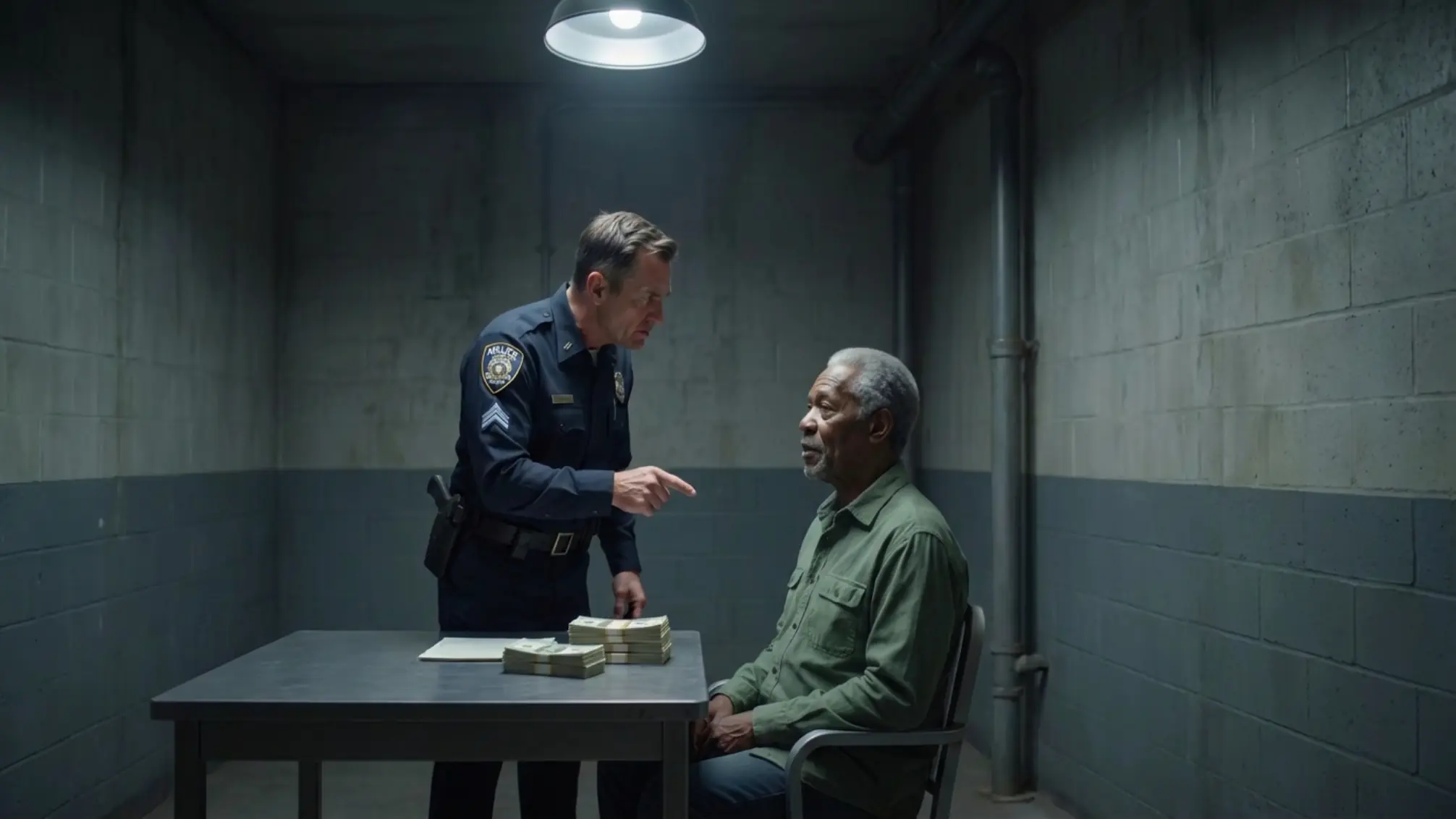
Navy veteran Isaiah Cole leaned forward until the rope tightened across his faded olive jacket. “Untie me and call me a thief to my face.”
Rusk slammed his palm beside the bundled money. “Keep challenging me, old man, and you’ll leave here crawling.”
Isaiah lifted his calm dark eyes toward the one-way mirror. “Touch me again—the federal investigator behind that glass ends your badge.”
The windowless interrogation room beneath the Norfolk Police Department fell silent.
Sergeant Rusk stared at the black glass covering one wall, then laughed as if Isaiah had offered the desperate bluff of a frightened criminal. The forty-two-year-old white officer had short brown hair streaked with silver, cold gray eyes, and a rigid build hardened by two decades of wearing authority like armor. His dark patrol uniform was immaculate, his boots polished, and his gold sergeant’s badge reflected the single overhead lamp.
Isaiah Cole sat opposite him with rope wrapped twice around his chest and the back of the chair. His wrists were not cuffed, but the knots around his torso prevented him from standing. At sixty-eight, he still carried the broad shoulders and straight posture developed over twenty-four years of service in the United States Navy, though age had softened his strength and placed gray across his closely cropped hair.
Three bundles of cash rested on the steel table.
Each stack was wrapped in a numbered paper band.
Together they totaled fifty thousand dollars.
The money belonged to Harbor Haven, a nonprofit organization that purchased abandoned homes and converted them into transitional housing for homeless veterans. Isaiah served as its volunteer treasurer. That morning, he had been instructed to deliver the funds to a federal auditor conducting a surprise review of the organization’s latest property purchase.
He never reached her office.
Sergeant Rusk stopped him two blocks from the federal building.
Isaiah had been driving an old dark-green pickup truck with a cracked rear light and a Harbor Haven magnet attached to the driver’s door. The cash rested inside a locked metal case beneath the passenger seat. Every bundle had been recorded, photographed, and entered into the organization’s accounting ledger before he left.
Rusk claimed the truck matched the description of a vehicle connected to a robbery.
It did not.
The robbery suspect drove a black sport utility vehicle with temporary plates. Isaiah’s pickup was registered in his own name and had carried the same Virginia plates for eleven years.
Rusk knew that before ordering him from the truck.
The patrol computer displayed Isaiah’s registration, insurance, driver’s license, and veteran status within thirty seconds of the stop. Yet Rusk approached with one hand resting near his holster and demanded that Isaiah place both hands on the hood.
Isaiah complied.
“Reason for the stop?” he asked.
Rusk immediately disliked the question.
“You’ll know when I tell you.”
A younger patrol officer named Evan Pierce stood several feet behind him. Pierce had graduated from the academy eight months earlier and had been assigned to Rusk for field supervision. His body camera was active. Rusk’s was not.
Rusk searched the truck without obtaining consent.
When Isaiah objected, Rusk told him the vehicle might contain evidence connected to an active robbery investigation. He opened the locked case with a key taken from Isaiah’s pocket and discovered the bundled money, a donation ledger, bank withdrawal slips, and a sealed envelope addressed to Special Agent Laura Chen.
Rusk held up the first stack.
“Where did you steal this?”
“I did not steal anything.”
“Old truck, cheap clothes, fifty thousand dollars. That story writes itself.”
Isaiah looked at the name on the sealed envelope. “Call the recipient.”
Rusk tore it open instead.
Inside was a scheduled audit notice issued by the Office of Inspector General for the Department of Housing and Urban Development. It identified Isaiah as the authorized representative of Harbor Haven and instructed him to deliver the organization’s restricted property-restoration funds at ten o’clock that morning.
Rusk read the first page.
Then he folded it and placed it inside his patrol bag.
Pierce watched him.
“Sergeant, that appears to explain the cash.”
Rusk’s eyes hardened. “It explains what he wants us to believe.”
“There’s a federal contact number.”
“I’m handling it.”
Isaiah turned toward Pierce. “Your camera is recording?”
“Yes, sir.”
Rusk looked sharply at the younger officer.
Pierce’s hand moved instinctively toward his chest-mounted camera, but he did not deactivate it.
That decision later saved several lives from being destroyed.
Rusk transported Isaiah to the station without formally announcing an arrest. The cash, ledger, phone, keys, and audit notice disappeared into Rusk’s personal evidence bag rather than a sealed departmental container. Pierce entered the seizure into the cruiser computer, but Rusk ordered him to remove the reference to the federal letter.
“Unverified documents do not belong in the initial report,” he said.
Isaiah heard every word from the rear seat.
At the station, Rusk avoided the main booking floor. He led Isaiah through a service corridor and down a concrete staircase to an old interview room used mostly for storage. Its official recording system had been disconnected months earlier.
Two other officers were waiting.
One was Lieutenant Harold Vane, Rusk’s immediate supervisor. The other was Detective Miles Carson from financial crimes.
Vane looked at the money and smiled.
“Where did you find him?”
“Heading toward downtown,” Rusk answered. “Claims he was delivering it to a federal auditor.”
Carson examined the paper bands. “These numbers are consecutive.”
“Probably taken directly from a bank.”
Isaiah remained standing near the door. “The withdrawal receipt is in the metal case.”
Rusk shoved him into the chair.
“No one asked you.”
Isaiah steadied himself before his shoulder hit the wall. “You have the auditor’s name, telephone number, withdrawal receipt, nonprofit ledger, and written authorization.”
Carson’s expression changed slightly.
Vane looked toward Rusk. “Did you call the number?”
“Not yet.”
“Why not?”
“Because I wanted to hear his story before his accomplices had time to prepare one.”
Isaiah shook his head. “You already decided the answer before asking the question.”
Rusk ordered Pierce to leave the room.
The younger officer hesitated.
“Sergeant, my report—”
“Upstairs.”
Pierce left, but he did not return directly to the patrol office. He walked to the evidence intake desk and searched the incident number Rusk had assigned. No robbery report matched Isaiah’s vehicle. No alert described an elderly Black male, green pickup, or bundled cash.
Pierce then called the number printed on the photograph he had taken of the federal notice before Rusk removed it from the case.
Special Agent Laura Chen answered.
Pierce identified himself and explained that Isaiah Cole had been detained carrying fifty thousand dollars.
Chen’s voice changed immediately.
“That money was scheduled for delivery to me forty minutes ago.”
Pierce looked toward the staircase.
“Is Mr. Cole under arrest?”
“I don’t know.”
“Who is questioning him?”
“Sergeant Daniel Rusk, Lieutenant Harold Vane, and Detective Miles Carson.”
The line remained quiet for one second.
Then Chen said, “Do not alert them that I am coming.”
Pierce almost asked why.
Instead, he listened.
“Preserve your body-camera footage,” Chen instructed. “Do not upload it through any terminal controlled by those three officers. Make a direct copy through internal affairs or the state police evidence system.”
“Agent Chen, is this bigger than the traffic stop?”
“It may be the reason the audit was scheduled.”
She arrived twenty-two minutes later with two federal investigators, a state police captain, and the department’s internal affairs commander. Rather than walk directly into the interrogation room, Chen entered the unused observation chamber behind the one-way mirror.
She wanted to hear what happened when the officers believed no outside authority was listening.
Inside the room, Rusk placed the money in three neat stacks and began demanding a confession.
Isaiah refused.
He explained that Harbor Haven had purchased a condemned apartment building near the shipyard. The fifty thousand dollars came from restricted donations intended for roof repairs, electrical inspections, and emergency housing units. A federal grant review required the cash to be counted in person because several earlier payments connected to the project had disappeared.
That was the real reason Chen had summoned him.
Harbor Haven’s records showed that seventy-eight thousand dollars in repair funds had been paid to contractors who never appeared at the property. Isaiah discovered that the invoices carried authorization signatures from people who denied approving them.
Two contractor addresses led to empty lots.
The third belonged to a company managed by Lieutenant Vane’s brother-in-law.
Isaiah had not known that connection when he entered the room.
Agent Chen did.
For six weeks, her team had been investigating whether Harbor Haven’s funds were being stolen through shell companies protected by local officers. The surprise audit was intended to confirm whether the remaining cash could be secured before another fraudulent invoice appeared.
Rusk interrupted Isaiah’s explanation.
“You expect me to believe federal agents trusted you with fifty thousand in cash?”
“They trusted the records.”
“You’re a volunteer.”
“I’m the elected treasurer.”
“You live in a two-bedroom house.”
“I do.”
“You drive a truck older than my youngest officer.”
“It still runs.”
Rusk placed both hands on the table. “Men with money show it.”
Isaiah looked at him. “Men with stolen money often do.”
Carson turned his face to hide a reaction.
Vane did not.
He moved behind Isaiah and pulled a length of rope from a storage cabinet. The room contained no functioning restraint rail, and Isaiah had not behaved violently. Yet Vane wrapped the rope across his torso and tied it behind the chair.
“What is this for?” Isaiah asked.
“Officer safety.”
“You have three armed officers surrounding an unarmed old man.”
Rusk leaned toward him. “You’re not an old man when you’re running your mouth.”
Isaiah tested the rope once. It was tight enough to restrict his breathing but not his arms.
“Record that knot,” he said.
Rusk smiled. “There is no camera in here.”
“That does not mean no one is watching.”
The three officers looked toward the mirror.
Carson seemed uneasy. “We should take this upstairs.”
Vane ignored him. “Ask him where the rest of the money is.”
“What rest?” Isaiah said.
“The funds already taken from Harbor Haven.”
Isaiah’s eyes narrowed.
Rusk had not mentioned the missing seventy-eight thousand.
Neither had Isaiah.
Only investigators and people connected to the false invoices knew the exact problem under review.
“How do you know money was already missing?” Isaiah asked.
Vane’s expression tightened.
Rusk answered too quickly. “Because organizations like yours are always losing money.”
“I did not say the amount.”
“You don’t have to.”
“You knew this was connected to Harbor Haven before you opened my case.”
Rusk slammed his hand beside the cash.
That was the moment Isaiah understood the traffic stop had never been random.
They had been waiting for him.
The broken taillight was an excuse. The nonexistent robbery vehicle was an excuse. Rusk had intercepted him because someone knew he was carrying the remaining funds to an auditor.
Isaiah turned toward the mirror.
“Agent Chen,” he said clearly, “they knew about the audit.”
Rusk laughed.
Then the observation-room door opened.
Special Agent Laura Chen entered first.
She was forty-six, Asian American, composed, and dressed in a dark gray suit beneath a federal credentials lanyard. Behind her came Internal Affairs Commander Rochelle Gaines, State Police Captain Marcus Hill, and two investigators wearing evidence gloves.
Rusk’s finger was still extended toward Isaiah.
Vane stood behind the chair beside the rope.
Carson moved away from the table.
Agent Chen surveyed the room without speaking. Her attention passed over Isaiah’s restraint, the bundled money, the torn federal envelope inside Rusk’s open bag, and the inactive camera mounted in the ceiling.
Rusk recovered first.
“This is an active local investigation.”
Chen held up her credentials. “It became a federal evidence-tampering investigation when you opened a sealed audit notice and concealed it.”
Vane stepped forward. “You cannot enter a restricted police interview without authorization.”
Internal Affairs Commander Gaines answered from behind Chen.
“She has mine.”
Rusk glanced toward the one-way mirror. “How long were you back there?”
“Long enough,” Chen replied.
Isaiah leaned against the rope. “I told him someone was watching.”
Chen approached the chair and examined the restraint.
“Who tied him?”
Vane said nothing.
Isaiah answered. “Lieutenant Vane.”
Chen looked toward Gaines. “Photograph the knots before removing them.”
Rusk’s voice rose. “You’re treating us like criminals based on the claims of a suspect.”
Chen turned toward him.
“Mr. Cole is not a suspect.”
“He was carrying fifty thousand dollars.”
“Funds my office instructed him to deliver.”
“Cash can be washed through nonprofit accounts.”
“Yes,” Chen said. “That is why we were examining invoices connected to Lieutenant Vane’s brother-in-law.”
Vane took one step backward.
Captain Hill moved between him and the door.
Carson raised both hands. “I was called downstairs after the detention. I did not know about the contractor connection.”
Chen looked at him. “You will have an opportunity to document exactly what you knew.”
An investigator photographed the rope from every angle, then cut it away without disturbing the knots. Red pressure marks crossed Isaiah’s shirt and skin. He stood slowly, rubbing one shoulder while Gaines brought him water.
Rusk pointed toward the cash. “That is departmental evidence.”
“No,” Chen said. “It is federally monitored nonprofit property that you failed to enter into your evidence system.”
“I was conducting a preliminary interview.”
“You tore open the audit letter, removed it from the case, and ordered a junior officer to alter his report.”
Rusk looked toward Pierce, who had entered the observation room behind the investigators.
The younger officer stood beside Gaines.
His body camera remained active.
“You went behind my back,” Rusk said.
Pierce’s face was pale, but his voice stayed steady. “I verified the document.”
“You disobeyed a direct order.”
“I refused to delete evidence.”
For the first time, Rusk appeared frightened.
Chen ordered the three senior officers separated. Their badges, weapons, phones, notebooks, vehicle computers, and body cameras were secured. Rusk protested that his camera had malfunctioned during the stop.
Pierce’s footage showed Rusk switching it off before approaching Isaiah’s truck.
It also captured the nonexistent robbery claim, the unauthorized search, the federal letter, and Rusk’s instruction to remove the notice from the report.
Isaiah was offered medical attention but refused transportation. He allowed a paramedic to examine the bruising around his ribs and shoulders. Then he asked Chen whether the Harbor Haven funds were safe.
She looked at the bundles being placed into numbered evidence containers.
“They are now.”
The investigation expanded before sunset.
Agent Chen’s team compared the seized cash bands against the bank’s withdrawal record. Every bundle matched. Harbor Haven’s ledger balanced to the dollar. Isaiah’s fingerprints appeared only where expected: on the case handle, ledger, and bank receipt.
Nothing supported Rusk’s accusation.
The officers’ phones supported something worse.
Messages between Rusk and Vane showed that they had been tracking Isaiah’s movements for two days. Vane received information from his brother-in-law, contractor Philip Danner, who learned that a federal audit would occur after a Harbor Haven employee accidentally copied him on an internal scheduling email.
Vane told Rusk that Isaiah would be carrying “the rest of the repair money” downtown.
Rusk replied:
I’ll stop him before he reaches them.
Another message read:
If the old man panics, we call it probable cause.
Their plan was not simply to seize the cash.
They intended to pressure Isaiah into signing a statement admitting he had withdrawn funds for personal use. That confession would redirect suspicion away from the fraudulent contractors and place the missing money on Harbor Haven’s elderly volunteer treasurer.
The rope had been meant to frighten him.
The stacks on the table had been arranged to make him feel surrounded by evidence.
The disconnected recording system allowed them to create their own account afterward.
What they had not anticipated was Pierce preserving the federal notice and contacting Chen.
Detective Carson agreed to cooperate. He admitted that Vane had previously asked him to approve financial-crime reports without reviewing the original invoices. Carson claimed he believed the shortcuts were intended to reduce paperwork.
Investigators found three files in which he had done exactly that.
His cooperation did not protect his career, but it helped expose the larger operation.
Philip Danner’s company had received more than two hundred thousand dollars from city-supported housing projects over four years. Several repair jobs existed only on paper. Other projects used cheap materials while invoices listed premium supplies.
Lieutenant Vane approved police security reports stating that contractors had completed work in neighborhoods where no officers had ever visited.
Rusk provided intimidation.
When residents questioned missing supplies, unexpected traffic tickets appeared. When nonprofit volunteers requested records, officers stopped them for minor violations or accused them of interfering with investigations.
Isaiah was not the first person they tried to silence.
He was simply the first one carrying evidence directly to someone prepared to preserve it.
At the public hearing three months later, Rusk’s attorney described the traffic stop as an unfortunate but understandable misunderstanding. He claimed bundled cash created immediate suspicion and that Isaiah’s refusal to accept the sergeant’s authority escalated the encounter.
Pierce’s video played before the administrative board.
It showed Isaiah keeping his hands visible, answering questions, identifying the funds, and repeatedly requesting that officers contact Agent Chen. It showed Rusk reading the federal document and placing it inside his own bag.
The interrogation audio came next.
Agent Chen’s team had recorded every word from the observation chamber.
“You walked in with fifty thousand in stolen cash—confess before I bury you.”
“Untie me and call me a thief to my face.”
“Keep challenging me, old man, and you’ll leave here crawling.”
The board listened as Isaiah warned that someone was watching.
Then they watched the door open.
Isaiah testified last.
He wore a dark blue suit and a small Navy service pin on his lapel. He did not speak about his years at sea or demand special respect because of his veteran status.
“I should not have needed a decorated past to be treated lawfully in the present,” he said. “The records were enough. The receipt was enough. The telephone number was enough. The truth was available, but Sergeant Rusk treated verification as an enemy because he had already chosen the lie he needed.”
Rusk was dismissed from the department and later charged with unlawful detention, conspiracy, evidence tampering, obstruction, official misconduct, and attempted extortion.
Vane faced the same charges, along with fraud and bribery related to the housing contracts. Philip Danner was indicted for wire fraud, theft of public funds, and falsifying invoices.
Carson resigned and lost his law-enforcement certification after admitting that he approved reports he had not verified.
Pierce remained with the department.
Some officers called him disloyal for reporting his supervisor. Internal Affairs Commander Gaines transferred him to a different field-training team and publicly reminded the department that loyalty to a colleague never outranked loyalty to the law.
Harbor Haven recovered most of the missing money through frozen contractor accounts and restitution orders. The condemned apartment building was eventually repaired under independent supervision.
The roof stopped leaking.
The wiring passed inspection.
Twenty-four small units opened the following winter for veterans who had been sleeping in shelters, vehicles, and abandoned buildings.
Isaiah refused to have the residence named after him.
“They already have names,” he said, referring to the people who would live there.
The organization placed a modest brass plaque near the entrance instead:
Truth requires records, witnesses, and someone willing to preserve both.
Months later, Isaiah returned to the same police station.
The old basement interview room had been emptied. The disconnected camera was replaced, and no interview could begin until its recording status was verified by both the officer and the person being questioned. Improvised restraints were prohibited, and every cash seizure required immediate counting beneath two active cameras.
Pierce met Isaiah near the lobby.
“I should have challenged him sooner,” the young officer said.
“You challenged him before it was too late.”
“I watched him open that letter and still hesitated.”
“Hesitation is human,” Isaiah replied. “What you do next tells people who you are.”
Pierce looked toward the stairs leading to the basement.
“Were you really certain Agent Chen was behind the glass?”
Isaiah smiled.
“No.”
Pierce stared at him.
“I knew someone had to be listening eventually,” Isaiah continued. “Men like Rusk grow careless when they believe no one important can see them.”
“You bluffed?”
“I gave the truth time to reach the door.”
Isaiah left the station and drove his old green pickup toward Harbor Haven. The rear light had been repaired, though he kept the cracked plastic cover in a drawer beside the original bank receipt and a certified copy of Pierce’s video.
Not because he enjoyed remembering the humiliation.
Because memory without evidence was too easily challenged by people wearing badges, titles, and polished explanations.
Rusk believed fifty thousand dollars on a steel table made Isaiah look guilty.
Instead, the money documented every lawful step the veteran had taken and every unlawful step the officers took to stop him.
They had tied an elderly man to a chair and demanded that he confess to stealing funds meant for homeless veterans.
But when the door finally opened, Isaiah was not the man forced to explain where the money came from.
The officers were forced to explain why they had been waiting for it.