The first kick was supposed to stop three inches from Emily Carter’s face. Instead, Staff Sergeant Grant Mercer drove his boot through the space where her head had been less than half a second earlier, hard enough that the rush of air lifted strands of dark-brown hair from her ponytail. Five hundred soldiers sitting around the combat demonstration floor suddenly stopped cheering, because everyone in the auditorium understood the difference between controlled training and a strike meant to hurt someone. Emily slid backward across the mat, reset her stance, and stared directly at the decorated NCO twice her size without blinking.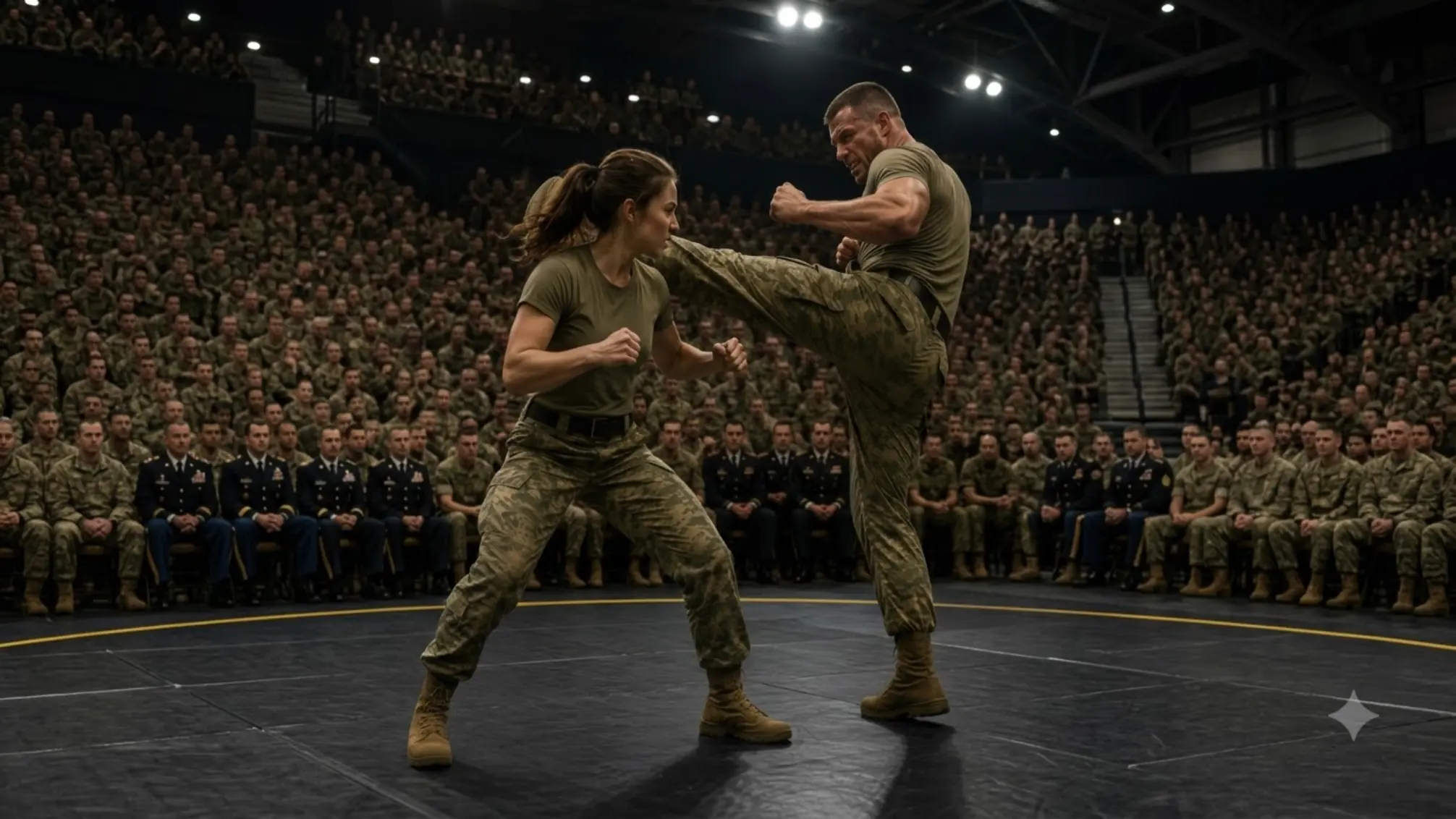
Grant straightened slowly and gave her a cruel smile. At thirty-eight, he was one of the training center’s most recognizable instructors, a heavily muscled man with fourteen years of service, multiple awards, and a reputation for reducing inexperienced soldiers to exhausted silence within minutes. Emily was twenty-four, athletic but much smaller, with only eighteen months at the training center and no reputation beyond consistently high scores that some senior instructors dismissed as classroom numbers. Grant had volunteered to demonstrate advanced hand-to-hand techniques against her because, as he had told another instructor that morning, “Somebody needs to remind the rookies what real pressure feels like.”
“You should’ve stayed in the back row, rookie,” Grant said as he circled her. “This floor’s too brutal for you.” Emily kept both fists raised and shifted lightly on the balls of her feet. “Then stop performing and hit me like you mean it.”
Laughter rolled through part of the audience, but it died when Grant’s expression changed. He stepped forward with a fast combination meant to crowd her toward the edge of the mat, expecting her to retreat in a straight line. Emily pivoted instead, redirected his wrist, stepped outside his shoulder, and was suddenly behind him before he could recover. A few soldiers in the first rows exchanged surprised looks.
Grant turned sharply. The demonstration supervisor, Captain Daniel Reeves, raised one hand from beside the mat and reminded both fighters, “Controlled contact.” Emily nodded immediately. Grant did not.
He came forward again, faster this time. Emily slipped beneath his first punch, deflected the second, and used his momentum to force him off balance without throwing him to the floor. The audience reacted louder now, not because she had hurt him but because she had made the much larger instructor miss twice in less than thirty seconds. Grant heard the reaction, and Emily saw something dangerous appear in his eyes.
This was no longer about instruction. It was about embarrassment.
Grant lowered his voice as they circled. “You think these people are impressed?” Emily’s jaw tightened. “I think you’re getting angry.” His mouth twisted. “I’m about to fold you in front of this whole base.”
“Try it,” Emily answered. “Then explain why your rank couldn’t save you from one clean move.”
Captain Reeves took a step closer to the mat. He had known Grant for years and recognized the tightening shoulders, the shortened breathing, and the way his movements became heavier whenever pride replaced discipline. Reeves called out, “Mercer, reset.” Grant glanced toward him but continued moving.
The next exchange lasted only five seconds. Grant threw a controlled jab, then unexpectedly followed it with a full-power elbow that was not part of the approved demonstration sequence. Emily turned just enough that the strike passed her cheek, but the motion forced her backward. The crowd became quiet again.
Emily looked toward Reeves. “Sir?” Reeves raised his voice. “Staff Sergeant Mercer, break.” Grant ignored him.
He charged.
The difference between Grant and Emily was nearly seventy pounds. If she tried to stop him head-on, she would lose. Instead, she stepped diagonally, caught his arm, redirected his shoulder, and forced him to stumble past her.
Someone in the bleachers shouted.
Grant spun around with his face burning red. “You think this is funny?” Emily lowered her stance. “No.”
He launched the high kick.
Emily saw his hip turn before the leg rose. The strike was far too high, far too hard, and aimed directly toward her head instead of stopping short as demonstration rules required. She moved inside the arc rather than retreating, caught his lower leg against her shoulder, controlled his balance, and turned sharply.
Grant tried to pull free.
That was his mistake.
His planted foot twisted while his upper body moved in the opposite direction, and the sound that followed cut through the auditorium like a snapped branch. Grant collapsed immediately, grabbing his knee and shouting as Emily released him and stepped backward with both hands open. For one frozen second, nobody moved.
Then Captain Reeves ran onto the mat.
“Medical!”
Two medics rushed from the edge of the auditorium. Emily remained several feet away, breathing hard but controlled, while Grant rolled onto his back and cursed through clenched teeth. The five hundred spectators who had arrived expecting a routine demonstration were now staring at the instructors with the uncomfortable realization that they had witnessed something very different.
Reeves looked at Emily. “Are you hurt?” She shook her head. “No, sir.”
“You sure?”
“Yes.”
Grant heard them. “She broke my knee!”
Emily looked toward him but said nothing.
Grant pointed at her from the mat. “She attacked me after the break!”
The room changed again.
Emily’s breathing slowed. Captain Reeves stared at Grant. “I called the break before you threw the kick.”
“No,” Grant snapped. “She kept engaging.”
Reeves looked toward the audience, where hundreds of people had witnessed the sequence. “Five hundred people just watched it.”
Grant’s expression tightened.
Lieutenant Colonel Rebecca Sloan stood from the front row. She commanded the training battalion and had been scheduled to give closing remarks after the demonstration. Instead, she walked onto the mat with a face so controlled that everyone who knew her understood she was furious.
“Stop talking,” she told Grant.
He looked stunned. “Ma’am?”
“Medical will treat you. Nobody discusses responsibility until the video is preserved.”
That sentence mattered.
Four fixed cameras covered the training floor from different angles. A fifth camera streamed the event to an internal training archive, while dozens of soldiers had also been recording from the audience. Whatever happened next would not depend on rank, reputation, or whichever person wrote the first report.
Grant was carried out on a stretcher. Emily remained beside the mat while another instructor checked her face and arms for injuries. There was a faint red mark near her cheek where Grant’s elbow had brushed past, but nothing serious.
Sloan approached her. “Carter, give me exactly what happened.”
Emily straightened.
“We began the scheduled demonstration. Staff Sergeant Mercer increased contact after the first minute. Captain Reeves ordered controlled contact, then ordered a break. Mercer continued, threw a full-force high kick, and I used the approved defensive response.”
“Did you intentionally attack the knee?”
“No, ma’am.”
“Did you hear Captain Reeves call break?”
“Yes.”
“Did you stop?”
“Yes.”
Sloan nodded. “Do not discuss this with anyone else until statements are taken.”
Emily swallowed. “Understood.”
She started walking toward the locker room when a voice stopped her.
“Carter.”
It was Sergeant First Class Michael Dunn, another senior instructor. He waited until Sloan moved away, then stepped close enough that only Emily could hear him. “You need to be careful how you write your statement.”
Emily frowned. “Why?”
Dunn glanced toward the doors where Grant had disappeared. “Mercer has friends.”
Emily stared at him.
Dunn lowered his voice further. “You’re new. He isn’t.”
“What are you telling me?”
“I’m telling you not to make this bigger than it needs to be.”
Emily felt her stomach tighten. “He ignored a break and tried to kick me in the head.”
Dunn’s jaw hardened. “And now he’s going to surgery while you walked away.”
“That doesn’t change what happened.”
“No,” Dunn said quietly. “But reports can change how it looks.”
Emily watched him walk away.
That warning frightened her more than Grant’s kick.
She had grown up believing training failures were corrected by procedure. Somebody violated a safety rule, the violation was documented, leadership reviewed the event, and policies changed if necessary. Dunn’s words suggested something else: that the real contest had not ended on the mat.
At 4:20 that afternoon, Emily sat inside a small administrative office with Captain Reeves and an investigating officer from the base safety section. A camera recorded the interview. Emily described every movement in chronological order and resisted the investigator’s repeated invitations to speculate about Grant’s motivation.
“Did you believe Staff Sergeant Mercer wanted to injure you?” the investigator asked.
Emily paused.
“I can tell you the strike was not controlled.”
“That wasn’t my question.”
“I can’t prove what he intended.”
Reeves looked toward her approvingly. Emily continued. “But I can describe exactly what he did.”
The investigator nodded.
That distinction became important later.
Grant’s first written statement arrived from the hospital before midnight. He claimed Emily had become overly competitive after the audience reacted positively to her performance. According to Grant, he called for an unofficial reset, attempted to disengage, and Emily trapped his leg before deliberately rotating his knee.
Captain Reeves read the statement twice.
Then he opened the video.
The first camera showed Grant’s mouth moving immediately before the final exchange, but no clear audio. The second showed Emily stepping backward after Reeves ordered the break. The third captured Grant’s face.
He was moving forward.
Not retreating.
Then the fourth angle showed everything.
Grant’s kick extended toward Emily’s head with enough force that his upper body rotated almost completely through the strike. Emily moved inside, caught the leg, and turned only after he continued driving forward. The injury occurred because Grant attempted to wrench himself free while standing on one planted foot.
Reeves stopped the video.
The safety investigator said quietly, “His statement is false.”
Reeves leaned back.
“Yes.”
But Sloan wanted more than one false report.
She had spent years learning that serious failures rarely appeared without warning. Her first question the next morning was simple.
“Has Mercer done this before?”
The answer initially appeared to be no.
His official record was excellent. High performance evaluations, instructor awards, commendations, and consistently strong completion rates among trainees. Formal safety complaints were almost nonexistent.
Sloan did not trust the absence.
She ordered a review of training injuries connected to Grant over the previous four years. At first, the numbers looked ordinary: sprains, bruises, one broken wrist, two concussions, and several training suspensions. Combat instruction carried risk.
Then Captain Reeves noticed something.
Seven injured soldiers had requested reassignment after completing sessions with Grant.
Five were women.
Three had filed informal concerns with instructors.
None appeared in Grant’s official record.
Sloan asked where the complaints had gone.
Nobody had a clear answer.
Sergeant First Class Dunn suddenly became nervous.
Investigators recovered archived emails from a training account. One message from two years earlier came from a female soldier named Lauren Price.
Staff Sergeant Mercer continued after I tapped twice. I believe he knew I was trying to stop.
Dunn had responded.
Training gets intense. Recommend you discuss expectations directly with instructor before pursuing formal action.
No formal report followed.
Another email involved a young male soldier who suffered a shoulder injury during a demonstration.
Mercer told me if I complained everyone would know I couldn’t handle real pressure.
Again, the issue disappeared.
Sloan called Dunn into her office.
He arrived already defensive.
“These were minor complaints.”
Sloan placed printed emails in front of him.
“Who decided that?”
Dunn hesitated.
“I used judgment.”
“Were they entered into the safety system?”
“No.”
“Why?”
“We would have destroyed his career over misunderstandings.”
Sloan’s eyes narrowed. “Your job wasn’t to decide his career. Your job was to document the complaint.”
Dunn said nothing.
The investigation widened.
Former trainees were contacted privately. Most described Grant as aggressive but professional. Several praised him.
Then seven people told almost identical stories.
Grant selected inexperienced soldiers during public demonstrations, especially those who performed well in technical drills. He increased pressure whenever the audience reacted positively to them. If they struggled, he called it realism; if they succeeded, he escalated until they failed.
One former trainee explained it simply.
“He needed everyone watching to remember he was the toughest person in the room.”
Emily listened to none of these interviews. Sloan deliberately kept her separate from the review so nobody could claim she coordinated testimony.
Meanwhile, Grant began calling senior leaders from the hospital.
He had torn major ligaments in his knee and required surgery. His career as an instructor was uncertain. He told friends that Emily had humiliated him intentionally and that leadership was protecting her because public opinion had turned against him.
One of those friends posted part of the story online.
Decorated instructor permanently injured by rookie during controlled demonstration.
No names were included.
They did not need to be.
Within hours, everyone on base knew who the post described.
Emily began receiving messages.
Some supported her.
Others called her reckless.
One anonymous message read: You broke a senior NCO and think leadership will save you? Wait.
Emily showed it to Captain Reeves.
He immediately forwarded it to investigators.
“Do not respond.”
“I wasn’t planning to.”
“You okay?”
Emily looked tired. “I’m starting to understand why people didn’t report him.”
Reeves had no answer.
Three weeks after the demonstration, Sloan convened a formal safety and command review. The auditorium where Grant had been injured was used again, but this time there was no cheering crowd. Only commanders, investigators, legal advisers, training supervisors, and witnesses.
Four synchronized video angles played across a large screen.
The footage was impossible to argue with.
Reeves’s command to break was audible.
Emily disengaged.
Grant advanced.
His kick was outside the approved demonstration sequence.
His own momentum contributed directly to the injury.
Then investigators presented the older complaints.
The atmosphere grew colder with each one.
Grant sat near his attorney with his injured leg braced. For the first time since Emily had known him, he looked smaller than his reputation.
When given the opportunity to speak, he did not apologize.
“I train soldiers for real situations,” he said. “Real opponents don’t stop because somebody yells break.”
Sloan stared at him.
“This was not a real opponent.”
Grant’s jaw tightened.
“It was training.”
“Exactly,” Sloan replied. “Which means you had a duty to maintain control.”
He looked toward Emily.
“She wanted to prove something.”
Emily did not react.
Sloan answered for her.
“The video shows she proved she could follow instructions while you proved you could not.”
Nobody spoke.
Grant looked down.
The final findings took another month. He was removed permanently from instructor duties for violating safety procedures, disobeying the demonstration supervisor, and filing a materially false account of the incident. Additional administrative consequences followed after investigators concluded that earlier complaints had been improperly minimized.
Dunn was removed from his supervisory position.
The training center changed its rules.
All public combat demonstrations required a second safety official with independent authority to stop the event. Complaints involving instructor conduct bypassed local supervisory chains and entered a centralized review system automatically. Demonstration video had to be preserved for one year instead of thirty days.
Emily returned to training six weeks after the incident.
The first time she stepped onto the same mat, conversation in the room stopped.
She hated that.
She did not want to become the soldier who broke Grant Mercer’s knee.
She wanted to become the soldier who did her job correctly.
Captain Reeves stood across from her.
“No demonstration today.”
Emily raised an eyebrow.
“Then why are we here?”
He tossed her a pair of gloves.
“Because you missed six weeks.”
She smiled.
“That sounds like a challenge.”
“It is.”
They trained for forty minutes.
No audience.
No cameras beyond standard safety recording.
No humiliation.
No instructor trying to prove anything.
At the end, Reeves sat on the edge of the mat and handed Emily a bottle of water.
“You know what people keep getting wrong about what happened?”
Emily took a drink.
“What?”
“They think the important part was that you beat him.”
Emily frowned.
“I didn’t beat him.”
“Exactly.”
Reeves nodded toward the center of the floor.
“You kept control when he lost his.”
Emily looked across the empty auditorium.
That was the part she remembered most clearly.
Not the crack.
Not Grant falling.
Not the crowd.
The half-second before the kick arrived, when every instinct told her to panic but years of repetition told her exactly where to move.
Months later, Emily was asked to assist with a new group of trainees. During the first session, a nervous nineteen-year-old recruit struggled with a defensive movement and apologized after getting it wrong three times.
Emily reset his position.
“Again.”
He tried.
Missed.
“Again.”
On the fifth attempt, he finally performed it correctly.
The recruit smiled.
Emily nodded.
“Good.”
He looked surprised.
“That’s it?”
“What were you expecting?”
“Yelling.”
Emily almost laughed.
“No.”
She stepped backward.
“You’re here to learn, not to protect my ego.”
Captain Reeves heard the sentence from across the room.
He said nothing.
He simply smiled.
Grant Mercer eventually completed rehabilitation and transferred into an administrative position away from combat instruction. His decorations remained his, because nothing in the investigation erased the good work he had done earlier in his career. Emily believed that mattered too.
People were complicated.
Grant could have served honorably for years and still made terrible choices.
The investigation was not about rewriting his whole life around one incident.
It was about refusing to let past accomplishments excuse present misconduct.
A year after the fight, Emily returned to the auditorium for another demonstration.
This time she was one of the instructors.
Five hundred soldiers filled the seats again.
A young male trainee stood across from her, visibly nervous because everyone knew the story of what had happened on that floor.
Emily raised her hands.
“Ready?”
He nodded.
They began.
He attacked carefully.
Emily redirected.
He tried again.
She countered.
After thirty seconds, he caught her balance correctly and forced her to take two steps backward.
The audience cheered.
The trainee froze, suddenly terrified that he had embarrassed her.
Emily immediately saw it.
She smiled.
“Good move.”
His shoulders relaxed.
“Again.”
They continued.
No anger.
No punishment for succeeding.
No need for one person to be smaller so another could feel bigger.
When the demonstration ended, Emily shook his hand in the center of the mat.
The crowd applauded.
This time, the sound did not change anyone’s behavior.
Later that evening, Emily walked through the empty auditorium alone. The overhead lights had been dimmed, leaving only the center of the training floor illuminated.
She stopped at the spot where Grant had fallen.
There was no mark.
No plaque.
Nothing identifying it as important.
That seemed appropriate.
People sometimes asked whether she felt proud of what happened that day.
She never knew how to answer.
She was proud that she remained controlled.
She was proud the evidence survived.
She was proud the earlier trainees were finally heard.
But she took no pride in another person’s injury.
The real victory happened afterward.
It happened when video mattered more than rank.
When old complaints were pulled from forgotten inboxes.
When leaders stopped asking whether Grant was respected and started asking whether the accusations were true.
Emily had walked onto that floor as the young soldier nobody thought could win.
Grant believed size, reputation, rank, and rage would finish her.
He was wrong.
But the lesson was never that Emily was stronger.
It was that real strength had nothing to do with being the most frightening person in the room.
Real strength was knowing exactly how much force was necessary—and having enough control to stop there.