The mess hall at Forward Operating Base Copper Canyon went silent before the last drop of purple sports drink reached Sergeant Maya Reeves’s collar.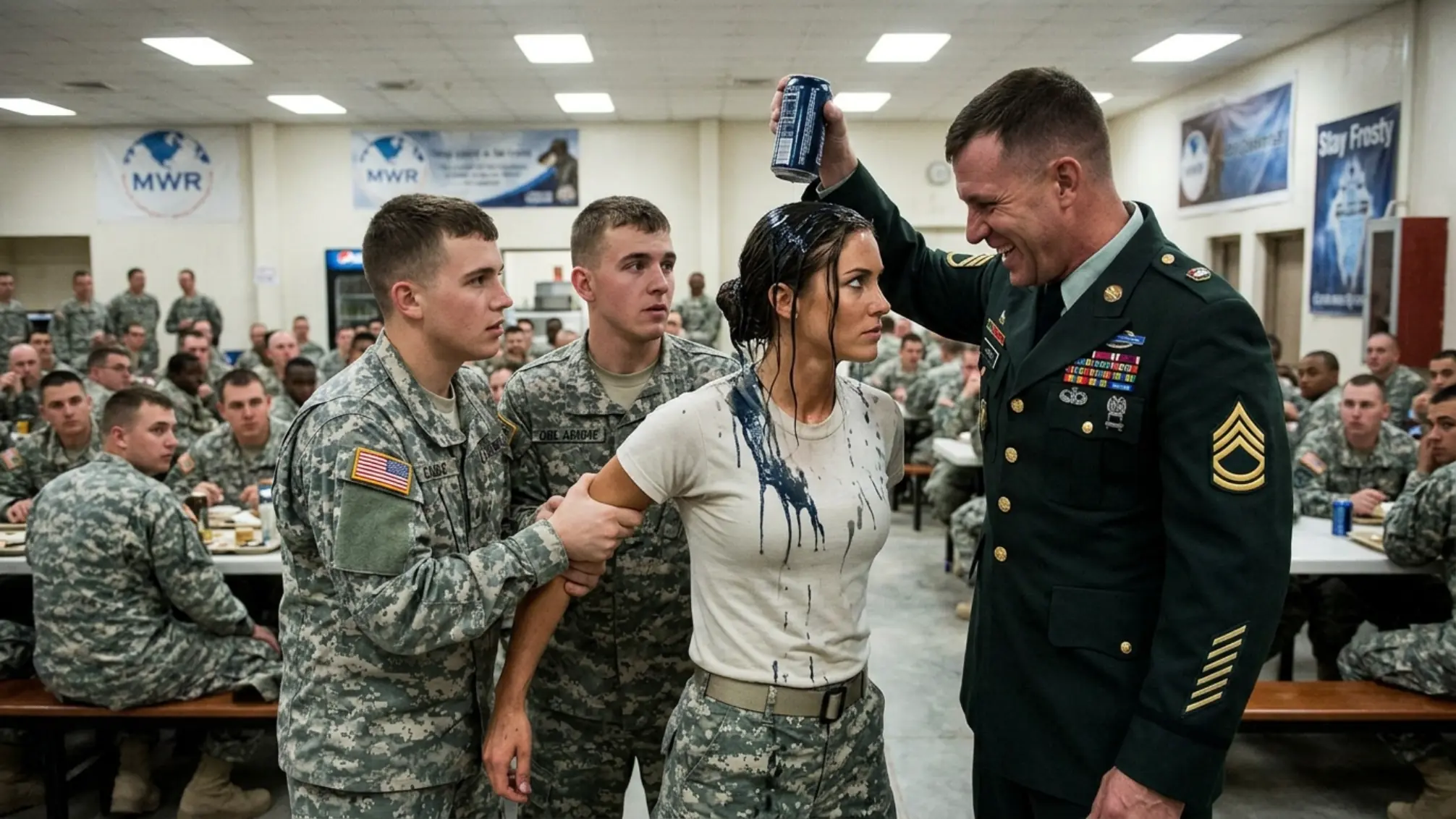
Two hundred American soldiers had been eating beneath the harsh fluorescent lights, surrounded by the constant scrape of metal trays, boots, exhausted laughter, and industrial fans fighting a losing battle against the Iraqi heat. Then Sergeant Wade Garrison lifted a large cup over Maya’s head and emptied it slowly, making certain everyone saw the humiliation. Cold liquid ran through her tightly pinned brown hair, across her face, and down the fitted white undershirt beneath her open camouflage jacket.
Garrison threw his head back and laughed.
“Clumsy me,” he said. “Guess you’ll need to requisition yourself a clean shirt.”
The soldiers surrounding him produced nervous laughter. His friends understood that he expected an audience, but even they sensed he had crossed a line. Two young infantrymen stood behind Maya with their hands gripping her upper arms, supposedly preventing her from “overreacting,” though neither man seemed comfortable touching her.
Maya remained perfectly still.
She was twenty-nine years old, five feet six inches tall, and built with the lean, compact strength of someone who trained for function rather than appearance. Even soaked and humiliated, she was strikingly beautiful, with sun-warmed fair skin, sharp storm-gray eyes, sculpted cheekbones, and wet brown hair beginning to slip free from its regulation bun. Nothing in her expression revealed fear.
That disturbed Garrison more than anger would have.
He had expected tears, shouting, or a desperate attempt to pull free. Any of those reactions would have allowed him to keep laughing. Instead, Maya looked at him with the cold concentration of someone calculating distance, weight, balance, and consequences.
“Cat got your tongue?” Garrison asked, leaning closer. “Or can’t support troops speak to real soldiers?”
Maya raised her eyes.
“Take your hands off me.”
Her voice was quiet enough that the soldiers restraining her almost missed it.
Garrison grinned. “That’s your only warning?”
“Yes.”
The infantryman holding her left arm loosened his grip, but Garrison noticed and snapped at him.
“Hold her.”
The soldier obeyed reluctantly.
Maya looked at the man on her right. “You should let go.”
He swallowed. “Sergeant, don’t make this worse.”
“I’m trying to prevent that.”
Garrison stepped directly into her space.
“You reorganized my entire supply depot without permission. You made my men think I’m incompetent. You walked around this base like you’re too good to speak to anyone, and now you’re giving me warnings?”
“I completed the job you neglected.”
A murmur passed through the room.
Garrison’s smile vanished.
“You’re a clerk.”
“I’m the logistics sergeant assigned to repair your inventory failures.”
“You count boxes.”
“And apparently I do that better than you lead soldiers.”
His face flushed deep red.
The two infantrymen tightened their hold because they believed Garrison might strike her. They did not understand that restraining Maya was placing them between a trained operator and the threat she had already assessed.
Garrison pushed one finger against her shoulder.
“Say it again.”
Maya looked at the hand touching her.
“Come closer,” she said. “Then wake up wondering who dropped you.”
The room inhaled as one.
Garrison’s pride made the decision before his judgment could interfere. He grabbed the front of her wet shirt and pulled her toward him.
Maya moved.
Her left foot stepped behind his right ankle. Her shoulder rotated beneath the soldier’s weakening grip, freeing enough space for her right hand. She drove an open palm sharply into the outside of Garrison’s knee—not hard enough to break it, but precisely enough to collapse the joint.
His leg buckled.
As his upper body pitched forward, Maya’s right hand struck just below his ear.
The movement was small.
The effect was immediate.
Garrison’s eyes rolled upward. Every muscle in his two-hundred-thirty-pound body released at once, and he collapsed onto the plywood floor before anyone understood what had happened.
The impact shook nearby trays.
Maya stood over him while purple liquid dripped from her hair onto his motionless face.
The soldiers who had been holding her released both arms and stepped away.
Nobody laughed now.
Maya adjusted her soaked jacket, picked up her tray, and placed it neatly on the collection counter. She did not threaten Garrison, celebrate, or explain herself.
She simply walked out of the mess hall.
Colonel James Hartley stood in the doorway.
He had arrived seconds before Garrison poured the drink and had witnessed the entire confrontation. At sixty-four, Hartley had served through the Gulf War, Afghanistan, and three other deployments rarely mentioned outside secure rooms. He had trained soldiers in advanced resistance and escape techniques at Fort Bragg.
The strike Maya used was not standard self-defense.
It was a controlled vagus-nerve technique taught only to specialized personnel because a slight increase in force could kill.
Major Foster appeared beside him.
“What happened?”
Hartley continued watching the doorway through which Maya had disappeared.
“Get me her complete background file.”
“We already reviewed her personnel record.”
“I don’t want the record she was sent here with.”
Foster looked toward Garrison, who was beginning to groan as medics rolled him onto his side.
“Sir, what exactly are we looking for?”
Hartley’s expression hardened.
“Someone taught a logistics sergeant how to end a fight before the other man understood it had started.”
Maya showered, changed uniforms, and reported to Hartley’s office within forty minutes.
Garrison sat in a chair near the wall with an ice pack pressed beneath his ear. The arrogance that usually filled his posture had been replaced by fury and a thin layer of fear. He refused to look directly at Maya for more than a second.
Hartley allowed the silence to stretch.
Maya stood at parade rest before his desk, dry hair once again secured in a perfect bun. Her expression showed no anxiety. She might have been reporting a missing radio rather than answering for incapacitating a senior noncommissioned officer.
“I have forty witnesses saying you assaulted Sergeant Garrison,” Hartley began.
“He poured a drink over me and grabbed my shirt.”
“That was humiliating and unprofessional. It was not a deadly attack.”
“No, sir.”
“Yet you rendered him unconscious.”
“Yes, sir.”
Garrison lowered the ice pack. “She could have killed me.”
Maya looked at him.
“If I intended to kill you, the medic would not have given you an ice pack.”
Garrison surged half out of his chair.
Hartley slammed one palm against the desk.
“Sit down.”
Garrison obeyed.
Hartley opened Maya’s personnel folder.
According to the document, she was a logistics specialist with an exceptional but ordinary record. She had completed supply-chain certifications, received efficiency awards, and served at several secure bases. No combat deployments appeared anywhere.
“Your file says you have spent most of your career managing supplies.”
“That is correct.”
“Where did you learn that strike?”
“Hand-to-hand training at Fort Bragg.”
“I taught advanced training at Bragg. That technique was not included in general courses.”
“Different program, sir.”
“Which program?”
Maya said nothing.
Hartley leaned forward.
“Sergeant Reeves, I have commanded soldiers for more than forty years. I recognize someone concealing information.”
“My orders and clearance do not authorize me to discuss previous assignments.”
Garrison laughed bitterly. “She’s a supply clerk pretending to be intelligence.”
Hartley turned toward him.
“You publicly harassed a subordinate, poured a drink over her, and grabbed her uniform. You will apologize.”
“Sir—”
“That is an order.”
Garrison stared at Maya.
“I apologize for my conduct.”
The words sounded painful.
Maya nodded once. “Accepted.”
Hartley did not believe either of them considered the matter finished.
He assigned Maya to Echo Seven, a neglected depot on the western perimeter containing twelve rusted shipping containers that had not been properly inventoried in years. It was a miserable, isolated task designed to keep her away from the main compound while he investigated.
“I want every crate, serial number, and missing item documented by Friday.”
“Yes, sir.”
“Sergeant Garrison will check on you daily.”
Both looked at him.
Hartley’s expression did not change.
“You created this problem together. You can both live with the inconvenience.”
Maya began work at six the next morning.
The Echo Seven depot sat near the weakest section of the western perimeter, where a single layer of concertina wire separated the base from open desert. The first containers held ammunition, medical supplies, communications gear, and equipment forgotten through years of hurried rotations.
Maya cataloged everything with mechanical precision.
She created a digital database, attached physical backup tags, and reorganized the most important supplies for rapid access. By nine, she had completed work that would have taken an ordinary team several days.
Garrison arrived carrying water and packaged meals.
He stopped several feet from her and placed the box on the ground.
“The colonel told me to check on you.”
“He did not tell you to bring food.”
“No.”
Maya studied him.
The bruise beneath his ear had darkened. His posture lacked the aggression he had displayed in the mess hall.
“I was wrong,” Garrison said. “About you. About yesterday.”
“You already apologized.”
“That was an order.”
“And this?”
“My decision.”
Maya nodded toward the water. “Thank you.”
Garrison looked at the organized containers.
“You did all this since sunrise?”
“Yes.”
“Why are you in logistics?”
“It is useful work.”
“That isn’t what I’m asking.”
Maya stopped scanning a crate.
Garrison held up both hands. “Forget it.”
He turned to leave, then paused.
“For what it’s worth, I don’t remember becoming the man who poured that drink.”
Maya looked at him more carefully.
“Men rarely notice while it’s happening.”
“I used to be better.”
“What changed?”
“Fallujah.”
The single word carried sixteen years of buried weight.
Garrison told her about clearing houses, nearly shooting a child, returning home unable to sleep, and using anger to avoid admitting fear. His marriage ended. His children stopped answering calls. He continued touching his Ranger tab as if fabric could remind him who he had once been.
Maya listened.
“Control what you can,” she said. “Release what you cannot.”
“You make that sound easy.”
“It isn’t.”
“How do you do it?”
“Every day. Sometimes every minute.”
Garrison looked toward the desert.
“I’ll check on you tomorrow.”
Maya returned to work after he left.
Several hours later, she noticed sunlight flash from a ridge four hundred meters northwest. It appeared once, vanished, and returned at a slightly different angle.
An optic.
Someone was watching her.
She continued working as if she had seen nothing, but her mind shifted into tactical assessment. During a staged perimeter inspection, she located fresh boot prints, American cigarette butts, energy-bar packaging sold at the base exchange, and tripod impressions overlooking Echo Seven.
This was not insurgent surveillance.
Someone inside the wire was monitoring her.
Container Nine increased her concern.
Its lock was newer than the others, and its contents appeared on no manifest. Inside were crates marked with a false task-force designation. They contained restricted panoramic night-vision equipment, encrypted radios, commercial explosives, and remote detonators.
The depot was being used as a black-market transfer point.
Maya photographed serial numbers and packaging.
That night, she concealed herself inside another container and waited.
At 10:00 p.m., an unmarked contractor truck arrived without headlights. Two men opened Container Nine and began loading equipment. Then Major Foster walked from the direction of headquarters.
Maya watched him exchange money with the contractors.
“The attack happens tomorrow night,” Foster said. “Western perimeter. Make it resemble insurgent action.”
“And the woman?” the contractor asked.
“Kill her first.”
“The logistics sergeant?”
Foster’s voice lowered.
“She isn’t a logistics sergeant. She is Raven.”
Maya’s blood turned cold.
Raven had been her operational name during years of classified missions. Officially, she had died in Vienna three years earlier. An empty grave at Arlington protected the younger sister who believed Maya now performed harmless paperwork in Germany.
If Foster knew Raven was alive, he might know about Hannah.
A crate shifted beneath Maya’s boot.
The contractor raised his pistol.
“Someone’s here.”
Maya moved before they reached her.
She slipped through the shadows between containers, crossed the western service lane, and ran toward Hartley’s headquarters. Foster shouted behind her, but she did not look back.
When she entered Hartley’s office, three armed contractors were already inside.
One restrained the colonel.
Another aimed at the door.
Maya struck the first weapon hand, seized the pistol, and shot the second attacker through the thigh. The third dragged Hartley against his chest and pressed a gun to the colonel’s head.
Foster entered behind her.
“Well,” he said. “Raven finally stopped pretending.”
Hartley looked at Maya. “Is that true?”
“Yes, sir.”
Foster smiled. “Your harmless quartermaster officially died in Vienna. The woman standing there carried out operations governments still deny happened.”
“What do you want?” Hartley asked.
“The restricted equipment, the payment network, and no witnesses.”
“You’ve been selling weapons from my base.”
“For years.”
Foster signaled the contractor.
“Kill them.”
Hartley threw his head backward, breaking the man’s nose. Maya fired once into the contractor’s shoulder, and both escaped through the side door before Foster’s remaining men reacted.
They reached Maya’s Humvee and accelerated toward Echo Seven.
Foster broadcast an alert claiming Maya had kidnapped the colonel.
A quick-reaction vehicle blocked their route.
Garrison stood beside it with his rifle raised.
Maya slowed.
Their eyes met.
Garrison lowered the weapon.
“Vehicle malfunction,” he said into his radio. “Unable to pursue.”
He stepped aside.
Minutes later, he arrived at Echo Seven with Corporal Mitchell and Specialist Diaz. Hartley told them the truth without softening it.
“Foster arranged an armed attack to cover weapons trafficking. They are coming through the western perimeter.”
Garrison looked at Maya.
“What do you need?”
She opened the containers.
“Everything you mocked me for counting.”
They transformed the depot into a defensive position.
Ammunition was already organized. Medical supplies sat where they could be reached in seconds. Flares, radios, rifles, night-vision equipment, and emergency explosives were logged and accessible because Maya had completed the inventory properly.
The punishment Hartley gave her became the reason they had a chance.
Shortly after midnight, explosions struck the southern and eastern gates. The attacks were diversions. Thirty armed contractors moved toward Echo Seven beneath the darkness, disguised as insurgents.
Maya climbed onto the container roof.
The quiet logistics sergeant disappeared.
Raven took her place.
Her first shot dropped the enemy point man. The second struck the machine gunner before he completed his firing position. She changed locations after every shot, moving across the rooftops so quickly that the attackers could not determine where she would appear next.
Garrison, Mitchell, and Diaz held the lower line.
Hartley coordinated loyal units through secure radio channels.
When the attackers attempted to flank through a drainage ditch, they triggered Maya’s magnesium flares. White fire exposed them against the sand.
The defenders opened fire.
The contractors suffered heavy losses but continued advancing.
An RPG struck the container beneath Maya.
The explosion threw her into a steel wall. Shrapnel tore through her left arm, blood filled her mouth, and the world became a spinning mixture of white light and darkness.
She forced herself upright.
Pain was information.
The mission was not finished.
Maya tightened a field dressing around her arm, drew her sidearm, and killed three contractors who entered the gap believing they would find a corpse. A fourth attacked at close range. She broke his elbow, took him to the ground, and ended the fight with her knife.
Garrison found her moments later.
“You need a medic.”
“How many remain?”
“Six, maybe seven.”
“They’re regrouping.”
A voice called from the darkness.
“Raven.”
James Krueger, the contractor commander, stepped into view with six surviving men spread behind him.
“I know about your sister,” he shouted. “Hannah Reeves. Kindergarten teacher in San Diego.”
Maya became completely still.
Garrison saw the last trace of fatigue disappear from her eyes.
Krueger continued.
“Surrender, or she becomes the next assignment.”
Maya began walking toward him.
Garrison reached for her.
“That’s suicide.”
“He threatened my sister.”
Krueger smiled as she approached.
“You’re wounded, outnumbered, and holding a pistol with one useful arm. The mathematics do not favor you.”
“They never do.”
Maya stopped five yards away.
Then she threw her knife.
The blade struck Krueger’s gun hand. His pistol dropped, and Maya charged before his men could fire safely. She drove him into the sand and used his body as cover while Garrison and the others opened fire from the depot.
The remaining contractors broke.
Some surrendered.
Others disappeared into the darkness.
Krueger never stood again.
Maya remained on her knees after the shooting stopped. Blood ran through her fingers, and her breathing had become shallow. Garrison reached her before she collapsed.
“Stay awake.”
“Did we hold the depot?”
“Yes.”
“Foster?”
“Hartley sent the recordings and evidence to loyal command.”
Maya nodded weakly.
“Then finish it.”
Foster was arrested before sunrise. The recovered equipment, contractor payments, recorded conversations, and messages on Krueger’s phone proved years of trafficking and conspiracy. He received a life sentence after a military court convicted him of treason, murder, and arms smuggling.
Maya woke in the field hospital with Hartley beside her.
Her left arm required forty-seven stitches. She had three cracked ribs, a severe concussion, and shrapnel wounds across her shoulder and back.
“You saved the base,” Hartley said.
“I completed the assignment.”
He laughed quietly.
“You were supposed to inventory containers.”
“I did that too.”
Garrison entered carrying his Ranger scroll.
“I want you to have this.”
Maya shook her head.
“You earned it.”
“I forgot what it meant.”
“Then earn it again. Get treatment. Save your family.”
His eyes filled.
“I called my former wife. I agreed to therapy.”
“Good.”
Garrison snapped to attention and saluted.
Maya returned it from the bed.
Three days later, against medical advice, she returned to Echo Seven. One container remained unfinished. Her arm rested in a sling while she entered the final serial numbers with her good hand.
Hartley arrived in a wheelchair required by hospital policy.
“Your report was due Friday.”
Maya handed him a completed clipboard.
“Six hours early.”
He reviewed the pages.
Every container, crate, weapon, medical kit, radio, and bullet had been documented.
“You never leave anything unfinished.”
“No, sir.”
Hartley gave her an envelope containing new orders and a letter with no operational details.
At the bottom, he had written one sentence:
History may never remember your name, but I will.
Maya folded the paper and placed it beside her sister’s photograph.
Months later, official records described the attack as an attempted insurgent breach defeated by routine base security. Sergeant Maya Reeves returned to a logistics position in Germany, where nobody knew why a soldier with gray eyes occasionally examined every exit before sitting down.
Back at Copper Canyon, the soldiers remembered a different truth.
They remembered the beautiful military nurse standing soaked in the mess hall while a larger man laughed at her. They remembered how quickly the laughter stopped.
Garrison had poured a drink over her head because he believed silence meant weakness.
One strike taught him otherwise.
But the greater lesson came later, when that same woman protected him, Hartley, and the entire base from an enemy hidden inside their own command.
The drink washed away in a shower.
The humiliation faded.
What remained was the moment every soldier at Copper Canyon understood that the quietest person in the room might be quiet because she already knew exactly what she could do.