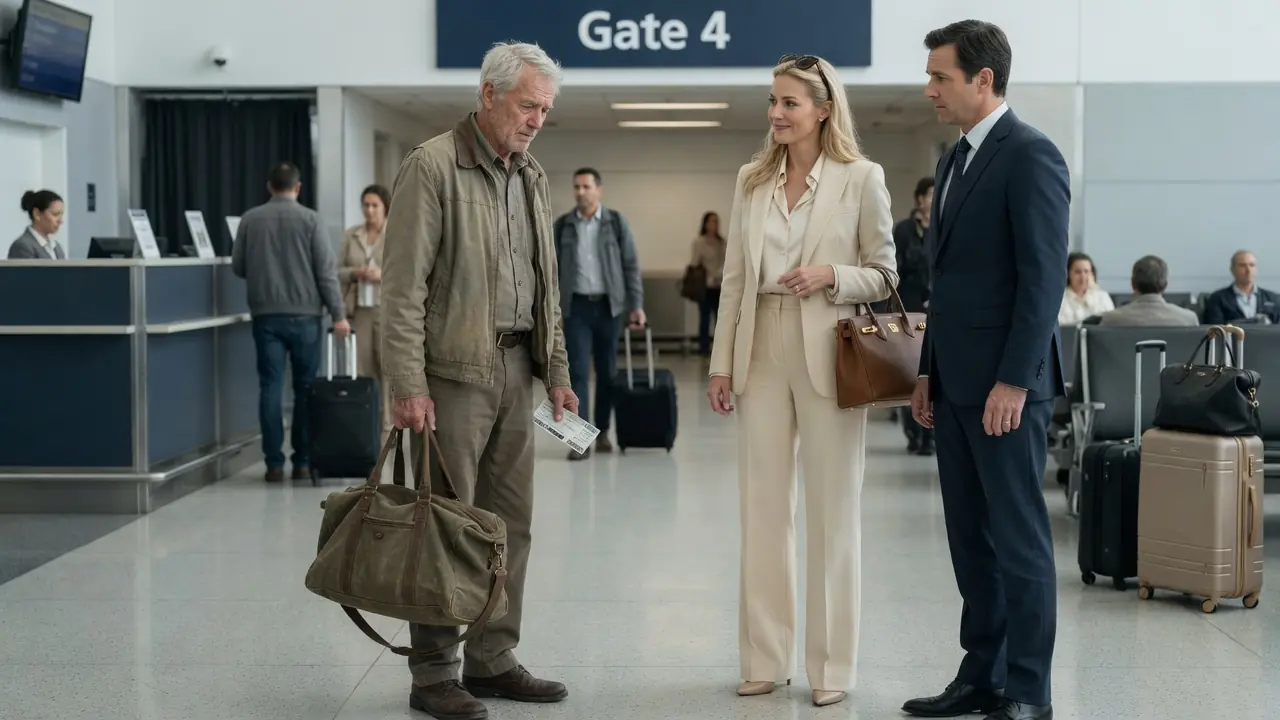
At Gate 4 inside JFK Airport, my daughter-in-law Jessica Turner smiled at her phone like an angel and spoke to her followers in a voice sweet enough to rot teeth.
“We are finally heading to the Caribbean,” she said, lifting the camera high enough to catch her oversized sunglasses, her cream travel outfit, and the three Louis Vuitton suitcases stacked beside my son like trophies.
“Family time is so important. We even brought Damon’s father along because everyone deserves a little kindness.”
Then she turned the camera toward me.
I stood there holding my old brown duffel bag like a prop in a charity commercial.
My name is Caleb Turner.
I was seventy-two years old, a white American man with a gray-stubbled jaw, slow knees, rough hands, and a back that had carried too much work for too many years. I was dressed that morning in a faded khaki jacket, a blue button-down shirt, pressed trousers, and the same brown shoes I had worn for nearly a decade because they still held their shape. Jessica hated that jacket from the moment she saw it.
She liked people polished, expensive, and useful to her image.
I was useful only when she could film me as the grateful old father-in-law she was generously “treating” to a vacation.
What she forgot was that old men often hear more than people think.
The airport was packed with travelers, rolling suitcases, coffee cups, gate announcements, crying children, and the tired anxiety that hangs over every boarding area before an international flight. A man in a Yankees cap was arguing with his wife over passports. A toddler in sparkly shoes was licking the handle of a suitcase while her mother searched frantically through a diaper bag. Across from us, two businessmen stared at laptops as if they could bully the internet into working faster.
Damon stood beside Jessica in a tight navy suit, staring at the floor like the tiles were giving him instructions.
He was forty-one years old, my only son, a man I had raised with both hands and too much forgiveness. I had paid for his private school when my trucking company was just starting to turn a profit. I had paid for his college after his scholarship fell through because he had spent more time chasing parties than grades. I had paid for his wedding because he said Jessica’s family expected something elegant, and I did not want him starting married life embarrassed.
After that, I paid for house repairs.
Then I paid off a credit card.
Then I loaned him money for a business idea that turned into a storage unit full of unsold imported fitness equipment.
Then I paid for what he called “temporary support” because Jessica wanted to build her lifestyle brand and needed the right look before sponsors came.
Sponsors never came.
Bills did.
Lately, I had become less a father and more a private bank with bad knees.
Jessica finished her video, lowered her phone, and the smile vanished from her face like a light switch had been flipped.
“Okay, Caleb,” she said, snapping her fingers once near my chest. “Listen carefully.”
I looked at her hand first.
Then at her face.
She did not notice.
Women like Jessica never notice the moment before an old man stops forgiving.
“Damon and I are flying business class,” she continued, “because we need to network, relax, and look presentable. You are going to sit in economy.”
She shoved a boarding pass into my hand.
It was wrinkled from her grip, and the seat number read 32B.
A middle seat, near the back, close enough to the lavatory that I could already imagine the smell.
I looked at the ticket.
Then I looked at my son.
“Is this how it is going to be, Damon?”
Damon shifted his weight and would not meet my eyes.
“It is just one flight, Dad,” he muttered. “Jessica gets anxious if we are not together, and the tickets were expensive.”
Expensive.
That was a funny word coming from a man who had used fifty thousand dollars of my money to book this vacation under the lie of a business investment.
Two months earlier, Damon had sat in my kitchen with both hands around a coffee mug and told me he had found a “limited entry hospitality opportunity.” He said a Caribbean investment group needed short-term capital, and if he could put money down, he and Jessica might finally build something stable.
I had asked for documents.
He said they were coming.
I had asked for a business plan.
He said Jessica handled the branding side.
I had asked if he was in trouble again.
He said, “Dad, why can’t you trust me just once?”
The cruel thing was, I had trusted him too many times.
Jessica rolled her eyes now, standing there in front of the gate with sunglasses perched on her head like she was already posing beside turquoise water.
“Do not start making this dramatic,” she said. “You will be fine back there. The food is simpler, and the bathroom is closer, so it is actually better for you.”
She smiled again, but this time it was not for the camera.
It was for herself.
Jessica enjoyed placing people where she believed they belonged.
I folded the economy ticket slowly.
“No trouble,” I said. “I just wanted to know where everyone stands.”
Jessica smirked, thinking she had won.
That hurt worse than her insult.
A son who is relieved when his father accepts humiliation has already made a choice.
What they did not know was that twenty minutes earlier, while Jessica was posing near the coffee stand and Damon was checking his watch, I had gone to the counter and changed the whole trip.
I had purchased full-fare first-class tickets under my own name, then moved Jessica and Damon to the very seats they had planned for me. I still had the real boarding pass tucked inside my jacket pocket.
Seat 1A.
But I was not ready to use it yet.
The gate agent, Brenda, had seen enough to understand.
She was a tired woman with kind eyes, silver hoops in her ears, and a name tag slightly crooked from a long morning of travelers acting like boarding zones were moral rankings. When I approached her counter quietly, I explained nothing beyond what needed explaining. I showed her identification, confirmed my purchases, changed the assignments, and asked that the new arrangement remain private until necessary.
Brenda glanced from her screen to me.
Then to Jessica, who was filming herself with her hand on Damon’s chest.
Then back to me.
“Are you sure, sir?” she asked softly.
“I am.”
Her mouth tightened in a way that was not quite a smile.
“Then I will handle it.”
Now, when Jessica pushed past me to wave her priority pass at the counter, Brenda glanced at her screen, then at me, then back at the screen.
Her eyebrows lifted just enough to tell me she saw the changes I had made.
“Any problem?” Jessica asked, tapping her manicured nails on the counter. “We are priority boarding.”
Brenda’s face settled into perfect professionalism.
“No problem at all, ma’am,” she said. “Have a safe flight.”
Then her eyes flicked to mine for one second.
I saw the smallest spark of amusement there.
Jessica marched toward the jet bridge, dragging Damon by the arm.
“Come on,” she said. “Let’s get champagne before takeoff.”
She did not wait to see if I followed.
People like Jessica never look back unless they think someone is filming.
I walked down the jet bridge with my old duffel bag in one hand and the economy boarding pass in the other. The tunnel smelled of jet fuel, stale air, and carpet that had absorbed years of nervous departures. Damon and Jessica were several steps ahead of me, already whispering to each other as if I had become luggage they had forgotten to check.
When we reached the cabin, I did not turn toward the wide leather seats up front.
I walked past first class.
Past business class.
Past the curtain.
Past the rows where people still had room to breathe.
I kept going until I reached row 32.
Seat 32B was exactly as miserable as it looked on paper.
A large man slept in 32A with his shoulder spilling over the armrest before the plane had even pushed back. A teenager with headphones sat in 32C, tapping anxiously on his phone while his knee bounced hard enough to shake the row. I squeezed into the middle seat, lifted my duffel bag into the overhead bin, and lowered myself carefully into a space designed for someone younger, smaller, and less familiar with joint pain.
My knees touched the tray table.
The armrests were already claimed.
A faint chemical smell from the lavatory drifted through the air.
I could have sat in 1A.
I could have ordered wine, stretched out my legs, and let Jessica discover the reversal before takeoff.
But this was not about comfort.
This was about evidence.
I needed to see whether Damon would come back. Whether he would check on me. Whether some piece of the boy I raised still lived inside the man who had let his wife shove me to the back of a plane.
He did not come.
Not during boarding.
Not after the doors closed.
Not during the safety demonstration.
Not after takeoff.
Not when the flight attendants began moving through the cabin with drinks.
My son sat behind that curtain and enjoyed the luxury I had paid for while his father sat between strangers, breathing stale air and waiting for the last bit of hope to die.
An hour into the flight, a young flight attendant came down the aisle holding a plastic cup.
She looked embarrassed before she even reached me.
“Mr. Turner?” she asked softly.
I nodded.
She leaned closer, lowering her voice.
“Mrs. Turner asked me to bring this to you.”
The cup held a half-finished sparkling drink. The bubbles were almost gone, and there was a red lipstick mark on the rim.
The flight attendant’s face flushed.
“She said to tell you it was a taste of the good life.”
The teenager beside me took off his headphones.
The man in 32A shifted awake and glanced at the cup.
Public cruelty does not need a crowd to be effective.
It only needs enough witnesses to turn a private insult into a performance.
I took the cup from the flight attendant.
“Thank you,” I said. “This is not your fault.”
She looked relieved and almost sorry enough to cry.
I lifted the cup toward the curtain at the front of the plane, as if making a toast to people who could not see me.
“To the good life,” I whispered.
Then I placed the cup on my tray table and did not drink.
The bubbles died slowly, just like the last excuse I had been making for Damon.
For the rest of the flight, I watched small things.
I watched the teenager beside me type a message to his mother saying the flight was okay.
I watched the man in 32A wake long enough to ask if I wanted the armrest.
I watched a little girl across the aisle hand her grandfather a cookie because, as she told him, “Old people need snacks too.”
I smiled at that.
Then I looked toward the curtain and felt something inside me settle.
A man can be insulted by a stranger and shrug it off.
But when his own son lets him be made small, the wound has roots.
When we landed in the Caribbean, Jessica stepped off the plane glowing with triumph. Damon followed her like luggage. She did not ask how my flight was, did not offer water, did not even pretend to care. Her phone was already out again, camera pointed toward the bright island sky.
“We made it,” she sang to her followers. “Look at this light. I am obsessed.”
Then she turned off the camera and snapped, “Keep up, Caleb. The resort does not wait for slow people.”
The transfer boat to Emerald Bay took forty minutes.
Jessica sat near the front, one hand gripping her hat, the other holding her phone at angles that made the turquoise water look even richer than it was. She complained about the salt spray touching her hair, about the boat not having chilled towels, about the staff not greeting her with drinks at the dock. Damon nodded weakly at everything she said.
I sat near the back, holding my duffel bag between my knees and watching the island rise from the water like a postcard someone had paid too much for.
Emerald Bay was beautiful.
Not the loud beauty of a crowded resort trying too hard, but a clean, expensive kind of beauty. White sand curved around the bay like a half-moon. Palm trees bent in the wind. Villas climbed the hillside in terraces of cream stone and glass, each one placed to look effortless while costing a fortune to build. At the highest point, above a blue infinity pool, stood the royal villa Jessica believed she had booked with my money.
What Jessica did not know was that I had bought the resort three days earlier through a holding company.
It was not an impulse.
Old men with sharp heads do not make moves without paperwork.
I had spent forty years building Turner Logistics from two trucks and a rented garage into a company that moved freight through six states. I had sold it at sixty-eight for more money than Damon ever understood because I never talked about money in a way he respected. To him, wealth was something to display. To me, it was something to move quietly, protect carefully, and use only when necessary.
After I learned the fifty thousand dollars had gone not into a business investment, but into a luxury trip, I called my attorney.
Then I called an old contact in hospitality acquisition.
Emerald Bay had been struggling under debt after an ownership dispute. The sale was private, rushed, and useful to all parties. My holding company finalized the purchase before Damon and Jessica finished packing sunscreen.
I had not told them because truth, delivered too early, becomes warning.
Truth, delivered at the right moment, becomes consequence.
The general manager, Julian, stood waiting at the dock with a line of staff in crisp white linen. He was a tall man with elegant posture, silver at his temples, and the kind of professional calm that comes from years of solving rich people’s problems without making faces.
He recognized me instantly.
His eyes widened, and he took one sharp step forward.
I lifted one finger to my lips.
He understood.
Smart man.
He straightened, swallowed whatever greeting he had planned, and turned to Jessica with a professional smile.
“Welcome to Emerald Bay, Mr. and Mrs. Turner.”
Jessica loved that.
She lifted her chin like royalty and handed him her passport.
“We booked the royal villa,” she said. “I want the one with the sunset pool, and make sure the champagne is chilled.”
Then she waved one hand toward me without looking.
“As for him, put him somewhere simple. He does not need anything fancy.”
Julian’s smile trembled.
“We can certainly arrange—”
“No upgrades,” Jessica cut in. “He needs something authentic. Rustic. Grounding.”
She turned to me with a fake sweet expression.
“I found you an eco lodge, Caleb. No television, no nonsense, just nature. You are always saying people are too soft these days.”
I looked at Damon.
He stared at the dock.
The eco lodge was not a lodge.
It was a hot wooden room near the far edge of the property, used mostly for storage and seasonal workers when the resort was overbooked. No real glass in the windows. A thin mattress. A ceiling fan that clicked like it was counting down to its own death. One small lamp. A bathroom with a shower that coughed before producing water.
Julian looked physically pained as the bellboy led me down the path.
I carried my own duffel bag.
The walk was long, hot, and thick with mosquitoes. Behind me, I heard the electric hum of the golf cart carrying Jessica and Damon to their air-conditioned villa. Jessica laughed as they drove away.
Inside the eco lodge, I sat on the thin mattress and loosened my collar.
The room smelled of wood, heat, and old rain.
The bellboy, a young man named Mateo, apologized under his breath and told me to keep the screen door closed so the crabs would not get in.
I gave him a hundred-dollar tip.
His eyes nearly popped out of his head.
“Sir, I cannot—”
“You can,” I said. “And you will not mention it.”
He looked confused, then grateful, then terrified that he had accidentally stepped into something larger than a tip.
“Do not worry about me,” I told him. “I have slept in worse places.”
When he left, I pulled an iPad from my bag and connected to the resort’s private owner network.
The screen asked for biometric confirmation.
I placed my thumb on the reader.
Welcome, Mr. Turner.
The royal villa appeared on the management screen.
Temperature set to sixty-eight.
Room service active.
Minibar unlocked.
Jacuzzi heating.
Champagne delivered.
Additional floral arrangement approved.
Jessica thought she had sent me to the edge of the island.
Really, she had given me the control room.
That evening, Jessica came to my door wearing a white resort dress and an expression of mild disgust. Damon stood behind her in white linen, looking ridiculous and ashamed. The sun was lowering behind the palms, and the heat had turned the eco lodge into a wooden oven.
“We are having a private sunset dinner,” she said. “It is all white, very exclusive. You do not have anything appropriate.”
“I suppose that means I am not invited.”
She laughed.
“Do not be dramatic. I had the kitchen pack you something hearty.”
A waiter stepped forward and handed me a brown paper bag.
Inside was a soggy sandwich and a small bag of chips.
Damon looked at me for half a second.
“Enjoy dinner, Dad,” he mumbled.
Jessica pulled him away before he could say anything else.
I watched them go, then opened the sandwich.
It tasted like wilted lettuce and insult.
I did not eat more than two bites.
Instead, I opened the resort security feed and selected the cliffside pavilion camera.
There they were, seated at a white table above the ocean, drinking expensive wine and pretending they belonged to a world they could not afford. Jessica adjusted her hair between bites, constantly checking the angle of the sunset behind her. Damon kept smiling weakly for photos, like a man holding a mask to his own face.
I turned on the audio.
At first, they talked about photos and lighting.
Then Jessica leaned across the table and lowered her voice.
“We need to talk about the house.”
Damon went pale.
“Not tonight, Jess.”
“Yes, tonight,” she snapped. “Your father signed it over to you years ago, but he thinks he is going to live there until he dies. That cannot happen.”
Damon stared at his plate.
“He is my dad.”
“He is a problem,” Jessica said. “We sell the house when we get back. Developers will pay two million for that lot. We put Caleb somewhere safe, a state facility, somewhere clean enough, and we move on with our lives.”
Damon did not slam his hand on the table.
He did not defend me.
He did not say that the house had never been signed over to him, only placed inside a family trust with restrictions he had apparently failed to read.
After a long silence, he whispered, “Okay.”
I stopped the recording and saved it to the cloud.
Evidence.
That was the word I typed into the file name.
The house my late wife and I had built, the place where Damon took his first steps, the porch where my wife, Margaret, drank coffee every Sunday morning, the backyard where I taught my son to throw a baseball, was just a number to them.
A down payment on a fantasy.
I sat in that hot wooden room while the ceiling fan clicked above me, and for the first time in my life, I allowed myself to stop protecting Damon from who he had become.
The next morning, Jessica woke me at five to reserve a pool cabana.
She did not knock politely.
She tapped on the door with the impatience of a hotel guest summoning housekeeping.
When I opened it, she handed me towels, sunscreen, a canvas bag, and a tiny dog wearing sunglasses.
The dog blinked at me.
“What is this?”
“His paws cannot get dirty,” Jessica said. “Carry him if the path is sandy.”
I looked at Damon.
He stood behind her holding two iced coffees.
He looked away.
Jessica flicked a twenty-dollar bill at me for my trouble.
It landed on the floor.
I bent slowly, picked it up, and held it between two fingers.
“Thank you,” I said.
She smiled as if she had been generous.
When she left, I wrote “debt” across the bill with a red marker and placed it in my notebook.
Every transaction must be recorded.
Every insult has a cost.
At the cabana, I waited four hours while the sun came up. I set the towels out. I placed the sunscreen on the small table. I sat in the corner with the tiny dog on my lap while the staff gave me concerned looks and pretended not to see too much.
When Jessica arrived, she told me to move because I was wrinkling the towel.
Then she ordered two mimosas, sparkling water for the dog, coconut shrimp, imported berries, and something called a sunrise platter.
“Charge everything to room 101,” she told the bartender.
So I did.
Only I told the bartender to use the expensive champagne.
Then I added caviar for the dog.
By afternoon, the resort bill was already climbing.
Jessica wanted luxury.
I was finally done subsidizing it quietly.
Later, at the resort boutique, her supplementary credit card declined.
I had lowered the limit to zero from my phone while sitting on the porch of the eco lodge with a glass of iced water and a mosquito coil burning by my feet.
She called me screaming, demanding that I fix it.
I pretended confusion.
“Which app is the banking app?” I asked.
“You know which app!”
“There are many icons, Jessica.”
“The blue one!”
“I see three blue ones.”
“The bank, Caleb! The bank!”
“Is the password the name of my first dog?”
She shrieked so loudly I had to pull the phone from my ear.
“We are on an island, Caleb! There is no bank branch here!”
“That is unfortunate,” I said calmly. “Computers are very careful with old people’s money.”
She hung up.
I smiled for the first time that day.
The next day, Jessica tried to turn me into a servant for her fake investor meeting.
She sent Damon to the eco lodge with a straw hat, stiff overalls, and a plaid shirt from the resort costume closet.
My son stood at my doorway holding the clothes like an offering to a crime.
“She wants you to look like the old family groundskeeper,” he said, unable to meet my eyes. “Just for an hour.”
I looked at him for a long time.
“You brought this to me?”
His mouth opened.
Closed.
Then he said, “Dad, please. If this meeting goes well, we can fix a lot.”
“We?”
He flinched.
“She has people coming,” he said. “Potential investors. She needs the image to work.”
I took the costume from him.
Not because I was obedient.
Because props hear things.
The so-called investors arrived just before noon. They were young men with expensive watches, matching loafers, and the restless confidence of people selling an idea they did not fully understand. Crypto, Jessica told them. Hospitality-backed digital luxury membership. Island lifestyle access. Fractional villa rights. Words stacked on words until the lie sounded almost intelligent.
I stood near the terrace in the straw hat, holding a rake.
Jessica introduced me as “Caleb, who has been with the family property forever.”
Family property.
She spoke of old money and generational wealth while standing on property she did not know I owned. Then she promised them two million dollars she planned to get from selling my house.
I waited.
Timing matters.
A fool interrupts at the first lie.
A patient man waits for the lie to grow legs.
When Jessica leaned toward the investors and said, “The Turner estate is a guaranteed liquidity event,” I lifted my head from raking the sand.
“Miss Jessica,” I said, “the manager said the card on file did not go through.”
The terrace went silent.
The investors removed their sunglasses.
Jessica’s face turned red, then white.
“It is a mistake,” she snapped. “He gets confused.”
One investor looked at me.
I looked back with the steady eyes of a man who had negotiated with shipping executives, union breakers, and city officials who thought they were smarter than they were.
“Does the family property also have trouble with cards?” the investor asked.
Jessica laughed too quickly.
“No, no. Caleb is very old-fashioned. He does not understand modern finance.”
I lowered my rake.
“I understand debt.”
The second investor stood up.
“We have another meeting.”
Jessica’s eyes widened.
“Wait, gentlemen, please. This is just a misunderstanding.”
But people who sell fantasies are very good at recognizing when someone else’s fantasy begins to collapse.
They left.
Jessica watched her future walk away down the stone path.
When they were gone, she turned on me with pure hatred.
“You ruined it,” she whispered.
I held the rake upright.
“I am just the gardener, ma’am. I rake the dirt. I do not make it.”
Damon stood behind her, pale and silent.
Always silent.
That night, I called Samuel Goldstein, my attorney in New York.
Samuel was eighty-one, sharper than men half his age, and had handled my legal affairs since Turner Logistics was a two-truck operation with bad tires and a dream. He answered on the second ring.
“Caleb,” he said. “I assume the island has clarified matters.”
“It has.”
“How bad?”
“Worse than expected.”
I looked at the recorded file on my screen.
House conversation.
Investor fraud.
Credit dependence.
Pattern of humiliation.
“Execute Omega,” I said.
Samuel was quiet for a long moment.
He knew what that meant.
The family trust protections would lock. Damon’s discretionary distributions would freeze. His access to house-related accounts would be suspended. Jessica’s supplemental card would remain at zero. Any business accounts connected to the fifty-thousand-dollar “investment” would be audited. Return tickets purchased through my account would be canceled and reissued only at my discretion.
“Are you certain?” Samuel asked.
I thought of Jessica’s economy ticket.
Damon’s silence.
The leftover drink.
The eco lodge.
The house conversation.
The costume.
“I am certain,” I said. “And transfer Emerald Bay Resort into my personal name now that the holding period is complete. I want the staff notified by morning.”
“Understood.”
Samuel paused.
“Caleb?”
“Yes?”
“I am sorry it had to be your son.”
I looked toward the dark window, where I could see only my reflection.
“So am I.”
The storm came the next day.
A hurricane warning moved across the island like judgment. The sky darkened before noon, turning the bright water iron gray. Palm trees bent in the wind. Staff moved furniture indoors. Guests whispered at breakfast and checked phones while the resort’s emergency team distributed printed instructions.
Commercial flights were canceled.
Private transfers were limited.
Jessica arrived at my eco lodge soaked, wild-eyed, and desperate.
The wind had ruined her hair.
Her face had no filter now.
“We need money for a private helicopter,” she said. “Twenty-five thousand cash or wire.”
I looked at her calmly.
“That is a lot of money.”
Damon stepped forward, almost shaking.
“Dad, please. We cannot leave without you.”
The helicopter rotors were already starting somewhere in the distance.
They had laughed at my economy seat, but now they needed the old man from 32B to save them.
“I cannot help you,” I said. “I am just a poor old man on a fixed income, remember?”
Jessica stared at me as if she finally understood that the words she had used as weapons were now walls around her.
Damon’s face crumbled.
“Dad, this is not the time for a lesson.”
“It is exactly the time,” I said. “You told me we were not on the same level. Now you are asking me to pay for your escape.”
Jessica stepped back, speechless.
For once, she had no line ready.
They missed the helicopter.
The storm trapped them on the island overnight, and the royal villa’s glass walls became unsafe in the wind. Julian advised that all guests in exposed villas be moved to interior reinforced rooms or low structures.
Jessica and Damon ended up back in the eco lodge.
I let them stay in the corner because I was not them.
I would not throw family into danger, even when family had tried to throw me away.
The storm hammered the island for hours.
Rain struck the roof like thrown gravel. Wind pushed through every crack. Jessica sat on the floor wrapped in a towel, shivering and furious. Damon sat near the wall with his head in his hands.
At some point after midnight, he looked at me.
“Dad,” he said, voice hoarse. “When did I become like this?”
I looked at him through the dim light.
I could have said, when you married her.
But that would have been too easy.
So I told the truth.
“When you learned that being rescued felt better than being responsible.”
His eyes filled.
Jessica snapped, “Do not listen to him. He enjoys this.”
I turned toward her.
“No, Jessica. I have hated every minute of it.”
For once, she looked away first.
By morning, the storm had passed.
The island looked bruised but standing. Palm fronds littered the paths. The sea was still rough. Staff moved quickly and calmly, repairing, sweeping, checking on guests. And then the whole resort changed.
At nine o’clock, the ownership notice went out.
Julian came to the eco lodge himself with a golf cart, a pressed suit, and an expression of total respect.
“Mr. Turner,” he said, standing straight at the door. “Your table is ready for tonight’s owner’s gala.”
Jessica heard him from the corner and looked up sharply.
“Owner?” she whispered.
Damon looked like he might be sick.
I said nothing.
I simply opened my bag and pulled out the midnight-blue tuxedo I had brought for exactly this moment.
That evening, I walked into the gala as Caleb Turner, sole owner of Emerald Bay Resort.
No khaki jacket.
No stoop.
No servant costume.
Just a white-haired man in a tailored tuxedo, escorted by the general manager past a velvet rope that opened like the sea.
The ballroom overlooked the ocean through high glass windows. Candles glowed on white tables. A string quartet played near the terrace doors. Guests in linen, silk, and diamonds murmured over champagne while staff moved through the room with silver trays.
Jessica was near the bar, trying to charm a wealthy guest with a story about her family’s private island connections.
When she saw me, her glass slipped from her hand and shattered on the marble.
Champagne splashed across her dress.
Every head turned.
“Good evening, Jessica,” I said.
She stared at me.
Then at Julian standing beside me.
Then at Damon behind me with his face lowered.
“You,” she whispered. “How are you here?”
Julian answered before I could.
“Ladies and gentlemen,” he said clearly. “Allow me to introduce Mr. Caleb Turner, owner of Emerald Bay Resort and the private island on which we are standing.”
The room fell silent.
Jessica’s face collapsed.
I looked at the wealthy guest she had been charming.
“My daughter-in-law loves to tell stories,” I said. “Unfortunately, many of them are charged to accounts she cannot pay.”
A low murmur moved through the room.
The guest took one step away from her.
Jessica tried to laugh, but it came out broken.
“Caleb is confused,” she said. “He is old. He has episodes.”
I smiled without warmth.
“Perhaps. But I am not confused about who owns this resort, who paid for this trip, or who tried to sell my house behind my back.”
Damon finally looked up.
He did not defend her.
He did not defend himself.
He simply looked like a man seeing the truth arrive too late.
I almost felt sorry for him.
But pity is not the same as forgiveness.
Jessica stepped closer, lowering her voice.
“You would humiliate your own family?”
I looked around the room.
“At JFK, you turned me into content. On the plane, you sent me leftovers like a dog. At this resort, you put me in a storage room and dressed me as a servant. Do not confuse harvest with cruelty, Jessica. You planted this.”
Her lips trembled.
“Damon,” she hissed. “Say something.”
Damon opened his mouth.
For the first time in days, he looked directly at me.
“I am sorry,” he said.
Two words.
Small.
Late.
Not useless, perhaps, but not enough to repair what silence had cost.
I nodded once.
“I believe you are sorry now.”
He flinched.
The next morning, I canceled their first-class return tickets.
Mine remained.
Seat 1A.
At the airport, Jessica found out at the counter, in front of strangers, just as she had humiliated me in front of strangers at JFK. The agent told her the tickets had been canceled by the purchaser.
She spun toward me.
“You canceled our way home?”
“No,” I said. “I canceled what I paid for. There is a difference.”
Damon grabbed my sleeve with both hands.
“Dad, please. We have no money.”
I looked at my son, searching for the boy I had once carried on my shoulders.
I could not find him.
“My son would never let his wife treat his father like luggage,” I said. “My son would never steal from me and call it need.”
He began to cry.
Jessica began to beg.
Neither sound moved me the way it once would have.
I had spent a lifetime rescuing Damon from consequences, and all I had taught him was that someone else would always pay.
I walked through first-class security alone.
In the lounge, I ordered a glass of wine and sat by the window. Outside, planes lifted into the bright sky, leaving the island behind them. For the first time in years, I felt lighter.
Not happy.
Not victorious.
Lighter.
There is a difference.
When I boarded, the flight attendant greeted me by name.
“Welcome back, Mr. Turner. Seat 1A is ready.”
I placed my worn duffel bag in the overhead bin and sat down in the wide leather seat Jessica had thought was hers by right. The cabin was quiet, clean, and cool. A flight attendant offered me water before takeoff, then a glass of wine once we reached cruising altitude.
As the plane lifted off, I looked down at the island shrinking beneath us.
The royal villa.
The eco lodge.
The pool.
The dock.
The whole battlefield became a tiny green shape in the blue water.
From thirty thousand feet, even betrayal looks small.
That is the mercy of distance.
I blocked Damon’s number before the plane reached cruising altitude.
Then I blocked Jessica’s.
My hands shook only once, and I let them.
A father can love a son and still close the door when that son has become a stranger.
Three weeks later, Samuel told me Damon had filed objections through an attorney. He claimed emotional coercion, unfair financial restriction, and elder confusion. Jessica posted a tearful video about “toxic family systems” and “being punished for setting boundaries.” It had good lighting and bad acting.
Samuel handled it.
The recordings handled the rest.
The trust remained protected.
The house stayed mine until my death, then would pass not to Damon directly, but into a charitable housing foundation in my late wife’s name unless Damon completed certain requirements: debt counseling, financial independence, a year of employment without family support, and written consent to never sell the property for personal gain.
He called from an unknown number once.
I listened to the voicemail.
“Dad,” he said. “I know I failed you. I do not know how to fix it.”
For a long time, I sat in my kitchen with the phone in my hand.
Then I saved the message.
I did not call back.
Not yet.
Forgiveness is not a vending machine.
You do not insert tears and receive trust.
Months passed.
Emerald Bay stabilized under new management. Julian stayed on. Mateo became guest services coordinator after I learned he had been supporting two younger siblings. Brenda, the gate agent from JFK, received a vacation voucher she never asked for and sent me a postcard that simply said: I knew you had a plan.
I laughed when I read it.
My khaki jacket still hangs by the door.
I wear it often.
Not because I cannot afford better.
Because I have learned that the people who judge a man by his jacket usually reveal more about themselves than they learn about him.
Dignity is not loud.
It does not need to scream at a gate or beg for respect from people who already decided you were beneath them.
Dignity can sit quietly in the back row.
It can hold an old duffel bag.
It can accept a dead glass of sparkling wine and say thank you to the person forced to deliver it.
Dignity watches.
Dignity waits.
Dignity remembers where every door is.
Then, when the lesson is ready, dignity stands up, straightens its jacket, and shows everyone who really owned the trip.