At the airport, my daughter-in-law looked me dead in the eye and said, “My husband and I are flying business class, and you are sitting in cheap economy because you are simply not on our level.”
She laughed as she said it, a cold, sharp sound that cut through the noise of the terminal.
I just nodded silently and took the crumpled ticket she shoved into my chest.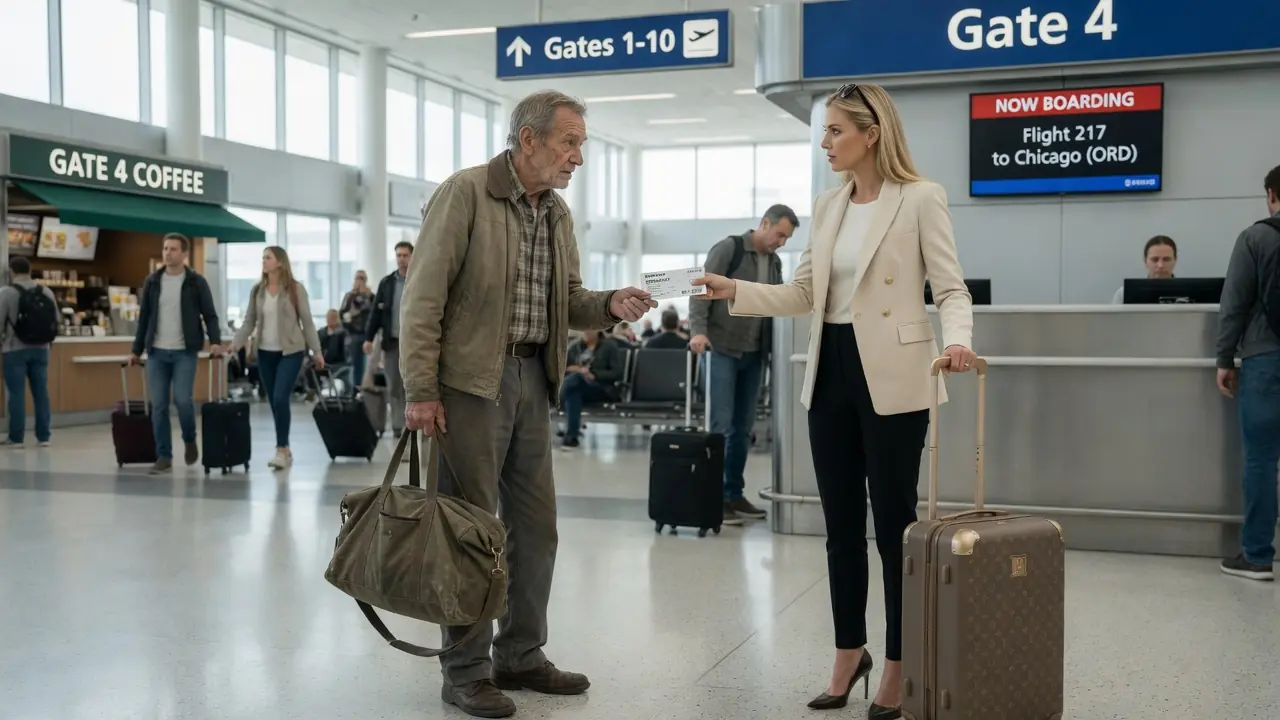
She did not know that twenty minutes prior, I had bought every single seat in the first-class cabin and switched the names in the system.
My name is Caleb Turner. I am 72 years old. Most people see an old Black man in a faded khaki jacket and assume I am invisible. They see the gray stubble on my chin and the way I walk a little slower these days, and they think I am weak.
My son Damon and his wife Jessica certainly do.
They think I am a senile old relic who exists only to pay their bills and embarrass them in public. They do not know that the man standing before them, holding a plastic bag of snacks because he was not allowed to pack a carry-on, used to run the toughest shipping union on the East Coast.
They do not know that silence is not weakness.
Silence is where you load the gun.
We were standing at Gate 4 at JFK Airport. The air was thick with the smell of overpriced coffee and anxiety. I hate airports, but I agreed to this trip because Damon begged me.
He said it was a family bonding retreat. A chance to heal old wounds.
I should have known better when Jessica showed up wearing sunglasses indoors and dragging three Louis Vuitton suitcases that I knew for a fact my son could not afford.
Jessica is what they call an influencer.
I call it being unemployed with a loud voice.
She held her phone up, the ring light reflecting in her eyes, and started recording.
“Hey, tribe,” she chirped, her voice jumping an octave higher than normal. “We are finally heading to the Caribbean for a much-needed detox. We are flying business class, of course, because self-care is not selfish.”
Then she panned the camera to me.
I was standing there holding my worn-out duffel bag, the one I have had since 1995.
“And look who we brought along,” she said, her voice dripping with fake sweetness. “We are treating Damon’s dad to a vacation. He has had a rough year, and honestly, he needs to get out of that dusty old house. We are so blessed to be able to give back to the elderly.”
I felt my jaw tighten.
Give back.
I paid for the house they live in. I paid for the car that drove us here. I paid for the very phone she was holding.
But on camera, I was the charity case. I was the prop in her movie about being a benevolent saint.
Damon stood next to her, checking his watch, refusing to meet my eyes. He was wearing a new suit, one that was too tight in the shoulders. He looked like a man trying to be something he was not.
“Cut the camera, Jess,” Damon muttered.
But he did not tell her to stop insulting me.
He just wanted to get to the lounge.
Jessica lowered the phone, and her smile vanished instantly. It was like watching a light switch flip.
“Okay, listen up, Caleb,” she said, snapping her fingers in front of my face. “We have a system. Damon and I need to network on the flight. There are some crypto investors in business class that we need to impress. You are going to be in economy. It is better for you anyway. Less complicated food. You would not like the menu up front.”
She handed me a boarding pass.
I looked at it.
Seat 32B.
“Is this a middle seat?” I asked, my voice low and steady.
She rolled her eyes.
“Oh, do not start complaining. It is a four-hour flight. You can sleep. Besides, it is right next to the toilets, so you do not have to walk far with your bladder issues.”
I do not have bladder issues.
I run three miles every morning.
But I did not correct her. I just looked at Damon.
“Is this how it is going to be, son?” I asked.
Damon shifted his weight, looking at the floor tiles.
“Look, Dad, it is just for the flight. Jess gets anxious if we are not together. And the tickets were expensive. We had to budget.”
Budget.
The word hung in the air.
I have three million dollars in liquid assets sitting in an account they do not know exists. I own four apartment buildings in Brooklyn under an LLC that does not bear my name. I could buy this entire plane if I wanted to.
But to them, I am just a retired mechanic living on a pension.
I looked at the gate agent. She was a middle-aged woman with tired eyes and a name tag that said Brenda. She had been watching the whole exchange.
She saw the way Jessica snapped her fingers at me. She saw the way my son looked at his shoes. She saw the ticket in my hand.
Brenda looked at me with pity.
That familiar look.
Poor old man.
I approached the counter. Jessica stepped in front of me, shoving her platinum status pass at the scanner.
“We are priority boarding,” she announced. “And he is with us, but he is in the back. Can you make sure he gets on the plane without getting lost? He gets confused easily.”
“I am not confused,” I said, stepping up beside her.
Jessica laughed, a dry, humorless sound.
“He thinks he is sharp,” she told the agent. “But you know how it is. Last week, he forgot where he put his keys.”
I did not forget my keys.
She hid them to force me to stay home and watch her dogs while she went to brunch.
The gate agent took my passport. She paused, looking at the screen. Her eyebrows shot up. She typed something, frowned, and typed again.
“Sir,” she started, looking at me with confusion.
I leaned in, resting my elbows on the high counter. I lowered my voice so only Brenda could hear.
“Everything is in order, ma’am. Just check the update from twenty minutes ago.”
Brenda looked at the screen again.
Her eyes widened.
She saw the modification. She saw the purchase history. She saw that Caleb Turner had purchased three full-fare first-class tickets and then, just moments ago, assigned two of them to the standby list and rebooked two passengers named Jessica and Damon Turner into seats 32B and 32C.
She looked up at me, and for a second, I saw a spark of amusement in her tired eyes.
She understood.
She did not know the full story, but she knew a power move when she saw one.
“Is there a problem?” Jessica demanded, tapping her manicured nails on the counter. “We are holding up the line.”
“No problem at all, ma’am,” Brenda said, her voice professional and cool. “I just need to print a new boarding pass for your father-in-law.”
She printed a slip of paper, but she did not give it to me. She handed back my original economy ticket, the one Jessica had printed at the kiosk.
“Have a safe flight,” she said to me with a slight nod.
Jessica snatched her boarding passes.
“Come on, Damon. Let’s go get some champagne before takeoff. Bye, Caleb. See you in five hours. Don’t fall asleep and miss the snack cart.”
She did not even wait for me to answer.
She grabbed Damon’s arm and marched down the jet bridge, her heels clicking like gunshots on the metal floor.
I stood there for a moment, watching them go.
My heart was pounding, not from fear, but from the adrenaline of the hunt.
I felt inside my jacket pocket. There, tucked against my chest, was the real boarding pass.
Seat 1A.
The seat I had saved for myself.
But I was not going to sit there.
Not yet.
I looked at the economy ticket in my hand.
Seat 32B.
The middle seat next to the toilet.
I took a deep breath. I adjusted my old baseball cap. I picked up my duffel bag. I walked down the jet bridge, but I did not turn left toward the wide leather seats and the champagne.
I turned right.
I walked past the business-class curtain. I saw Jessica already settling in, snapping selfies with a glass of sparkling water, kicking her shoes off. Damon was stuffing his bag into the overhead bin, looking relieved that he did not have to deal with me.
I kept walking.
I walked past row 10.
Row 20.
The air got stuffier. The seats got smaller.
I found row 32. A large man was spilling out of seat 32A, asleep and snoring. A teenager with headphones was in 32C.
I squeezed into the middle seat, my knees pressed against the plastic tray table in front of me. The smell of the lavatory chemical was faint but present.
Why did I do this?
Why did I possess a first-class ticket in my pocket but choose to sit here in this cramped metal tube, sandwiched between strangers?
Because I needed to see how far they would go.
I needed to know if there was any redemption left in my son. I needed to see if he would come back to check on me. I needed to see if he would bring me a bottle of water. I needed to see if he would trade seats with me, even for an hour.
This was not just a flight.
This was a trial.
And the verdict would determine whether they inherited a multimillion-dollar empire or whether they would return to a life of debt and mediocrity that they so richly deserved.
I buckled my seat belt. The buckle was cold against my stomach.
I pulled out my phone, an old model with a cracked screen that I kept just for show. I opened a hidden app, encrypted and password protected. I logged into the airline’s passenger manifest.
I saw their names.
Jessica Turner.
Damon Turner.
I scrolled down to the return flight.
“Cancel,” I whispered to myself.
I pressed the button.
Confirm cancellation, the screen asked.
I pressed yes.
Their return tickets vanished from the system.
I leaned back, closing my eyes as the engines roared to life.
Let them have their champagne.
Let them have their leg room.
Let them think they are kings and queens of the sky.
Because when we land, the ground is going to shake, and I will be the one holding the only parachute.
The seat belt sign dinged above my head with a cheerful little chime that felt like a mockery of my current situation. Seat 32B was not a seat. It was a torture device designed by engineers who hated the human spine.
To my left sat a man who must have been a defensive lineman in a former life. His shoulders were so broad they spilled over the armrest and pinned me against the other side. He was already asleep, his head lolling onto my shoulder, emitting a snoring sound that vibrated through my entire rib cage.
To my right was a terrified teenager clutching a bag of chips, his elbows digging into my side every time the plane hit a pocket of turbulence.
And the smell.
The air back here was thick, recycled, and carried the distinct aroma of the lavatory door opening and closing every thirty seconds.
Somewhere three rows behind me, a baby had been screaming since we reached cruising altitude. It was a high-piercing shriek that drilled directly into the center of my skull.
I closed my eyes and took a slow breath.
In the old days, when I was negotiating union contracts on the docks in Baltimore, I had sat in rooms hotter than this, with men more dangerous than this, for eighteen hours straight without flinching.
I could handle a cramped economy seat.
What I could not handle was the image burning in my mind of what was happening fifty feet ahead of me on the other side of that navy blue curtain.
Up there, the air smelled like fresh linen and warmed nuts. Up there, my son Damon and his wife Jessica were reclining in lie-flat seats that cost more than my first car.
I knew exactly what they were doing.
Jessica was likely arranging her legs artfully on the ottoman, holding a glass of Bollinger champagne, taking fifty photos to get the perfect angle for her Instagram story. She would caption it, “Hustle hard, play hard,” or “Grateful for this life.”
Grateful.
The word tasted like bile in my throat.
I shifted my weight, trying to pull my phone out of my pocket without waking the giant on my left. I unlocked the screen and opened my banking app.
I did not need to look at the balance, but I needed to look at the transaction history. I needed to remind myself why I was here, breathing in recycled air and listening to a stranger snore.
I scrolled down to a date three months ago.
A transfer of $50,000.
I remembered that Tuesday vividly.
It was raining. Damon had come to my house, his eyes wide and desperate, his hands shaking slightly as he gripped a cup of coffee at my kitchen table.
He had worn a suit that was too expensive for a man who had not held a steady job in two years.
“Dad,” he had said, leaning forward. “This is it. This is the big break. I have a friend who is developing an app. It is going to disrupt the logistics market. We just need seed money. Fifty thousand. I will pay you back double in six months.”
I had looked at my son.
I saw the gray hairs starting to form at his temples. I saw the fear behind his eyes.
But it was not fear of failing a business.
It was fear of her.
I knew Jessica had been pressuring him. She wanted a lifestyle he could not provide. She wanted the trips, the clothes, the status that she saw on her phone screens.
I knew he was lying to me.
I knew there was no app. I knew there was no logistics disruption. A man who spent forty years in shipping knows when someone is talking about the industry and when someone is just throwing around buzzwords they learned from a YouTube video.
But I wrote the check anyway.
Why?
Because sometimes you have to give a man enough rope to see if he builds a ladder or a noose.
I tracked the money. I have a forensic accountant named Saul who has been with me since the eighties. Saul does not sleep.
He followed that $50,000.
It did not go to a software developer. It did not go to a business account. It went to a luxury travel agency in Miami.
It paid for two first-class tickets to the Caribbean. It paid for a week-long stay at the Emerald Bay Resort and Spa. It paid for a private boat charter. It paid for the very champagne they were drinking right now.
Damon had stolen my retirement savings to treat his wife to a vacation, all while looking me in the face and talking about his future.
But here is the part they do not know.
Here is the part that kept me warm in that freezing-cold cabin.
When Saul told me where the money went, I did not get angry. I did not call Damon and scream.
I got curious.
I looked into this Emerald Bay Resort. It was a beautiful place, exclusive, located on a private island.
But financially, it was bleeding.
The ownership group was overleveraged. They were desperate for a liquidity event.
So two weeks ago, I made a phone call. I used a shell company I established years ago called Atlas Holdings. It is a boring name. It sounds like a company that makes cardboard boxes. Nobody looks twice at Atlas Holdings.
I bought the debt.
I bought the mortgage.
I bought the operational rights.
Technically, as of last Friday, the pilot flying this plane does not work for me.
But the ground he is going to land on, that is mine.
The bed Jessica is going to sleep in, mine.
The food she is going to eat, mine.
I own the sand beneath their feet, and they are treating me like a stray dog they allowed to tag along.
“Excuse me, sir.”
A voice interrupted my thoughts.
I opened my eyes.
Standing in the aisle was a flight attendant. She was young, looking flustered, holding a plastic tray. She looked out of place in the economy cabin, her uniform slightly different, more polished than the crew serving back here.
“Are you Mr. Caleb Turner?” she asked, checking a piece of paper in her hand.
“Yes,” I said, straightening up as much as the seat allowed.
She bit her lip, looking uncomfortable. She glanced at the passengers around me, then leaned in close, lowering her voice.
“I have a delivery from the first-class cabin. From Mrs. Turner.”
My heart slowed down.
Here it comes.
She held out a clear plastic cup. Inside was a pale yellow liquid, bubbling slightly. It was not a fresh glass. It was half full, and the me, then leaned in close, lowering her voice.
“I have a delivery from the first-class cabin. From Mrs. rim had a smudge of bright red lipstick on it.
I stared at the cup.
The flight attendant hesitated, her face turning pink.
“She said to tell you that this is a taste of the good life. She said she couldn’t finish her second bottle, and she didn’t want it to go to waste, so she thought you might appreciate the leftovers.”
The teenager next to me took his headphones off, watching the scene with wide eyes. The large man on my left even stopped snoring for a second, shifting in his sleep.
The humiliation was designed to be precise.
It was not just about the wine. It was the message.
You get what we discard.
You exist on our scraps.
The flight attendant looked like she wanted to run away.
“I am so sorry, sir,” she whispered. “I didn’t want to bring it, but she was very insistent. She said she would file a complaint if I didn’t deliver it personally.”
I looked at the young woman.
It was not her fault.
Jessica knew exactly how to weaponize service workers.
I reached out and took the plastic cup. The plastic was cold and flimsy in my calloused hand.
“Thank you,” I said, my voice calm and steady.
I raised the cup, looking at the lipstick stain.
Jessica’s shade.
Fire-engine red.
I did not drink it. Instead, I held it up as if making a toast to the closed curtain ahead of me.
“To the good life,” I whispered.
I placed the cup on the tray table. I did not take a sip. I let it sit there, the bubbles slowly dying, going flat and stale.
Damon had allowed this.
That was the thought that hurt more than the cramped seat.
My son, who I taught to ride a bike, who I taught to shake hands with a firm grip, was sitting up there watching his wife send his father her backwash.
He had made his choice.
I reached into my pocket and touched the small leather notebook I always carried. I pulled it out and clicked my pen.
Under the heading “Day One,” I wrote, “Item: half a glass of warm champagne. Cost: one son.”
The plane banked left, beginning its descent. The captain’s voice came over the intercom, announcing that we were approaching paradise. The baby behind me finally stopped crying, exhausted.
I looked out the small, scratched window. Below us, the ocean was a brilliant turquoise blue. It looked peaceful. It looked expensive.
Jessica thought she was flying toward a week of relaxation. She thought she was the queen of the sky.
She did not realize she was flying straight into a hurricane.
And the storm was not coming from the clouds.
It was sitting in seat 32B, waiting for the seat belt sign to turn off.
The boat ride to the island took forty minutes.
Forty minutes of Jessica complaining that the salt spray was ruining her hair extensions while I sat in the back of the vessel watching the wake churn white against the deep blue of the Caribbean.
I know this water.
I know the currents here. Years ago, before I wore suits and negotiated contracts, I worked on a merchant marine vessel. I know that the ocean does not care how much money you have or how many followers watch your videos.
It will swallow you whole if you do not respect it.
As the Emerald Bay Resort came into view, I had to admit it was impressive.
Thatched-roof villas dotted the white sand, and a massive main pavilion stood at the center, open to the breeze. It looked like paradise.
And technically, it was my paradise.
I had signed the deed transfer exactly seventy-two hours ago. The ink was barely dry on the paperwork sitting in a safe in New York, paperwork that listed the new owner as a generic holding company.
We docked at the private pier. A line of staff members stood waiting, dressed in crisp white linens, holding cold towels and trays of tropical drinks.
Jessica stepped off the boat like she was royalty returning from exile. She ignored the outstretched hand of the deckhand helping her. She did not say thank you.
She just snapped her fingers at the porters.
“Be careful with the beige suitcases,” she barked. “They are vintage custom leather. If you scratch them, you are buying them.”
I stepped onto the wood of the pier.
It was teak. Good quality.
I made a mental note to check the maintenance logs later.
“Welcome to Emerald Bay,” the general manager said.
He was a tall man, British, with a posture that suggested military background. His name tag read Julian.
Julian stepped forward with a practiced smile to greet Damon and Jessica.
But then his eyes drifted to me.
I saw the moment of recognition hit him like a physical blow. His eyes widened. His jaw went slack. The color drained from his face under his tan.
He knew exactly who I was.
He had been on the Zoom call when the acquisition was finalized. He knew that the old Black man in the stained khaki jacket standing behind these two loud tourists was the man who now signed his paycheck.
“Mr. Turner,” he stammered, taking a step toward me, his hand raising to salute or shake mine. He did not seem to know which.
I locked eyes with him.
I did not blink.
Slowly, deliberately, I raised my index finger and pressed it against my lips.
Shh.
The gesture was small, almost invisible to anyone else.
But Julian froze.
He was a smart man. He understood instantly.
This was a test.
This was a play.
And he was an extra in my scene.
He swallowed hard, regaining his composure with effort. He turned back to Jessica, his hands trembling slightly as he clasped them behind his back.
“Welcome, Mr. and Mrs. Turner,” he said, his voice a little higher than before. “We are honored to have you.”
Jessica did not notice his fear. She was too busy scanning the lobby, looking for the best lighting.
“We booked the royal penthouse,” she announced, handing him her passport. “I want the one with the infinity pool facing the sunset, and make sure the champagne is chilled. We had a terrible flight.”
“Of course, madam,” Julian said. “We have prepared the royal villa for you. It is our finest accommodation.”
“And for him?”
Jessica waved a hand backward at me without looking.
Julian looked at me, then back at the computer screen, sweat beading on his forehead. He was trapped. He did not know what to do.
“He is with you?” Julian asked carefully.
“Unfortunately,” Jessica sighed. “My father-in-law is joining us, but he is on a budget. We need to put him somewhere authentic. You know, something that matches his vibe.”
She turned to me, a sickly sweet smile plastered on her face.
“Dad, I found the perfect spot for you. It is called the Eco Lodge. It is right in the nature preserve. It is very rustic, very grounding. You are always talking about how soft people are these days, right? So I thought you would appreciate getting back to basics. No AC, no TV, just you in the jungle. It is practically camping, but with a bed.”
I looked at Julian.
He looked like he was about to faint.
He knew what the Eco Lodge was.
It was not a guest room. It was a glorified shed on the far side of the island, usually used for seasonal groundskeepers or storage. It had no glass in the windows, just screens. It had a ceiling fan that barely worked. It was a mile walk from the main restaurant.
Julian opened his mouth to protest.
“Mr. Turner, surely we can upgrade—”
“No,” Jessica cut him off sharply. “No upgrades. He needs to learn to live within his means. Besides, the walk will be good for his circulation.”
Damon was standing by a pillar, pretending to examine a potted palm tree. He knew this was wrong. He knew I had high blood pressure. He knew walking a mile in ninety-degree heat was dangerous.
“Damon,” I said.
He jumped.
He looked at me, his eyes full of guilt.
“Is this okay with you, son?” I asked.
Damon looked at Jessica. She arched an eyebrow, daring him to speak.
“It sounds like an adventure, Dad,” he mumbled. “You like nature.”
I nodded.
The final nail in the coffin.
I picked up my duffel bag.
“Lead the way,” I said to the bellboy.
The bellboy looked confused. He looked at the luxury golf cart waiting to whisk Jessica and Damon to the royal villa. Then he looked at the dirt path leading into the thick trees.
“It is a bit of a walk, sir,” the boy said apologetically.
I started walking.
I did not look back.
I heard the electric hum of the golf cart as it sped my son and his wife toward air-conditioned luxury. I heard Jessica laughing, the sound fading into the distance.
The walk to the Eco Lodge took twenty minutes. The heat was oppressive, a wet blanket that wrapped around my lungs. Mosquitoes the size of dimes buzzed around my ears. My knees ached with every step, but I did not stop.
When we arrived, the bellboy looked ashamed to even unlock the door.
“I am so sorry, sir,” he whispered. “The generator is loud at night, and keep the screen door shut or the crabs will get in.”
I tipped him $100.
His eyes popped open.
“Don’t worry about me, son,” I told him. “I have slept in worse places than this.”
He left, confused and grateful.
I stepped inside.
The room was stifling. There was a single metal cot with a thin mattress. The floor was concrete. A lizard scurried across the wall. The bathroom was a small closet with a shower that dripped rusty water.
I set my bag down on the cot. I took off my heavy jacket. I sat down and wiped the sweat from my face with a handkerchief.
Most men would be furious.
Most men would be marching back to the lobby, demanding their rights, screaming that they own the place.
But I am not most men.
I sat in the heat, listening to the jungle sounds.
I thought about the three nights ahead.
Jessica thought she had put me in a prison. She thought she had banished me to the edge of her world so I would not ruin her aesthetic.
She did not realize that she had just given me the perfect vantage point.
I reached into my bag and pulled out my iPad. I connected it to the resort’s private satellite network, the admin network that only the owner had access to.
The screen lit up.
I accessed the room control system. I saw the status of the royal villa.
AC temperature: 68 degrees.
Jacuzzi heating.
Mini bar unlocked.
Room service active.
I looked at the options available to me.
I had full control.
I could shut off their power with a single tap. I could lock their door. I could cancel their dinner reservation.
But not yet.
The game was just beginning.
You do not checkmate your opponent on the first move. You let them get comfortable. You let them think they control the board. You let them extend their lines of supply until they are vulnerable.
I heard a beep from my pocket.
It was a text message from Julian, the general manager.
Sir, please forgive me. I am mortified. I have prepared the presidential suite in the north wing for you. Just say the word, and I will send a car.
I typed back slowly.
Stay put. Do not approach me. Do not blow my cover. Treat me exactly as she requested. If I get a single extra pillow that she did not pay for, you are fired.
I hit send.
I lay back on the thin, lumpy mattress. The ceiling fan clicked rhythmically above me, wobbling on its axis.
Click-clack.
Click-clack.
It sounded like a countdown.
I closed my eyes.
Let them have their night in the royal villa.
Let them drink the expensive wine.
Let Jessica post her photos.
Tomorrow, the real experience would begin.
She wanted an authentic rustic struggle. She wanted to see how the other half lives.
I smiled in the darkness.
Be careful what you wish for, Jessica.
You just might get it.
The sun began to dip below the horizon, painting the sky in violent shades of orange and purple. It was the kind of sunset that people pay thousands of dollars to see. It was the kind of sunset that belongs on a postcard.
But I was not watching it from the infinity pool or the terrace of the royal villa. I was watching it through a torn screen mesh in a wooden shack that smelled of mildew and rot.
An hour earlier, Jessica had come to the door of my so-called Eco Lodge. She did not knock. She just stood outside and called my name as if she were summoning a disobedient dog.
When I stepped out, blinking in the late-afternoon sun, I saw that she and Damon were dressed entirely in white.
Damon wore a white linen suit that looked ridiculous on him, like he was trying to be a drug lord in a bad movie. Jessica wore a flowing white dress that probably cost more than my first car.
“We are having a sunset dinner at the Cliffside Pavilion,” she announced, looking me up and down with open disgust. “It is an all-white party. Very exclusive, very chic. The aesthetic is purity and luxury.”
I looked down at my clothes. I was wearing my dark blue work pants and a gray polo shirt. I packed practical clothes because I am a practical man.
“I suppose that means I am not invited,” I said, my voice flat.
Jessica laughed, a sound that was becoming the soundtrack to my nightmare.
“Oh, Caleb, don’t be dramatic. You literally do not have anything white. You would stand out like a stain. Besides, the menu is a tasting menu. Twelve courses, tiny portions. You would hate it. You are a meat-and-potatoes guy. You wouldn’t understand the nuance of foam and reduction.”
She signaled to a waiter who had followed them down the path. The young man looked embarrassed as he handed me a brown paper bag.
“I had the kitchen pack you something hearty,” Jessica said. “A club sandwich and some chips. You can eat it here. Listen to the jungle noises. It will be peaceful. We will come get you tomorrow when we are ready to go to the beach.”
Damon refused to look at me. He was adjusting his cufflink, staring intently at a palm tree.
“Enjoy the dinner, son,” I said.
He mumbled something that sounded like, “Sorry,” before Jessica grabbed his arm and pulled him away.
Now, sitting on the edge of the cot in the fading light, I opened the brown bag.
The sandwich was soggy. The lettuce was wilted. It was the kind of meal you give to a staff member you are planning to fire.
I took a bite.
It tasted like humiliation.
But Jessica made a mistake.
She judged me by my clothes and my silence.
She forgot that before I was a retiree, before I was a widower, I was a man who managed complex logistics for the entire Eastern Seaboard.
I know how systems work.
And I know that in a modern resort, everything is connected.
I put the sandwich down. I wiped my hands on a napkin. I reached into my duffel bag and pulled out my iPad Pro.
To them, it was just an old tablet I used to play solitaire.
To me, it was the master key.
I connected to the secure admin network again. The password had not changed since the acquisition three days ago. I bypassed the guest firewall and went straight to the security subnet.
Detailed maps of the island popped up on my screen. Green dots indicated active cameras.
There were cameras everywhere.
The lobby.
The pool.
The beach.
And, of course, the private Cliffside Pavilion.
I tapped on the camera labeled VIP Dining 1. The screen flickered and then resolved into a crystal-clear 4K high-definition video feed.
There they were.
They sat at a table draped in white linen, surrounded by candles. The ocean crashed against the rocks fifty feet below them. A private waiter was pouring a vintage Cabernet into oversized crystal glasses.
I adjusted the volume on my iPad.
The resort had installed high-gain microphones in the VIP areas to monitor guest satisfaction. It was meant for quality control.
Tonight, it was for intelligence gathering.
The audio crackled, then the sound of the wind faded as the software isolated their voices.
“So amazing, babe. Seriously, the lighting here is perfect.”
That was Jessica.
She was holding her phone up, taking a selfie with the sunset.
Damon’s voice was lower, slurred. He had been drinking.
“Yeah, it is nice.”
“Nice?” Jessica snapped.
She put the phone down.
“Damon, this is $5,000 a night. Show some enthusiasm.”
“I am enthusiastic,” Damon said, taking a large gulp of wine. “I am just… I don’t know. Do you think Dad is okay back there? It gets dark fast in the jungle.”
I leaned closer to the iPad screen.
This was it.
The moment of truth.
Jessica sighed, a long, exaggerated exhalation. She picked up a piece of bread and tore it apart viciously.
“Why are you so obsessed with him? He is fine. He is probably asleep. Old people sleep twelve hours a day.”
“He is not just old people, Jess. He is my dad. And that shack… I saw a rat trap outside the door.”
“He is tough,” Jessica said, waving her hand dismissively. “He is always bragging about how he grew up on the streets, right? Let him relive his glory days. Besides, we need to talk about the plan.”
I froze.
My finger hovered over the screen.
I tapped the record button. A small red circle appeared in the corner of the display.
“What plan?” Damon asked.
“The house, Damon. The house.”
I watched my son’s face on the screen. He looked pale in the candlelight.
“We already talked about this, Jess. He signed the house over to me, but he thinks he is going to live there until he dies. That was the deal.”
Jessica laughed.
It was a cruel, sharp sound.
“Damon, grow up. We cannot live in that house with him. It is depressing. The decor is from the seventies. And honestly, I cannot stand the smell anymore.”
“The smell?” Damon asked.
“Yes, the smell. That old man smell. It is like mothballs and stale coffee and decay. It seeps into the furniture. It seeps into my clothes. I cannot have my friends over. I cannot build my brand in a house that smells like a nursing home waiting room.”
I felt a cold rage spread through my chest.
I shower twice a day. I use expensive cologne. I keep my house spotless.
The smell she was talking about was not hygiene.
It was the smell of her own prejudice.
To her, I was not a person.
I was a rotting piece of furniture.
“So what do you want to do?” Damon asked, his voice barely a whisper.
Jessica leaned across the table. Her eyes were gleaming in the candlelight. She looked predatory.
“As soon as we get back, we sell it. The market is hot right now. We can get two million for that lot easily. Developers will tear it down and build condos.”
“And Dad? Where does he go?”
Jessica took a sip of wine, savoring it.
“I did some research. There is a facility called Shady Pines in North Jersey. It is state-funded. It is not fancy, but it is clean. Well, clean enough. They take Medicare. We drop him off, tell him it is temporary while we renovate, and then we just stop visiting.”
Damon choked on his wine.
“Jesus, Jess. Put him in a state home? He has money. He has savings.”
“He had savings,” Jessica corrected him. “But we spent a chunk of it on this trip, didn’t we? And the rest, we need that for our new place in the city. Look, Damon, he is 72. His mind is going. Did you see him at the airport? He is confused. He won’t even know the difference after a week. We are doing him a favor. He will be with people his own age.”
I watched my son.
I watched the man I raised. I watched the boy I taught to fish. The boy I held when he cried over a broken arm. The man I bailed out of debt three times.
I waited for him to slam his fist on the table.
I waited for him to throw the wine in her face.
I waited for him to say, “Over my dead body.”
Damon looked down at his plate. He twirled his fork in the foam of his appetizer.
“He is going to be really mad,” he said softly.
“He won’t have the power to be mad,” Jessica said soothingly, reaching out to stroke his hand. “We will have power of attorney. We will control the narrative. It is for us, Damon. For our future. Don’t you want to be happy? Don’t you want to be free?”
Damon was silent for a long time.
The waves crashed against the rocks below.
Then slowly, he nodded.
“Okay,” he whispered. “Okay. We sell the house.”
I stopped the recording. The file saved automatically to the cloud.
I named it Evidence_01_Conspiracy.
I sat there in the dark shack. The air was hot and sticky, but I felt ice cold. I looked at the half-eaten sandwich on the table.
I was not hungry anymore.
They were planning to sell the home my wife and I built brick by brick. They were planning to throw me into a warehouse for the dying so they could buy a loft in Manhattan.
They were planning to erase me while I was still breathing.
Jessica was right about one thing.
There was a smell.
But it was not old age.
It was the stench of betrayal.
I stood up. My knees popped, but I did not feel the pain. I felt strong. Stronger than I had felt in years.
I walked to the small rusty mirror hanging on the wall of the shack. I looked at my reflection. I saw the lines on my face. I saw the gray in my beard.
But I also saw the eyes of Caleb Turner, the eyes of a man who had stared down union busters and mob enforcers.
“You want to send me to hell?” I whispered to the empty room.
I picked up the iPad again. I opened the resort management app. I navigated to the kitchen orders. I saw their dessert order pending.
Chocolate soufflé.
I tapped the screen. I added a note to the chef.
Change order. Serve the bill instead. Full price. No comp.
I smiled.
It was a small jab.
A warning shot.
Tonight, they would pay for dinner.
Tomorrow, they would pay for everything else.
Five in the morning in the jungle does not sound like a relaxation playlist. It sounds like a war zone. The cicadas were screaming, the monkeys were howling, and the humidity was already thick enough to chew on.
I had slept maybe three hours on the metal cot, my back aching in places I had forgotten I had. I was lying there staring at a spiderweb in the corner, wondering if the spider had a better life than I did right now, when the banging started.
It was not a knock.
It was a demand.
Someone was hammering on the wooden frame of the screen door with the kind of entitlement that only exists in people who have never been told no.
I sat up, my joints popping like dry twigs. I pulled on my pants.
I did not rush.
I never rush for people who do not respect my time.
When I pushed the screen door open, Jessica was standing there. She was already in full makeup. She wore a silk kimono that probably cost more than the monthly pension of the maids cleaning her room.
Beside her, looking miserable and sleepy, was my son Damon.
And in Jessica’s arms was Mr. Guapo.
Mr. Guapo is a standard poodle. He is not a dog. He is a fashion accessory with a heartbeat. He was wearing a tiny Hawaiian shirt. And I am not joking. A pair of miniature aviator sunglasses were strapped to his head.
“Dad, finally,” Jessica snapped, looking at her Apple Watch. “Do you know what time it is?”
“It is five in the morning, Jessica,” I said, my voice raspy from dehydration.
“Exactly,” she said. “The sun comes up in thirty minutes. You need to get to the pool.”
I looked at her. I looked at the dark path leading to the main resort.
“The pool is closed, Jessica,” I said.
She rolled her eyes, a gesture she had perfected.
“That is the point, Caleb. You have to go reserve our spots. The Europeans get up at dawn and steal all the best cabanas. We want the one right in the center facing the swim-up bar. The one with the white curtains. You need to go put our towels down and sit there so nobody takes it.”
She thrust a tote bag into my chest.
“Here are the towels and sunscreen. And don’t let anyone move them. If we get stuck in the back row near the kids’ pool, my content is ruined.”
I held the heavy bag. I looked at Damon. He was looking at a beetle crawling on the ground.
“Damon,” I said, “you are waking me up at five in the morning to watch empty chairs.”
Damon rubbed the back of his neck.
“It is just… it is important to her, Dad. Just do it for us. Please. We want to sleep in a little bit. We are on vacation.”
We are on vacation.
The words hung in the humid air.
They were on vacation.
I was on a labor-camp detail.
“And take the dog,” Jessica added, dropping the leash into my hand. “Mr. Guapo needs his morning walk, but do not let him walk on the dirt. Carry him until you get to the paved path. I don’t want his paws getting muddy before his photo shoot.”
She reached into the pocket of her silk robe. She pulled out a $20 bill. It was crumpled. She flicked it at me. It fluttered through the air and landed on the dirty concrete floor of my shack.
“Here,” she said. “For your trouble. Buy yourself a soda or something, but don’t lose the dog sunglasses. They are Gucci. They cost $300.”
She turned on her heel.
“Come on, babe. Let’s go back to bed. It is freezing out here.”
They walked away.
They left their 72-year-old father standing in the dark, holding a bag of towels and a dog that was dressed better than he was.
I looked down at the $20 bill lying in the dirt.
A younger version of me would have left it there. A younger version of me would have thrown the towels in the mud and marched to the airport.
But the Caleb Turner of today is playing a long game.
I bent down. My knees cracked loud enough to startle the dog. I picked up the money. I dusted it off.
I looked at Mr. Guapo. The dog looked back at me through his dark lenses. He looked as trapped as I was.
“Come on, dog,” I muttered. “Let’s go do our job.”
The walk to the main pool was lonely.
The resort was asleep. The only people awake were the groundskeepers and the kitchen staff prepping for breakfast. They stopped their work to watch me pass.
An old Black man carrying a poodle in a Hawaiian shirt.
I could see the confusion in their eyes.
They did not know if I was an eccentric millionaire or a servant who had lost a bet.
I arrived at the main pool. It was a glassy sheet of turquoise, perfectly still. I found the central cabana, the prime real estate. I laid out the towels exactly as Jessica had instructed. I fluffed the pillows.
Then I sat down on the edge of the lounge chair.
I was the unpaid butler.
The invisible guard dog.
I took the $20 bill out of my pocket. I smoothed it out on the table. I reached into my pocket and pulled out a red permanent marker. I carry it everywhere, an old habit from my days checking cargo manifests.
I uncapped the pen. The smell of the ink was sharp and chemical.
On the face of Andrew Jackson, I wrote a single word in bold capital letters.
Debt.
Underneath it, I wrote the date.
And then I wrote: Labor, 5:00 a.m., cabana boy.
I slipped the bill into my wallet, into a separate compartment where I was keeping the physical evidence.
This was not just $20.
This was a transaction.
And in my world, every transaction must be balanced.
I looked at the dog. He was curled up on the expensive towel, sleeping.
“You know, Guapo,” I whispered to him. “You have a better life than my son. You are loyal. You don’t ask for money, and you probably wouldn’t sell your father for a business-class ticket.”
I sat there for three hours.
I watched the sun come up. It was beautiful, I suppose. The sky turned from black to gray to a brilliant burning pink.
But beauty is hard to appreciate when your stomach is growling and your heart is cold.
Around eight o’clock, the other guests started to trickle in. They were young, beautiful, wealthy. They looked at me with suspicion.
Why was this old man in the work clothes sitting in the VIP cabana?
A security guard walked by. He slowed down, his hand hovering near his radio.
I stared him down.
I gave him the look I used to give the strikebreakers in 1989.
The look that says, Do not test me.
He kept walking.
Finally, at 9:30, they arrived.
Jessica looked refreshed. She was wearing a bikini that was barely there and a cover-up that flowed behind her like a cape. Damon was trailing behind her, carrying her beach bag, her hydration cup, and her tripod.
“Oh, good. You got the spot,” she said, not even looking at me.
She dropped her bag on the chair I had been guarding for four hours.
“Move over, Caleb. You are wrinkling the towel.”
I stood up. My legs were stiff.
“Did you walk the dog?” she asked, picking up Mr. Guapo and cooing at him.
“Yes,” I said.
“Good. You can go now. We have a photo shoot to do.”
I turned.
“Oh, and Caleb.”
I stopped.
“Go to the bar and get us two mimosas. And a water for the dog. Sparkling water. Tap water gives him gas.”
I looked at her.
“I don’t have money for the bar, Jessica. You gave me $20. A mimosa here is twenty-five.”
She sighed, the sound of pure exhaustion at my incompetence.
“Just charge it to the room, Caleb. God, do I have to explain everything? Use room number 101.”
Room 101.
The royal penthouse.
I smiled.
It was the first time I had smiled all morning.
“Of course,” I said. “Room 101. I will make sure they get the order right.”
I walked to the bar.
The bartender was a young man named Mateo. He looked at me, then at the couple in the cabana setting up a tripod.
“What can I get you, sir?” he asked.
I leaned over the bar.
“My son and his wife would like two mimosas,” I said. “But listen to me closely, son. I want you to use the vintage Dom Pérignon, the 2008 bottle.”
Mateo’s eyes widened.
“Sir, that is $600 a bottle.”
“I know,” I said. “They are celebrating. And they want a bowl of caviar for the dog. The beluga.”
Mateo hesitated.
“Are you sure?”
I tapped the counter.
“Room 101. Charge it all to room 101. And keep the bottle coming. If their glass is half empty, fill it.”
I walked away as Mateo popped the cork.
I did not go back to the cabana. I did not go back to the shack.
I walked to the business center.
I had some work to do.
Jessica wanted me to be a servant.
Fine.
I would serve her.
I would serve her exactly what she deserved.
I took the red marker out of my pocket again. I clicked the cap.
The debt was growing, and the interest rate just went up.
My phone buzzed in my pocket.
It was a notification from my bank.
An attempted transaction for $5,400 at the resort boutique.
I looked at the screen and smiled.
It had begun.
I was sitting on the porch of the Eco Lodge, swatting away mosquitoes and watching a line of ants march across the cracked concrete floor. It was two o’clock in the afternoon.
While I was battling the heat and the humidity, my daughter-in-law Jessica and my son Damon were seeking refuge in the air-conditioned sanctuary of the high-end shopping district located near the main lobby.
I knew exactly where they were because I was tracking them, not just with the GPS on the family plan, but with the spending alerts I had set up on the supplementary credit card Damon carried in his wallet.
That card, the Platinum American Express, Damon carried it like a badge of honor. He liked the weight of it in his hand. He liked the way it clanged against the counter when he tossed it down.
He thought that card was a magic wand.
You wave it, and things appear.
Designer clothes.
Fine wines.
First-class tickets.
He never stopped to think about who paid the bill at the end of the month. He never thought about the interest rates or the late fees because he never saw them.
I did.
For years, I had covered his mistakes. I had paid off his failed business ventures. I had quietly settled the debts Jessica racked up trying to keep up with her friends in the Hamptons.
I told myself I was helping.
I told myself I was being a good father.
But sitting there in that jungle shack, wiping sweat from my forehead with a rag, I realized I had not been helping.
I had been enabling.
I had created a monster that was now trying to eat me alive.
The notification on my phone was just the first warning shot.
Five thousand dollars.
Probably a handbag.
Jessica had a weakness for handbags that cost more than a Honda Civic. She said they were investments.
I have never seen a handbag pay a dividend, but I am just a simple man who made his fortune moving shipping containers. So what do I know about economics?
I unlocked my phone and opened the banking app. The interface was clean, simple, and powerful. I navigated to the card management section.
There it was.
Damon Turner supplementary card.
Status: active.
Credit limit: $50,000.
I looked at that number.
Fifty thousand dollars of my hard-earned money available to them at the tap of a terminal. They thought that money was theirs. They thought they were entitled to it because they shared my last name.
My thumb hovered over the screen.
I tapped settings.
I tapped spending limit.
I deleted the five and the four zeros.
I typed in a single digit.
Zero.
I hit save.
The screen refreshed.
New limit: $0.
I leaned back against the rotting wood of the cabin wall and waited.
It did not take long.
Maybe two minutes.
My phone rang.
The ringtone shattered the jungle silence.
It was Jessica.
I let it ring three times.
You have to sell the performance. An old man does not answer on the first ring. He fumbles for his glasses. He looks for the button.
I answered on the fourth ring.
“Hello,” I said, making my voice sound thin and confused.
“Caleb!”
Jessica’s voice exploded in my ear. She was screaming so loud I had to pull the phone away from my head. I could hear the background noise of the boutique, soft jazz music, the murmur of polite conversation, and the distinct sharp silence of people listening to a woman lose her mind.
“Caleb, what did you do?” she shrieked.
“I don’t understand,” I stammered. “Who is this?”
“Don’t play dumb with me. It is Jessica. We are at the register. We have a line of people behind us. The card was declined. Declined, Caleb. Do you have any idea how embarrassing that is? The sales lady looked at me like I was a criminal.”
I pictured the scene.
Jessica standing there in her white resort wear, holding a bag she could not pay for, her face flushing red, not from the sun, but from the sudden, jarring reality of being told no.
I paused, acting as if I was processing the information slowly.
“Declined? That can’t be right. I paid the bill last month. Or did I?”
“You better fix this right now,” she yelled. “Call the bank. Tell them to authorize the charge. They think it is fraud or something. Tell them it is me.”
I closed my eyes and let a long, confused sigh escape my lips.
“Oh dear. I don’t have the number for the bank, Jessica. It is in my address book back home. You know, the black one on the desk. I didn’t bring it.”
“Use the app,” she screamed. “You have the app on your phone.”
“The app?” I asked, injecting a tone of bewilderment into my voice. “Which one is that? The one with the blue bird or the green square? I have so many squares on this screen now. The grandkids installed games on here.”
“Caleb, I swear to God, it is the blue one. Open it and authorize the transaction. The manager is staring at us. He is going to call security if we don’t pay. We have the merchandise in our hands.”
I looked at the blue icon on my screen, the one I had just used to cut off their lifeline.
“I am tapping it, Jessica,” I lied. “But it is asking for a password. I don’t remember the password. Is it your birthday?”
“No, that is the alarm code.”
“Is it the name of my first dog?”
“Try Password23. Try Damon88. Just try something.”
She was hysterical now. I could hear Damon in the background, his voice a frantic whisper.
“Jess, keep it down. People are looking.”
“I am trying,” I said. “Oh, wait. It says account locked.”
“What? What do you mean locked?”
“It says suspicious activity. It says I need to visit a branch in person to unlock it.”
There was a silence on the other end of the line. A heavy, suffocating silence.
“Visit a branch,” Jessica whispered, her voice trembling with rage. “We are on an island, Caleb.”
“There is no branch here, I know,” I said sympathetically. “That is unfortunate. I guess the computers are just being careful. You know how they are with seniors. They think someone is trying to steal my money.”
She let out a scream of frustration that sounded like a tea kettle boiling over.
“So what are we supposed to do? We have three bags of clothes and the limited-edition sunglasses. We can’t just walk out.”
“Do you have your own card?” I asked innocently.
There was a pause.
I knew the answer.
Jessica’s cards were maxed out. They had been maxed out for years.
“No,” she hissed. “You know we use this card for travel expenses. This is a travel expense.”
“Well,” I said, my voice dropping to a low, sad register. “I guess you will have to put the items back, dear. Maybe next time.”
I hung up.
I did not wait for her to scream again. I pressed the red button and ended the call. Then I put the phone on Do Not Disturb.
I sat there and imagined the walk of shame. I imagined the sales clerk, a man who probably spoke three languages and had zero patience for Americans with declined cards, taking the bag out of her hands. I imagined the hushed whispers of the other customers. I imagined Damon, red-faced, shuffling out of the glass doors, trying to disappear into the floor.
For years, they had walked through life assuming the doors would always open for them. They assumed the bill would always be paid. They assumed that my hard work was their birthright.
Today, the door slammed shut.
I looked down at my hands.
They were rough hands, hands that had changed tires in the snow, hands that had held picket signs, hands that had signed contracts that saved thousands of jobs.
These hands built an empire.
And these hands could dismantle it just as easily.
I opened the banking app again just to be sure.
Credit limit: $0.
I smiled.
I reached into my duffel bag and pulled out a bottle of lukewarm water. It was not champagne. It was not sparkling.
But as I drank it, sitting in the heat of the jungle, it tasted sweeter than any vintage wine.
The card decline was just the beginning.
It was a small inconvenience, a pebble in their shoe.
They did not know that I was about to trigger an avalanche.
I picked up my notebook. Under the heading “Day Two,” I wrote, “Item one: shopping spree. Cost: their dignity.”
I lay back on the cot and listened to the monkeys howling in the trees. They sounded like they were laughing, and for the first time in a long time, I wanted to laugh with them.
Tonight, there would be no fancy dinner. Tonight, there would be an argument in the royal penthouse. Tonight, the cracks in their marriage, which had been plastered over with money and luxury, would start to show.
And I would be here in the dark, listening to every word.
The summons came at four in the afternoon. I was sitting on the edge of my cot, trying to repair the wobbly leg of the table with a folded piece of cardboard, when Damon appeared at the screen door.
He looked sweaty and frantic. He was wearing a polo shirt that was buttoned all the way to the top despite the heat.
“Dad,” he said, not making eye contact. “We need you at the main villa right now.”
I stood up slowly.
“Is everything okay? Did someone get hurt?”
“No, no.” Damon waved his hands. “It is… well, Jessica has some guests coming. Potential investors. High-net-worth individuals. They are into crypto, blockchain, that sort of thing.”
I nodded.
I knew the type. Men who made imaginary money selling imaginary coins to people who could not afford to lose real dollars.
“And she wants me to meet them?” I asked.
Damon winced. He looked at the floor, then at the jungle, then anywhere but at me.
“Not exactly. See, the pitch is about lifestyle. Jessica is selling them on the idea of legacy, old money, generational wealth. She told them that the villa has been in our family for fifty years. She told them it was your father’s estate.”
I almost laughed.
My father was a sharecropper in Georgia who never owned a piece of land in his life until he bought a cemetery plot.
“So she lied,” I said calmly.
“It is marketing, Dad. It is storytelling. Look, she needs the vibe to be authentic. She wants you to help set the scene.”
He reached into a plastic bag he was holding and pulled out a bundle of clothes. It was a pair of oversized denim overalls, a plaid shirt that looked like it came from a costume shop, and a straw hat with fraying edges.
I stared at the clothes.
“She wants me to wear this.”
“She thought it would look rustic,” Damon mumbled. “Like you are the old faithful groundskeeper who has been tending the family gardens for decades. You know, to show that we have staff who stay for life. It proves stability.”
I looked at my son.
I looked at the man who had my last name.
“You want me to dress up like a caricature and pretend to be your servant?”
“It is just for an hour, Dad. Please. If she closes this deal, we are set. We can pay you back for everything.”
I took the clothes. The denim felt stiff and cheap.
“I will do it,” I said.
Damon let out a breath he had been holding.
“Thanks, Dad. Seriously, just don’t say much. Just rake the sand. Smile. Nod. Keep it simple.”
I changed into the outfit. I put on the ridiculous straw hat. I looked in the mirror.
I looked like something out of a bad movie from the 1930s.
I looked like a prop.
But props have a unique advantage.
Nobody pays attention to them.
Nobody whispers when the furniture is in the room.
We walked to the royal villa.
As we approached, I heard the bass of electronic dance music thumping from the portable speakers. There were three men lounging by the infinity pool. They were young, maybe late twenties. They wore swim trunks that cost $400 and mirrored sunglasses. They were vaping, blowing thick clouds of strawberry-scented smoke into the pristine ocean air.
Jessica was holding court. She was wearing a sheer caftan, holding a glass of champagne, laughing too loudly at something one of the men said.
“Oh, here he is,” she announced as I walked onto the terrace. “Gentlemen, this is Caleb. He has been taking care of this estate since before my husband was born. Part of the family, really.”
The three men looked at me.
They did not see Caleb Turner, former union vice president. They did not see a man who could buy and sell their entire bloodline.
They saw a gardener in a straw hat.
“Hey there, old-timer,” one of them said. He had bleached blond hair and a gold chain that looked heavy. “Keep up the good work. Place looks dope.”
I nodded.
I picked up a rake that was leaning against the wall. I started to slowly drag it across the white sand of the Zen garden near the pool.
Scratch.
Scratch.
Scratch.
Jessica turned back to the men.
“So, as I was saying, the Turner family believes in long-term holds, just like this property. My husband’s grandfather built this villa in 1970. We come here every year to recenter, to disconnect from the noise of the market.”
In 1970, I was working double shifts at the dockyard trying to save enough money to buy a used Ford.
“Wow, that is legit,” the blond man said. “Real estate is the only real hedge, you know. But our coin, Apex Alpha, is basically digital real estate. We are building an ecosystem.”
“Exactly,” Jessica chimed in. “That is why I want to put the family trust fund into it. We are looking to diversify. We have about two million in liquid capital just sitting in low-yield bonds. It is so boring.”
I stopped raking.
Two million dollars.
She was offering them two million dollars.
Money she did not have.
Money she thought she could get by selling my house and dumping me in a nursing home.
“I see,” the second man said. He was typing furiously on his phone. “Well, the buy-in for the founders tier is 500K, but for you, since you have this establishment, we could probably let you in for 250. But you have to move fast. The presale ends tonight.”
Jessica looked at Damon.
Damon was standing by the bar mixing drinks. He looked pale. He knew the accounts were empty. He knew the credit card had been declined yesterday.
But he also knew that if he told the truth, the fantasy would crumble.
“We can wire the deposit tomorrow morning,” Jessica said confidently. “Once the banks open in New York.”
I went back to raking.
Scratch.
Scratch.
I moved closer to the group, pretending to pick up fallen leaves.
“Hey, Pops,” the third man called out to me. He held up his empty beer bottle. “Can you grab me another brew and maybe some limes?”
I stopped.
I looked at him.
Jessica froze. She stared at me, her eyes wide with warning.
Don’t you dare, her eyes said.
Don’t you dare break character.
I put down the rake. I shuffled over to the man. I took the empty bottle from his hand.
“Yes, sir,” I said, making my voice sound shaky and subservient. “Right away, sir.”
I walked to the cooler. I grabbed a beer. I grabbed a lime.
As I walked back, I listened to them.
“You know,” the blond man was saying, dropping his voice, “we just need to pump the liquidity pool until Friday. Then we dump the retail tokens and ride the crash. It is classic.”
They were scammers.
Of course they were.
Jessica was trying to scam scammers. It was a circle of vipers eating each other’s tails.
I handed the beer to the man.
“Thanks, boss,” he said, not looking at me.
I walked back to my rake.
Jessica looked relieved.
She thought I had been tamed.
She thought she had won.
“So about that transfer,” the blond man pressed. “If you can’t do it tonight, we might lose the spot. Don’t you have a cold wallet or a crypto account ready?”
Jessica laughed nervously.
“Well, we are old school. We like wire transfers, but trust me, the money is there. You are sitting on the collateral.”
She waved her hand at the villa, at the ocean, at my property.
I looked at Damon.
He was staring into his drink.
I realized then that this was not just greed. It was desperation. They were drowning. They needed a miracle.
And they thought selling my life was that miracle.
I decided to help the scene along.
I looked up from my raking.
“Miss Jessica,” I called out.
Jessica turned, annoyance flashing on her face.
“What is it, Caleb? Not now.”
“The manager was here earlier,” I said, keeping my voice innocent. “He asked about the bill for the champagne. He said the credit card on file didn’t go through.”
Silence descended on the terrace.
The music seemed to stop.
The three crypto bros looked at Jessica.
“What?” Jessica hissed. “That is ridiculous. It must be a glitch.”
“Yes, ma’am,” I said. “He said something about insufficient funds. And he said he needs a cash deposit before he can bring out the lobster for dinner.”
Jessica’s face turned the color of a tomato.
“Go back to the garden, Caleb,” she snapped. “You are confused.”
The blond man sat up straighter. He took off his sunglasses.
“Wait a minute,” he said. “Insufficient funds?”
“It is a mistake,” Jessica cried. “My father-in-law… he is… he has dementia. He doesn’t know what he is talking about. He hears things.”
The man looked at me.
He looked at my eyes.
I did not look confused.
I looked at him with the steady, cold gaze of a man who knows exactly what a balance sheet looks like.
He looked back at Jessica.
“You know what?” he said, standing up. “I think we are good. We actually have a meeting with some investors in Dubai on Zoom. We should go.”
“No, wait,” Jessica pleaded. “Stay for dinner. We have Wagyu beef.”
“Maybe next time,” the man said. “Come on, boys.”
They gathered their phones and vapes. They walked out of the villa without looking back.
Jessica stood there, watching her two-million-dollar fantasy walk out the door.
She turned to me. Her hands were shaking. Her eyes were filled with pure hatred.
“You ruined it,” she whispered. “You stupid, senile old man. You ruined everything.”
I picked up my rake.
“I am just the gardener, ma’am,” I said softly. “I just rake the dirt. I don’t make it.”
I turned and walked away, leaving them alone in the silence of the luxury they could not afford.
As I walked back to my shack, I took off the straw hat and threw it into the bushes. The charade was over, but the reality check was just beginning.
I pulled out my notebook.
Day Three.
Item one: failed business deal.
Cost: the truth.
Tomorrow, the storm was coming.
And I needed to make sure my umbrella was ready.
The silver tray was heavy. It was solid sterling silver, engraved with the resort’s logo and loaded with four crystal glasses of iced sparkling water with lime twists.
My arms were trembling, not because I was weak. I have lifted engine blocks out of pickup trucks. I have carried picket signs for twelve hours in the freezing rain.
My arms were trembling because of the rage that was vibrating in my marrow.
It was three o’clock in the afternoon. The sun was at its peak, a white-hot hammer beating down on the pool deck.
Jessica had decided to host a small gathering. The crypto investors had fled, but she had managed to corner a new group of victims. Two older couples from Connecticut, old-money people who spoke in hushed tones about their summer homes in the Hamptons.
Jessica was desperate to impress them. She wanted to prove she belonged to their tribe.
And I was the prop again.
She had told them I was the family retainer.
Old Caleb, she called me.
“He has been with us forever. He insists on serving. It gives him purpose.”
The guests looked at me with that benign, condescending smile people reserve for well-trained pets. They did not see a 72-year-old man being abused. They saw a charming relic of a bygone era.
A loyal servant.
I moved through the crowd. The heat was suffocating in the denim overalls. Sweat trickled down my back. My knees were screaming with every step on the slippery tile.
“Caleb.”
Jessica’s voice cut through the air. She snapped her fingers.
“We need water over here. Mrs. Sterling is thirsty.”
I turned.
Mrs. Sterling was a woman in her sixties wearing a silk caftan that probably cost more than the down payment on a house. She was sitting on a lounge chair looking bored.
I approached them, my grip on the tray tightening.
“Careful now, old-timer,” one of the husbands said, chuckling as he watched my hands shake. “Don’t spill the good stuff.”
I reached the table. I leaned forward to place the glass on the coaster.
And then it happened.
Maybe it was the heat. Maybe it was the exhaustion. Or maybe it was the fact that Mrs. Sterling’s poodle, a nervous little creature, decided to bark at my ankles at that exact moment.
My foot slipped on a wet patch of tile.
I lurched forward. I tried to correct my balance, but the laws of physics are unforgiving.
The tray tilted.
One of the heavy crystal glasses slid off the edge.
It did not break.
It did something worse.
It landed squarely in Mrs. Sterling’s lap.
Ice water, lime, and condensation exploded onto the sheer pink silk of her dress.
Mrs. Sterling screamed. It was a high-piercing shriek that stopped every conversation within a hundred yards. She jumped up, batting at her dress as if it were on fire.
“Oh my God, it is ruined. This is Italian silk, you clumsy idiot.”
The silence that followed was instant and absolute.
The music seemed to die. The wind seemed to stop.
Every eye on the pool deck turned to us.
I stood there holding the empty tray. I looked at the wet stain spreading on the woman’s dress.
“I am sorry, ma’am,” I began to say. “I slipped, but—”
I never finished the sentence.
Jessica was there in a flash. She moved faster than I had ever seen her move. Her face was twisted into a mask of pure panic and fury.
She was not worried about me. She was not worried about the accident.
She was worried that her facade was cracking.
She was worried that these rich people would see through her act.
She did not yell. She did not scold.
She raised her hand.
And she slapped me.
Smack.
It was not a hard slap. It did not draw blood. It was not the kind of punch that knocks a man down.
It was a quick, stinging slap across my cheek.
A slap of correction.
A slap you give to a misbehaving child or a disobedient dog.
The sound echoed across the pool.
I stood frozen.
My cheek stung, but the pain was not on my skin. The pain was deep in my chest, ripping through the scar tissue of my heart.
My daughter-in-law had struck me in public in front of strangers.
“You useless old fool,” Jessica hissed, her voice trembling. “Look what you did. Get out of here. Go get a towel. Do something useful for once in your miserable life.”
She turned to Mrs. Sterling, her voice instantly changing to a desperate apology.
“Oh, darling, I am so sorry. He is losing his motor skills. We should have retired him years ago. I will pay for the dry cleaning. I will buy you a new dress. Please forgive us.”
I did not move.
I did not go get a towel.
I slowly turned my head.
I was not looking at Jessica.
She was dead to me.
She was a ghost.
I was looking for Damon.
My son was standing by the cabana bar holding a beer. He had seen everything. He had seen his wife strike his father. He had heard the insult.
He was thirty feet away.
I locked eyes with him.
For forty years, I had been his shield. When he was bullied in third grade, I was there. When he crashed his car in high school, I was there. When he needed money for college, for his wedding, for his failed businesses, I was there.
I had stood between him and the world.
Now I needed him to stand between me and humiliation.
I did not speak. I did not have to.
My eyes asked the question loud and clear.
Are you going to let her do this?
Are you going to say something?
Damon looked at me.
I saw his Adam’s apple bob as he swallowed. I saw the conflict in his eyes. I saw the shame.
But then he looked at Jessica. He looked at the angry guests. He looked at the luxury that surrounded him.
And he looked down.
He turned his back to me.
He took a sip of his beer and pretended to examine the label on the bottle.
He chose silence.
In that moment, something inside me broke.
But it was not a break that made me weak.
It was the kind of break that happens when a shackle is snapped.
The heavy weight of fatherhood, the burden of unconditional love, the obligation to protect him, it all fell away.
It hit the ground like the spilled ice.
I looked at the back of his head.
I nodded once.
A small, almost imperceptible motion.
“Okay,” I whispered.
I placed the silver tray on the nearest table. I placed it gently. I did not throw it. I did not make a scene.
I reached up and took off the ridiculous straw hat. I placed it on top of the tray.
I straightened my back.
I am six foot two.
For three days, I had been stooping. I had been making myself small.
I stood up to my full height. I wiped the sweat from my forehead. I looked at Jessica, who was still dabbing at Mrs. Sterling’s dress.
“I will get the towels,” I said.
My voice was different.
It was not the voice of the servant.
It was the deep baritone voice of the man who used to command a thousand men on the shipping docks.
Jessica did not notice the change. She waved her hand at me.
“Just go, Caleb. Get out of my sight.”
I walked away.
I walked past the pool. I walked past the bar where my son was hiding in his bottle. I walked past the security guards who looked at me with pity.
I walked all the way back to the Eco Lodge.
I went inside the shack. I stripped off the denim overalls. I took off the plaid shirt. I threw them into the corner of the room.
I went to the tiny bathroom and washed my face. I washed the spot where she had slapped me. I scrubbed it until the skin was raw.
Then I put on my own clothes.
My clean khaki pants.
My button-down shirt.
My leather loafers.
I packed my duffel bag.
I was not leaving the island.
Oh no.
I was just leaving the role.
I sat down on the cot and pulled out my notebook. I opened it to a fresh page. I wrote one sentence.
The father is dead.
Then I picked up my phone.
It was time to make the call.
Not to the bank.
Not to the airline.
I dialed the number for Samuel Goldstein, my attorney in New York.
Samuel is a shark. He is the kind of lawyer who eats other lawyers for breakfast.
The phone rang twice.
“Caleb,” Samuel’s voice came through, sounding surprised. “Is everything okay? You are supposed to be on vacation.”
I looked at the spiderweb in the corner.
“Samuel,” I said, “I want you to execute the Omega Protocol.”
There was a pause on the line.
A long pause.
Samuel knew what that meant. We had drafted it five years ago as a doomsday scenario. It was the nuclear option.
“Are you sure?” Samuel asked, his voice serious. “Once we start this, there is no going back. It freezes everything. The trust fund, the inheritance, the access to the properties. It leaves them with nothing but the clothes on their backs.”
I touched my cheek. It still burned.
“I am sure,” I said. “And Samuel.”
“Yes, Caleb?”
“Transfer the ownership of the Emerald Bay Resort from the shell company to my personal name. Effective immediately. Update the registry.”
“You want them to know?”
“I want everyone to know,” I said. “I want the staff to know. I want the guests to know. And I want to be sitting in the owner’s chair when they find out.”
“Consider it done,” Samuel said.
I hung up the phone.
I stood up and walked to the door of the shack. The sun was setting. The air was cooling down.
I was not a servant anymore.
I was not a father anymore.
I was the landlord.
And the eviction notice was about to be served.
I stepped out into the twilight.
And for the first time in three days, I did not walk toward the service path.
I walked toward the main road, the road that led to the executive offices.
The game was over.
The slaughter was about to begin.
The jungle at night is never truly silent. It is a chorus of things hunting and things being hunted. The tree frogs scream, the insects buzz like electric wires, and somewhere in the distance, the ocean crashes against the rocks with a rhythm that sounds like a heartbeat.
I sat on the edge of the cot in the dark, listening to it all.
The only light in the shack came from the blue glow of my secure satellite phone.
It was three in the morning.
My cheek no longer stung from the slap, but the memory of it was branded into my mind. It was not the physical pain that kept me awake. I have taken punches from dock workers twice my size. I have been hit with police batons during protests in the seventies.
Physical pain fades.
Bruises heal.
But the image of my son, my own flesh and blood, turning his back on me while his wife struck me, that was a wound that would never close.
I looked at the phone in my hand.
It was a heavy, rugged device. I did not use this phone to order pizza or check the weather. This was the war phone. This was the line I kept for emergencies that threatened the foundation of the empire I had built.
I poured myself a glass of lukewarm tap water. It tasted metallic. I drank it slowly, letting the reality of what I was about to do settle in my stomach.
For forty years, I had built walls to protect my family.
I built financial trusts. I built real estate portfolios. I built a reputation. I did it all so Damon would never have to know the cold that I grew up with.
I wanted him to be soft. I wanted him to be safe.
But I made a mistake.
I made him too soft.
I created a man who had no spine, a man who would watch his father be humiliated just to keep the peace with a woman who despised him.
I unlocked the phone. I did not need to look up the number. It was speed dial number one.
The name on the screen read: Goldstein.
Samuel Goldstein, the Wolf of Wall Street before the movie was even made. We met thirty years ago when the union was facing a federal indictment. Everyone told me to plead guilty. Samuel told me to fight.
We fought.
We won.
Since then, he has been the only man I trust with the bodies buried in the backyard.
The phone rang once.
Twice.
“Caleb.”
Samuel’s voice was instantly alert. No grogginess, no confusion. It was three in the morning in New York, but Samuel sleeps with one eye open.
“I am here, Samuel,” I said.
My voice sounded different in the dark. It was deeper, stranger. It was the voice of the man who used to shut down shipping lanes with a single word.
“Is everything all right?” Samuel asked. “The GPS shows you are in the Caribbean. I thought you were on vacation.”
“I was,” I said. “But the vacation is over.”
I heard the rustle of sheets on the other end. I heard the click of a bedside lamp turning on.
“Talk to me, Caleb. What do you need? Bail money? An extraction team?”
“No,” I said. “I need you to open the vault. I need you to pull the file marked Omega.”
There was silence on the line, a heavy, pregnant silence.
Samuel let out a long breath.
“Omega. Are you sure, Caleb? We drafted that protocol five years ago as a nuclear deterrent. You told me you never wanted to use it. You told me it was too cruel.”
I looked at the moonlight filtering through the torn screen door. I saw a moth throwing itself against the mesh, trying to get to the light, destroying itself in the process.
“I was wrong, Samuel. It is not cruel. It is necessary.”
“Okay,” Samuel said, his voice shifting into professional mode. “I am logging into the secure server now. Give me a minute.”
I waited. I could hear the rapid clicking of a mechanical keyboard on the other end. Samuel was working.
“I am in,” Samuel said. “Protocol Omega. This triggers a complete restructuring of the estate. It revokes all power of attorney. It dissolves the revocable living trusts. It freezes the monthly stipends. It locks the access to the family offices. Caleb, this leaves Damon with nothing. No access to the accounts, no access to the properties, not even the car lease.”
“I know,” I said.
“And the inheritance?” Samuel asked softly. “The clause about the grandchildren?”
“Cut it,” I said. “I don’t have grandchildren. I have a dog named Mr. Guapo who wears sunglasses. Cut it all. Redirect the funds to the United Negro College Fund and the Union Pension Relief. Leave Damon the statutory minimum required by state law so he can’t sue for omission.”
“That is one dollar.”
“One dollar,” Samuel repeated. “Understood. And the house? The one they are living in?”
“Initiate the eviction process,” I said. “But not yet. Let them come home to changed locks. I want the deed transferred to the charitable trust by tomorrow morning.”
“Done.”
“But Samuel, that is not all.”
I stood up and walked to the window. The wind was picking up outside. The palm trees were starting to sway.
A storm was coming.
It was fitting.
“What else?” Samuel asked.
“The Emerald Bay Resort,” I said. “The shell company, Atlas Holdings. I want it dissolved.”
“Dissolved? But Caleb, that protects your liability.”
“I don’t care about liability anymore. I want the title transferred. By the time the sun comes up over this island, I want the legal owner of this resort to be Caleb Turner. Not a corporation. Not a holding firm. Me, personally. I want my name on the deed. I want my name on the operating license. I want every employee from the bellboy to the general manager to receive a notification that the ownership structure has changed.”
Samuel whistled low.
“That is a bold move, Caleb. You are blowing your cover. They will know you have millions. They will know you played them.”
“That is the point,” I said. “I want them to know who they slapped. I want them to know that the hand that fed them is the same hand that can crush them.”
“Okay,” Samuel said. “I can have the electronic filing done in an hour. The registry in the Caymans opens at nine, but I can force the update through the digital portal now. It will be official by breakfast.”
“One more thing, Samuel.”
“Yes?”
“Check their flight status. Damon and Jessica Turner. They are booked on the return flight to New York this Sunday. Flight 402. First class.”
I heard typing.
“Yes, I see it here. Paid for by… well, paid for by the funds they stole from you.”
“Cancel them,” I said.
Samuel paused.
“Cancel the tickets?”
“Cancel them. Revoke the purchase and put them on the internal no-fly list for the corporate account.”
“Caleb,” Samuel said, his voice cautious. “If you cancel their tickets, they are stranded. It is peak season. The commercial flights are fully booked for weeks because of the hurricane warning. They won’t be able to get off the island.”
“I know.”
“They have no money, Caleb. You just cut their credit cards. You just froze their bank accounts. If they are stuck there, how will they eat? Where will they sleep?”
I looked around my shack. I looked at the lumpy mattress. I looked at the rust stains in the sink.
“They can figure it out,” I said, “just like I did. Maybe there is an opening for a dishwasher in the kitchen. Or maybe they can sleep in the Eco Lodge. I hear it is very rustic, very grounding.”
Samuel chuckled. It was a dry, dark sound.
“You are a cold man, Caleb Turner.”
“I learned from the best, Samuel. Do it.”
“Consider it done. Anything else?”
“Yes. Send a courier to the resort tomorrow evening. I want a package delivered to the royal penthouse.”
“What is in the package?”
“The final bill,” I said.
I hung up the phone.
I stood there in the silence. The deed was done. The button had been pressed. Somewhere in New York, servers were humming. Digital codes were being rewritten. Money was moving through the invisible veins of the banking system, flowing away from my son and back to me.
I felt a heaviness in my chest, a deep aching sorrow.
No father wants to do this. No father wants to declare war on his own child.
But I remembered the look in Damon’s eyes by the pool.
The cowardice.
The weakness.
He needed to be broken. He needed to be stripped down to the studs like a rotten house so that maybe, just maybe, he could be rebuilt into something solid.
I lay back down on the cot. I pulled the thin sheet up to my chin. Outside, the wind howled.
The storm was getting closer.
“Sleep well, Jessica,” I whispered to the dark. “Sleep well, Damon. Enjoy your Egyptian cotton sheets. Enjoy your air conditioning. Because when you wake up, the world you know will be gone, and you will be standing in the wreckage wondering where the roof went.”
I closed my eyes.
For the first time in three nights, I fell into a deep, dreamless sleep. I slept the sleep of a man who had finally put down a heavy load.
The wolf had been fed.
The trap was set.
Now all I had to do was wait for the snap.
The sky turned the color of a fresh bruise around noon. It was a deep, angry purple that seemed to press down on the island like a heavy hand.
The ocean, which had been a polite turquoise neighbor for three days, was now a roaring gray beast. I sat on the porch of my shack, watching the palm trees bend in the rising wind. They looked like they were bowing in submission to a power they could not fight.
I was not bowing.
I was waiting.
The resort staff was moving with the kind of organized panic I recognized from my days on the docks before a nor’easter. They were stripping the cushions off the lounge chairs. They were boarding up the glass windows of the main pavilion. They were hauling the expensive catamarans out of the water and tying them down with heavy chains.
The illusion of paradise was dissolving.
Without the sun, without the perfectly arranged furniture, without the cocktails with little umbrellas, this place was just a rock in the middle of a violent sea.
And nature was about to remind everyone who was really in charge.
I took a sip of water from my plastic bottle. The humidity had dropped, replaced by a strange electric coolness.
My phone buzzed with a weather alert.
Hurricane warning. Category 3. Landfall expected in six hours.
I knew what was coming. I had checked the weather patterns before I even initiated the Omega Protocol. I knew the storm was tracking north. I knew it would clip the island.
I did not cause the storm, of course. I am a powerful man, but I am not God.
However, I am a man who knows how to use the wind when it blows in his favor.
I heard the sound of a golf cart engine whining, pushed to its absolute limit. It was struggling up the dirt path to the Eco Lodge.
I did not need to look to know who it was.
Jessica jumped out of the cart before it even came to a full stop. She was not the polished influencer I had seen yesterday. Her hair was a tangled mess, whipped by the wind. Her expensive caftan was soaked with sea spray. She was not wearing makeup.
For the first time, I saw the fear etched into the lines around her eyes.
Damon was right behind her. He looked sick. His face was a pale shade of green.
“Dad!” Jessica screamed. Her voice was shrill, cutting through the sound of the wind. “Dad, get your bag. We are leaving.”
I stayed seated. I leaned back against the peeling wood of the shack wall.
“Leaving?” I asked calmly. “I thought we had four more days. I was just starting to enjoy the rustic lifestyle.”
“Don’t be smart with me,” she yelled, stomping onto the porch. “The airport is closing. They just announced it. All commercial flights are canceled. Delta, American, JetBlue. They are all pulling their birds out before the storm hits.”
I nodded slowly.
“That sounds prudent. Safety first.”
“You don’t understand,” she shrieked, grabbing the railing of the porch. “We are stuck. The resort manager said the storm surge could hit twenty feet. This whole island is going to be underwater. We have to get out now.”
“Well,” I said, looking at the sturdy concrete foundation of the Eco Lodge. “This old shack has stood here since 1980. I think I will be fine. You two go ahead. I will ride it out.”
“We can’t go ahead,” Damon shouted. He stepped forward, his hands shaking. “Dad, the only way off the island is a private medical evacuation helicopter. There is one chopper left. It is refueling right now.”
“That sounds lucky,” I said. “You should take it.”
“We can’t,” Jessica cut in. “They want $25,000 cash or certified wire transfer up front before they spin the rotors.”
I looked at them.
I looked at the desperation radiating off them like heat waves.
“Twenty-five thousand,” I repeated. “That is a lot of money.”
“We don’t have it,” Damon whispered. “The credit cards are dead. All of them. Jessica tried three different cards. I tried mine. They are all declining. The bank must have frozen them because of the location. We can’t get through to customer service because the cell towers are overloaded.”
He looked at me with pleading eyes. The eyes of a boy who had broken a window and needed Daddy to fix it.
“Dad, you have to help us. You have your retirement savings. You have that account you kept from the union pension. Write them a check or give them your card, please. We have twenty minutes before the pilot leaves with someone else.”
I looked at my son.
I looked at the woman who had slapped me.
I looked at the people who had planned to throw me into a state-run nursing home so they could renovate their kitchen.
I stood up. I walked to the edge of the porch. The wind whipped my shirt around my body.
I let a look of profound confusion and sadness wash over my face. I slumped my shoulders. I became the frail old man they wanted me to be.
“Twenty-five thousand?” I asked, my voice trembling. “I don’t have that kind of money, son.”
“What do you mean you don’t have it?” Jessica snapped. “You sold the boat last year. You have the dividends.”
“I spent it,” I lied. “I spent it on the nursing care for your mother before she passed.”
“And the rest?”
“Well, living is expensive, Jessica. Inflation, medicine.”
“You are lying,” she screamed. “You have money. You are a miser. You hoard it. Give it to me.”
She stepped toward me, her hand raised as if she might strike me again.
I did not flinch.
I just looked at her.
“I am sorry,” I said. “My accounts are empty. I am just a poor old man living on a fixed income. Remember?”
Damon grabbed his hair, pulling at it in frustration.
“Oh my God, we are going to die here. We are going to die in this stupid resort.”
I looked at them, and then I delivered the line I had been saving.
The line that was colder than the storm winds.
“But wait,” I said, looking at them with wide, innocent eyes. “Why are you asking me? I am riding in economy next to the toilet. You two are the ones flying business class. You are the ones renting the royal penthouse. You are the high rollers. Surely people of your status have an emergency fund. Surely you did not spend your last dime on a vacation you could not afford.”
Jessica’s face went white.
The blood drained out of her so fast I thought she might faint. She opened her mouth, but no sound came out.
“Because,” I continued, my voice hardening just a fraction, “if you are telling me that you brought me here to a foreign country in the middle of hurricane season with zero dollars in the bank, well, that sounds very irresponsible. That sounds like something a child would do.”
“Dad, stop,” Damon cried. “This isn’t a lecture. This is life or death.”
“Is it?” I asked. “Or is it just a little rain? You know, people in my neighborhood survive storms all the time. We board up the windows. We light candles. We eat canned soup. We don’t need helicopters. We have grit.”
I sat back down on my chair.
“I can’t help you,” I said. “I literally do not have a card that will work for you.”
This was technically true.
My cards worked fine, but they would not work for them.
Not anymore.
Jessica looked at the helicopter pad in the distance. We could hear the faint sound of rotors starting to turn. She looked back at me with pure venom.
“I hate you,” she whispered. “I hope the storm takes this shack and washes you out to sea.”
“That is not very nice,” I said. “But I forgive you. Stress makes people say crazy things. Run along now. You better go find a safe place to hide. The glass in that penthouse isn’t rated for a Category 3. I would suggest the basement of the laundry building. It is concrete. It smells like bleach, but it is safe.”
Jessica let out a primal scream of frustration. She grabbed Damon’s hand and dragged him back to the golf cart.
“Come on. We have to find someone else. Maybe the crypto guys. Maybe they will let us share a seat.”
They drove off, the cart skidding in the mud.
I watched them go.
They were running around looking for a savior, not realizing that they had just insulted the only man on the island who owned a fleet of rescue vehicles back on the mainland.
I picked up my phone. I dialed the number for the pilot of the private medevac helicopter, the one Jessica was trying to hire.
“Pilot, this is Turner,” I said.
“Mr. Turner, go ahead.” The pilot’s voice crackled in my ear. “We are spooled up. Are you coming aboard?”
“No,” I said. “I am staying. I have some unfinished business with the property. But listen to me.”
“Yes, sir.”
“You take off empty. Do not take any passengers. I don’t care how much they offer you. I don’t care if they offer you a kidney. You fly that bird back to Miami empty. Do you understand?”
“But sir, there are people here waving cash.”
“I said empty,” I roared. “Or you will never fly for my logistics company again.”
“Understood, sir. Lifting off now.”
I watched in the distance as the helicopter rose into the gray sky. It banked sharp left and headed north, disappearing into the clouds.
I saw the golf cart stop on the runway. I saw two tiny figures get out and wave their arms at the retreating aircraft. I saw them collapse onto the tarmac as the rain began to fall in sheets.
They were trapped.
The cage was locked.
The key was in my pocket, and the water was rising.
I went inside my shack and closed the door. I lit a kerosene lantern. The soft yellow glow filled the small room.
It felt cozy.
It felt like justice.
I opened a can of beans and ate them cold.
It was the best meal I had had in years.
Let the storm come.
I was the eye of the hurricane, and everything around me was about to be destroyed.
The wind outside was screaming now, a constant high-pitched wail that sounded like a jet engine parked right outside the door. The rain was hammering against the corrugated tin roof of the Eco Lodge, turning the small shack into a drum.
I sat in the single wooden chair, watching the flame of the kerosene lantern dance.
The electricity had cut out ten minutes ago. The resort was dark. The luxury was gone.
All that was left was the storm and the truth.
I knew they would come back.
They had nowhere else to go. The helicopter was gone. The golf carts were useless in the mud. And the royal penthouse, with its floor-to-ceiling glass windows, was a death trap in a Category 3 hurricane.
But I did not expect them to come back like this.
The door to my shack did not open.
It was kicked open.
A gust of wind and rain blew into the room, instantly soaking the floor.
Standing in the doorway, illuminated by a flash of lightning, was Jessica.
She looked like a creature from a horror movie. Her hair was plastered to her skull. Her white resort dress was transparent with rain and stained with mud.
But it was her eyes that were terrifying.
They were wide, manic, and filled with a rage that burned hotter than the storm.
In her hand, she clutched a sheath of papers. They were wet, crumbling at the edges, but I recognized them instantly.
She had been through my bag.
Of course she had.
When the credit cards failed, when the helicopter pilot flew away, she had done the only thing she knew how to do.
She had violated my privacy.
She had torn through my duffel bag, looking for a stash of cash, emergency traveler’s checks, anything to save her skin.
Instead, she found the file folder I kept in the zippered lining.
“You sick, twisted old man!” she screamed.
Her voice was raw, fighting against the roar of the wind. She stepped into the room, dripping water onto the concrete.
Damon stumbled in behind her.
He looked broken. He was shivering violently, his arms wrapped around himself, his eyes staring at the floor.
He did not want to look at me.
He knew what she was holding.
I remained seated. I picked up my can of beans and took a slow bite.
“Close the door, Jessica,” I said calmly. “You are letting the rain in.”
She did not close the door.
She threw the papers at me. They fluttered through the damp air and landed on my lap.
“What is this?” she shrieked. “Tell me this is a joke. Tell me this is some kind of sick dementia hallucination.”
I looked down at the document on top. It was a notarized deed transfer.
“It looks like a property deed,” I said.
“I know what it is,” she yelled. “I know how to read. It says you transferred the title of the house, our house, to the Veterans Housing Initiative.”
I corrected her gently.
“My house, Jessica. It was never our house.”
She lunged at me.
For a second, I thought she was going to claw my eyes out. Damon grabbed her arm, holding her back.
“Jess, stop,” he pleaded weakly. “Don’t.”
She shook him off.
“He gave it away, Damon!” she screamed at him, pointing a shaking finger at me. “Do you understand what he did? He didn’t just sell it. He gave it away for free to a bunch of strangers.”
I set my food down. I wiped my mouth with the back of my hand.
“They are not strangers,” I said, my voice cutting through her hysteria. “They are men and women who served their country. They are people who know the meaning of duty and sacrifice. People who don’t throw their fathers away like garbage when they become inconvenient.”
Jessica was hyperventilating. She was pacing the small room like a caged animal.
“That house is worth two million,” she cried. “That was our equity. That was our future. We had plans. We were going to develop the lot.”
“I know,” I said. “I heard your plans. I heard you talking at the dinner table. You were going to tear down the home where my wife and I raised our son. You were going to build condos, and you were going to use the money to buy your way into a society that doesn’t want you.”
I stood up. The chair scraped loudly against the floor.
“You counted your chickens before they hatched, Jessica. And then you tried to kill the farmer.”
She stared at me, her chest heaving.
“You did this on purpose,” she whispered. “You knew before we even got on the plane. You signed these papers last week.”
“That is correct,” I said.
“Then why?” she screamed. “Why did you let us bring you here? Why did you let us spend the money on the tickets? Why did you let us humiliate ourselves?”
“Because I wanted to be sure,” I said.
I took a step toward her. She flinched.
“I wanted to give you one last chance. I told myself, Caleb, maybe you are wrong. Maybe they are just stressed. Maybe deep down they still love you. Maybe if you spend a week with them, you will see a spark of decency.”
I looked at Damon. He was weeping silently, the tears mixing with the rain on his face.
“And what did I see?” I asked. “I saw you put me in the seat next to the toilet. I saw you feed me leftovers. I saw you dress me up like a servant. I saw you slap me.”
I picked up the wet deed from the floor.
“So yes, I signed this house away. I donated it. It is a tax write-off for me, but for the veterans, it is a home. It will be a transition center for wounded soldiers, men who have lost their legs, their eyes, their minds, fighting for something real.”
I looked at Jessica.
“Better them than you. They will appreciate the roof over their heads. You never did. You only looked at the walls and saw dollar signs.”
“You are insane,” Jessica spat. “You are a vindictive, senile old psycho. I am going to sue you. I am going to get a lawyer, and I am going to prove you were mentally incompetent when you signed this.”
I laughed.
It was a low rumble of a laugh.
“Good luck with that,” I said. “The lawyer who prepared this is Samuel Goldstein. He has video evidence of me signing it. He has a doctor’s note from that same morning certifying my mental health, and he has the recording of you two plotting to put me in a state home.”
Jessica froze.
Her mouth opened, but no words came out.
“The recording?” Damon whispered.
I tapped my pocket where the iPad was.
“Every word, son. The dinner, the plan to sell, the insults. It is all backed up on the cloud. If you try to sue me, I will release it to the public. I will release it to your followers, Jessica. Let’s see how many brand deals you get when the world hears you calling your father-in-law a smelly old burden.”
Jessica collapsed.
She did not faint. She just gave up. Her legs gave out, and she slid down the wall until she was sitting in the puddle on the floor. She buried her face in her hands and began to sob.
It was not a cry of sorrow.
It was the cry of a spoiled child who had finally been told no.
Damon looked at me. His eyes were red.
“Dad,” he said, his voice cracking. “What are we going to do? We have nothing.”
I sat back down. I looked at the storm raging outside.
“You have each other,” I said. “Isn’t that enough? That is what you told me at the airport. You said you were a team. You said you were on a different level.”
Damon looked at his wife, who was curled up in a ball on the dirty floor. He looked at the woman who had led him off a cliff.
“Dad, please,” he whispered. “Can we stay here just for the storm?”
I looked around the shack. It was twelve feet by twelve feet. There was one cot, one chair.
“There is not much room,” I said.
“We will sleep on the floor,” Damon said quickly. “Just don’t make us go back out there. The wind, it is tearing the trees down.”
I looked at my son. I saw the fear in him.
And despite everything, despite the betrayal, despite the anger, a small part of me was still a father.
I could not send him out to die in a hurricane.
That is the difference between me and them.
They would have thrown me to the wolves.
I would only let them sleep in the doghouse.
“Fine,” I said. I pointed to the corner of the room, the one furthest from the cot where the roof leaked slightly. “You can sit there. But don’t touch my things. Don’t touch my food. And if you say one word, one single word of complaint, I will throw you out myself.”
Damon nodded frantically.
“Thank you. Thank you, Dad.”
He went to Jessica and tried to help her up.
She slapped his hand away.
“Don’t touch me,” she hissed at him. “This is your fault. You said he was stupid. You said he was weak.”
They crawled into the corner.
Two people dressed in ruined luxury clothes huddled together on the damp concrete of a servant’s shack.
I blew out the lantern.
The room went pitch black.
I lay down on my cot. It was lumpy, but it felt like a throne.
I listened to the storm battering the island. I listened to the sound of Jessica weeping softly in the corner.
They had wanted an authentic experience. They wanted to know what it was like to struggle.
Now they knew.
I closed my eyes.
The house was gone. My legacy was secure. And the rats were finally in the cage.
Tomorrow, the sun would rise.
But for them, the long night was just beginning.
The storm passed as quickly as it had arrived, leaving behind a sky so blue it felt like an apology. The sun beat down on the island, drying the mud and the misery of the night before.
The resort staff moved like an army of ants, sweeping away the palm fronds, scrubbing the decks, and restoring the illusion of paradise.
By noon, you could hardly tell that a hurricane had almost swallowed us whole. The only evidence of the chaos was the damp smell in the air and the broken spirit of my son Damon.
We were still in the shack. The air inside was stifling hot. Damon was sitting in the corner, his head in his hands, staring at a line of ants marching across the concrete floor.
He looked like a man who had lost everything because he had.
He had lost his inheritance. He had lost his dignity. And worst of all, he had lost the respect of the woman he destroyed his life to please.
Jessica was not sitting in the corner.
Jessica was a survivor.
She was a cockroach in a silk dress.
As soon as the rain stopped, she had been up rummaging through her damp suitcases, trying to salvage what she could. She found a dress that was only slightly wrinkled, a silver cocktail number that she had been saving for a special occasion. She spent an hour in the tiny rusted bathroom applying makeup with the precision of a soldier applying war paint.
“Where are you going?” Damon asked, his voice raspy from crying.
“I am going out,” Jessica said, snapping her compact shut. “The resort is hosting a gala dinner tonight. It is a farewell party for the VIP guests since the airport reopens tomorrow. Everyone who is anyone will be there.”
“But we have no money,” Damon whispered. “We have nothing, Jess. Dad cut us off.”
“You have nothing,” Jessica corrected him, cold as ice. “I still have my looks. I still have my charm. And I am not going to spend my last night on this island rotting in a shed with a loser and a senile old man.”
She put on her heels.
She did not even look at me. To her, I was already dead. I was just an obstacle she had failed to climb.
She walked out the door, leaving her husband sitting in the dirt.
I watched her go. I felt a strange sense of admiration mixed with disgust.
She was relentless.
She was a predator.
And predators do not stop hunting just because they are hungry. They just hunt harder.
I stood up. My back popped.
I looked at Damon.
“Get up, son,” I said.
Damon shook his head.
“Leave me alone, Dad. Just let me rot here.”
I walked over and kicked the sole of his shoe. Not hard, but enough to get his attention.
“I said, get up. You are a Turner. We do not rot. We act.”
“I am not a Turner anymore,” he said bitterly. “You made sure of that.”
I ignored him.
I reached into my duffel bag. But I did not pull out my old khakis or my worn-out polo shirts. I reached to the very bottom of the bag, to a garment bag that I had folded flat and vacuum sealed.
I pulled it out. I broke the seal. The air rushed in, and the fabric expanded.
It was a tuxedo.
But not just any tuxedo.
It was a midnight-blue bespoke suit cut from Italian wool with black satin lapels. It was the suit I wore when I accepted the Lifetime Achievement Award from the National Shipping Association five years ago. It was the suit I wore to my wife’s funeral.
It was my armor.
Damon looked up. His eyes widened.
“Dad,” he whispered. “Why do you have that?”
“Because,” I said, unzipping the bag, “a general never goes to war without his uniform.”
I stripped off my damp clothes. I put on the crisp white shirt. It was starched perfectly. I put on the onyx cufflinks. I tied the bow tie with hands that were steady and sure. I stepped into the trousers. I shrugged on the jacket.
I turned to the small cracked mirror on the wall.
The man looking back at me was not the frail, confused grandfather from the airport.
He was Caleb Turner.
He was power.
He was history.
He was the man who could shut down a port with a single phone call.
I turned back to Damon. He was staring at me as if he were seeing a ghost.
“Wash your face,” I told him. “Put on your best shirt. You are coming with me.”
“Where are we going?” he asked, scrambling to his feet.
“We are going to the party,” I said. “Your wife is looking for a new sponsor. I think we should be there to wish her luck.”
We walked out of the shack. The sun was setting, casting long shadows across the path.
I did not walk with a stoop anymore. I walked with the long, confident strides of a man who owned the ground beneath his feet.
Because I did.
We reached the main pavilion.
It was transformed. Crystal chandeliers hung from the rafters. A jazz band was playing soft, sophisticated music. Waiters in white gloves circulated with trays of lobster tail and caviar. The champagne flowed like water.
I saw her immediately.
Jessica was standing near the bar. She was working the room. She was talking to a gray-haired man in a linen suit, laughing too loudly at his jokes, touching his arm with feigned intimacy. I could see the desperation in her eyes.
She was casting her net, hoping to catch one last fish before the reality of her life crashed down on her.
I signaled to the security guard at the velvet rope.
He was a big man, new to the shift. He looked at my tuxedo, then he looked at Damon’s rumpled shirt.
“Invitation, sir?” he asked, blocking the way.
I did not reach for an invitation. I did not reach for a wallet.
I looked him in the eye.
“My name is Caleb Turner,” I said.
My voice was low, but it carried the weight of absolute authority.
The guard hesitated. He checked his list.
“I don’t see a Turner on the VIP list, sir,” he said.
“That is because I am not a guest,” I said.
Before he could respond, a voice cut through the noise.
“Mr. Turner.”
It was Julian, the general manager. He came running across the marble floor, looking flushed and breathless. He had been waiting for this moment. He had received the legal filing from Samuel Goldstein three hours ago.
He knew exactly who was standing at his gate.
Julian shoved the security guard aside.
“I am so terribly sorry, Mr. Turner,” he said, bowing his head slightly. “I didn’t know you would be joining us this evening. Please forgive the staff. They haven’t been briefed on the ownership change yet.”
“It is fine, Julian,” I said, smoothing my cuffs. “I prefer a low profile.”
“Of course, sir,” Julian said.
He snapped his fingers at the guard.
“Open the rope. This is the owner.”
The guard’s jaw dropped. He unhooked the velvet rope so fast he almost tripped over it.
“Right this way, Mr. Turner,” Julian said, gesturing toward the center of the room. “We have the owner’s table reserved for you. It has the best view of the ocean.”
I walked in. Damon followed me, keeping his head down, trying to hide behind my shoulder.
The atmosphere in the room changed.
It is a strange thing about power. You can feel it. When a shark enters the reef, the little fish stop swimming.
The conversation in the room lulled. People turned to look.
They saw the tall Black man in the impeccable tuxedo walking with the general manager. They saw the way the staff bowed as I passed.
They whispered.
Who is that?
Is he a diplomat?
Is he a celebrity?
I walked straight toward the bar.
Jessica was in the middle of a sentence, telling the gray-haired man a lie about her family’s estate in the Hamptons.
“My husband and I are separated, actually,” she was saying, her voice dripping with fake sadness. “He just couldn’t handle my ambition. I need a man who understands the world of high finance. A man like you.”
She took a sip of her drink, looking up over the rim of the glass.
And then she saw me.
The glass slipped from her fingers. It hit the marble floor with a shatter that sounded like a gunshot. Champagne splashed onto her silver dress.
She did not move.
She could not move.
She stared at me. She stared at the tuxedo. She stared at the way Julian was holding my chair for me.
I stopped in front of her.
The jazz band seemed to fade away.
“Good evening, Jessica,” I said.
My voice was smooth, rich, and terrifyingly calm.
She opened her mouth, but no sound came out. She looked at Damon standing behind me, looking clean but defeated. Then she looked back at me.
“You,” she whispered. “You are wearing a tuxedo.”
“I am,” I said. “It is a special occasion. I am celebrating a new acquisition.”
The gray-haired man looked at me, then back at Jessica.
“Is this the husband you were talking about?” he asked, confused.
“No,” Jessica stammered, backing away. “No, that is… that is his father. He is… he is nobody. He is broke. He is senile.”
I smiled.
It was a cold smile, the smile of a wolf who had cornered the rabbit.
“I think there has been a misunderstanding,” I said to the gray-haired man, extending my hand. “Caleb Turner, sole proprietor of the Emerald Bay Resort. I hope you are enjoying your stay at my hotel.”
The man’s eyes widened. He shook my hand vigorously.
“A pleasure, Mr. Turner. A beautiful property. You own all this?”
“Every grain of sand,” I said.
He looked at Jessica with sudden suspicion.
“But she said… she said you were a charity case. She said you were staying in the gardening shed.”
I laughed, a rich, hearty laugh that echoed through the hall.
“Oh, she has a wonderful imagination, doesn’t she?” I said. “My daughter-in-law loves to tell stories. But the truth is, I like to inspect my properties from the ground up. Sometimes you have to sleep in the shed to see where the rats are hiding.”
I looked at Jessica.
“Found one,” I said softly.
Jessica’s face crumbled.
The mask fell away. The arrogance, the pride, the pretense all dissolved, leaving only naked terror.
She looked around the room. People were staring. They were whispering.
They were laughing.
She realized in that moment that she had not just lost a house. She had not just lost money. She had played a game against a grandmaster and she had lost her life.
“Dad,” Damon stepped forward, his voice shaking. “Dad, please. Everyone is looking.”
“Let them look,” I said without taking my eyes off Jessica.
Julian, the manager, stepped up to my side.
“Mr. Turner,” he said, “shall I have security escort this woman out? She seems to be disturbing the other guests.”
I pretended to think about it. I tapped my chin.
“No, Julian,” I said. “Let her stay. She can have a drink, but put it on her tab.”
I leaned in close to Jessica, close enough to smell the cheap hairspray she had used.
“And Jessica,” I whispered. “The bar does not accept credit. Cash only.”
I turned my back on her.
I walked to the owner’s table in the center of the room. I sat down. Julian poured me a glass of vintage scotch.
I took a sip.
It burned going down, but it warmed my soul.
I watched Jessica from across the room. She was standing in a puddle of spilled champagne. The gray-haired man had walked away. The other guests had turned their backs on her. She was alone in a room full of people.
She looked at Damon, but he turned away, too. He walked over to my table and stood there waiting for permission to sit.
“Sit down, son,” I said.
He sat. He looked at the white tablecloth.
“I am sorry, Dad,” he whispered.
“I know,” I said.
I looked out at the ocean, dark and restless under the moon.
The party was just getting started.
But for Jessica, the music had already stopped.
The air in the ballroom was cool and smelled of expensive perfume and fresh orchids. But for my daughter-in-law Jessica, the atmosphere was rapidly becoming toxic.
I sat at the center table, the one reserved for the owner, my back straight, my hands resting calmly on the white linen tablecloth. I took a slow, deliberate sip of the 25-year-old scotch Julian had poured for me.
It was smooth with a hint of smoke, just like the revenge I was serving.
From my vantage point, I watched Jessica navigate the room. She was like a desperate swimmer treading water, trying to keep her head above the waves of her own failure.
She had attached herself to a group of investors from Chicago, men who wore Patek Philippe watches and spoke in loud, booming voices about commercial real estate. I saw her hand resting on the arm of the silver-haired man in the center of the group. She was leaning in close, whispering lies into his ear, laughing at jokes that were not funny, playing the part of the sophisticated heiress she so desperately wanted to be.
Then she turned and saw me.
Her eyes locked onto mine across the room.
For a second, she looked confused, as if her brain could not process the image.
Caleb Turner, the old man she had banished to the jungle shed, the man she had called a burden, the man she had slapped, was sitting at the head table wearing a tuxedo that cost more than her entire wedding.
The color drained from her face.
She excused herself from the group with a jerky, nervous motion and began to march toward me. Her heels clicked sharply on the marble floor, a staccato rhythm of aggression.
I did not move.
I did not blink.
I waited.
She reached my table and slammed her clutch purse down next to my drink. Her chest was heaving. Her eyes were wide with panic and rage.
“What are you doing here?” she hissed, her voice a low, venomous whisper. “Who let you in here? Look at you. You stole that suit, didn’t you? You went into one of the guest rooms and stole a tuxedo.”
I looked at her.
I looked at the sweat beading on her upper lip.
“Good evening, Jessica,” I said, my voice calm and steady. “You look flushed. Perhaps you should have some water.”
“Don’t play games with me, Caleb,” she snapped. “You are embarrassing me. I have important people here. I am closing a deal that will save us from the mess you made. Now get up. Get up right now and go back to the shed before I call security and have you thrown out for theft.”
She looked around the room, checking to see if anyone was watching.
People were watching.
The sudden confrontation at the head table had drawn eyes. The music seemed to fade into the background.
I remained seated. I picked up my glass and swirled the amber liquid.
“I am not going anywhere, Jessica,” I said. “I like this table. The view is excellent.”
“You are senile,” she spat. “You are having an episode. You think you are someone important, but you are just a confused old man who forgot to take his medication.”
She turned and waved frantically at a security guard standing near the entrance.
“Hey,” she shouted, her voice rising an octave, shrill and desperate. “Security! Over here! We have an intruder.”
The room went silent.
The chatter stopped. The clinking of silverware ceased. Every head turned toward us. The investors she had been flirting with, the Chicago group, stepped closer, their faces filled with curiosity and distaste.
The security guard started to move toward us, but before he could take two steps, Julian, the general manager, stepped out from the shadows.
Julian was a man of impeccable composure. He walked toward the table with a slow, dignified stride.
He did not look at Jessica.
He looked at me.
He stopped at the side of my chair. He bowed slightly, a gesture of deep respect that rippled through the room.
“Is there a problem, Mr. Turner?” Julian asked, his voice projecting clearly to the silent crowd.
Jessica let out a sharp laugh, a sound that bordered on hysteria.
“Yes, there is a problem, Julian,” she said, pointing a manicured finger at my face. “This man is trespassing. He is my father-in-law. He is mentally unstable. He has been harassing guests and stealing property. Please remove him immediately before he causes a scene.”
Julian turned his head slowly to look at Jessica. His expression was one of polite confusion mixed with cold professional disdain.
“I am afraid you are mistaken, madam,” Julian said.
“Mistaken?” she shrieked. “I know who he is. He is a retired mechanic. He has nothing. He is a charity case. Drag him out.”
Julian straightened his back. He clasped his hands behind him. He addressed the room, his voice ringing out with absolute authority.
“Ladies and gentlemen, I apologize for the interruption. There seems to be a misunderstanding regarding the guest list.”
He gestured to me with an open hand.
“Allow me to introduce our host for the evening. This is Mr. Caleb Turner. He is the chairman of the board. He is the sole owner of the Emerald Bay Resort and the private island upon which we are all standing.”
The silence that followed was heavy.
It was the kind of silence that happens when a bomb drops but has not exploded yet.
Jessica froze. Her hand, which had been pointing at me, trembled and then slowly dropped to her side. Her mouth opened, but no sound came out. She looked at Julian, waiting for the punchline. She looked at Damon, who was standing a few feet away looking at his shoes.
And then she looked at me.
“Owner,” she whispered. “That is impossible.”
I stood up. I rose slowly, unfolding my height until I towered over her. I buttoned my jacket. I looked out at the room, at the hundreds of faces staring back at me.
“It is not impossible, Jessica,” I said, my voice deep and resonant. “It is business.”
I looked at the Chicago investors. The silver-haired man took a step back. He looked at Jessica as if she were contagious. He realized instantly that he had been listening to a fraud.
“You see,” I continued, addressing the room, “my daughter-in-law here seems to have trouble distinguishing between value and price. She knows the price of everything. The price of a first-class ticket. The price of a designer bag. But she knows the value of nothing.”
I turned my gaze back to Jessica.
She was shrinking.
She looked small. The silver dress looked cheap. The makeup looked like a mask that was cracking.
“You called me a charity case,” I said softly. “You said I had nothing. But Jessica, who paid for your wedding? Who paid for your car? Who paid for the house you tried to sell out from under me? And who do you think paid for the champagne you just spilled on the floor?”
Tears began to well up in her eyes. Not tears of remorse.
Tears of humiliation.
“Dad,” she stammered, her voice shaking. “Dad, please, let’s go outside. Let’s talk about this.”
“There is nothing to talk about,” I said. “The conversation is over.”
I looked at the investors she had been courting.
“Gentlemen,” I said, “I apologize if this woman has been bothering you. She has a habit of making promises she cannot keep with money she does not have. I would advise you to check your wallets.”
The investors turned their backs on her.
It was a synchronized movement of rejection. They turned away and walked back to the bar, leaving a wide, empty space around her.
Jessica looked around.
She looked for an ally. She looked for a friend.
But in a room full of people, she was completely alone.
The guests were whispering now, pointing at her, shaking their heads. She was the pariah. She was the joke.
She turned to Damon.
“Damon, do something,” she pleaded, grabbing his arm. “Tell them. Tell them who we are.”
Damon looked at me. He looked at the father he had betrayed. He looked at the tuxedo I wore, the armor of the man he should have tried to be.
Then he looked at his wife.
“I can’t, Jess,” Damon said, his voice quiet but audible.
“Why not?” she screamed, digging her nails into his sleeve.
“Because he is right,” Damon said, pulling his arm away. “We are nobody.”
Jessica gasped. She stumbled back as if he had hit her.
I sat back down. I picked up my menu.
“Julian,” I said without looking up.
“Yes, Mr. Turner.”
“Please ensure that the lady pays for her drinks before she leaves. And Julian?”
“Yes, sir?”
“Make sure she knows that the service charge is not included.”
I snapped my napkin open and placed it on my lap.
Jessica stood there for a moment longer, a statue of ruin in the middle of the gala. Then, with a choked sob, she turned and ran. She ran across the marble floor, her heels slipping, her dignity gone, fleeing from the light she had so desperately craved.
The door swung shut behind her.
I looked at the empty space she left behind.
I felt a hand on my shoulder.
It was the silver-haired investor.
“Mr. Turner,” he said. “I had no idea. I apologize for the intrusion. Can I buy you a drink?”
I looked at him.
I smiled.
“No need,” I said, lifting my glass. “I own the bar.”
The band started playing again. The conversation resumed. The world kept turning, but the balance had been restored.
The queen was dead.
And the king had returned to his throne.
The jazz band was playing a slow, mournful tune that sounded like the soundtrack to a funeral.
In a way, it was.
We were attending the funeral of my son’s ego.
Damon sat across from me at the owner’s table, staring into a glass of water as if he hoped to find a trap door at the bottom of it. The gala was winding down. The other guests were drifting toward the exits, whispering and glancing back at us.
They knew something had happened. They knew the woman in the silver dress had been destroyed, and they knew the man in the tuxedo was the one holding the hammer.
I took a sip of my scotch. It was older than Damon and had significantly more character.
“Where did she go?” Damon asked, his voice barely a whisper.
“I don’t know,” I said, placing my glass down on the white linen. “And frankly, I don’t care. She is an adult. She can find her own way back to the shack.”
Damon winced at the word shack.
He looked around the opulent ballroom with its crystal chandeliers and velvet drapes. The contrast between where we sat and where we were going to sleep was tearing him apart.
“Dad,” he started, his eyes pleading. “About the bill.”
I held up a hand.
A single commanding gesture that silenced him instantly.
“Not here,” I said. “We do not discuss finances on an empty stomach. Julian.”
The general manager appeared at my elbow instantly. He had been hovering nearby, waiting for my signal.
“Yes, Mr. Turner?”
“I believe my guests are ready to settle their account,” I said. “Please bring the folio.”
Damon let out a breath of relief.
He thought I meant I was settling the account. He thought Daddy was going to pull out the black card and make the scary numbers go away.
He thought this was the part where I lectured him but ultimately bailed him out because that was what I had done for thirty years.
He was wrong.
Julian snapped his fingers. Two waiters approached the table. They were not carrying a small leather folder. They were carrying a roll of paper that looked like an architectural blueprint.
They stood on either side of Damon.
With a synchronized motion practiced to perfection, they unrolled the document. It hit the table with a heavy thud, and then it kept going. It rolled off the edge of the table. It rolled onto the marble floor. It rolled past Damon’s chair. It kept unrolling until it reached the velvet rope six feet away.
It was a bill.
A continuous dot matrix printout of every single transaction recorded under Room 101 for the past five days.
Damon stared at the paper ribbon, his eyes bulging.
“What? What is this?” he stammered.
I leaned forward. I put on my reading glasses. I looked at the top of the document.
“This, son, is the cost of living,” I said. “You wanted the high life. You wanted the authentic billionaire experience. Well, the most authentic part of being rich is paying the bill.”
I ran my finger down the list.
“Let’s see here,” I said, my voice calm and conversational. “Tuesday arrival. Private boat transfer, $500. Luggage handling fees, $200.”
I looked at Damon.
“You didn’t tip the porters,” I noted. “That is very tacky, Damon. I added a twenty-percent gratuity on your behalf.”
Damon did not speak.
He was reading the list.
“Wednesday,” I continued. “Room service. Three bottles of Veuve Clicquot. Beluga caviar for Mr. Guapo. Six hundred dollars.”
I looked up.
“Does the dog have a job?” I asked. “Does the dog contribute to the economy, or is he just another mouth I am feeding?”
Damon gripped the edge of the table.
“Dad, stop. Please.”
I did not stop.
I was just getting started.
“Thursday,” I read. “Spa treatments. Deep tissue massage. Gold-leaf facial. Manicure. Pedicure. Twenty-four hundred dollars.”
I paused at a specific item.
“Ah, here is an interesting one. Friday, compensation for Mrs. Sterling’s dress. Italian silk. Dry cleaning was not an option. Replacement cost, $3,500.”
I looked at Damon.
“That was an expensive slip,” I said. “But don’t worry. I didn’t charge you for the slap. That one was on the house.”
I kept scrolling down the list.
It was a catalog of gluttony. It was a diary of excess. Lobster Thermidor. Truffle fries. Private yoga sessions. Cabana rentals.
And then I reached the bottom.
The grand total.
I tapped the number with my index finger.
“Forty-five thousand, two hundred eighty dollars and fifty cents,” I read aloud.
The number hung in the air.
Forty-five thousand dollars.
Damon looked at me. His face was gray. He looked like he was going to vomit on the nice tablecloth.
“We don’t have that kind of money,” he whispered. “You know we don’t. You cut the cards. You froze the accounts.”
I sat back in my chair. I removed my glasses and folded them slowly.
“I know,” I said.
“Then how do you expect us to pay this?” Damon cried, his voice rising in panic. “We are stranded here. We have nothing.”
I looked at him with cold, hard eyes.
“I expect you to pay it the same way I paid for my first truck,” I said. “By working. By selling things. By understanding that actions have consequences.”
“But forty-five thousand.”
“It is a lot of money,” I agreed. “But think about it, son. You flew here in business class. You sat in seat 1A. You drank the good champagne. You sneered at the people in economy. You looked down on the working class.”
I leaned in closer, my voice dropping to a dangerous growl.
“You presented yourselves as wealthy. You presented yourselves as elite. So I assumed you had the funds to back it up. I mean, surely you wouldn’t book a five-star resort if you couldn’t afford the checkout fee. That would be fraud, wouldn’t it?”
Damon put his head in his hands.
“Why are you doing this?” he sobbed. “We are family.”
I stood up. I buttoned my tuxedo jacket.
“No,” I said. “Family respects each other. Family protects each other. Family doesn’t steal $50,000 from their father to go on a vacation. Family doesn’t slap their father in public.”
I pointed at the bill.
“That is not a family discount, Damon. That is the retail price. I don’t subsidize strangers. And that is what you are to me now. Strangers. Strangers who are trespassing on my property and drinking my liquor.”
I turned to Julian.
“Mr. Turner,” Julian said.
“What is the policy for guests who cannot settle their bill?” I asked.
Julian clasped his hands.
“Standard procedure, sir. We confiscate their passports. We contact the local authorities. And they are detained until the debt is cleared.”
“Detained?” Damon squeaked. “You mean jail?”
“It is a holding facility,” Julian corrected him politely. “It is not quite a jail, but it is certainly not the penthouse.”
I nodded.
“Excellent.”
I looked down at my son one last time.
“You have until checkout time tomorrow at eleven o’clock,” I said. “I suggest you find your wife. I suggest you start checking the cushions for loose change. Or maybe you can sell that watch. It looks fake, but you might get fifty bucks for it.”
I turned and walked away.
“Dad, wait,” Damon shouted, scrambling out of his chair. “Dad, don’t leave us.”
I kept walking.
I walked out of the ballroom. I walked out into the cool night air. I walked toward the ocean. I could hear him crying behind me. I could hear him begging.
But I did not stop.
Because the bill had arrived.
And for the first time in his life, Damon Turner was going to have to pick up the check.
The police boat hit the dock with a dull thud that rattled my teeth. It was not the luxury catamaran that had brought us to the island five days ago. There were no cold towels. There was no tropical punch.
There was only the smell of diesel fuel and the stern face of Officer Mendes, who sat at the helm with his hand resting near his belt.
I sat in the back of the boat, watching the wake churn white against the dark water.
To my left sat my son Damon and his wife Jessica. They were not wearing handcuffs, but they might as well have been. They were trapped in something far stronger than steel.
They were trapped in the consequences of their own arrogance.
Jessica looked like a ghost of the woman who had arrived here. Her silver dress from the night before was stained and wrinkled. Her hair was pulled back in a messy bun. She refused to look at the island as it faded into the distance. She refused to look at the paradise she had tried to conquer and failed.
Damon just stared at his feet.
He had been staring at his feet for twelve hours.
I wondered if he would ever look up again.
When we docked at the mainland terminal, the sun was beating down with a vengeance. The air was thick and heavy.
This was not the private VIP terminal.
This was the general public dock. It was crowded. It was loud. It smelled of sweat and desperation.
Officer Mendes stood up.
“All right,” he said, his voice cutting through the noise. “You are free to go, but do not return to the resort. If you set foot on that island again, you will be arrested for trespassing. The resort management has declined to press charges for the unpaid bill on the condition that you leave the country immediately.”
He looked at me.
“Mr. Turner,” he said, nodding respectfully. “Your car is waiting at the curb.”
“Thank you, officer,” I said.
I stepped onto the dock. My legs felt strong. My back felt straight. I adjusted my hat and walked toward the terminal building.
Damon and Jessica scrambled after me. They were like stray dogs following a butcher wagon, hoping for a scrap of meat to fall off.
“Dad, wait,” Damon called out, his voice cracking. “Dad, where are you going?”
“I’m going home,” I said without breaking stride.
“But we need to talk,” Jessica shouted, running to catch up. Her heels clacked unevenly on the pavement. “Caleb, please. We need to figure this out.”
“There is nothing to figure out,” I said.
We entered the airport.
It was chaos because of the storm. Thousands of tourists had been stranded. The departures hall was a sea of people. Lines snaked around the block. Babies were crying. People were sleeping on their luggage. The air conditioning was struggling to keep up with the body heat.
I looked at the departure board.
Most flights were still delayed or canceled. Only a few were flashing green.
Flight 402 to New York.
On time.
That was our flight.
The flight I had paid for three months ago.
The flight they had stolen from me.
I walked toward the first-class check-in counter.
The line there was short. The red carpet was vacuumed. It was a calm island in the middle of the storm.
Jessica grabbed my arm. Her grip was tight, desperate.
“Dad,” she whispered, her eyes darting around the crowded terminal. “You have the tickets, right? You have the reservation code.”
I pulled my arm away gently but firmly. I dusted off the sleeve of my jacket.
“I have my ticket,” I said.
“What do you mean your ticket?” she asked, her voice rising in panic. “We are on the same itinerary. We are all in first class. Remember? You paid for it.”
I looked at her.
I looked at the woman who had mocked me for flying economy. I looked at the woman who had told me I was not on her level.
I walked up to the counter.
The agent was a young man with a crisp uniform and a tired smile.
“Good afternoon, sir,” he said. “Destination today?”
“New York,” I said. “Kennedy Airport.”
“Name, please.”
“Caleb Turner.”
He typed on his keyboard.
Click.
Click.
Click.
“Ah, yes, Mr. Turner. Welcome back. I see you are in seat 1A. We have your meal preference on file. Would you like us to check your bag?”
“No,” I said. “I am traveling light. Just this carry-on.”
“Very good. Here is your boarding pass. You have access to the VIP lounge. It is just through security to the left. It is much quieter in there.”
“Thank you,” I said, taking the ticket.
It felt heavy in my hand.
It felt like a golden ticket.
I turned around.
Jessica and Damon were standing right behind me, blocking the way for the next passenger.
“Check us in,” Jessica demanded, slamming her passport onto the counter. “Jessica Turner and Damon Turner. We are with him.”
The agent looked at her. He looked at her disheveled appearance. He looked at the desperation in her eyes. He picked up her passport with two fingers as if it were contaminated.
“One moment, ma’am,” he said.
He typed.
He frowned.
He typed again.
“I am sorry,” he said. “I don’t see a reservation for you on this flight.”
“What do you mean?” Jessica screamed. “We are booked. We have been booked for months. Check again.”
“I am checking, ma’am,” the agent said, his voice cooling. “The system shows that your tickets were canceled.”
“Canceled?” she gasped. “Who canceled them?”
“The purchaser,” the agent said, looking at me. “Mr. Caleb Turner initiated the cancellation four days ago. The funds were refunded to the original form of payment.”
Jessica spun around to face me. Her face was a mask of horror.
“You canceled our tickets,” she whispered. “You canceled them while we were on the island.”
I nodded.
“I did,” I said.
“But why?” Damon cried. “Why would you do that? How are we supposed to get home?”
I looked at my son.
“I don’t know,” I said. “How does anyone get home, Damon? You buy a ticket.”
“But we have no money,” he sobbed. “You know we have no money. You took everything.”
“I didn’t take anything,” I said. “I simply stopped giving. There is a difference.”
I stepped closer to them. The people in the line behind us were watching. They were listening.
This was the final scene of the play, and I wanted to make sure the audience heard every word.
“You told me at the beginning of this trip that you were flying business class,” I said, my voice low and hard. “You told me I belonged in the back. You told me I wasn’t on your level.”
I held up my boarding pass.
“Well, you were right. We are not on the same level.”
I pointed to the chaotic, crowded economy terminal behind us.
“You belong out there,” I said. “You belong with the people who have to wait. You belong with the people who have to struggle. Maybe if you spend a few nights sleeping on the airport floor, you will learn to appreciate a bed. Maybe if you have to beg strangers for a meal, you will learn to appreciate the food I put on your table for thirty years.”
Jessica grabbed my lapels. She was crying now, ugly tears that ran down her face, ruining her makeup.
“Dad, please,” she begged. “You can’t leave us here. It is a foreign country. We have no place to stay. We have no food. We will die here.”
“You won’t die,” I said, removing her hands from my jacket. “You are young. You are healthy. You are resourceful. You have a voice, don’t you? Use it. Go make a video. Go tell your followers you are stranded. Maybe one of them will send you a private jet.”
I looked at Damon.
“Or maybe,” I said, “you can get a job. I hear the resort is looking for dishwashers. They pay minimum wage, but they include a meal. It is honest work, Damon. You should try it sometime.”
“Dad,” Damon whispered. “I am your son.”
I looked at him.
I looked for the little boy I used to carry on my shoulders. I looked for the young man I taught to drive.
I could not find him.
All I saw was a stranger in a dirty shirt.
“My son would never let his wife slap his father,” I said. “My son would never steal from me. My son died the moment you signed that check for the travel agency.”
I turned my back on them. I started walking toward the security checkpoint.
“Dad!” Jessica screamed. “Dad, wait. How are we going to get across the ocean?”
I stopped. I turned my head just slightly over my shoulder. I looked at the blue ocean visible through the massive glass windows of the terminal.
“I don’t know,” I said.
I looked at her one last time.
“Swim,” I said.
And then I walked away.
I walked through the sliding glass doors into the cool quiet of the security area. I put my bag on the belt. I walked through the metal detector.
It did not beep.
I was clean.
I was free.
I did not look back.
I did not need to.
I knew exactly what was happening behind me. I knew they were standing there in the heat, realizing that the ATM was closed forever.
I walked into the VIP lounge. I ordered a glass of champagne. I sat by the window and watched the planes take off.
In an hour, I would be in the air. I would be drinking wine and eating warm nuts. I would be flying toward a new life.
A life where my house was a shelter for heroes.
A life where my money was my own.
As for Damon and Jessica, they were right about one thing.
It was going to be a long trip home.
I took a sip of champagne.
It tasted like victory.
I walked toward the sliding glass doors of the VIP security checkpoint. The air conditioning was blowing cold against my face, drying the sweat that had gathered on my brow during the confrontation at the ticket counter.
I could hear the hum of the X-ray machines and the low murmur of travelers who, unlike my son and his wife, had paid for their passage.
I felt lighter.
I felt the specific kind of relief that comes when you finally cut off a limb that has been gangrenous for too long. It hurts, but you know the infection has stopped spreading.
But Damon was not done.
I heard the sound of running footsteps behind me.
They were not the confident strides of a businessman. They were the frantic slapping steps of a desperate animal.
“Dad. Dad, please.”
He grabbed my arm. His grip was wet and trembling.
I stopped.
I did not turn around immediately. I looked at the gray plastic bin moving along the conveyor belt inside the security zone. I watched a stranger’s shoes disappear into the machine.
I wondered if I could just keep walking.
I wondered if I could pretend I did not hear him.
But a father’s ear is tuned to the frequency of his child’s distress, even when that child has grown into a monster.
I turned slowly.
Damon was a wreck. His designer shirt was soaked with sweat. His eyes were red and swollen. Snot was running from his nose.
He looked thirty years old going on five. He looked exactly like he did the day he broke my favorite fishing rod when he was seven.
Terrified.
Guilty.
And looking for a way out.
“Dad,” he panted, his chest heaving. “You can’t leave us. You can’t just walk away. It is Jessica.”
I looked at him.
I looked at the man who carried my last name.
“What about Jessica?” I asked, my voice devoid of any warmth.
“She made me do it,” Damon blurted out.
The words hung in the air between us. They were toxic. They were pathetic.
“She made you do it?” I repeated.
“Yes. Yes, exactly.”
Damon nodded frantically, his eyes wide with a sudden spark of hope. He thought he had found the magic key. He thought if he could paint himself as the victim, I would open the gate.
“Dad, you know how she is,” he said, the words tumbling out of his mouth like garbage spilling from a can. “She is controlling. She is manipulative. She said we deserved the vacation. She said you owed it to us because you have so much and we have so little. I tried to tell her no. I swear to God, Dad, I tried, but she screamed. She threatened to leave me. She said I wasn’t a real man if I couldn’t provide this lifestyle for her.”
I listened to him.
I watched his hands waving in the air.
“She took the credit card, Dad. She booked the flights. I just… I just went along with it to keep the peace. I didn’t want to hurt you. I love you, Dad. You know I love you. It was her. It was all her. She is the villain here. I am just… I am just caught in the middle.”
He looked at me expecting to see softening. He expected to see the familiar nod of the father who always forgives. He expected me to say, “I understand, son. Women can be difficult.”
But I did not nod.
My face felt like stone.
I looked past him. I saw Jessica standing fifty feet away near the ticket counter. She was not running after him. She was watching him. She knew what he was doing. She knew he was selling her out to save his own skin.
And for the first time, I felt a flicker of pity for her.
She was a shark, but she had married a jellyfish.
“You are a coward, Damon,” I said softly.
Damon froze, the hope in his eyes shattered.
“What?” he whispered.
I took a step toward him. He shrank back.
“I said, you are a coward and a liar.”
“No, Dad. I am telling the truth.”
“Stop,” I commanded.
My voice was not loud, but it had the force of a hammer strike.
“Do not lie to me. Not now. Not at the end.”
I pointed a finger at his chest, right over his heart.
“You say she made you do it? Did she hold a gun to your head when you stole my money? Did she force your hand when you signed the check?”
Damon stammered.
“Well, not a gun, but—”
“Did she make you sit in silence while she insulted me at the airport?” I asked. “Did she sew your mouth shut when she called me a servant?”
Damon looked down.
“No,” he whispered.
“And the slap,” I said.
My voice dropped lower, becoming dangerous.
“The slap, Damon. When she struck my face in front of strangers. When she treated your father, the man who wiped your ass and paid for your college and bailed you out of jail, when she treated me like a dog, did she force you to turn your back?”
Damon started to cry.
It was an ugly sound, a high-pitched keen that made people in the line turn and stare.
“I was scared, Dad. I was scared of losing her.”
“And because you were scared of losing her, you were willing to lose me,” I said.
I waited for him to answer.
I waited for him to deny it.
But he could not because it was the truth.
It was the only truth in a lifetime of lies.
Damon dropped to his knees.
Right there on the dirty linoleum floor of the airport terminal, he collapsed. He grabbed the hem of my jacket. He buried his face in the fabric of my suit.
“Please, Dad,” he sobbed. “I am sorry. I will divorce her. I will leave her right now. I will come home with you. I will work in the garden. I will do anything. Just don’t leave me here. I can’t survive without you.”
I looked down at the top of his head. I saw the thinning hair.
I remembered the day he was born. I remembered holding him in the hospital, thinking he was the most precious thing in the world. I remembered promising myself that I would make him strong. I would make him a king.
I had failed.
I had not raised a king.
I had raised a parasite.
I reached down and pried his fingers off my jacket.
One by one.
It was not hard.
He had no strength left.
“Get up,” I said.
He did not move. He just kept sobbing into the floor.
“Get up,” I roared.
He scrambled to his feet, terrified by the sound of my voice.
“Look at me,” I said.
He looked at me. His face was wet and blotchy.
“You say you will divorce her?” I said. “You say you will leave her to save yourself?”
“Yes, Dad. Yes, I will do it today.”
“That is exactly why you are not my son,” I said.
Damon looked confused.
“I don’t understand.”
“You are willing to betray your wife just as easily as you betrayed your father,” I said. “You have no loyalty, Damon. You have no code. You drift wherever the wind blows. You cling to whoever has the money. Yesterday, it was her. Today, it is me. Tomorrow, it will be someone else.”
I straightened my jacket. I brushed the spot where he had touched me as if it were dirty.
“A man chooses his wife,” I said. “It is the most important decision he makes. If you chose a woman who hates your father, that is your fault. If you chose a woman who values money over blood, that is your fault. But once you choose, you stand by it. You don’t throw her to the wolves the second it gets cold.”
“But she is evil,” Damon wheezed.
“Then you married evil,” I said. “And now you must live with it.”
I looked at the security checkpoint again.
The line was moving.
My future was waiting.
“You said you can’t survive without me,” I said.
Damon nodded, wiping his nose.
“That is the problem,” I said. “You are thirty years old, Damon. By your age, I had buried my parents. I had built a business. I had started a union. I was a man.”
I looked him up and down.
“You are just a child with a credit card, and the credit limit has been reached.”
I took a deep breath.
The air smelled of jet fuel and floor wax.
It smelled of departure.
“Goodbye, Damon,” I said.
“Dad, no.”
I turned my back.
I walked toward the TSA agent. I handed him my boarding pass. He scanned it.
It beeped.
Green light.
I walked through the metal detector.
I could hear Damon screaming behind the glass partition.
“Dad, please come back.”
I did not turn around. I did not pause.
I walked into the secure zone. I walked past the duty-free shops selling expensive perfume. I walked past the bars selling twelve-dollar beers.
I felt a tear run down my own cheek.
Just one.
It was hot, and it burned.
I let it fall.
It was the last tear I would ever shed for Damon Turner.
He was right about one thing.
It was too late.
It was too late for tears. It was too late for apologies. And it was certainly too late for him to learn how to be a man.
I wiped my face with a handkerchief. I put the handkerchief back in my pocket. I checked the departure board.
Flight 402.
On time.
I headed for the lounge.
I needed a drink.
And then I needed to go home and change the locks.
The lesson was over.
School was out.
And the tuition had been paid in full.
The velvet curtain separating the galley from the first-class cabin is heavy. It is a thick, plush barrier designed to block out sound and light and the frantic energy of the world behind it.
When I stepped through that curtain and settled into seat 1A, I felt the physical weight of the last five days slide off my shoulders like a sodden, heavy coat.
The air here was different. It was cool, still, and smelled faintly of expensive leather and fresh orchids. There was no middle seat here. There was no stranger’s elbow digging into my ribs. No fighting for armrest dominance.
There was only space.
The kind of space you earn.
The kind of space you protect.
I lifted my duffel bag, the same worn canvas bag that Jessica had sneered at in the terminal, and placed it into the overhead bin.
Up here, nobody looked at the bag with judgment.
They looked at the man carrying it.
They saw the tuxedo, the posture, the quiet certainty in my movements.
They saw a man who belonged.
A flight attendant named Evelyn appeared at my side before I could even buckle my seat belt. She was a woman in her forties with a genuine smile, the kind that reaches the eyes, not the plastic grimace of someone working for tips in a crowded resort.
“Good afternoon, Mr. Turner,” she said, her voice a soft murmur. “Welcome aboard. Can I get you something to drink before we push back?”
I looked at the menu she offered. My eyes skimmed over the champagne.
Champagne was for celebrations, and this was not a celebration.
This was survival.
This was the quiet aftermath of a necessary surgery.
“I will have the Cabernet,” I said. “The 2015 vintage, if you have it open.”
“Excellent choice, sir,” she replied, taking the menu. “I will bring it right out.”
She returned a moment later with a crystal glass.
Not plastic.
Crystal.
The wine was a deep, impenetrable ruby red. I took the stem in my fingers and swirled it gently, watching the legs of the wine run down the side of the glass.
I raised it to my lips.
It tasted of blackberries, oak, and dark earth.
It tasted real.
It tasted like dignity.
I leaned back into the soft Italian leather of the seat and closed my eyes. The cabin was silent, save for the low, comforting hum of the auxiliary power unit and the rustle of a newspaper from across the aisle.
I let my mind drift back to the scene I had just left.
The heat of the terminal. The noise of crying babies and shouting tourists. The smell of sweat and desperation.
I thought about Damon and Jessica standing on the curb, their faces twisted in shock, their hands empty, their future uncertain.
For a brief, treacherous moment, a wave of guilt tried to rise in my chest.
It is a stubborn thing, a parent’s guilt. It is biological programming that tells you that you are responsible for their pain. Even when they are the ones holding the knife, it whispers that you should turn back, that you should fix it, that you should suffer so they do not have to.
But I pushed it down.
I washed it away with another slow sip of wine.
I had not abandoned them.
I had liberated them.
I had freed them from the crippling delusion that they were entitled to a life they had not built. I had given them the greatest gift a father can give a grown man, which is necessity.
Hunger.
The absolute requirement to stand on one’s own two feet.
Now they would have to survive. Now they would have to become something real, or they would fade away into the background noise of the world.
The plane jolted slightly as the tug began to push us back from the gate.
I turned my head to look out the window.
Below me, the tarmac was a sprawling gray haze of heat. I saw the terminal building, a glass and concrete box where thousands of people were waiting for flights that might never come.
Somewhere in that mass of humanity, somewhere in that chaos, were my son and his wife.
They were probably arguing right now. They were probably counting the coins in their pockets. They were probably realizing for the first time in their lives that the sun goes down early when you do not have a roof over your head.
I reached into my pocket and pulled out my phone.
The screen was lit up with notifications.
Twelve missed calls from Damon.
Six text messages from Jessica.
I unlocked the screen. I opened the first message from Jessica.
Caleb, please. This isn’t funny. Send money. We are sorry. We will do anything.
I stared at the words.
We will do anything.
It was a lie.
They would do anything except work.
They would do anything except show respect.
I deleted the message.
I opened the last message from Damon.
Dad, I am scared.
I looked at those three words.
I am scared.
Good, I thought.
Fear is a teacher.
Comfort is a liar.
Fear will make you move. Fear will make you think. Fear might just make you a man.
I went to my contacts list. I found the entry for Damon Turner. I scrolled down to the bottom of the screen. My thumb hovered over the red text that said, Block Caller.
Memories flashed before my eyes.
I remembered teaching him to ride a bike on a Saturday morning. I remembered his high school graduation, the pride I felt when he walked across the stage. I remembered the day he married Jessica and the sinking cold feeling in my gut that I had ignored for the sake of his happiness.
I took a deep breath.
I pressed the button.
Block Contact.
You will no longer receive calls or messages from this number.
I pressed confirm.
The name turned gray.
I went to Jessica’s name.
I did not hesitate this time.
Block.
Confirm.
I put the phone face down on the tray table.
It was done.
The digital umbilical cord was cut.
There was no going back.
The engines roared to life, a deep, resonant vibration that traveled through the floor and into my bones. It was a sound of power. A sound of moving forward.
We taxied to the runway.
The pilot came over the intercom, his voice calm and assuring, telling us our flight time to New York would be three hours and forty minutes.
Three hours and forty minutes to a new life.
As the plane accelerated down the runway, I felt the gravity pressing me back into the seat. I watched the ground rush by in a blur of concrete and grass.
The terminal blurred.
The palm trees blurred.
The past blurred.
And then we lifted.
The wheels left the ground. We rose above the airport. We rose above the island. We rose above the storm clouds still lingering on the horizon like bruised cotton.
I looked down one last time.
The Emerald Bay Resort was just a tiny speck of green in a vast, indifferent blue ocean.
The royal penthouse was invisible.
The Eco Lodge was invisible.
The drama, the lies, the betrayal, it all looked so small from thirty thousand feet.
It was insignificant.
I took a deep breath. My lungs filled with cool, filtered air.
“Excuse me.”
I turned my head.
Sitting in seat 1B across the aisle was a woman. She was about my age, perhaps a few years younger. She had silver hair tied back in an elegant loose bun, and she was wearing a silk scarf that looked like it had traveled the world.
She was holding a hardcover biography of Winston Churchill.
She lowered her book and smiled.
It was a warm smile, a smile that reached her eyes and crinkled the corners in a way that spoke of a life well lived.
“I couldn’t help but notice,” she said, pointing to my glass with a slender hand. “You savor your wine. Most people just drink it. But you took a moment.”
I smiled back.
It felt natural.
It felt easy.
“I have learned that the good things in life are rare,” I said. “When you find them, you should pay attention to them. You should respect them.”
She nodded, closing her book and placing it on her lap.
“I agree,” she said. “My name is Eleanor.”
I extended my hand across the aisle.
“Caleb,” I said. “Caleb Turner.”
“Nice to meet you, Caleb. Are you heading home?”
I paused.
I thought about the empty house waiting for me in New York. I thought about the locks I needed to change. I thought about the quiet garden where I would spend my mornings. I thought about the Veterans Housing Initiative that would soon take over the property.
“No,” I said. “I am not going home. I am going forward.”
Eleanor tilted her head, intrigued.
“That sounds like a story,” she said.
“It is,” I said. “But it is a long one.”
“We have three hours and forty minutes,” she said. “And I am an excellent listener.”
I looked at her. I looked at the wine in my glass. I looked at the clouds beneath us, which were now bathed in sunlight.
For the first time in years, I did not feel like a father or a provider or a bank account to be drained.
I felt like a man.
I felt like Caleb.
I took a sip of wine.
“Well,” I began. “It started with a bottle of cheap champagne, a very rude daughter-in-law, and a very expensive lesson.”
The plane banked left, turning north toward the future.
I was free.
Dignity is not a loud voice. It is quiet strength.
We often spend our lives building castles for our children, only to find they are eager to lock us in the dungeon. But remember this: the hand that built the castle holds the master key.
Never give away your power hoping for love.
Love that requires purchase is just a transaction.
Real respect is free, but if they do not give it, charge them the full price for your absence.
Sometimes cutting off the dead branches is the only way to save the tree.