At the party, I looked my wife straight in the eye and said, “One more dance with him and we’re done.”
The music kept playing.
Nobody around us realized a marriage was hanging by a thread.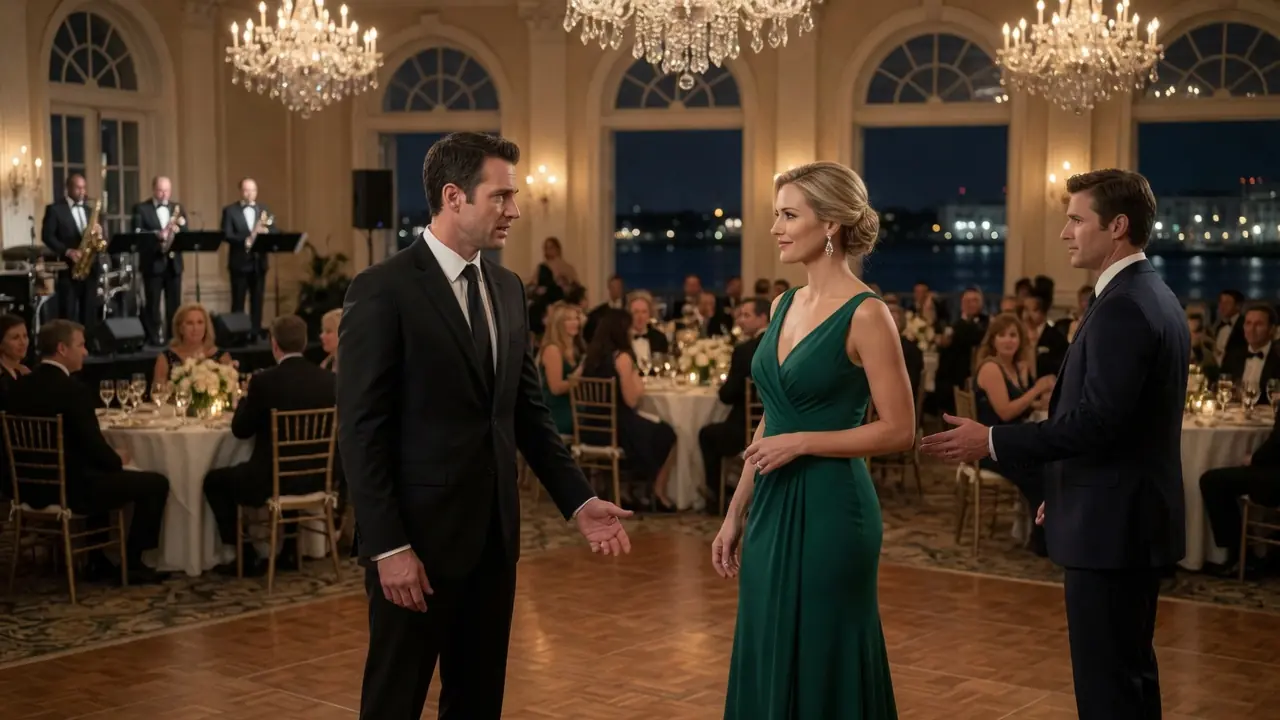
The charity gala was being held inside a historic ballroom near Charleston Harbor in South Carolina. Crystal chandeliers filled the ceiling. Live jazz floated through the room, soft and elegant, wrapping itself around the laughter of hundreds of guests who had paid five hundred dollars a plate to feel generous for one evening.
Waiters moved between tables with trays of champagne. Women in satin gowns leaned close to whisper. Men in tailored suits shook hands, exchanged business cards, and spoke in low voices about donations, contracts, and future favors disguised as philanthropy.
Meanwhile, my entire world was beginning to crack.
My wife, Lauren Whitmore, stood ten feet in front of me beneath the glowing chandeliers, one hand resting lightly on the arm of another man.
Ethan Brooks.
A familiar face around her office.
A man she had introduced as “just a friend” so many times the phrase had become an insult.
He was handsome in the polished, effortless way of men who knew exactly how to make other men feel plain. Dark hair, white dress shirt, black tuxedo, smile that never reached his eyes. He worked with Lauren at Whitmore Foundation, the nonprofit she had built over six years into one of Charleston’s most visible charity organizations.
At least, that was the version she told donors.
The version I saw at home was different.
Late nights.
Locked phone.
Messages turned face down.
A new password.
A sudden irritation whenever I asked simple questions.
And Ethan, always Ethan, appearing in her stories with just enough frequency to become part of the furniture.
“Ethan thinks we should restructure the grant committee.”
“Ethan knows someone at the city office.”
“Ethan says the gala numbers look strong.”
“Ethan stayed late to help.”
Ethan.
Ethan.
Ethan.
I had spent months telling myself not to be small. Not to be jealous. Not to become the insecure husband she accused me of being every time I noticed something that deserved noticing.
But that night, at the gala, I watched my wife dance with him four times.
Not once.
Not twice.
Four times.
The first dance, I told myself it was professional. The second, I told myself it was optics. The third, I watched Ethan place his hand lower on her back than any colleague had the right to. The fourth, I saw Lauren tilt her head toward him and laugh in a way she had not laughed with me in nearly a year.
So when the song ended and she returned toward our table, flushed and smiling, I stood.
“Lauren,” I said quietly. “Enough.”
She blinked at me.
Not surprised.
Not ashamed.
Almost amused.
“What?”
“You heard me.”
Around us, people continued talking. A woman in emerald silk at the next table raised her champagne glass. A donor near the stage laughed at something a board member said. The saxophone began another song, slow and smooth.
Ethan stood beside Lauren, pretending to adjust his cufflink.
I looked directly at my wife.
“One more dance with him and we’re done.”
The sentence came out calmer than I expected.
Maybe because I had already crossed some invisible line inside myself. Maybe because there are moments when anger burns so clean it leaves only clarity behind.
Lauren looked at me for a long moment.
Not angry.
Not embarrassed.
Not even surprised.
Then she smiled.
A calm smile.
The kind that appears only when someone has already made their decision.
She reached for Ethan’s hand.
Then she said the sentence I still hear in my head.
“Then you’d better leave right now.”
A few people nearby heard it.
Nobody intervened.
Nobody looked shocked.
That was almost worse.
Because it suggested this was not new.
The music continued.
The dance continued.
And Lauren walked back onto the floor with Ethan as if I had never existed.
For several seconds, I could not move.
Not because I was heartbroken.
Because something felt wrong.
Deeply wrong.
The confidence in her voice did not sound spontaneous. It sounded prepared. Rehearsed. Almost expected. As though she already knew exactly how the night would end.
I watched Ethan spin her gently beneath the chandelier light. I watched her place one hand on his shoulder. I watched her smile up at him, not with guilt, not with regret, but with victory.
And then I understood something terrible.
She had wanted me to say it.
She had wanted the public ultimatum.
She had wanted witnesses.
My name is Daniel Mercer, and until that night, I believed my marriage was in trouble.
I did not yet understand that I was standing inside a trap.
I left the ballroom without another word.
The hotel lobby was cooler than the ballroom, quieter too, though not silent. The Harbor Regent Hotel had marble floors, brass lamps, dark wood walls, and a wide staircase curving down from the mezzanine. Beyond the glass doors, Charleston Harbor shimmered under the night, broken by reflections of dock lights and passing boats.
I walked past the concierge desk and stepped outside.
The cool air hit my face.
For the first time all evening, I could breathe.
I stood near the stone railing overlooking the harbor, listening to water tap softly against the pilings below. Behind me, through the hotel windows, the gala continued. Music. Laughter. Applause. The elegant noise of people pretending they were not surrounded by quiet disasters.
My phone buzzed.
I almost ignored it.
Then I saw the number.
Unknown.
No name.
No contact photo.
Just one message.
You were supposed to leave earlier.
I stared at it.
Read it once.
Then twice.
Then a third time.
The words did not feel random.
They felt specific.
Personal.
Like someone had been watching the entire evening unfold.
Before I could decide whether to respond, a second message arrived.
You need to see what was planned.
My fingers tightened around the phone.
For a moment, I forgot the cold air, the harbor, the ballroom, even Lauren dancing with Ethan. The betrayal shifted shape in my mind. It no longer felt like a marriage falling apart.
It felt like a script being followed.
And somehow, everyone else already knew their lines.
I typed back.
Who is this?
Three dots appeared.
Disappeared.
Appeared again.
Then the reply came.
Someone who was supposed to help them. I can’t do it anymore. Go to the private business lounge on the second floor. Room 214. The door is unlocked. Don’t tell Lauren.
I stood there under the hotel awning, staring at the message as the wind moved across the water.
Part of me wanted to delete it.
Part of me wanted to return to the ballroom, grab Lauren by the arm, and demand the truth in front of every guest who had watched her humiliate me.
But the rest of me, the part that had spent ten years as a corporate risk analyst before starting my own consulting firm, understood one thing clearly.
When someone offers information, you gather it before you react.
I slipped the phone into my pocket and went back inside.
The staircase to the second floor was near the lobby bar. Couples leaned close over cocktails. A man in a white dinner jacket argued softly into his phone. A hotel employee pushed a cart stacked with empty glassware toward the service hallway.
No one noticed me.
That was another advantage of public humiliation.
Once people decided you had lost, they stopped watching.
Room 214 was at the end of a quiet corridor lined with framed photographs of old Charleston streets. The door had a small brass sign: Private Business Lounge. I turned the handle.
Unlocked.
Inside, the room smelled faintly of leather, coffee, and printer ink. There was a long conference table, two armchairs, a sideboard with bottled water, and a wall-mounted screen. A single lamp had been left on.
On the table sat a manila envelope.
My name was written across the front.
DANIEL MERCER
My mouth went dry.
I looked around once, then opened it.
Inside were printed screenshots.
Text messages.
Emails.
A copy of a calendar invitation.
Photographs.
A flash drive taped to a note card.
The first screenshot showed a message thread between Lauren and Ethan.
I recognized Lauren’s writing style immediately. Short sentences when she was irritated. Perfect punctuation when she wanted to sound controlled.
Lauren: He won’t leave unless I force it publicly.
Ethan: Then force it. He cares too much about appearing calm. Use that.
Lauren: If he walks out, everyone sees him abandon me at the gala.
Ethan: Exactly. Then tomorrow you call it emotional instability. Say you’ve been afraid of his jealousy for months.
My hand went cold around the paper.
I turned to the next page.
Lauren: The lawyer says optics matter.
Ethan: Optics are everything. Donors, board, court, settlement. If he looks controlling, you look trapped.
Lauren: And if he refuses to leave?
Ethan: Dance with me again. He’ll either explode or walk. Either works.
I lowered the page slowly.
For a moment, the room tilted.
Court.
Settlement.
Lawyer.
This was not about one dance.
This was not even only about an affair.
It was a planned performance.
I kept reading.
The next printed email came from Lauren to an attorney named Vivian Cross.
Subject line: Separation Strategy — Public Incident
Lauren had written:
Daniel has become increasingly suspicious of my relationship with Ethan. If I can create a public incident where he appears possessive or threatening, it may support the narrative that I felt emotionally controlled. The gala is ideal because board members, donors, and staff will be present.
I read that sentence three times.
Not because I did not understand it.
Because I did.
The note card with the flash drive had one handwritten sentence.
There’s more. I’m sorry.
I inserted the drive into the laptop sitting open on the conference table.
The first folder was labeled Gala Plan.
Inside was a document outlining seating arrangements. Lauren had arranged for me to be seated at Table 7, directly across from the dance floor, with Ethan assigned to the donor table beside it. There were highlighted notes:
Ensure Daniel can see Lauren and Ethan clearly.
Lauren should decline first dance with Daniel, accept Ethan’s second invitation.
Talia to mention Daniel’s jealousy near board members.
Talia.
Lauren’s assistant.
A woman who always smiled too sweetly when I came to the foundation office.
Another file contained audio.
My pulse beat in my ears as I pressed play.
Lauren’s voice filled the room.
“I don’t need him destroyed. I just need him cornered.”
Ethan answered, “Same difference.”
“No,” Lauren said. “Daniel isn’t stupid. If we push too hard, he’ll start asking questions.”
“So let him ask after the board already believes he’s unstable.”
Then Talia’s voice, lighter and nervous.
“What if he doesn’t react?”
Lauren laughed softly.
“He will. He loves me. That’s always been his weakness.”
I stopped the recording.
For a few seconds, I sat motionless in the leather chair.
He loves me.
That’s always been his weakness.
I had believed love was the strongest thing I brought into my marriage.
Lauren had used it as the weak point in a structure she intended to collapse.
My phone buzzed again.
Unknown number.
You found it?
I typed back with shaking hands.
Yes. Who are you?
A pause.
Then:
Talia.
I stared at the screen.
Lauren’s assistant.
The woman whose name appeared in the plan.
Another message came.
I helped at first because Lauren said you were cruel to her. She said she needed protection. But tonight I saw your face. And I heard Ethan laughing about how easy it was. I couldn’t keep doing it.
I typed:
Where are you?
Service corridor near the ballroom. I can meet you by the lounge. Five minutes.
I closed the laptop, gathered the papers, and put everything back into the envelope. Then I made two quick decisions.
First, I took photos of every document with my phone.
Second, I uploaded them to a secure cloud folder.
If Lauren had planned this carefully, I could not assume the envelope would remain safe.
Five minutes later, a soft knock sounded at the lounge door.
I opened it.
Talia stood in the corridor, pale and trembling.
She was twenty-eight, maybe twenty-nine, wearing a black cocktail dress and a staff badge hidden under a shawl. Her usually perfect hair had loosened around her face, and her eyes were red as if she had been crying.
“You shouldn’t have come alone,” she whispered.
“You told me to.”
“I know. I’m sorry.”
I stepped aside.
She came in and shut the door quickly.
For a moment, neither of us spoke.
From below, faint jazz drifted through the walls, muffled and surreal.
Talia looked at the envelope on the table.
“You saw enough?”
“Yes.”
Her face crumpled.
“I didn’t know at first. I swear. Lauren told me you were controlling. That you monitored her. That you wouldn’t let her have male friends. She said she needed witnesses because she was afraid you’d ruin her reputation if she left.”
I looked at her.
“And you believed her.”
Talia flinched.
“I wanted to. She gave me my job. She mentored me. She made me feel like I mattered.”
“Then you helped her set me up.”
“Yes.”
The honesty was ugly.
But at least it was honesty.
“What changed?” I asked.
Talia swallowed.
“Ethan.”
I waited.
“He got careless. He said after tonight you’d either leave on your own or look unstable enough that Lauren could push for a favorable divorce. Then he joked that once the foundation accounts were fully reorganized, nobody would care what happened to you.”
My eyes narrowed.
“Foundation accounts?”
Talia looked down.
“That’s the part you don’t know.”
I felt the room grow colder.
“What accounts?”
She opened her purse and removed another folded sheet.
“I printed this right before I left the office.”
It was a financial transfer summary.
Whitmore Foundation.
Restricted donor funds.
Vendor payments.
Consulting invoices.
Ethan Brooks Strategy Group.
My eyes moved line by line.
Amounts.
Dates.
Authorizations.
Some of the payments were legitimate at first glance. Strategy consulting. Fundraising support. Event planning. Brand development.
But there were too many.
Too frequent.
Too vague.
The total at the bottom made my stomach turn.
$412,000.
“Talia,” I said slowly, “what is this?”
She whispered, “I think Ethan has been siphoning money through consulting contracts. And I think Lauren knows.”
I looked at the page again.
“She runs the foundation.”
“I know.”
“Her name is on the approvals.”
“I know.”
The betrayal widened.
It was no longer only personal.
It was financial.
Legal.
Public.
Dangerous.
Talia wiped at her eyes.
“Lauren told me the foundation was moving funds into a temporary account for expansion grants. I believed her. But then I saw duplicate invoices. Ethan’s company billed the foundation for work another vendor had already done. When I asked Lauren, she told me not to be naive. She said the world runs on relationships.”
“And what did Ethan say?”
“He said if I wanted to keep my job, I should stop learning accounting at midnight.”
I almost laughed.
Not because it was funny.
Because my entire career had been built on noticing exactly what people hoped no one would learn at midnight.
Before starting Mercer Risk Advisory, I had spent years investigating internal fraud for companies that believed their executives were too polished to steal. Money never disappeared dramatically. It walked out wearing a nice suit and a clean invoice.
Lauren knew that better than anyone.
She had watched me explain it at dinner parties.
She had asked questions.
She had learned.
And now she had planned to use my emotional reaction at the gala to discredit me before I could see what else was happening.
I looked at Talia.
“Why give me this?”
“Because there’s a board vote tomorrow morning,” she said. “Lauren is going to recommend removing you as an informal financial advisor to the foundation.”
I blinked.
“I’m not on the board.”
“No. But donors trust you. You review the annual financial transparency packet every year before it’s published. She wants you gone before the next packet is due.”
The pieces locked together.
My chest tightened.
Every year, I reviewed the foundation’s donor reporting as a favor to Lauren. I had done it unpaid, because I believed in her mission and wanted to support her. The annual packet was due in two weeks.
If $412,000 had moved through vague vendor contracts, I would have noticed.
Lauren knew I would have noticed.
So she needed me discredited first.
The gala was not the betrayal.
It was the cover story.
I sat down slowly.
Talia stood near the table, shaking.
“What are you going to do?”
I looked at the envelope.
Then at the ballroom beyond the wall.
“My first instinct is to walk in there and confront her.”
Talia’s eyes widened.
“Please don’t.”
“I know.”
Public anger would complete the script.
Lauren would cry. Ethan would step in. The room would see a jealous husband invading a charity gala. The documents would become revenge. The evidence would become bitterness. The truth would be buried beneath my reaction.
I had spent the night thinking my restraint was weakness.
Now I understood it was my only advantage.
I pulled out my phone and called the one person I trusted more than my own emotions.
My attorney, Rebecca Lang.
She answered on the third ring.
“Daniel? It’s late.”
“I need you at the Harbor Regent Hotel. Now.”
Her voice changed.
“What happened?”
“I have evidence of marital misconduct, planned reputational damage, and possible foundation fraud.”
Silence.
Then Rebecca said, “Do not confront anyone. Do not threaten anyone. Do not leave evidence unattended. Send me copies immediately.”
“I already uploaded them.”
“Good. Where are you?”
“Private business lounge. Room 214.”
“I’ll be there in twenty minutes.”
I ended the call.
Talia stared at me.
“She’s good?”
“She’s terrifying.”
“Good.”
For the first time all night, I almost smiled.
Rebecca arrived in eighteen minutes.
She was in her early fifties, wearing black slacks, a camel coat, and the expression of a woman who had been dragged away from a quiet evening and intended to make that fact someone’s problem. Her silver-streaked hair was pulled back, and she carried a leather briefcase like a weapon.
She stepped into the lounge, looked at me, then at Talia, then at the envelope.
“Start from the beginning,” she said.
We did.
I explained the dance.
The ultimatum.
Lauren’s response.
The unknown messages.
The envelope.
Talia explained her role, the documents, the financial transfers, and the board vote.
Rebecca listened without interrupting. That was how you knew she was dangerous. She did not waste anger early. She stored it for impact.
When we finished, she laid the documents across the table and photographed everything with her own phone.
Then she turned to Talia.
“Are you willing to provide a sworn statement?”
Talia hesitated.
“If I do, I lose my job.”
Rebecca looked at her.
“You may lose it anyway. The difference is whether you lose it as a participant or a whistleblower.”
Talia went pale.
I said nothing.
Rebecca continued.
“I am not your lawyer. You should get one. But if what you’ve told us is accurate, you need to preserve every email, every message, every file, and every instruction. Do not delete anything. Do not warn Lauren. Do not warn Ethan.”
Talia nodded.
Rebecca turned to me.
“You are leaving now.”
I looked toward the ballroom doors.
“Lauren is still in there.”
“Let her stay in there.”
“She’ll say I abandoned her.”
“She already planned to say that. Now we make sure she says it before knowing you have proof.”
That was colder than I felt.
But correct.
Rebecca continued.
“You will send one text. Calm. Brief. No accusations. Something like, ‘I left the gala because your conduct with Ethan made it impossible for me to remain. We will speak later.’ Nothing else.”
I typed it exactly.
Then I sent it to Lauren.
The message showed delivered.
No reply.
Of course not.
Lauren was likely still dancing, still smiling, still believing I had done exactly what she wanted.
Rebecca gathered the documents.
“I’ll hold the originals tonight. You keep digital copies. Go home if it’s safe. If she comes back, do not argue. Record nothing illegally. Communicate by text if possible.”
“What about the foundation?”
“I’ll contact a forensic accountant by morning. We also need to determine whether donor funds were restricted. If so, this becomes much more serious.”
Talia whispered, “They were.”
Rebecca looked at her.
“Then tomorrow will be unpleasant for many people.”
We left separately.
I walked through the lobby without looking toward the ballroom.
But near the front entrance, I heard laughter behind me.
Lauren’s laughter.
I turned.
She stood near the ballroom doors with Ethan, one hand on his arm, surrounded by three board members and a wealthy donor named Charles Vinton. She looked radiant. Confident. Untouched by the wreckage she had just created.
Then she saw me.
Our eyes met across the lobby.
For one brief second, confusion crossed her face.
I was not supposed to still be there.
Then she recovered and smiled.
The same calm smile.
She lifted her champagne glass slightly, as if toasting my defeat.
I walked out without giving her the scene she had paid for.
At home, the house was dark.
It sat in Mount Pleasant on a quiet street lined with palmettos and white fences, the kind of house Lauren had once said made her feel like we had finally become the people we pretended to be at donor dinners. We bought it five years into our marriage, back when she still called me from the grocery store to ask whether I wanted peaches or strawberries because she said choosing fruit alone felt sad.
I stood in the kitchen for a long time.
The marble counters gleamed.
A vase of white roses sat on the island, already beginning to wilt.
Lauren had chosen them for the gala pre-party we hosted two nights earlier. Ethan had been there too. I remembered him standing near the wine fridge, laughing with Lauren, while I refilled ice buckets and told myself not to be petty.
I poured a glass of water and sat at the kitchen table.
My phone remained silent for thirty-six minutes.
Then Lauren finally texted.
I hope you’re proud of yourself. Everyone saw you leave.
I stared at the message.
There it was.
The first line of the script.
I replied only:
We’ll speak tomorrow.
She answered immediately.
No. We’ll speak now. You humiliated me.
Humiliated her.
I almost admired it.
A woman who had danced with another man after her husband’s ultimatum was accusing me of humiliation because I had left quietly.
I did not respond.
Fifteen minutes later, headlights crossed the front windows.
Lauren came inside at 12:47 a.m.
She wore the same navy gown from the gala, her hair still pinned, diamond earrings still catching the light. She looked beautiful, composed, and dangerous in the way a storm looks beautiful from far away.
She dropped her clutch on the counter.
“Well?” she said.
I stood in the kitchen doorway.
“Well what?”
“Are you going to apologize?”
The question was so astonishing that I said nothing for a moment.
Lauren folded her arms.
“You embarrassed me in front of the board.”
“I embarrassed you?”
“You made a scene.”
“I said one sentence.”
“You threatened divorce in public.”
“You took Ethan’s hand and told me to leave.”
Her jaw tightened.
“Because I refuse to be controlled.”
There it was.
The narrative.
She spoke it too smoothly.
“Controlled,” I repeated.
“Yes. Controlled. Monitored. Judged. Questioned every time I have a male colleague.”
“Is that what Ethan is?”
Her eyes sharpened.
“Don’t do that.”
“Do what?”
“Make this about him instead of your behavior.”
I studied my wife.
For twelve years, I had known her face better than my own. I knew the tiny crease that appeared between her eyebrows when she was lying about being fine. I knew the way she pressed her lips together when she was afraid. I knew the brightness she forced into her voice when donors made her uncomfortable.
But that night, looking at her in our kitchen, I realized something devastating.
I knew her habits.
Not her heart.
Not anymore.
“Lauren,” I said quietly, “were you hoping I would react worse than I did?”
She blinked.
Only once.
But I saw it.
“What kind of question is that?”
“A direct one.”
“You’re paranoid.”
“Maybe.”
She took a step closer.
“You need help, Daniel.”
There it was again.
Another line.
I wondered how many times she had practiced it.
I nodded slowly.
“You may be right.”
That surprised her.
She had expected resistance.
I gave her none.
“I’m going to sleep in the guest room,” I said.
Her eyes narrowed.
“So now you’re punishing me with silence.”
“No. I’m declining to fight at one in the morning.”
I turned to leave.
Her voice followed me.
“Everyone saw tonight. Don’t forget that.”
I stopped.
Looked back.
“I won’t.”
For the first time that night, something like uncertainty moved across her face.
Good.
The next morning, the board meeting began at 9:00.
I did not attend.
I was not invited.
But Rebecca had already been working for four hours.
By 7:30 a.m., she had connected with a forensic accountant named Aaron Patel, who reviewed the transfer summary and requested bank records, vendor contracts, donor restriction agreements, and copies of board approvals. By 8:15, Rebecca had drafted letters preserving evidence. By 8:45, Talia sent over a written timeline, screenshots, emails, and her resignation letter, which she did not yet submit.
At 9:06, Lauren texted me.
We need to talk about separation.
At 9:09, another text.
I cannot continue in a marriage where I feel unsafe.
At 9:11:
Vivian says it’s best if communication goes through attorneys.
I stared at that one.
So Vivian was real.
The attorney from the email.
At 9:18, Rebecca called.
“Lauren just sent you the narrative in writing, didn’t she?”
“Yes.”
“Good. Do not respond except to say your attorney will contact hers.”
I did.
Then I asked, “What happens now?”
Rebecca exhaled.
“Now we stop playing defense.”
At 10:32, the Whitmore Foundation board received a letter from Rebecca Lang on my behalf. It did not accuse Lauren of adultery. It did not mention the dance. It did not indulge in emotion.
It requested preservation of all financial records, vendor contracts, communications with Ethan Brooks Strategy Group, payment approvals, donor restrictions, and board minutes.
It stated that I had obtained documents suggesting potential financial irregularities involving restricted funds.
It warned that destruction of records could create legal exposure.
At 10:47, Talia submitted her resignation and whistleblower statement directly to the board chair, a retired judge named Elaine Porter.
At 11:03, Elaine Porter called me.
Her voice was cold with controlled concern.
“Daniel, what exactly is happening?”
“I think Lauren and Ethan planned last night to discredit me before I could discover improper financial transfers.”
Silence.
Then Elaine said, “Do you have evidence?”
“Yes.”
“Send it to me.”
“I’ll have Rebecca send it.”
“That would be wise.”
By noon, the board meeting had collapsed.
By 1:15, Lauren called me eight times.
I did not answer.
By 2:00, Ethan Brooks Strategy Group’s office line went directly to voicemail.
By 3:20, Lauren arrived at the house.
I was not there.
I had taken Rebecca’s advice and moved into a hotel temporarily. If Lauren wanted a dramatic confrontation, she would have to perform it alone.
She left a voicemail.
Her voice was different now.
Not victorious.
Sharp.
Breathless.
“Daniel, what did you do?”
I listened once.
Then saved it.
That evening, Elaine Porter called an emergency board session.
Lauren was placed on administrative leave pending review.
Ethan’s contracts were suspended.
The foundation’s accounts were frozen except for essential operations.
And the annual gala, the beautiful charity event where my marriage had supposedly broken under the weight of my jealousy, became the beginning of a financial investigation.
The newspapers did not know yet.
The donors did not know yet.
But the board knew.
And Lauren knew I knew.
That changed everything.
Two days later, Lauren agreed to meet at Rebecca’s office.
She arrived with Vivian Cross, the attorney whose emails had helped build the trap around me. Vivian was elegant, mid-forties, with perfect posture and the faintly bored expression of someone used to turning bad facts into manageable language.
Lauren wore a cream blouse, black trousers, and no wedding ring.
I noticed.
She wanted me to notice.
Rebecca noticed too, and smiled like a woman watching an amateur reveal strategy too early.
We sat across from each other in a conference room.
For a moment, nobody spoke.
Then Vivian began.
“My client wishes to proceed with separation due to a pattern of controlling and emotionally volatile behavior—”
Rebecca lifted one hand.
“No.”
Vivian stopped.
“I’m sorry?”
“We’re not beginning with fiction.”
Lauren’s face hardened.
Rebecca opened a folder and slid across the screenshots.
The messages between Lauren and Ethan.
The gala plan.
The email to Vivian.
Vivian’s expression changed so slightly most people would have missed it.
Rebecca did not.
“You were copied on some of this,” Rebecca said.
Vivian adjusted one page.
“I advised my client on potential separation scenarios.”
“You advised her to manufacture a public incident?”
“I did no such thing.”
Rebecca’s smile was thin.
“Then you’ll be relieved when the bar complaint omits your name after further review.”
Vivian went very still.
Lauren stared at the papers.
Her face had gone pale.
I looked at her.
No ballroom.
No Ethan.
No chandeliers.
No applause.
Just a table and proof.
“Why?” I asked.
For the first time, her polished mask cracked.
She looked at me with something almost like anger, but underneath it was fear.
“Because you would have ruined everything.”
“I would have found the transfers.”
“Yes.”
“At least we’re being honest.”
Her eyes flashed.
“You don’t understand what it takes to run something like this.”
“I understand fraud.”
She leaned forward.
“It was temporary.”
“There it is.”
“We were going to replace the money after the new donor campaign.”
“You moved restricted funds into Ethan’s contracts.”
“Ethan created value.”
I laughed once.
Not loudly.
Not happily.
“Did he create $412,000 worth of value, or just the kind that dances well?”
Her face twisted.
Vivian placed a hand on Lauren’s arm.
“Don’t answer that.”
Lauren pulled away.
“No. He should hear this.”
Rebecca leaned back.
“I agree.”
Lauren looked at me.
“You always got to be the stable one. The ethical one. The one everyone trusted. Do you know what that felt like? Building a foundation with my name on it while donors asked if you had reviewed the numbers? My own board trusted you more than me.”
I stared at her.
“So you stole from the foundation because donors respected my financial judgment?”
“I borrowed from timing gaps.”
“You stole.”
Her jaw tightened.
“I built Whitmore Foundation. Me. I was the one at every luncheon, every meeting, every hospital wing, every fundraiser. I was the face. I was the one who made people care.”
“You were also the one who approved false invoices.”
She looked away.
I said, “Was Ethan worth it?”
Silence.
Then Lauren whispered, “Ethan made me feel powerful.”
There it was.
Not loved.
Not seen.
Powerful.
Rebecca spoke then.
“Here is what happens next. Daniel will proceed with divorce. He will not accept any narrative of emotional instability, coercive control, or abandonment. The evidence of the gala plan will be preserved. As for the foundation, that matter is now with the board.”
Vivian recovered enough to say, “My client is willing to resolve the marital estate privately.”
Rebecca looked at me.
I nodded once.
“I want out,” I said. “Cleanly. Legally. Truthfully.”
Lauren’s eyes lifted.
“You’re not going to fight for us?”
I almost smiled at the cruelty of that question.
The woman who had planned my public humiliation now wanted to know why I would not fight.
“I did fight for us,” I said. “For years. I fought by trusting you when my instincts told me not to. I fought by explaining away your lies. I fought by standing beside you while you turned our marriage into a prop for donors. Last night, I stopped fighting alone.”
She looked down.
Good.
Some truths need silence afterward.
The investigation took four months.
By then, the marriage was already over.
Lauren resigned from the foundation before the board could remove her. Ethan disappeared from Charleston for several weeks, then reappeared through a lawyer claiming all consulting services had been legitimate. Aaron Patel’s forensic review proved otherwise. Duplicate billing. Inflated invoices. Payments for services never delivered. Restricted funds moved without proper authorization.
Lauren avoided criminal charges only because the board chose restitution, public resignation, and a civil settlement over a long public trial that might have damaged ongoing programs. Ethan was not as fortunate. His firm collapsed under lawsuits from other clients once the investigation became public.
Talia testified to the board.
She lost her job anyway.
But Elaine Porter wrote her a recommendation for another nonprofit, one that needed honest people more than polished ones.
As for me, I moved into a smaller house on James Island, near the marsh. Quiet. Modest. No ballroom memories. No gala photographs. No white roses dying on marble counters.
The divorce finalized in September.
Lauren received less than she expected and more than I wanted her to have. That is how divorce often works. Nobody leaves satisfied. The law divides property, not grief.
The night after the papers were signed, I drove to the harbor.
The Harbor Regent Hotel glowed in the distance.
Another event was happening inside. Music drifted faintly across the water. Men and women moved behind tall windows, laughing, dancing, raising glasses. From the outside, it looked beautiful.
That was the danger of beautiful rooms.
They made destruction look elegant.
I stood by the same stone railing where my phone had buzzed months earlier. The wind moved across the harbor. A boat horn sounded far away. Somewhere behind me, a couple walked past arguing softly about dinner reservations.
I thought about the moment I had told Lauren, “One more dance with him and we’re done.”
I had believed that was the moment my marriage ended.
I was wrong.
The marriage had ended earlier.
Maybe when Lauren first decided power mattered more than trust.
Maybe when Ethan became a secret instead of a colleague.
Maybe when she wrote to her attorney about creating a public incident.
Maybe when she learned to say controlling before I ever asked a question.
The dance was not the end.
It was only the reveal.
My phone buzzed.
For a second, my stomach tightened.
But it was not an unknown number.
It was Talia.
I heard the divorce finalized. I’m sorry for my part in everything. I hope you’re okay.
I looked at the message for a long time.
Then I replied.
I’m getting there. Tell the truth earlier next time.
Her answer came quickly.
I will.
I put the phone away.
A year later, I ran into Lauren at a bookstore downtown.
It was raining lightly outside, the kind of rain Charleston wore beautifully. I was browsing historical biographies when I saw her at the end of the aisle. She looked different. Less polished. No diamond earrings. No perfect donor smile. Her hair was shorter, her face thinner.
For a moment, we simply stared at each other.
Then she said, “Daniel.”
“Lauren.”
She held a book against her chest like a shield.
“I heard your firm is doing well.”
“It is.”
“That’s good.”
Silence.
Then she said, “I’m working again. Smaller organization. No leadership role. Just grant administration.”
I nodded.
“I hope you do it honestly.”
She flinched.
“I deserved that.”
“Yes.”
Her eyes shone, but she did not cry.
“I was awful to you.”
“Yes.”
“I thought if I could make you look weak, I wouldn’t have to admit how weak I had become.”
That was the closest thing to truth she had ever given me.
I did not know what to do with it.
So I simply said, “I hope you become someone who doesn’t need to destroy people to feel powerful.”
She looked down.
“Me too.”
We did not hug.
We did not promise friendship.
We did not pretend the past had softened into something harmless.
We walked away in opposite directions, two people who had once shared a home and now shared only history.
That was enough.
I learned something from that night at the gala.
Not that love can betray you.
I already knew that.
Not that people can lie beautifully.
Anyone who has attended enough fundraisers understands that.
I learned that humiliation is sometimes bait.
That not every public insult deserves a public response.
That the room laughing around you may not be blind. Sometimes it is waiting to see whether you will perform the role someone else wrote for you.
And I learned that restraint is not weakness.
It is evidence waiting for its turn.
Lauren thought my love made me easy to control.
She thought I would either explode or crawl.
She thought I would give her the scene she needed.
Instead, I walked out.
And because I walked out calmly, I was clear enough to see the message that changed everything.
You were supposed to leave earlier.
Those five words saved me from becoming the villain in a story my wife had already written.
The ballroom kept laughing that night.
The music kept playing.
Lauren kept dancing.
But outside, by the harbor, the truth had already started moving toward me.
And once truth arrived, it did what truth always does when given enough paper, enough patience, and enough light.
It ended the performance.