“Kid, put your hand down. That tractor’s dead.”
Auctioneer Hollis Dunar’s voice carried across the crowded farm auction barn as laughter rolled through the wooden bleachers behind him. Twelve-year-old Leland Tanner stood beside Lot 142 with one arm raised and an old rusted savings tin tucked tightly against his chest.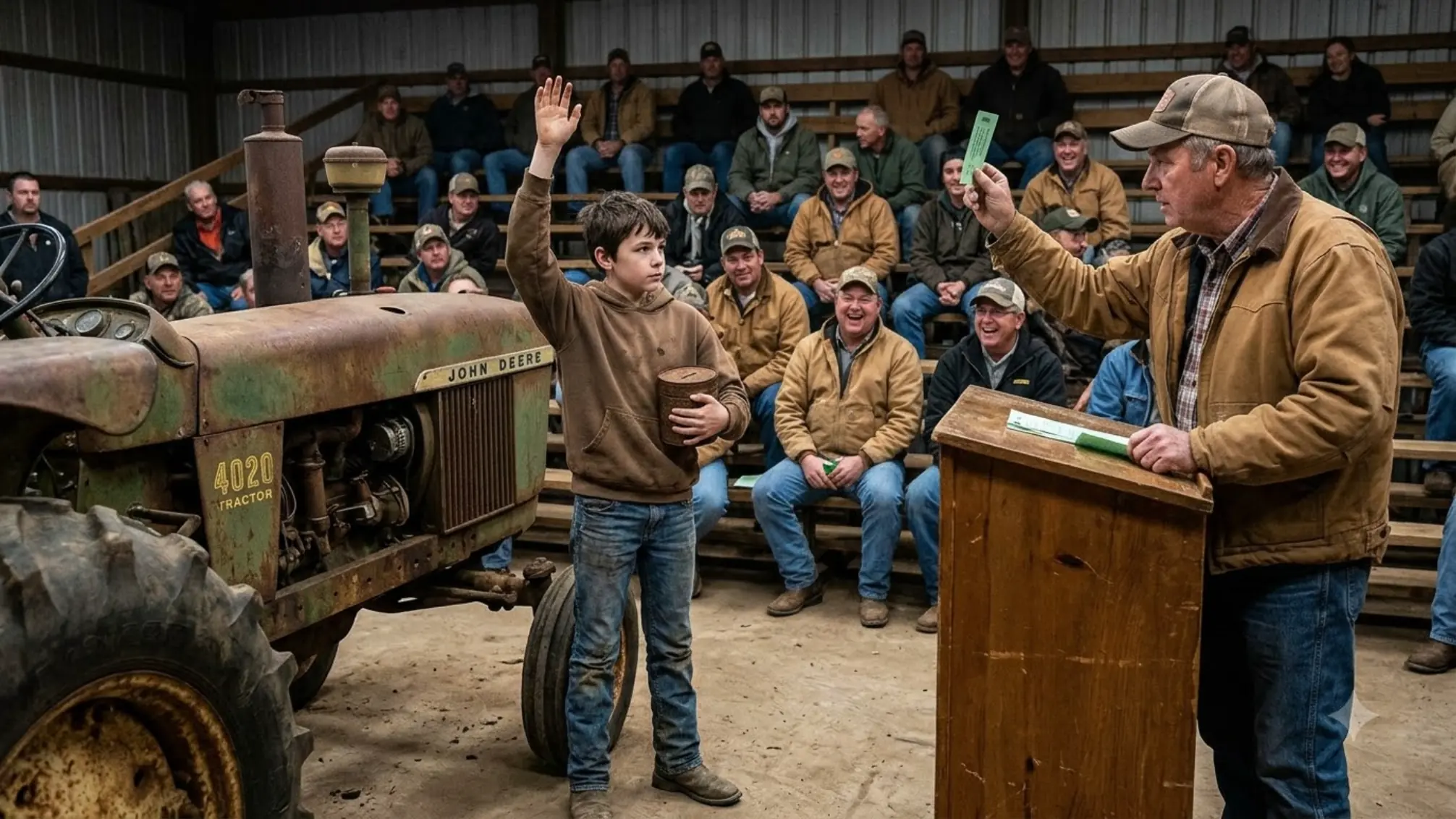
“No,” Leland said.
The laughter softened.
“It’s seized.”
Hollis stared at him. Somewhere behind Leland, another farmer chuckled.
“You’re twelve. You wouldn’t know the difference.”
Leland’s expression did not change.
“Then take my $450 and watch me prove it.”
The barn went quiet.
The machine standing behind him certainly looked dead. The 1967 John Deere 4020 had spent close to twenty years exposed to moisture and neglect. Its once-bright green paint had faded toward gray, rust covered bolts and seams, the seat was split, the tires were cracked, and the engine had not turned under its own power in longer than Leland had been alive.
Most men in the room saw scrap iron.
Leland saw two seized cylinders, a damaged injector pump, corrosion that could be cleaned, sleeves that could be replaced, and an engine his grandfather had taught him to understand before dying.
That difference was why his hand remained raised.
It was also why Grover Weathersfield was watching him from the other side of the barn.
Three months earlier, Leland’s life had looked entirely different.
His grandfather, Harlon Tanner, had still been alive then. Harlon had farmed ninety-five acres in Harmon County for most of his adult life, repairing machinery instead of replacing it whenever possible and teaching Leland that a farm survived through attention more often than through money.
Then, on a Tuesday morning in June, Harlon suffered a heart attack in the north field.
He died beside the equipment he had been operating.
The paramedics told Mabel Tanner that it had happened quickly. Neighbors arrived with casseroles, pies, coffee, and promises of help. Men from the agricultural cooperative stood at the funeral and told Mabel that Harlon had been a good farmer and a good man.
Leland listened to every word.
He also noticed nobody talked about what came next.
Nobody mentioned the ninety-five acres that still required work. Nobody mentioned the machinery loan Harlon had been paying for four years. Nobody asked specifically who would handle the harvest.
Everybody said, “If you need anything, call.”
Harlon had taught Leland something about that too.
A promise without a specific action was often only a polite sentence.
Eleven days after his grandfather’s death, Leland climbed onto the family’s old Case tractor and turned the key.
The engine made one terrible mechanical sound.
Then it stopped.
Leland immediately removed his hand from the ignition.
Harlon had taught him years earlier never to keep forcing an engine after hearing that particular sound. Trying again would not prove determination. It would only turn one damaged component into several.
He climbed down and walked into the farmhouse.
Mabel was sitting at the kitchen table with a tractor-parts catalog.
She looked at Leland once.
“The Case?”
“Yes.”
She closed the catalog.
The repair estimate eventually came back at $3,400.
There was roughly $400 available in the farm account.
Leland found both numbers on the kitchen counter and performed the subtraction silently. Mabel never needed to tell him they were in trouble.
Three days later, Grover Weathersfield arrived.
His diesel pickup came up the gravel driveway too fast and stopped directly in front of the farmhouse. Grover was in his mid-sixties, broad-shouldered, successful, and influential enough that people in Harmon County often lowered their voices before disagreeing with him.
He owned hundreds of acres surrounding the Tanner property.
For years he had wanted the eastern forty acres belonging to Harlon.
Harlon had always refused.
Grover entered the house, sat in Harlon’s chair without asking, and placed a folded offer on the kitchen table.
“Twelve hundred an acre for the east forty.”
Leland immediately knew the number was low. Harlon had discussed a comparable sale six months earlier at approximately sixteen hundred an acre.
Mabel did not even pick up Grover’s paper.
“What situation makes twelve hundred fair?”
Grover leaned back.
“You’re managing ninety-five acres alone now. Harvest is coming. Your tractor is down.”
His tone sounded almost compassionate.
“I’m trying to make this easier.”
Mabel folded the offer once and pushed it back.
“Thank you for coming.”
Grover remained seated.
His eyes moved toward Leland.
“That boy cannot run ninety-five acres, Mabel.”
Something about the word boy stayed with Leland after Grover left.
Grover had not spoken angrily.
He had spoken with certainty.
As though the future had already been decided and everyone else simply needed enough time to accept it.
That night, Leland went into Harlon’s workshop because the barn door had a loose hinge.
He opened the third drawer of his grandfather’s steel toolbox looking for a wrench.
Under a folded piece of oil cloth, he found an envelope.
His name was written across the front.
LELAND.
The handwriting belonged to Harlon.
Inside was an old sheet of paper listing diesel-engine components by system. Beside several components were short handwritten notes.
At the bottom Harlon had written:
Leland will need this. Do not leave it in the bookcase.
Leland sat on the workshop stool for a long time.
The paper was old enough that Harlon clearly had not written it during the final weeks of his life. He had prepared it long before anyone knew exactly when Leland would need it.
That realization hurt more than the funeral had.
It also gave Leland something grief had taken away.
Direction.
Harlon had begun teaching him engines when Leland was nine.
He started with a lawn mower, then a generator, then a chainsaw. Every machine came apart across the same piece of oil cloth.
Harlon rarely told Leland an answer immediately.
Instead he asked the same question.
“What do you see?”
Not, “What is this?”
What do you see?
Harlon believed knowing the name of a component was easy. Understanding what it was doing, why it failed, and how its failure affected everything around it required actual thought.
The summer before his death, Harlon spent six weeks teaching Leland the systems inside a John Deere 4020.
He showed him sleeve wear, injection timing, compression, corrosion, fuel delivery, and the differences between an engine destroyed by catastrophic damage and one simply locked by years of moisture.
One evening Harlon demonstrated seizure using a piece of metal pipe.
He showed Leland what inactivity and moisture could do to metal surfaces.
Then he said something Leland remembered perfectly.
“That is not a dead engine. That is an engine that was left behind. There is a difference.”
The service manual Harlon used eventually became Leland’s.
But its final technical page had been deliberately removed.
When Leland noticed and asked about it, Harlon answered simply.
“You’ll find that page when you need it.”
Leland protested.
Harlon shook his head.
“I don’t want you to read the answer.”
Three weeks later, Harlon died.
By September, Leland was spending afternoons at the local library searching agricultural auction listings because the internet connection at the farm barely worked.
One Thursday he found the listing.
1967 JOHN DEERE 4020. ENGINE SEIZED. ABANDONED APPROXIMATELY TWENTY YEARS. PARTS ONLY.
Leland read it four times.
The librarian, Levvenia Morfield, came behind him and looked at the screen.
“Parts only.”
Leland nodded.
“You’re twelve.”
“I know.”
She looked at him.
“My grandfather taught me this engine.”
Levvenia studied him for several seconds, walked to the printer, and returned with the auction listing.
She did not charge him for the page.
That evening, Leland placed the paper in front of Mabel.
She read it and asked only one question.
“How much money do you have?”
Leland showed her the rusty tin where he had kept years of chore money, birthday cash, and payment from small farm jobs.
Mabel looked at the money, then at him.
“Are you sure this isn’t because you miss your grandfather?”
Leland did not answer quickly.
Harlon had taught him not to answer a hard question simply because silence made him uncomfortable.
Finally Leland said, “Both things are true.”
Mabel waited.
“I miss him. And I know this engine.”
He looked at the auction listing.
“I think he taught it to me because he knew I’d need it someday.”
Mabel closed the savings tin.
That was her answer.
Later that night, Grover’s wife Velma telephoned about an old cultivator attachment. During the conversation, Mabel suddenly asked, “When did Grover see the auction listings?”
Leland heard only pieces from the kitchen.
Then Velma said something that made the room feel colder.
“Mabel, he isn’t going there because he wants that tractor.”
The following morning, while driving toward the auction, Mabel told Leland exactly what she expected.
“If Grover pushes the price above what you have, you walk away.”
Leland stared down at the savings tin between his boots.
“No arguing?”
“No.”
“No explaining?”
“No.”
Mabel looked toward the road.
“You cannot save the farm by proving something to Grover.”
The auction grounds were already filling when they arrived.
Leland went straight toward the tractor.
Up close, the 4020 looked worse than the photographs.
He spent forty-five minutes inspecting it.
He checked the oil, traced injection lines, opened an access panel, examined what he could see of the cylinder sleeves, and finally put both hands on the flywheel.
It moved.
Barely.
But it moved.
The resistance came at two specific points rather than throughout the rotation.
Leland felt his pulse change.
Localized seizure.
Two cylinders.
Not complete destruction.
A voice behind him said, “You know what you’re looking at?”
Leland turned.
A lean man in his mid-sixties stood several feet away. His hands were scarred and worn in the unmistakable way of someone who had spent decades repairing machinery.
“Two cylinders seized,” Leland said. “Injector pump corroded. Both fixable.”
The man looked at his hands on the flywheel.
Then he simply walked away.
His name was Aldis Kettleworth.
Leland did not know that yet.
He also did not know Aldis had known Harlon Tanner.
Twenty minutes later the auction began.
Hollis Dunar opened bidding on the tractor at two hundred dollars with the casual humor of an auctioneer who believed the machine would soon become someone’s parts supply.
Several men laughed.
Grover laughed louder.
Then Leland raised his hand.
“Two fifty.”
The barn changed.
Hollis looked toward him.
“Son, what exactly do you think you’re buying?”
“A 4020.”
“A seized 4020.”
“Two seized cylinders.”
Someone behind Grover laughed.
Hollis asked what made him so certain.
Leland opened his backpack, removed Harlon’s worn service manual, and placed it on the table.
He pointed toward the cylinder diagram.
“I turned the flywheel. Resistance is localized. Injector pump housing isn’t cracked. Moisture damage is bad, but the block’s salvageable.”
Hollis stopped smiling.
He asked Leland a technical question about reassembly.
Leland answered.
Then another.
Leland answered again.
Finally Leland added, “There’s one thing I don’t know yet.”
The room remained quiet.
“The pressure-verification procedure after sleeve replacement. That page is missing.”
Hollis studied him.
“You’re bidding on a machine you don’t know how to finish?”
Leland nodded.
“I know where the missing answer has to come from.”
That was enough.
Hollis returned to the auction.
“Two fifty. Do I hear three?”
Grover raised his paddle.
“Three hundred.”
Leland looked at him.
“Three fifty.”
Grover barely hesitated.
“Three seventy-five.”
“Four hundred.”
Whispers moved through the crowd.
Grover’s expression changed.
This was no longer about the tractor.
He did not need it.
He wanted Leland to understand who controlled outcomes in Harmon County.
“Four twenty-five.”
Leland opened the rusty tin.
Every dollar inside represented something he had not bought.
Candy.
Baseball cards.
A bicycle.
Birthday treats.
Three years of small choices.
He looked at Hollis.
“Four fifty.”
Grover held his paddle halfway up.
The barn became absolutely still.
Five seconds passed.
Then eight.
Then twelve.
Grover lowered his paddle.
Hollis brought down the gavel.
“Sold. Four hundred fifty dollars.”
For a moment Leland heard nothing.
Then one deliberate clap came from the corner.
Aldis Kettleworth.
Another farmer joined.
Then another.
Within seconds, much of the barn was applauding.
Not because a boy had won something.
Because some of them finally realized he had known exactly what he was buying.
Grover walked toward the door.
Before leaving, he turned.
He looked directly at Leland for two long seconds.
There was no embarrassment in his face.
There was calculation.
Then he disappeared outside.
Leland completed the paperwork carefully.
When he finished, another man approached.
“Merritt Ashford.”
Leland recognized the name. Merritt directed agricultural youth programs through the Harmon County Farm Bureau.
He shook Leland’s hand like he was speaking to another adult.
“You meant what you said about repairing it?”
“Yes.”
“Show me.”
They returned to the tractor.
For twelve minutes, Leland described each failure and the likely repair sequence. He estimated the cost of sleeves, pump repair, seals, gaskets, and related components.
Merritt deliberately asked one question Leland could not answer.
Leland admitted he did not know.
Merritt raised an eyebrow.
“Why tell me that?”
Leland thought about it.
“Because if I pretend I know something I don’t, then everything else I told you stops meaning anything.”
Merritt closed his notebook.
“There are programs that can help pay for parts and provide technical mentorship.”
Mabel arrived beside them.
“When can he apply?”
Merritt looked at Leland.
“He already did.”
Two weeks later, Aldis Kettleworth drove onto the Tanner farm in an old pickup with a toolbox mounted in the bed.
He walked straight into the barn.
“Show me your disassembly sequence.”
Leland handed him several handwritten pages.
Aldis read them.
Then he shook his head.
“You copied the factory sequence.”
“That’s what the manual says.”
“This tractor has sat wet for twenty years.”
Aldis pointed toward the injector system.
“Pull this pump before dealing with these corroded delivery lines and you could crack fittings you cannot afford to replace.”
Leland felt defensive.
“My grandfather taught me to follow the manual.”
Aldis looked directly at him.
“Your grandfather worked on maintained machines.”
He tapped the rusted tractor.
“This is different.”
Leland narrowed his eyes.
“Did you know my grandfather?”
Something shifted in Aldis’s expression.
“I’ll tell you about Harlon Tanner after you give me a reason to think you’re worth telling.”
Leland wanted to argue.
Instead he picked up a pencil.
He rewrote the sequence.
Delivery lines first.
Mounting hardware second.
Pump third.
When Aldis checked it, he gave one instruction.
“Start.”
The restoration became Leland’s life.
Before school, he spent forty minutes in the barn.
After school, he worked until supper.
After supper, he returned with a flashlight.
Aldis came four afternoons a week and Saturday mornings, rarely doing something for Leland that the boy could learn to do himself.
Three weeks into the work, Aldis arrived late and silently watched from the barn doorway.
Leland had already removed the delivery lines.
Each was arranged neatly on oil cloth.
Every bolt sat in a labeled tray.
The pump came free without damaging the housing.
Aldis helped hold one fitting.
That was all.
Later that evening he drove to Merritt Ashford’s house.
“In forty years,” Aldis told Merritt, “I’ve never said this about anybody under thirty.”
Merritt waited.
“That boy will be fine.”
The greatest threat to the Tanner farm did not arrive through the tractor.
It arrived through the mailbox.
Mabel received a Harmon County Revenue Office notice claiming $1,847 in unpaid property taxes from 2019.
She knew the bill had been paid.
She remembered arguing with Harlon because he wanted to pay it in March and she preferred April.
Harlon paid in March.
Sheriff Fletcher Grimshaw later delivered formal follow-up paperwork but explained that it was only an assessment process. They had thirty days to provide documentation.
That night, Mabel spread every financial paper across the kitchen table.
The tax notice.
Farm bills.
Repair expenses.
Parts invoices.
The numbers looked impossible.
Leland stared at them.
“If I stop the tractor project, can Merritt return any parts?”
Mabel looked surprised.
“Probably some.”
“I need to know.”
“Why?”
“Because if I keep going, I want it to be because I chose to keep going. Not because I’m afraid to admit I should stop.”
Mabel looked at him for a long time.
“You still have a choice.”
Leland sat silently.
Then he stood.
He returned to the barn.
He picked up his wrench.
The next afternoon, Velma Weathersfield called.
Leland answered.
After asking for Mabel, Velma hesitated.
“Leland?”
“Yes?”
“I need you to know something.”
Her voice dropped.
“That tax review didn’t happen by itself.”
Leland stopped breathing.
“Someone called the county and asked questions.”
She did not say Grover’s name.
She did not need to.
“I’ve stayed quiet about too many things,” Velma said. “I’m tired of it.”
When Mabel returned, Leland repeated every word exactly.
She listened.
Then she told him, “Go back to the barn.”
Merritt handled the rest.
He searched Harlon’s records and found the canceled check.
The payment had been made on March 14, 2019.
A county system migration later transposed part of the property identification number and separated the payment from the Tanner account.
Merritt personally carried the documentation into the revenue office.
Twenty-two minutes later, the assessment was corrected.
The property flag disappeared.
Grover had apparently made an inquiry, but he possessed no authority over the county office. His influence worked only when other people treated his questions like commands.
Merritt explained something Mabel already understood.
“The answer to men like Grover isn’t shouting.”
“What is?”
“Documentation.”
Back in the barn, Leland faced a different problem.
The missing page.
The engine was almost ready for compression testing, but the manual’s removed section contained the precise pressure-verification procedure.
Aldis refused to provide it.
So Leland started from the beginning.
He read the entire manual again.
He found the target pressure range in the assembly section.
He found symptoms of insufficient compression in the maintenance section.
He found allowable variation inside the sleeve specifications.
Three pieces of information.
None contained the procedure alone.
Together they created it.
Leland worked backward.
He wrote the test sequence in his own words, assembled the compression gauge, and began testing each cylinder before Aldis arrived the next morning.
All four readings fell within specification.
Aldis stood behind him.
“Who showed you that?”
“Nobody.”
“You guessed?”
“No.”
Leland showed him the three sections.
“I worked it out.”
Aldis said nothing for several seconds.
Then he reached into his jacket and placed an old folded photocopy on the workbench.
Leland opened it.
His stomach tightened.
It was the missing page.
“You had this?”
“For twenty-five years.”
“While I was trying to figure it out?”
“Yes.”
Leland stared at him.
Aldis explained that Harlon had deliberately removed the original page.
Years earlier, Harlon had told Aldis something unusual: the verification procedure itself was easy to copy, but someone capable of deriving it from the engine’s principles would understand the machine far more deeply.
Harlon asked Aldis that if the correct student ever appeared, he should wait.
Do not give him the answer.
Let him earn the question first.
“He never told me your name,” Aldis said.
Leland looked confused.
“Then how did you know?”
Aldis smiled faintly.
“When I saw a twelve-year-old boy at an auction turning a seized 4020 flywheel with his hands instead of staring at the paint, I knew.”
Leland placed the photocopy beside his handwritten procedure.
He compared them.
Same measurements.
Same sequence.
Same tolerances.
Different words.
His grandfather’s missing answer and his own answer were identical where it mattered.
Leland remained silent for a long time.
Then he folded the photocopy carefully.
“What’s next?”
Aldis looked at him.
“Valve clearances.”
Eleven weeks after the auction, everyone gathered inside the barn before sunrise.
Mabel stood by the door.
Merritt arrived early.
Aldis waited beside the tractor.
Leland climbed onto the restored 4020.
He had cleaned the gauges, repaired the fuel system, replaced damaged sleeves, serviced the pump, checked compression, adjusted valves, and documented forty-three pages of work.
He turned the key.
The engine cranked.
Nothing.
Leland stopped immediately.
Twenty seconds passed.
He tried again.
The engine caught.
Then died.
Mabel closed her eyes.
Merritt looked toward the floor.
Aldis did nothing.
Leland recognized the expression on the mechanic’s face.
Aldis was not worried.
He was watching.
Thirty seconds.
Leland adjusted the throttle slightly.
Third attempt.
The starter turned.
The engine caught.
It stumbled roughly for three seconds.
Then something inside the machine found balance.
Fuel.
Air.
Compression.
Timing.
The idle smoothed.
A deep, steady diesel rhythm filled the barn.
Nobody spoke.
Leland sat completely still.
He listened for irregularities.
None came.
Mabel slowly walked toward the tractor.
She placed both hands on the hood.
The vibration traveled through her palms.
Her shoulders shook once.
She did not remove her hands.
Leland looked at her.
For the first time since Harlon died, the barn did not feel empty.
Merritt finally whispered to Aldis, “Did you know?”
Aldis watched Leland.
“I knew when he rebuilt the missing page himself.”
Six weeks later, Leland stood before four judges at a state agricultural youth competition.
His forty-three-page restoration notebook rested on the table.
He spoke for twenty-two minutes without reading from it.
One judge had spent thirty years as a diesel mechanic.
He asked about compression verification.
Leland explained the missing page.
He explained the three sections he used to reconstruct the procedure.
He explained Aldis possessing the original answer.
The judge leaned forward.
“Who taught you to think that way?”
Leland immediately knew.
“My grandfather.”
He won first place.
Afterward the diesel mechanic found him in the hallway.
“You didn’t only fix a tractor.”
Leland waited.
“You filled in a gap somebody deliberately left for you.”
The judge shook his hand.
“That is different work.”
By January, Grover Weathersfield had stopped asking about the Tanner property.
Velma told Mabel that he had purchased another tractor from a dealer in the next county and paid full retail price.
No apology came.
No dramatic confession.
But one afternoon, while Leland tested the restored 4020 in a field near the road, Grover’s truck slowed.
He watched the tractor make two passes.
Leland saw him.
Grover saw Leland.
Neither waved.
Eventually Grover gave one slow nod.
Then he drove away.
It was enough.
Aldis continued visiting the farm.
One evening, after drinking coffee with Mabel, he walked into the barn where Leland was performing his first scheduled post-restoration service.
He removed an old Craftsman 15/16-inch combination wrench from his jacket.
Its chrome had been worn almost completely dull by decades of use.
Aldis held it out.
Leland accepted it.
Neither spoke.
Aldis walked away.
Leland placed the wrench beside Harlon’s service manual.
Spring eventually returned to Harmon County.
In April, Merritt stood at the fence watching Leland drive the 4020 across the north field.
The tractor moved steadily through the dark soil.
Mabel stood nearby holding a cup of coffee and the planting calendar.
Merritt watched for almost twenty minutes.
“That boy’s going to be the best mechanic in Harmon County.”
Mabel kept watching the tractor.
“His grandfather already was.”
Merritt nodded.
“I can see it.”
The engine’s sound carried across the field.
Not perfect because it was new.
Not valuable because it was green.
Not important because an auction crowd had once laughed at it.
It mattered because someone had learned enough to understand the difference between broken and abandoned.
Leland returned the tractor to the barn late that afternoon.
He shut down the engine and climbed from the seat.
For several seconds he simply stood with one hand against the hood, feeling the last vibration fade through the metal.
Then he opened Harlon’s service manual.
The torn edge remained visible.
Beside it were pages in Leland’s handwriting.
He no longer wished the missing page had never been removed.
He understood now.
Harlon had not hidden knowledge from him.
He had left room.
Room for Leland to think.
Room to fail.
Room to ask what he actually saw instead of repeating what someone else had already named.
The old rusty savings tin sat on a kitchen shelf inside the farmhouse.
It had been empty since the auction.
Mabel eventually placed Velma’s Christmas card inside it.
Leland liked that.
The tin had once contained money saved for a machine.
Now it held evidence of something the machine had changed.
The ninety-five Tanner acres were still there.
Grover had not bought the east forty.
The tax problem was gone.
The tractor everyone called dead was working the farm.
And Leland was no longer only repeating what Harlon had taught him.
He was beginning to understand why Harlon had taught him that way.
Years later, Leland would remember the laughter inside the auction barn.
He would remember Hollis telling him to lower his hand.
He would remember Grover pushing the bid higher even though Grover never wanted the tractor.
He would remember opening the rusty tin and realizing $450 was every dollar he could risk.
But the moment that stayed clearest was not the gavel falling.
It was the third turn of the key eleven weeks later.
The engine stumbling.
Then settling.
His grandmother walking forward and placing her hands against the hood.
Because that sound proved something larger than whether a twelve-year-old could repair a John Deere.
Harlon Tanner had died before seeing whether his grandson could solve the problem he had prepared him for.
But perhaps that had never required seeing.
Harlon had spent three years teaching the boy how to observe, how to question, how to record, how to wait, and how to admit when he did not know something.
He had already made his judgment.
That was why the note existed.
Leland will need this.
Harlon had known.
The auction crowd had seen a twelve-year-old wasting $450 on a tractor abandoned for twenty years.
Grover Weathersfield had seen a boy too small to protect ninety-five acres.
Hollis Dunar had initially seen a child who did not understand the difference between courage and foolishness.
Aldis Kettleworth had seen something else.
And eventually everyone else saw it too.
The tractor had never been the real test.
Leland was.
And when the engine finally started, the loudest thing in that old barn was not the diesel.
It was the answer his grandfather had left him to discover for himself.