The first thing Bailiff Raymond Knox noticed was the black turtleneck. The second was the man sitting behind the judge’s bench as if he belonged there, one hand resting calmly on the polished wood and the other beside a silver watch that probably cost more than Raymond’s monthly mortgage payment. Courtroom 7A in downtown Atlanta was already filling with attorneys, defendants, clerks, and spectators waiting for the nine o’clock docket, yet the forty-one-year-old Black man showed no sign of moving. Raymond stopped in the aisle, stared at him, and decided before asking a single question that he was looking at a trespasser.
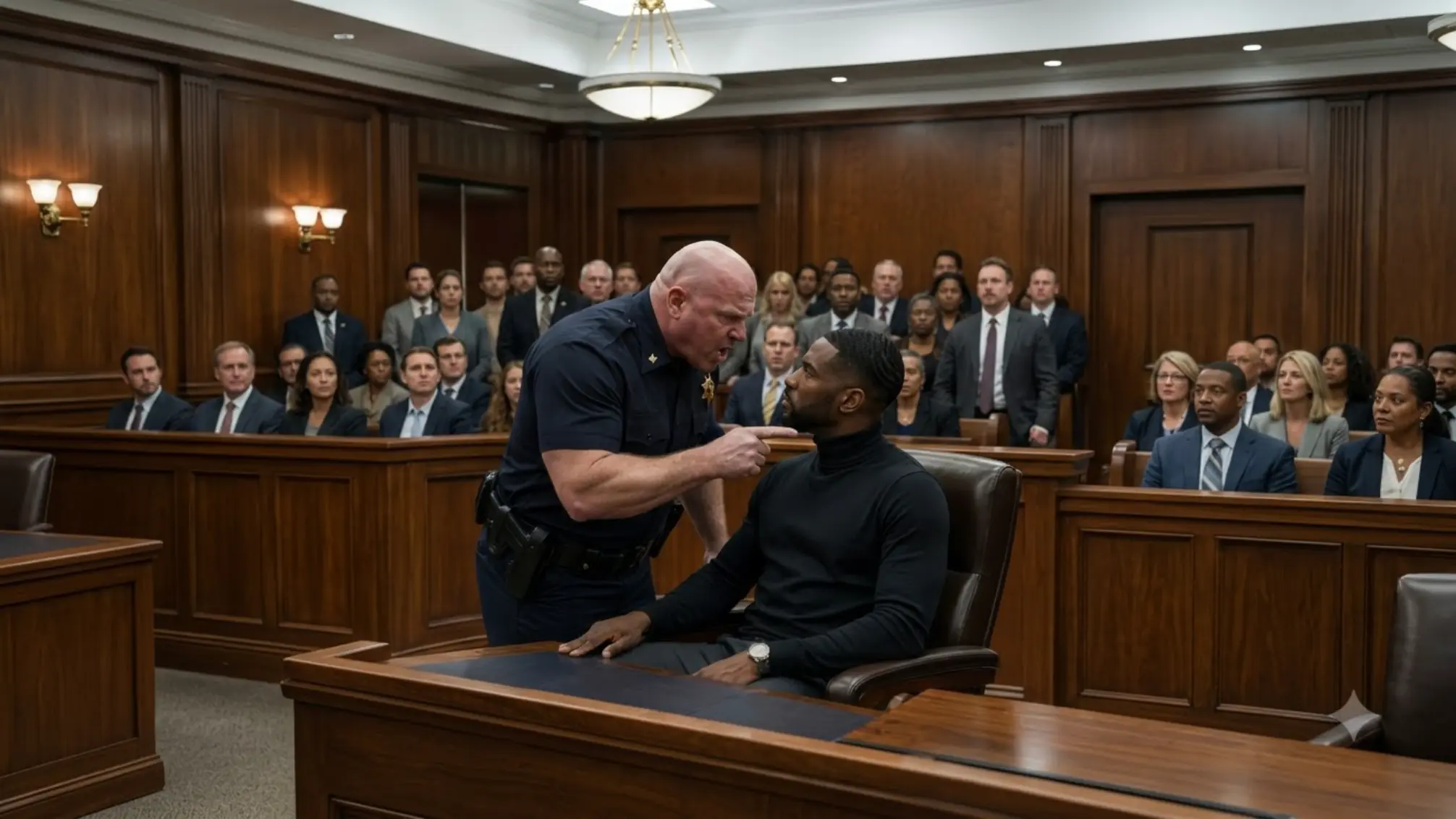
“Get out of that chair before I drag you out myself,” Raymond barked as he crossed the courtroom. The man looked up slowly, revealing neatly trimmed black hair, a close beard, deep-brown skin, and dark eyes that remained almost unnervingly calm. He wore charcoal trousers, polished black shoes, and no robe, badge, or courthouse identification visible anywhere. Instead of standing, he said quietly, “Put your hand on me and make sure the whole courtroom sees it.”
The response hit Raymond like a challenge. At forty-eight, Raymond was a huge bald white man who had worked courthouse security for nearly seventeen years, and people rarely answered him that way once he leaned forward and lowered his voice. He planted one hand on the bench and pointed the other directly toward the seated man’s face. “That chair belongs to the judge, not some smart-mouth stranger.”
Several attorneys stopped unpacking their files. A young prosecutor near the jury box looked from Raymond to the stranger and frowned, while two public defenders seated in the front row whispered to each other. Nobody recognized the man, which only reinforced Raymond’s certainty. The courthouse had been preparing for a new presiding judge for almost a month, but most employees had never met him in person.
Judge Malcolm Hayes had intentionally arrived early. He had been appointed to Fulton County Superior Court after twelve years as a civil-rights attorney, six years as an appellate judge, and a reputation for dismantling complicated cases with an almost irritating level of patience. His formal investiture was scheduled for the following week, but his judicial commission had already taken effect and his first docket began that morning. Malcolm had come without an entourage because he wanted to see how the courtroom functioned before everyone began performing for the new judge.
His robe was hanging in chambers twenty feet behind him. His identification card sat inside his leather briefcase beneath the bench, and his court clerk, Elena Ramirez, was downstairs collecting the final docket packet after discovering that three emergency motions had arrived overnight. Malcolm had planned to spend ten quiet minutes reading files before anyone noticed him. Raymond Knox ruined that plan within ninety seconds.
Malcolm looked toward the bailiff’s hand, still hovering inches from his chest. “Before you touch me, perhaps you should ask who I am.” Raymond gave a short contemptuous laugh. “I know exactly what you are right now.” Malcolm’s expression sharpened slightly. “Do you?”
Raymond leaned closer. “You’re somebody sitting where you don’t belong.” Malcolm glanced around the room. Almost everyone was watching now, although most people pretended to be reading documents. “That sounds like an assumption,” Malcolm said.
“It’s experience.” Raymond pointed toward the gallery. “People wander into restricted areas every day thinking rules don’t apply to them.” Malcolm remained seated. “And do you usually threaten to drag them out before asking their names?”
Raymond’s face reddened. “Stand up.” Malcolm said nothing. The silence made Raymond angrier than shouting would have.
He reached toward Malcolm’s shoulder. Malcolm moved only enough to keep Raymond’s hand from landing cleanly, not striking or grabbing him, merely shifting backward in the chair. “Do not touch me,” he said. Raymond immediately straightened as if that tiny movement had confirmed everything he believed.
“You resisting court security now?” Raymond asked. Malcolm looked almost disappointed. “Resisting what lawful instruction?” Raymond’s jaw tightened. “You are in a restricted judicial area.” Malcolm replied, “Correct.”
That answer confused him. Raymond stared. “Then why are you still sitting there?”
Malcolm folded his hands. “Because I am exactly where I’m supposed to be.” A few people in the gallery exchanged looks, and one older attorney suddenly began studying Malcolm’s face more carefully. Raymond, however, heard only arrogance.
“Last warning,” he said. “Get up or you leave in cuffs.” Malcolm’s eyes moved briefly toward the empty judge’s robe stand near chambers. “You may want to think very carefully about that sentence.” Raymond snapped, “I’m done thinking.”
He grabbed Malcolm’s forearm.
The courtroom changed immediately. Malcolm did not pull away violently, but his posture hardened as Raymond tried to force him upward. A defense attorney named Sarah Whitmore stood from the front row and said, “Bailiff, perhaps you should verify—”
“Sit down, counselor,” Raymond shouted without turning. Malcolm looked directly at him. “Release my arm.”
“You don’t give orders in my courtroom.”
Malcolm’s voice became colder. “That sentence is going to age poorly.”
Raymond tightened his grip. “You think jokes are going to help you?” Malcolm looked at his fingers around his sleeve. “No. Documentation will.”
That finally made Raymond glance toward the ceiling cameras. Courtroom 7A had recently been upgraded with three high-definition security systems after an incident involving a defendant threatening a prosecutor. Everything was being recorded, including audio near the bench. Raymond released Malcolm’s arm, but instead of backing away, he reached for the handcuffs on his belt.
The double doors opened.
Elena Ramirez entered carrying a thick blue docket folder, a laptop, and a travel mug balanced precariously beneath one arm. She was thirty-nine, Latina, sharp-eyed, and famous among courthouse staff for being able to identify procedural mistakes before most attorneys finished making them. She took two steps inside before noticing Raymond standing over Malcolm with handcuffs in his hand. The color drained from her face.
“Raymond!”
Everyone turned.
He looked toward her. “Good. Get security supervisor up here. I found somebody trespassing behind the bench.”
Elena nearly dropped the docket.
She hurried down the aisle. “Put those away.”
Raymond frowned. “What?”
“Put the handcuffs away.”
Malcolm remained seated.
Elena stopped beside them and looked directly at Raymond. “Do you have any idea who you’re threatening?”
Raymond’s confidence wavered for the first time. “Some guy who refuses to identify himself.”
Malcolm raised one eyebrow. “You never actually asked.”
Elena turned the blue folder around.
Across the top of the morning docket, printed in large black letters, were the words:
PRESIDING: THE HONORABLE MALCOLM D. HAYES
The room went completely silent.
Raymond stared at the page. Then at Malcolm. Then back at the page.
“No.”
Elena’s expression hardened. “Yes.”
Raymond’s mouth opened slightly.
Malcolm slowly rose from the chair.
He was not as tall as Raymond, but something about standing changed the entire balance of the room. The man Raymond had been towering over suddenly became the person everyone was waiting for to speak. Malcolm walked around the bench, opened his briefcase, and removed his judicial commission and courthouse credential.
He handed both to Raymond.
The bailiff looked down.
Judge Malcolm Hayes.
Fulton County Superior Court.
Presiding Judge, Courtroom 7A.
Raymond swallowed.
“This wasn’t posted.”
Elena stared at him. “His appointment has been posted for three weeks.”
“I hadn’t seen a picture.”
Malcolm took back the credential. “Would a photograph have changed the legal basis for grabbing someone before asking who he was?”
Raymond’s face reddened again. “Your Honor, I was securing the courtroom.”
“No.”
Malcolm’s voice remained calm.
“You were securing an assumption.”
Nobody moved.
Raymond tried to recover. “With respect, sir, you were seated behind the bench without robes, and the courtroom wasn’t officially in session.”
Malcolm nodded once. “Reasonable observation.” Raymond visibly relaxed.
Then Malcolm continued.
“What comes after a reasonable observation?”
Raymond hesitated.
“A question.”
Silence.
Malcolm looked toward the attorneys and spectators.
“Not a threat. Not physical contact. Not handcuffs.”
Raymond’s shoulders stiffened.
“I told you to identify yourself.”
“No, you didn’t.”
Sarah Whitmore spoke from the front row. “He didn’t, Your Honor.”
Raymond turned toward her. “Counselor—”
Malcolm raised one hand.
“Do not intimidate a witness in front of me.”
Raymond immediately stopped.
Malcolm looked toward Elena. “Is courtroom video currently active?”
“Yes, Judge.”
“Preserve everything from the moment I entered this room.”
Raymond’s eyes widened.
“Your Honor, is that really necessary?”
Malcolm looked at him.
“You were prepared to handcuff me ten seconds ago. Now preservation seems excessive?”
Raymond said nothing.
Malcolm walked toward chambers.
Before disappearing through the door, he stopped.
“Elena.”
“Yes, Judge?”
“Call courthouse administration and have another bailiff assigned to this room.”
Raymond’s jaw dropped.
“For today?”
Malcolm turned slightly.
“Until the incident is reviewed.”
He entered chambers.
Courtroom 7A immediately filled with whispers.
Raymond remained standing near the bench like a man who had just discovered the floor beneath him was not solid. Elena closed the docket folder and looked at him with something between anger and disappointment. “You should go downstairs.”
Raymond’s voice dropped. “I didn’t know.”
Elena shook her head.
“That’s the problem.”
Twenty minutes later, Judge Malcolm Hayes returned wearing black judicial robes.
Every person who was able stood.
Raymond was gone.
A temporary bailiff named Marcus Hill stood near the side door. Malcolm took his seat behind the bench, looked across the courtroom, and said, “Please be seated.”
No one moved for half a second.
Then chairs lowered almost simultaneously.
Malcolm opened the docket.
“Before we begin,” he said, “I want something entered into the record.”
Several attorneys immediately reached for pens.
“This morning, before court convened, there was an incident involving courthouse security and myself.”
He paused.
“I am not discussing it because I believe my title makes the incident unusually important.”
The room became still.
“I am discussing it because my title prevented the situation from becoming worse.”
Sarah Whitmore looked up.
Malcolm continued.
“Had I been an ordinary citizen, a witness, a defendant, a delivery driver, or someone who did not possess a credential capable of instantly correcting the assumption made about me, I might have been handcuffed and removed before anyone asked the most basic question.”
He closed the docket briefly.
“That concerns me.”
The speech lasted less than two minutes.
Then Malcolm began hearing cases.
For most people in Courtroom 7A, that should have been the end of the story.
It was not.
Courthouse Administrator Rebecca Sloan reviewed the security footage that afternoon. She watched Raymond enter the room, study Malcolm for several seconds, walk directly toward him, and begin issuing commands without making any attempt to identify him. She watched Raymond ignore Malcolm’s request that he ask who he was, touch him, threaten cuffs, and shout down Sarah when she tried to intervene.
Rebecca had worked with Raymond for eleven years.
That made the footage harder to watch.
He was experienced.
He knew procedure.
The failure could not be dismissed as ignorance.
Rebecca requested his personnel file.
At first, there was nothing catastrophic.
Positive annual evaluations.
Reliable attendance.
Strong emergency-response scores.
Two commendations for helping control dangerous courtroom situations.
Then she reached the complaints.
There were twelve.
Most had been marked resolved.
One Black attorney wrote that Raymond had demanded to inspect his bar identification three separate times despite seeing him appear in court weekly.
A Hispanic process server complained that Raymond forced him to wait outside because he “didn’t look official.”
A young Black public defender reported that Raymond ordered her away from counsel tables because he assumed she was a defendant’s relative.
Rebecca stopped reading.
She began printing.
The similarities were impossible to ignore when the complaints sat beside each other.
Each case had been treated as a misunderstanding.
Each involved Raymond deciding who belonged where before verifying credentials.
Each ended when the person produced something proving status.
The next morning, Malcolm received a call from Rebecca.
“I think you need to see this.”
He read the complaint summaries in chambers.
His expression changed slowly.
“How far back?”
“Eight years.”
“And nobody connected them?”
“No.”
Malcolm leaned back.
“Why?”
Rebecca hesitated.
“Because each complaint was reviewed separately.”
That answer bothered him more than anything else.
Patterns disappeared when systems insisted on looking at one event at a time.
Malcolm tapped one complaint.
“This attorney was required to show ID three times?”
“Yes.”
“Raymond knew him?”
“The attorney believes so.”
Another.
“This woman was removed from counsel table?”
“Yes.”
“She was defense counsel?”
“Yes.”
Malcolm closed the folder.
“Then this is not about what happened to me.”
Rebecca nodded.
“No.”
The formal review expanded.
Raymond was interviewed with a representative present.
He defended himself strongly.
“I treat everyone the same.”
The investigator asked, “Then why did you approach Judge Hayes?”
“He was in a restricted area.”
“Did you ask his name?”
“No.”
“Why?”
Raymond hesitated.
“He didn’t look like a judge.”
The investigator stopped writing.
“What does a judge look like?”
Raymond immediately recognized the trap in his own words.
“I meant he wasn’t wearing robes.”
“Judge Patricia Collins often enters without robes before docket.”
“That’s different.”
“How?”
Raymond had no good answer.
Investigators compared security footage from multiple mornings.
Judges, attorneys, court reporters, contractors, and clerks routinely entered restricted areas before sessions began.
Raymond questioned some.
He ignored others.
The strongest pattern involved people he did not personally recognize who did not visually match the professional role he expected them to occupy.
The review did not conclude Raymond hated anyone.
It concluded something more complicated.
He trusted assumptions too quickly.
And authority allowed those assumptions to become consequences.
Malcolm insisted the investigation remain independent.
“I will not decide his employment,” he told Rebecca. “I was involved.”
That decision surprised several people.
One attorney asked why Malcolm did not simply demand Raymond be fired.
“Because procedure matters most when you already believe you’re right,” Malcolm answered.
The irony was intentional.
Raymond had skipped procedure because he believed he was right.
Malcolm would not repeat the mistake in reverse.
Over the following month, courthouse staff were interviewed.
Several defended Raymond.
“He’s tough, but he keeps people safe.”
“He’s handled dangerous defendants.”
“He doesn’t tolerate nonsense.”
Malcolm never disputed those facts.
Good work did not erase bad conduct.
That became the central issue.
A person could be brave during emergencies and still exercise poor judgment in ordinary interactions.
A person could protect a courtroom one day and misuse authority the next.
Human beings were not neat categories.
The investigation eventually substantiated seven complaints involving improper credential challenges, unnecessarily aggressive language, selective enforcement of restricted-area rules, and one incident where Raymond physically redirected an attorney despite her repeatedly stating who she was.
The review recommended removal from courtroom-facing security duties, mandatory retraining, and a disciplinary suspension.
Raymond appealed.
During the appeal hearing, Malcolm was called as a witness.
Raymond sat across the room in a dark suit rather than his uniform.
For the first time, he looked smaller.
An attorney asked Malcolm, “Did Mr. Knox use racial language toward you?”
“No.”
“Did he threaten you because you are Black?”
“I cannot testify to what was inside his mind.”
“Then why do you believe this incident matters?”
Malcolm thought for a moment.
“Because discrimination does not always announce itself.”
The room became quiet.
“Sometimes it appears as certainty.”
The attorney waited.
Malcolm continued.
“The certainty that one person belongs behind a bench and another does not. The certainty that one person is counsel while another is probably family. The certainty that an unfamiliar person in a restricted space must be removed before being identified.”
Raymond looked down.
Malcolm added, “Whether those assumptions were consciously racial is something I cannot prove. What I can prove is that the assumptions repeatedly produced unequal treatment.”
That testimony became part of the final findings.
Raymond’s appeal failed.
He was transferred to a non-courtroom security assignment while completing retraining and was barred from direct enforcement duties during that period.
Some people wanted harsher consequences.
Others believed the punishment was too severe.
Malcolm refused to participate in either argument publicly.
Instead, he focused on the system.
Courthouse employees created a digital credentialing platform that allowed security staff to verify judges, attorneys, contractors, investigators, and authorized visitors within seconds.
New judges were formally introduced to court-security teams before their first docket.
But Malcolm demanded something more important.
Staff were trained to ask first.
May I see your identification?
Not:
What are you doing here?
Not:
You don’t belong here.
Not:
Get out.
That linguistic difference seemed small.
Malcolm argued that it changed the entire starting point.
One assumed wrongdoing.
The other sought information.
Six months later, Raymond requested a meeting.
Malcolm almost declined.
Then he agreed.
Raymond entered chambers without a uniform.
He looked uncomfortable.
“I owe you an apology.”
Malcolm closed the file he was reading.
Raymond continued.
“I’ve replayed that morning a hundred times.”
“Why?”
“Because I keep trying to figure out when I decided you were trouble.”
Malcolm waited.
Raymond sat across from him.
“And I can’t.”
“That’s probably because you didn’t consciously decide.”
Raymond looked confused.
Malcolm explained.
“Assumptions usually feel like observations when we make them.”
Raymond lowered his eyes.
“I thought I was protecting the bench.”
“I believe you.”
Raymond looked up sharply.
Malcolm continued.
“That doesn’t mean you were right.”
“I know.”
Silence filled the chambers.
Raymond finally said, “If you’d told me immediately you were the judge, none of it would’ve happened.”
Malcolm’s expression changed.
Raymond realized the mistake before Malcolm responded.
“That’s still asking me to fix your assumption.”
Raymond nodded slowly.
“You’re right.”
Malcolm leaned back.
“The next person may not have a title.”
Raymond said nothing.
“That person matters more than I did that morning.”
Months later, Malcolm was presiding over a complicated fraud trial when he noticed a young Black attorney standing uncertainly near the courtroom entrance.
A new bailiff approached her.
Malcolm watched.
“Good morning,” the bailiff said. “May I see your court identification?”
She handed it over.
“Thank you, counselor. Your table is on the left.”
That was all.
Malcolm looked down at his files.
Nobody else noticed.
He smiled faintly.
Systems rarely changed with dramatic speeches.
Sometimes they changed through one ordinary interaction happening differently.
A year after Malcolm’s first docket, Elena brought him the anniversary calendar.
“You realize what today is?”
Malcolm looked at the date.
“Oh.”
She smiled.
“You going to sit here in a turtleneck again and terrify security?”
Malcolm laughed.
“I thought I was the one being threatened.”
“Depends who tells the story.”
He looked toward the judge’s chair.
“That chair caused a lot of trouble.”
Elena shook her head.
“No.”
She placed the docket in front of him.
“The assumption caused the trouble.”
Malcolm looked at her.
“Fair.”
The courtroom doors opened.
Attorneys entered.
Defendants took seats.
Families whispered.
Security officers checked credentials.
Nobody knew that one year earlier, the presiding judge had nearly been handcuffed in the very chair he now occupied.
Malcolm preferred that.
The story was never supposed to become mythology about a secretly powerful Black man revealing himself and embarrassing a bailiff.
That version missed the point.
Raymond Knox was wrong before he saw Malcolm’s credential.
He was wrong before Elena entered carrying the docket.
He was wrong when the man sitting in front of him had no title at all.
The docket simply exposed the mistake.
And every morning afterward, Courtroom 7A operated under a rule Malcolm believed should never have required a scandal to establish:
Ask who someone is before deciding who they cannot be.