“Stand up… or face contempt.” The bailiff’s voice cut across Courtroom 4B so sharply that conversations died before the judge even raised his gavel. Thirty-eight-year-old Angela Brooks sat motionless in her wheelchair at the defense table, her hands resting over a dark folder in her lap, her navy blouse visible beneath a fitted black blazer. She looked directly at Bailiff Thomas Grady as he leaned over her with his jaw clenched, close enough that she could smell coffee on his breath. Angela did not stand, because Angela could not stand.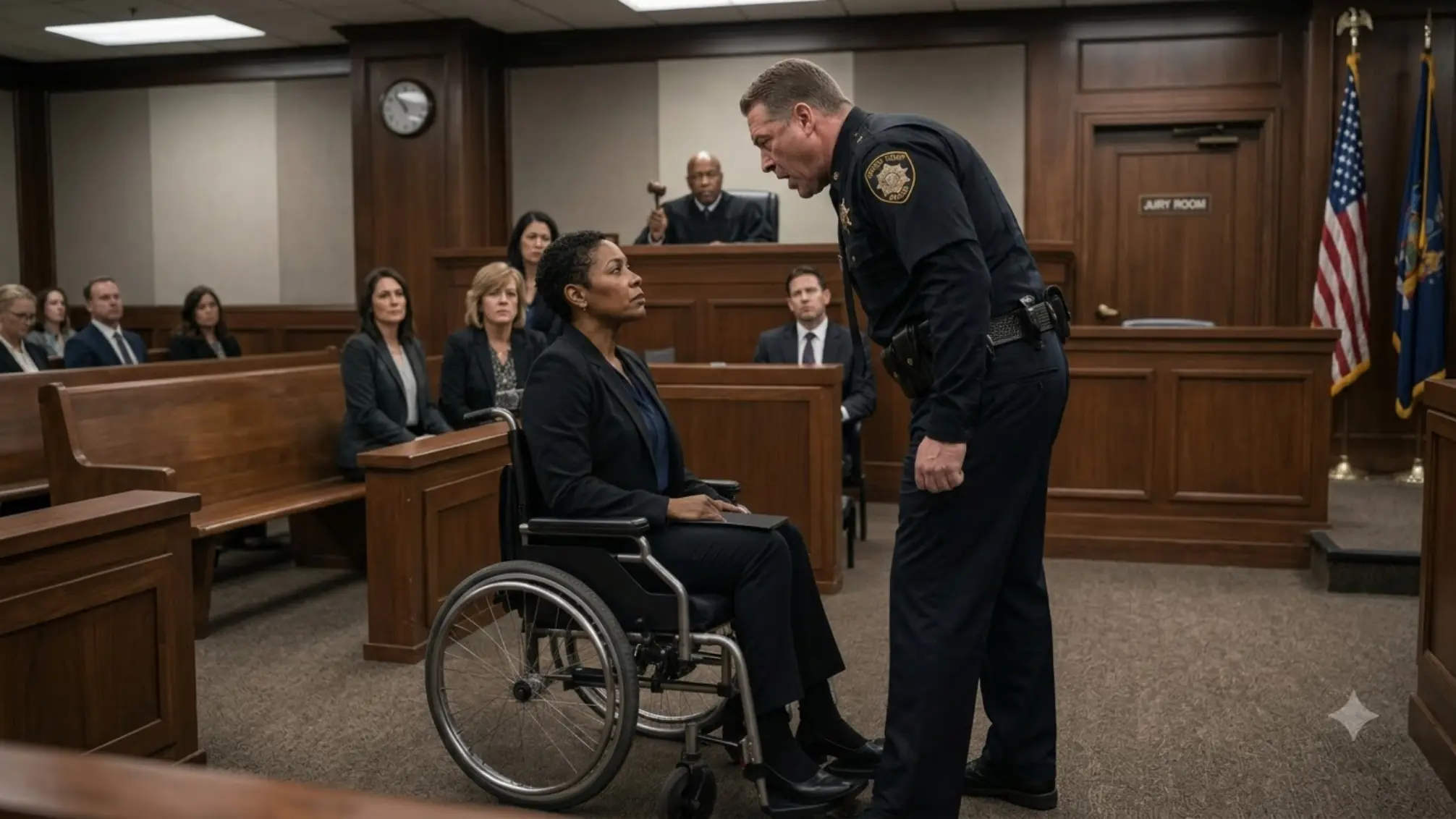
Grady straightened and looked toward Judge Calvin Monroe as though expecting approval. The judge, a sixty-year-old Black man with a reputation for rigid courtroom procedure, peered down from the bench and asked why proceedings had stopped. Grady pointed at Angela and said, “She refuses to rise when the court enters.” A few spectators shifted uncomfortably, but nobody spoke.
Angela had arrived at the Franklin County Courthouse in Columbus, Ohio, forty minutes earlier for what should have been a simple civil hearing. She was not facing criminal charges, nor was she there because she had done anything wrong. Angela was suing the property-management company responsible for the apartment complex where a collapsed stairway had permanently damaged her spine eighteen months earlier. She had spent months gathering inspection reports, medical records, maintenance complaints, and photographs that she believed proved the company ignored repeated warnings before the accident.
The wheelchair was not temporary. Angela had sustained severe injuries to her lower spine and pelvis, leaving her with only limited movement below the waist. She could transfer with assistance under certain conditions, but standing without specialized support was medically forbidden because another fall could cause further nerve damage. Her physician had submitted a formal accommodation order to the court two weeks before the hearing.
Angela knew the document had been accepted. Her attorney, Rebecca Sloan, had received written confirmation from the court’s accessibility coordinator. The accommodation stated clearly that Angela was exempt from standing requirements, would remain seated during entry and exit of the judge, and should not be physically assisted unless she specifically requested help. The order was supposed to be attached electronically to the courtroom calendar.
Someone had failed to read it.
“I said stand,” Grady repeated, louder this time. Angela lifted her chin. “And I heard you.”
His expression hardened. “Then obey.”
Angela’s hands tightened over the folder. “I cannot.”
Grady leaned closer. “You can’t, or you won’t?”
Rebecca immediately stood beside her client. “Bailiff, there is a medical accommodation on file.” Grady waved toward her without looking away from Angela. “Counselor, your client still has to show respect to the court.”
Rebecca’s eyes narrowed. “Respect does not require violating a spinal-injury order.”
The judge tapped his gavel once. “What is happening down there?”
Grady looked toward the bench. “Your Honor, the defendant is refusing to stand.”
Angela’s eyes flashed. She was not the defendant. She was the plaintiff.
Rebecca spoke before Angela could. “Your Honor, Ms. Brooks is the plaintiff, and the court approved an accessibility accommodation stating she remains seated.”
Judge Monroe looked toward the clerk beside him. “Do we have that?”
The clerk began searching through the electronic file. Grady interrupted. “She was sitting here when you entered and didn’t even attempt to rise.”
Angela stared at him. “Because my doctor told me not to.”
Grady stepped closer to the wheelchair. “This is your last warning.”
Rebecca moved between them slightly. “Do not touch my client.”
The room became very still.
Grady looked at Rebecca. “Counselor, move.”
“No.”
Judge Monroe struck the gavel harder. “Everyone stop.”
Angela remained silent, but her breathing had become shallow. The accident had taught her what fear felt like when the body could not retreat. It was not simply panic. It was the awareness that someone else could move you before you could stop them.
Grady pointed toward Angela’s lap. “She’s sitting there challenging the court.”
Angela finally spoke. “I am sitting here because two vertebrae were crushed when a staircase collapsed under me.”
Grady did not pause.
That mattered.
If he had paused, the entire morning might have ended differently. Instead, he leaned toward her again and said, “Everybody has an excuse.”
The sentence traveled across the room like something thrown.
One woman in the gallery whispered, “Oh my God.”
Rebecca’s face reddened. “Your Honor, I am requesting that the bailiff step away from my client immediately.”
Judge Monroe looked toward Grady. “Thomas, back up until the clerk verifies the accommodation.”
Grady should have listened.
He did not.
He looked at Angela and said, “She should have told me before court.”
Angela’s voice became colder. “I did.”
Grady stopped.
“I handed you my accommodation letter at security.”
Rebecca looked toward him.
Angela continued. “You read the first page, handed it back, and told me not to make things complicated.”
For the first time, Grady’s confidence cracked.
“That’s not what happened.”
Angela reached for the dark folder resting on her lap.
Grady immediately grabbed the wheelchair handle.
Rebecca shouted, “Do not touch her!”
Angela’s eyes widened, not in fear but in controlled fury. “Take your hand off my chair.”
Judge Monroe stood halfway from the bench. “Bailiff!”
Grady released the handle.
Angela slowly opened the folder and removed a white court order with a red medical-accommodation stamp across the top.
She raised it.
“Read this spinal-injury order first, Judge,” she said, “before your courtroom becomes my next case.”
Nobody moved.
Judge Monroe extended his hand toward the clerk. “Bring me that document.”
The clerk walked down and accepted it from Angela carefully. Grady stood beside the wheelchair, suddenly aware that every person in the room was now watching him instead of her. Rebecca kept one hand on the back of Angela’s chair.
The judge read the first page.
Then the second.
His expression changed.
“This was approved twelve days ago.”
Rebecca nodded. “Correct.”
Judge Monroe looked toward the clerk. “Why was it not flagged on the courtroom schedule?”
The clerk looked horrified. “It should have been.”
Grady spoke quickly. “Your Honor, I never saw that.”
Angela turned toward him.
“You held this paper in your hand downstairs.”
His face tightened. “I saw paperwork. I didn’t know what it was.”
“You never finished reading it.”
Grady opened his mouth, then closed it.
The judge slowly sat down.
“Ms. Brooks, I apologize.”
Angela looked at him. “Thank you.”
Monroe then turned toward Grady. “Step outside.”
Grady blinked. “Your Honor?”
“Now.”
The bailiff walked toward the side door with every eye following him.
The hearing could have continued from there. Judge Monroe could have treated the confrontation as an unfortunate misunderstanding and moved on. But Rebecca Sloan had spent fifteen years litigating civil-rights and accessibility cases, and she recognized the difference between a mistake and a process failure.
She stood.
“Your Honor, before we continue, I need to place an objection on the record regarding what just occurred.”
Monroe nodded. “Go ahead.”
Rebecca’s voice was steady. “My client arrived with an approved accommodation, presented it to courthouse security, and was still threatened with contempt and physical removal because staff failed to communicate the order.”
Angela looked toward her attorney.
Rebecca continued. “The bailiff physically touched the wheelchair after being told not to. That needs to be preserved.”
Judge Monroe looked uncomfortable.
“I agree.”
Rebecca raised an eyebrow slightly.
Monroe continued. “Courtroom security footage and audio will be preserved. I’m also requesting an immediate administrative review before this hearing proceeds.”
Angela exhaled.
That was the first moment she believed someone in authority had actually understood the problem.
The judge recessed court for forty-five minutes.
Rebecca wheeled Angela into a private conference room even though Angela usually insisted on moving herself. Her hands were shaking now.
“You okay?” Rebecca asked.
Angela stared at the floor.
“No.”
Rebecca sat across from her.
Angela looked up.
“I hate that he made me explain my body to a room full of strangers.”
Rebecca nodded slowly.
“That should never have happened.”
Angela rubbed one palm across her thigh, though she could barely feel it.
“He didn’t even ask.”
“No.”
“He just decided.”
Rebecca leaned forward.
“That’s why we document it.”
Angela laughed bitterly.
“I’m getting tired of my entire life becoming documentation.”
Rebecca had no easy answer.
Eighteen months earlier, Angela had been walking down the exterior staircase of Westfield Gardens Apartments when the central landing collapsed. Maintenance records later showed residents had complained about rust, loose supports, and cracking concrete for more than a year. One internal email warned management that the structure might be unsafe.
Nothing was repaired.
Angela fell almost fifteen feet.
Her lower spine struck the metal railing before she hit concrete.
She spent nine days in the hospital, two months in rehabilitation, and nearly a year learning how to rebuild a life that no longer resembled the one she had before the fall.
Westfield’s insurer initially blamed her.
Their first response claimed she might have been “moving improperly” on the stairs.
The phrase had stayed with Angela.
Moving improperly.
Now a bailiff was accusing her of sitting improperly.
Sometimes systems seemed remarkably skilled at finding ways to make injured people responsible for other people’s failures.
When court resumed, Grady was gone.
A female deputy named Alicia Moore stood near the entrance instead.
She approached Angela before the judge returned.
“Ms. Brooks?”
Angela looked up.
“I’ve reviewed your accommodation.”
Angela waited.
Moore continued. “You do not need to stand at any point. If you need assistance moving, entering, leaving, or accessing exhibits, tell me. Otherwise I will not touch your chair.”
Angela’s shoulders relaxed slightly.
“Thank you.”
“That’s what should’ve happened the first time.”
The judge returned.
Nobody asked Angela to stand.
Monroe addressed the courtroom immediately.
“Before proceeding, I want the record to reflect that Ms. Brooks had a valid accommodation on file. The court failed to ensure that information reached courtroom security.”
He looked toward Angela.
“That failure was ours.”
Angela nodded.
The hearing continued.
For nearly three hours, Rebecca presented evidence against Westfield Gardens. Maintenance emails showed that managers knew the staircase supports were deteriorating. Photographs taken two months before the collapse showed severe rust beneath the landing.
A former maintenance worker testified that he had requested replacement materials twice.
The property manager denied remembering the request.
Rebecca produced the signed work order.
Angela watched silently.
This was why she had come.
Not to fight with a bailiff.
Not to become a courtroom story.
To prove that what happened to her had been preventable.
By late afternoon, the judge ordered additional records produced and scheduled the case for trial. Angela and Rebecca began packing when Alicia Moore approached.
“There’s someone who wants to speak with you.”
Angela looked toward the door.
A woman in a gray suit entered carrying an identification badge.
“Angela Brooks?”
“Yes.”
“My name is Denise Carter. I’m with courthouse administration.”
Angela glanced at Rebecca.
Denise continued.
“We’ve begun reviewing the incident involving Bailiff Grady. I need your permission to take a statement.”
Angela looked tired.
“Today?”
“If you prefer another day, absolutely.”
Angela thought about it.
“Today.”
The interview lasted forty minutes.
Angela described everything from the moment she entered security.
She remembered handing Grady the accommodation.
She remembered him scanning the first page.
She remembered him saying, “We don’t have time for special treatment.”
That sentence had felt rude at the time.
Now it mattered.
Denise asked whether anyone else heard it.
Angela remembered a security officer standing beside the metal detector.
His name was Gerald Price.
Administrators interviewed him the next morning.
Gerald confirmed Angela’s account.
He had seen the paperwork.
He had heard Grady dismiss it.
Even more importantly, security footage showed Angela handing Grady the document.
There was no audio in that section of the courthouse, but the video clearly showed Grady opening the folder, looking at the paper, and returning it.
The explanation that he had never seen the accommodation collapsed immediately.
Then administrators reviewed his record.
That was where the incident became something larger.
Grady had worked courthouse security for eleven years.
His personnel file contained no major discipline.
But there were complaints.
Seven.
Three involved elderly visitors who said he had shouted at them for moving too slowly through security.
One involved a deaf man who claimed Grady repeatedly ordered him to respond verbally even after being shown documentation explaining the disability.
Another complaint came from a woman using crutches who said Grady accused her of “playing games” when she requested additional time.
None of the complaints had resulted in formal discipline.
Each had been categorized as a communication issue.
Denise Carter began reading the files side by side.
The language was different.
The pattern was not.
One complainant described Grady as becoming hostile when someone needed an exception to standard procedure.
Another said he treated accommodation as disrespect.
A third wrote, He seemed angry that my disability made the process slower.
Denise sent the review to the county court administrator.
Grady was suspended pending investigation.
The local courthouse employees’ association challenged the suspension, arguing that one confrontational morning should not destroy an eleven-year career.
The administrator agreed with part of that statement.
One morning should not.
That was why they investigated all eleven years.
More people came forward after courthouse staff received notice of the review.
A former public defender remembered Grady threatening to remove a client who had severe anxiety and could not stop shaking.
A clerk described seeing him move a walker without permission because it blocked an aisle.
Another attorney produced an email from two years earlier complaining that Grady mocked a client who used a communication board after throat surgery.
The issue was no longer whether Grady had been having a bad day.
The question became why warning signs had repeatedly been documented and treated as isolated personality conflicts.
Angela learned about the investigation from Rebecca.
She sat in her apartment kitchen when Rebecca called.
“They found other complaints.”
Angela closed her eyes.
“How many?”
“Enough.”
Angela looked toward the wheelchair beside the counter.
“Then why was he still doing it?”
Rebecca was silent.
That question would eventually reach Judge Monroe too.
He had been reviewing his own courtroom procedures since Angela’s hearing. He discovered that accommodation notices were stored in a separate administrative system that bailiffs did not consistently check before each docket.
Some judges printed them.
Some clerks flagged them manually.
Some courtroom security staff relied on verbal notification.
There was no single mandatory process.
The court had created accessibility rules.
It had failed to build a reliable system for enforcing them.
Judge Monroe hated that conclusion.
It meant the incident was not only Grady’s failure.
It was institutional.
He asked Denise to expand the review.
Within six weeks, Franklin County issued new courthouse procedures. Approved disability accommodations were automatically attached to electronic case calendars and displayed before courtroom staff opened each session.
Security officers were required to review accommodation notes before moving, touching, or physically assisting any person with mobility equipment.
Wheelchairs, walkers, canes, and communication devices were formally treated as extensions of personal space.
Staff could not move them without permission except during genuine emergencies.
Angela read the policy twice.
Then she called Rebecca.
“They wrote the chair part.”
“They did.”
“They actually wrote it.”
Rebecca smiled.
“I know.”
Angela looked out the window.
That small sentence mattered more to her than Grady’s suspension.
Her wheelchair was not luggage.
It was not furniture.
It was part of how she moved through the world.
Months passed.
Angela’s lawsuit against Westfield Gardens reached trial.
She returned to Courtroom 4B.
This time nobody told her to stand.
Alicia Moore opened the door early so Angela could position herself comfortably at the table.
Judge Monroe entered.
Every person who was able stood.
Angela remained seated.
Nobody looked at her.
That almost made her cry.
The trial lasted seven days.
Rebecca presented maintenance records, inspection photographs, employee testimony, engineering reports, and internal emails showing property managers repeatedly postponed repairs.
The defense argued that management had not understood the severity of the structural risk.
Then Rebecca displayed an email written eleven weeks before the collapse.
Landing support badly corroded. Recommend immediate closure until replaced. Failure risk increasing.
The property manager had replied.
Hold until next quarter. Budget already tight.
Angela watched the jury read it.
That was the moment the case changed.
The jury returned after five hours of deliberation.
They found Westfield Gardens negligent.
Angela was awarded compensation for medical expenses, lost income, future care, and pain caused by the preventable accident.
She did not celebrate in the courtroom.
She closed her eyes and cried quietly.
It was not happiness.
It was release.
Judge Monroe waited until the jury left.
Then he looked toward her.
“Ms. Brooks.”
Angela raised her eyes.
“I want you to know something.”
She waited.
“This court learned from what happened the first time you were here.”
Angela nodded.
“I hope so.”
Monroe’s expression softened.
“We did.”
Several months later, the administrative investigation into Grady concluded.
He was dismissed from courthouse security after investigators determined he had repeatedly disregarded disability accommodations, failed to accurately report prior incidents, and ignored direct instructions during Angela’s hearing.
But Angela asked Rebecca not to make Grady the entire story.
“He was part of it,” she said. “Not all of it.”
Rebecca understood.
The more important change was that the courthouse could no longer claim accommodation failures were just misunderstandings.
Procedures changed.
Training changed.
Complaint tracking changed.
People were required to document why accessibility complaints were closed rather than simply marking them resolved.
Angela was invited to speak at a courthouse accessibility committee meeting.
She almost refused.
Then she went.
She wore the same navy blouse she had worn the day Grady confronted her.
When it was her turn to speak, she rolled toward the table and looked at a room filled with judges, administrators, deputies, attorneys, and disability advocates.
“I’m not here because I think everyone in this building is cruel.”
Nobody spoke.
“I’m here because cruelty isn’t required for someone to get hurt.”
Several people leaned forward.
“All it takes is assumption.”
Angela placed both hands on the table.
“Someone sees a wheelchair and assumes weakness. Someone sees a person not standing and assumes disrespect. Someone sees a different need and assumes inconvenience.”
Judge Monroe sat near the back.
Angela continued.
“The dangerous part is what happens next.”
She looked around the room.
“Authority starts acting before curiosity gets a chance to ask why.”
That sentence appeared in the final accessibility report.
A year after the original hearing, Angela returned to Courtroom 4B one last time.
Not for a lawsuit.
The county had invited her to observe the rollout of new accessibility signage and staff procedures.
She almost laughed at the idea.
A year earlier, she had been threatened with contempt.
Now they wanted her opinion on signage.
Life could be strange.
Near the entrance, she saw a nervous older man using a walker.
A new bailiff approached him.
Angela watched carefully.
“Sir,” the bailiff said, “do you need additional time getting to the front?”
The man nodded.
“Yes.”
“No problem.”
The bailiff stepped aside.
That was it.
No shouting.
No frustration.
No public embarrassment.
Angela looked toward Rebecca.
Rebecca smiled.
“Worth coming?”
Angela nodded.
“Yeah.”
They moved toward the exit.
Near the hallway, Angela stopped and looked back at the courtroom where everything had begun.
She remembered Grady leaning over her.
The judge ordering her to stand.
The silence from people who sensed something was wrong but did not yet understand what.
She also remembered the moment she lifted the medical order from her lap.
People later told the story as though that document had saved her.
Angela disagreed.
The document had always existed.
The problem was that nobody had bothered to read it.
That was the lesson she carried away.
Evidence only protects people when systems are willing to see it.
Rules only create fairness when the people enforcing them understand why exceptions exist.
Authority only deserves trust when it knows when to stop and ask a question.
Angela rolled through the courthouse doors into bright afternoon sunlight.
Rebecca walked beside her.
“You want lunch?”
Angela smiled.
“Only if the restaurant has a ramp.”
Rebecca laughed.
“I already checked.”
Angela looked at her.
“See? Somebody learned.”
They crossed the plaza together.
Behind them, Courtroom 4B continued its afternoon docket.
People entered.
People stood when they could.
People remained seated when they needed to.
Nobody demanded an explanation from every person whose body worked differently.
Nobody grabbed a chair.
Nobody turned accommodation into confrontation.
And for Angela Brooks, that quiet ordinary change meant more than watching one bailiff lose his job.
Because the first time she entered that courtroom, everyone had been waiting for her to prove why she deserved an exception.
By the time she left it for the final time, the system had finally learned the better question.
Not Why won’t you stand?
But What do you need?