The question cracked across the marble lobby of Philadelphia Heritage Bank just after nine on a cold Monday morning. Conversations stopped beneath the crystal chandelier, and several customers turned toward the elderly Black man standing near the private elevators. Charles Whitmore did not flinch. He simply shifted the worn brown briefcase in his left hand and looked at the woman blocking his path.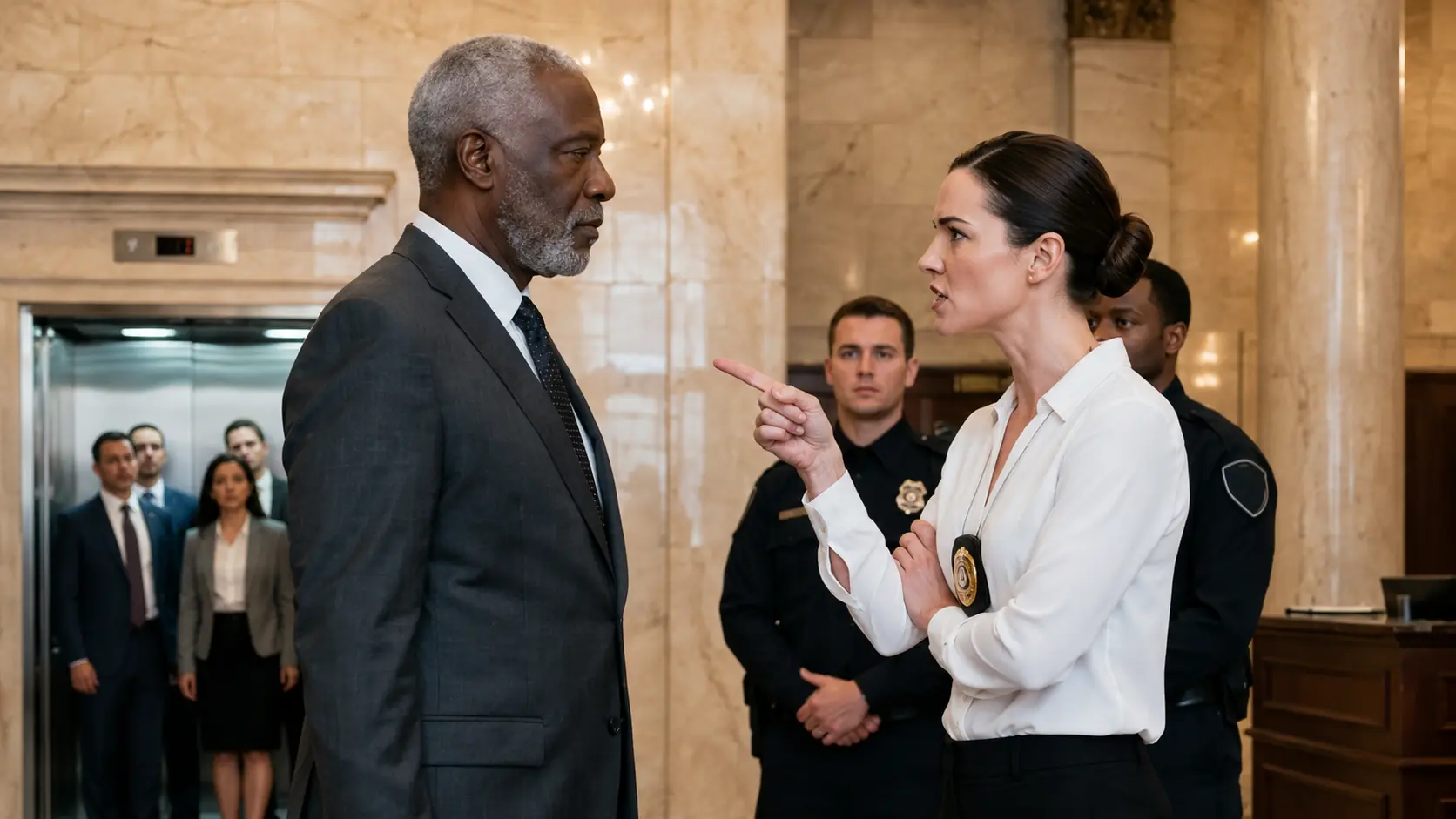
Rebecca Miles wore a crisp white blouse, tailored black trousers, and a gold badge identifying her as the bank’s senior client-relations manager. Her dark hair was pulled into a severe bun, and one finger remained pointed at Charles as though she had caught him crossing a restricted line. Two security officers near the reception desk watched without moving. Behind Charles, customers waiting for service began lifting their phones.
“To the boardroom,” Charles said. “Move.”
Rebecca gave a short laugh.
“The executive floors are restricted.”
“I know.”
“You need an appointment and proper identification.”
“My appointment began six minutes ago.”
Rebecca looked him over again. Charles wore a perfectly tailored charcoal suit, but age had softened its shoulders, and his leather briefcase showed years of wear. His silver hair was cut neatly, his shoes were polished, and his posture remained upright despite his seventy-one years. None of those details changed the conclusion Rebecca had already reached.
“You’re not on my executive visitor list.”
“Then your list is incomplete.”
Her lips tightened.
“Sir, take another step and security will escort you outside.”
Charles calmly opened his briefcase.
“Call them over. I came to decide who leaves this bank.”
The nearest security officer shifted uncomfortably. Rebecca folded her arms, visibly annoyed that Charles had not been frightened by the threat. Before she could answer, one of the private elevators chimed behind her.
The doors opened.
Six executives stepped into the lobby, led by bank president Martin Hale. He was a broad fifty-six-year-old white man with silver at his temples, a navy suit worth more than many customers earned in a month, and the carefully rehearsed smile of someone accustomed to speaking before investors. That smile vanished when he saw Charles.
“Mr. Whitmore.”
Rebecca turned.
Martin crossed the lobby quickly.
“We’ve been waiting upstairs.”
Charles closed the briefcase.
“I gathered that.”
Rebecca stared between them.
“You know him?”
Martin did not answer her immediately. His eyes moved toward the customers filming, the two security officers, and Rebecca’s outstretched arm still blocking Charles from the elevators.
Finally, he said, “This is Charles Whitmore, chairman emeritus and majority shareholder of Philadelphia Heritage Bank.”
The lobby went silent.
Rebecca’s face drained of color.
Charles had founded the institution forty-three years earlier with one branch, eleven employees, and a promise that working families would not be treated as inconveniences simply because they lacked wealth. Under his leadership, Heritage had grown into one of Pennsylvania’s most respected regional banks. He had stepped away from daily operations eight years ago after his wife became ill, leaving management to a board he believed understood the institution’s values.
Now he was back because nearly twenty-eight million dollars had disappeared from customer trust accounts.
Charles looked at Rebecca.
“You were saying something about who belongs upstairs.”
Her mouth opened, but no answer came.
Martin attempted a nervous smile.
“Mr. Whitmore, I’m certain this was just a misunderstanding.”
Charles looked around the lobby.
“A misunderstanding usually ends when someone offers verification.”
Rebecca swallowed.
“He didn’t provide identification.”
“I asked you to check my appointment.”
“You weren’t on the list.”
“Who prepared the list?”
Rebecca glanced toward Martin.
His expression warned her not to answer.
Charles noticed.
“Interesting.”
He stepped toward the private elevator. Rebecca moved aside immediately, but Charles did not enter. Instead, he looked at one of the security officers.
“What is your name?”
“Daniel Price, sir.”
“Did Ms. Miles ask you to verify who I was?”
“No, sir.”
“Did she ask reception to contact the executive office?”
“No.”
“What did she ask you to do?”
Daniel hesitated.
Rebecca turned sharply.
“Officer Price, you don’t need to answer that.”
Charles looked at her.
“He does.”
Daniel lowered his eyes.
“She told us to prepare to remove you if you approached the elevator.”
Several customers murmured.
Charles nodded once.
“Thank you for telling the truth.”
He entered the elevator without another word. Martin and the other executives followed. Rebecca remained in the lobby, surrounded by customers who now knew exactly who she had threatened to throw outside.
The executive boardroom occupied the twenty-third floor, overlooking downtown Philadelphia and the Delaware River beyond it. A polished walnut table stretched beneath recessed lights, with twelve leather chairs arranged around it. Financial reports, legal folders, and tablets had been placed neatly at every seat.
Charles took the chair at the head of the table.
Martin sat to his right.
The board members settled slowly, each one aware that the atmosphere had changed before the meeting even began. The chief financial officer, Thomas Reed, kept adjusting his tie. General counsel Evelyn Parker opened a legal pad but did not write anything. Chief operations officer Leonard Shaw stared at the closed folder in front of Charles.
Martin cleared his throat.
“First, I want to apologize for what happened downstairs.”
Charles removed several documents from his briefcase.
“Did you know customer trust accounts were being drained?”
The apology died instantly.
Martin leaned back.
“That allegation is still under review.”
“It is not an allegation.”
Charles placed bank records on the table.
“Twenty-seven million eight hundred thousand dollars was moved from protected customer accounts into three affiliated investment entities over fourteen months.”
Thomas Reed looked toward Martin.
Charles continued.
“Two of those entities were created by shell companies registered in Delaware. The third is controlled by someone sitting in this room.”
No one spoke.
Martin folded his hands.
“Charles, financial structures at this level can appear suspicious without proper context.”
“Then provide the context.”
“The transfers were temporary liquidity adjustments.”
“Trust accounts are not operating capital.”
“They were never at risk.”
“Customers could not access their money.”
“That was a technical delay.”
Charles opened another folder.
“A widow named Margaret Ellis waited thirty-seven days for funds from her husband’s estate because Heritage claimed her trust account was under routine verification.”
Martin’s jaw tightened.
“A single customer complaint does not establish wrongdoing.”
“There were two hundred eighteen complaints.”
Leonard Shaw looked up.
Charles slid a list across the table.
“People were denied access to inheritance accounts, disability funds, medical trusts, and court settlements. Some missed mortgage payments. One family delayed a child’s surgery.”
Evelyn Parker finally spoke.
“I was never given this report.”
Charles turned toward her.
“You signed a summary dismissing the complaints as customer confusion.”
Her face changed.
“I signed what Martin’s office presented.”
“Without reviewing the underlying files?”
“I was told compliance had cleared them.”
Charles looked around the table.
“That sentence is why I returned.”
Martin’s voice became sharper.
“You stepped away from operations. The bank could not remain frozen in the methods you used thirty years ago.”
“Honesty is not an outdated method.”
“No one stole anything.”
“Then why were the transfers concealed?”
“They were not concealed.”
Charles placed a final document on the table.
The page showed internal authorization codes, time stamps, and encrypted approvals.
The approving executive was Martin Hale.
Thomas Reed moved slightly away from him.
Martin did not look at the document.
“Those codes could have been entered by anyone with administrative access.”
“Your biometric confirmation was recorded for every transfer.”
The room became completely still.
Martin stared at Charles.
“How did you obtain this?”
“I asked the one department you forgot I created before you arrived.”
“The internal audit office reports to the board.”
“It also reports directly to the majority shareholder when criminal exposure threatens the institution.”
Martin glanced toward Evelyn.
She did not defend him.
Charles continued.
“Three months ago, an audit analyst named Samuel Bennett noticed irregular transfers. He reported them to Thomas.”
Every face turned toward the chief financial officer.
Thomas raised both hands.
“I forwarded the concerns to Martin.”
“And then?”
“I was told the transfers were part of an approved stabilization plan.”
“Did you verify that with the board?”
Thomas looked down.
“No.”
“Why?”
“Martin said revealing the strategy would create panic.”
Charles nodded slowly.
“Fear is useful when someone needs silence.”
Martin stood.
“I will not sit here and be accused of theft inside a company I have led successfully for eight years.”
Charles remained seated.
“You will sit until I finish.”
The command carried no raised voice, yet Martin stopped.
Charles looked at him steadily.
“You grew revenue by closing neighborhood branches, increasing fees, reducing staff, and moving money customers trusted us to protect. That is not leadership.”
“I saved this bank from stagnation.”
“You converted it into a machine that respected customers only when they looked wealthy.”
Martin laughed bitterly.
“This is about the lobby incident now?”
“It is connected.”
“That employee made a mistake.”
“She made the same judgment this institution has been making for years. She decided appearance mattered more than verification. She saw an elderly Black man with an old briefcase and assumed he had no authority. You saw customers with limited influence and assumed their money could be used without consequence.”
Several board members shifted uneasily.
Charles had not intended to speak publicly about Rebecca’s behavior during the meeting, but the connection had become impossible to ignore. The problem was not one employee, one insult, or one missing name on a visitor list. It was a culture that had learned to treat certain people as obstacles until power forced attention.
Martin sat again.
“What do you want?”
“The truth.”
“You have your version.”
“I have records.”
Charles turned toward Evelyn.
“Federal investigators are waiting in the conference suite next door.”
Martin’s face changed.
“You contacted authorities before allowing the board to respond?”
“The board had fourteen months.”
The double doors opened.
Three federal investigators entered with representatives from the state banking commission. The lead investigator, Alicia Monroe, presented a warrant authorizing the seizure of financial records, executive communications, and devices connected to the trust-account transfers.
Martin looked at Charles.
“You planned this before coming here.”
“I planned to protect the customers.”
Alicia approached Martin.
“Mr. Hale, step away from your phone.”
He had slipped one hand beneath the table.
Two investigators moved closer.
Martin slowly placed the device on the wood.
“This is a regulatory dispute, not a criminal matter.”
Alicia looked at the authorization records.
“That determination is no longer yours.”
The investigators collected Martin’s phone and laptop. Thomas voluntarily surrendered his devices, insisting that he had acted on incomplete information. Leonard Shaw requested counsel. Evelyn opened every legal archive investigators requested and began identifying documents she had signed without receiving full supporting records.
Charles remained at the head of the table.
He felt no satisfaction.
Martin had been his personal choice for president. Eight years earlier, Charles had praised his confidence, financial intelligence, and ambition. He had ignored warnings that Martin viewed community banking as a sentimental limitation rather than the institution’s purpose.
That failure belonged partly to Charles.
While investigators worked upstairs, Rebecca Miles remained in a small conference office near the lobby. Human resources had ordered her away from customers after a video of the confrontation began circulating online.
She sat alone with her handbag on the table.
The words replayed in her mind.
Take another step, and security throws you outside.
When the human-resources director entered, Rebecca immediately stood.
“I did not know who he was.”
The director closed the door.
“That is not a defense.”
“He was not on the list.”
“You refused to verify him.”
“He was challenging me.”
“He said he had a boardroom appointment.”
“People make false claims.”
“Do all people making false claims receive the same treatment?”
Rebecca looked away.
“I was protecting a restricted area.”
“You threatened removal before asking reception to make one phone call.”
Rebecca’s voice hardened.
“So I lose my job because he owns the bank?”
“You are under review because of your conduct.”
“But if he were an ordinary customer, none of this would matter.”
The director studied her.
“Do you hear what you just said?”
Rebecca went silent.
That was precisely the problem. She believed the encounter became serious only because Charles had power. She had not yet understood that the behavior was wrong before his identity became known.
The investigators remained inside Heritage Bank for nine hours.
By evening, Martin Hale had been placed on administrative leave, and the board voted unanimously to suspend his authority. Thomas Reed was removed from financial oversight pending investigation. Several senior managers were ordered not to access bank systems.
Charles accepted temporary control.
His first act was not to address the press.
It was to call Margaret Ellis.
Margaret was seventy-four and lived alone in a narrow brick row house in West Philadelphia. Her husband had spent thirty-six years working for the city transit authority. After his death, his insurance settlement and retirement funds were placed into a Heritage trust account intended to cover Margaret’s mortgage and medical costs.
The bank had frozen access after transferring part of the account into the concealed liquidity pool.
When Charles introduced himself over the phone, Margaret sounded tired.
“I’ve spoken to six people already.”
“I know.”
“They all promised to call back.”
“I am calling to tell you the money will be available tomorrow morning.”
There was silence.
“Who are you?”
“My name is Charles Whitmore. I founded the bank.”
Margaret laughed once, without humor.
“And you expect me to believe that?”
Charles understood.
“No. I expect you to believe the funds when you see them.”
The following morning, Margaret’s account was restored with interest and reimbursement for every late fee caused by the freeze. By the end of the week, all two hundred eighteen affected customers received full access to their money. Heritage established an emergency compensation fund for additional damages.
Charles personally reviewed the worst cases.
A single father had borrowed money to pay for his daughter’s medication.
A retired teacher had nearly lost her home.
A disabled construction worker had been told that his court settlement required extended review while the bank used the funds elsewhere.
Each file carried the same language: temporary administrative hold.
Charles crossed out the phrase on the first report.
“What should replace it?” an assistant asked.
“Unlawful denial of customer funds.”
The assistant hesitated.
“That is strong language.”
“It is accurate.”
The federal investigation moved quickly because the internal records were unusually complete. Martin had assumed executive authority would protect him, so he documented decisions in private emails that he believed would remain inaccessible.
One message described trust accounts as “idle pools belonging to customers unlikely to challenge delays.”
Another instructed managers to prioritize complaints from lawyers, public officials, and wealthy clients because they represented “reputational risk.” Customers without influence were routed through slower procedures.
Charles read the messages twice.
Martin had not merely taken money.
He had classified human beings according to their ability to create consequences.
Three weeks after the board meeting, Martin Hale was arrested on charges involving bank fraud, conspiracy, falsification of records, and misuse of protected funds. Thomas Reed cooperated with investigators and admitted he ignored warning signs to preserve his position. Two outside investment executives were charged alongside Martin.
The story dominated Philadelphia news.
Reporters crowded outside the bank every morning, asking Charles whether he intended to remain chairman. He declined interviews until every customer account had been restored.
When he finally stood before the cameras, he carried the same worn briefcase.
“We failed people who trusted us,” Charles said.
A reporter asked whether Martin alone was responsible.
“No.”
The answer surprised everyone.
“Martin created the scheme. Others supported it, ignored it, or chose not to ask questions. I appointed him. I stepped away without ensuring the institution’s values were protected. Responsibility does not disappear because we can identify the person most responsible.”
Another reporter raised her hand.
“What about the employee who stopped you in the lobby?”
Charles paused.
“That incident is being reviewed separately.”
“Will she be fired?”
“The question is not whether she recognized the owner. The question is whether she would have treated an ordinary customer with dignity.”
The clip spread widely.
Inside the bank, employees began describing incidents they had previously dismissed as normal. Low-income customers were regularly directed toward slower lines. Elderly clients were spoken to impatiently. Black business owners were asked for additional documentation not requested from white applicants with similar financial profiles.
Some employees denied discrimination.
The data did not.
Loan approvals, complaint handling, and account restrictions revealed patterns too consistent to ignore. Charles created an independent review panel with authority to examine policies, employee conduct, and lending decisions.
Rebecca appeared before the panel one month after the lobby confrontation.
She no longer wore her employee badge.
Charles sat across from her with two outside reviewers.
Rebecca looked directly at him.
“I owe you an apology.”
Charles waited.
“I decided you didn’t belong before I checked anything.”
“Yes.”
“I told myself I was following security procedure.”
“Were you?”
“No.”
“What were you doing?”
Rebecca struggled with the answer.
“Protecting a space I associated with a certain kind of person.”
“What kind?”
“Wealthy. Powerful. Familiar.”
“And I did not look familiar?”
She lowered her eyes.
“No.”
Charles leaned back.
“Would you be apologizing if I had not owned the bank?”
Rebecca’s eyes filled, but she did not look away this time.
“I don’t know.”
“That is the most honest thing you have said.”
She took a breath.
“I want to say yes, but I think I might have convinced myself I had done nothing wrong.”
Charles nodded.
“Then what changed?”
“You had the power to force me to see it.”
“And what happens to the customer who has no power?”
Rebecca had no immediate answer.
Her employment was terminated.
Not because she failed to recognize Charles, but because the investigation found three previous complaints describing similar conduct. In each case, she had denied access, threatened security involvement, or dismissed customers without proper verification.
Charles offered her participation in a professional accountability program funded independently from the bank. Completion would not restore her job, but it could allow her to work elsewhere with a better understanding of what she had done.
She accepted.
Six months later, Heritage reopened two neighborhood branches Martin had closed. The bank eliminated several punitive fees, established mandatory review of account freezes, and created a customer advocate’s office independent from executive management.
Charles appointed Alicia Grant, a forty-eight-year-old Black banking executive known for expanding small-business lending, as the new president. She accepted only after receiving written authority to challenge the board directly when customer protection conflicted with revenue targets.
On her first morning, Charles met her in the same marble lobby.
The chandelier still hung above the reception desk. Customers still crossed the polished floor carrying deposit slips, loan applications, trust documents, and private worries.
Alicia looked toward the executive elevators.
“Are you staying?”
“For a while.”
“How long?”
“Until the institution remembers why it exists.”
They entered the elevator together.
Near the reception desk, a new employee welcomed an elderly man wearing a worn coat and carrying a grocery bag filled with documents. He appeared uncertain about where to go.
Instead of pointing toward a general line, the employee stepped around the desk.
“Good morning, sir. Let me help you find the right person.”
Charles watched until the elevator doors closed.
The change was small.
No cameras recorded it.
No one important intervened.
That was exactly why it mattered.
Martin Hale had believed customers without influence could be ignored. Rebecca Miles had believed an elderly Black man could be threatened because he did not appear to belong near power.
Both had misunderstood the same thing.
Dignity was not a service reserved for people after their importance was confirmed.
It was where every honest institution had to begin.