“Oh my God, what’s that smell? No. Not here. Not in my bank.”
“Sir, I just need to transfer some money. Fifteen minutes.”
“Fifteen minutes? I’m not giving you fifteen seconds. You look like something I’d scrape off my shoe.”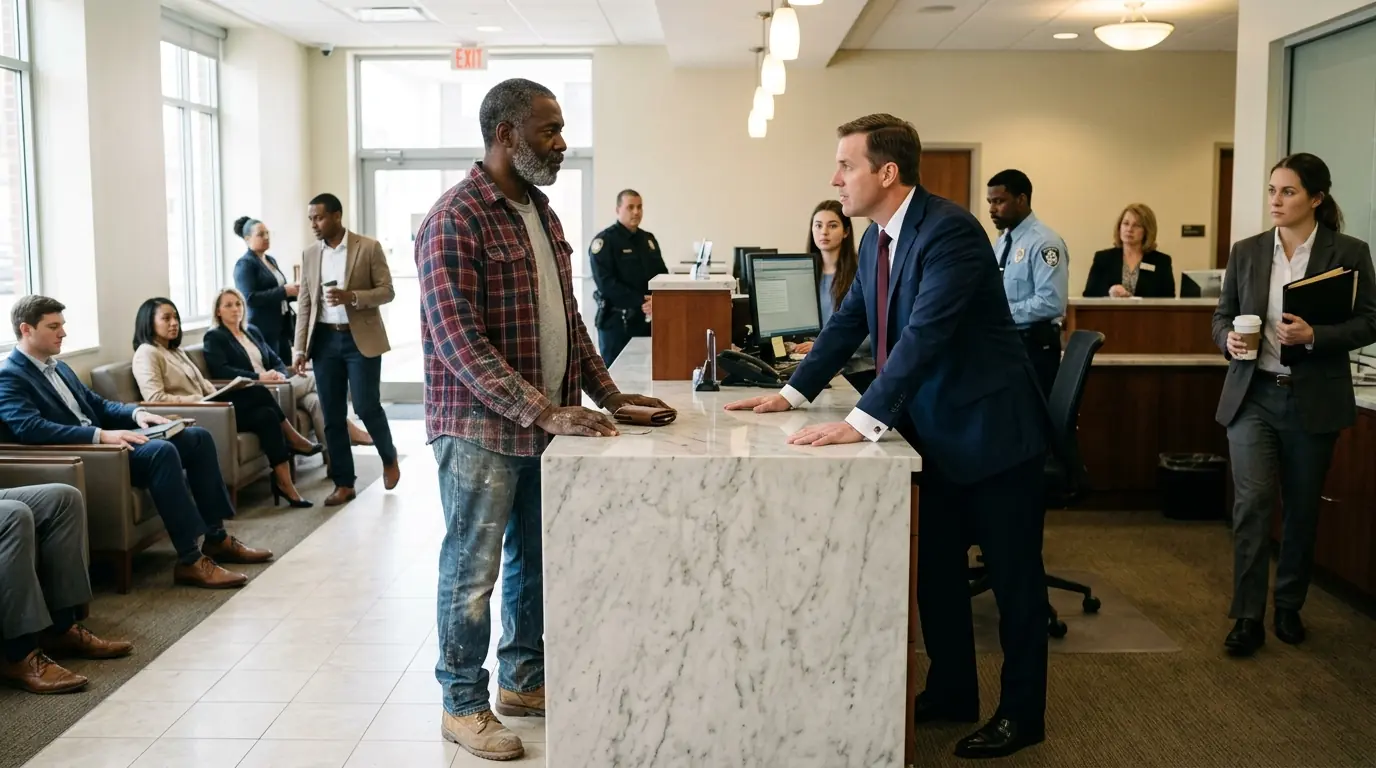
“I have an account here.”
“An account?” The manager turned toward the lobby, spreading his arms wide. “Can you believe it? A stray dog wandered in here and thinks he can do business.”
“Please, I just—”
“Don’t beg. Get out. Crawl back to whatever hole you came out of. Don’t touch anything. I’m going to have to disinfect this place.”
He turned toward the door.
Alone.
No one in the lobby knew who he was.
But by Friday, nine hundred million dollars would be gone from that bank.
And everyone would remember him.
Let me take you back to that Monday morning, before the insults, before the lobby, before everything fell apart.
At 5:45 a.m. in Richmond, Virginia, the sun had not cracked the horizon yet. A thin layer of fog hung low over a half-built house on the east side of Church Hill.
Malcolm Foster was already awake.
He sat on the edge of a sleeping bag spread across a plywood subfloor.
No mattress.
No pillow.
Just a rolled-up hoodie under his neck and a thermos of cold coffee beside him.
Sawdust stuck to his forearms. Dried paint lined the creases of his knuckles. His boots, the same cracked, dust-covered pair, sat by the door frame.
There was no door yet, just a frame.
Malcolm had been here for twelve days straight, sleeping on site, waking before dawn, hauling lumber, mixing concrete, and framing walls side by side with a small crew of Habitat for Humanity volunteers.
He did not have to be here.
Nobody had asked him to stay overnight.
Nobody expected him to show up at all.
But this house was being built on Elm Street, the same block where his grandmother, Lorraine, had raised him in a two-bedroom shotgun house with a leaking roof and a garden out back.
That house was gone now.
Lorraine was gone, too.
But Malcolm never forgot what she told him the day he left for college.
“Don’t ever get so big that you forget where your feet started.”
His phone buzzed on the plywood. The screen lit up.
Terrence Brooks.
Four missed calls.
Malcolm glanced at it, silenced it, and slid it into his back pocket without reading a single message.
He poured the last of the cold coffee into a tin cup and took a long sip. Then he pulled on his flannel, laced up those old boots, and grabbed his grandmother’s leather wallet from the windowsill.
Inside that wallet, tucked behind a faded photograph of Lorraine, sat a American Express Centurion card.
The kind of card most bank managers only see once or twice in their careers.
Malcolm needed to visit Heritage National that morning. A wire transfer for the Lorraine Foster Memorial Foundation.
Simple.
Fifteen minutes.
He climbed into his truck, a dented 2004 Ford F-150 with a small wooden cross hanging from the rearview mirror.
Lorraine’s truck.
The engine coughed twice before turning over.
He did not check the mirror. He did not fix his hair. He did not think twice about the concrete on his jeans or the sweat stains on his collar.
He was just a man heading to his bank.
Now, let me tell you about that bank.
Heritage National sat in the heart of Richmond’s West End, a gleaming suburban branch with floor-to-ceiling glass, polished marble floors, and fresh orchids on the reception counter.
The air smelled like vanilla and new leather.
The clientele matched.
Designer handbags.
Bluetooth earpieces.
Tailored business casual.
The kind of people who called their financial advisor by first name and never once worried about a minimum balance.
And then there was Gregory Dawson, branch manager, six years running, mid-forties, white, always the sharpest suit in the room, always the loudest laugh.
He stood near the entrance most mornings, adjusting his cufflinks, checking his reflection in the glass partition, and greeting regulars with a wide practiced smile.
“Morning, Dr. Harrison. Looking sharp as always.”
“Mrs. Caldwell, how’s the grandkid? Tell her Uncle Greg says hi.”
Warm.
Polished.
Rehearsed.
But only for certain people.
Dawson had a habit.
A habit nobody in corporate had bothered to question.
If a customer did not look like he belonged, if he was too casual, too rough, too far outside the image Dawson preferred, that warm smile disappeared fast.
Now picture this.
The glass doors slid open.
In walked Malcolm Foster.
Dusty boots on marble.
Paint-cracked hands.
A flannel that had not seen a washing machine in four days.
A man who looked like he had slept on a construction site.
Because he had.
Every head in the lobby turned.
The marble echoed under his boots. The smell of sawdust and sweat followed him like a shadow.
A woman near the entrance pulled her handbag to her chest.
A man in a polo looked him up and down, then looked away.
The receptionist’s smile froze mid-greeting.
“Good morning, sir. How can I help you?”
Malcolm smiled.
“I need to arrange a wire transfer, please.”
Nadine nodded.
“Let me get the branch manager for you.”
She did not know what she had just set in motion.
Gregory Dawson saw him before Nadine even finished waving him over.
He was mid-conversation with a client, a white woman in a cashmere cardigan, when his eyes drifted past her shoulder and landed on Malcolm.
His smile dropped.
His jaw tightened.
He excused himself from the woman without finishing his sentence.
He walked toward the counter slowly, deliberately, like a man approaching something unpleasant he had to deal with.
He stopped three feet away from Malcolm.
Not close enough to shake hands.
Just close enough to look him over.
His nostrils flared. His upper lip pulled back slightly, a reflex, like he had caught the scent of something rotting.
His eyes started at the boots, moved up to the concrete-dusted jeans, the stained flannel, the calloused hands resting on the counter, then the face.
A man in his mid-fifties with a graying beard and tired but steady eyes.
Dawson did not say good morning.
He did not introduce himself.
He did not offer a handshake.
He just tilted his chin and said, “What do you need?”
Malcolm kept his voice even.
“I’d like to arrange a wire transfer. I have accounts here.”
Dawson’s eyebrow lifted. One side of his mouth curled, not a smile, something closer to amusement.
The kind of look you give a child who says something ridiculous.
“You have accounts here? At this branch?”
“Yes, sir. Under Malcolm Foster.”
“Malcolm Foster.”
Dawson repeated the name slowly, like he was tasting something sour.
He did not move toward a computer.
He did not check the system.
Instead, he held out his hand.
“ID.”
Malcolm pulled his driver’s license from the leather wallet and placed it on the counter.
Dawson picked it up between two fingers, like he did not want to touch anything Malcolm had touched.
He turned it over, held it up to the light, squinted at the photo, looked back at Malcolm, then at the photo again.
Then he tilted it sideways, checking for a hologram the way someone would inspect a counterfeit bill.
“This doesn’t look current,” Dawson said.
“It’s valid through next year,” Malcolm replied.
Dawson made a sound like he did not believe a word of it.
He set the license down on the counter.
Not handed back.
Set down.
Then he slid it toward Malcolm with one finger.
“Have a seat over there. I’ll get to you when I can.”
He pointed at a row of chairs near the back wall.
Not the comfortable leather seats near the coffee station where preferred clients waited.
The hard plastic chairs by the restroom hallway.
The ones nobody ever sat in.
The ones that might as well have had a sign that said, You don’t belong here.
Malcolm picked up his license, walked to the back, sat down, and waited.
Ten minutes passed.
Then fifteen.
Then twenty.
During that time, Dawson helped three other customers.
All of them had arrived after Malcolm.
All of them were white.
Every single one was greeted with a handshake, a first name, and a warm, “What can we do for you today?”
A man in a navy blazer walked in. Dawson practically jogged to meet him.
“Mr. Whitfield, great to see you. Come on in. Let’s take care of you right away.”
The man had been in the building for less than thirty seconds.
Malcolm watched from the plastic chair.
He did not complain.
He did not wave anyone down.
He did not raise his voice.
He just sat, hands folded, eyes forward, quiet.
Nadine glanced at him twice from behind the counter.
The second time, she caught his eye.
She mouthed the words, “I’m sorry.”
Malcolm gave her a small nod.
At the twenty-two-minute mark, Malcolm stood up.
He walked back to the counter.
His voice was the same as before.
Calm.
Steady.
Respectful.
“Excuse me. I’ve been waiting quite a while. Could someone help me with that wire transfer?”
Dawson turned around from his desk.
His face was already set.
Not surprised.
Not apologetic.
Annoyed.
Like a man being bothered by a fly that refused to die.
He walked to the counter, leaned on it with both palms, and looked Malcolm dead in the eyes.
Then, loud enough for the entire lobby to hear, he said, “Sir, I’m going to be real with you. Multiple customers have come up to me in the last twenty minutes about a smell.”
The lobby went quiet.
Every conversation stopped.
“I don’t know where you slept last night. I don’t know what ditch you crawled out of this morning, but you reek. You smell like wet garbage and body odor, and it is affecting every single person in this building.”
Malcolm’s expression did not change.
“I’ve been doing volunteer construction work. I apologize for my appearance. But I just need fifteen minutes to—”
“Fifteen minutes?”
Dawson slammed his palm on the counter. The sound cracked through the lobby.
“I gave you twenty-two minutes already. Twenty-two minutes of my customers breathing through their mouths because of you. And now you want fifteen more?”
He shook his head like he was talking to someone too foolish to understand.
“No. Here’s what’s going to happen. You are going to turn around. You are going to walk out that door, and you are never going to set foot in this bank again.”
His voice sharpened.
“Because people like you, dirty, smelling like the bottom of a trash can, acting like you belong wherever you walk in, do not belong here. You never did.”
“I have a right to access my accounts.”
“You have nothing.”
Dawson’s voice was ice.
“You are nothing. Now get out of my bank before I call the police and have you removed in handcuffs. Your choice.”
Dawson snapped his fingers at the security guard.
“Devon. Now.”
Devon, early twenties, broad shoulders and uncomfortable eyes, walked toward Malcolm like a man approaching something he did not want to touch.
“Sir, I’m really sorry,” Devon whispered. “He’s telling me to—”
“I understand,” Malcolm said quietly. “It’s not your fault, son.”
Malcolm turned toward the door.
The lobby was frozen.
Fifteen people, maybe more, and not one of them moved.
A woman in a silk blouse stared at her phone, but her eyes were not reading.
She was hiding.
A man in the waiting area crossed his arms and shook his head.
Not at Dawson.
At Malcolm.
Like he agreed with every word.
An older couple near the entrance stepped apart to let Malcolm pass, as if standing too close might contaminate them.
Malcolm’s boots echoed on the marble.
Each step loud.
Each step slow.
The whole lobby could hear him leaving.
And then Dawson fired one last shot.
“Hey!”
Malcolm stopped.
He did not turn around.
“Next time you want a hot meal and a shower, try the homeless shelter on Broad Street. Tell them Greg sent you. Maybe they can hose you down in the parking lot first.”
He grinned.
A man in the waiting area snorted.
A woman in designer sunglasses covered her mouth, but her shoulders were shaking.
A teenager next to his father actually giggled out loud.
The father did not stop him.
Nadine Ellis gripped the edge of the counter with both hands. Her knuckles were white. Her eyes burned.
She opened her mouth, but nothing came out.
Nobody defended him.
Nobody said a word.
Malcolm pushed through the glass doors and stepped into the parking lot.
The morning sun hit him full in the face.
Warm.
Bright.
Completely indifferent to what had just happened inside.
He walked to his grandmother’s truck, the dented 2004 Ford with peeling paint and the wooden cross on the mirror.
He opened the door.
Sat down.
Pulled it shut.
He did not start the engine.
For a long moment, he just sat there, both hands gripping the steering wheel, knuckles tight, eyes locked on the bank.
At the gleaming glass.
The polished brass letters spelling Heritage National.
The well-dressed people moving behind the windows like shadows in an aquarium.
His jaw was clenched.
Not from anger.
From something deeper.
Something older.
The kind of hurt that does not scream.
It just sits in your chest like a stone and presses down until you can barely breathe.
He looked up at the rearview mirror, at the small wooden cross Lorraine had hung there twenty years ago.
The wood was faded now. The string was fraying.
But it was still there.
Just like him.
He picked up his phone.
Dialed.
Terrence answered on the second ring.
Malcolm’s voice was steady.
No shaking.
No hesitation.
“Terrence, pull everything from Heritage National. All of it. Every account. Every fund. Every dollar. I want it done by Friday.”
A pause.
Then Terrence’s voice came through.
Careful.
Measured.
“Malcolm. That’s all nine hundred million. You’re sure?”
Malcolm stared at the bank’s glass doors, the same doors he had just been pushed through like a stray animal off the street.
“Every cent.”
He hung up.
Set the phone down.
Looked at the cross one more time.
Then he started the engine, pulled out of the lot, and drove east.
Back to Elm Street, where a half-built house was waiting for him to finish what he had started.
The glass doors closed behind Malcolm, and the lobby exhaled.
Customers went back to their phones.
Tellers went back to their screens.
The air conditioning hummed like nothing had happened.
Gregory Dawson straightened his tie, smoothed his jacket, and turned back toward his office with the satisfied look of a man who had just taken out the trash.
But not everyone moved on.
Nadine Ellis stood behind her counter, both hands flat on the surface, staring at the door Malcolm had just walked through.
Her chest was tight.
Her throat burned.
She could still hear it.
The echo of his boots on the marble.
The laughter from the waiting area.
Dawson’s voice cutting through the lobby like a blade.
She kept replaying the moment in her head.
The way Malcolm had looked at her before he turned to leave.
Not angry.
Not broken.
Just knowing.
Like he had been through this before.
Like he expected it.
That look gutted her more than anything Dawson had said.
She waited until the last customer at her window walked away.
Then she stepped out from behind the counter and walked straight to Dawson’s office.
She did not knock.
“Mr. Dawson?”
He looked up from his computer, annoyed.
“What?”
“That man had an account here. He told you his name. He gave you his ID. You didn’t even bother to check the system.”
Dawson leaned back in his chair.
His expression shifted from annoyance to amusement, like a parent humoring a child throwing a tantrum.
“Nadine, sweetheart, let me explain something to you.”
“Don’t call me sweetheart.”
“That man was a vagrant. Someone who wandered in off the street smelling like a landfill. I did what any responsible manager would do. I protected the customer experience.”
“He was a customer. He said he had accounts.”
“He was a problem.”
Dawson’s voice hardened.
His smile disappeared.
“And I handled it. That’s my job. That’s what I get paid to do. Now, if you want to keep yours, I suggest you walk back to your window and stop losing sleep over people who don’t belong in this building.”
Nadine did not move.
Her hands were shaking at her sides.
“Is that a threat?”
Dawson smiled.
Thin.
Cold.
Practiced.
“It’s advice. Free advice. Take it or leave it. But if I hear one more word about this from you, from anyone on this floor, I’ll write you up for insubordination. And I promise you, Nadine, I will make it stick. We clear?”
He turned back to his screen.
Conversation over.
Nadine stood there for three more seconds.
Her jaw was clenched so tight her teeth ached.
Then she walked out of his office, sat down at her counter, and pulled her phone out under the desk.
She opened her email and started typing.
She typed the date.
She typed Dawson’s name.
She typed what she had seen.
Every word.
Every gesture.
Every laugh.
She described Malcolm’s face.
She described how he walked out.
She described the silence that no one in the lobby had the courage to break.
She did not know yet exactly who she was going to send it to.
But she was going to send it to someone.
Because what she had just witnessed could not stand.
Now, let’s talk about Malcolm.
Or rather, let’s talk about who Malcolm Foster actually was.
Because the man Gregory Dawson had just called a vagrant, a nobody, a stray dog, had a story Dawson could not have imagined in his worst nightmare.
Malcolm James Foster, born in 1968, Church Hill, Richmond, Virginia.
Raised by his grandmother, Lorraine, in a shotgun house with no air conditioning and a roof that leaked every April.
His mother left when he was three. His father was never in the picture.
Lorraine worked two jobs, a morning shift at a laundromat and an evening shift cleaning offices downtown, to keep food on the table and shoes on Malcolm’s feet.
Malcolm was a quiet kid.
He read everything he could get his hands on.
He won a full scholarship to Howard University at seventeen, graduated top of his class, and earned his MBA at Wharton two years later, one of only four students in his cohort.
He did not go to Wall Street.
He came home.
He started buying run-down properties in Church Hill, the same neighborhood where he grew up.
He fixed them up and rented them out at fair prices to families who looked like his.
One building became three.
Three became twelve.
Twelve became a portfolio worth forty million dollars by the time he turned thirty-five.
Then he pivoted.
He founded Foster Capital Group, a private equity firm specializing in energy infrastructure, commercial real estate, and emerging tech.
Within a decade, the firm’s assets under management crossed the billion-dollar mark.
Within fifteen years, Malcolm’s personal net worth was estimated at 2.1 billion dollars.
But here was the thing about Malcolm Foster.
He never changed.
He still drove Lorraine’s truck. He still wore the same work boots. He still volunteered on build sites every chance he got.
He still carried that worn leather wallet with her photograph tucked inside.
He had no interest in yachts, penthouse suites, magazine profiles, or red-carpet appearances.
His name had appeared in Forbes exactly once.
He asked them not to print it again.
He kept his wealth quiet because Lorraine taught him that money was a tool, not a trophy.
“You don’t wave a hammer around to impress people,” she used to say. “You pick it up when there’s something that needs building.”
Most billionaires lived behind iron gates and press teams.
Malcolm lived behind sawdust and silence.
And that was exactly why Gregory Dawson had looked at him and seen nothing.
Because Malcolm had spent his entire life making sure people like Dawson never saw him coming.
And right now, Terrence Brooks, Malcolm’s attorney, financial advisor, and closest friend for the past fifteen years, was about to make sure they never forgot him, either.
Terrence sat in his downtown Richmond office on Tuesday morning, staring at a screen full of account numbers.
Nine hundred million dollars spread across twelve separate accounts at Heritage National Bank.
Operating funds for Foster Capital Group.
Reserve accounts.
Trust allocations.
The Lorraine Foster Memorial Foundation’s entire endowment.
Every single one flagged for full withdrawal.
Terrence had made the calls Monday night.
By Tuesday morning, the first wire transfers were already processing.
Millions moving in clean, silent batches, routed through compliance, verified, approved, and sent.
By Wednesday afternoon, four hundred million had landed safely at Cornerstone Trust Bank, where Calvin Moore personally oversaw every incoming deposit.
By Thursday evening, the total had climbed to six hundred eighty million, with the remaining two hundred twenty million queued for Friday morning.
The money was leaving Heritage National like blood from an open wound.
Quietly.
Steadily.
Completely unstoppable.
Meanwhile, Gregory Dawson had absolutely no idea.
Tuesday, he bragged to a colleague over coffee about hitting his quarterly target two weeks early.
Wednesday, he took a long lunch at a steakhouse downtown, split a bottle of expensive wine, and told the waiter to put it on his corporate card.
Thursday, he stayed late at the office, not because he had work to finish, but because he wanted to be seen working hard when the regional vice president visited next month.
He checked his reflection in the glass partition four times that day, adjusted his cufflinks twice, and practiced his handshake in the men’s room mirror once.
He even rehearsed a joke for Patricia Coleman’s upcoming visit, something about customer loyalty being in the Heritage National DNA.
He thought he was untouchable.
He thought his numbers were rock solid.
He thought his branch was the pride of the Mid-Atlantic division.
He had no idea that the single largest client in his branch’s history had been silently pulling out every dollar since Monday night.
He never opened Malcolm Foster’s account file.
He never checked the back-end transaction logs.
He never noticed that the account responsible for nearly forty percent of his branch’s total managed assets was bleeding out in real time.
Dollar by dollar.
Wire by wire.
Hour by hour.
But someone noticed.
Heritage National’s internal compliance system flagged the outflows late Thursday night.
An automated alert triggered by cumulative withdrawals exceeding five hundred million dollars within a seventy-two-hour window landed in the regional office inbox at 11:14 p.m.
Patricia Coleman, regional vice president of Heritage National’s Mid-Atlantic division, opened the alert at 6:15 Friday morning.
She read it once.
Then again.
Then a third time, slower.
Making absolutely sure she was not misreading the numbers on her screen.
Nine hundred million dollars.
One single client.
One single branch.
All of it gone.
Or about to be.
She picked up her phone and called the West End branch.
No answer.
It was before business hours.
She did not bother leaving a voicemail.
She set the phone down, grabbed her coat, her laptop, and her keys, and got in the car.
She did not call ahead.
She did not schedule a meeting.
She did not send a courtesy email.
Patricia Coleman was going to walk through that branch door, sit Gregory Dawson down in his own office, and find out exactly what he had done to lose nine hundred million dollars in four days.
And Gregory Dawson, still asleep in his bed at that very moment, alarm set for 7:30, suit already pressed and hanging on the closet door, had no idea what was driving toward him.
Friday morning.
8:41 a.m.
Gregory Dawson pulled into the Heritage National parking lot right on schedule.
He checked his teeth in the rearview mirror.
Straightened his tie.
Grabbed his coffee and briefcase.
He walked through the front doors with the same stride he had worn every morning for six years.
He smiled at the receptionist.
Nodded at Devon.
He did not notice the Audi in the visitor spot.
He did not notice how quiet the branch was.
He did not notice Nadine Ellis refusing to look at him.
He walked into his office, set down his briefcase, and took his first sip of coffee.
That was the last normal moment of Gregory Dawson’s career.
The door opened behind him.
No knock.
Patricia Coleman stepped in.
Her face was pale.
Her jaw was locked.
Her laptop was tucked under her arm.
She closed the door with a soft click that somehow sounded louder than a slam.
Dawson turned.
His smile activated on instinct.
“Patricia, I wasn’t expecting you until—”
“Sit down, Gregory.”
The smile flickered.
“Is everything—”
“Sit down.”
He sat.
Patricia remained standing.
She placed her laptop on his desk, opened it, and turned the screen toward him.
But she did not press play.
She just looked at him.
Hard.
Measured.
The way a surgeon studies a scan before delivering bad news.
“Do you know who Malcolm Foster is?”
Dawson blinked.
The name landed nowhere.
He shook his head.
“No. Should I?”
Patricia’s voice was flat.
Controlled.
The kind of calm that comes right before an explosion.
“Malcolm Foster is the sole owner of Foster Capital Group. His net worth is estimated at 2.1 billion dollars. His accounts at this branch, your branch, held nine hundred million in managed assets. Roughly forty percent of everything this location manages.”
She paused.
Let the numbers land.
“As of 8:00 this morning, every single dollar has been transferred out. Nine hundred million. Gone. Moved to Cornerstone Trust.”
The color left Dawson’s face like a tide pulling out.
His lips parted.
No sound came.
His coffee sat untouched, steam curling between them.
“That can’t—”
He swallowed.
“I would have known if we had a client that size.”
“You did know. He was here Monday morning. He stood at that counter and asked for a wire transfer for his grandmother’s memorial foundation.”
Dawson’s mouth opened.
Closed.
Opened again.
Nothing.
Patricia pressed play.
The security footage was sharp.
Every detail visible.
Every sound clear.
There was Dawson, face twisted in disgust, stopping mid-stride.
There was Malcolm, calm and patient, hands resting on the counter.
There was Dawson’s voice cutting across the lobby.
“You smell like a garbage can. Get out.”
There was the finger snap at Devon.
The laughter from the waiting area.
There was Dawson leaning in close, jabbing his finger toward the door.
And then the final moment.
Dawson grinning wide, arms spread open, announcing to the whole lobby that a stray dog had wandered into his bank.
Then telling a billionaire to get hosed down at a homeless shelter.
Then Malcolm walking out alone, back straight, head high.
Not one person in the lobby standing up for him.
Patricia hit pause.
The frozen frame showed Dawson with his arms crossed, chin up, looking pleased with himself.
She closed the laptop.
“That man you called a stray dog builds houses for families who can’t afford them. He sleeps on site with the crew. That’s why his clothes were dirty. That’s why he smelled like concrete. He wasn’t homeless, Gregory. He was building homes for people who need them.”
Dawson’s hands were shaking.
Sweat lined his forehead.
“I didn’t know. I swear I didn’t know who he was. He looked—He was wearing—”
“He was wearing work clothes. And you decided that meant he was worthless.”
Silence.
“I can fix this.”
His voice was small.
Desperate.
“Let me call him. I’ll apologize personally. I’ll drive to his house.”
“He doesn’t want your apology.”
“Then what does he want?”
Patricia looked at him the way you look at someone who still does not understand what he has done.
“Accountability.”
Dawson’s phone buzzed.
He looked down.
A news alert.
The headline read:
Richmond Bank Manager Ejects Billionaire Volunteer Over Bad Smell. Nine Hundred Million Withdrawn.
His stomach dropped.
The room tilted.
His mouth went dry.
He could feel his pulse hammering in his ears.
The headline was already out there.
On every phone, every screen, every newsfeed in the city.
“How—Who told the—”
“It doesn’t matter who told.”
Patricia straightened.
“As of right now, you are on immediate administrative suspension. You will hand over your keys, your badge, and your access card. You will not speak to staff. You will not contact the client. You will not make any public statement. HR and legal will reach you by the end of the day.”
She buttoned her coat.
“And Gregory, start thinking about what you’re going to tell your family, because by the time the evening news runs this, everyone in Richmond is going to know your name, and not for the reasons you wanted.”
She walked out.
The door clicked shut.
Dawson sat alone in his office.
The Branch Manager of the Quarter plaque stared at him from the wall.
His coffee had gone cold.
His phone kept buzzing.
Notification after notification.
He did not move.
He did not speak.
He just stared at the blank screen, his own reflection looking back at him.
For the first time in six years, Gregory Dawson had nothing to say.
At 9:32 a.m., Gregory Dawson walked out of Heritage National for the last time.
He carried a cardboard box.
Inside were a framed photo of his wife and kids, a desk calendar he never used, a coffee mug with the bank’s logo, and sitting right on top, the Branch Manager of the Quarter plaque.
And the man holding the door open for him was Devon, the same security guard Dawson had snapped his fingers at on Monday.
The same one he had ordered to remove Malcolm Foster from the building.
Now Devon stood by the glass door, holding it wide, watching his former boss walk out into the parking lot with a box in his arms and nothing left to say.
Devon did not speak.
He did not need to.
The symmetry said everything.
Behind the counter, Nadine Ellis watched through the window.
Her hands were folded on the desk.
Her face was still.
But inside, something had loosened.
A knot she had been carrying since Monday morning.
She exhaled slowly and turned back to her screen.
The rest of the staff stood frozen at their stations.
Nobody whispered.
Nobody joked.
The lobby felt like a funeral home.
Quiet.
Heavy.
Full of people pretending they did not know what had just happened.
Dawson loaded the box into his trunk, got in his car, and sat there for a moment with both hands on the wheel, the same way Malcolm had sat in his grandmother’s truck four days earlier.
But where Malcolm had been steady, Dawson was shaking.
His phone rang.
His wife.
“Greg, what is going on? There’s a story online. Your name, the bank, a video? Greg, what did you do?”
He could not answer.
He opened his mouth, but nothing came out.
She asked again.
And again.
He ended the call without saying a word.
By the time he pulled out of the parking lot, the story had already jumped from local news to regional feeds.
By noon, it was trending on social media.
The security footage, leaked in full, had been viewed over two hundred thousand times.
The comments were merciless.
Gregory Dawson’s name was no longer associated with Heritage National’s quarterly numbers.
It was associated with one sentence.
A stray dog wandered into my bank.
And the bank itself was drowning.
Heritage National’s corporate communications team scrambled to draft a statement.
It took four people, three revisions, and two hours to produce exactly two sentences.
Heritage National takes all allegations of discriminatory conduct seriously. We are conducting a thorough internal review and will take appropriate action.
It landed like a wet napkin on a forest fire.
By Friday afternoon, the phones at the West End branch were ringing nonstop.
But the callers were not asking about rates or loans.
They were asking about their accounts.
Specifically, they were asking how to close them.
Three high-value clients of color pulled their funds before the end of business.
One of them, a retired surgeon who had banked at Heritage National for nineteen years, told the new acting manager on his way out, “If that’s how you treat a man who builds homes for people in need, I don’t want to know how you’d treat me on a bad day.”
The bleeding had started.
And Heritage National had no tourniquet.
Meanwhile, Malcolm Foster said nothing.
He did not hold a press conference.
He did not post a statement.
He did not go on television.
He let Terrence handle every media inquiry with one line.
The same line, repeated word for word every time.
“Mr. Foster’s financial decisions are his own. He expects to be treated with the same dignity extended to any customer.”
That was it.
No anger.
No gloating.
No victory lap.
Because Malcolm was not at a microphone.
He was on Elm Street, back on the build site, back in his dusty flannel with a hammer in his hand, framing a wall that would become someone’s living room.
Around midday, one of the other volunteers, a young guy named Curtis, jogged over with his phone.
“Yo, Mr. Foster, you seen this? You’re all over the news, man.”
Malcolm looked at the screen, read the headline, and saw the view count climbing in real time.
He nodded once.
Just once.
“Good,” he said quietly.
Then he handed the phone back, picked up a nail, and went back to work.
Because Malcolm Foster had never been the kind of man who needed the world to watch him do the right thing.
He just did it.
And today, the whole world happened to be watching.
The story did not die over the weekend.
It grew.
By Saturday morning, the security footage had been viewed over four million times. By Sunday night, it had crossed ten million.
Comment sections exploded.
Op-eds were written.
Cable news panels debated it.
The phrase “stray dog banker” was trending in three states.
Then Janet Simmons got involved.
Janet was an investigative journalist based in Washington, D.C.
Sharp.
Relentless.
Known for one thing.
She did not write stories about moments.
She wrote stories about patterns.
And this moment smelled like a pattern.
She drove to Richmond on Monday morning, spent three days pulling records, interviewing former customers, filing public records requests, and making phone calls that nobody at Heritage National wanted to answer.
She sat across kitchen tables from people who had been humiliated in that same lobby and told to go somewhere else.
She listened to every story.
She recorded every name.
What she found was worse than expected.
Fourteen formal complaints had been filed against the West End branch in the past three years.
Every single one came from a or Latino customer.
Every single one described the same behavior.
Denied services.
Excessive ID verification.
Being asked to leave without explanation.
Being redirected to other branches for no stated reason.
And every single one had been buried.
Marked as resolved in the system without investigation.
Filed away in a folder that nobody in corporate had opened.
Fourteen people had raised their hands and said something was wrong here.
Fourteen times, Heritage National had looked the other way.
Janet published her exposé on a Thursday.
The headline read:
Smelled Like Discrimination: Inside Heritage National’s Pattern of Racial Profiling
The article ran over six thousand words.
It named Dawson.
It named the branch.
It named the compliance officers who had signed off on those closed complaints without reading them.
It was the most-read article on the site for three days straight.
The legal reckoning came fast.
Virginia’s state attorney general announced a formal investigation into Heritage National within forty-eight hours of the article’s publication.
The charges being explored included violations of the Equal Credit Opportunity Act and Section 1981 of the Civil Rights Act of 1866, the federal statute that guarantees all citizens the right to make and enforce contracts regardless of race.
Gregory Dawson’s suspension was upgraded to immediate termination.
No severance.
No reference.
No exit interview.
Just a certified letter delivered to his home informing him that his employment had been terminated for cause effective immediately.
Heritage National was forced into a consent decree, a legally binding agreement with the state that required three things.
First, mandatory bias and anti-discrimination training for every employee at every branch, conducted by an independent third-party firm.
Second, the creation of an independent oversight committee to review all customer complaints involving race, ethnicity, or appearance, with the authority to escalate directly to regulators.
Third, the establishment of a twelve-million-dollar settlement fund to compensate affected customers.
Three former customers, two men and one Latina woman, all of whom had been turned away from the West End branch during Dawson’s tenure, filed individual civil lawsuits.
Their cases were strong.
Dawson’s documented behavior, the bank’s failure to investigate prior complaints, and the security footage gave their attorneys everything they needed.
Heritage National’s stock price dipped four percent in a single week.
Two board members resigned quietly.
The CEO issued a public apology, widely criticized as too little and far too late.
And Gregory Dawson, the man who had once stood at the front door of that bank greeting wealthy clients by first name, watched his entire world collapse from his living room couch.
He gave one interview.
A local news crew caught him outside his house on a Tuesday afternoon.
He was combative at first, arms crossed, jaw tight.
“I was following standard protocol,” he said. “I made a judgment call based on the information I had. Any manager would have done the same.”
The reporter asked if he had watched the security footage.
Dawson hesitated.
“I’ve seen it.”
“And do you still believe what you did was appropriate?”
He did not answer.
He turned and walked inside.
The door closed behind him.
But the footage answered for him.
The clip of him grinning at the lobby, arms spread, chin up, calling a billionaire philanthropist a stray dog, had become the defining image of the scandal.
It was screenshotted, shared, discussed, and replayed on every major news network in the country.
No bank would touch him.
No financial institution returned his calls.
His LinkedIn profile went dark.
His name had become a punchline and a cautionary tale all at once.
Three weeks after the incident, Dawson drove back to the West End branch.
He parked across the street.
He did not get out.
He just sat in his car with the engine off and watched through the window.
The lobby looked the same.
The marble floors.
The brass letters.
The orchids on the counter.
But the person standing at the front door was different.
A woman in a navy blazer.
Smiling.
Shaking hands.
Greeting every customer who walked in.
Every single one with the same warmth.
The new branch manager.
Dawson watched her for a long time.
Then he started the engine and drove away.
He did not come back.
While Dawson’s world was falling apart, Malcolm Foster was building something new.
He did not use the moment for fame.
He used it for impact.
Within two weeks of the incident, Malcolm formally established the Lorraine Foster Foundation, a nonprofit with a fifty-million-dollar endowment funded entirely from his personal wealth.
The foundation’s mission was clear.
Financial literacy programs for underserved communities.
Home ownership grants for first-time buyers.
Full-ride scholarships for students in the Richmond public school system.
Cornerstone Trust Bank, now managing Malcolm’s nine hundred million, partnered with the foundation to launch a zero-fee banking program for low-income residents.
No minimum balance.
No hidden charges.
No judgment at the door.
Calvin Moore, Cornerstone’s president, told the press, “Malcolm Foster didn’t come to us because we’re a better bank. He came because we treated him like a human being. That should be the bare minimum. We’re going to make sure it is.”
The foundation’s first community center was built on Elm Street, the same block where Lorraine Foster had raised Malcolm in a two-bedroom house with a leaking roof.
At the ribbon-cutting ceremony, Malcolm stood in front of a small crowd.
He wore the same flannel.
The same boots.
The same leather wallet in his back pocket.
He did not give a long speech.
He just said, “This one’s for you, Grandma.”
Then he cut the ribbon, shook a few hands, and walked back to the build site across the street, where another house was waiting.
Three weeks later, on a Tuesday morning, Malcolm Foster walked into Cornerstone Trust Bank.
Same old boots.
Same flannel.
Same concrete dust on his jeans.
Same leather wallet in his back pocket with Lorraine’s photograph inside.
The receptionist at the front desk looked up and smiled.
Not a polite, forced, corporate smile.
A real one.
“Good morning, Mr. Foster. Coffee?”
Malcolm grinned.
“, two sugars, like always.”
He sat down in the lobby and leaned back.
The air smelled like fresh paper and wood polish.
Soft music played overhead.
The place felt calm, like a bank that did not need to prove anything to anyone.
A few minutes later, the front door opened.
A young woman walked in holding the hand of a small boy, maybe nine or ten. He wore a backpack too big for him and sneakers with untied laces.
He was .
Small.
Nervous.
His mother walked him to the teller window.
“We’d like to open a savings account, please. For him.”
The teller smiled.
“Absolutely. What’s your name, young man?”
The boy looked up at his mother.
She nodded.
He turned back to the teller.
“Elijah,” he said quietly.
“Nice to meet you, Elijah. Let’s get you started.”
The mother filled out the paperwork.
When she got to the deposit amount, she wrote twenty-five dollars.
The teller processed it with the same warmth and respect she would have given a deposit of twenty-five million.
Because in this bank, there was no difference.
Malcolm watched from across the lobby.
The boy caught his eye, curious and uncertain, the way kids look at someone they cannot quite figure out.
Malcolm winked.
The boy smiled back.
Small.
Shy.
Completely real.
Then he turned back to the counter and watched the teller print his very first bank statement.
He held it with both hands, like it was something precious.
Malcolm finished his coffee, set the cup down, stood up, and walked toward the door.
Outside, the Richmond sun was warm on his face.
His grandmother’s truck sat at the curb.
Across the street, the Lorraine Foster Foundation banner hung bright against the brick of the new community center.
Malcolm looked at the banner for a long moment.
Then he climbed into the truck, started the old engine, and drove east toward Elm Street.
There was always another house to build.