The certified check made almost no sound when Vanessa Cole tore it in half.
That was what Marcus Holloway remembered most clearly afterward. Not the gasp from the private-banking clerk, the scrape of chairs across the marble floor, or the silence that spread through the flagship branch on Park Avenue. He remembered the soft rip of security paper separating between the bank manager’s manicured fingers as if one hundred million dollars—and the man carrying it—were both too ridiculous to deserve serious consideration.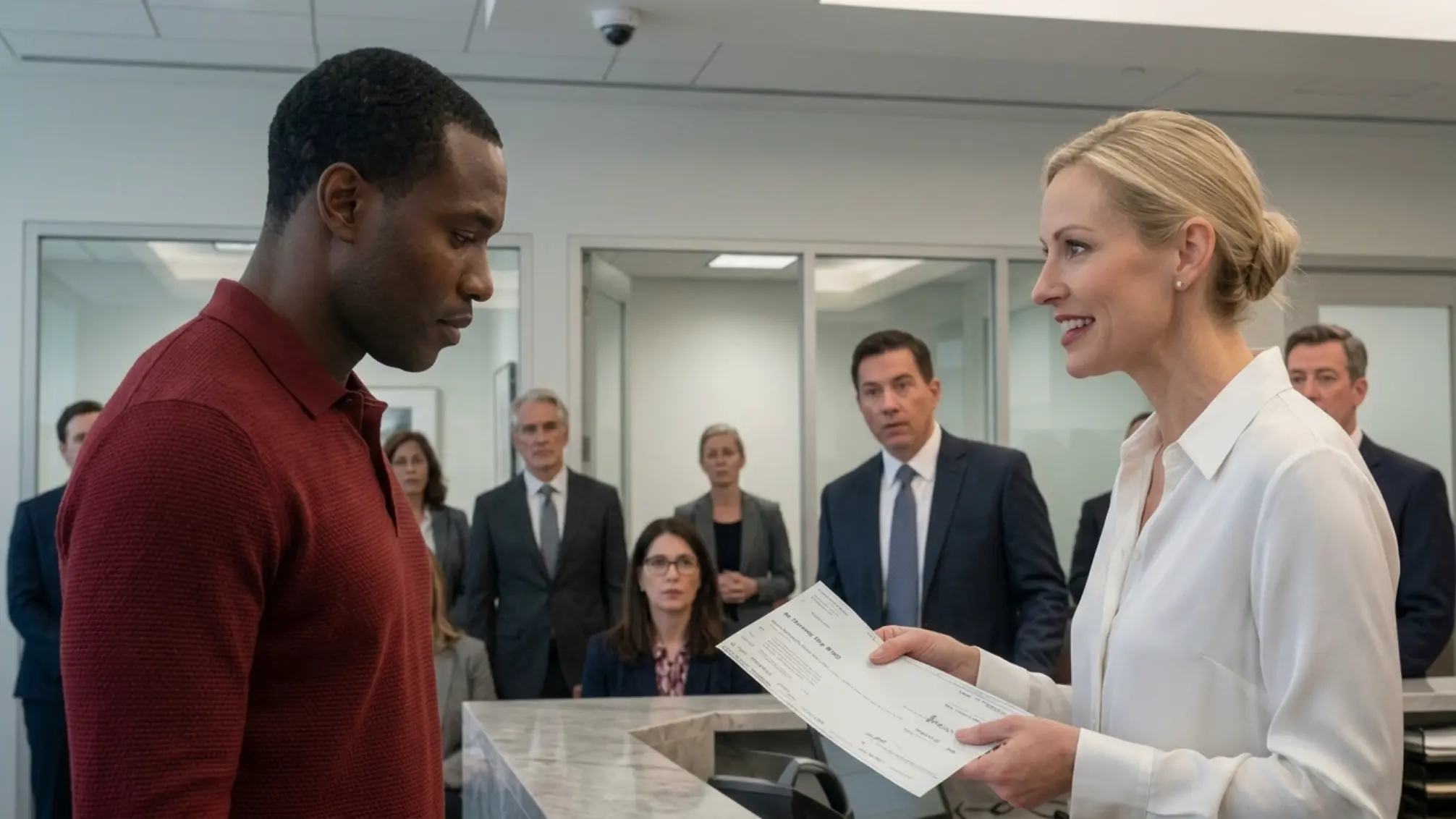
Vanessa held the two halves above the counter and smiled.
“A hundred million dollars?” she said. “This fake belongs in the trash—and so do you.”
Marcus stood motionless on the customer side of the marble counter. He was forty-three, tall and athletic, with close-cropped black hair, a neatly trimmed goatee, and the calm expression of a man who had spent years watching people reveal themselves through the decisions they made under pressure. His navy leather jacket was expensive but understated, and the pale-blue shirt beneath it carried no visible designer label.
Nothing about him announced the extent of his wealth.
That had been intentional.
He looked down at the torn check. “Put both pieces on the counter.”
Vanessa laughed. “You still think we’re processing this?”
“I said put them down.”
Her blue eyes narrowed. She was forty-four, elegant and severe, with blonde hair pulled into a perfect bun and a fitted black suit that matched the polished authority she projected throughout the branch. Employees feared disappointing her. Junior bankers stood when she entered conference rooms, and clients without significant balances were quietly redirected before they reached her desk.
She believed she could identify a valuable person before reading a name.
Marcus had already watched that belief cost the bank millions.
“Touch one more piece,” he said quietly, “and this bank loses more than your job.”
Vanessa leaned across the counter. “Are you threatening me?”
“I’m explaining consequences.”
She reached toward the silent-alarm button beneath the terminal. “Security will put you through those doors in cuffs.”
A voice thundered from behind her.
“Take your hand off that button and call him sir—now.”
Every head in the lobby turned.
Arthur Pembroke, the seventy-one-year-old chairman of Pembroke Continental Bank, was moving through the private-banking floor faster than anyone had seen him move in years. His silver hair was disordered, his tie hung slightly loose, and two members of the executive board struggled to keep pace behind him.
Arthur stopped beside Vanessa and stared at the torn check.
The color left his face.
“What did you do?”
Vanessa straightened. “Mr. Pembroke, this man presented a fraudulent instrument for one hundred million dollars. I was protecting the bank.”
Arthur looked at Marcus.
Not at his clothes.
Not at the leather jacket.
At his face.
“Mr. Holloway,” the chairman said carefully, “I am profoundly sorry.”
Vanessa glanced between them. “You know him?”
Arthur’s expression hardened. “Everybody in this institution should know him.”
Marcus lowered his gaze to the check again. “Apparently not.”
The bank manager gave a strained laugh. “There must be a misunderstanding.”
“There is,” Marcus said. “You misunderstood how long I was willing to watch.”
Arthur placed both hands on the marble counter. “Vanessa, step away.”
She did not move.
The chairman turned toward her. “Now.”
For the first time that morning, Vanessa obeyed without argument.
Arthur carefully picked up the torn halves and placed them beside each other. The check had been drawn on the Federal Reserve account of Holloway Capital Partners and made payable to Pembroke Continental Bank. A bank-certified security strip crossed both halves, along with a verification number that any qualified employee could have confirmed in less than a minute.
The amount was clearly written:
$100,000,000.00
Vanessa looked at the name printed in the upper-left corner.
“Holloway Capital,” she said slowly.
Marcus met her eyes.
The recognition struck a second later.
Holloway Capital Partners controlled more than sixty billion dollars in infrastructure, logistics, housing, and technology investments across four continents. Financial magazines frequently mentioned its founder, but Marcus rarely attended public events and had refused most interview requests for nearly a decade.
His official photographs usually showed him wearing glasses.
He was not wearing them today.
Vanessa’s mouth opened, but no words came.
Arthur spoke before she recovered. “Mr. Holloway is the largest private shareholder in this bank.”
The lobby remained silent.
“He also chairs the independent committee currently reviewing our executive operations,” Arthur continued. “And the check you destroyed was part of the emergency capital agreement keeping this institution above its regulatory threshold.”
A private-banking clerk covered her mouth.
Marcus watched Vanessa’s confidence collapse in stages. First disbelief. Then calculation. Finally fear.
She glanced toward the torn check. “Certified instruments can be replaced.”
“That isn’t the problem,” Marcus said.
“Then what is?”
“You.”
Arthur looked around the lobby, aware that employees, clients, and security officers were listening. “We should continue this discussion upstairs.”
Marcus did not move. “No.”
“Sir?”
“She made her decision in public. She can hear the consequences in public.”
Vanessa’s face flushed. “You came in here dressed like that without an appointment and expected immediate access to private banking.”
Marcus looked down at his jacket.
“Dressed like what?”
She realized the trap but had already stepped into it.
“I meant casually.”
“You said the check was fake before you verified the account.”
“The amount was suspicious.”
“You did not call the issuing bank.”
“I was exercising professional judgment.”
“You tore up a certified instrument because you decided the person holding it did not look like he could possess it.”
Vanessa crossed her arms. “You’re twisting this into something else.”
Marcus’s voice remained calm. “I have watched the recordings.”
Arthur’s head turned sharply. “Recordings?”
Marcus removed a small black drive from his jacket and placed it on the counter.
“For the last ninety days, Holloway Capital’s audit team has reviewed customer complaints from six Pembroke Continental branches. This location generated the highest concentration.”
Vanessa looked at Arthur. “Complaints are common in retail banking.”
“These weren’t ordinary complaints,” Marcus said. “They involved account access being delayed, appointments canceled, identification challenged repeatedly, and security summoned against clients whose balances were later confirmed to be substantial.”
He tapped the drive.
“Your name appears in twenty-seven incidents.”
“That is impossible.”
“Would you like me to list them?”
Vanessa said nothing.
Marcus turned slightly so the employees could hear.
“Dr. Evelyn Brooks, retired cardiothoracic surgeon. She was asked to wait in the public lobby for ninety minutes because your staff assumed she was seeking a charitable loan. Her account held eight million dollars.”
Arthur closed his eyes briefly.
“Daniel Cho, technology founder. You refused to accept his wire instructions until his white business partner arrived. The partner had no signing authority.”
A young banker near the glass offices lowered his head.
“Jamal Peters, commercial contractor. Security escorted him outside after he questioned why a business-loan officer had not disclosed an additional review fee. His company moved fourteen million dollars to a competitor the next morning.”
Vanessa’s voice sharpened. “I did not personally handle every customer interaction.”
“No. You trained people to repeat your behavior.”
“That is an accusation.”
“It is the conclusion of the independent review.”
Arthur reached for the drive. “How much has this cost us?”
Marcus looked at him. “Directly? Forty-three million dollars in deposits transferred out over eighteen months.”
The chairman’s shoulders dropped.
“Indirectly,” Marcus continued, “the estimate exceeds one hundred twenty million when lost lending relationships, commercial referrals, legal expenses, and regulatory exposure are included.”
Vanessa stared at him. “You are blaming me for clients who chose to leave?”
“I’m blaming a management culture that decided respect should depend on appearance.”
She glanced toward the employees again, searching for support.
No one spoke.
Arthur looked toward the security officer standing near the entrance. “Close the private-banking floor. No clients enter until further notice.”
Vanessa’s eyes widened. “You cannot shut down the branch over a torn check.”
“The check is merely the incident you performed in front of the wrong witness,” Marcus said.
Arthur turned toward his board members. “Contact legal, compliance, and human resources. I want every branch manager on an emergency call in thirty minutes.”
Vanessa stepped closer to the chairman. “Arthur, I have worked for this bank for sixteen years.”
He looked at her coldly. “Then you had sixteen years to understand our obligations.”
“I increased private-banking revenue by twenty-two percent.”
Marcus opened a thin leather folder he had carried beneath his arm.
“You increased fee revenue.”
“That is the same thing.”
“No. It isn’t.”
He removed several internal reports.
“Your branch generated higher fees because clients were pushed into premium products they did not need. Elderly customers were moved into high-cost managed accounts. Small-business owners were charged expedited-review fees even when no expedited work occurred.”
“That is standard banking practice.”
“It is not standard to hide the cost.”
Vanessa’s voice rose. “Every agreement was signed.”
“Several signatures were obtained after employees told customers their existing accounts would be frozen if they refused.”
“That is not true.”
Marcus held up a transcript. “Would you like to hear your assistant manager explain it?”
Vanessa looked toward a nervous man standing beside one of the glass offices.
“Paul?”
Paul Whitman had worked under her for six years. He was thirty-eight, thin, and usually so eager to please that employees joked he could sense Vanessa’s footsteps through two floors of concrete.
Now he could not meet her eyes.
Arthur addressed him. “Mr. Whitman, is the allegation accurate?”
Paul swallowed. “Sometimes clients were told compliance had placed restrictions on their accounts.”
“Had compliance done so?”
“Not always.”
Vanessa turned on him. “You are lying to protect yourself.”
Paul flinched. “You approved the scripts.”
“There were no scripts.”
Marcus placed another document beside the check.
The page carried Vanessa’s electronic signature.
Across the top were the words:
CLIENT RETENTION ESCALATION LANGUAGE
Arthur read the first paragraph silently.
His face hardened.
The instructions advised employees to imply that account access could become “temporarily limited” if clients resisted moving funds into fee-generating services. It never explicitly ordered staff to freeze accounts, but the language had been designed to create that fear.
“You signed this,” Arthur said.
Vanessa’s composure began to fracture.
“It was a draft.”
“It was distributed to forty-three employees.”
“I did not know how they would use it.”
Marcus stared at her. “You rewarded the employees who used it most effectively.”
She turned toward him. “Why did you bring the check personally?”
The question changed the atmosphere.
Marcus closed the folder.
“Because numbers show patterns, but people reveal intent.”
“You set me up.”
“No.”
“You entered without identifying yourself.”
“I gave the receptionist my name.”
The receptionist, a young woman named Lydia Grant, stood near the entrance. Everyone looked at her.
Lydia’s face went pale.
Marcus addressed her gently. “What did you do after I gave you my identification?”
She looked toward Vanessa, then back at him.
“I entered the name into the appointment system.”
“And?”
“There was no appointment.”
“Did you search the shareholder directory?”
Lydia hesitated. “No.”
“Why?”
“Ms. Cole told us not to waste private-banking resources on walk-ins unless their appearance indicated significant assets.”
A murmur moved through the employees.
Vanessa stared at Lydia as though she had been betrayed.
“You misunderstood that instruction.”
Lydia’s voice trembled. “You said we should use visual judgment.”
“I said professional judgment.”
“You said watches, shoes, and vehicles were reliable indicators.”
Marcus looked toward Arthur.
The chairman seemed older than he had ten minutes earlier.
“How far does this go?” Arthur asked.
“Farther than this branch,” Marcus replied.
The emergency capital check had been part of a larger agreement. Pembroke Continental had suffered significant losses after financing several commercial developments that collapsed during a regional downturn. The bank was not yet insolvent, but federal regulators had ordered it to strengthen reserves immediately.
Holloway Capital was prepared to invest one hundred million dollars in exchange for expanded oversight, governance reforms, and protections for customers affected by deceptive practices.
Marcus had insisted on conducting the final evaluation personally.
He wanted to know whether the bank’s problems were temporary financial mistakes or symptoms of a corrupted culture.
Vanessa had answered the question before the meeting began.
Arthur glanced toward the torn check. “Does this mean Holloway Capital is withdrawing?”
Vanessa’s fear deepened.
Without the capital injection, Pembroke Continental would face immediate regulatory intervention. Branch closures, executive removals, and a forced sale could follow.
Marcus allowed the silence to remain.
“That depends.”
“On what?” Arthur asked.
“Whether this bank is capable of changing before it is forced to.”
Arthur nodded quickly. “It is.”
“That response is not evidence.”
“Tell me what you require.”
Vanessa stepped toward them. “You cannot negotiate the bank’s future while using me as a public example.”
Marcus turned to her. “You made yourself the example.”
“You have no idea what it takes to run this branch.”
“I know exactly what it takes to run an organization.”
“Investment companies do not deal with ordinary customers walking in every day.”
Marcus’s eyes hardened. “Ordinary customers built every institution in this room.”
She scoffed. “That sounds admirable, but banks survive on profitable relationships.”
“Respect is profitable.”
“Not always.”
“No. Sometimes it is simply right.”
Arthur looked at the board members. “Vanessa Cole is suspended effective immediately. Access to bank systems and premises is revoked pending investigation.”
Her mouth fell open.
“You cannot do that without a human-resources hearing.”
“I can remove your authority while one is arranged.”
“I have a contract.”
“So does the bank.”
She looked toward Marcus. “This is what you wanted.”
“What I wanted was to deposit a check without watching someone prove every complaint correct.”
Security approached.
Vanessa raised one hand. “Do not touch me.”
The guards stopped and looked toward Arthur.
The chairman spoke quietly. “Give them your access card.”
She held his gaze for several seconds before unclipping the badge from her jacket.
Instead of handing it over, she dropped it on the marble floor.
Then she turned toward Marcus.
“You think they respect you? They fear your money.”
Marcus looked at the torn check.
“Today you feared it too late.”
Vanessa walked toward the elevator without assistance. The employees moved aside, creating a silent path between the counter and the executive floor.
When the doors closed behind her, no one spoke.
Arthur exhaled slowly.
“Mr. Holloway, I understand if you need time.”
Marcus gathered the torn pieces of the check and returned them to the leather folder.
“I do not need time. I need action.”
The chairman straightened.
“Name it.”
“First, no employee involved in this review destroys emails, recordings, client files, or internal messages. Legal preservation notices go out within the hour.”
Arthur nodded.
“Second, all clients charged fees through Vanessa’s escalation program receive an independent review and automatic reimbursement where disclosures were inadequate.”
Another nod.
“Third, every complaint involving discrimination, improper security removal, or unexplained account restriction goes to an outside law firm—not your internal compliance department.”
One of the board members shifted uncomfortably. “Outside counsel will be expensive.”
Marcus looked at him. “So is regulatory fraud.”
Arthur silenced the director with a glance.
“Continue.”
“Fourth, no branch employee will receive compensation based solely on fee-product conversions. Customer retention and complaint resolution become part of performance reviews.”
Arthur took notes.
“Fifth, Lydia keeps her job.”
The receptionist looked up in surprise.
Marcus continued. “So does every employee who cooperates honestly, unless evidence shows direct abuse.”
Paul Whitman appeared relieved but ashamed.
“And Vanessa?” Arthur asked.
“That decision belongs to the investigation. Do not fire her merely to protect senior leadership.”
The board members stiffened.
Marcus stepped closer.
“She operated openly for years. Either executives knew, should have known, or benefited enough not to ask. I will not accept one branch manager as the entire explanation.”
Arthur lowered his pen.
“You believe I share responsibility.”
“You are chairman.”
The words landed harder than any accusation Vanessa had heard.
Arthur looked through the glass offices toward the employees waiting for direction. For years, he had trusted reports showing strong growth, increased fee income, and expanding private-client revenue. He had praised Vanessa at board meetings without examining how those numbers were created.
“I should have looked closer,” he said.
“Yes.”
The answer contained no comfort.
Arthur nodded. “Then I will.”
Marcus left the bank without depositing the check.
He walked three blocks to a small coffee shop, ordered black coffee, and sat near the window while his audit team began receiving calls from Pembroke Continental’s legal department.
His phone rang twenty minutes later.
The caller was his mother.
“You finished your meeting?” she asked.
“Not exactly.”
Marcus smiled despite the morning.
His mother, Eleanor Holloway, was a retired public-school principal who still believed every business meeting could be improved by bringing sandwiches. She knew about the planned investment but not the undercover review.
“Did they accept your check?”
Marcus looked through the window at pedestrians moving along Park Avenue.
“The manager tore it up.”
There was a long silence.
“She did what?”
“The bank chairman arrived before things became worse.”
“Were you rude?”
Marcus almost laughed. “Why is that your first question?”
“Because money has never prevented you from being stubborn.”
“She judged me before verifying my name.”
Another silence followed, softer this time.
“You remember your father trying to open the hardware-store account?”
Marcus did.
He had been twelve when his father, James Holloway, entered a bank carrying years of savings inside a worn leather folder. The loan officer barely examined the business plan before rejecting him. Two weeks later, another bank approved the financing.
James built a regional hardware company with thirty-four stores.
Years later, Marcus sold his first technology investment for enough money to purchase the branch that had rejected his father. James refused to let him do it.
“Own something because it has value,” his father said. “Not because you want revenge.”
Marcus had carried that lesson into every deal.
“Are you still investing?” Eleanor asked.
“I haven’t decided.”
“Do the employees deserve to lose their jobs because one manager behaved badly?”
“It wasn’t only one manager.”
“Then decide whether the place can become better.”
Marcus stared at the torn check inside his folder.
“That is what I’m trying to determine.”
Over the next seventy-two hours, Pembroke Continental changed faster than it had in twenty years.
Arthur suspended three executives, including the head of retail banking, after emails showed they had praised Vanessa’s methods despite repeated complaints. The bank froze incentive programs tied to high-cost product conversions and retained an independent law firm to examine customer treatment across all branches.
More employees came forward.
Some described being pressured to avoid clients who appeared unlikely to generate high fees. Others admitted they had remained silent because Vanessa controlled promotions, schedules, and annual bonuses.
Lydia provided copies of informal training notes listing visual indicators of wealth.
Luxury watches ranked first.
Shoes ranked second.
Race, accent, age, and clothing appeared through coded language such as “client compatibility” and “relationship potential.”
The investigation revealed what Marcus had suspected.
Discrimination had been converted into an operating system.
Arthur met him again on Friday afternoon.
This time, they sat in a plain conference room without assistants.
A replacement check rested between them.
“The board approved every condition,” Arthur said. “We also established a restitution reserve of twenty-five million dollars.”
“From whose funds?”
“Executive bonuses and retained earnings.”
“Not employee pensions?”
“No.”
“Not customer fees?”
“No.”
Marcus read the agreement carefully.
Arthur waited.
Finally, Marcus signed.
Holloway Capital transferred one hundred million dollars into Pembroke Continental’s reserves before the close of business.
The bank survived the regulatory deadline.
Vanessa’s employment did not.
The investigation found that she had personally authorized deceptive sales scripts, altered complaint records, and ordered security removal against clients who questioned fees. She also deleted several messages after the preservation notice, exposing her to additional legal consequences.
She was terminated for cause.
Two executives resigned.
The retail-banking director was dismissed after regulators discovered he had received bonuses tied directly to Vanessa’s branch performance.
Pembroke Continental refunded more than eighteen million dollars to customers during the first phase of the review. Several former clients returned, though Marcus insisted the bank earn their trust rather than purchase it through promotional offers.
Dr. Evelyn Brooks received a personal apology from Arthur.
Daniel Cho declined to reopen his accounts but agreed to advise the bank’s new customer-equity council.
Jamal Peters returned only after Pembroke Continental financed a housing project in the same neighborhood where he had grown up.
Six months later, Marcus visited the Park Avenue branch again.
There were no cameras waiting and no executive reception.
He wore the same navy leather jacket.
Lydia now worked as an assistant branch manager. She greeted him at the entrance but did not lower her voice or summon a senior employee.
“Good morning, Mr. Holloway.”
“Good morning.”
“Do you have an appointment?”
He smiled.
“No.”
“That’s fine. Someone will be with you shortly.”
She directed him toward the same marble counter where Vanessa had torn the check.
A young banker approached.
“How can I help you, sir?”
Marcus placed a modest cashier’s check on the counter.
It was for ten thousand dollars, a donation to a financial-literacy program serving public-school students.
The banker examined the identification, verified the instrument, and processed it without surprise.
No one rushed from the executive floor.
No security guard moved closer.
No customer turned to watch.
It was an ordinary transaction.
Marcus preferred it that way.
Arthur appeared only after the receipt had been printed.
“You were testing us again,” the chairman said.
Marcus folded the receipt. “I was making a deposit.”
Arthur looked toward the employees assisting clients across the branch.
Complaint volume had fallen by sixty-eight percent. Customer retention had improved. Fee revenue had declined initially, but commercial deposits were rising again because former clients had begun recommending the bank.
“Respect was profitable,” Arthur admitted.
Marcus looked at him.
“It was right before it became profitable.”
Arthur nodded.
On the wall behind them hung a new framed statement adopted across every Pembroke Continental branch:
Verify the person. Verify the facts. Never estimate dignity.
The sentence did not mention Marcus, Vanessa, or the check.
That had been his decision.
He did not want the bank’s lesson reduced to the story of a billionaire who possessed enough power to demand accountability. Most customers did not have a chairman rushing across the lobby to protect them.
That was exactly why the institution had to change.
Vanessa tore the check because she believed Marcus Holloway did not belong in private banking.
Three minutes later, the chairman called him “sir.”
But the title was never the real reversal.
The real reversal came when the bank finally understood that a customer should not need one hundred million dollars, a famous company, or ownership shares to be treated as though his presence mattered.