The final piece of the check slipped from Diane Foster’s fingers and landed beside Grace Walker’s pink shoes. For a moment, nobody inside the Ellsworth branch of Holstead National Bank moved. Customers stood with phones raised, tellers stared from behind their stations, and the security guard remained halfway between Ethan Walker and the front doors, visibly unsure which person in the confrontation represented the danger.
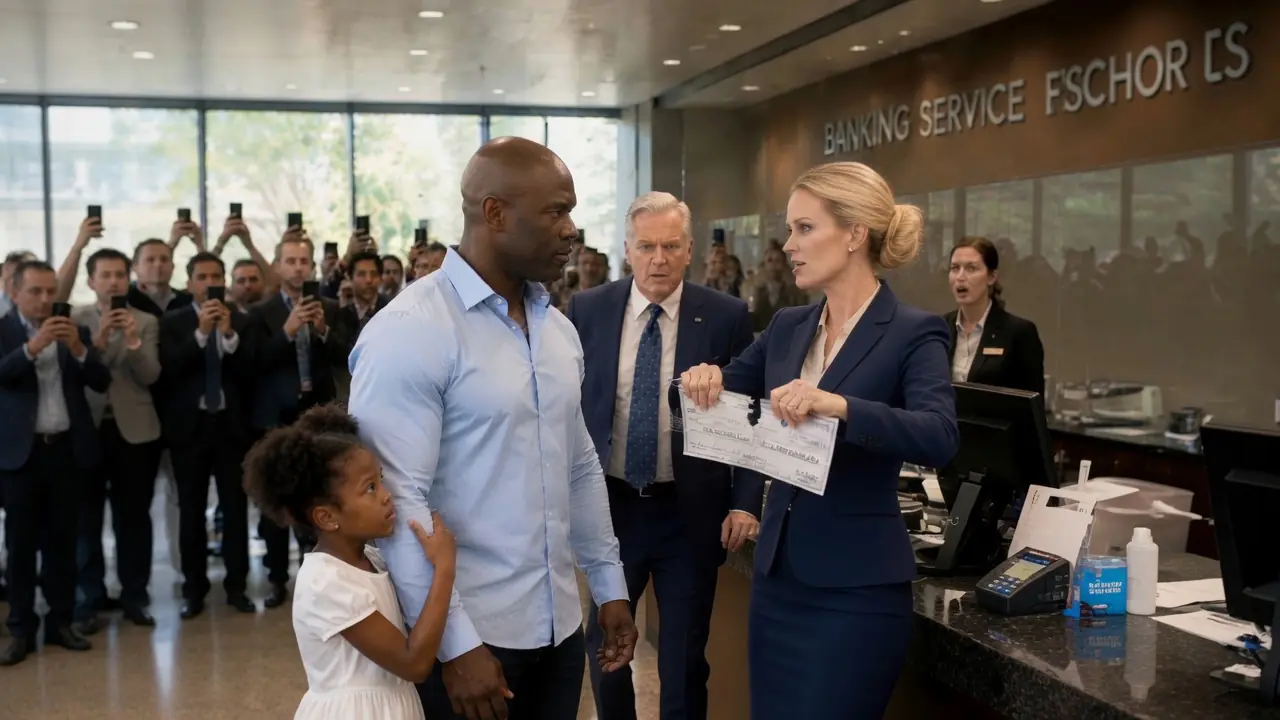
Grace tightened both arms around her father’s left hand. She was eight years old, small for her age, with natural black hair gathered into two puff ponytails and frightened eyes fixed on the pieces scattered across the polished floor. Ethan looked down at her before he looked at the manager who had just humiliated him, because his daughter’s fear mattered more than his anger.
“Do not pick those up,” he told Grace quietly.
Diane lifted her chin behind the marble counter. She was forty-four, newly transferred from a larger branch in Richmond, and had spent her first month in Maple Hollow making sure every employee understood that she valued rules, appearance, and control. Her navy blazer was perfectly fitted, her blonde hair did not move, and the contempt on her face suggested she believed calmness belonged only to people with authority.
“You heard me,” she said to the security guard. “Escort him outside before the police arrive.”
Dean Coleman glanced at Ethan. “Sir, I need you to step away from the counter.”
“I haven’t threatened anyone.”
Diane pointed toward him. “He said I made an expensive mistake. That is a threat.”
“It was a prediction,” Ethan replied.
The words caused a murmur among the customers. One man standing near the deposit slips continued filming, while another woman lowered her phone and looked uncomfortable. A teller named Rachel Simmons stood frozen near the verification terminal, where she had offered to call the issuing bank before Diane ordered her away.
Ethan had provided everything required for the transaction. His driver’s license matched his Holstead account. His signature matched fifteen years of banking records. The five-million-dollar cashier’s check came from a federally insured institution in New York and included direct verification information printed across the front.
Diane had ignored all of it.
She had looked at Ethan’s pale-blue shirt, dark jeans, old sedan outside, and the Black child holding his hand. Then she had decided the check did not belong to him.
The bank’s glass entrance opened behind the crowd.
A silver-haired man in a navy suit strode into the lobby with two executives and an attorney close behind him. He had been speaking rapidly until he saw the security guard, the raised phones, and the torn paper surrounding Grace’s shoes.
Robert Ellsworth, regional president of Holstead National Bank, stopped so abruptly that one of the executives nearly collided with him.
His face went pale.
“Mr. Walker,” he said. “Sir, what happened?”
The entire lobby changed.
Dean lowered his hands. Rachel looked from Ethan to Robert. Diane’s expression shifted from irritation to confusion, then fear, as the man she reported to crossed the floor and addressed the customer she had just ordered removed with visible respect.
Ethan did not answer immediately.
He reached into his pocket, removed a clean handkerchief, and crouched beside Grace. One piece of the torn check had landed against her shoe. He lifted it without allowing her to touch the floor and placed it on the counter.
“Your manager decided my check was fraudulent,” he said. “She refused verification, accused me publicly, destroyed the instrument, and called the police.”
Robert stared at Diane. “You tore up the check?”
“She was protecting the bank,” Diane said quickly. “He arrived with an implausible amount, refused to leave, and became confrontational.”
Rachel spoke before fear could stop her. “He gave us identification and verification documents. He never raised his voice.”
Diane’s eyes cut toward her.
Robert noticed.
“Preserve every security recording,” he told Dean. “Lock the lobby doors. No employee deletes, edits, or removes anything from the system.”
Diane stepped around the counter. “Robert, I followed fraud-prevention procedure.”
“No procedure authorizes you to tear up a customer’s negotiable instrument.”
“He doesn’t look like a five-million-dollar customer.”
The sentence left her mouth before she could pull it back.
Grace looked up at her father. “What does a five-million-dollar customer look like?”
No adult in the room seemed able to answer.
Ethan rested one hand on his daughter’s shoulder. He had spent years teaching her that money did not make people superior, that a clean heart mattered more than an expensive coat, and that success should never become an excuse to forget where one began. He had deliberately raised her in a modest house, driven an old car, and kept his professional life separate from her school and friendships.
Now another adult had taught her something Ethan wished she had not learned so young.
People could decide what she was allowed to possess before asking who she was.
Robert turned to Diane. “Go to the conference room.”
“I am the branch manager.”
“You are suspended from duty while we investigate.”
“You cannot suspend me because one customer is offended.”
Robert’s voice became colder. “This is not one offended customer. This is Ethan Walker, founder and chief investment officer of Walker Capital Group.”
Diane stared at Ethan.
Walker Capital managed retirement assets, university endowments, community-development funds, and more than twelve billion dollars in private investments. The firm’s name appeared frequently in financial publications, though Ethan rarely appeared in public photographs. He had built the company without attaching his face to its advertising because he preferred clients to evaluate performance rather than personality.
Robert continued. “His firm is Holstead National’s largest institutional depositor in this region.”
The customers began whispering.
Diane tried to recover. “That information was not visible on the account screen.”
“You never opened the account screen,” Rachel said.
The lobby went silent again.
Robert looked toward the torn check. “Mr. Walker was also scheduled to meet me here today regarding a seventy-five-million-dollar community banking partnership.”
Diane’s face drained of color.
The five-million-dollar check was not Ethan’s only reason for visiting. Walker Capital had been negotiating with Holstead National to create a lending fund for single parents, minority-owned businesses, and rural families rejected by conventional credit systems. Ethan wanted the Ellsworth branch to serve as the pilot location because Maple Hollow contained both working-class neighborhoods and nearby farming communities underserved by larger banks.
The meeting was supposed to begin upstairs after Ethan completed his personal deposit.
Instead, Diane had turned the lobby into evidence of the exact problem the proposed partnership was designed to address.
Police arrived four minutes later.
Two officers entered expecting a fraud suspect threatening employees. Dean met them near the door and explained that the alleged suspect had made no threats, possessed valid identification, and remained a customer in good standing.
Diane stepped from the conference-room doorway. “I am the person who made the call. The check was clearly suspicious.”
One officer looked at Robert. “Was it fraudulent?”
“No.”
“Did Mr. Walker threaten anyone?”
“No.”
“Did he refuse a lawful order?”
Robert glanced at Ethan. “He refused to leave while the branch held his property.”
The officer turned toward Diane. “Then this is not a criminal matter against him.”
“It became criminal when she destroyed the check,” Ethan said.
Diane looked at him. “It was paper.”
“It was an instrument representing five million dollars.”
“The money still exists.”
“So does the video.”
Several customers raised their phones higher.
Grace leaned into Ethan’s side. “Are they going to take us away?”
He crouched in front of her. “No.”
“You didn’t do anything.”
“I know.”
“Then why did she call them?”
Ethan looked at Diane, who had no answer ready now that the question came from a child instead of an executive.
“Because she made a decision before learning the truth,” he told Grace. “That was her mistake, not ours.”
Robert offered to move them into a private office, but Ethan refused.
“This happened publicly,” he said. “The first response should not be hiding it privately.”
He asked Dean to gather the torn pieces in a transparent evidence sleeve while Rachel printed his account history. The records showed that Ethan had maintained personal and corporate relationships with Holstead National for fifteen years, including seven-figure deposits, investment transfers, and philanthropic accounts.
His name was not merely known to the bank.
It appeared throughout its most valuable customer records.
Rachel then called the issuing bank using the number from its official directory rather than the information on the destroyed check. A senior officer confirmed the cashier’s check, named Ethan as the payee, verified the amount, and offered to issue a replacement immediately.
The call took ninety seconds.
Diane had spent less time than that deciding he was a criminal.
Robert asked Ethan to continue with the scheduled partnership meeting. Ethan looked toward Grace, whose earlier excitement about visiting the bookstore had disappeared.
“No.”
Robert’s shoulders lowered. “I understand.”
“I don’t think you do.”
Ethan pointed toward the tellers, customers, and security desk. “This branch did not become unsafe for me when she tore the check. It became unsafe the moment every system around her allowed suspicion to replace verification.”
Robert glanced at Rachel. “A teller tried to intervene.”
“And was silenced.”
“Dean hesitated before removing you.”
“And still approached because the manager’s description carried more weight than my behavior.”
Robert absorbed the criticism.
Ethan continued. “You want Walker Capital to place seventy-five million dollars into a program claiming this bank can serve communities that have historically been dismissed. Your own manager could not imagine a Black father possessing five million without committing fraud.”
Diane stepped back into the lobby. “You are turning one error into a political performance.”
Ethan faced her. “You tore the check in front of my daughter.”
“You kept challenging me.”
“I asked you to make a telephone call.”
“You were trying to intimidate staff with money.”
“I never told you who I was.”
“Exactly,” she snapped. “You walked in dressed like an ordinary man and expected special treatment.”
This time, Robert did not need anyone to explain what she had admitted.
Ethan’s expression remained controlled. “I expected ordinary treatment.”
The police officers looked at one another. The customers no longer filmed with curiosity. They were documenting something they understood could no longer be dismissed as misunderstanding.
Robert ordered Diane to leave the building. She refused until the bank’s attorney informed her that continued interference could violate the evidence-preservation notice. Dean escorted her through the lobby without touching her.
She passed the same customers who had watched her threaten Ethan minutes earlier.
Nobody defended her.
The bank closed early.
Ethan took Grace to the bookstore as promised, though she selected only one book instead of three. It was about a girl who built a bridge after adults told her the river was too wide.
At dinner, Grace remained unusually quiet.
Finally, she looked across the diner table and asked, “Would she have believed you if you wore a better jacket?”
Ethan set down his fork.
“Maybe.”
“Then why don’t you?”
“Because nobody should need an expensive jacket to be believed.”
“But you have money.”
“Yes.”
“Does that make you important?”
“No.”
She studied him. “Then why did her boss call you ‘sir’ after he learned?”
The question stayed with Ethan throughout the night.
Robert had treated him respectfully because he recognized Walker Capital, the institutional deposits, and the pending partnership. The police believed the check was valid because a bank president confirmed it. Diane’s humiliation became a crisis because Ethan had wealth powerful enough to threaten the institution.
What would have happened if he were exactly what he appeared to be?
A working father carrying a legitimate five-thousand-dollar insurance settlement instead of five million.
The next morning, Ethan called Robert.
“The partnership is suspended.”
Robert had expected cancellation. “What would it take to restore it?”
“An independent review of every fraud escalation, security removal, account denial, and customer complaint involving this branch for five years.”
“That could take months.”
“Then it takes months.”
“We have confidentiality obligations.”
“My legal team can work under court-approved protections.”
Robert hesitated. “And if we refuse?”
“Walker Capital moves every institutional account to another bank.”
The amount exceeded two hundred million dollars across several divisions.
Robert agreed.
The review began with Diane’s decisions but quickly expanded beyond them. Investigators compared lobby footage, complaint records, security calls, account applications, and employee emails. Patterns appeared almost immediately.
Black customers were three times more likely to be referred to managers for identity verification. Latino business owners were more likely to have deposits held for extended review. Customers wearing work clothes were frequently asked to wait while formally dressed customers received immediate assistance.
Diane’s name appeared often.
But she was not alone.
Several employees had learned that questioning well-dressed customers could generate complaints, while questioning working-class or minority customers rarely created consequences. Managers rewarded speed in removing “uncertain situations” from public areas but never examined who those situations involved.
One former teller reported that Diane instructed staff to “trust the picture before the paperwork.”
Another employee saved an email in which she praised a security guard for removing a Black teenager attempting to cash a scholarship check. The teenager later proved to be the payee, but the incident was classified as a misunderstanding and removed from branch-performance reports.
Robert received weekly updates.
Each one made his initial belief in an isolated mistake harder to defend.
The review also uncovered twenty-seven complaints that never reached regional leadership. Branch managers had settled them with waived fees, gift cards, or apologies written by junior employees. None had been analyzed together.
Ethan asked Robert one question during a review meeting.
“How many people needed my account balance to make you look?”
Robert did not answer.
Diane hired an attorney and claimed she had been dismissed because Ethan was wealthy enough to demand punishment. She argued that fraud prevention required suspicion and that management had praised her for aggressive loss control.
Part of her defense was true.
Holstead National had rewarded branches for reducing fraud while measuring almost nothing about false accusations. Managers faced consequences when fraudulent checks cleared, but rarely when legitimate customers were humiliated.
The incentives pushed employees toward excessive suspicion.
Diane chose whom to suspect, but the institution benefited from never asking how she chose.
The bank board placed Robert on administrative leave while an outside firm reviewed regional leadership. Rachel was promoted temporarily, not as a reward for loyalty to Ethan, but because she had followed written procedure when others ignored it.
Dean submitted the original security call and agreed to testify during the review. His recording showed Diane described Ethan as “aggressive” before he had said more than three sentences.
Investigators found no aggressive behavior in the footage.
Diane had added danger to justify the response she already wanted.
Six weeks after the incident, Holstead National released its findings publicly. Diane was terminated for discrimination, destruction of customer property, falsifying an incident description, and retaliating against employees who questioned her.
The bank did not stop with one dismissal.
It created an independent customer-rights office, required documented reasons for security calls, and banned appearance-based fraud escalation. Employees had to verify account history and issuing-bank information before publicly accusing a customer of wrongdoing, except when immediate safety risks existed.
Every branch began measuring false-positive fraud reports alongside actual losses.
Robert returned after accepting responsibility for inadequate oversight. He agreed to remain only long enough to implement the reforms, after which he would step down from regional leadership.
He met Ethan privately before the announcement.
“I called you ‘sir’ because I knew who you were,” Robert said. “I keep thinking about that.”
“So do I.”
“You deserved respect before I walked into the lobby.”
“Everyone did.”
Robert looked toward the new policy documents on the table. “Will Walker Capital reconsider the partnership?”
“Not yet.”
“What is missing?”
“The people harmed before me.”
Holstead National located customers whose complaints had been buried. Some wanted apologies, others wanted fees returned, and several wanted nothing more to do with the bank.
The teenager removed while cashing his scholarship check was now a college student. The bank refunded every fee associated with his account and funded the remaining years of his education without requiring publicity.
A Black nurse falsely accused of using a stolen debit card received compensation after investigators found that Diane had ignored three matching forms of identification.
A Mexican American contractor whose business deposit was held for twenty-one days recovered the interest and penalties he paid when he could not meet payroll.
The bank offered each person independent legal consultation before signing any agreement. Ethan insisted on that condition because restitution should not become another transaction controlled by the institution that caused the injury.
Three months later, Walker Capital approved a reduced pilot program.
The initial fund was twenty million dollars, not seventy-five. Additional investment would depend on measurable results, independent audits, and customer feedback rather than promotional photographs.
The first grants supported single parents building small businesses.
Ethan named the scholarship portion after Grace.
At the opening meeting, reporters asked him whether he forgave Diane.
“This was never about whether I felt generous enough to forgive her,” he said. “It was about whether the bank became accountable enough to change.”
Grace stood beside him in a navy dress, holding the book about the girl who built a bridge.
She asked to speak.
Ethan hesitated, then adjusted the microphone for her.
“My dad says money does not make people important,” she told the room. “But that day, people listened because they found out he had money. The new rules should work for people nobody knows.”
The room became completely quiet.
Ethan looked at his daughter with more pride than he had felt the day Walker Capital crossed its first billion dollars under management.
Months later, they returned to the Ellsworth branch.
The lobby looked almost unchanged. The marble counters remained, the same digital screens displayed interest rates, and customers still formed lines beneath bright ceiling lights.
Rachel greeted Ethan and Grace when they approached.
“How can I help you?”
Ethan placed a check on the counter.
It was for five hundred dollars, issued to Grace from the scholarship foundation as a ceremonial first deposit into a youth savings account.
Rachel asked Grace for the documents required for a minor’s account. She verified Ethan’s identity, explained every form, and treated the small check with the exact care the bank should have given the five-million-dollar one.
No manager rushed over.
No security officer moved closer.
No one looked toward the parking lot to decide whether the car outside matched the money on the counter.
After the deposit, Grace received a printed receipt.
She examined it carefully. “This one belongs here?”
Rachel smiled. “It belongs wherever you choose to save it.”
Outside, Ethan and Grace walked toward the same old sedan Diane had used as evidence against him. The paint remained faded, one rear door still made a clicking sound, and Ethan had no immediate plan to replace it.
Grace climbed into the passenger seat.
“Daddy?”
“Yes?”
“Was tearing the check really the most expensive mistake of her career?”
Ethan considered the suspended partnership, the investigation, the compensation fund, and the customers who were finally believed.
“No,” he said. “The expensive mistake was believing some people deserve questions while others deserve accusations.”
Grace placed her receipt inside the bridge book.
Ethan started the car and drove toward the bookstore.
The five-million-dollar check had been replaced within a day.
The dignity stolen in that lobby took much longer to restore.
But this time, the bank had finally been forced to account for both.