Malcolm Coleman entered Ashford Regional Bank carrying eighteen wrinkled dollar bills, an antique brass key, and a sealed yellow envelope his grandfather had warned him never to open without a reason strong enough to change hundreds of lives.
Mud covered the lower legs of his jeans. Dust marked the shoulders of his brown work jacket, and a dark streak of engine grease ran across the back of one hand. He had spent the morning inspecting storm damage at Coleman Harvest Systems’ largest Iowa grain operation, where straight-line winds had torn sheet metal from two storage buildings and overturned an irrigation rig. He could have changed clothes before entering the bank, but the board’s merger vote was less than three hours away.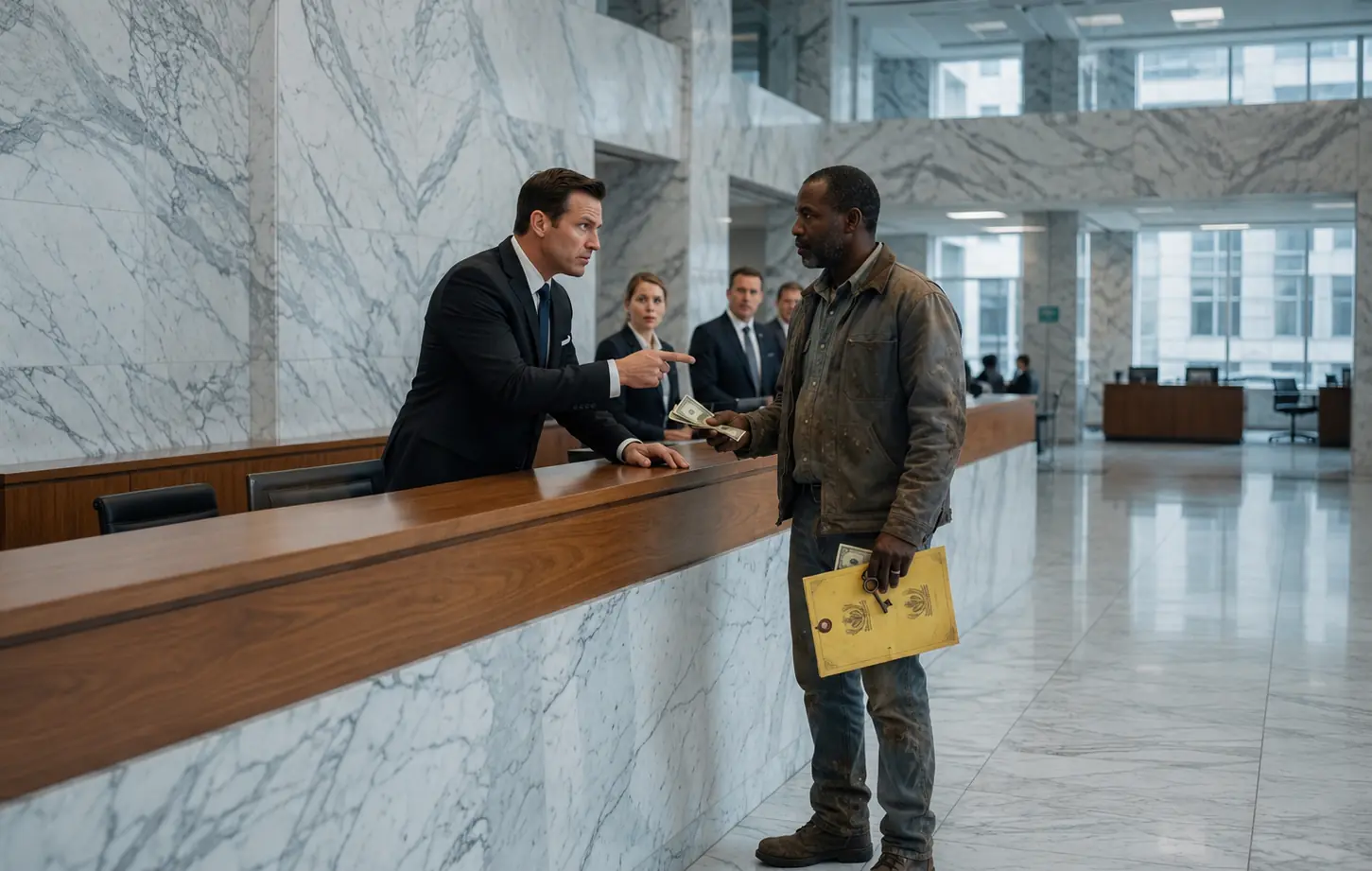
The marble lobby in downtown Des Moines looked designed to make ordinary people feel smaller. Tall windows poured white daylight across polished floors, brushed-metal signs, and expensive leather chairs arranged beneath screens advertising wealth management and commercial expansion. A rotating presentation promised that the proposed merger with Meridian National would create a stronger future for rural America.
Malcolm stopped beneath the main clock and studied those words.
He had already read Meridian’s private definition of a stronger future.
It included accelerated foreclosures, consolidated farmland, automated labor reductions, and the transfer of locally controlled agricultural loans into investment packages traded hundreds of miles away. More than three hundred family farms appeared on the preliminary acquisition list. Some belonged to people Malcolm had known since childhood.
He approached the main counter.
Behind it stood Preston Hale, Ashford Regional’s forty-three-year-old executive bank manager. Preston was tall, handsome, and dressed in a perfectly tailored black suit, white shirt, and deep blue tie. His dark hair had been carefully swept away from his forehead, while a white pocket square sat sharply inside his jacket.
He looked like the sort of man banks placed in advertisements to suggest competence, discipline, and trust.
At that moment, he was scolding a young teller for allowing an elderly customer to spend too long asking questions about an overdraft fee.
“The Meridian delegation arrives before noon,” Preston said. “I want this lobby controlled. No scenes, no delays, and no people wandering around as though this were a county aid office.”
The teller noticed Malcolm first.
Preston followed her eyes.
His expression changed before Malcolm spoke.
Malcolm placed the soil-marked bills, brass key, and sealed envelope on the counter. The envelope displayed the faded blue crest of the Ashford Agricultural Cooperative, the institution’s original name before decades of expansion transformed it into a regional bank.
“I need access to Vault Register A and the original agricultural trust ledger,” Malcolm said.
Preston looked at the muddy cash.
Then he looked at Malcolm’s boots.
“You cannot put that on my counter.”
“It is legal currency.”
“It is covered in dirt.”
“It came from a field.”
Preston gave a short laugh and glanced toward two employees behind him. Neither joined him.
“Deposit slips are at the other end,” he said. “Though judging by the amount, the machine in the grocery store might be more appropriate.”
“I am not making a deposit.”
“Then take your money and leave.”
Malcolm pushed the brass key forward.
A narrow number had been engraved into its darkened surface.
A-1.
“I need the vault register.”
Preston did not examine the key. “This bank does not give secured access to strangers who walk in carrying junk.”
“My name is Malcolm Coleman.”
Preston’s eyes sharpened slightly, but recognition did not arrive. Coleman Harvest Systems appeared regularly in financial news, yet Malcolm rarely appeared in advertising. He preferred fields, processing facilities, and employee meetings to public stages.
The company had begun with forty acres his father nearly lost during the agricultural crisis of the 1980s. Malcolm expanded it into a national network of grain farms, equipment manufacturing plants, food-processing facilities, and soil-recovery laboratories. Coleman Harvest employed more than six thousand people and generated annual revenue exceeding four billion dollars.
None of that was visible in his muddy jacket.
Preston saw only a Black farmer holding worn cash.
“That name means nothing here,” the manager said.
“It should mean something to your lending department.”
“If you have a loan problem, make an appointment.”
“I do not have a loan problem.”
“Everyone dressed like you who enters this branch has a loan problem.”
Malcolm looked toward the teller. She lowered her eyes, embarrassed on Preston’s behalf.
He placed one palm over the sealed charter.
“The board votes on the Meridian merger at noon.”
Preston’s posture changed.
That information had not been publicly announced.
“Where did you hear that?”
“From people who understand what the merger will do.”
“The board’s schedule is confidential.”
“The foreclosure list should have been confidential too.”
Preston leaned closer.
“What foreclosure list?”
“The one identifying three hundred and seventeen farms Meridian plans to acquire during the first eighteen months.”
For one brief moment, fear passed through Preston’s eyes.
Then arrogance covered it.
Bank Manager (furiously, pointing toward the exit): “Take that filthy cash and crawl back to your field—this bank does not serve people who bring garbage through its doors.”
Black CEO Farmer (coldly, placing the brass key beside the charter): “I did not come for service. I came to stop your merger.”
Bank Manager (sneering, grabbing for the sealed document): “One more lie and security throws you out while I tear this worthless paper in half.”
Black CEO Farmer (dangerously calm, crushing his wrist against the counter): “Tear it—and I take this bank from you before security reaches the door.”
The lobby became silent.
Malcolm’s grip was not wild or violent. He held Preston’s wrist firmly against the polished wood, stopping his fingers less than an inch from the wax seal.
A security guard began moving from the entrance.
Malcolm released Preston before the guard reached them.
“Do not touch that document again,” he said.
Preston rubbed his wrist, his face red with humiliation. “You just assaulted a bank officer.”
“I stopped you from destroying protected trust property.”
“You threatened to take this bank.”
“No. I informed you what happens if the charter is activated.”
Preston turned toward the guard. “Remove him.”
The young teller stepped forward before the guard could respond.
Her nameplate read Leah Morgan.
“Mr. Hale, I recognize that crest,” she said.
Preston stared at her. “No one asked you.”
“It appears in the legacy-governance manual.”
“There is no active legacy account connected to this man.”
“You have not checked.”
Preston’s expression sharpened. “Return to your station.”
Leah remained where she was. “Compliance policy requires us to verify any document bearing a founders’ seal before removing the holder from the branch.”
Preston pointed at Malcolm. “He entered with dirty money, made threats, and grabbed me.”
Malcolm looked at the security guard.
“Your cameras recorded every second.”
The guard hesitated.
He had seen Preston reach for the envelope first.
Leah picked up the internal phone and called compliance. She provided Malcolm’s full name, the trust title printed beneath the seal, and the number engraved on the key.
The officer on the other end asked her to repeat the number.
“A-1,” Leah said.
The line went quiet.
Leah’s posture changed while she listened.
Then she placed one hand over the receiver.
“Compliance says no one is to touch Mr. Coleman, the envelope, or the key. They are contacting the board chairman.”
Preston stepped toward her.
“Give me the phone.”
She moved it away. “They also ordered the merger presentation suspended.”
The main doors opened.
Four representatives from Meridian National entered carrying black portfolios. Their leader, Celia Ward, was a precise, silver-haired attorney whose negotiation team had spent six months pressuring Ashford’s board to approve the acquisition.
She stopped after seeing Preston at the counter with Malcolm.
“Is there a problem?” she asked.
Preston straightened his tie.
“No. A customer is confused about an obsolete account.”
Malcolm turned toward her.
“Are you leading Meridian’s agricultural consolidation plan?”
Celia studied him more carefully than Preston had. Her eyes moved from his worn jacket to the seal on the envelope.
“We call it a regional growth strategy.”
“Do the families on your foreclosure schedule call it that?”
Preston stepped between them.
“That is enough.”
Malcolm looked over his shoulder at the digital display showing a golden wheat field beneath Meridian’s logo.
“The farms in that picture were built by people your merger classifies as inefficient assets.”
Celia closed her portfolio.
“Who are you?”
“Malcolm Coleman.”
Recognition arrived immediately.
Her professional expression remained controlled, but the blood drained slightly from her face.
Preston noticed.
“You know him?”
Celia did not answer.
She knew Coleman Harvest Systems was one of the largest privately controlled agricultural companies in the United States. She also knew Malcolm had recently purchased more than two hundred million dollars of distressed rural debt through an employee-owned recovery fund.
What she did not know was why he possessed the Ashford founders’ key.
Twenty-five minutes later, Board Chairman Jonathan Ashford entered the lobby with two attorneys and the bank’s chief compliance officer.
Jonathan was sixty-six, with silver hair and the long narrow face visible in the oil portrait of his great-grandfather hanging near the elevators. He ignored Preston and crossed directly toward Malcolm.
The two men shook hands.
“You should have called me,” Jonathan said.
“I did,” Malcolm replied. “Six times.”
Jonathan’s expression tightened.
“I received no messages.”
“That explains why I came through the front door.”
Preston approached them.
“Chairman Ashford, this man disrupted the lobby, threatened employees, and physically grabbed me.”
Jonathan turned toward him.
“Did you attempt to tear the charter?”
Preston looked at the envelope. “I believed it was fraudulent.”
“Did you verify it?”
“No, but—”
“Did you examine the key?”
“He walked in covered in mud.”
Jonathan’s face became still.
“That was not my question.”
Preston said nothing.
Jonathan looked at Malcolm’s clothing.
“Storm damage?”
“North-field storage facility.”
“How bad?”
“Repairable.”
The ease of their conversation shattered Preston’s remaining confidence.
“You know each other personally?”
Jonathan faced him.
“Every Ashford chairman is required to know the controlling trustee of the Agricultural Recovery Fund.”
Preston stared at Malcolm.
Jonathan continued.
“The fund holds thirty-eight percent of the bank’s protected voting shares. Its authority predates this building, this management structure, and your employment contract.”
Preston’s mouth opened.
“The trust is dormant,” he said.
“Dormant does not mean dissolved.”
“It has not voted in decades.”
“Because the bank respected the purpose for which it was created.”
Malcolm picked up the envelope.
“And now it does not.”
The emergency board meeting began at 10:06.
Nine directors gathered inside the top-floor conference room. Two joined by secure video from other states. Meridian’s legal delegation demanded the right to attend, but Malcolm invoked the trust’s governance clause and excluded them until the bank’s internal compliance status had been determined.
Preston sat near the far end of the table.
Malcolm remained in his work clothes. His boots left a faint trace of dried soil on the pale carpet. No one asked him to remove them.
The sealed charter lay before him beside the brass key and eighteen wrinkled bills.
Jonathan opened the meeting.
“Mr. Coleman has requested activation review of the Agricultural Recovery Fund.”
Director Margaret Ellis adjusted her glasses.
“On what basis?”
Malcolm removed a thick file from inside his jacket.
“The bank has been manufacturing defaults on agricultural loans.”
Preston leaned forward. “That accusation is false.”
Malcolm ignored him.
He distributed payment receipts from thirty-two farms. Each receipt showed that the borrower had paid on time. The bank’s internal statements showed those same payments arriving between twelve and twenty-one days late.
The difference created penalties.
Three late classifications triggered automatic risk review. Five allowed the bank to alter interest rates. Seven permitted accelerated repayment demands under revised contracts Preston’s office had approved.
Director Ellis examined the documents.
“Where did you obtain these?”
“From farmers whose debt Coleman Harvest’s recovery fund purchased after Ashford sold it at a discount.”
Preston spread his hands. “Those were distressed loans.”
“No. You made them appear distressed, sold them cheaply, and expected buyers to foreclose.”
“That is your interpretation.”
Malcolm opened a second file.
“Our auditors reconstructed the transaction history. Payments entered Ashford’s system on time, were transferred into internal holding accounts, and returned after the grace period expired.”
Jonathan looked toward the chief compliance officer.
“Is that possible?”
She answered carefully.
“Only someone with executive authorization could move funds through those accounts.”
Every face turned toward Preston.
He shook his head.
“Multiple employees have access.”
Leah, who had been asked to attend as a witness, stood near the wall.
“Not to the override function,” she said.
Preston’s voice rose.
“You are a teller.”
“I am the teller who processed several of the original payments.”
“You do not understand executive systems.”
“I understand that customers handed me checks before their deadlines and later received letters claiming they had not paid.”
Preston turned toward Jonathan.
“This meeting has become an organized attack.”
Malcolm folded his hands.
“An attack is what happens when a family wakes up and discovers its land has been taken through numbers someone changed after the payment arrived.”
The board reviewed another document.
Meridian’s transition plan identified three hundred and seventeen agricultural properties targeted for acquisition after the merger. The farms would be combined into six large operating zones and leased to national contractors.
Local workers would be dismissed.
Independent seed agreements would be canceled.
Water access, storage facilities, and distribution roads would be consolidated under Meridian-controlled subsidiaries.
Director Ellis looked toward Preston.
“Were these properties selected before default?”
He hesitated.
“They were modeled as potential distressed assets.”
“Some have never missed a payment.”
“Current performance does not eliminate future risk.”
Malcolm’s voice remained calm.
“Neither does wearing a suit eliminate present corruption.”
Preston’s face tightened.
Jonathan turned toward Malcolm.
“Explain the trust’s connection.”
Malcolm placed both hands near the sealed charter.
The Ashford Agricultural Recovery Fund had been formed in 1910 by nineteen Iowa farming families after a bank collapse wiped out seasonal deposits and forced dozens of farms into emergency sales. Malcolm’s great-grandfather, Elijah Coleman, contributed eighty acres of debt-free land and the grain reserve that allowed the cooperative to survive its first winter.
The trust’s protected shares could not be diluted.
They remained silent while the bank maintained minimum standards for agricultural lending, including transparent payment records, independent default review, and restrictions against profiting from manufactured distress.
If those protections were deliberately violated, the trustee could activate the shares and block any merger, asset sale, or executive restructuring.
Director Ellis looked toward Malcolm.
“How did your family retain trusteeship?”
“We did not retain it automatically. My grandfather was elected by borrowers and cooperative members. Before his death, he transferred oversight to an independent agricultural foundation.”
“And you control that foundation?”
“I founded it, but I do not own it. Its voting council includes employees, farmers, and community representatives.”
Preston laughed bitterly.
“So you walked in here pretending to be poor while secretly controlling the bank.”
Malcolm looked at him.
“I did not pretend to be anything. I came from a damaged farm wearing the clothes I worked in.”
“You carried eighteen dollars.”
“The first eighteen dollars my great-grandfather deposited into this cooperative. My grandfather kept them after the original account books were retired.”
Preston looked at the wrinkled bills.
They were not random cash.
They were part of the founders’ record.
The board suspended the merger vote.
Preston was placed on administrative leave and ordered to surrender his laptop, office keys, access token, and company phone. He stood so quickly that his chair struck the wall.
Bank Manager (furiously, lowering his voice beside Malcolm): “You dressed like a laborer and walked in here looking for a fight.”
Black CEO Farmer (coldly, returning the charter to his jacket): “I walked in looking for records. You gave me the fight for free.”
The independent audit began that afternoon.
By midnight, investigators had confirmed that forty-eight agricultural payments had been transferred into suspense accounts after arriving on time. False late fees generated more than six hundred thousand dollars in charges.
The delayed payments lowered borrowers’ credit classifications.
Ashford then sold those loans at reduced prices to a company named Prairie Meridian Recovery.
Prairie Meridian’s controlling shareholder was Preston’s brother-in-law.
The company did not attempt to help borrowers recover. It demanded immediate payment, filed foreclosure actions, and sold farmland options to Meridian National before legal ownership had even transferred.
Every foreclosure increased Preston’s private compensation package.
If the merger closed and Meridian acquired more than two hundred designated farms, Preston would receive stock and cash worth nearly nine million dollars.
The investigation widened.
Two agricultural loan officers had raised concerns during the previous year. One was transferred to a branch three hours away. The other resigned after Preston threatened to accuse him of mishandling client records.
Their written complaints never reached the board.
Jonathan discovered that Executive Vice Chairman Malcolm Price—not related to Malcolm Coleman—had intercepted the reports. Price had promoted the merger and repeatedly described family farms as low-efficiency holdings occupying high-value land.
His emails contained discussions with Meridian officials about accelerating rural defaults before the acquisition.
He resigned the following morning.
The resignation did not stop investigators from seizing his devices.
Malcolm returned to Coleman Harvest’s storm-damaged facility while the audit continued. He spent the afternoon beside mechanics, roofers, and grain-storage engineers. Several employees asked whether the reports about Ashford Regional were true.
He gave them the same answer.
“The evidence will decide what is true.”
Malcolm had learned that discipline from his father, Isaiah Coleman.
Isaiah had nearly lost their family farm when Malcolm was twelve. A bank manager delayed recording two payments, then used the resulting default to demand immediate repayment. Elijah Coleman, Malcolm’s grandfather, used the Ashford trust to force an audit.
The payment records were corrected.
The farm survived.
Isaiah spent the next thirty years teaching his son that land was never merely property. It carried labor, memory, water rights, burial ground, and the future decisions of people not yet born.
Malcolm built Coleman Harvest Systems around that principle.
His company purchased struggling farms but rarely removed the families. Instead, it restructured debt, invested in equipment, and created profit-sharing agreements that allowed farmers to retain ownership.
Critics called the model inefficient.
Malcolm called it patient.
Five days after the lobby confrontation, he visited the Ruiz family farm near Boone.
Daniel Ruiz had borrowed from Ashford Regional for twenty-two years. His father had borrowed before him. The family grew corn and soybeans on four hundred acres while operating a small repair shop during winter.
Daniel spread every receipt across his kitchen table.
None was late.
Ashford had still declared the loan delinquent.
“My grandfather believed that bank belonged to the community,” Daniel said.
“It was designed to,” Malcolm replied.
“What is it now?”
Malcolm looked through the window toward two teenage boys repairing a combine.
“That depends on what we do next.”
Daniel lowered his voice.
“If the merger happens, we lose the farm.”
“The vote has been stopped.”
“For how long?”
“Until the truth is finished.”
Daniel looked unconvinced.
Truth moved more slowly than foreclosure notices.
Malcolm understood.
At the next emergency board meeting, Meridian presented a revised proposal. It promised to preserve current farm loans for eighteen months, establish a five-million-dollar rural-development fund, and retain local branding.
Celia Ward described the offer as a historic compromise.
Malcolm read the proposal.
Then he placed it on the table.
“You expect to acquire land worth more than eight hundred million dollars.”
“Those values are speculative.”
“Your own documents contain the estimates.”
“The farmers received loans secured by property.”
“They made their payments.”
“Some accounts still carry elevated risk.”
“Risk created by the bank manager you planned to reward.”
Celia’s expression hardened.
“Coleman Harvest also purchases distressed agricultural debt.”
“Yes.”
“What makes your company different?”
“We make money when farms recover. Meridian makes money when they disappear.”
Silence followed.
The bank’s financial adviser then delivered the report everyone had avoided.
Ashford Regional was not insolvent.
The merger was unnecessary.
Its financial weakness came from legal expenses, false default processing, executive bonuses, outside consulting fees, and millions spent preparing the Meridian transaction.
If the bank canceled the merger, recovered fraudulent payments, and restructured management, it could survive independently.
Malcolm opened the yellow envelope.
Inside was the original charter, handwritten in dark ink and signed by nineteen families. One signature belonged to Elijah Coleman.
The document contained a clause requiring activation whenever the bank used deliberate accounting manipulation to acquire agricultural land.
Malcolm cast the trust’s thirty-eight percent against the merger.
Jonathan joined him.
Four other directors followed.
The acquisition failed.
Celia gathered her documents.
“You have chosen history over progress.”
Malcolm returned the charter to its sleeve.
“No. We chose farming over harvesting farmers.”
Preston Hale was arrested two weeks later.
He faced charges of bank fraud, conspiracy, falsifying financial records, obstruction, and unlawful interference with protected agricultural lending. His brother-in-law was arrested while attempting to transfer Prairie Meridian Recovery’s assets into accounts outside the country.
Executive Vice Chairman Price was charged after investigators discovered undisclosed consulting payments from Meridian-linked companies.
Preston rejected a plea agreement.
At trial, his attorneys argued that he had used aggressive but lawful strategies to reduce risk. Prosecutors presented internal messages in which he identified farms with strong land value, stable water access, and aging owners who might lack resources to fight foreclosure.
One message described a seventy-one-year-old widow as “ideal conversion inventory.”
Another described the Ruiz farm as “high equity, low legal resistance.”
Malcolm testified during the third week.
He entered the courtroom in a dark suit, but the prosecutor placed his work jacket, brass key, founders’ bills, and sealed charter on the evidence table.
The defense attorney approached him.
Defense Attorney (smoothly, adjusting his cuffs): “Mr. Coleman, you are a billionaire CEO, correct?”
Black CEO Farmer (calmly, resting his hands on the witness rail): “My company has substantial value.”
Defense Attorney (skeptically, gesturing toward the work jacket): “Yet you entered the bank dressed like a struggling laborer.”
Black CEO Farmer (firmly, meeting his eyes): “I entered dressed like a farmer after working on a farm.”
Defense Attorney (pressing, raising his voice): “You wanted Mr. Hale to underestimate you.”
Black CEO Farmer (coldly, glancing toward Preston): “I expected him to verify documents before judging the man carrying them.”
The attorney changed direction.
He suggested Malcolm had used his trust authority to eliminate a competitor and expand Coleman Harvest’s influence over rural lending.
Malcolm answered without defensiveness.
“The trust stopped a merger. It did not transfer the bank to me.”
“But your company purchased some of the loans involved.”
“Yes.”
“And you profit from them.”
“When the borrowers recover and repay under corrected terms.”
“You are not a charity.”
“No. Fair business does not require charity. It requires earning money without destroying the people who created the value.”
Leah testified next.
She described Preston’s attempt to tear the charter, his order to remove Malcolm, and his effort to silence compliance staff. She also provided records showing that he had searched Coleman Harvest Systems on his phone only after learning the trust was valid.
Before that moment, he had never tried to determine whether Malcolm was telling the truth.
The lobby confrontation did not prove the financial crimes.
It proved how Preston behaved when he believed the other person lacked power.
The records proved the rest.
Preston was convicted on every major count.
The judge sentenced him to federal prison, ordered restitution, and permanently prohibited him from working for a federally insured financial institution. Prairie Meridian Recovery was dissolved, and its remaining assets were placed into a compensation fund.
Ashford Regional canceled every fraudulent fee.
All three hundred and seventeen targeted farm accounts received independent review. Most were restored to their original terms. Families who had already lost land through manipulated defaults received either returned property or compensation based on current market value.
Daniel Ruiz kept his farm.
The widow Preston described as conversion inventory received repayment of legal costs and a written correction clearing the false default from her credit record.
The board faced consequences too.
Malcolm used the trust’s votes to remove two directors who had ignored warnings because the merger promised higher stock value. He refused to replace them with Coleman Harvest executives.
Instead, he nominated an agricultural economist, a cooperative lawyer, a Black woman who owned a three-generation dairy farm, and Leah Morgan.
Leah initially refused.
“I am a teller,” she said.
“You were a teller who recognized the charter while executives recognized only mud.”
“I do not have board experience.”
“Neither did the first farmers who built the bank.”
She accepted the position.
Jonathan Ashford remained chairman for one final year while the institution established new protections. Payment changes required dual authorization. Borrowers received immediate digital confirmation when funds arrived. Foreclosure decisions were reviewed by an independent committee containing farmer representatives.
Executive bonuses could no longer depend on seized property, delinquency volume, or loan sales.
The bank also removed the polished marketing display celebrating the failed merger.
In its place, workers installed a framed copy of the original charter and photographs of the nineteen founding families.
Elijah Coleman’s picture showed a serious Black farmer standing beside a mule and a wooden grain wagon. Beneath it appeared one sentence from the trust documents:
A bank serving the land must never profit by separating honest hands from it.
Malcolm refused a permanent seat as chairman.
Reporters were surprised.
Some assumed he had activated the trust because he wanted control.
He explained that the trust’s power belonged to a purpose, not a person.
“Any authority strong enough to stop corruption is also strong enough to create it,” he said. “The answer is not finding a perfect owner. The answer is building limits no owner can escape.”
He amended the trust.
Future trustees would be elected by agricultural borrowers, bank employees, community representatives, and independent farming cooperatives. No trustee could serve longer than eight years. Coleman Harvest Systems would receive no automatic vote.
Malcolm’s family would not inherit permanent control.
One year after the confrontation, Malcolm returned to the bank wearing the brown work jacket.
It had been cleaned, though a faint grease mark remained near the cuff.
Leah met him beneath the clock.
“You own suits,” she said.
“I have been accused of that.”
“You could wear one occasionally.”
“I wore one to the trial.”
“That was nine months ago.”
He opened one hand.
The eighteen founders’ bills rested in his palm.
Leah smiled.
“Are you finally depositing them?”
“No.”
He carried them downstairs to the original vault.
The brass key opened Box A-1.
Inside were old account books, land pledges, grain receipts, and letters from families who had established the cooperative. Malcolm found one envelope addressed to the future trustee.
The handwriting belonged to Elijah Coleman.
Malcolm opened it carefully.
The letter was brief.
Do not save the bank merely because our names are attached to it.
Save it only if it remembers the people who gave it meaning.
A building can be replaced.
A reputation can be repaired.
Land taken from honest families carries the theft for generations.
Malcolm read the letter twice.
Jonathan and Leah waited beside him.
“Are you closing the trust?” Jonathan asked.
Malcolm looked at the century of records.
“Not today.”
He returned the original documents to the box, but he did not keep the key.
Three new keys were created and held by separate custodians. Opening the founders’ vault would require agreement between a farmer representative, an employee trustee, and an independent legal guardian.
No single person would again carry its entire authority.
Before leaving, Malcolm went to the main counter.
A bowl had been placed there containing apples from the Ruiz farm. Beside it stood a donation box supporting emergency meals and legal assistance for farming families.
Malcolm unfolded the eighteen wrinkled dollars.
He placed them inside.
Leah watched him.
“Your grandfather kept those for decades.”
“They were never meant to become museum pieces.”
“What were they meant to become?”
“Useful.”
Years later, people told the story as though a rude bank manager had insulted a poor Black farmer and discovered too late that the man was a billionaire CEO.
That version attracted attention.
It was not the lesson Malcolm wanted remembered.
Preston’s conduct would not have become acceptable if Malcolm had actually been poor. Muddy boots did not require hidden wealth to deserve dignity. Wrinkled cash did not need a founders’ story to become real money.
The manager’s first failure was not overlooking a billionaire.
It was believing that a powerless man could be mistreated without consequence.
Malcolm entered Ashford Regional wearing work clothes because he had been working. He carried soil on his boots because soil was the foundation beneath every polished office claiming to finance agriculture.
Preston saw the dirt and assumed weakness.
He saw a Black farmer and imagined desperation.
He saw a sealed charter and reached to destroy it before reading a single word.
By the time he recognized the person standing across the counter, the decision that ended his career had already been made.
Not by the billionaire CEO.
Not by the controlling trustee.
By the farmer he believed did not matter.