The black card struck the marble counter with a quiet click.
Inside the main lobby of Sterling Crown National Bank in downtown Chicago, where three crystal chandeliers hung above polished black marble floors and brass railings gleamed beneath towering cream-colored columns, the sound should have disappeared beneath the soft conversations of wealthy clients.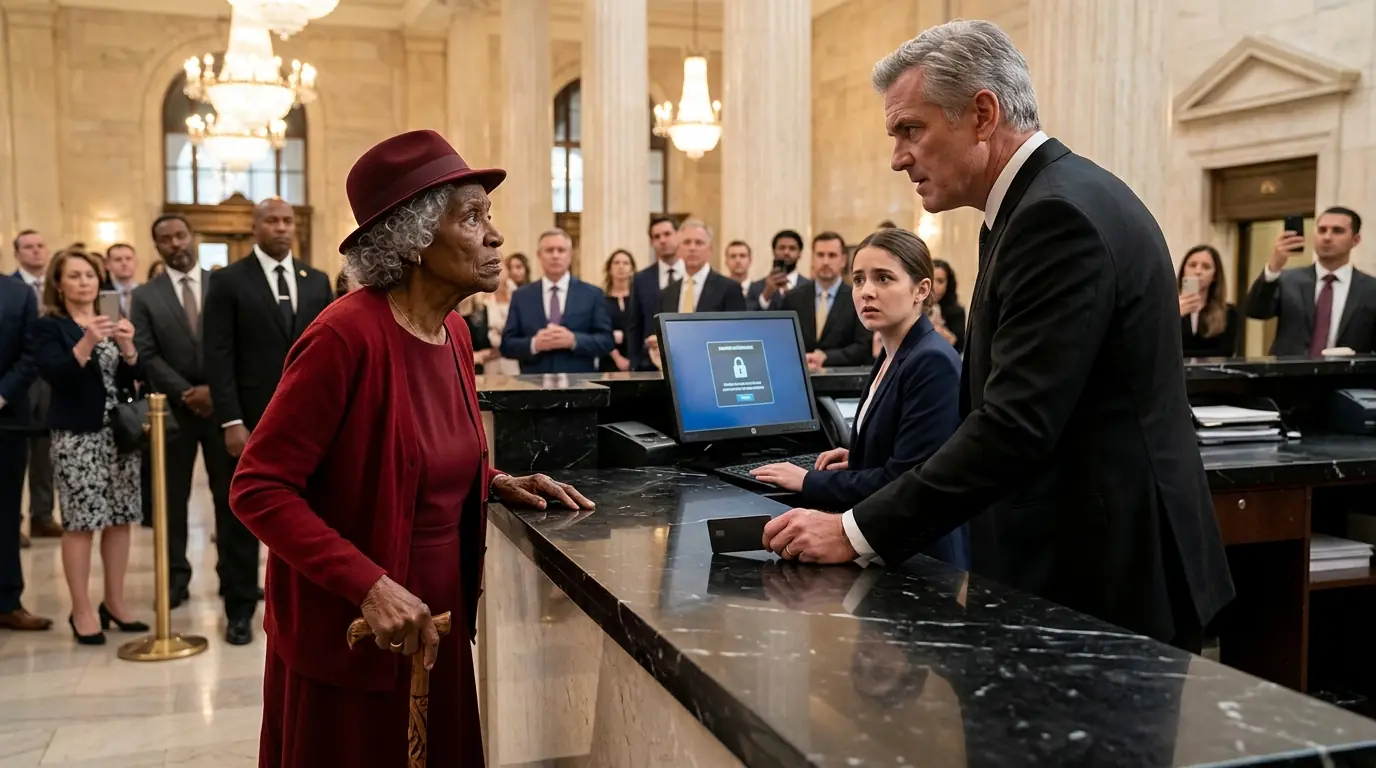
Instead, it seemed to stop the room.
Margaret Ellison stood at Window Four with one hand resting on a carved walnut cane. At ninety years old, she was small and slightly stooped, but nothing about the way she carried herself looked weak.
Her deep-brown skin was marked by the fine lines of a long life, and soft gray curls showed beneath a dark-red felt hat. A matching red cardigan rested over a simple burgundy dress that reached below her knees, and a brown leather handbag hung from her forearm.
She had dressed carefully that morning.
Not because she wanted to impress anyone.
Because Margaret Ellison believed there were certain places where a person should arrive looking exactly like herself.
Across the counter, twenty-four-year-old teller Janet Morales stared at the card.
It was unlike the premium cards she handled every day.
No platinum logo.
No embossed numbers.
No advertisement promising luxury travel.
The surface was matte black, almost completely plain except for MARGARET ELLISON printed in small silver letters and a narrow crest in the lower corner.
Janet turned it over.
There was no magnetic strip she recognized.
Only a security chip.
“Mrs. Ellison,” Janet said gently, “what would you like me to do today?”
Margaret adjusted her grip on the cane.
“I want to check the balance on my primary account.”
“Of course.”
Janet inserted the card into her terminal.
The screen flashed.
Then it went dark for half a second before displaying a warning she had never seen.
EXECUTIVE AUTHORIZATION REQUIRED.
Janet frowned.
She tried again.
The same message appeared.
This time, a second line followed.
RESTRICTED RELATIONSHIP PROFILE.
“Is something wrong?” Margaret asked.
“I’m not sure yet.”
Janet kept her voice calm, but her fingers had begun to tighten around the edge of the desk.
She entered Margaret’s name manually.
Nothing.
She attempted an account lookup through the private-client database.
The screen rejected her credentials.
Janet glanced at Margaret.
“Could I see identification, please?”
Margaret opened her handbag without complaint.
She removed a small leather wallet and handed over an Illinois identification card.
Janet compared the photograph.
It was her.
Margaret Ellison.
Age ninety.
Chicago address.
Janet entered the information.
Again, access denied.
A supervisor override icon appeared.
Janet exhaled slowly.
“I’m going to need someone with higher authorization.”
Margaret nodded.
“That is what the card usually does.”
Janet looked up.
“Usually?”
Margaret almost smiled.
“Yes, child.”
Across the lobby, Charles Whitmore was laughing with a commercial real-estate developer beside the private banking entrance.
At fifty-eight, Charles had perfected the appearance of effortless authority. His silver hair was always combed neatly back, his charcoal suits were tailored in London, and he moved through Sterling Crown as though the marble floor had been installed beneath his feet personally.
He had been president of the flagship branch for six years.
Employees knew his moods before he spoke.
Clients knew his reputation.
Charles remembered the names of men who managed nine-figure funds and regularly forgot the names of cleaning staff who had worked beneath him for a decade.
Janet hesitated before pressing the internal assistance button.
Charles noticed.
His smile faded slightly.
He excused himself from the developer and walked toward Window Four.
As he approached, he examined Margaret before he examined the computer.
Old.
Black.
Red cardigan.
Walking cane.
Worn handbag.
No assistant.
No chauffeur waiting beside her.
No expensive watch.
Charles had spent his entire career learning to evaluate people quickly.
He considered it instinct.
Others would eventually call it something else.
“What’s the issue?” he asked.
Janet lowered her voice.
“Mr. Whitmore, her card triggered executive authorization.”
Charles glanced at the black card.
Then at Margaret.
“Which account?”
“Her primary account.”
Charles gave a short laugh.
Margaret heard it.
Janet did too.
“I tried identification search and private client access,” Janet continued. “The profile is restricted.”
Charles picked up the card between two fingers.
He studied it.
“I’ve never seen one of these.”
Margaret looked directly at him.
“That does not make it counterfeit.”
Charles raised his eyebrows.
“I didn’t say counterfeit.”
“You were about to.”
Janet looked down.
A wealthy couple standing at the neighboring counter glanced over.
Charles noticed them watching.
His voice became smoother.
“Mrs. Ellison, there are unfortunately a number of fraudulent cards circulating that are designed to resemble private banking products.”
“This one was issued by this bank.”
Charles tilted the card toward the chandelier.
“So you say.”
Margaret’s hand tightened around the cane.
“Your computer says more than I do.”
Charles looked at Janet.
“What exactly did the computer say?”
“Executive authorization required.”
“And?”
“Restricted relationship profile.”
For the first time, uncertainty crossed his face.
It lasted only a second.
Then arrogance returned.
“Probably an old institutional card.”
Margaret’s expression hardened.
“It is active.”
Charles placed the card on the counter.
“Mrs. Ellison, perhaps you’ve confused Sterling Crown with another institution.”
“No.”
“We are a private banking institution.”
“I know.”
“Many of our accounts require significant minimum assets.”
“I know that too.”
His mouth formed a thin smile.
“Do you?”
Margaret stared at him.
Several people nearby stopped pretending not to listen.
Janet swallowed.
“Mr. Whitmore, I could call corporate authorization.”
Charles ignored her.
He leaned slightly toward Margaret.
“Perhaps a relative gave you this card.”
Margaret said nothing.
“Or perhaps someone told you money was being held here.”
Still nothing.
Charles continued.
“We see these situations more often than you might think.”
Margaret’s eyes narrowed.
“What situations?”
Charles gestured vaguely toward her.
“Confusion.”
The word hung between them.
Janet’s face changed.
Margaret had spent ninety years learning how insult could be dressed as concern.
She recognized the costume immediately.
“I am not confused,” she said.
Charles sighed.
“Mrs. Ellison, no one is suggesting that you are.”
“You just did.”
“I am trying to avoid embarrassing you.”
Margaret looked around at the growing audience.
“Then you are doing poorly.”
A man near the waiting area lifted his phone.
Charles saw him.
His cheeks tightened.
“Let’s keep our voices down.”
Margaret tapped one finger against the counter.
“I came here to check my balance.”