“I said check my balance.”
The Elderly Woman’s voice crossed the marble lobby of Hayes Continental Bank with none of the weakness the Bank President had expected from someone carrying a worn wooden cane.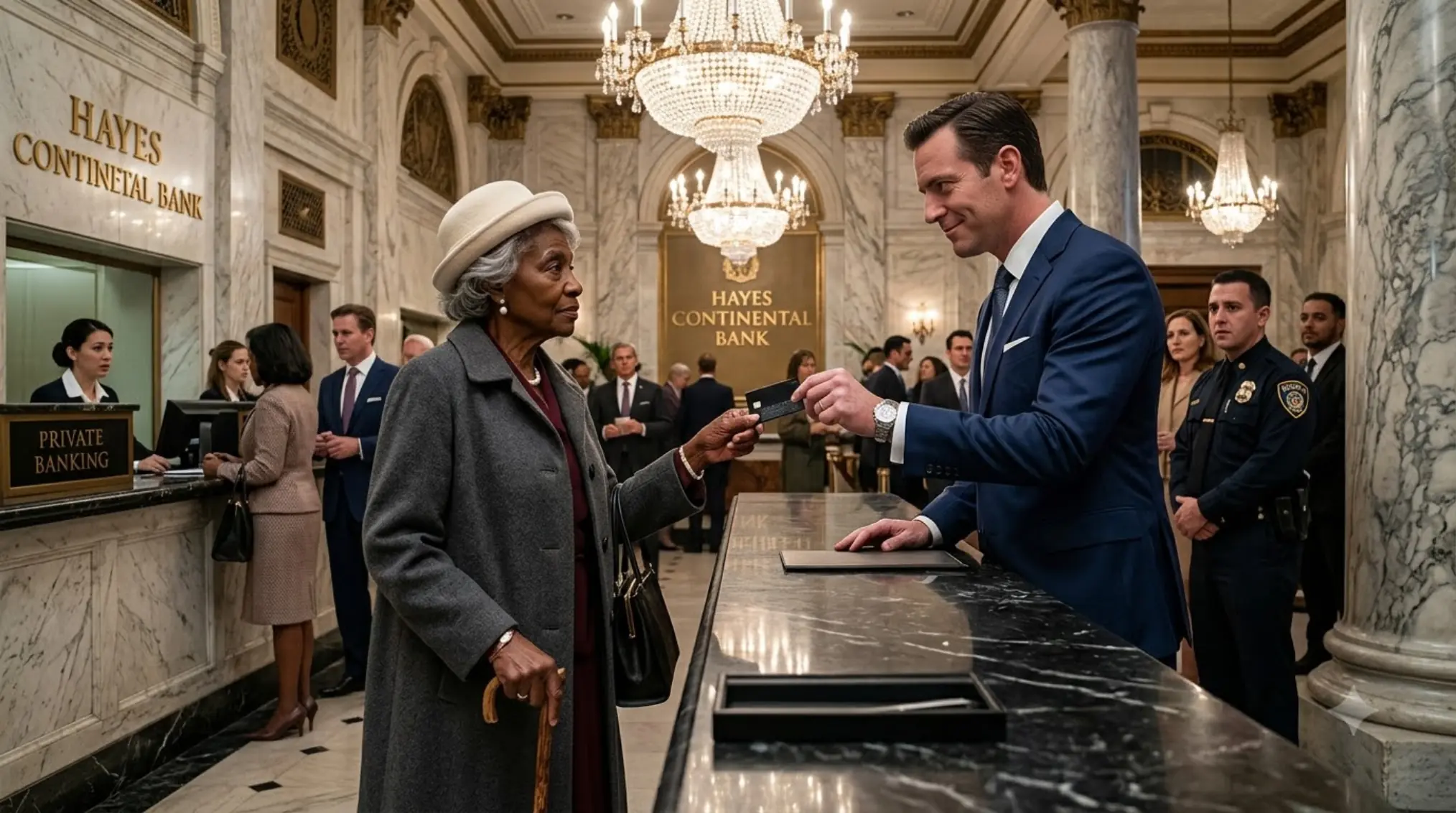
Conversations stopped beneath the crystal chandeliers.
A private wealth adviser lowered his tablet.
Two executives near the coffee bar turned their heads.
A woman seated beneath one of the enormous marble columns slowly raised her phone.
At the private-banking counter, the Elderly Woman remained perfectly still.
She was seventy-seven years old, elegantly dressed but without any obvious display of wealth. Silver-gray hair rested beneath a modest cream church hat. A charcoal coat covered a burgundy dress, and a small black handbag hung from one wrist.
Her shoes were sensible.
Her cane was old.
Nothing about her appearance announced power.
That was precisely why almost everyone in the lobby had underestimated her.
The young Teller standing behind the counter looked from the Elderly Woman to the sleek black card lying beside the terminal.
“I’m sorry,” the Teller said softly. “The system keeps requesting executive authorization.”
“That’s fine.”
The Elderly Woman nodded.
“Then request it.”
The Teller had tried.
The authorization request had gone upstairs.
Less than three minutes later, the Bank President himself had appeared.
He crossed the lobby with the confidence of a man accustomed to having doors opened before he reached them.
Mid-forties.
Perfect navy suit.
White shirt.
Silver watch.
Polished shoes.
His name was engraved on several plaques throughout the building, though he had not personally built anything inside it.
He stopped beside the Teller.
“What seems to be the problem?”
The Teller pointed toward the terminal.
“She wants an account verification, sir.”
The Bank President glanced at the Elderly Woman.
Then at her coat.
Her cane.
Her shoes.
Finally, the black card.
His expression changed.
Not concern.
Suspicion.
“Where did you get that?”
The Elderly Woman looked at him.
“From this bank.”
The Bank President smiled.
“That wasn't my question.”
“It was my answer.”
A man sitting nearby suppressed a laugh.
The Bank President heard it.
His smile tightened.
“This particular card is issued under extremely limited circumstances.”
“I know.”
“I’m sure you understand why we have to be cautious.”
“I understand caution.”
The Elderly Woman tapped the cane once against the marble.
“I don't understand refusing to do the one thing that would settle your concern.”
The Bank President folded his arms.
“And what would that be?”
“Check my balance.”
He laughed.
Not loudly.
That made it worse.
“You are creating a disturbance in a private banking lobby.”
The Elderly Woman looked around.
“I was standing quietly before you arrived.”
Another phone rose.
The Bank President noticed.
His posture straightened.
He lowered his voice.
“Ma’am, Hayes Continental primarily serves institutional investors, corporate trusts, and private family offices.”
“And?”
“You may be more comfortable at one of our retail branches.”
“Comfort has nothing to do with my account.”
The Teller looked down.
The Bank President continued.
“There is a branch six blocks south. They handle ordinary personal banking.”
The Elderly Woman’s fingers tightened around the cane.
“I did not ask where poor people bank.”
The President’s eyebrows lifted.
“I didn't say that.”
“You didn't need to.”
The lobby became quieter.
The Elderly Woman stepped half a pace closer.
“I walked into your bank.”
She pointed toward the black card.
“I provided the card.”
Then toward her handbag.
“I offered identification.”
Finally, she looked him directly in the eyes.
“And instead of checking the account, you studied my coat.”
The President's expression hardened.
“I’m trying to protect this institution.”
“From what?”
He looked at the card again.
“Fraud.”
The insult finally entered the open.
A murmur moved through the lobby.
The Teller looked uncomfortable.
“Sir, perhaps we should contact Private Accounts.”
The Bank President turned sharply.
“I’m handling it.”
The Teller fell silent.
The Elderly Woman noticed.
She noticed everything.
The fear in the Teller’s shoulders.
The way the security staff looked toward the President before making decisions.
The way employees avoided eye contact whenever he raised his voice.
Those details mattered.
They were the reason she had come personally.
The Bank President held out one hand.
“Give me the card.”
The Teller hesitated.
“Sir—”
“The card.”
She picked it up carefully and placed it in his palm.
The President held it between two fingers.
“Let’s end this embarrassment.”
The Elderly Woman’s expression did not change.
“Please do.”
He turned toward the terminal.
Typed.
The system requested an executive credential.
He entered his code.
The screen loaded.
For one second, the President smiled.
Then the smile stopped.
The terminal displayed several lines of restricted information.
He stared.
The Teller leaned closer.
Her eyes widened.
The Bank President typed again.
A warning appeared.
ULTRA-HIGH-NET-WORTH MASTER CUSTODIAL ACCOUNT.
Below it:
EXECUTIVE OWNERSHIP AUTHORIZATION REQUIRED FOR MODIFICATION.
Then the balance populated.
The Bank President’s face lost color.
The amount alone would have been enough to silence most rooms.
But the balance was not what frightened him.
Beneath it was a second entry.
BENEFICIAL CONTROL: WHITFIELD CAPITAL HOLDINGS.
A third line appeared.
CONTROLLING INTEREST — HAYES CONTINENTAL FINANCIAL GROUP.
The President stopped breathing normally.
The Teller whispered, “Sir?”
He clicked into the ownership section.
Another warning appeared.
RESTRICTED BOARD-LEVEL ACCESS.
The Elderly Woman tapped her cane.
Once.
Then again.
“Well?”
The President turned slowly.
Every phone in the lobby was pointed toward him now.
“You were very eager to finish this.”
He swallowed.
“This account…”
His voice cracked.
The Elderly Woman waited.
The Teller stared at the screen.
The Security Guard straightened.
The President tried again.
“This account controls our holding company.”
The Elderly Woman nodded.
“Yes.”
He looked at her differently now.
That was the mistake she had been waiting to see.
The sudden respect.
The immediate fear.
The transformation from annoyance to obedience the second her wealth became visible.
She hated it more than the insult.
The Bank President glanced toward the lobby.
“Perhaps we should continue upstairs.”
“No.”
“Ma’am—”
“No.”
Her cane struck the floor.
“You had no trouble discussing my business in front of everyone when you believed I was nobody.”
His face tightened.
“That was not—”
“So we’ll finish here.”
The Elderly Woman extended one hand.
“My card.”
He returned it immediately.
She looked down at the card, then back at him.
“Now freeze my account.”
The President blinked.
“What?”
“You threatened to freeze it.”
“I never—”
Several people in the lobby reacted.
He had.
Multiple phones had captured it.
The Elderly Woman tilted her head.
“Should we replay the recording?”
The President looked toward the raised phones.
“No.”
“Then do what you threatened.”
“I cannot freeze that account.”
“Why?”
He hesitated.
“Because it requires board authorization.”
“And who controls the board?”
Silence.
The Elderly Woman smiled faintly.
“Now we’re learning.”
Two weeks earlier, the Elderly Woman had been sitting at her kitchen table when a sealed package arrived from Whitfield Capital’s compliance division.
She had spent more than forty years building the investment company from a two-room accounting office into a private holding group with interests in logistics, real estate, agricultural finance, insurance, and regional banking.
She had never enjoyed publicity.
Her late husband had hated it even more.
They believed quiet ownership created better information.
People behaved differently around those they believed could help or hurt them.
So the Elderly Woman rarely announced herself before visiting a company in which Whitfield Capital held controlling interest.
Hayes Continental was one of those companies.
Whitfield had acquired a majority economic stake through a restructuring eight years earlier.
The public brand remained unchanged.
The Hayes family name remained above the doors.
And the Bank President continued behaving as though the institution belonged personally to him.
For years, the Elderly Woman had ignored that arrogance because performance remained strong.
Then complaints began arriving.
Not about profitability.
About culture.
Older clients described being dismissed.
Small-business owners complained that advisers ignored them until account balances were revealed.
Employees reported that wealthy clients received rules exceptions unavailable to everyone else.
Tellers said executives openly ranked customers by perceived value.
And three employees separately named the Bank President as the source of the problem.
One complaint caught the Elderly Woman’s attention.
A retired school principal had entered the flagship branch to ask about a trust established by her late husband.
A manager reportedly asked whether she was sure she had the correct institution.
Another complaint came from a mechanic wearing work clothes who had arrived to transfer proceeds from the sale of his company.
He claimed staff kept directing him toward basic banking services until he mentioned the size of the transaction.
A third came from an elderly man carrying an old canvas bag.
He was made to wait forty minutes while clients arriving after him were assisted first.
The Elderly Woman did not believe every complaint automatically.
She believed patterns.
And this was becoming one.
So she made a decision.
She would visit.
No assistants.
No board notice.
No executive escort.
She intentionally wore one of her oldest coats.
She carried the cane she had used since knee surgery.
And she brought the black card connected to a master custodial account so restricted that ordinary branch employees could not access it.
She wanted to know what would happen when someone who looked unimportant requested important service.
Now she knew.
The Bank President tried to recover.
“Mrs.—”
The Elderly Woman lifted one finger.
“You didn't ask my name earlier.”
He stopped.
“You were very comfortable without it.”
The Teller covered a nervous smile.
The Elderly Woman looked toward her.
“Young lady.”
“Yes, ma’am?”
“What was your first instinct when the system requested authorization?”
“To contact Private Accounts.”
“Correct.”
The Teller nodded.
“And what happened?”
She glanced at the President.
“Tell me.”
The Teller took a breath.
“He told me not to.”
The President turned.
“Be careful.”
The Elderly Woman’s cane struck the marble.
The sound was sharp.
“Do not threaten an employee while I’m asking her a question.”
He froze.
The entire room felt different now.
Five minutes earlier, he had controlled it.
Now every word he spoke made his position worse.
The Elderly Woman turned back to the Teller.
“Continue.”
“He said cards like yours were often used in impersonation attempts.”
The President interrupted.
“That is legitimate security guidance.”
The Elderly Woman looked at him.
“Did you check her identification?”
“No.”
“Did you run the card?”
“Eventually.”
“Before accusing me of fraud?”
Silence.
“That’s what I thought.”
One of the private clients near the windows lowered his phone.
“Ma’am?”
The Elderly Woman turned.
He was perhaps sixty.
Expensive suit.
Known corporate lawyer.
“I saw the entire thing.”
The President looked furious.
The lawyer continued.
“She never raised her voice until after he suggested she leave.”
Another woman spoke from the waiting area.
“He also told her cards like that weren’t issued to people who walk in making demands.”
The President's shoulders stiffened.
The Elderly Woman looked around.
“How many people recorded this?”
Seven hands rose.
She nodded.
“Good.”
The President stepped closer.
“We should not turn a misunderstanding into a spectacle.”
The Elderly Woman stared at him.
“You keep calling this a misunderstanding.”
“What else would you call it?”
“A demonstration.”
His eyes narrowed.
“Of what?”
“How quickly your standards change when you learn somebody’s balance.”
The sentence landed heavily.
The Elderly Woman lifted the black card.
“Ten minutes ago, this was suspicious.”
Then she pointed toward the terminal.
“Now it frightens you.”
She put the card away.
“The plastic didn’t change.”
The President said nothing.
“You did.”
The private elevator opened behind them.
Three people stepped into the lobby.
The Board Chair.
The Chief Compliance Officer.
And the bank’s outside General Counsel.
The President turned.
His face collapsed.
He understood immediately.
The Elderly Woman had not come alone in the larger sense.
She had arranged the visit before arriving.
The Board Chair walked forward.
“Good morning.”
The Elderly Woman nodded.
“Did you receive the alert?”
“Yes.”
“When?”
“The moment the master account was accessed using branch executive credentials.”
The Bank President looked toward the terminal.
He had triggered it himself.
The Board Chair continued.
“Compliance also received the audio notification from the internal review team.”
The President stared.
“Audio?”
The Elderly Woman opened her handbag.
Inside was a small recording device.
“I told compliance I was visiting.”
His jaw dropped.
“You recorded me?”
“In accordance with counsel’s instructions and applicable policy.”
The General Counsel spoke.
“The institution’s lobby is also covered by security audio.”
The President looked toward the ceiling.
Small microphones sat beside cameras he had walked beneath every day.
For the first time, he seemed genuinely frightened.
“This was a setup.”
The Elderly Woman shook her head.
“No.”
“You came dressed like—”
He stopped.
Too late.
The Board Chair’s eyes sharpened.
The Elderly Woman leaned slightly forward.
“Finish that sentence.”
He did not.
She waited.
Nothing.
“That is exactly the problem.”
The General Counsel opened a folder.
“We need your executive badge.”
The President stared at him.
“What?”
“Effective immediately, your administrative privileges are suspended pending review.”
“You cannot suspend me in the lobby.”
The Board Chair answered.
“Yes, we can.”
“I am President of this bank.”
The Elderly Woman looked toward him.
“You are an employee of a bank.”
The distinction seemed to physically strike him.
The President turned toward the Board Chair.
“You’re going to remove me because I questioned one unusual card?”
“No.”
The Elderly Woman replied before anyone else could.
“We’re reviewing you because this morning confirmed a pattern we were already investigating.”
His expression changed.
“What investigation?”
The Chief Compliance Officer stepped forward.
“Seventeen client-service complaints.”
The President blinked.
“Seventeen?”
“Twelve employee complaints.”
He looked toward the staff.
Several people avoided his eyes.
The Compliance Officer continued.
“Four allegations of retaliation.”
The President stared at the Teller.
“You?”
She looked frightened but stood straighter.
The Elderly Woman noticed.
He pointed toward her.
“You filed against me?”
The Board Chair stepped between them.
“That will be enough.”
The President lowered his hand.
The Elderly Woman said quietly, “Now imagine how she felt before I walked in.”
Nobody answered.
The investigation lasted seven weeks.
What it found reached far beyond one embarrassing confrontation.
Hayes Continental had developed an informal culture of what senior executives called “client prioritization.”
On paper, that sounded reasonable.
Banks had always assigned resources according to customer needs.
In practice, senior managers had turned it into something uglier.
Internal notes placed clients into unapproved categories.
Platinum relationship.
Strategic relationship.
Standard relationship.
Resource-sensitive.
Low-conversion.
Employees learned which customers could be kept waiting.
They learned whose complaints received immediate executive attention.
They learned which clients could demand exceptions.
And they learned that appearance often influenced the category before any financial information was verified.
Nobody had written a policy saying:
Judge people by their clothes.
They did not need to.
Culture had taught them.
The Bank President's emails were particularly damaging.
In one message, he wrote:
Do not waste senior adviser hours on walk-ins who obviously cannot generate meaningful assets.
In another:
Our lobby should look like our brand.
Compliance investigators asked him what that meant.
He could not explain it convincingly.
Another message instructed employees to “protect premium atmosphere” when dealing with customers who appeared confused or “out of profile.”
The President insisted those phrases concerned efficiency.
The investigators examined actual customer outcomes.
Older customers were disproportionately redirected.
Clients arriving in work clothing waited longer on average before being assigned senior advisers.
Customers introduced by wealthy existing clients received faster escalation even when their account values were lower.
It was not one bad employee.
It was a system.
And the President had encouraged it.
The Teller became an important witness.
She described how employees were trained unofficially to identify “valuable” customers before opening accounts.
Nice watch.
Tailored clothing.
Luxury car.
Executive assistant.
Recognizable family name.
Those indicators often mattered more than actual financial data.
The Elderly Woman listened to her testimony during a board session.
When it ended, she asked one question.
“Who taught you this?”
The Teller hesitated.
“Everyone.”
That answer changed the investigation.
Firing the President alone would not fix anything.
The Board removed him permanently.
His termination was announced internally without dramatic language.
The statement cited leadership failures, compliance concerns, and conduct inconsistent with institutional standards.
But the Elderly Woman refused to stop there.
She ordered every customer-service complaint from the previous five years reopened.
Not every allegation was validated.
Some were misunderstandings.
Some resulted from legitimate security procedures.
But enough revealed patterns that the bank could no longer pretend the problem belonged to one man.
Training changed.
Executive incentives changed.
Complaint review changed.
Most importantly, employees were instructed to verify facts before assigning value to people.
The bank removed internal language encouraging staff to estimate financial worth based on appearance.
Mystery-client evaluations became routine.
Not actors dressed extravagantly.
Ordinary people.
Retirees.
Tradespeople.
Small-business owners.
Young entrepreneurs.
Widows.
People wearing jeans.
People using canes.
People who did not fit anybody’s mental picture of wealth.
The Elderly Woman insisted that every employee learn one sentence.
Service begins before the balance appears.
At first, employees treated it like another corporate slogan.
Then they understood why it existed.
Three months later, the Elderly Woman returned to the flagship lobby.
She wore the same charcoal coat.
Same cream hat.
Same worn cane.
The chandeliers were unchanged.
The marble remained polished.
But the atmosphere felt different.
A young banker approached.
“Good morning, ma’am. How may I help you?”
“I need an account verification.”
“Certainly.”
No inspection of her shoes.
No glance toward her coat.
No assumption.
He guided her to the private counter.
The Teller from the original incident was now a Senior Client Services Associate.
She recognized the Elderly Woman immediately.
Her face brightened.
“Good morning.”
“Good morning.”
The Elderly Woman placed the black card on the counter.
The Teller smiled.
“Balance verification?”
The Elderly Woman smiled back.
“You remember.”
“I don't think anyone here will ever forget.”
She inserted the card.
The terminal requested executive authorization.
The Teller did not panic.
She followed procedure.
Private Accounts verified identity.
The Elderly Woman produced identification.
Everything took three minutes.
No shouting.
No humiliation.
No frightened employees.
No President charging across the lobby.
When the verification finished, the Teller returned the card.
“Anything else today?”
The Elderly Woman looked around.
“No.”
She paused.
“Actually, yes.”
The Teller waited.
“How are you?”
The question surprised her.
“Me?”
“Yes.”
The Teller smiled.
“Better.”
“Why?”
“Because I don't spend every day wondering whether one mistake will cost me my job.”
The Elderly Woman nodded slowly.
“That matters more than chandeliers.”
The Teller laughed.
“Yes, ma’am.”
The former Bank President never returned to Hayes Continental.
He challenged his termination.
The board upheld it.
For months, he blamed the Elderly Woman.
Then the recordings became impossible to argue with.
He heard himself dismissing her.
He heard himself refusing verification.
He heard the threat to freeze the account.
Most painfully, he heard the instant change in his own voice after seeing the balance.
That was the evidence no lawyer could explain away.
He had treated two versions of the same person differently.
Before the screen.
After the screen.
Nothing about her character changed between those moments.
Only his understanding of her power.
Years later, that became the part of the incident most frequently discussed in the bank’s leadership training.
Employees were shown a transcript.
Not the account balance.
Not the ownership amount.
Just the dialogue.
At the end, instructors asked:
At what moment did the President begin treating her with respect?
The answer was always obvious.
When he discovered who she was.
Then came the second question.
Why did he need to know?
That question was harder.
The Elderly Woman continued visiting companies in the Whitfield portfolio anonymously.
Sometimes nothing happened.
Those were her favorite visits.
A restaurant manager helped her when she dropped her cane.
A hotel clerk patiently explained a reservation.
A young insurance employee spent forty minutes correcting a paperwork error without once knowing who owned the parent company.
Those employees often received quiet recognition afterward.
The Elderly Woman believed organizations revealed themselves in ordinary moments.
Not annual meetings.
Not shareholder presentations.
Not carefully staged executive dinners.
A company revealed itself when an employee faced someone they believed had no influence.
That was when values stopped being slogans.
One afternoon, nearly a year after the bank confrontation, the Board Chair visited her office.
Hayes Continental’s results were improving.
Customer complaints were down.
Employee retention was up.
More importantly, independent evaluations showed service differences between high-value and ordinary clients had narrowed sharply.
The Board Chair placed the report on her desk.
“You changed the bank.”
The Elderly Woman shook her head.
“No.”
“You did.”
“I exposed it.”
She opened the report.
“The employees changed it.”
The Board Chair smiled.
“You could have replaced everyone.”
“That would have been easy.”
“What would have been difficult?”
She looked at him.
“Teaching people that dignity is not a premium service.”
He sat quietly.
The Elderly Woman closed the report.
“That man thought wealth was the reason people deserved attention.”
She looked toward the city beyond the window.
“I spent my whole life building wealth.”
Then she smiled faintly.
“I hope I never become foolish enough to believe that.”
Years later, customers still told different versions of what had happened beneath the chandeliers.
Some claimed the account contained hundreds of millions.
Others said billions.
Some insisted the Elderly Woman fired the President on the spot.
Others said security escorted him outside while the lobby applauded.
Most of those details were wrong.
The truth was quieter.
An elderly woman walked into a bank.
She handed over a card.
She asked for a balance check.
A man looked at her clothes and decided the card could not belong to her.
Then a computer displayed information he could not ignore.
That was all.
But sometimes the smallest moments expose the largest failures.
The Bank President believed the shocking part of that morning was discovering the Elderly Woman controlled the institution.
It was not.
The shocking part was how completely that knowledge changed him.
Before the screen loaded, she was a nuisance.
Afterward, she was “ma’am.”
Before the balance appeared, he threatened security.
Afterward, he suggested privacy upstairs.
Before he knew her name, her appearance told him everything he believed he needed to know.
After he saw her financial power, suddenly every word she spoke mattered.
That contradiction cost him his career.
More importantly, it forced an entire bank to examine how often it had made the same mistake without a billionaire standing on the other side of the counter.
And that was why the Elderly Woman kept the old cane.
Kept the plain coat.
Kept walking into places without announcing herself.
Because a title could make people behave.
Money could make people polite.
Power could make doors open.
But none of those things revealed character.
Only the absence of them did.
So whenever someone later asked the Elderly Woman what she remembered most from that morning, she never mentioned the President's expression when the ownership code appeared.
She never mentioned the phones.
She never mentioned the board members walking from the elevator.
She remembered one sentence.
The President had said people with cards like hers did not walk into banks making demands.
And she had answered with the simplest request imaginable.
“I said check my balance—not my appearance.”
That sentence eventually appeared inside the bank’s employee training handbook.
Not as a slogan.
As a warning.
Because the next person standing quietly at the counter might control the entire institution.
But even if they owned nothing beyond the clothes they were wearing, the standard should have been exactly the same.