Thunder crashed outside Mama's Kitchen as Kesha Williams watched a well-dressed stranger stumble through the rain. His expensive suit was soaked, his leather briefcase clutched tight to his chest, and he was clearly lost.
Most people would have assumed a man like that could take care of himself and minded their own business. Kesha did not hesitate.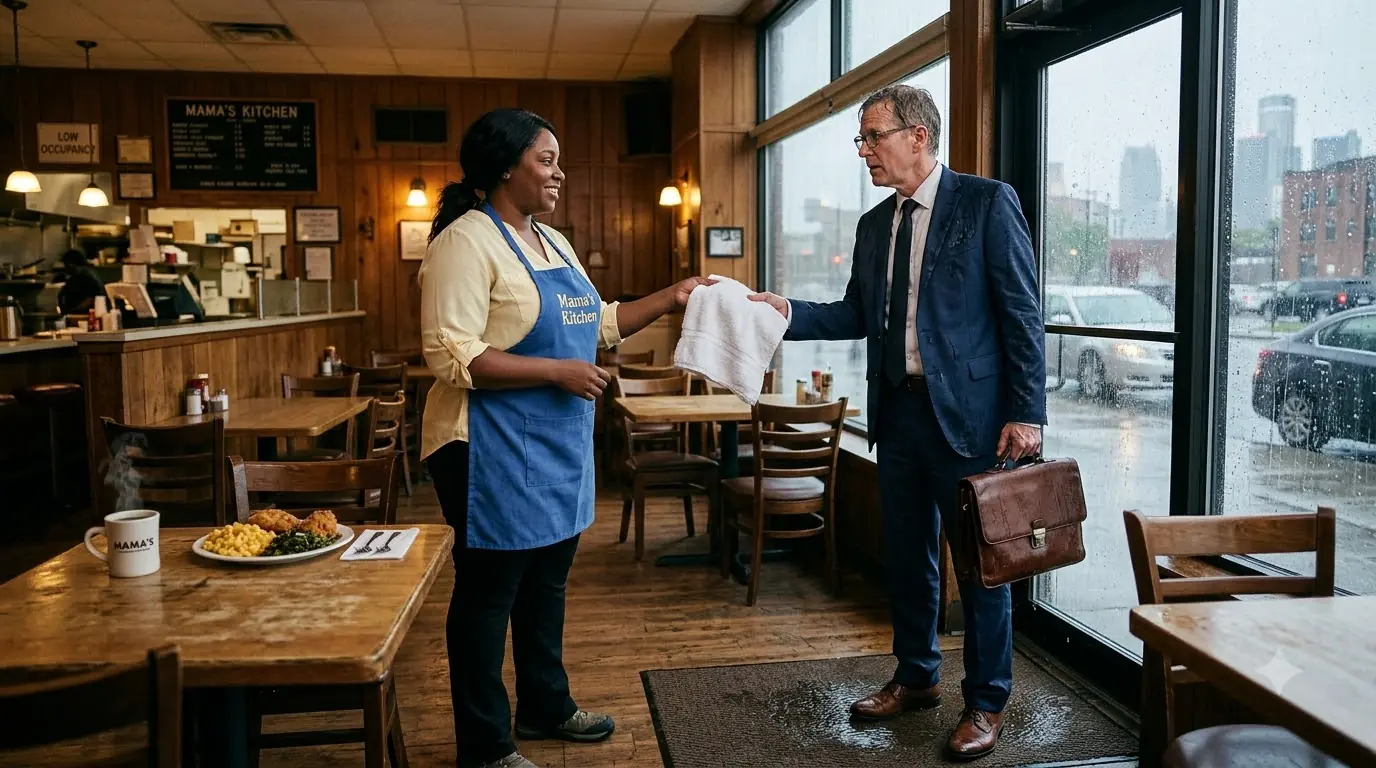
She unlocked the door and called into the storm, "Come in! You'll catch your death out there."
The man's grateful eyes met hers as water streamed from his designer clothes. She handed him towels without asking questions and started brewing fresh coffee as if he were family.
What Kesha did not know was that this storm-soaked stranger held the power either to save her dying restaurant or destroy it completely. The choice he made would change everything.
Twelve hours earlier, dawn broke over Detroit's Corktown district as Kesha pulled up to Mama's Kitchen at 5:00 a.m. sharp. It was the same time she had arrived every morning for the past three years, ever since her mother, Clara, died and left her the restaurant.
She sat in her beat-up Honda for a moment, staring at the building that held everything she had left in the world. The metal security gate bore fresh scratches from a break-in attempt the previous week, and the blue awning needed an $800 replacement she could not afford.
Taped to the front door was the notice that made her stomach tighten every time she saw it: "Foreclosure Notice - 30 Days Remaining."
Kesha took a deep breath, unlocked the gate, and stepped inside her mother's dream. The restaurant could seat forty people when it was packed, but lately she was lucky to fill ten chairs in an entire day.
Mismatched chairs surrounded worn wooden tables, and every piece of furniture carried a story. The corner booth had hosted the Martinez family's daughter's quinceanera, while the round table near the window was where Mr. Johnson proposed to his girlfriend the previous Christmas.
Faded photographs lined the walls like a timeline of better days. There was Clara flipping golden pancakes, the grand opening twenty-three years earlier with customers stretching around the block, and holiday gatherings from years when money was not tight and the future felt bright.
Each image felt like a ghost now. Kesha walked to the register and counted the previous day's earnings: $47.50.
She needed $3,200 for monthly rent, the electricity bill was $340 overdue, and the business savings account held $23.12. Her personal account was not much better.
She opened the calculator on her phone and added the minimum she needed to survive another month: rent, utilities, food costs, and employee wages. The total was about $6,000.
"Come on, Mama," she whispered to Clara's photograph behind the register. "Show me how to make miracles from nothing."
Even as she said it, Kesha knew the math. Three customers a day at an average of fifteen dollars did not equal survival; it equaled a slow death.
She began the morning prep anyway, dicing onions for the collard greens and seasoning mac and cheese that could feed fifty people but would probably serve eight. She mixed cornbread batter using Clara's exact recipe: two cups flour, one cup cornmeal, three eggs, and love.
"Always love," Clara used to say. "Love makes everything better, baby girl."
Every dish carried her mother's memory: the way Clara tasted everything twice before serving, adjusted seasoning depending on the weather, and whispered about the secret ingredient while stirring.
At 7:00 a.m., Kesha's nephew Jerome arrived looking exhausted. Nineteen years old, he had dreams of college and the work ethic to reach them, but he worked security at a warehouse from midnight to 6:00 a.m. before coming straight to Mama's Kitchen for morning prep.
"Tia," he said gently, using the Spanish nickname he had called her since childhood. "The morning crowd's getting smaller every week."
Kesha saw the worry in his dark eyes. This job paid for his community college classes, and losing it could mean losing his path forward.
"Maybe we should talk about-"
"Not today, baby," Kesha cut in, forcing optimism into her voice. "Today feels different."
"I can feel it."
The truth she refused to say aloud sat heavy in her chest. Her landlord, Mr. Patterson, had called twice the day before and left messages about "options" and "timeline flexibility," phrases that sounded suspiciously like preparation for eviction.
The health inspector had rescheduled the following week's visit, usually a bad sign, and the local food blogger who promised a review never showed. Her commercial insurance premium had jumped forty percent because of "neighborhood risk factors," which really meant too many break-ins, too much crime, and too much poverty.
At 9:00 a.m. sharp, Kesha flipped the sign to OPEN. Through the front window, she watched the neighborhood wake up.
Children headed to school with backpacks too large for their bodies, commuters hurried toward bus stops with phones pressed to their ears, and elderly residents began their daily walks over uneven sidewalks. This community had raised her, supported Clara's dream through good times and bad, and celebrated birthdays, graduations, engagements, and losses within these walls.
Kesha could not let them down.
Miss Dorothy arrived at 9:30. At seventy-three, arthritis had twisted her hands, but she refused to slow down.
She had worked at Mama's Kitchen for six years, ever since her husband died and Social Security was no longer enough to cover her rent. "Morning, honey," Dorothy said, tying on her apron.
"Are we ready for another day?"
"We're always ready," Kesha replied, swallowing the fear that threatened to spill over.
What she did not say was that Dorothy needed this job more than anyone. She needed the income, the purpose, and the family feeling that came from feeding people who appreciated her work.
Together they prepared for a day that might bring enough customers to matter, or might not. Kesha adjusted wilted discount flowers in a mason jar, reviving them with sugar water and hope.
"Lord," she whispered, "I'm not asking for much. Just enough to keep going."
"Just enough to honor Mama's memory."
By 2:00 p.m., only two customers had entered Mama's Kitchen. Mrs. Brooks ordered coffee and sweet potato pie, and Mr. Williams bought cornbread to go, bringing total earnings to $12.50.
Kesha stood behind the register practicing the speech for the next day's bank meeting. She had written it on a napkin and rehearsed it twenty times.
"Mr. Davidson, I know the loan payment is overdue, but if you could give me just thirty more days..."
Her phone buzzed with a weather alert. Severe thunderstorm warning, tornado watch, dangerous winds, and flooding expected.
Through the front window, the sky darkened unnaturally fast, as if someone had dimmed the entire city. Wind rattled the old windows, then the first drops hit.
Within minutes, sheets of rain blurred the street. Lightning cracked overhead and thunder followed almost immediately, meaning the storm was directly above them.
Kesha moved quickly, unplugging electronics and lighting candles in case the power failed. She had lived in Detroit long enough to recognize the kind of storm that flooded intersections and sent people running for cover.
Cars crawled through rising water on Michigan Avenue. Pedestrians ducked beneath awnings and into doorways while the few people still outside moved with urgency.
That was when Kesha saw him.
Through the rain-distorted glass, a tall figure stumbled down the sidewalk. He was well dressed despite being completely soaked and clutched a leather briefcase protectively against his chest.
His suit caught Kesha's attention immediately. Her mother had once altered clothing for wealthy clients, and she had taught Kesha how to recognize expensive tailoring.
The man's clothes probably cost more than many people earned in a month, but at that moment he looked helpless. His dress shoes slipped on the wet pavement as he shielded his face from the driving rain.
Water streamed from his silver hair and his expensive glasses fogged with moisture. He stopped under the broken streetlight outside Mama's Kitchen, pulled out what looked like a high-end phone, and stared at a dead screen.
The man looked left, then right, obviously disoriented. Hail began pounding the metal awning above the restaurant with a thunderous drumbeat.
Most people would have assumed he could afford a taxi or had resources that made him someone else's problem. Kesha saw only a person who needed help.
Something in his posture reminded her of her father during his final illness: proud but vulnerable, dignified but desperate. She moved toward the door.
"Tia, don't be stupid," Jerome called from the kitchen, where he had been washing dishes. "You don't know this guy."
"Baby, I know enough," Kesha replied, already turning the deadbolt.
Clara Williams had never turned away a person in need, regardless of bank account or ZIP code. Kesha knew exactly what her mother would have done.
The wind fought against the door when Kesha opened it, immediately soaking her apron. "Sir!"
"Come inside!"
The man looked up, startled. Through the downpour, she saw distinguished features and kind eyes behind fogged glasses.
There was something almost familiar about the way he carried himself, though she could not place it. He hesitated, which struck her as strange for someone being offered shelter from a dangerous storm.
"Please!" she shouted over another crack of thunder.
"You'll get sick out there."
The hesitation broke and he hurried toward her, holding the briefcase high against the rain. As he crossed the threshold, Kesha noticed details that did not fit the neighborhood.
His watch gleamed beneath the water, sophisticated and clearly custom-made. Even soaked, his shoes showed hand stitching and premium leather.
This man did not belong in struggling Corktown. Kesha wondered what he had been doing there alone in a thunderstorm, but she did not ask.
"Thank you," he said, breathing hard from the short sprint. "I..."
"my driver was supposed to meet me, but-"
Driver. Of course he had a driver.
"Don't worry about that now," Kesha said, locking the door behind him. "Let me get you towels and some hot coffee."
She did not question why the driver had left him stranded, ask about the expensive briefcase, or comment on the gulf between his obvious wealth and her nearly empty restaurant. Those questions felt invasive when someone simply needed shelter.
She returned with three thick towels and her warmest smile. "Here, sugar."
"Get yourself dry."
The stranger accepted them with surprising grace. He dried his face and silver hair, then carefully wiped the briefcase before tending to the rest of himself.
"I'm Robert Brooks," he said, extending a damp hand.
"Kesha Williams. This is Mama's Kitchen," she replied proudly.
"Been in my family twenty-three years."
Robert's eyes moved around the restaurant with unexpected attention. He noticed the family photographs, the handwritten menu board, the mismatched chairs, and the community bulletin board covered with job postings, lost-pet flyers, thank-you notes, and a handwritten message saying, "Support local business."
"Mama's Kitchen needs customers."
"Coffee's fresh," Kesha said, moving behind the counter. "And if you're hungry, I've got cornbread that'll warm you right up."
She did not mention that the cornbread was from the previous day. Pride told her that guests received abundance, even when abundance required creative presentation.
Robert accepted the steaming mug with both hands and inhaled deeply. "This smells incredible."
"I haven't had real coffee in weeks."
As he sipped, his shoulders relaxed. Some of the tension seemed to leave him.
Kesha adjusted the heater vent toward him and brought honey and cream without being asked. His phone remained waterlogged and unresponsive.
"Where are you trying to get to?" she asked.
Robert paused a fraction too long, as though calculating his answer. "Downtown."
"The Renaissance Center."
"That's a good twenty-minute drive in this weather," Kesha said. "Longer with flooding."
"You're stuck here until this passes."
Her tone allowed no argument. "Let me heat up some real food."
"Can't send you back out there on coffee."
She disappeared into the kitchen, leaving Robert alone with his thoughts and briefcase. From the prep area, she watched him discreetly as he studied the restaurant's setup, the cleanliness despite the age, and the way everything had been maintained with love when money was unavailable.
Robert opened the briefcase slightly. Kesha caught glimpses of legal documents, financial reports, and a folder whose title she could not read.
Something small slipped out and caught the light: a silver keychain engraved with an elegant logo. Robert retrieved it quickly and handled it with an almost reverent care.
Twenty minutes later, Kesha emerged with a full plate: mac and cheese with a golden crust, collard greens, fresh cornbread with honey butter, and a generous slice of sweet potato pie. "Mama's special."
"No charge. Storm victims eat free."
Robert stared at the plate as if he had not seen home cooking in years. He took a bite of mac and cheese, closed his eyes, and smiled.
"This is extraordinary. Secret ingredient?"
Kesha winked. "Love."
As Robert ate, the corporate stiffness disappeared. He asked about Clara's recipes, the neighborhood, and how long the restaurant had been operating.
His questions felt genuine rather than politely obligatory. Eventually he asked, "Is business good?"
Kesha's smile faltered for only a moment. "You know, ups and downs."
"The economy's been tough on small businesses."
She did not mention the foreclosure notice, the empty seats, or the sleepless nights spent calculating impossible numbers. Robert's observant eyes, however, took in the overdue bills near the register, the overly clean dining room that suggested few customers, and the slight tremor in her hands when she thought he was not looking.
Outside, the storm eased from a downpour to steady rain. Robert looked toward the window.
"I should call for a ride."
"Use my phone," Kesha said, handing it over without hesitation.
Robert dialed and spoke with the authority of someone accustomed to immediate responses. The person on the other end recognized him at once.
"James, yes, I'm safe. Send a car to..."
Robert looked at Kesha.
"Corner of Michigan and 14th," she supplied. "Tell them to look for the soul food place with the blue awning."
After hanging up, Robert reached for an expensive leather wallet filled with cards and cash. "Let me pay for the meal at least."
"Absolutely not," Kesha said with quiet finality. "Hospitality isn't for sale."
"Besides, you'd do the same for me."
Robert studied her face, taking in the dignity behind the refusal. "Yes," he said slowly.
"I believe I would."
Something in his tone made it sound as if he was surprised by the idea of someone refusing money without wanting anything else. Kesha simply began clearing dishes.
"You have family, Robert?"
"Not really. Work keeps me..."
The loneliness in his voice triggered Kesha's maternal instincts. Successful or not, he sounded like a man who needed more than meetings, drivers, and boardrooms.
"Well, you have family now," she told him. "Mama's Kitchen is always here if you need shelter from another storm."
Robert looked around at the photographs, the community board, and the warm room. "Family," he repeated quietly.
"I haven't had that in a very long time."
A black sedan with tinted windows pulled up outside. The driver emerged carrying an umbrella, moving with practiced efficiency.
Robert rose and straightened his dry suit. "I cannot express how grateful I am."
"Your kindness today was nothing special," Kesha interrupted gently. "Just what neighbors do."
"Neighbors," Robert repeated, testing the word. "I haven't had neighbors in a very long time."
"Well, you got them now. Door's always open if you need shelter from another storm."
Robert pulled out a business card made from thick, expensive stock and handed it to her. It read, "Robert Brooks, Chief Executive Officer," followed by a phone number and email address, but no company name.
As Kesha accepted it, the silver keychain fell from his jacket pocket and struck the floor. They both reached for it and their hands brushed as Kesha picked it up.
The logo was elegant and minimalist, a stylized letter intertwined with the shape of a building or tower. It looked familiar but remained just beyond recognition.
"Thank you," Robert said, taking it carefully. "This was my father's."
Kesha noticed that the same emblem appeared in the face of his custom watch. Whoever Robert was, family history clearly mattered to him.
The sedan's driver stepped inside. "Mr. Brooks, we should proceed."
"The board meeting was rescheduled for 4:30."
Board meeting. Another clue.
Robert turned back to Kesha. "If there's ever anything I can do-"
"Just take care of yourself out there," she said. "And maybe avoid walking in storms."
Robert laughed, the first completely relaxed sound Kesha had heard from him. "I'll try to remember that."
Before leaving, he paused at the community bulletin board. His gaze settled on Dorothy's shaky handwritten flyer asking people to support Mama's Kitchen.
"Your customers are loyal," he observed.
"Like family," Kesha said. "This neighborhood takes care of its own."
Robert nodded slowly. "Family."
"Yes, I can see that."
The sedan door closed and the car disappeared along Michigan Avenue. Kesha tucked Robert's card into the register beside overdue bills and Dorothy's flyer.
Jerome emerged from the kitchen. "Who was that guy, Tia?"
"Just someone caught in the storm. Said his name was Robert Brooks."
Jerome paused. "That name sounds familiar."
"Like news familiar. Business familiar."
He reached for his phone. "Let me Google him."
"Baby, don't," Kesha said gently. "Man's entitled to his privacy."
"Storm's over. He's gone."
"Life goes on."
Still, something felt unfinished. Robert had studied their operation, asked pointed questions, and lingered over details most wealthy strangers would have ignored.
Later that evening, Jerome helped Kesha close the restaurant. They counted the day's earnings: $47, better than expected after the storm, but still nowhere near sustainable.
Robert's business card sat beside the register, heavy between Kesha's fingers. Jerome glanced at it again but respected her decision not to search the name.
Across Detroit, Robert Brooks sat in his penthouse office overlooking the city through floor-to-ceiling windows. His assistant, Sarah Kim, brought him notes from the board meeting he had rescheduled because of the storm.
"The Detroit acquisition project is ready for final approval," she said. "Legal has reviewed all properties in the target zone."
Robert accepted the folder without much interest and began turning pages. The project involved buying struggling Corktown properties below market value, clearing them, and constructing luxury retail and residential developments.
On page forty-seven, a familiar address stopped him cold: the corner of Michigan and 14th Street. The file identified the current tenant as Mama's Kitchen, Soul Food Restaurant, with the status listed as "behind on rent, foreclosure pending, excellent redevelopment potential."
Robert stared at the page for a long time. It was the same corner where he had found shelter, the same room where Kesha had refused his money and called him family.
Sarah waited beside the desk. "Sir, should I confirm tomorrow's demolition survey appointments?"
"Cancel them," Robert said quietly.
Sarah blinked. "All of them?"
"All of them. I need to review the project parameters."
After she left, Robert opened a desk drawer and removed the silver keychain. It had belonged to his father, the man who had taught him that profit without compassion was simply another form of theft.
Robert had spent years telling himself that expansion, acquisition, and redevelopment were neutral business concepts. That evening, those words suddenly looked different beside Kesha's foreclosure file.
He called his driver. "James, I need you to research something quietly."
"Everything about a restaurant called Mama's Kitchen: financial status, community impact, family history, everything."
Robert looked again at the acquisition folder. "And James, do it tonight."
"I have a feeling time is running out."
Three days later, Kesha's phone rang during morning prep. The number was unfamiliar.
"Miss Williams, this is Sarah Kim from Brooks Development Corporation. Mr. Brooks would like to schedule a meeting with you regarding your restaurant."
Kesha's blood turned cold. Brooks Development Corporation was the company buying properties throughout Corktown, replacing long-standing businesses with luxury condominiums, boutique stores, and high-end developments.
Robert Brooks was not merely a corporate executive. He was the man at the center of the company reshaping her neighborhood.
"I don't understand," Kesha said. "What kind of meeting?"
"Mr. Brooks would prefer to discuss that in person. Would tomorrow at 2:00 p.m. work?"
Kesha ended the call with shaking hands. Within an hour, Jerome, Dorothy, and Santiago had gathered around the center table for an emergency family meeting.
"Brooks Development bought Murphy's hardware store last month," Dorothy said grimly. "Tore it down in two weeks."
"Now it's supposed to be some fancy coffee shop charging eight dollars for what we make for two."
Santiago nodded. "And the Rodriguez family grocery store."
"They offered half what the building was worth. The family couldn't afford to fight."
Jerome finally pulled up Brooks Development's website. The homepage showed Robert in a crisp suit standing in front of a gleaming skyscraper beneath the slogan, "Transforming communities through strategic development."
Everyone at the table knew what "transforming" had looked like in Corktown. It meant people who had been there for decades were suddenly unable to stay.
"He was casing the place," Jerome said, anger rising in his voice. "All those questions about the business, studying the layout, looking at our customer base."
"He wasn't just lost."
Kesha stared at Robert's photograph on the phone. She remembered the kind eyes, the grateful smile over her coffee, and the quiet way he had said the restaurant felt like family.
Had all of it been an act?
"What do we do, Tia?" Jerome asked.
"We meet with him," Kesha said. "And we find out exactly what he wants."
The following afternoon, Robert arrived in the same black sedan, but this time he brought Sarah and a senior acquisitions associate carrying a leather portfolio. The atmosphere was completely different from the evening of the storm.
Robert's casual warmth had been replaced by professional courtesy. He sat across from Kesha as if Mama's Kitchen were a boardroom instead of the place where she had fed him for free.
"Miss Williams, I want to be direct with you," he began. "Brooks Development is interested in acquiring this property."
There it was. The truth without decoration.
"For how much?" Kesha asked, forcing her voice to remain steady.
Sarah slid a contract across the table. The figure at the bottom made Kesha blink twice: $450,000.
It was more money than Mama's Kitchen had ever generated, enough to erase every debt and leave a substantial amount behind. Robert explained that the offer was significantly above current market value for a restaurant already facing foreclosure.
The word foreclosure hung between them. Kesha realized instantly that Brooks Development had investigated everything.
"You've done your research," she said.
"It's what we do," Robert replied. "We identify properties with potential and make competitive offers."
His tone was neutral, but something in his expression looked conflicted. Three days earlier, he had sat in the same restaurant eating her mac and cheese and calling the food extraordinary.
"What happens to the restaurant?" Kesha asked.
"To the jobs? To the people who depend on this place?"
The acquisitions associate answered smoothly. "The development plan calls for mixed-use retail space."
"There could be opportunities for food-service vendors within the new structure."
Kesha heard the translation immediately. Mama's Kitchen would disappear and perhaps return as a small stall in someone else's building, stripped of the history that made it matter.
"And if I refuse?"
A long pause followed. Robert exchanged a glance with his team.
"The foreclosure process will proceed naturally," Sarah said diplomatically. "At that point, the property would likely sell at auction for significantly less than our current offer."
The threat was polite but unmistakable: take the money now or risk losing everything later for far less. Kesha looked around the restaurant at Clara's photographs, the community board, and the mismatched chairs that had hosted thousands of conversations.
Twenty-three years of history and three generations of recipes had been reduced to a number on a contract.
"I need time to consider this."
"Of course," Robert said. "We can give you forty-eight hours."
His team began packing their documents, but Robert lingered after Sarah and the associate stepped outside. The professional mask slipped slightly when he was alone with Kesha.
"Kesha, the offer is genuinely fair," he said. "More than fair."
"You could start over anywhere. Do anything."
"Could I?" Her quiet disappointment cut deeper than anger.
"Could I rebuild twenty-three years of community trust? Could I replace my mother's legacy?"
"Could I find jobs for Jerome and Dorothy and Santiago that actually matter to them?"
Robert had no answer.
"Three days ago, you told me this neighborhood takes care of its own," Kesha continued. "You said you could see we were like family."
"I guess I misunderstood what that meant to you."
The words struck him visibly. Kesha held his eyes.
"I thought you were different. I thought maybe you understood what this place means, but you're just another developer who sees dollar signs where other people see home."
Robert left carrying the weight of her words with him. For the first time in years, a business decision felt like a betrayal rather than a transaction.
That evening, he sat alone in his penthouse office staring at two documents representing two different futures. One was the approved Brooks Development acquisition contract for Mama's Kitchen, ready for his signature.
The other was a handwritten letter he had rewritten repeatedly for three hours. Every draft sounded too corporate and too far from what he was actually trying to say.
His father's keychain lay between the papers. Robert remembered the phrase he had heard throughout childhood: "Profit without compassion is just theft."
He had built an empire by gradually forgetting that lesson. He had convinced himself that displacement could be called progress if the numbers looked good enough.
Then Kesha Williams had opened her door in a storm and fed him without asking what he could do for her.
Robert picked up the phone. "James, I need you to take me somewhere."
"And we're going alone. No Sarah, no associates, no contracts."
At 8:00 p.m., Robert knocked on Mama's Kitchen's locked door. Through the window, he saw Kesha counting receipts by lamplight beneath the foreclosure notice.
She opened the door with visible reluctance. "We're closed, Mr. Brooks."
"I know. I came because I need to explain something."
"May I come in?"
Something vulnerable and uncertain in his voice made her step aside. Robert entered the restaurant that felt completely different without lawyers, contracts, and corporate staff filling the room.
Surrounded by Clara's photographs and neighborhood memories, demolition no longer looked like strategy. It looked like cultural vandalism.
"I owe you an apology," Robert began. "And the truth."
Kesha crossed her arms but listened.
"Three days ago, I wasn't simply lost in a storm. I was conducting site surveys for our development project."
"Your restaurant was already on our acquisition list."
The admission landed hard. Jerome's suspicion had been correct.
"So you were casing the place."
"Initially, yes." Robert sat down, suddenly looking older than he had in the boardroom.
"But something happened that I didn't expect."
He told her that she had treated him like a human being instead of a business opportunity. She had offered genuine hospitality to a stranger and refused payment even though she clearly needed every dollar she could get.
"You didn't refuse money because you could afford to," he said. "You refused because caring for someone isn't transactional to you."
Kesha's expression softened slightly, though she remained guarded.
Robert explained that after returning to his office, he tried to proceed as usual: approve acquisitions, sign contracts, and move the project forward. Instead, he kept hearing her say that the neighborhood took care of its own.
Then he pulled out his phone and showed her a faded photograph. It pictured a small grocery store with "Brooks Market" painted across the window and a young boy standing beside an older man in matching aprons.
"My father came here from Taiwan with two hundred dollars and a dream of serving his community," Robert said. "He built Brooks Market in Chinatown, and for thirty years it was exactly what Mama's Kitchen is now: a gathering place, a source of jobs, a cornerstone of neighborhood life."
Kesha saw the parallel immediately. "What happened to it?"
"Developers bought the block. They offered my father twice what the store was worth."
"He took the money and used it to start what eventually became Brooks Development Corporation."
Robert's voice carried old pain. "He thought he was making the smart decision, building something bigger, but he never stopped missing the store or the people who had made it matter."
Kesha finally understood why Robert handled the keychain with such care.
"Those were the keys to Brooks Market," he said. "The only thing he kept when the store was sold."
Robert looked directly at her. "He died five years ago."
"Before he passed, he made me promise to remember that businesses aren't just numbers on spreadsheets. They're people's lives."
Silence stretched between them. Kesha looked at Clara's photograph behind the register.
"So what are you saying, Robert?"
"I'm saying I want to honor that promise, and I want to make you an offer that has nothing to do with acquisition."
Robert pulled out a new document, not the polished corporate contract from the previous day but a personal proposal he had drafted himself. "I want to become your business partner, not buy you out."
The proposal called for an immediate $200,000 capital investment. It would pay off the restaurant's debts, renovate the kitchen, expand seating, and give Mama's Kitchen enough operating stability to stop living from one desperate day to the next.
"In exchange for what?" Kesha asked.
"Twenty percent equity. You retain full creative and operational control."
"I provide capital, business expertise, and connections. The restaurant stays what it is: a community cornerstone."
Kesha stared at the paper. It was not simply money; it was validation of everything she had been fighting to preserve.
"There's more," Robert said. "I want Mama's Kitchen to become the first project in a new development model."
Instead of demolishing struggling neighborhood businesses, Brooks Development would identify community anchors and invest in them. The company would provide financing, resources, and protection from displacement while allowing local owners to remain in control.
"You want to start with Mama's Kitchen?"
"I want to start with Mama's Kitchen. If we can prove community-centered development can also be profitable, we'll expand the model across Detroit and possibly beyond."
Kesha looked around the restaurant with new eyes. What had seemed like a dying family business could become the seed of something much larger.
Still, she did not surrender her caution. "Why should I trust you?"
"Yesterday you were ready to tear this place down."
Robert reached into his jacket, removed his father's keychain, and placed it on the table between them. "Because I'm betting my father's memory on this."
"And because you reminded me that some things are worth more than profit margins."
Kesha picked up the keychain and felt its weight in her palm. "Your father would be proud."
"I hope so. More importantly, I think my father and your mother would have understood each other."
"They both built something bigger than themselves."
For the first time since Robert revealed his identity, Kesha smiled without reservation. "Mama always said the best partnerships start with shared values, not shared profits."
"Then we have a foundation." Robert extended his hand.
"Partners?"
Kesha shook it firmly. "Partners, but I have conditions."
"Name them."
"Jerome, Dorothy, and Santiago keep their jobs, with raises. The menu stays true to Mama's recipes."
"And we don't change the name. This will always be Mama's Kitchen."
Robert nodded. "Agreed."
"All of it." Six months later, Mama's Kitchen buzzed with the kind of energy Kesha had once feared she would never see again.
The renovation doubled the seating capacity while preserving the restaurant's original character.
Clara's photographs now hung in custom frames under soft lighting that made the memories glow. The community bulletin board had expanded across an entire wall, overflowing with job postings, thank-you notes, neighborhood announcements, and scholarship celebrations.
The kitchen gleamed with professional equipment, including workstations chosen to make prep easier on Dorothy's arthritic hands. Kesha had insisted that every upgrade solve a real problem rather than simply make the room look expensive.
Jerome no longer worked two jobs. As assistant manager of Mama's Kitchen, he earned enough to attend Wayne State University part-time, studying business administration with dreams of eventually opening a second location.
Dorothy coordinated a new community care program offering free meals for seniors every Tuesday, subsidized lunches for struggling families, and cooking classes for neighborhood children. Her official title was Director of Community Outreach, and she wore it with fierce pride.
Santiago now managed a staff of eight, including three other immigrants who had found steady work and dignity through Mama's Kitchen's expansion. His youngest daughter spoke fluent English, his oldest had earned a community college scholarship, and his wife launched a catering business using Mama's Kitchen as her commercial kitchen base.
The local food blogger who had once stood Kesha up finally published a glowing review titled, "Mama's Kitchen: Where Soul Food Meets Social Change." The restaurant soon appeared in Detroit Magazine and Midwest Living, followed eventually by a Food & Wine feature about community-centered dining.
The changes reached far beyond a single restaurant. Brooks Development launched its community investment initiative with Mama's Kitchen as the flagship example.
Instead of buying struggling neighborhood businesses only to demolish them, the company began identifying local anchors worth preserving. It offered capital, renovation support, and business expertise while allowing owners to remain part of what they had built.
Murphy's Hardware, which had been marked for demolition six months earlier, received a $75,000 renovation loan through the program. Old Man Murphy expanded into tool rental and weekend do-it-yourself workshops, creating jobs while serving needs the big-box stores ignored.
The Rodriguez family's grocery store became a community fresh market after receiving Brooks Development funding. They expanded their produce section, added a small pharmacy, and created a meeting room in the back where neighbors could gather.
Local news covered the changes with headlines about a Detroit neighborhood fighting displacement through partnership. National outlets picked up the story, Harvard Business School requested case-study materials, and urban planning conferences invited Robert to speak about profitable community development.
The changes Robert valued most did not appear in headlines. Mrs. Patterson, an eighty-seven-year-old widow from down the block, had not missed a Tuesday senior meal in four months.
She brought photographs of her late husband to share with other diners and rediscovered the kind of community she had lost as old neighbors moved away. Mama's Kitchen gave her somewhere to belong again.
Marcus, a teenager who bused tables after school, saved enough for his first car. His wages also gave his family enough stability that college application fees no longer felt impossible.
Monthly community forums in Mama's Kitchen's expanded dining room drew more than forty neighbors at a time. They discussed school board elections, block parties, safety concerns, small-business needs, and whatever else mattered locally.
Kesha liked to say that democracy happened naturally around tables where people shared food and stories. The restaurant was proving her point.
Robert moved his office from a downtown high-rise to a renovated building two blocks from Mama's Kitchen. He walked to work, stopped for coffee, and learned the names of business owners who knew him as a neighbor rather than a net worth.
Brooks Development still built luxury projects, but the company now balanced them with community investment. Profit margins were sometimes smaller, yet employee retention improved and the company's reputation shifted from neighborhood gentrifier to community partner.
One Friday evening, six months after the partnership began, Kesha stood in the kitchen during the dinner rush. Orders moved smoothly, staff crossed paths with practiced efficiency, and the dining room echoed with satisfied conversation.
Through the pass-through window, she saw Robert at table seven sharing dinner with his elderly aunt, who visited monthly from San Francisco. He was not a CEO conducting business that night, just a nephew enjoying family time in a place that had become his second home.
The cash register showed numbers Kesha could barely have imagined eight months earlier. More important to her, the community board overflowed with job announcements paying living wages, thank-you notes from families who had found stability, and photographs of neighborhood children graduating, getting married, and starting businesses.
This, Kesha thought, was what success looked like when measured in human terms instead of only financial ones.
Robert caught her eye through the window and raised his coffee cup in a small toast. To partnership, to community, and to the storm that had brought them together.
Kesha smiled back, hearing Clara's voice in memory. "Love makes everything better, baby girl."
Her mother had been right. Sometimes love simply needed help from an unexpected place.
One year after that first storm, another heavy rain rolled through Detroit. It was not as fierce, but it was enough to send people searching for shelter.
Kesha watched from windows that no longer needed security gates. The foreclosure notice was long gone, replaced by framed reviews and a plaque recognizing Mama's Kitchen's growing reputation.
At 3:00 p.m., someone pounded urgently on the door. Through rain-streaked glass, Kesha saw a young woman, perhaps twenty-five, soaked through and clutching a baby against her chest.
Behind her, an older man in work clothes fought with an umbrella that the wind had turned inside out. Without hesitation, Kesha opened the door.
"Come in! Come in!"
"You'll catch your death out there."
The words echoed exactly what she had said to Robert a year earlier. The young woman hurried inside, grateful tears mixing with rainwater.
"Thank you. My car broke down six blocks away, and my baby-"
"Don't worry about that now," Kesha said. "Let me get you towels and some hot soup."
Robert emerged from the kitchen wearing an apron. He had been learning Clara's cornbread recipe under Kesha's patient supervision and understood the situation immediately.
Without asking questions, he disappeared to gather dry clothing from the emergency supply Mama's Kitchen now kept for situations exactly like this one. The baby, about eight months old, stopped crying when Kesha gently took her.
"I'm Maria Santos," the young woman said as she caught her breath. "This is my daughter, Sophia, and my grandfather, Eduardo."
"We were trying to get to a job interview downtown when-"
"Job interviews can wait," Kesha said firmly. "Storms don't respect schedules."
Over coffee and fresh cornbread, Maria's story unfolded. She had recently graduated from a community college culinary program and was raising Sophia with help from her grandfather after her husband died while serving in the military.
The interview downtown was for an assistant chef position, her first serious opportunity in the field. Robert and Kesha exchanged a meaningful glance.
"Maria," Kesha said carefully, "what kind of cooking experience do you have?"
"Traditional Mexican food, some French technique from school, but honestly, I just love feeding people. I like making people feel cared for through food."
Robert smiled. "How would you feel about a different kind of interview?"
Maria blinked. Robert continued, "We're looking for a sous-chef who understands that cooking is about community, not just cuisine."
The circle completed itself: a storm brought strangers to shelter, kindness was offered without expectation, and opportunity emerged through human connection. Maria's eyes widened with possibility.
Baby Sophia reached for the silver pendant around Kesha's neck, a small locket containing Clara's photograph. It caught the light in the same way Robert's father's keychain had a year earlier.
"Some storms," Kesha murmured to Robert, "bring exactly what we didn't know we needed."
Robert nodded, thinking of his father's words about profit and compassion and the keychain that still reminded him why the work mattered. Outside, the rain slowed to a gentle patter.
Inside Mama's Kitchen, the warmth continued. The tradition of kindness had become stronger, one storm, one stranger, and one act of grace at a time.
Kesha's choice had never been about money or strategy. It began when one person chose kindness over caution, opened her door to a stranger, and refused to profit from basic human decency.
That choice transformed two lives and rippled outward through a neighborhood. Mama's Kitchen survived not because Kesha abandoned what her mother taught her, but because she held onto it when doing so seemed impractical.
Robert changed because someone treated him as a person before she knew his title. Kesha's restaurant changed because he eventually remembered that businesses are made of people before they are made of numbers.
And in Corktown, the lesson remained visible every time someone entered Mama's Kitchen needing food, work, shelter, conversation, or simply a place where another person would notice them. The door stayed open, the coffee stayed hot, and Clara's oldest rule stayed alive: love makes everything better.