The laughter spread through Hangar Seven before Captain Marcus Webb had even finished pointing at the woman in pale-blue scrubs.
“Hey, nurse,” he called across the polished concrete floor. “Since you keep walking around our aircraft, why don’t you climb up there and start one?”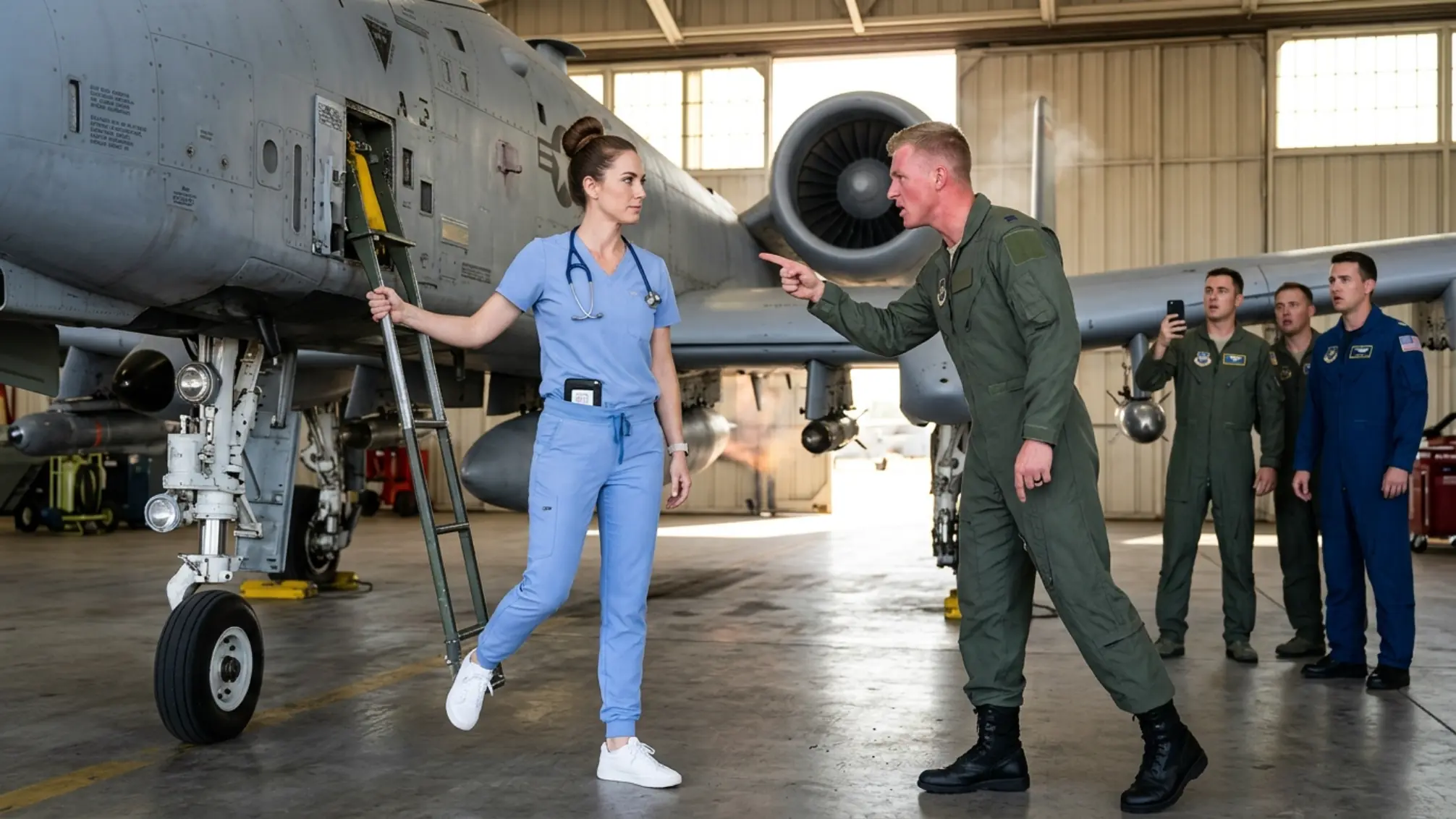
Three younger pilots standing behind him immediately reached for their phones. One lifted his camera toward the gray A-10 Thunderbolt positioned beneath the hangar lights, while another covered his mouth to hide a laugh. They expected the beautiful woman beside the boarding ladder to blush, retreat, or admit she had no idea what any of the switches inside the cockpit controlled.
Dr. Elena Carter did none of those things.
At thirty-four, Elena had flawless fair skin, striking blue eyes, delicate facial features, and long chestnut-brown hair secured in a neat high bun. A silver stethoscope rested against the fitted neckline of her medical scrubs, and clean white sneakers made almost no sound when she stepped away from the emergency supply cabinet. Her calm expression did not change as Marcus approached with the theatrical confidence of a man certain the entire room would support him.
For now, Marcus believed he had found another easy target.
Elena had arrived at Davis-Monthan Air Force Base twelve weeks earlier as a temporary flight nurse assigned to the aviation medical clinic. Officially, her duties included evaluating pilot health, reviewing emergency response procedures, inspecting trauma kits, and observing medical readiness during flight-line operations. Most personnel knew her only as the exceptionally beautiful nurse who spoke quietly, asked precise questions, and seemed more interested in checklists than conversation.
Unofficially, she had been assigned by the Inspector General’s office to conduct a concealed safety-culture investigation.
Three mechanics had reported pressure to approve aircraft with incomplete inspections. Two junior pilots claimed Marcus shortened mandatory briefings whenever they interfered with his schedule. A female technician who challenged one of his decisions found herself transferred to overnight inventory duty two days later.
The complaints shared one central problem.
Every person who raised concerns feared retaliation.
Elena’s medical role allowed her to move between the clinic, hangars, maintenance areas, and operations offices without attracting suspicion. She carried emergency equipment, asked health-related questions, and listened while people spoke freely around someone they considered support staff. A recording device inside her credential wallet captured every direct interaction relevant to the investigation.
Marcus had noticed her beauty immediately.
He had not noticed anything else.
During Elena’s first week, he asked whether nurses received special training for “looking good in scrubs.” The next week, he ordered her to bring coffee during a flight briefing she had attended to inspect emergency medical protocols. When she explained that refreshments were not part of her duties, he laughed and told the room she lacked teamwork.
She documented both incidents.
What concerned her more was his attitude toward safety. Marcus treated procedures as obstacles designed for less talented people. He rushed inspections, mocked cautious mechanics, and rewarded younger pilots who copied his confidence. His authority did not come from consistency or judgment; it came from making disagreement feel dangerous.
That morning, Elena had entered Hangar Seven to inspect oxygen equipment and emergency trauma supplies. The A-10 had returned from a training flight the previous afternoon and was scheduled for maintenance. Technical Sergeant Luis Rodriguez stood near the left wing with a tablet, reviewing a checklist while two mechanics examined the landing gear.
Elena noticed the red safety pin before anyone else did.
It remained inserted near the main landing-gear assembly, where it should have been removed after ground maintenance. Attempting certain system checks with the pin still installed could damage components and create a dangerous false indication inside the cockpit.
She crouched beside the wheel and removed nothing.
Instead, she called Luis.
“Sergeant, could you verify this before anyone continues?”
Luis walked over, followed her gaze, and stopped abruptly.
“Who left that in place?”
“I don’t know.”
He photographed the pin, marked its location, and began checking the maintenance log. Marcus entered the hangar during the discussion and immediately assumed Elena had interfered with the aircraft.
“What are you doing near my jet?”
“I identified a safety item and notified the maintenance supervisor.”
Marcus glanced at the pin. “Anyone could have spotted that.”
“Then someone should have.”
The younger pilots behind him exchanged looks.
Marcus disliked the answer because Elena had not delivered it defensively. She spoke as though his opinion carried no power over the facts. The calmness made him feel challenged in front of the men who usually laughed before he completed a joke.
He pointed toward the cockpit.
“Since you understand the aircraft so well, maybe you should start it for us.”
Luis looked up sharply. “Sir, that is not appropriate.”
Marcus waved him away. “Relax. She won’t get past the first switch.”
One of the pilots, Lieutenant Aaron Blake, lifted his phone. “This might be worth recording.”
Elena studied Marcus for several seconds.
“Are you formally directing me to enter the cockpit?”
The question should have warned him.
Instead, he grinned. “Absolutely. Show everyone what the clinic taught you.”
Captain Daniel Mills, the flight commander, emerged from the nearby office after hearing the laughter. He was thirty-seven, serious by appearance but hesitant whenever confronting Marcus directly. He asked what was happening, and Marcus described the challenge as harmless fun.
Daniel frowned. “No unauthorized person should enter that cockpit.”
Marcus shrugged. “Then stop her.”
Elena looked directly at Daniel. “Do you want me to remain on the floor?”
The correct answer was yes.
Daniel glanced at the phones, Marcus’s mocking smile, and the personnel gathering around them. Rather than risk appearing humorless, he chose the weakest possible response.
“Just do not touch anything.”
Marcus laughed again. “She would not know what to touch.”
Elena placed her stethoscope inside the medical bag. She checked that no loose objects remained in her scrub pockets, secured her hair, and approached the boarding ladder. Her movements were economical and familiar.
Luis watched more carefully than the others.
She did not search for the first foothold. Her right hand found the designated grip automatically. She climbed without looking down, avoided restricted surfaces, and entered the cockpit using the same sequence Luis had observed from experienced pilots for fifteen years.
Aaron’s phone lowered slightly.
“She has done that before.”
Marcus folded his arms. “She has watched people climb ladders.”
Elena settled into the seat and adjusted it. Her feet found the pedals. She positioned the mirrors, examined the instrument panel, and began verifying switch positions without touching anything prohibited.
The cockpit contained hundreds of controls, indicators, and systems. An untrained person would not know where to look first. Elena moved through the preliminary check in a deliberate sequence, pausing at each stage long enough to confirm the proper position.
Luis stepped beneath the cockpit.
“Ma’am, where did you learn that procedure?”
Elena looked down. “Are the maintenance records current?”
“They are.”
“Is the aircraft cleared for a ground engine test?”
Luis checked his tablet. “It is scheduled for one after the hydraulic inspection.”
Elena pointed toward the open access panel. “Utility pressure is below the normal resting range.”
Luis checked the digital record.
She was correct.
Marcus’s smile tightened. “Lucky observation.”
Elena continued. “The safety pin should be entered as a procedural discrepancy before any systems are activated.”
Luis began typing. “Already documenting it.”
Daniel stepped closer to the ladder. “Nurse Carter, I need you to climb down now.”
Marcus raised one hand. “Wait. She thinks she can start it.”
“I never said that,” Elena replied.
“You climbed into the seat.”
“Because you directed me to demonstrate what I knew.”
Marcus looked around at the growing audience. Backing down now would mean admitting the joke had turned against him. His ego required a larger challenge.
“If you can complete the startup correctly, I will apologize to you in front of everyone.”
Daniel shook his head. “Marcus, stop.”
“But when she fails,” Marcus continued, “she admits she was pretending to understand equipment she had no business touching.”
Elena met his stare through the canopy.
“Acceptable.”
The laughter vanished.
Luis moved closer. “Ma’am, before anything happens, I need to know whether you are qualified.”
Elena’s expression softened slightly. Luis was not mocking her. He was doing his job.
“I am qualified to conduct the procedure.”
“Can you prove it?”
“Yes.”
“Then please do so before continuing.”
Marcus stepped between Luis and the ladder. “Do not ruin this.”
“This is not entertainment,” Luis replied.
Marcus’s voice hardened. “I am giving you an order.”
“To permit an unidentified person to activate a multimillion-dollar aircraft?”
“She is a nurse pretending to be a pilot. Nothing will happen.”
Elena reached into her pocket and touched the black credential wallet but did not reveal it. Her instructions required her to maintain cover unless safety, legal necessity, or direct exposure made disclosure unavoidable. She could end the demonstration immediately.
But the moment had already revealed something important.
Marcus was willing to disregard security and safety rules to protect a joke. Daniel knew the situation was improper but lacked the courage to stop it. The younger pilots continued recording instead of intervening. Luis was the only person placing procedure above social pressure.
Elena decided the evidence needed to be unmistakable.
“Sergeant Rodriguez,” she said, “remain beside the aircraft and independently verify each step.”
Luis hesitated. “Yes, ma’am.”
Elena began calling out the preliminary sequence. She identified the auxiliary power controls, checked the electrical configuration, verified fuel quantity, reviewed hydraulic indications, and confirmed that the area behind the aircraft was clear.
Her language was exact.
Luis followed the technical checklist on his tablet. Every call matched.
Aaron stopped smiling.
Lieutenant Sean Chen moved closer to the wing. “How does she know this without reading?”
Marcus answered too quickly. “She memorized something.”
Elena activated the auxiliary power unit.
A high mechanical whine rose from the rear of the aircraft. Instrument lights came alive across the cockpit, and ventilation stirred the loose edge of Elena’s scrub top. She watched voltage, pressure, and temperature values stabilize before continuing.
The people near the aircraft stepped back.
Marcus stared upward, his confidence beginning to fracture.
“She should not have gotten that far.”
Luis looked at him. “She is following the procedure perfectly.”
Elena waited the required interval, then moved toward the first engine sequence.
Daniel reached for his radio. “We need operations control involved.”
“You needed them before she climbed the ladder,” Luis said.
Daniel ignored the criticism and began reporting an unauthorized engine start. Before he completed the call, the left engine started to spool.
The sound deepened rapidly.
Elena monitored temperature and oil pressure, allowing the engine to stabilize at idle. No hurried movements. No confusion. She made each adjustment with the disciplined precision of someone whose hands remembered the cockpit better than they remembered ordinary furniture.
The left engine came fully alive.
The hangar floor vibrated beneath Marcus’s boots.
Thirty seconds later, Elena began the right-side sequence. The second engine turned, caught, and settled into a steady roar beside the first.
Two TF34 engines filled Hangar Seven with power.
Aaron’s phone shook in his hand.
Sean whispered, “She is not guessing.”
Luis watched the readings. “Both engines stable.”
Elena completed the post-start checks. She tested controls within the approved ground limits, confirmed pressure across the required systems, and identified a small fluctuation in the right hydraulic indication.
“Sergeant, note intermittent pressure movement on the right side.”
Luis examined the reading. “Confirmed.”
Marcus stepped toward the ladder.
“Shut it down.”
Elena did not respond immediately because she was monitoring the instruments.
“I said shut it down!”
She turned her head toward him. “Do not approach the aircraft while the engines are operating.”
“You do not give me instructions.”
“Then follow the safety markings on the floor.”
Marcus crossed the painted boundary anyway.
Luis grabbed his arm. “Sir, stay clear of the intake zone.”
Marcus ripped himself free. His face was red now, not from amusement but from the realization that everyone had watched his intended victim outperform his assumptions. He pointed upward at Elena.
“You planned this.”
Elena began the shutdown sequence.
Marcus moved toward the ladder before both engines had fully spooled down. Luis blocked him again. The two men nearly collided as the younger pilots stepped backward.
When the engines finally fell silent, the hangar seemed unnaturally still.
Elena secured the cockpit and climbed down.
Marcus waited at the bottom.
The moment her white sneaker touched the concrete, he moved into her space and pointed toward the aircraft.
“Why are you operating that aircraft? You’re a nurse, not a pilot!”
Elena did not retreat.
“You ordered me to start it. Now get your hand away from me.”
Marcus reached toward her upper arm.
“Shut it down, or security will drag you across this hangar.”
“It is already shut down.”
“Do not get smart with me.”
Elena’s blue eyes hardened. “Do not touch me.”
He moved closer.
Luis stepped forward, but Elena raised one hand, stopping him. She opened the slim black wallet taken from her scrub pocket and held it between herself and Marcus.
“Call security,” she said. “Then explain why you threatened the investigator who once flew this jet.”
Marcus looked down.
The first credential identified Elena as a special investigator assigned through the Inspector General’s office. The second showed her previous aviation qualifications, including more than eight hundred hours in the A-10.
Recognition moved across Luis’s face.
“Elena Carter,” he whispered. “Call sign Nightingale.”
Aaron looked between Elena and the aircraft. “That was you?”
Years earlier, Elena had flown A-10s before a spinal injury during an emergency landing ended her combat-flight eligibility. Rather than leave aviation entirely, she completed medical training and became a registered trauma nurse specializing in flight medicine. Her rare combination of operational experience, medical expertise, and investigative training made her ideal for evaluating safety cultures others could not easily enter.
Marcus read the credential again.
“This is fake.”
A black command vehicle stopped outside the hangar.
Colonel Patricia Hayes entered with two security officers and a legal adviser. Her steel-gray hair was pinned neatly behind her head, and her expression suggested she had already heard enough through the radio.
She walked directly to Elena.
“Investigator Carter.”
Elena closed the wallet. “Colonel.”
Marcus stared. “You knew?”
Patricia looked at him. “I knew an undercover investigator had been assigned. I did not know which employee she was portraying.”
“She deceived us.”
“That was her assignment.”
Marcus pointed toward the A-10. “She operated an aircraft without authorization.”
Elena removed a small recorder from beneath the fold of her scrub pocket.
“You explicitly ordered me to demonstrate the startup procedure. Captain Mills declined to stop the demonstration. Sergeant Rodriguez repeatedly raised safety concerns. Every word was recorded.”
Daniel’s face went pale.
Patricia looked at Marcus. “Did you direct her to enter the cockpit?”
“It was a joke.”
“Did you order Sergeant Rodriguez to permit it?”
Marcus did not answer.
“Did you approach her physically after the shutdown?”
“She was insubordinate.”
“To whom?” Patricia asked. “She is not under your command.”
Marcus looked toward the pilots who had recorded the incident. None defended him.
Aaron lowered his phone.
“I filmed the whole thing,” he admitted.
“Preserve the original file,” Elena said. “Do not edit, share, or delete it.”
Marcus’s voice rose. “This is entrapment.”
Elena faced him. “Entrapment would require me to pressure you into conduct you were not predisposed to commit. I entered the hangar to inspect medical supplies. You initiated the humiliation, issued the challenge, ignored safety objections, and attempted to grab me when the result embarrassed you.”
Patricia turned to Daniel. “Why did you allow this?”
Daniel swallowed. “I thought it would end quickly.”
“You knew it violated procedure.”
“Yes, ma’am.”
“But you chose avoiding conflict over enforcing safety.”
Daniel lowered his head.
Patricia ordered security to escort Marcus away from the flight line pending a formal inquiry. His access credentials, flight authorization, and supervisory authority were suspended immediately.
As the officers approached, Marcus looked at Elena.
“You destroyed my career over a joke.”
“No,” she said. “You risked other people’s safety to protect your pride. I documented it.”
The investigation expanded that afternoon.
Elena’s twelve weeks of records included seventeen incidents involving abbreviated safety procedures, eleven examples of retaliation against personnel who raised concerns, and repeated pressure on maintenance teams to approve incomplete work. Audio captured Marcus insulting civilian employees, belittling junior technicians, and telling pilots that rules were written for people without talent.
Daniel had been informed of several incidents.
He had documented none.
Luis supplied names of mechanics transferred or punished after refusing to sign questionable maintenance forms. Once leadership formally guaranteed protection, more personnel came forward. The technician assigned to overnight inventory produced emails showing that Marcus had requested her reassignment hours after she reported a hydraulic discrepancy.
The problem was larger than cruelty toward one nurse.
Arrogance had entered operational decisions.
An aircraft had flown after an incomplete inspection. Another had returned with a hydraulic issue that maintenance personnel had been discouraged from documenting fully. Three hard landings had been classified as pilot technique rather than reviewed for procedural failures.
Elena’s cockpit demonstration became the clearest example of the culture she had investigated. Marcus believed expertise belonged only to people who looked important to him. He ignored Luis because Luis was enlisted maintenance staff. He humiliated Elena because she wore medical scrubs. He overrode Daniel because he knew Daniel avoided confrontation.
His leadership depended on everyone accepting the value he assigned them.
The formal hearing began two weeks later.
Elena testified first. She described her assignment, the safety concerns that led to it, and the events inside Hangar Seven. The panel watched Aaron’s recording, listened to Elena’s concealed audio, and reviewed Luis’s maintenance checklist confirming that every startup action had been performed correctly.
Marcus’s attorney argued that Elena encouraged the situation by accepting the challenge.
Elena answered calmly.
“I accepted because the order itself revealed the issue. A responsible leader would never use a complex aircraft as a prop for humiliating an employee.”
“Could you have declined?”
“Yes.”
“Then why didn’t you?”
“Because Captain Webb believed consequences depended on the identity of the person he mistreated. The investigation needed to establish whether his conduct changed only when authority appeared.”
The attorney paused. “And did it?”
“No. Even after seeing my credentials, he blamed me.”
Marcus was removed from leadership and flight duties. Further review found sufficient evidence of retaliation, repeated safety violations, and conduct unbecoming his position. Daniel lost his command role for knowingly permitting unsafe behavior and failing to act on earlier complaints.
Aaron and Sean received formal reprimands but remained eligible for rehabilitation. Both admitted participating in the ridicule and completed extensive professional-leadership training. Aaron later volunteered to speak with new officers about the moment he realized recording someone’s humiliation made him part of it.
Luis received a promotion and became the senior maintenance safety liaison. His new position gave technicians direct access to leadership when flight crews pressured them to overlook discrepancies.
Elena stayed for six additional months.
She did not return to her undercover role. Everyone knew who she was now, but her work continued openly through revised safety procedures, confidential reporting channels, and leadership workshops requiring senior personnel to listen to mechanics, medics, technicians, and civilian staff.
One afternoon, she entered Hangar Seven wearing blue scrubs again.
A young mechanic stood beside the same A-10, checking the right hydraulic system. He noticed Elena and straightened nervously.
“Ma’am, I found a pressure fluctuation.”
“Did you document it?”
“Yes.”
“Did anyone ask you to clear it anyway?”
“No, ma’am. The pilot said the aircraft would stay grounded until I was satisfied.”
Elena smiled.
“That is how it should work.”
The mechanic looked toward the cockpit. “Is it true you started this aircraft without a checklist?”
“I had a checklist.”
“I never saw one.”
Elena tapped two fingers against her temple. “It was here.”
He laughed, then returned to work.
Across the hangar, pilots spoke respectfully with maintenance crews before a scheduled inspection. Nobody used support staff as entertainment. Nobody dismissed a warning because it came from someone with a lower title.
The transformation was not perfect.
Real culture change rarely was.
But personnel no longer believed silence was the safest choice.
On Elena’s final day, Patricia Hayes joined her beside the A-10. The aircraft rested beneath the lights exactly where it had during Marcus’s challenge.
“Do you miss flying?” Patricia asked.
“Every day.”
“Would you return if you could?”
Elena looked through the canopy at the cockpit that had once felt more familiar than any room on earth.
“No,” she said after a moment. “I would return to who I was then. That is not the same thing.”
Patricia nodded. “What will you do next?”
“The Inspector General wants me to lead safety-culture reviews across several aviation units.”
“That sounds exhausting.”
“It probably will be.”
“Will you wear scrubs again?”
Elena smiled. “Only if the assignment requires honesty from people who become careful around visible authority.”
They stood together as the hangar doors opened and Arizona sunlight crossed the floor.
The A-10 remained silent, but Elena could still feel the remembered vibration of its twin engines moving through her body. Marcus had believed starting the jet would expose her ignorance. Instead, the roar exposed his leadership, his contempt, and every person who had learned to stay quiet beneath it.
Elena placed the silver stethoscope around her neck and walked toward the medical clinic.
Behind her, the aircraft waited beneath the hangar lights—not as a weapon, a trophy, or a tool for someone’s joke, but as a complex machine protected by hundreds of people whose knowledge mattered equally.
The beautiful nurse had not needed the cockpit to prove her worth.
She had entered it so everyone else could finally see what their arrogance had taught them to ignore.