The Prairie Star Travel Mart looked warm and ordinary from the highway, but behind it, an eight-year-old boy was turning into ice.
For sixteen months, Mason Reed had lived under a guardian who looked like a savior in public and like a jailer at home.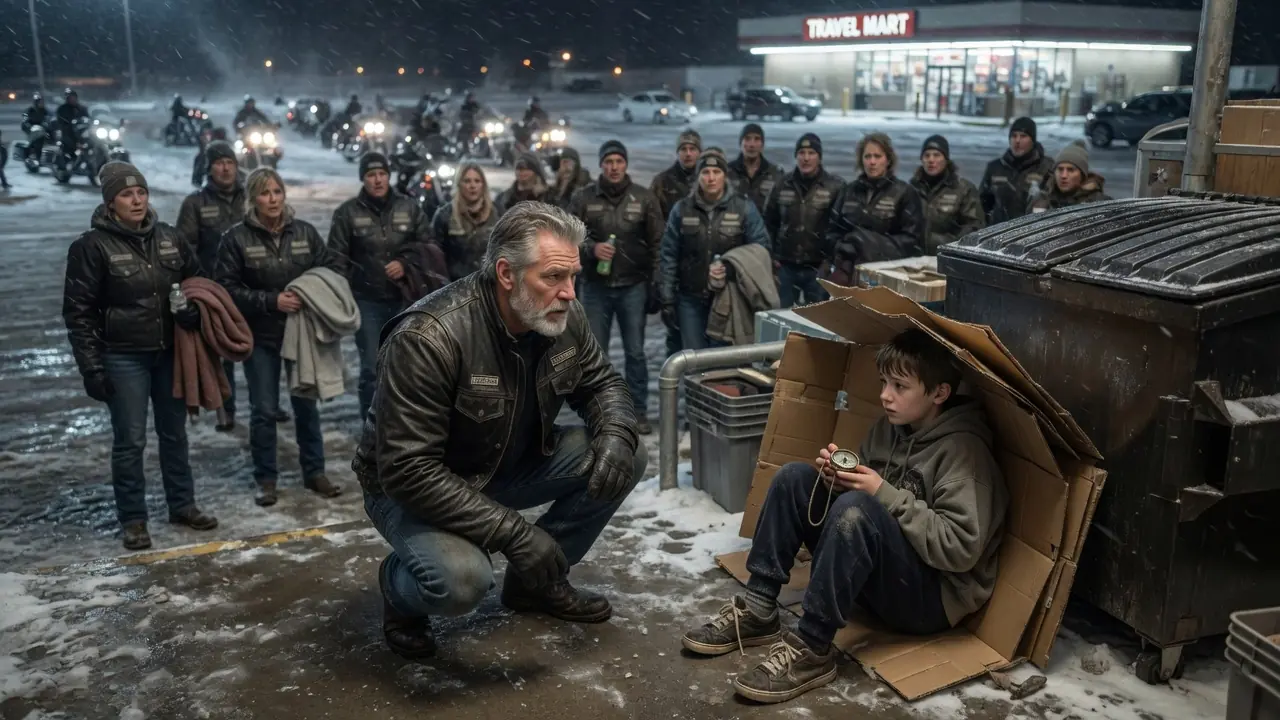
In the next twelve minutes, Hank “Atlas” Monroe would have to keep Mason awake long enough for an ambulance to arrive.
But what happened before sunrise would expose a countdown already marked on a calendar, and it would pull one hundred eighty Hells Angels into a town that had trained itself to look away.
This is Mason and Atlas’s story, and the ending will remind you that the gentlest help sometimes comes in the loudest leather.
One stopped bike changed everything.
“Please don’t send me back. He’ll smile, and they’ll believe him.”
Mason Reed was eight years old, pale under the parking lot lights, his lips tinged a bruised purple that made Atlas’s stomach drop.
Atlas had stopped at the Prairie Star Travel Mart outside Sundown Junction, North Dakota, for fuel and coffee. Nothing more. The neon sign promised hot food twenty-four hours a day, like a guarantee the world was still decent.
Behind the building, the wind cut down the alley like a blade.
Atlas heard a faint tapping first.
Tap, tap.
Pause.
Like someone knocking on plastic with a weak hand.
He followed it around the corner and saw what the shadows were hiding.
A small body wedged against the dumpster’s base.
Cardboard draped over him like a failed blanket.
Snow packed into the folds of a hoodie that was far too thin for the weather.
Mason’s shoes did not match. One sneaker was missing its lace. The other had a split sole that gaped open when he tried to move.
His sweatpants were soaked from the knee down, and his fingers, when they slipped out for a second, were pale at the tips, darkening toward the knuckles.
Atlas crouched low, making himself smaller.
“Hey, kid,” he said, voice calm on purpose. “Look at me. Can you hear me?”
Mason’s eyes cracked open.
Dark brown.
Unfocused.
He tried to speak, but the cold chewed the words into pieces.
Atlas touched two fingers to the boy’s neck.
The pulse was there, but slow and slipping.
Atlas did not need a thermometer to know what he was seeing.
He shrugged off his riding jacket, blocked the wind with it, then slid one arm under Mason’s shoulders and the other under his knees.
Mason weighed almost nothing.
That was the moment Atlas stopped thinking about gas and roads and started thinking about one thing only.
Heat.
“Stay with me,” Atlas said. “Give me sixty seconds. That’s all I need.”
He carried Mason to the front doors.
The bell chimed.
Three bright notes, too cheerful for what was happening.
Ding, ding, ding.
Warm air spilled over Mason’s face, and Atlas felt the boy’s shiver spike like a last protest.
Inside, the travel mart smelled like burnt coffee, fryer grease, and wet winter boots. A cashier in a beanie looked up, half asleep, then saw Mason’s color and snapped fully awake.
“Call 911,” Atlas said steadily. “Tell them it’s a child with hypothermia.”
The cashier hesitated, eyes flicking to the Hells Angels patch.
“I… I can’t.”
“You can,” Atlas said, not loud. Certain. “And you will.”
The cashier grabbed the phone.
Atlas lowered Mason onto the bench by the space heater and wrapped a silver emergency blanket around him. Mason’s hands stayed tucked under his arms like he was trying to hold his own heat in.
His lips moved again.
“Please don’t call him,” Mason whispered. “He’ll come.”
“Who?” Atlas asked.
“My uncle,” Mason said. “Caleb.”
That was when Atlas noticed the boy’s eyes kept drifting toward the front window, like he expected headlights to appear the second the name was spoken.
“Okay,” Atlas said. “We’re not calling him. We’re calling help.”
Mason’s voice broke into a tiny, exhausted confession.
“I tried,” he whispered.
Atlas leaned closer.
“Tried what?”
Mason swallowed, eyes fluttering.
“I asked people.”
The words came in short bursts, like each one cost energy he did not have.
First was a lady at the pump. Mason said she rolled her window down a crack. She said, “Where’s your coat?” like that was the whole problem.
Then she drove away.
He took a shallow breath.
A truck driver said he did not want trouble.
“He said, ‘Kid, I got my own stuff.’”
Another breath.
A security guy told him to leave the property.
“He said if I stayed, he’d call the cops on me.”
Mason’s eyes closed for a full second.
Atlas felt his own heart hammer harder.
“And the last one,” Mason whispered, “was a man with a charity hat. He said I should pray. He said the county has rules, and I need to go through the right steps.”
“Then he bought coffee and looked at me like I was trying to steal it.”
Atlas did not comment because anything he said would either be too small or too angry.
Instead, he watched Mason’s fingers twitch toward something on his chest.
Atlas followed the movement and saw a tiny brass compass keychain on a frayed cord. The glass was scratched. The needle stuck and wobbled like it could not find north.
On the back, two initials were carved crudely.
J + L.
Mason touched it twice, like checking that a piece of his old life still existed.
“What’s that?” Atlas asked softly.
“My mom,” Mason whispered. “She gave it to me.”
Atlas filed that away because the way Mason touched it was not like a toy.
It was like proof.
Outside, the wind hit the windows in gusts. Inside, the clock above the lottery machine ticked louder than it should have.
Atlas watched Mason’s eyes droop and forced his voice to stay gentle but firm.
“Eyes on me,” Atlas said. “You can rest later. Right now, you listen.”
The EMTs arrived fast.
Six minutes.
Maybe seven.
The older one, a woman with gray hair tucked under her cap, pressed a thermometer under Mason’s tongue, then exhaled through her nose.
“Ninety point nine,” she said. “We’re on the edge here. If he goes under ninety, his heart can decide it’s done. We need to start active warming now.”
There was the countdown.
Not dramatic.
Medical.
Real.
They lifted Mason onto the stretcher, careful with his hands and feet.
Mason’s eyes found Atlas’s face, panicked.
Atlas put a large hand on the stretcher rail.
“I’m right here,” he said. “You keep breathing. I keep my position. Deal?”
Mason’s eyelids fluttered.
A tiny nod.
Then the ambulance doors shut.
Atlas caught the cashier staring, pale.
“Did you see him earlier?” Atlas asked.
The cashier’s throat bobbed.
“He was by the pumps,” he admitted. “But I thought… I thought he was with someone.”
Atlas did not argue.
He did not shame him.
But he did not forget either, because that cashier would become one of the guilty witnesses later.
The kind who did not mean to fail a child, but did.
Atlas rode behind the ambulance through blowing snow to St. Bridget Medical Center in Grand Forks.
In the ER bay, the air smelled like disinfectant and warm plastic, and machines beeped like patient metronomes.
Dr. Priya Anand listened to the EMT report, looked at Mason’s weight, his bruising, his skin color, and her expression shifted from concern to certainty.
“This is not one bad decision,” she said quietly. “This is a pattern.”
They cut Mason’s wet clothes away.
Atlas turned his head, but he still saw enough.
Ribs too visible.
A fading ring bruise at the wrist.
Frost-nipped toes that made Dr. Anand’s mouth flatten.
In the hallway, Dr. Anand faced Atlas.
“You got him here with minutes,” she said. “Another ten or fifteen, and we’d be discussing organ damage. You understand me?”
Atlas nodded, throat tight.
“How do I keep him safe?” he asked.
“Right now,” she said, “you keep anyone from walking out with him without a court order.”
Atlas stepped into a quiet alcove, pulled out his phone, and called the one person who could turn a single biker into a wall of witnesses.
The line picked up on the second ring.
“Deacon, it’s Atlas. I need every brother within two hundred miles at St. Bridget Medical Center now.”
For a beat, Atlas heard only the hum of fluorescent lights and the distant squeak of a cart.
“What’s going on?”
“Eight-year-old boy found freezing behind a dumpster. He’s terrified of his guardian. We’re not waiting for paperwork to move slower than the cold.”
“Say no more. We’re coming.”
Atlas ended the call and stared at his screen like it had changed the world.
Because it had.
Mason woke briefly after the first round of warming. His eyes were clearer, but his body still shook in small, constant tremors.
A nurse adjusted his blankets and asked, “Do you have family we can call, honey?”
Mason’s eyes flicked to the door.
“They’ll call him,” he whispered.
That was when he said it, Dr. Anand would later testify.
And she knew they had to move faster than normal.
Chalk arrived before dawn because Chalk always did.
That was his road name, and it fit.
Retired school counselor.
Kind eyes.
Voice like a soft landing.
Chalk sat beside Mason and did not interrogate him.
He pointed gently at the compass.
“Who gave you that?” Chalk asked.
Mason’s fingers tightened around it.
“My mom,” he whispered. “She said if I’m lost, I go toward the lights.”
He swallowed, then added, “Sometimes north doesn’t work, so I just hold it.”
Atlas looked at those carved initials and felt something twist in his chest.
Two parents gone.
Two letters left behind.
By three in the morning, motorcycles began arriving in controlled lines.
Engines low, then off.
Not a show.
A response.
Men carried blankets, hand warmers, and a box of new kids’ socks still in plastic.
Badge came with them.
Retired detective.
Neat gray mustache.
Eyes that noticed everything.
Stitch came too, a former corpsman and EMT already talking to nurses about frostbite care and follow-up referrals.
Circuit came last, young and sharp, already holding an evidence bag and a small notebook.
Deacon met Atlas in the hallway.
He did not ask for the story first.
He asked for the child.
Then he asked for the plan.
“Keep it clean,” Deacon said. “Evidence. Procedures. No hero moves.”
Atlas nodded.
“That’s what I want.”
Because people might imagine one hundred eighty Hells Angels rolling in ready to break something.
But what filled that hospital was not chaos.
It was discipline.
Presence with a purpose.
Deacon laid it out like a checklist.
“Badge handles law enforcement contact. Circuit documents and preserves. Stitch coordinates medical follow-up. Chalk stays with the boy. I’ll deal with the public part if it comes.”
Atlas heard the phrasing and understood.
This was not go get him.
This was make sure the system cannot fail him again.
Mason’s truth came out in layers, the way trauma always does.
First, the small truth that sounded almost normal if you were not listening right.
“I sleep in the garage,” Mason whispered, eyes on the ceiling. “In the little laundry room. The door locks from the outside.”
Second, the deeper truth that made Dr. Anand stop writing.
“He locks the cabinets,” Mason said. “With a real lock. If I take food, he says I’m stealing.”
Third, the system truth.
Paperwork as a weapon.
“He took me out of school,” Mason whispered. “He said I’m homeschooled. He made papers. People signed.”
Atlas felt the anger rise, then forced it down again.
Because anger without strategy is just noise.
“What school?” Chalk asked gently.
“Maple Ridge,” Mason whispered. “Mrs. Feldman. She asked about my lunch. I said I wasn’t hungry. Uncle Caleb brought donuts the next day. Everyone laughed. Then she stopped asking.”
A teacher who noticed, then let charm do the rest.
Another rung on the failure ladder.
“And there was a lady from the county,” Mason added, eyes shiny. “She came once. Uncle talked outside. He smiled after. He told me if I said anything, I’d sleep in the snow.”
Kim Alvarez’s fingers paused over the keyboard when she heard that.
“You remember her name?” she asked.
Mason shook his head.
“She wore a badge on a lanyard,” he whispered. “Like school.”
The fourth layer was the one Mason struggled to say, because saying it made it real.
“He said after New Year’s,” Mason whispered, voice cracking. “He won’t have to feed a kid anymore. He said, ‘The money clears.’”
“What money?” Dr. Anand asked.
Mason hesitated, then whispered, “My mom and dad had money when they died.”
Atlas finally got the backstory in one sharp, awful sentence.
Mason’s parents had been killed sixteen months ago in a highway pileup near Devil’s Lake. A lawsuit settlement and life insurance payout had come afterward. Hundreds of thousands. The money was supposed to cover Mason until adulthood, but the guardian controlled it.
And the guardian apparently had decided Mason was temporary.
Mason reached under the blanket and pulled out a cheap prepaid flip phone with a cracked screen.
“I hid it,” he said. “I recorded him.”
The room went quiet in that particular way, like everyone heard the same invisible door click shut.
Circuit did not touch the phone yet.
He asked the nurse for gloves.
He asked the social worker to witness.
He asked Badge to log the time.
Because later, when Caleb Rourke tried to claim, “That isn’t my voice,” Circuit wanted the court to have nowhere to hide.
At 4:46 a.m., Kim Alvarez arrived.
A social worker.
Hair pulled back tight.
Eyes tired in the way that comes from too many cases that should have been prevented.
She listened to Dr. Anand.
Then to Mason.
Mason kept glancing toward the door.
Chalk leaned in.
“Be brave for two minutes,” he murmured. “Just two. Let her write it down. Then you can rest.”
Two minutes.
Another countdown.
Emotional, not medical.
Kim started typing.
“Emergency protective hold,” she said quietly. “Seventy-two hours while we verify.”
Seventy-two hours could be a lifetime.
Or a gap a predator could squeeze through.
And that was when the nurse leaned into the hallway and said the sentence that made every man in leather shift his weight.
“Someone is here asking for him.”
Atlas turned.
At the far end of the corridor stood a tall man with combed hair, a clean jacket, and work boots that looked new.
His smile was ready.
Practiced.
Almost friendly.
He held a paper bag like he had brought breakfast and concern.
“Caleb Rourke,” he called out, voice warm enough to melt suspicion. “I’m Mason’s uncle. I heard he got scared and ran. I’m here to take my boy home.”
Mason’s hands started shaking so hard the blankets rustled.
Chalk angled his chair so Mason could not see the hallway.
“Eyes here,” he murmured. “Breathe with me.”
Badge stepped forward.
Not aggressively.
Professionally.
He spoke to hospital security, then to the deputy who had just arrived, using words like minor, medical instability, and suspected neglect, because those words open doors anger never will.
Deacon addressed Caleb without heat.
“You can speak to the deputy and the social worker,” he said. “You are not taking that child out of this hospital.”
Caleb’s smile did not fall.
It sharpened.
“Now hold on,” he said with a chuckle. “He’s been sensitive since his parents passed. He dramatizes. He wanders. I’ve been doing my best.”
Atlas watched the performance and understood why Mason had whispered what he whispered.
He’ll smile, and they’ll believe him.
Dr. Anand stepped out and looked Caleb dead in the eye.
“Sir, he is not being discharged,” she said. “And the county is being notified.”
For the first time, Caleb’s face flashed something real.
Irritation.
Quick and cold.
Then the mask returned.
“Of course,” Caleb said smoothly. “Do what you have to do. I love my nephew. I just don’t want these misunderstandings to get out of hand.”
Mason’s fingers clamped around his compass like it was the only solid thing left in the universe.
Kim Alvarez held up the printed hold paperwork.
“This is active now,” she told the deputy. “He stays.”
The deputy nodded and turned to Caleb.
“Sir, where does the child sleep?”
Caleb spread his hands.
“He has a room,” he said. “We’re renovating.”
“What room?” the deputy asked.
Caleb hesitated a fraction too long.
“In the garage,” he said. “It’s fine. It’s heated.”
Stitch, standing nearby, did not speak.
He just looked at Dr. Anand’s notes, then at Caleb, and his silence said everything.
Sometimes the strongest moment is not a punch.
It is a pause where the lie does not land.
Caleb tried one more time.
“This is getting blown up,” he said. “He’s a kid. He gets scared. He makes things sound worse.”
Mason’s voice came from behind the door, small but steady, aimed at Atlas like a lifeline.
“He circled the date,” Mason whispered. “He said, ‘After the ball drops.’”
Atlas felt Deacon’s hand settle on his shoulder, heavy and calm.
“We heard you,” Deacon murmured. “And you’re not going back.”
When the sun came up, Atlas and Badge were going to County Road 12 with daylight, warrants, and a recording in an evidence bag.
What they were going to find behind that garage door would prove Mason was not the first.
Before sunrise, the hospital parking lot began to fill with a sound that did not belong to winter.
At first, it was a low rumble out on the access road, so distant it felt like thunder trapped under the snow clouds.
Then headlights appeared.
Rows of them.
Motorcycles rolled in with disciplined spacing, tires crunching on salt and slush. The roar swelled, steady and synchronized, until it seemed to press against the hospital walls.
Then, almost together, the engines cut.
The silence afterward was so complete that Atlas could hear the automatic doors sigh open, the squeak of a nurse’s shoes, and the steady beep of a monitor somewhere behind glass.
By 5:10 a.m., one hundred eighty Hells Angels were in that lot.
Not a rally.
Not a show.
A perimeter of witnesses.
Men stood beside their bikes in loose formation, hands in pockets, shoulders squared against the wind.
A few carried practical things.
Socks.
Blankets.
Bottled water.
Hand warmers.
Nurses arriving for shift slowed down, bracing for the story they had been taught to expect.
But the story did not go that way.
Deacon gathered the chapter officers, twenty-three men who knew the difference between anger and action, and led them into the small hospital chapel.
It smelled like lemon cleaner and old paper.
He did not pace.
He did not shout.
He just looked around the room.
“We keep this boy safe,” Deacon said. “We do it clean. We do it legal. We don’t give anyone an excuse to hand him back. All in favor?”
For a moment, there was nothing.
Just the tick of the wall clock and the soft hiss of a vent.
Then hands rose.
Every single one.
No debate.
No hesitation.
Twenty-three men voted unanimously to protect a child they had met only hours ago.
Badge walked out with Atlas, and Circuit was already moving into procedure.
“We need paper,” Badge said. “Not feelings. Paper.”
Sheriff Lyall Keenan met them in a cramped office off the ER, the kind of room that always smelled like stale coffee and printer toner.
He glanced at the patches, then at Dr. Anand’s notes, then at the sealed evidence bag in Circuit’s hand.
“I’m not looking for trouble,” Keenan said.
“Neither are we,” Badge replied. “We’re looking for the truth while the kid’s still alive.”
Kim Alvarez slid a form across the desk.
“Protective hold is active,” she said. “But he has guardianship. He’ll push hard. We need an emergency custody order and a search warrant.”
Circuit kept his voice flat.
“We have a recording, medical documentation, and the child’s statement.”
Dr. Anand did not soften her assessment.
“This isn’t a runaway,” she said. “This is neglect with exposure injury and chronic malnutrition.”
Keenan exhaled once.
“Get me the affidavit,” he said. “I’ll wake the on-call judge.”
That was when Atlas understood the real enemy was not only Caleb Rourke’s temper.
It was time.
Because every minute the system moved at normal speed was another minute Caleb could rewrite the narrative.
At 5:42 a.m., Circuit duplicated the audio in a secure room with hospital security as witness, timestamped it, and logged chain of custody.
He did not do it for drama.
He did it because later Caleb would claim it was edited, planted, or stolen.
At 6:07 a.m., Judge Marlene Oaks signed the emergency custody order on a video call, glasses low on her nose as she scanned the affidavit.
“Child remains in protective custody,” she ruled. “No guardian contact. Warrant granted for the residence, limited to evidence of confinement, neglect, and financial exploitation tied to guardianship accounts.”
Paper.
The kind that kept children from disappearing.
Mason woke again a few minutes later, eyes clearer but still glassy with fatigue.
Chalk was there immediately, voice like a blanket.
“You’re doing good,” Chalk told him. “Your body’s warming up. You’re safe.”
Mason’s fingers found the compass keychain under the blanket and touched the scratched glass twice.
The stuck needle trembled.
“He’ll say I lie,” Mason whispered.
Atlas leaned in.
“Then we’ll use facts,” he said. “Facts don’t care about smiles.”
Mason swallowed.
“He hums,” he whispered. “When he’s mad.”
That small, ordinary detail told Atlas everything about the kind of man they were dealing with.
By 7:03 a.m., the search team was set.
Sheriff Keenan.
Deputy Reena Hall.
A county investigator from family services named Tessa Brandt.
And Badge as a civilian consultant, because Keenan did not want to miss anything.
Atlas rode with them as the reporting party Mason had trusted first.
Deacon kept the brothers at the hospital, rotating in pairs near entrances.
No blocking doors.
No arguments.
Just quiet presence.
Because witnesses cannot be brushed aside.
The convoy rolled out under a pewter sky, tires hissing on wet asphalt.
They passed Maple Ridge Elementary, dark and silent, and Atlas wondered how many mornings Mason had walked in hungry and still said, “Yes, ma’am,” like it would protect him.
What Atlas did not know yet was that the school had helped make Mason invisible.
They reached 611 County Road 12 at 7:28 a.m.
A ranch house with a detached garage and a long drive lined with snowdrifts.
Normal from the outside.
Ordinary.
Deputy Hall knocked.
The door opened on warmth and the smell of butter.
Caleb Rourke stood there in flannel pajama pants, spatula in hand. A little radio played old country softly from the kitchen. He looked freshly groomed, like he had been waiting to be seen.
He smiled easy as sunrise.
“Morning,” he said. “What’s all this?”
Keenan held up the warrant.
“Caleb Rourke, we’re executing a search warrant and serving an emergency custody order,” he said. “You are not to contact Mason Reed.”
Caleb’s smile wobbled, then returned with a practiced chuckle.
“Misunderstanding,” he said. “That boy panics. He runs. I’ve been trying my best.”
“Step back,” Hall ordered.
They moved through the house methodically, body camera blinking red, gloves on, photos taken, notes logged.
In the kitchen, the pantry door had a padlock.
The refrigerator handles were looped with a chain and combination lock.
Caleb tried to turn it into a joke.
“He sneaks food,” he said. “Kids, right?”
Badge did not look up.
“He’s eight,” Badge said. “He’s not running a black market.”
In the hall, they found the garage door deadbolted from the outside.
Beyond it, a narrow laundry room held a thin cot, a plastic bucket with a lid, and a space heater unplugged from the wall.
The window had been screwed shut.
Atlas stared at the cot and felt something cold settle under his ribs.
This was not poverty.
It was design.
Then Badge spotted the calendar in the master bedroom.
December and January were marked with heavy red ink.
January 3 was circled three times with a note.
After court, funds clean.
Other notes sat in the margins like instructions.
No school questions.
Storm window.
Dock call.
Caleb’s mask slipped.
“You can’t use scribbles as proof,” he snapped.
Keenan turned, voice flat.
“You want to explain the locked food?”
Caleb’s jaw flexed.
“You don’t understand,” he said, sharper now. “I’m the one raising him.”
Tessa Brandt opened a desk drawer and went still.
“Sheriff,” she said quietly. “There’s trust paperwork here.”
A folder labeled Mason Legal held bank statements showing a trust that started at $314,000.
Over sixteen months, $228,000 had drained out through management fees, cash withdrawals, and purchases in Caleb’s name.
A 2025 Polaris snowmobile.
A lake cabin deposit.
Recurring charges from a casino in Fargo.
Numbers turned Mason’s fear into evidence.
But the bottom of the folder was worse.
Badge pulled out another packet, older, labeled Tyler Markham, a foster placement from three years earlier.
The death certificate listed accidental exposure after a winter storm.
A life insurance policy for $50,000 had paid out.
Beneficiary: Caleb Rourke.
Atlas felt his stomach drop.
It was not one child.
It was a pattern.
Keenan stared at the documents.
“Why do you have a policy on a foster kid?” he asked.
Caleb’s eyes darted once.
“Burial costs,” he said too fast. “People do that.”
“Stop talking,” Deputy Hall said.
Then the last rung of the failure ladder showed itself.
Tessa Brandt checked Caleb’s laptop, still logged in like he could not imagine anyone would ever look.
An email thread titled Homeschool Approval sat open.
A district administrator had written:
Rourke’s donation covered the new scoreboard. Mark compliant and close the attendance flag.
Another message from a family services supervisor read:
We can’t keep reopening cases on a community volunteer without hard proof.
“Hard proof?” Badge said quietly. “Like a child freezing behind a dumpster?”
He photographed the screen.
“This goes to the state,” he said. “Not just the county.”
By 8:03 a.m., Sheriff Keenan had enough.
He turned to Caleb.
“Caleb Rourke, you are under arrest for felony child neglect, endangering the welfare of a child, unlawful imprisonment, and misapplication of fiduciary property,” Keenan said. “Additional charges pending.”
Hall guided Caleb’s hands behind his back.
The cuffs clicked shut, clean and controlled.
Keenan read him his rights right there on the porch while the radio inside kept playing soft and cheerful behind the closed door.
Caleb looked at Atlas as he was led to the cruiser and tried to resurrect his smile one last time.
“He’ll come back,” he said. “He always does.”
Atlas did not answer because Mason was not in a locked laundry room anymore.
He was in a hospital bed with a compass under his blanket, a social worker at his side, and one hundred eighty witnesses outside who had decided always was over.
By late morning, the guilty witnesses began to crack.
One after another, each one adding a brick to the wall around Caleb.
First was Evan Klein, twenty-six, the Prairie Star cashier who had lived in Sundown Junction his whole life.
He had seen scams, drifters, and winter travelers who did not want help. When he saw Mason by the pumps, he had told himself the easiest lie in the world.
Someone else will handle it.
His hands shook as he spoke.
“I saw him,” Evan admitted. “His lips were wrong, and I thought, if I call it wrong, I’ll get in trouble. So I didn’t call.”
He swallowed hard and could not meet Atlas’s eyes.
“I knew something was wrong,” he whispered. “I just didn’t want to make it worse.”
Next came Janice Garrison, fifty-nine, the nearest neighbor on County Road 12, who had lived there fourteen years.
She had heard crying once, muffled through the snow. She had seen Mason hauling heavy bags to the garage in thin gloves. She had noticed the same clothes week after week and the way Mason flinched when Caleb’s truck door slammed.
“I called three months ago,” she confessed, voice breaking. “They came. He smiled. They left. Afterward, he told me if I kept meddling, he’d make sure the sheriff knew I was trespassing.”
Her fingers twisted in her lap.
“I stopped calling because I thought if the county saw it and did nothing, what was my voice going to change?”
Then Lorie Feldman, forty-seven, Mason’s third-grade teacher at Maple Ridge, sat down with her hands folded like she was trying to hold herself together.
She had noticed the empty lunchbox.
The bruise at his wrist.
The way Mason stared at other kids’ snacks like he was memorizing food.
“I filed a report,” she said, tears spilling. “The principal told me Caleb was a volunteer and a donor. He said, ‘Don’t turn this into a circus.’ Then Mason vanished into homeschool paperwork.”
Her voice cracked on the word vanished.
“I told myself the system would catch it,” she whispered. “It didn’t.”
By noon, Circuit arrived at the sheriff’s office and began imaging the laptop drive while Keenan requested the Tyler Markham file from archives.
In a back room, a clerk’s face changed when she saw the request.
“That file was closed fast,” she murmured. “Too fast.”
Badge did not push.
He just waited, letting the room be quiet enough for truth.
Because that was the pattern in this whole story.
Everyone had been waiting for someone else to do the hard thing.
And now, finally, the hard thing had names, dates, recordings, locks, and dollar amounts.
Caleb Rourke’s smile did not stand a chance against paper.
The first night, Mason slept in a real bed again.
He kept his fist closed around that little brass compass until his knuckles turned white. Nurse Haley had tried twice to ease it from his hand so she could check his fingers, but Mason’s eyes would snap open, wild and pleading, like the compass was the only thing stopping the world from sliding backward.
So Chalk found a softer way.
He brought a strip of gauze, looped it gently through the cord, and tied the compass to the bed rail where Mason could see it without gripping it.
Then he lowered his voice like a lullaby.
“It’s still here,” Chalk said. “And you’re still here. That’s the whole point.”
Mason blinked, breathing shallowly.
His eyes drifted to the hallway and back again.
Atlas sat in the chair by the window and did not pretend he was not tired.
His gloves were still damp from the ride. His shoulders still carried the weight of the alley behind the travel mart. But he stayed because Mason had looked at him first, and that mattered.
Over the next forty-eight hours, the story became paperwork.
Not because anyone wanted it to be cold and clinical, but because paperwork is the language the system understands.
Kim Alvarez filed the emergency petition for continued custody, attaching Dr. Anand’s medical findings.
Acute hypothermia.
Early frostbite.
Signs consistent with chronic malnutrition.
An injury pattern that did not match normal childhood clumsiness.
Stitch spoke with the nurses about rewarming protocols and long-term care, and he made sure the discharge notes did not downplay anything. He knew exactly how a sloppy sentence could get used later.
Circuit organized everything into a clean, boring timeline.
Dates.
Times.
Locations.
Logs.
Because boring evidence wins cases.
And Badge, in his calm retired-detective voice, made sure Sheriff Keenan’s team asked the right questions in the right order so the case would not collapse under technical mistakes.
Caleb Rourke tried to claw back control immediately.
From the county jail, he demanded a phone call to check on his nephew.
He complained to the sheriff about harassment and public humiliation.
He claimed the Hells Angels were intimidating the staff.
Deacon did not raise his voice once.
He met with hospital administration, showed them the custody order, then offered a written agreement.
Brothers would remain off property unless asked, and those on site would comply with security requests.
No exceptions.
Presence without pressure.
Support without spectacle.
It disarmed the fear people expected to feel, and it kept Mason from becoming a headline instead of a child.
At the first court hearing, Judge Oaks looked down over her glasses and asked one simple question.
“Where was the child sleeping?”
Sheriff Keenan described the locked laundry room in the garage, the chained refrigerator, and the padlocked pantry.
Judge Oaks’s face did not change much.
But her voice did.
“No contact,” she ordered. “Immediate restraining order. Guardian privileges suspended. Temporary custody remains with family services pending kinship placement.”
Caleb’s attorney argued that it was a misunderstanding and a grieving child acting out.
Then Circuit submitted the audio recording through proper channels.
The courtroom listened to Caleb’s voice, calm and ordinary, talking about money like a weather forecast, talking about timing like a plan.
There was a moment, barely two seconds, when Caleb realized his smile could not fix this.
Judge Oaks set bail at $500,000 cash surety.
High enough that Caleb would not stroll back into town by dinner.
She added conditions.
Surrender passports.
No contact with witnesses.
No access to any financial accounts tied to the trust.
Paper became protection.
Meanwhile, Mason’s world shifted from crisis to recovery, and recovery had its own kind of bravery.
Dr. Anand explained frostbite care in words an eight-year-old could handle.
“Your fingers are angry,” she told him gently. “We’re going to help them calm down.”
Chalk helped Mason eat slowly because after long hunger, the body needs patience.
Stitch taught him a simple breathing game when nightmares hit.
“Five breaths. I count with you. In, two, three. Out, two, three.”
Atlas watched Mason learn that safe adults did not vanish the moment you needed something.
On day three, Kim Alvarez found Mason’s aunt.
Her name was Samantha Reed Calder, and she lived in a small blue house at 2148 Walnut Avenue in Grand Forks, close enough that she could get to the hospital in ten minutes, far enough that she had not seen what was happening behind the garage door.
She walked into Mason’s room with her winter coat still on, cheeks red from the cold, eyes wide with the kind of regret that hits like a wave.
“Oh, baby,” she whispered.
Then she stopped herself like she did not know if she had earned the right to say it.
Mason stared at her for a long moment.
His fingers touched the compass on the bed rail twice.
“Aunt Sam?” he asked, voice thin.
She nodded fast, tears already falling.
“I’m here,” she said. “I’m here now.”
Mason did not run into her arms like a movie.
He did not trust the moment that quickly.
But he reached out one hand and let her hold his fingertips, careful around the tender skin.
That was his version of yes.
The kinship placement took another stack of forms, home checks, and interviews.
Badge insisted on it, not because he doubted Samantha, but because Caleb had been approved too easily once before.
This time, nothing would be easy.
On Mason’s discharge day, Samantha arrived with a new coat, new boots, and a backpack filled with things kids should be allowed to have without begging.
A hoodie that fit.
Thick socks.
A paperback about space.
A small stuffed dog with a red bandana.
Mason traced the dog’s stitched smile like he was testing whether it would disappear.
The club did not hand Samantha a bag of cash in the hallway.
They did it the right way.
Deacon set up the Northstar Safe Kids Fund through a local nonprofit partner.
Receipts.
Transparency.
Oversight.
The first week, chapters from three states donated quietly. Within ten days, the fund had $62,400 earmarked for Mason’s needs.
Therapy.
Winter clothing.
Tutoring.
A legal retainer so Samantha would not get buried by motions and delays.
Atlas did not tell Mason the number at first.
He just told him the truth that mattered more.
“You won’t have to earn being safe,” Atlas said. “Safety isn’t a reward.”
Before Mason left the hospital, he asked one question in a hoarse whisper.
“Is he coming?”
Chalk did not sugarcoat it.
“He’s in jail,” he said. “And there are rules now. Strong rules.”
Mason’s shoulders dropped half an inch, like his body finally believed the floor would hold.
The trial moved faster than Caleb expected because the evidence was clean and the paper trail was loud.
Circuit’s forensic report showed trust withdrawals and purchases tied directly to Caleb’s accounts. The school emails confirmed the attendance flag had been closed after donations. The pantry locks and garage photos made misunderstanding sound ridiculous. And the Tyler Markham folder, the second victim, turned Caleb’s case from cruelty into pattern.
The state reopened Tyler’s death review.
No spectacle.
No sensationalism.
Just a quiet, thorough audit that asked the questions no one had asked three winters earlier.
The medical examiner who had signed off too fast was investigated for professional misconduct. A family services supervisor resigned under pressure.
It was not vengeance.
It was accountability.
During testimony, the guilty witnesses sat under oath and finally said the words that had haunted them.
Evan Klein, the cashier, voice shaking.
“I saw him. I didn’t call. I’m sorry.”
Janice Garrison, the neighbor, wiping her face.
“I convinced myself the county knew better than me.”
Lorie Feldman, the teacher, barely able to speak.
“I believed the wrong adult.”
Their confessions did not erase what happened.
But they built a bridge for what happened next.
A town admitting it had learned the wrong habit.
Looking away.
On the fifth day of trial, the jury deliberated for one hour and twenty-one minutes.
When they returned, the courtroom stood.
The foreperson’s voice did not wobble.
“Guilty,” she said. “On all counts.”
Caleb Rourke stared straight ahead like he was listening to a different room.
At sentencing, Judge Oaks listed the charges plainly.
Felony child neglect.
Unlawful imprisonment.
Theft by deception.
Misapplication of fiduciary property.
Insurance fraud related to the prior case.
Then she said the sentence that made Mason’s aunt grip the pew.
“Seventeen years in state prison,” Judge Oaks ruled. “No parole eligibility for ten years. Restitution ordered. Permanent termination of guardianship rights, and a standing no-contact order for the duration of release.”
Caleb’s smile never came back after that.
Justice finally had a timestamp.
But justice was not the ending.
It was the beginning.
Three months later, Mason stood in Samantha’s kitchen wearing socks that did not have holes and a hoodie that fit his shoulders. The house smelled like cinnamon oatmeal and clean laundry.
Simple things.
But they hit Mason like proof.
He still woke some nights, heart racing, convinced he would hear a lock click. When that happened, Samantha would sit on the floor beside his bed and let him talk without rushing him.
Chalk had taught her that.
Stitch had reinforced it.
Atlas had simply modeled it by staying.
And the compass?
Circuit took it to a watch repair shop run by an old veteran who did not ask questions.
He just fixed what mattered.
When the compass came back, the needle moved smoothly.
No sticking.
It found north like it had been waiting to.
Mason turned it in his hands for a long time.
Then he did something he had not done in what felt like forever.
He smiled.
Six months after the night behind the dumpster, Mason returned to the Prairie Star Travel Mart.
Not to relive it.
To rewrite it.
Atlas parked his bike in the same spot, but the air did not feel like a trap anymore.
The bell over the door still chimed.
Ding, ding, ding.
Bright and ordinary.
Evan Klein stood behind the counter in a new uniform shirt with a patch that read Child Safety Trained.
The Travel Mart had installed a heated alcove by the entrance and a sign in plain language.
If you need help, ask. No questions first.
Evan came around the counter slowly, respectful.
“Hey, Mason,” he said, voice thick. “I’m glad you’re here.”
Mason held his repaired compass up, the needle steady.
“I’m not lost,” he said.
Evan nodded, tears in his eyes.
“No,” he said. “You’re not.”
That same month, Maple Ridge Elementary implemented a new policy.
No homeschool approval without a private child interview and a documented home visit.
The district partnered with family services for unannounced check-ins.
It was not perfect.
But it was a start.
Reports did not vanish into closed flags anymore.
Northstar Safe Kids Fund also grew into something bigger than Mason.
In its first year, it raised $148,000 and funded therapy and winter gear for fourteen at-risk kids across two counties.
Not because bikers were saving the day.
But because the community finally stopped pretending someone else would.
On Mason’s ninth birthday, the clubhouse did not throw a wild party.
They kept it simple because Mason liked simple.
A cake with chocolate frosting.
A small plastic compass on top pointing north.
A line of brothers in leather who stood back until Mason walked up first.
Atlas handed him a small framed photo Samantha had found in a box.
Mason’s parents at a lake, laughing, sunlight on their faces.
Beneath it, in neat letters, were the same initials carved into Mason’s old compass cord.
J + L.
Mason stared, throat working.
“They loved you before you could remember,” Atlas said. “And that love still counts.”
Mason took a breath and looked up at Deacon.
Then at Chalk.
Then at Stitch.
Then at Circuit.
Then at Badge.
He did not say a long speech.
He just said, “Thank you for not leaving.”
This story was never really about bikers, patches, or roaring engines.
It was about a child who did an adult thing.
He walked toward the lights when every instinct told him the world would not care.
It was about how easy it is for decent people to choose comfort over responsibility.
A window rolled up.
A door closed.
A report filed and forgotten.
And it was about what happens when someone decides to do the hard thing the right way.
Not with fists.
With presence.
Paper.
Patience.
Proof.
You do not need one hundred eighty motorcycles to change a child’s life.
You need to notice.
You need to ask the second question.
You need to call again when the first call goes nowhere.
Invisible is not the same as unworthy.
Mason was not invisible because he did not matter.
He was invisible because people got used to looking away.
So do not get used to it.
If a kid hesitates before answering a simple question, pay attention.
If a story sounds too polished, ask for the messy details.
If someone smiles too easily while a child goes quiet, trust your instincts and follow up.
Somewhere, another Mason may be standing at a gas pump with purple lips, waiting for someone to do the second hardest thing in the world.
The first hardest thing is being that kid.
The second hardest is stopping your comfortable life to help.
Be the person who stops.