Seven words in a Wyoming blizzard.
“Please help. I can’t feel my feet.”
Thirty-seven minutes.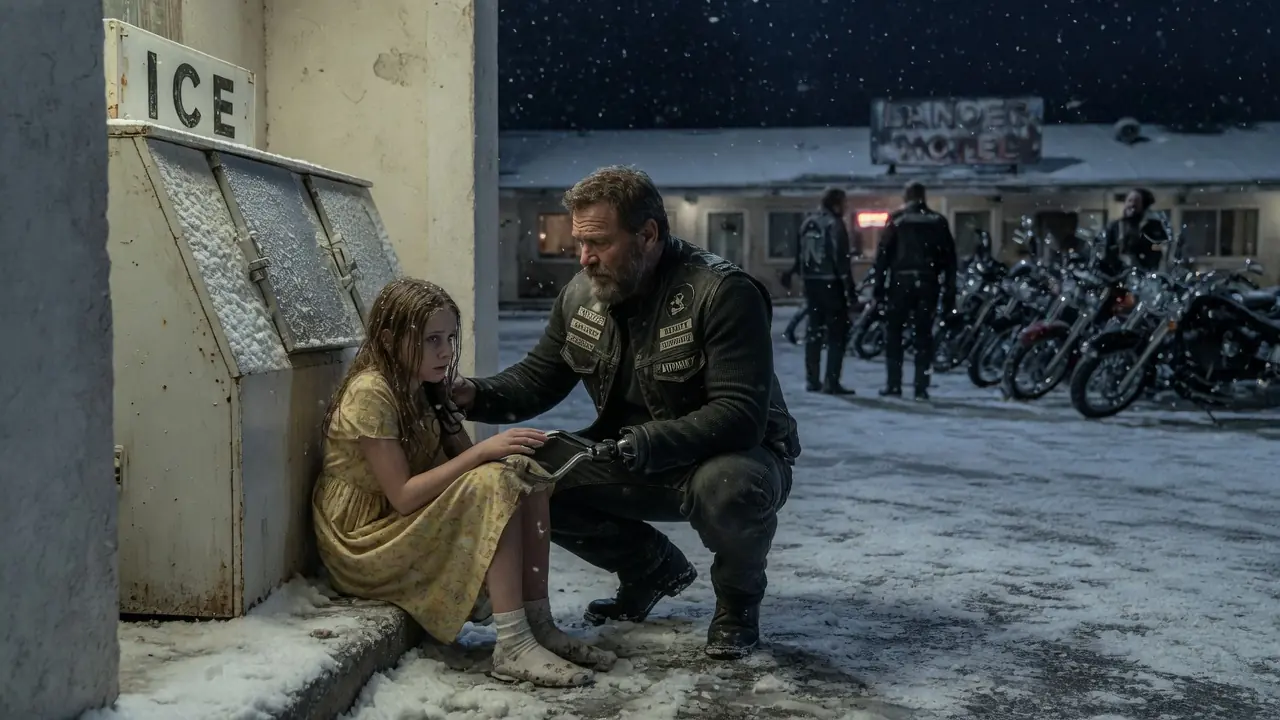
A nine-year-old girl.
An ice machine alcove behind a motel.
A summer dress soaked with snow.
No shoes.
Feet so numb they had stopped hurting.
She had tried to tell adults fourteen times in thirteen months. Every single door had closed. So she chose the blizzard, because facing the cold alone felt safer than going back inside.
What the man in the Hells Angels vest did in the next four minutes would trigger the largest three-state biker mobilization Wyoming had seen in eleven years.
And that was the part nobody saw coming.
“I can’t feel my feet. Please help.”
Ezra Dinger, road name Crowbar, had gone to the ice machine at 2:17 a.m. because his left knee was screaming.
Old ACL tear from his Ranger days, before the IED took his hand in Kandahar. Cold weather made it tighten like a vise. He had grabbed the ice bucket from his room, walked down the exterior corridor of the Sundowner Motor Lodge, turned the corner toward the alcove, and stopped.
There was something pale on the ground.
For one second, his brain tried to make it laundry. A dropped towel. Anything but what it actually was.
Then she blinked.
A child curled against the alcove’s interior corner, knees pulled to her chest, arms locked around her own ribs. Her lips were not blue anymore. They were past blue, a grayish purple he recognized from two combat winters, the color of tissue shutting down.
She was wearing a yellow summer dress in January, in Wyoming, with a minus-twenty-three-degree Fahrenheit wind chill.
No coat.
No shoes.
White ankle socks soaked black with snowmelt.
She was counting.
He could see her lips moving. No sound, just numbers she was mouthing to herself to stay present. The ice machine hummed. The blizzard wind screamed against the aluminum roof.
And this nine-year-old girl sat perfectly still, like she had learned a long time ago that making noise only made things worse.
Ezra moved.
No questions. No hesitation.
He unzipped his riding vest, heavyweight leather, Hells Angels Wyoming chapter patch across the back, and wrapped it around her in one smooth motion, shoulders to knees.
Then he crouched to her level.
His prosthetic hook was the first thing she saw up close. Carbon fiber and steel, the kind you use for riding when a myoelectric hand will not grip the throttle hard enough.
She looked at it for two full seconds.
She did not flinch.
Then she looked back at his face.
He pressed one finger, the real one on his right hand, to the back of her left hand, checking capillary refill.
The blood took three seconds to return.
Too long.
He looked at her feet. The skin was waxy and pale, blisters starting to form at the toes. Frostbite was developing fast.
He checked her lips again. Her eyes. Pupils responsive, but slow.
Hypothermia.
Moderate stage.
Maybe twenty minutes from severe.
“I can’t feel my feet,” she whispered.
Her voice was so soft he almost missed it under the wind.
“Please help.”
Seven words.
She did not explain. She did not give context. Just the medical fact and the request.
Because somewhere in the last thirteen months, she had learned that more words gave adults more room to say no.
The word please hit him harder than the cold.
She was still saying please after everything.
Still asking politely.
“I’ve got you,” Ezra said.
His voice came out rougher than he meant.
“We’re going inside right now.”
He lifted her carefully, one arm under her knees.
She weighed nothing.
Forty-four pounds of child who should have weighed sixty-two.
He could feel every rib through the wet dress.
She grabbed his prosthetic hook with her right hand as he stood.
Not accidentally.
Deliberately.
Her fingers closed around the metal and did not let go.
He did not ask her to.
The motel lobby was empty.
The overnight desk clerk was asleep in the back office, door closed.
Ezra kicked the front desk bell three times, hard enough to wake the dead.
The clerk stumbled out, took one look at Ezra’s patch and the child in his arms, and went pale.
“Call 911,” Ezra said. “Now. Tell them hypothermia, frostbite, possible abuse. Tell them we need EMS at the Sundowner Motor Lodge, Route 18 West, room seven, exterior corridor. Tell them the victim is nine years old and has been outside in this blizzard for God knows how long.”
The clerk picked up the phone.
Ezra carried Harper to the lobby couch, set her down gently, and kept his vest wrapped around her. The heat was on. Not much, but better than minus twenty-three.
“What’s your name?” he asked.
“Harper,” she said, barely audible.
“Harper. I’m Ezra. You’re safe now. I’m not going anywhere. EMS is coming. Can you tell me how long you were outside?”
She looked at the wall clock.
2:19 a.m.
“Since 1:40,” she whispered.
Thirty-nine minutes in a summer dress.
No shoes.
“Who locked you out?” he asked.
Calm. Steady.
The voice he had used with his own kids when they were small and scared.
She hesitated.
This was the moment.
The moment every abused child reaches the calculation.
If I tell the truth, will this adult believe me, or will they call the person who hurt me and make it worse?
“My aunt,” Harper said finally. “She locked me out of the room. She does that. I’m not allowed to knock once she locks it.”
The clerk was on the phone, speaking quickly to dispatch.
Ezra kept his eyes on Harper.
“The burns on your arm,” he said.
He had seen them when he lifted her. Four circular marks in a diagonal line. Different stages of healing.
“How did you get those?”
She pulled her right arm tighter against her ribs.
“She uses zip ties when I make noise. The burns are from when I asked about my mom’s stuff. My shoes are gone. She took them four days ago so I wouldn’t walk anywhere.”
Her voice did not shake.
She had said these sentences before, probably to teachers, to nurses, to people who had called her aunt and closed the file.
Ezra’s jaw tightened.
He did not say anything for five seconds.
He just breathed through his nose and kept his voice level.
“Harper, you did exactly the right thing. You got yourself out of that room. You stayed alive, and you told me the truth. I’m not calling your aunt. I’m not handing you back. You understand?”
She nodded once.
Then her face crumpled.
Not sobbing.
Just silent tears running down her face while her whole body shook.
Not from cold anymore.
From the kind of relief that only comes when someone finally, finally believes you.
Ezra reached out with his real hand and rested it on her shoulder. Gentle. Steady.
“EMS is eleven minutes out,” the clerk called from the desk.
Eleven minutes.
Ezra could work with that.
“Harper,” he said, “three weeks ago, you heard your aunt say something. Something about nine days and a name. The Teller boy. You remember that?”
Her eyes went wide.
“How did you—”
“You wrote it down, didn’t you? Told someone. Tried to get help.”
She nodded fast.
“I heard her talking in the kitchen. I was in the closet. She said nine days. And then she said the Teller boy. And then she said three hundred thirty-one thousand seven hundred dollars. And then she said the teacher who sends emails is the only variable. I don’t know what variable means.”
Ezra’s blood went cold.
Cody Teller.
He knew that name.
Every biker in three states knew that name.
An eight-year-old boy who had disappeared from Sunridge Flats in 2022. Vanished from his temporary guardian’s house. Declared a runaway. Case went cold.
“The guardian was…” Ezra started slowly. “Your aunt’s name. What’s her full name?”
“Miriam Stoultz.”
Miriam Grace Stoultz.
County commissioner.
PTA treasurer.
The woman who had organized the Fremont County winter coat drive for the past four years.
The woman who had taken in Cody Teller after his parents died in a house fire. The woman who had filed the runaway report six days after Cody was last seen. The woman who depleted Cody’s parents’ life insurance, $143,900, within fourteen months of his placement.
And now she had another child.
Another estate.
Another nine-day countdown to something permanent.
Ezra pulled out his phone and checked the time.
2:23 a.m.
He opened his contacts and scrolled to a name.
Luther “Notwood” Crane, president of the Hells Angels Wyoming chapter. Fifty-nine years old. Former search-and-rescue coordinator. The man who had led three missing-child searches that police had given up on.
Ezra pressed call.
Two rings.
“Crow.”
Notwood’s voice was alert. He did not sleep much anymore.
“Notwood. It’s an angel-down situation. I need the chapter. I need them now.”
No pause.
No questions.
“Where?”
“Sundowner Motor Lodge, Route 18 West, Sunridge Flats. I’ve got a nine-year-old hypothermia victim. Her aunt is Miriam Stoultz.”
Silence on the line.
Three seconds.
“Cody Teller’s Miriam Stoultz?”
“Same one.”
“Jesus.”
“She’s got this kid locked in a storage room, starving her, burning her. There’s an estate over three hundred thousand dollars. There’s a nine-day window before something goes final. And this little girl just told me her aunt mentioned Cody by name.”
Another pause.
Notwood was thinking fast.
“How many do you need?”
“Everyone you can get. This isn’t just rescue. This is evidence. This is a pattern. We need boots on the ground. We need witnesses. And we need it loud enough that the system can’t look away this time.”
“You’ll have it. Give me two hours.”
“EMS is eleven minutes out. I’m riding with her to the hospital, Elk Ridge Medical Center in Lander. I’ll meet you there.”
“And Crow?”
“Yeah?”
“Don’t let that woman anywhere near this kid.”
“Not a chance.”
The line went dead.
Ezra looked at Harper.
She was still holding his prosthetic hook. Her breathing had slowed. The shaking was easing as the warmth started to reach her.
“Harper, listen to me. In about eight minutes, an ambulance is going to get here. They’re going to take you to a hospital. I’m going to ride with you. And while you’re getting checked out, I’m calling some friends. A lot of friends. We’re going to make sure your aunt never touches you again. You understand?”
She looked at him.
Gray-green eyes that had seen too much.
“Are you really going to help me?” she whispered. “Or are you going to call her like everyone else?”
It was the question that broke him.
Because it meant every other adult in this child’s life had taught her that help was a lie.
“I’m really going to help you,” Ezra said. “And if I don’t, you can have my bike.”
The corner of her mouth twitched.
Almost a smile.
“I don’t know how to ride a motorcycle.”
“Then I’d better keep my word.”
Sirens in the distance.
Getting closer.
The EMS rig pulled into the parking lot at 2:31 a.m.
Two paramedics, a man and a woman, both in their forties, both moving fast.
They took one look at Harper and went professional.
“How long was she outside?”
“Thirty-nine minutes. Summer dress, no shoes. Minus twenty-three wind chill. I found her at 2:17 in the ice machine alcove.”
The female paramedic crouched, checking Harper’s feet.
“Developing frostbite. Stage one. We need to warm her slowly. Core temperature is going to be low.”
They wrapped her in thermal blankets, moved her to the stretcher, and started an IV.
Ezra walked alongside.
“I’m riding with her,” he said.
The male paramedic looked at the patch, the hook, and the face that had I will end you written all over it.
“Family?”
“No. But I’m not leaving her.”
The female paramedic looked at Harper.
“Honey, do you want him to come?”
Harper’s hand shot out from under the blankets and grabbed Ezra’s hook again.
“Please.”
The paramedic nodded.
“He’s riding.”
They loaded Harper into the rig. Ezra climbed in after her. The doors closed.
As they pulled out onto Route 18, the only vehicle moving on a road the Wyoming Department of Transportation had officially closed four hours earlier, Ezra looked at Harper’s face.
She was still awake, still watching him.
“I counted to four hundred eighty-seven,” she whispered.
“Counted what?”
“My heartbeats. I told myself if I could count to five hundred without anyone helping me, I would stop trying.”
Ezra felt something crack in his chest.
“You were at four hundred eighty-seven when I found you.”
She nodded.
Thirteen more heartbeats.
That was how close she had been to giving up.
“You don’t have to count anymore,” Ezra said. “I’ve got you.”
She closed her eyes.
And for the first time in thirteen months, Harper Joan Whitmore fell asleep without checking to see if the door was locked.
At Elk Ridge Medical Center, the examination room smelled like antiseptic and fear.
Dr. Anand, the on-call pediatrician, was forty-one years old and a mother of three. She checked Harper’s core temperature first.
91.2 degrees Fahrenheit.
She looked at Ezra, who stood against the wall, arms crossed, not moving.
“Normal is 98.6. Below ninety-five is hypothermia. Below ninety, the heart can go into arrhythmia without warning.”
She paused.
“We had maybe another twenty minutes outside before this conversation would have been very different.”
Ezra did not respond.
He just watched as Dr. Anand examined Harper’s feet, hands, arms, the burn marks, the ligature marks from zip ties, three weeks old and fading but visible under the exam lights, and the bruising along her jawline, purple transitioning to yellow.
“Eight days old,” Dr. Anand said softly, studying the bruising.
Her face went hard.
“How much does she weigh?” Ezra asked.
“Forty-four pounds. She should weigh sixty-two for her height and age. Her BMI is 13.8. The pediatric critical threshold is 14.5.”
Dr. Anand looked up.
“She’s been systematically starved.”
“For how long?”
“Months. Maybe longer. I’ll need to run labs, but I can see rib definition from here. This isn’t recent neglect. This is prolonged.”
Harper was asleep on the exam table, wrapped in warming blankets, IV running fluids.
“There are four burn marks on her right forearm,” Dr. Anand said quietly. “Each one is a different stage of healing, which means they happened over multiple weeks. Whoever did this wasn’t angry. They were methodical.”
Ezra’s jaw tightened.
“Her aunt. Miriam Stoultz. County commissioner. She’s been Harper’s legal guardian for thirteen months.”
Dr. Anand’s eyes narrowed.
“I’m calling CPS.”
“Good. But before you do, you should know something. This isn’t the first kid Miriam Stoultz has had.”
He told her about Cody Teller. The house fire. The temporary placement. The runaway report. The estate that vanished.
Dr. Anand listened without interrupting.
When he finished, she set her clipboard down.
“I’m documenting every injury. Photographs, measurements, written descriptions. This file is going to CPS, the police, and anyone else who needs it. And I’m filing a mandatory abuse report right now.”
“How long before CPS shows up?”
“They’re supposed to respond within twenty-four hours for non-emergency, but given the severity, I’m calling this an emergency. They’ll be here by morning.”
Ezra checked his phone.
3:47 a.m.
A text from Notwood.
Chapter mobilizing. 53 confirmed Wyoming. Montana plus Colorado en route. ETA Lander 8 a.m.
One hundred thirty-one bikers.
Three states.
All of them coming for a nine-year-old girl they had never met because Cody Teller had been lost.
But Harper Whitmore was still here.
And this time, the system was not going to look away.
By 6:30 a.m., the hospital security office had logged fourteen phone calls asking about a patient named Harper Whitmore.
All fourteen from the same number.
Miriam Stoultz.
She had called at 4:15 a.m. Then 4:32. Then 4:50. Each time asking if her niece had been admitted, each time being told they could not confirm patient information over the phone.
At 6:30, she showed up in person.
She walked through the main entrance of Elk Ridge Medical Center in a pressed navy blazer and slacks, hair brushed, makeup on, looking like someone who had had a full night’s sleep and not someone whose nine-year-old niece had been found freezing to death four hours ago.
She approached the front desk and smiled.
“Good morning. I’m here for my niece, Harper Whitmore. I was told she was brought in overnight.”
The receptionist, a woman named Diane, fifty-eight, who had worked that desk for nineteen years, looked at her computer screen.
“Are you listed as next of kin?”
“I’m her legal guardian. Miriam Stoultz.”
Diane’s fingers stopped moving on the keyboard.
She had been briefed by Dr. Anand at 5:00 a.m. Told not to allow Miriam Stoultz access to Harper’s room. Told to notify security immediately if she showed up.
“One moment, please.”
Diane picked up the phone and pressed extension 4401.
Security.
Miriam’s smile did not change.
“Is there a problem?”
“Just checking the system. I’ll be right with you.”
Security arrived in ninety seconds.
Two guards.
One of them was a former Fremont County sheriff’s deputy who had worked the Cody Teller case back in 2022. His name was Dale Rickman.
He recognized Miriam the second he saw her.
“Ms. Stoultz,” he said.
Polite. Professional. Absolutely cold.
“Dr. Anand would like to speak with you if you’ll come with me.”
They did not take her to Harper’s room.
They took her to a small consultation room off the main corridor.
No windows.
One table.
Three chairs.
Dr. Anand was already there.
So was a CPS case worker named Patricia Olmstead, forty-six years old, fifteen years with Child Protective Services. She had been woken up at 4:30 a.m. and told to get to Elk Ridge Medical Center immediately. She had read the file in her car on the way over.
Miriam walked in and saw the CPS badge.
Her smile faltered for just a second.
Then it came back warm and concerned.
“Is Harper all right? I’ve been so worried. She wandered off last night during the blizzard. I woke up and she was gone. I’ve been searching everywhere.”
“Ms. Stoultz,” Patricia interrupted. “Please sit down.”
Miriam sat.
Patricia opened a folder, pulled out a photograph, and slid it across the table.
It was Harper’s right forearm, the four burn marks, each one circled in red marker with a measurement notation beside it.
Miriam looked at the photo.
Her face did not change.
“I can explain that,” she said. “Harper has a behavioral issue. She’s been harming herself since her parents died. I’ve been working with her therapist.”
“Ms. Stoultz,” Dr. Anand said.
Her voice was surgical.
“Those are contact burns. The diameter and depth are consistent with a cigarette tip held against skin for three to five seconds. The healing stages indicate they were inflicted over a period of weeks. They are on the underside of her forearm, an area a child cannot easily reach to self-inflict, and the pattern is too uniform.”
Miriam’s jaw tightened, just slightly.
“There’s also the matter of her weight,” Patricia said. “Harper is eighteen pounds underweight. She has visible signs of malnutrition, and she told the ER staff that you ration her meals as punishment.”
“She’s a picky eater.”
“Ms. Stoultz,” Patricia said, her tone dropping. “We also have ligature marks on her wrists, bruising on her jaw, and a statement from Harper that you locked her out of your motel room last night in sub-zero temperatures, wearing only a summer dress. She had no shoes. She was outside for thirty-nine minutes before she was found.”
Miriam’s smile was gone now.
“Harper has always been dramatic. Her grief manifests as—”
“Stop,” Dr. Anand said.
She leaned forward.
“I’ve been a pediatrician for sixteen years. I know the difference between grief and systematic abuse, and I’ve documented every injury on that child’s body. This file is going to the police. It’s going to the DA. And it’s going to a judge.”
Miriam stood.
“I’m calling my attorney.”
“You’re welcome to do that,” Patricia said. “But as of this moment, Harper Whitmore is under emergency protective custody. You will not have access to her. You will not contact her. And any attempt to do so will result in immediate legal action.”
Miriam’s hands clenched into fists.
For exactly one second, the mask slipped.
Not anger.
Not shame.
Calculation.
She was doing math, figuring out her next move.
Then the professional smile came back, thinner this time.
“This is a misunderstanding. When my attorney arrives, we’ll clear this up.”
She walked out.
Dale Rickman watched her go.
Then he looked at Patricia.
“You know who that is, right?”
“County commissioner.”
“I know she’s got pull. Judge Pratt approved her guardianship over Harper in eleven days. Same judge who approved her executor appointment on the estate. She’s got relationships.”
Patricia closed her folder.
“Then we’d better make sure our case is airtight.”
At 8:14 a.m., the first motorcycles arrived.
Fifty-three Harleys from the Hells Angels Wyoming chapter, led by Notwood, who parked his bike in the first row of the Elk Ridge Medical Center parking lot and killed the engine.
The rumble stopped.
Silence.
Then fifty-two more engines cut off almost in unison.
The staff inside the hospital heard it. The deep, synchronized thunder of bikes pulling in, then the sudden quiet that felt heavy and expectant.
Notwood walked through the main entrance first.
Six feet tall. Fifty-nine years old. Gray beard braided. Hells Angels patch across his back. The kind of man who had seen enough to know when to be loud and when to be still.
This was a time to be still.
He walked to the front desk.
Diane looked up.
“I’m here for Harper Whitmore,” he said, calm and even. “Ezra Dinger called me. I’m with him.”
Diane picked up the phone and called up to the pediatric wing.
Ninety seconds later, Ezra came down.
He and Notwood clasped hands. One solid grip.
“She okay?” Notwood asked.
“Core temperature is back to normal. Frostbite stage one. She’ll keep her toes. Malnutrition severe. Burns are documented. CPS has her under protective custody. The aunt showed up at 6:30 and tried to see her. CPS shut it down.”
Notwood nodded.
“Montana and Colorado are forty minutes out. That’ll put us at one thirty-one. What do you need?”
Ezra pulled out his phone and opened a voice memo he had recorded at 5:00 a.m.
Harper’s statement, given to Dr. Anand and Patricia Olmstead with her permission.
He played it.
Harper’s voice, small, careful, but clear.
“My aunt locks me in a storage room every night. She uses zip ties on my wrists when I make noise. She took my shoes four days ago, so I couldn’t walk anywhere. She burned me when I asked about my mom’s stuff. Three weeks ago, I heard her talking about selling my grandparents’ ranch. She said nine days. She said the Teller boy. She said three hundred thirty-one thousand seven hundred dollars. I don’t know what it means, but I know it scared me.”
The recording ended.
Notwood’s face was stone.
“The Teller boy,” he said. “She said it out loud.”
“Harper heard her. There’s a conversation. There’s a timeline. There’s a dollar amount. We need to find out what happened to Cody Teller.”
“I know.”
“And we’ve got nine days to do it before whatever Miriam is planning goes through.”
Notwood looked out the window.
The parking lot was filling up.
Fifty-three motorcycles. Brothers in cuts, standing quietly, waiting for the word.
“We’re going to need more than bikes for this one,” Notwood said. “We’re going to need investigators, legal minds, people who know how to pull records.”
Ezra nodded.
“I’ve got a list.”
And that was when the chapter became more than muscle.
It became a machine.
By 9:00 a.m., the Montana and Colorado chapters had arrived.
Forty-seven bikes from Montana.
Thirty-one from Colorado.
They pulled into the overflow lot across from Elk Ridge Medical Center in tight formation, two parallel columns, practiced and disciplined, the kind of coordination that comes from years of riding together.
The engines died in sequence, row by row, the sound building into a roar, then cutting to silence so sudden it felt like the air had been vacated.
One hundred thirty-one bikers stood in that parking lot.
Not shouting.
Not revving engines.
Not making threats.
Just present.
The hospital staff watched through the windows.
Security called the Lander Police Department.
Dispatch logged the call.
Large motorcycle gathering at Elk Ridge Medical. Hells Angels. Approximately 130 individuals. No disturbance reported. Requesting officer presence for monitoring.
Two patrol cars arrived within fifteen minutes.
The officers parked at the edge of the lot, watched, and waited.
The bikers did not move toward the hospital. They did not block entrances. They did not approach staff. They stood in formation, leather cuts bearing the same insignia, chrome gleaming in the February morning light, and waited for orders.
Now you might think one hundred thirty-one Hells Angels showing up at a hospital means chaos is about to break loose.
Fists ready.
Confrontation brewing.
The kind of scene that ends with arrests and shattered glass.
Maybe years ago, that was what would have happened.
But these men were not here to start a fight.
They were here to make sure the system could not ignore one.
Inside the hospital, Notwood gathered his core team in a small conference room the hospital administrator had nervously offered when she realized they were not leaving.
Five men, each chosen for what he brought.
Spectre, fifty-three, former Wyoming Division of Criminal Investigation agent, seventeen years. He knew the Fremont County probate system better than the clerks who ran it. He knew which filings could be challenged, which judges had conflicts of interest, and exactly how long it took to freeze an estate transfer.
Razorback, sixty-four, Army combat medic, Gulf War. He had been first to assess Harper at the hospital and had worked with Dr. Anand to document every injury for the legal record.
Halftone, forty-six, former middle school counselor with child trauma certification. He had sat with Harper for forty minutes while she gave her statement to CPS. Never pushed. Never rushed. Just listened.
Diesel, thirty-two, digital forensics background. He had worked IT security for a Cheyenne law firm before the club became full-time. He could pull records, reconstruct data trails, and find patterns in financial noise.
Talenhawk, seventy-one, Wyoming chapter co-founder. He had attended every Fremont County commissioners’ public meeting for nine years. He knew where every procedural vulnerability in Miriam’s public record was buried.
Notwood looked at them.
“Here’s what we know. Harper Whitmore is under protective custody. Her aunt, Miriam Stoultz, has been systematically abusing her for thirteen months while draining a $331,700 estate left to Harper by her grandparents. Miriam is the executor. She’s also a county commissioner who chairs the budget committee that funds the probate court.”
Spectre leaned forward.
“That’s a conflict of interest. Judge Pratt approved her executor appointment in eight days. Should have taken thirty minimum. That’s procedurally suspect. Any other red flags in the appointment?”
“Harper mentioned a nine-day countdown. Three weeks ago, she overheard Miriam say the probate clearance happens in nine days. That puts us at…”
Notwood checked his phone.
“Six days from now. Thursday. Ten a.m.”
Diesel pulled out a laptop.
“What’s being cleared?”
“Harper said something about her grandparents’ ranch.”
“Miriam’s trying to sell it,” Spectre said slowly. “If the probate closes and the title transfers, the ranch sale becomes legally irreversible. Harper loses her inheritance. The estate gets liquidated and routed through whatever entity Miriam set up.”
Talenhawk spoke up. His voice was gravel and whiskey.
“Miriam established an LLC two years ago. Stoultz Family Holdings. I saw the filing when she disclosed it at a commissioners’ meeting, required for conflict-of-interest reporting. At the time, it was listed as managing family assets. I’d bet my bike that’s where the ranch sale proceeds are going.”
Diesel’s fingers were already moving across the keyboard.
“Give me twenty minutes. I can pull county records, cross-reference property transfers, and see what’s pending.”
“Do it,” Notwood said. “But there’s something else. Harper said her aunt mentioned the Teller boy.”
The room went silent.
Razorback was the first to speak.
“Cody Teller. 2022. Eight years old. Disappeared from Miriam’s house. Filed as a runaway.”
“Harper overheard Miriam say his name,” Notwood said. “In the same conversation where she mentioned the estate amount and the nine-day timeline. That’s not coincidence.”
“That’s a pattern,” Spectre said.
“If Cody Teller was another placement, another estate…”
“We need to find out what happened to him,” Notwood finished. “Halftone, you’re good with records. Can you pull the Teller case file?”
“I can try. It’s been closed for two years, but if there’s a file, it’s public record.”
“Talenhawk, you know the county records office. Can you get us access to Miriam’s executor files? Anything showing estate management, withdrawals, transfers?”
“I know the clerk. She owes me a favor. I’ll see what she’ll give us without a subpoena.”
“Good. Razorback, stay with Harper. Make sure nobody gets near her who shouldn’t. And I mean nobody.”
Razorback nodded.
Notwood looked at his phone.
Text from Ezra.
Miriam left the hospital. Heading back to Sunridge Flats. Want me on her?
Notwood typed back.
No. Let her go. We need evidence, not confrontation. Let her think she’s safe.
He looked up at his team.
“We’ve got six days to build a case strong enough that a judge can’t ignore it. That means witnesses, documents, financial trails, and we need to figure out what happened to Cody Teller. Because if Miriam did this before, we’re not just saving Harper. We’re stopping a killer.”
By 11:30 a.m., Diesel had the records.
He projected his laptop screen onto the conference room wall.
“Here’s what I found,” he said. “Whitmore Family Ranch, eleven miles east of Sunridge Flats. Two hundred forty acres. Assessed value: $420,000. It’s been in the family for three generations. Harper’s grandparents, Miriam’s parents, died nineteen months ago. They left the property entirely to Harper in their will. Miriam was named executor of the estate.”
He pulled up a document.
“This is the probate filing, dated eight days after the grandparents’ deaths, approved by Judge Howard Pratt on day nine.”
Spectre whistled.
“That’s lightning fast. Normal probate appointment takes thirty to forty-five days, especially for an estate this size.”
“It gets better,” Diesel said. “The ranch is currently listed with Clearwater Realty in Riverton. Internal listing, not public yet. Sale price: $380,000.”
“That’s forty thousand under assessed value,” Talenhawk said. “She’s dumping it fast.”
“And here’s the buyer.”
Diesel clicked to another screen.
“The ranch sale is pending final probate clearance. Once Judge Pratt signs the clearance order, which is scheduled for Thursday at ten a.m., the title transfers to the buyer within forty-eight hours. The buyer is listed as SFH Properties, LLC.”
“Stoultz Family Holdings,” Talenhawk said.
“She’s selling it to herself through a shell company,” Spectre added. “Which means the sale price goes into the LLC, not the estate. Harper gets nothing.”
Diesel pulled up another document.
“Bank records. I pulled Miriam’s estate account activity. She’s been transferring funds out for thirteen months. Look at the amounts.”
The screen showed fourteen transfers.
$9,800.
$8,400.
$9,750.
$9,200.
$8,900.
$9,600.
$8,700.
$9,400.
$9,100.
$8,800.
$9,500.
$8,600.
$9,300.
$9,000.
Spectre leaned in.
“Every single transfer is under ten thousand dollars.”
“That’s structuring,” Diesel said. “Federal law requires banks to report cash transactions over ten thousand dollars. Miriam kept every transfer just below that threshold to avoid triggering reports.”
“That’s a federal crime,” Spectre said. “Structuring is illegal whether or not the underlying funds are stolen. The pattern itself is evidence of intent.”
Diesel nodded.
“And it gets worse. I cross-referenced these transfers with Miriam’s personal bank account. She’s made three major purchases in the last thirteen months.”
He pulled up the receipts.
“Purchase one: vacation cabin near Jackson Hole. Down payment, $41,200. Purchased through Stoultz Family Holdings LLC. Purchase two: full kitchen renovation at her house, 317 Clearwater Drive. Total cost, $17,800. Contractor paid in cash installments. Purchase three: eight-day European river cruise. Booked under her sister’s name, Harper’s deceased mother. Cost: $6,900.”
Notwood did the math out loud.
“Forty-one thousand two hundred, plus seventeen thousand eight hundred, plus sixty-nine hundred. That’s $65,900 in traceable personal spending from estate funds.”
“And that’s just what I found in two hours,” Diesel said. “There’s probably more.”
The room was silent.
Then Halftone spoke up.
He had been on his phone in the corner, quietly working his contacts.
“I got the Cody Teller file,” he said. “It’s thin. Really thin. But there’s something.”
He pulled up a scanned document on his phone and passed it to Notwood.
“Cody Teller, age eight. Parents died in a house fire in May 2020. Cody was at a neighbor’s house when it happened. Miriam Stoultz volunteered to take him in temporarily. She was a family friend. Judge Pratt approved the temporary guardianship within six days.”
Spectre’s eyebrows went up.
“Six days for Cody. Eight days for Harper. Judge Pratt is fast when Miriam is involved.”
Halftone continued.
“Cody’s parents had a combined life insurance policy. Payout: $143,900. Miriam was named temporary guardian and executor. The policy paid out within two months.”
He pulled up another document.
“This is the final estate accounting filed fourteen months after placement. The entire $143,900 was depleted. Listed expenses: child care, medical, housing, educational costs.”
“One hundred forty-three thousand nine hundred dollars in fourteen months,” Talenhawk said. “That’s over ten thousand a month for one eight-year-old.”
“And then Cody disappeared,” Halftone said. “Filed as a runaway. The report was filed six days after his last confirmed sighting. Teacher at Sunridge Flats Elementary said he was absent for a week before Miriam called it in.”
“Who investigated?” Notwood asked.
“Fremont County Sheriff’s Office. Detective Warren Keane. He interviewed Miriam, searched the house, found no evidence of foul play. Case listed as voluntary runaway. Closed within thirty days.”
Spectre shook his head.
“An eight-year-old runs away in rural Wyoming, and the case closes in thirty days. That’s not normal.”
“There’s one more thing,” Halftone said. “I talked to Cody’s fourth-grade teacher. Her name is Karen Olsen. She still teaches at Sunridge Elementary. She said Cody showed signs of malnourishment three months before he disappeared. She filed a wellness concern with the principal.”
“What happened to it?”
“Principal forwarded it to Miriam as guardian notification per district protocol. Miriam responded within two hours with a note from her personal physician citing selective eating habits and behavioral adjustment. The concern was closed. No CPS contact was ever made.”
Notwood looked at the timeline on the wall.
Cody Teller.
May 2020.
Placement.
$143,900 estate.
Fourteen months later, estate depleted.
Sixteen months after placement, Cody disappeared.
Harper Whitmore.
January 2024.
Placement.
$331,700 estate.
Current value, thirteen months later, estate being liquidated.
Ranch sale scheduled in six days.
“It’s the same pattern,” Notwood said. “Take in a child after their parents die. Get executor control of the estate. Drain it over twelve to sixteen months. And when the money’s almost gone…”
He did not finish the sentence.
He did not have to.
Diesel closed his laptop.
“We need to take this to the FBI.”
“Not yet,” Spectre said. “We have a pattern. We have financial records. But we don’t have proof of what happened to Cody Teller. Without that, this is circumstantial.”
“Then we find proof,” Notwood said. “We’ve got six days. Diesel, keep digging into the financials. I want every transfer, every purchase, every receipt. Halftone, find witnesses. Anyone who saw Cody before he disappeared. Anyone who worked with Miriam. Anyone who filed a complaint that got buried. Talenhawk, get me those executor files. And Spectre, start drafting an emergency motion to freeze the estate and block the ranch sale. We’ll need a different judge. Someone who doesn’t have ties to Miriam.”
Notwood nodded once.
“We move fast. We move quiet. And we make sure when we hit her, it’s with everything.”
At 2:15 p.m., three witnesses walked into the Elk Ridge Medical Center conference room.
Notwood had put out the word. Brothers had gone door to door in Sunridge Flats, asked questions, listened, and found people who had seen things they had not reported.
The first witness was Ruth Anne Cobbs, sixty-seven, owner of the Sundowner Motor Lodge.
She sat down slowly, hands shaking slightly as she folded them in her lap.
Halftone sat across from her, gentle and patient.
“Ms. Cobbs, thank you for coming. I know this isn’t easy. Can you tell me what you saw?”
Ruth Anne looked at the table.
“I saw Harper arrive with Miriam three days before the blizzard. January 24. They checked into room eleven. I remember because Harper wasn’t wearing a coat. It was nineteen degrees that day. She had on a yellow summer dress and a thin cardigan. No hat. No gloves.”
“Did you say anything to Miriam?”
“I thought about it. But Miriam’s a county commissioner. She’s organized the county fair for years. I thought maybe I was reading too much into it. Maybe Harper had a coat in the car.”
“Did you see Harper again after they checked in?”
Ruth Anne’s voice broke.
“The night of the blizzard. I saw her in the hallway around 10:30 p.m. She was walking toward the vending machines, still in that dress, still no shoes. I was in the office. I saw her through the window, and I told myself it wasn’t my business.”
She looked up, tears in her eyes.
“I saw a child in a Wyoming winter with no coat and no shoes, and I told myself it wasn’t my business. And four hours later, she was found freezing to death in my parking lot.”
Halftone waited.
He did not interrupt her guilt.
He did not rush her.
“Ms. Cobbs, you’re here now. You’re telling the truth. That matters.”
“Does it?” Her voice was barely audible. “I could have called someone. I could have asked if she was okay. I could have given her a coat from the lost and found. But I didn’t because Miriam Stoultz is somebody in this county, and I’m just a motel owner, and I didn’t want to make trouble.”
Halftone wrote down every word.
“Thank you, Ms. Cobbs. This statement is going into the file. It’s evidence.”
She nodded and wiped her eyes.
“That little girl looked at me through the vending machine glass, and I looked away.”
The second witness was Gerald Fitch, seventy-two, former ranch hand at the Whitmore family property.
He had worked the ranch for nineteen years under Harper’s grandparents. He had been there when Harper’s mother was a girl. He had watched three generations of Whitmores build that land into something beautiful.
And he had watched Miriam strip it bare.
“I kept a log,” Gerald said.
He pulled a small notebook from his jacket pocket. Handwritten. Dated entries.
“After Mr. and Mrs. Whitmore died, Miriam hired me to manage the property during probate. But she wasn’t maintaining it. She was liquidating it.”
He opened the notebook.
“June 2024. Sold the tractor. John Deere 5075E. Worth thirty-eight thousand dollars. Sold it for twenty-two thousand cash to a buyer in Montana. No receipt I ever saw. August 2024. Sold the cattle. Forty-two head of Angus worth approximately sixty thousand at market rate. Sold to a broker in Casper for forty-one thousand. Again, cash sale. October 2024, sold the irrigation equipment. Pivot system, pumps, control panels, worth twenty-five thousand. Sold for fourteen thousand.”
He looked up.
“Every single sale was under market value. Every single one was cash. None of it went through the estate account that I could see.”
Diesel leaned forward.
“Did you report this?”
“To who? Miriam is the executor. The judge approved her. I’m just a ranch hand.”
“Did you keep any documentation? Receipts, buyer names, anything?”
Gerald pulled out a folded paper.
“I took photos of the equipment before it left the property. Timestamps. And I wrote down the license plates of the trucks that hauled it away.”
He handed it to Diesel.
“I knew something was wrong. I just didn’t know who’d listen.”
The third witness was Connie Shale, sixty-one, former Fremont County clerk. She had processed the original executor appointment paperwork when Miriam filed for control of Harper’s grandparents’ estate.
“I kept a copy,” Connie said.
She pulled a manila folder from her bag.
“The filing timestamp bothered me, so I made a personal copy before I left the clerk’s office.”
She opened the folder.
“Miriam’s parents died on March 3, 2024. Miriam filed for executor appointment on March 11. Eight days. The filing was approved by Judge Pratt on March 12. Nine days total.”
Spectre looked at the documents.
“Why did the timestamp bother you?”
“Because normal probate appointments take thirty to forty-five days. There’s supposed to be a notification period. Other potential executors have to be notified. Creditors have to be notified. There’s a waiting period built into the process to prevent exactly this kind of rush.”
“Was the waiting period waived?”
“Yes. Judge Pratt signed a waiver citing no contest from other parties and urgent need for estate management. But the waiver was signed the same day as the filing. There’s no way proper notification happened in one day.”
“Why didn’t you say something?”
Connie’s hands tightened on the folder.
“I did. I flagged it to my supervisor. He told me Judge Pratt had reviewed it personally and approved it. And that was the end of the discussion. Two weeks later, I was reassigned to a different department. No explanation. Just moved.”
She looked at Spectre.
“I worked in that office for twenty-two years. I know what retaliation looks like, so I kept the copy just in case someone ever asked the right questions.”
By 5:00 p.m., the pieces were coming together.
Notwood stood in the conference room looking at the evidence board Diesel had assembled.
Timeline.
Financial transfers.
Witness statements.
Property sales.
Two children.
Two estates.
One pattern.
And sitting in the middle of it all: Judge Howard Pratt.
Approved Cody’s guardianship in six days.
Approved Harper’s executor appointment in nine days.
Scheduled to sign the final probate clearance in six days, Thursday, 10:00 a.m.
The same judge every single time.
“He’s not just complicit,” Spectre said quietly. “He’s the architect.”
Notwood’s phone buzzed.
A text from a number he did not recognize.
He opened it.
It was a photo of a document.
A probate court internal memo dated March 12, 2024.
The subject line read: Re: Stoultz Executor Appointment — Expedited Processing.
The memo was from Judge Pratt to the court clerk.
Per discussion with Commissioner Stoultz, please expedite the Whitmore estate executor filing. Waive standard notification period. Approval to be signed same day. Commissioner Stoultz has assured me the estate requires immediate management to prevent asset loss. No objections anticipated.
Below that was a handwritten note in the margin.
This is the third expedited appointment for Stoultz in four years. Recommend review of protocol.
The note was signed with initials.
CS.
Connie Shale.
Notwood looked at the screen.
Then he looked at Spectre.
“We’ve got him.”
At 6:30 p.m., Miriam Stoultz sat in her kitchen, phone in hand, calling her attorney.
She had left the hospital hours ago and driven back to Sunridge Flats. Walked into her house at 317 Clearwater Drive like it was any other Tuesday evening. Put her blazer on the coat hook. Made coffee. Sat down at the kitchen table. Waited for her attorney to pick up.
Bernard Cook answered on the third ring.
“Bernard, we have a problem.”
“I heard. CPS called me an hour ago. They’re placing Harper under protective custody pending investigation.”
“Can they do that?”
“Yes. If there’s evidence of abuse, they can remove a child immediately. Miriam, what happened?”
“Harper wandered off during the blizzard. She’s always been impulsive. I woke up and she was gone. I searched for hours. Someone found her and overreacted.”
“Miriam.”
Bernard’s voice was flat.
“They have photographs of burns on her arms. They have medical documentation of malnutrition. They have a statement from Harper saying you locked her outside. This isn’t going away with an explanation.”
Miriam’s jaw tightened.
“Then we fight it. You file a motion to dismiss the protective order. You challenge the medical findings. You—”
“Miriam, listen to me very carefully. If this goes to trial, you will lose. The evidence is damning. The best option right now is to negotiate a voluntary termination of guardianship in exchange for no criminal charges.”
“No.”
“Miriam—”
“I said no. The probate clearance is scheduled for Thursday. Once that’s signed, the ranch sale goes through. The estate closes. Harper ages out of the trust at eighteen, but there won’t be anything left to age into. I’ve worked too hard for this.”
Silence on the line.
Then Bernard spoke. His voice was very quiet.
“You just told me the plan.”
“What?”
“You just confessed on a recorded line that you’re deliberately liquidating a child’s estate before she can access it.”
Miriam went cold.
“Bernard—”
“I’m done. Don’t call this number again.”
The line went dead.
Miriam sat in her kitchen staring at her phone.
The house was silent.
She had been so careful for thirteen months. Every transfer under ten thousand dollars. Every document filed correctly. Every appearance maintained.
And she had just confessed to her own attorney.
She set the phone down and looked around her kitchen.
The new cabinets.
The granite countertops.
The professional-grade appliances.
Seventeen thousand eight hundred dollars’ worth of renovations paid for with Harper’s inheritance.
For the first time in thirteen months, Miriam Stoultz felt afraid.
At the clubhouse in Lander, the war room had been running for eight hours.
Diesel had pulled every financial record he could access. Talenhawk had delivered the executor files from the county clerk. Connie had photocopied everything before Miriam’s supervisor could bury it. Spectre had drafted a forty-seven-page emergency motion to freeze the estate and remove Judge Pratt from the case due to conflict of interest.
And Halftone had found something nobody expected.
A phone.
Not Harper’s phone.
Not Miriam’s phone.
Cody Teller’s phone.
It had been found in a donation box at a Sunridge Flats thrift store six months after Cody disappeared. The store manager had tried to turn it on, found it password locked, and filed it in lost and found for ninety days.
When no one claimed it, it went into storage.
Halftone had tracked it down through a brutal paper trail. Found the manager. Found the storage box. Found the phone.
Diesel plugged it in.
The battery was dead.
He charged it for twenty minutes.
The phone powered on.
It was locked.
But the lock screen showed fourteen missed calls, all from the same number.
Diesel ran the number. It was disconnected now, but the record showed it had been active in 2022.
The number belonged to Miriam Stoultz.
“She called him fourteen times,” Diesel said slowly. “After he disappeared.”
“Why would you call a runaway’s phone fourteen times?” Halftone asked.
“Because you’re trying to find them,” Halftone said.
“Or because you’re making sure the phone stays off,” Spectre added. “If someone else found it and turned it on, those calls would show up. Fourteen attempts to reach a missing child. Looks like a concerned guardian.”
Diesel pulled up the phone’s activity log.
“Last known location before the phone died. Sunridge Flats, Wyoming. Date: November 18, 2022. Six days before Miriam filed the runaway report.”
“He didn’t run,” Halftone said quietly. “She took the phone before he disappeared.”
The room went silent.
Notwood looked at the evidence spread across the table.
Two children.
Two estates.
Two disappearances.
One woman.
“We need the FBI,” he said.
At 8:45 p.m., Special Agent Melissa Garrett walked into the clubhouse.
She was forty-one, fifteen years with the FBI’s Cheyenne Field Office, Crimes Against Children Division. She had been working a guardianship fraud case in Laramie when she got the call from Spectre, an old contact from his DCI days.
She had driven three hours to Lander.
Now she stood in a room full of Hells Angels, looking at an evidence board that spelled out a pattern she had been chasing for two years.
“How long has your office known about Miriam Stoultz?” Notwood asked.
Agent Garrett did not flinch.
“We’ve had her on our radar for eighteen months. Financial irregularities in estate management. But we’ve been building a federal case. Structuring charges. Wire fraud. It takes time.”
“How much time?”
“We were three months from filing.”
Notwood’s jaw tightened.
“Harper Whitmore has been in that house for thirteen months. You had eighteen months.”
“We built a case legally. By the book. Evidence that would hold up in court.”
“And while you built it, Harper was locked in a storage room.”
Agent Garrett had no response.
The silence sat heavy.
Then Ezra spoke.
He had been standing against the wall, arms crossed, not moving.
“We got her out in four hours. You had eighteen months.”
Agent Garrett looked at him, at the prosthetic hook, at the face that had seen too much.
“You’re right,” she said.
It was not an excuse.
It was acknowledgment.
She turned to the evidence board.
“What do you have?”
Diesel walked her through it.
Financial records.
Witness statements.
The Cody Teller phone.
The probate timeline.
The judge’s memo.
Agent Garrett listened without interrupting.
When Diesel finished, she pulled out her phone and made a call.
“This is Garrett. I need a warrant application prepared for Miriam Grace Stoultz, 317 Clearwater Drive, Sunridge Flats. Charges: structuring, wire fraud, child endangerment, theft by deception. I also need a freeze order on the Whitmore estate and an emergency injunction blocking the ranch sale. And I need Judge Pratt recused from anything involving Stoultz. Conflict of interest, documented coordination.”
She paused and listened.
“I’m looking at a two-victim pattern. One missing child, one rescued. Same financial method, same judge, same expedited process. If this is authenticated, it changes the scope significantly.”
She hung up and looked at Notwood.
“If I take this to a federal prosecutor, can you guarantee Harper’s safety while we move?”
“She’s under protective custody. Hospital security. Two brothers on rotation outside her room, twenty-four seven. Miriam Stoultz gets within one hundred feet, we’ll know.”
“Good. Because once we execute this warrant, Miriam is going to know we’re coming. Desperate people do desperate things.”
Notwood nodded.
“What do you need from us?”
“Everything you just showed me, documented. Signed witness statements. Chain of custody on that phone. And your people stay out of the arrest. We do this by the book.”
“Agreed. On one condition.”
Agent Garrett raised an eyebrow.
“What condition?”
“Harper gets a victim advocate assigned before the first interview. Nobody talks to her without her asking first, and she doesn’t get shuffled through the system like a case file. She gets care.”
Agent Garrett studied him for a moment.
“That’s the job,” she said quietly.
“Then do it right.”
She nodded.
“We’ll be in touch.”
She walked out.
Notwood watched her go.
Then he looked at his brothers.
“We just gave the FBI everything. Now we wait.”
Diesel closed his laptop.
“What if they move slow?”
“They won’t. Not with this much evidence. Not with a child in protective custody and a six-day window.”
“And if they do?”
Notwood’s face was stone.
“Then we make sure Miriam Stoultz doesn’t make it to Thursday.”
At 10:30 p.m., they found the second enabler.
His name was Dr. Raymond Hirsch. Fifty-eight years old. Miriam’s personal physician. The same physician who had provided the written statement explaining away Harper’s burns as an allergic reaction to a heating pad. The same physician who had signed off on Cody Teller’s selective eating habits when his teacher reported malnourishment.
Halftone had found his name in both case files.
Two children.
Two medical explanations.
Same doctor.
Talenhawk made a call and found out Dr. Hirsch had a clinic in Riverton. Small practice. Mostly county employees and their families, including Miriam Stoultz.
And here was the interesting part.
Dr. Hirsch’s clinic was funded partially through a Fremont County wellness grant, a grant administered by the county budget committee chaired by Miriam Stoultz.
At 11:00 p.m., Spectre and Halftone drove to Riverton.
They did not call ahead.
They walked up to Dr. Hirsch’s home, a modest two-story on Elm Street, and knocked.
Dr. Hirsch answered in a bathrobe and reading glasses.
He saw two men in Hells Angels cuts on his front porch and went pale.
“Dr. Hirsch,” Spectre said, calm and professional. “We need to talk about the medical statements you provided for Harper Whitmore and Cody Teller.”
“I don’t know what—”
“You signed a letter stating Harper’s contact burns were from a heating pad. You know that’s not true. You’re a physician. You know what burns like that look like.”
Dr. Hirsch’s hand tightened on the door.
“I provided a medical opinion based on the guardian’s account.”
“You provided false documentation to cover child abuse,” Halftone said.
His voice was quieter than Spectre’s.
Gentler.
Somehow worse.
“Twice. Once for Cody Teller, once for Harper Whitmore. Same pattern. Same guardian. Same medical excuse.”
Dr. Hirsch looked at the street.
No one was around.
“I need to call my attorney.”
“You’re welcome to do that,” Spectre said. “The FBI is going to want to talk to them anyway.”
The word FBI landed like a brick.
Dr. Hirsch’s face went gray.
“I didn’t… I didn’t know.”
“Yes, you did,” Halftone said. “You saw those marks. You saw that child’s weight. You knew. And you signed a piece of paper that let Miriam Stoultz keep hurting her.”
Dr. Hirsch’s shoulders sagged.
“She told me Harper was harming herself. She said the child had behavioral issues after her parents’ death. She said she was working with a therapist.”
“Did you verify that?” Spectre asked. “Did you ask to see the therapist’s notes? Did you examine the marks yourself? Or did you just take Miriam’s word?”
Silence.
“How much does Miriam Stoultz control in your clinic’s funding?” Spectre asked.
Dr. Hirsch looked at the floor.
“The county wellness grant is forty percent of our operating budget. Without it, I’d have to close.”
“So when Miriam asked you to sign a letter, you signed it.”
“She said it was just to help with a school inquiry. She said Harper was struggling and the school was overreacting.”
“And Cody Teller?” Halftone asked. “What was the excuse for him?”
“The same. Behavioral issues. Grief response. I thought…”
He trailed off.
“You thought what?” Spectre asked.
“I thought I was helping.”
Halftone stepped closer.
His voice dropped.
“Cody Teller is missing. He’s been missing for two years. Harper Whitmore was found freezing to death in a blizzard. You didn’t help. You enabled a predator.”
Dr. Hirsch looked up.
His eyes were wet.
“I didn’t know about Cody. I swear I didn’t know.”
“But you suspected. You saw the pattern and chose not to look.”
Dr. Hirsch covered his face with his hands.
“What do you want from me?”
“The truth,” Spectre said. “In writing. Every statement you signed for Miriam Stoultz. Every time you covered for her. Every time you knew something was wrong and didn’t report it. You write it all down, you sign it, and you hand it to the FBI.”
“And if I don’t?”
“Then you go down with her. Accessory to child abuse. Medical fraud. Obstruction. Take your pick.”
Dr. Hirsch was silent for a long moment.
Then he nodded.
“I’ll write it tonight.”
By 2:00 a.m. Wednesday morning, the full picture was clear.
Notwood stood in the clubhouse looking at the final evidence assembly.
Victims: Cody James Teller, age eight, disappeared November 2022. Estate depleted: $143,900.
Harper Joan Whitmore, age nine, rescued January 2026. Estate being liquidated: $331,700.
Financial crimes: fourteen structured transfers totaling $155,500.
Federal crime: $65,900 in traceable personal spending from estate funds.
Property liquidation: tractor, cattle, equipment, totaling $77,000 in cash sales with no estate accounting.
Pending ranch sale through shell company SFH Properties, LLC. Value: $380,000.
Timeline: both children placed with Miriam within six to nine days of their parents’ deaths. Both estates placed under Miriam’s executor control within six to nine days. Both estates depleted within twelve to sixteen months. Cody disappeared at the sixteen-month mark. Harper rescued at the thirteen-month mark, six days before final estate liquidation.
Institutional failure: Judge Howard Pratt expedited both guardianship appointments. Documented coordination with Miriam.
CPS called twice for Harper. Cases closed after Miriam’s explanations.
Teacher wellness concern for Cody. Closed after physician’s note from Dr. Hirsch.
School nurse report for Harper. Closed after physician’s note from Dr. Hirsch.
Enablers: Judge Howard Pratt, judicial corruption, conflict of interest. Dr. Raymond Hirsch, false medical documentation in two cases. Fremont County probate clerk supervisor, retaliation against whistleblower Connie Shale.
Charges to be filed: structuring, federal. Wire fraud, federal. Child endangerment, state felony. Theft by deception, state felony. Financial exploitation of a dependent person’s estate, state felony. Conspiracy to commit fraud, federal.
Notwood looked at the clock.
2:17 a.m.
Harper had been rescued exactly twenty-four hours ago.
In twenty-four hours, they had built a case that would have taken the system eighteen months.
And they had done it with motorcycles, handwritten logs, and brothers who refused to look away.
His phone buzzed.
Text from Agent Garrett.
Warrant approved. Arrest scheduled 6 a.m. Wednesday. Federal prosecutor filing charges Thursday morning. Estate freeze order signed. Ranch sale blocked. Judge Pratt recused. Case reassigned to Judge Ellen Corkran.
Notwood read it twice.
Then he sent a message to the chapter group text.
It’s done. FBI moves at 6 a.m. Harper’s safe. Miriam’s finished.
Within sixty seconds, one hundred thirty-one responses came back.
Most of them were just one word.
Good.
At 6:03 a.m., FBI agents and Fremont County sheriff’s deputies arrived at 317 Clearwater Drive.
Miriam Stoultz was in her kitchen making coffee.
The same kitchen she had renovated with Harper’s inheritance.
She was wearing a navy blazer and pressed slacks, hair brushed, makeup on. She had planned to drive to the county office at 8:00 a.m. for a budget committee meeting.
She never made it.
The knock on the door came at 6:03.
She opened it.
Agent Garrett stood on the porch, badge out, flanked by four deputies.
“Miriam Grace Stoultz, you’re under arrest for structuring, wire fraud, child endangerment, theft by deception, and conspiracy to commit fraud. You have the right to remain silent.”
Miriam’s face went blank.
Not angry.
Not shocked.
Just empty, like she had known this was coming and had already moved past it in her mind.
They handcuffed her, read her rights, and walked her to the patrol car.
As they put her in the back seat, Miriam looked at Agent Garrett.
“I want my attorney.”
“Your attorney declined representation this morning. You’ll be assigned a public defender.”
For the first time, Miriam’s face cracked, just for a second.
Then the door closed.
Miriam Stoultz, county commissioner, PTA treasurer, county fair chair, the woman who had organized the winter coat drive for four years, was driven away in handcuffs.
She asked once, quietly, if someone could feed her cat.
As if that were the thing that needed handling.
As if the world she had built and the world she had destroyed could wait while she sorted out pet care.
The final count was this.
Two victims.
One missing.
One saved.
$475,400 stolen across two estates over four years.
Six criminal charges filed against Miriam Stoultz.
Three enablers identified.
One judge recused.
One doctor cooperating.
One supervisor under investigation.
One hundred thirty-one Hells Angels.
Three states.
Twenty-four hours.
One child rescued.
Six days from rescue to arrest.
And sitting in a hospital room forty-one miles away, Harper Joan Whitmore was asleep, safe for the first time in thirteen months.
Thursday morning.
9:47 a.m.
Elk Ridge Medical Center pediatric wing.
Harper sat on the exam table, legs swinging. She had gained three pounds in three days. Her core temperature had been normal for forty-eight hours. The frostbite on her toes was healing. No tissue loss. No amputation needed.
Dr. Anand reviewed the chart one more time.
Razorback sat in the corner chair. He had been there for every examination, never intrusive, never hovering, just present.
The way a combat medic learns to be when someone needs to know they are not alone.
“Harper,” Dr. Anand said, “your feet are healing well. The blisters are starting to close. You’ll have some sensitivity to cold for a few months, but no permanent damage.”
Harper nodded.
She had been quiet for most of the examination.
“The malnutrition is more complex,” Dr. Anand continued.
She pulled up a chair and sat at Harper’s eye level.
“Your body has been in survival mode for a long time. We need to rebuild your strength slowly. That means regular meals, small portions at first. We’re going to set you up with a nutritionist who will work with you.”
“Where am I going to eat those meals?” Harper asked.
Her voice was still soft.
Still careful.
Dr. Anand glanced at Razorback.
He leaned forward.
“That’s being worked out right now. But wherever you go, you’re not going back to Miriam. That’s done.”
Harper’s shoulders dropped just slightly, like she had been holding them rigid for thirteen months and finally got permission to stop.
“When can I leave the hospital?”
“Today, if we can finalize placement. CPS is working on it.”
Harper looked at Razorback.
“Are you going to be there?”
“Me or one of my brothers. Yeah. Until you’re settled.”
She reached into her pocket and pulled out the shoelace she had been wearing around her neck.
The brass key to the Whitmore family ranch still hung from it.
She held it up.
“This is my grandparents’ house key. My mom gave it to me. She said someday it would be mine to take care of.”
Razorback looked at the key, then at her face.
“And it will be,” he said. “The ranch sale got blocked. Your estate is frozen. Nobody’s selling anything.”
Harper’s eyes went wide.
“Really?”
“Really. A federal judge signed the order Tuesday night. That ranch is yours. And when you’re ready, when you’re older, when you’re safe, you can go back there.”
Harper closed her fingers around the key.
For the first time since Ezra had found her in that alcove, she smiled.
Not a big smile.
Just a small one.
The kind that says maybe things can be okay.
Dr. Anand stood.
“I’ll be back in an hour with your discharge papers. And Harper?”
“Yes?”
“You did everything right. You survived. And now you get to do more than survive.”
At 1:30 p.m., Harper had her first safe meal.
The hospital cafeteria had made her a grilled cheese sandwich and tomato soup. Simple. Warm. The kind of meal a nine-year-old should be allowed to eat without calculating consequences.
Halftone sat across from her.
He had brought a deck of cards, not to play, just to have something to do with his hands while she ate.
Harper picked up the sandwich.
Took a small bite.
Chewed slowly.
Set it down.
Waited.
Halftone watched.
He did not say anything.
Thirty seconds passed.
Harper picked up the sandwich again.
“Another bite,” Halftone said quietly. “Nobody is going to take it away.”
She looked at him.
“I know you’re used to meals being conditional. Used to someone deciding whether you get to finish. That’s over. You eat as much or as little as you want. No one’s watching. No one’s judging. No one’s taking it back.”
Harper took another bite.
Tears started running down her face while she chewed.
She was not crying.
She was just leaking the way people do when relief is too big to hold inside.
Halftone slid the napkin dispenser closer.
“It’s okay,” he said.
And Harper, who had not been allowed to cry without consequences for thirteen months, let herself cry while she ate a grilled cheese sandwich.
The tomato soup cooled on the tray.
She finished half the sandwich.
It was the most she had eaten in one sitting in over a year.
At 4:15 p.m., CPS case worker Patricia Olmstead walked into the hospital conference room with a folder and a cautiously optimistic expression.
Ezra, Notwood, and Spectre were waiting.
“We have a placement option,” Patricia said. “It’s not permanent yet, but it’s safe and immediate.”
She opened the folder.
“Her name is Margaret Hail. Sixty-two years old. Retired schoolteacher. She’s been a licensed foster parent in Fremont County for eleven years. She specializes in emergency placements and trauma cases. She’s fostered twenty-three children over that time. Sixteen of them stayed with her long term.”
“What does her background check look like?” Spectre asked.
“Spotless. She’s been vetted six times. No flags. No complaints. And she specifically requested to take Harper.”
Notwood raised an eyebrow.
“Why?”
“She taught at Sunridge Elementary for thirty years. She knew Harper’s mother when she was a girl. She knew Harper’s grandparents. She’s not a stranger.”
Ezra leaned back.
“Does Harper know her?”
“We’re going to ask. But Margaret remembers Harper from a school event two years ago, before the placement with Miriam.”
Patricia pulled out a photo.
Margaret Hail. Gray hair pulled back in a practical bun. Kind eyes. The kind of face that looks like it has seen hard things and decided to stay soft anyway.
“She has a three-bedroom house on the north side of Lander. One of the bedrooms is set up specifically for foster placements. Bed, desk, bookshelf, closet full of clothes in various sizes. She keeps it ready.”
“What about support?” Spectre asked. “Therapy, medical follow-up, school enrollment.”
“Margaret has a standing relationship with a child trauma therapist in Lander, Dr. Sarah Chen. She’s already contacted her. Harper would have weekly sessions, more if needed. Medical follow-up happens through Dr. Anand at Elk Ridge. And for school, we’d give Harper the option. She can return to Sunridge Elementary if she wants familiarity or transfer to a school in Lander for a fresh start.”
Notwood looked at Ezra.
“What do you think?”
“I think we ask Harper.”
Twenty minutes later, Harper sat in the conference room with Patricia, Margaret Hail, and Ezra.
Margaret had brought something.
A small photo album.
She opened it carefully.
“Harper, I don’t know if you remember me. I taught third grade at Sunridge Elementary. I retired before you got to my class, but I knew your mom, and I knew your grandparents.”
She turned the album to show Harper.
The first photo was a young woman in her twenties standing in front of Sunridge Elementary, holding a teacher-of-the-year plaque.
Harper’s mother.
Margaret had taught with her. They had been colleagues for three years before Harper’s mom left teaching to work the family ranch.
The second photo was Harper’s grandparents at a county fair, standing in front of a prize-winning steer. Margaret had taken the photo herself. She had been friends with Harper’s grandmother for forty years.
Harper touched the photo with one finger.
“I don’t have any pictures,” she whispered. “Aunt Miriam sold everything.”
“I know,” Margaret said. “That’s why I brought these. I made copies. If you want them, they’re yours.”
Harper looked up.
“Really?”
“Really. And there are more. I have a whole box of photos from your grandparents’ ranch. Community events, county fairs, your mom’s wedding. I’ve been holding on to them for years. I always thought someday someone in your family might want them.”
Harper’s hands were shaking.
“Patricia told me you need a safe place to stay while the court figures out what happens next,” Margaret said. “I have a room. It’s quiet. It’s yours for as long as you need it. And if you want to talk about your mom or your grandparents, I have stories. A lot of them. Good ones.”
Harper looked at Ezra.
“Is she safe?” Harper asked.
Ezra looked at Margaret, then back at Harper.
“Yeah. She’s safe.”
Harper turned to Margaret.
“Can I bring my key?”
“The one to your grandparents’ ranch?”
Harper nodded.
“Absolutely. And when you’re ready, we can drive out there just to see it. Just so you know it’s still yours.”
Harper was quiet for a long moment.
Then she said, “Okay.”
At 6:00 p.m., they moved Harper’s things from the hospital to Margaret’s house.
It was not much.
The clothes the hospital had given her. A stuffed bear Razorback had bought from the gift shop. The photo album Margaret had brought. And the key on the shoelace.
Margaret’s house was a small one-story on Cottonwood Lane. Pale yellow siding. Front porch with two rocking chairs. A garden that would bloom in spring, but was sleeping now under snow.
Inside, it smelled like cinnamon and old books.
Margaret led Harper to the bedroom.
Door on the right down a short hallway.
The room was painted soft blue. Twin bed with a thick quilt. Desk under the window. Bookshelf full of books. Chapter books. Picture books. Some that looked old and well-loved. A closet full of clothes organized by size.
“I wasn’t sure what would fit,” Margaret said. “So I have a range. We can go shopping this weekend if nothing works.”
Harper walked to the bookshelf, touched the spines, and pulled out one book.
Where the Red Fern Grows.
“My mom used to read this to me,” Harper said.
“I know. She told me once it was her favorite.”
Harper held the book to her chest.
Margaret stepped back.
“I’m going to make dinner. Nothing fancy. Spaghetti. When you’re ready, come to the kitchen. No rush.”
She left.
Harper stood in the middle of the room.
Her room.
Not a storage closet.
Not a locked space.
A room with a window and a bookshelf and a closet full of clothes that were not punishment.
She sat on the bed.
The mattress was soft.
The quilt was thick.
She lay down.
And for the second time in four days, Harper fell asleep without counting her heartbeats.
At 7:30 p.m., four brothers stood on Margaret’s front porch saying goodbye.
Ezra, Notwood, Halftone, and Diesel.
They had stayed long enough to make sure Harper was settled. Long enough to meet Margaret’s neighbors and make it very clear that this house was under protection.
Now it was time to go.
Harper came to the door. Margaret stood behind her.
Ezra crouched to Harper’s level.
“We’re heading out,” he said. “But you’ve got my number. Margaret has it, too. You need anything, anything, you call.”
“Are you coming back?” Harper asked.
“If you want me to, yeah.”
She nodded.
“I do.”
“Then I will.”
Halftone stepped forward.
He pulled something from his pocket. A small notebook, the kind with a leather cover and blank pages.
“I brought you this,” he said. “In case you want to write things down or draw or just keep track of thoughts. Sometimes it helps.”
Harper took it carefully.
“Thank you.”
Diesel grinned.
“And I set up a phone for you. It’s inside with Margaret. My number’s already in it. So are Ezra’s, Halftone’s, Notwood’s, and about forty other brothers who want to make sure you’re okay.”
“Forty?”
“Well, technically one hundred thirty-one, but I didn’t want to overwhelm the contacts list.”
Harper smiled.
A real one this time.
Notwood was last.
He did not crouch.
He just looked at her straight on.
“You’re one of ours now,” he said. “That means you’ve got family. The kind that shows up. The kind that doesn’t leave. You remember that?”
Harper’s eyes filled.
“I will.”
They walked to their bikes and started the engines.
The rumble was loud for a moment.
Then they pulled out onto Cottonwood Lane, and the sound faded into the distance.
Margaret put her hand on Harper’s shoulder.
“You ready for spaghetti?”
Harper looked back at the house.
Her room.
The bookshelf.
The quilt.
“Yeah,” she said. “I’m ready.”
But this story was not really about a blizzard rescue or a county commissioner’s arrest.
It was about what happens when one person refuses to look away.
Ezra sat in his truck outside Margaret’s house, watching the window.
He had not planned to be there. He had told himself he was just passing through Lander on his way to a chapter meeting in Riverton, that Cottonwood Lane was not really on the way, that he did not need to check in because he had talked to Margaret on the phone yesterday and she had said Harper was doing fine.
But here he was anyway.
Through the window, he could see movement.
Margaret in the kitchen.
Harper at the table doing homework.
Normal.
Ordinary.
She was wearing a purple hoodie Margaret had bought her. Her hair was pulled back in a ponytail. She was writing something, head bent over the paper, one hand absently twisting the shoelace around her neck.
She still wore the key.
Probably always would.
As Ezra watched, Harper looked up and said something to Margaret.
Margaret laughed.
Actually laughed.
And Harper grinned.
The grief Ezra felt in that moment was not sadness.
It was the particular ache that lives alongside relief.
The understanding that what was taken from this child could never be fully returned.
Thirteen months stolen.
A mother and father gone.
Grandparents she would barely remember.
Years of safety she would never get back.
But she was laughing now in a warm kitchen with someone who remembered her family, doing homework at a table where the only condition for dinner was showing up.
That was something.
Ezra pulled out his phone, opened the folder labeled Why We Ride, and added Harper’s name to the list.
Forty-seven names now.
Forty-seven people who had needed help and gotten it because someone refused to walk past.
He started his truck.
He did not go inside.
Harper did not need him today.
She had Margaret. She had therapy appointments and school and a bedroom with a bookshelf.
He put the truck in gear and pulled away from Cottonwood Lane.
The ranch road opened ahead of him. The mountains in the distance. The endless Wyoming sky.
He checked his mirrors once.
The light in Harper’s window was still on.
He kept driving.
Harper stood in the courtroom, hands folded in front of her, wearing a dress Margaret had helped her pick out.
Dark blue with small white flowers.
The kind of dress you wear when you are ten years old and trying to look serious.
The judge was Ellen Corkran, fifty-one years old, sharp eyes, the kind of judge who had spent twenty years seeing broken children and refused to let the system break them further.
“Harper,” Judge Corkran said, “I’ve reviewed your case file. I’ve read the reports from Dr. Chen, your therapist. I’ve spoken with Margaret Hail, and I’ve read your letter.”
Harper had written the letter herself.
Three pages.
No help from anyone except Margaret checking the spelling.
In it, she had asked the court to make her placement with Margaret permanent.
Not temporary.
Not foster care.
Permanent.
“I want you to know,” Judge Corkran continued, “that you don’t have to make this decision today. You have options. There are other families who have expressed interest in adopting you.”
“I want to stay with Margaret,” Harper said.
Her voice was stronger than it had been eighteen months ago.
Still quiet, but steady.
“Can you tell me why?”
Harper looked at Margaret, sitting in the front row.
“Because she knew my mom. She tells me stories about my grandparents. She took me to the ranch when I was ready. She doesn’t lock doors, and when I wake up at night scared, she lets me sleep on the couch in the living room until I’m ready to go back to my bed. She doesn’t make me feel bad for being scared.”
Judge Corkran nodded slowly.
“Margaret, do you consent to permanent guardianship and adoption proceedings?”
Margaret stood.
“I do, Your Honor.”
“And you understand the financial responsibility, the long-term commitment, the challenges of raising a child who has experienced significant trauma?”
“I’ve been doing it for eighteen months. I’d like to keep doing it for the rest of my life.”
Judge Corkran looked at the file one more time.
Then she picked up her pen.
“Motion for permanent guardianship granted. Adoption proceedings to commence within thirty days.”
Harper’s hands unclenched.
Margaret walked to the front of the courtroom and put her arm around Harper.
Harper leaned into her.
And for the first time since her parents died, Harper Joan Whitmore had a mother again.
Outside the courthouse, Ezra was waiting.
He had driven three hours from Casper, taken the day off work, sat in the back row of the courtroom, and watched the whole proceeding without saying a word.
When Harper walked out, she saw him immediately and ran to him.
He caught her, lifted her off the ground for one second, then set her down.
“You came,” Harper said.
“Told you I would.”
“I didn’t think you’d remember.”
“I remember everything you tell me.”
Margaret walked up and extended her hand to Ezra.
“Thank you for being here.”
“Wouldn’t miss it.”
Harper pulled something from her pocket.
A folded piece of paper.
“I made this for you,” she said.
Ezra unfolded it.
It was a drawing, crayon on construction paper.
A motorcycle.
A girl.
And the words: Thank you for finding me.
Ezra looked at it for a long time.
Then he folded it carefully and put it in his vest pocket, right over his heart.
“I’m keeping this forever,” he said.
Harper smiled.
The system had not been broken.
That was the thing people got wrong.
A broken system could be fixed. This one worked exactly as designed. Built to move slowly, to require proof beyond doubt, to protect the rights of the accused, even at the cost of the victim’s time.
Nobody built it to be cruel.
It just turned out that way sometimes when the person inside it needed saving faster than the paperwork could catch up.
The brothers had not replaced the system.
They had bought the time the system needed to work.
Six months after the adoption, something else happened.
The Hells Angels Wyoming chapter established a program called Angels Watch.
It was simple.
A phone number.
A network.
A promise.
If a child needed help, they called.
If a teacher saw something wrong, they called.
If a neighbor heard something that did not sound right, they called.
And within the hour, someone showed up.
Not to replace CPS.
Not to circumvent the system.
But to make sure the call got heard.
To make sure the child did not fall through the cracks while paperwork processed.
The program launched with fifty-three Wyoming chapter members. Within a year, Montana and Colorado chapters had joined. Then Nevada. Then Utah.
By year three, Angels Watch covered six states, and the statistics started to change.
Average time from abuse report to CPS intervention dropped from forty-eight hours to twelve hours in counties with Angels Watch presence.
Reports of child abuse that resulted in protective custody increased by thirty-four percent in Wyoming alone.
School counselors willing to file formal abuse reports increased by sixty-one percent because they knew the report would not just sit in a file cabinet.
The chapter had not changed the law.
They had changed what happened between the call and the response.
And that was everything.
Harper was sixteen now.
She stood in the counseling office at Lander Valley High School, clipboard in hand, talking to a freshman girl who looked small and scared and too familiar.
The girl’s name was Emma.
Fourteen years old.
Her mother had just been arrested. Her father was gone. She had been placed with an aunt she barely knew.
And yesterday, she told her guidance counselor she did not feel safe.
The counselor called Margaret.
Margaret called Harper.
And Harper volunteered.
Because she recognized the look.
She had worn it for thirteen months.
That combination of terror and hope and exhaustion.
The face of someone who had been failed enough times to stop expecting anything, but had not quite given up yet.
Harper pulled a chair next to Emma and sat down.
“My name is Harper,” she said. “I’m a peer mentor here. Ms. Brennan said you wanted to talk to someone.”
Emma nodded.
She did not speak.
“I’m going to tell you something,” Harper said. “And I need you to believe me. You ready?”
Emma nodded again.
“You’re not alone. I know it feels like you are. I know the adults around you might have made promises and broken them. I know you’re scared that if you tell the truth, it’ll get worse. But I’m telling you, I’ve been exactly where you are, and there are people who will help. Not just say it. Actually help.”
Emma’s eyes filled.
“How do you know?”
Harper reached under her collar and pulled out the shoelace.
The brass key still hung from it.
Seven years later, she had never taken it off.
“Because when I was nine, someone found me freezing to death in a blizzard. I’d given up. I was counting my heartbeats and waiting to stop trying. And he didn’t walk past. He stopped. He helped. And he made one phone call that brought one hundred thirty-one people who refused to let the system fail me.”
She looked at Emma straight on.
“I’m one of those people now. So are a lot of others. You’re going to tell me what’s happening, and we’re going to make calls, and people are going to show up, and this time, someone is going to listen.”
Emma’s hands were shaking.
“What if they don’t believe me?”
“Then we keep calling until someone does. That’s what family does.”
Emma took a breath.
Then she started talking.
By the time Harper was seventeen, she had helped six kids navigate the system.
Not through any official capacity.
Just as a peer mentor.
Someone who knew what it felt like from the inside and could translate the language of fear into the language of help.
She testified twice in abuse cases.
Not as a victim.
As an expert.
Someone who understood how predators work, how systems fail, and what it takes to actually protect a child.
She started a blog.
The Key I Kept.
Named after the shoelace and the brass key she still wore.
It was a resource guide for kids in dangerous situations. How to recognize abuse. How to report it. How to survive while the system caught up.
It got forty thousand views in the first six months.
And the messages started coming in.
Kids who had read her story and realized they were not alone.
Teachers who had suspected something and now had the language to report it.
Foster parents who wanted to help but did not know how.
Harper answered every single message.
Even the hard ones.
Especially the hard ones.
Because she remembered what it felt like to whisper, Please help, and have the door close.
And somewhere between age nine and age seventeen, she had decided she would never be the person who closed the door.
Ezra sat in his garage in Casper, phone in hand, reading Harper’s latest blog post.
She had written about the seven-year anniversary of her rescue. About what it felt like to go from counting heartbeats in a blizzard to testifying in court. About the brothers who had shown up with motorcycles and refused to leave until she was safe.
At the end, she had written:
People ask me all the time if I’m angry. Angry at my aunt. Angry at the system. Angry at the teachers and nurses and neighbors who saw and didn’t act.
And the truth is, I was for a long time.
But I’m not anymore, because anger doesn’t save the next kid.
Action does.
So if you see something, don’t just feel bad. Don’t just hope someone else will handle it. Be the person who makes the call. Be the person who shows up. Be the reason someone counts to 488 instead of 500.
Ezra set his phone down and looked around his garage.
Tools organized on pegboards.
His bike parked in the center.
The Hells Angels Wyoming chapter calendar on the wall, showing next month’s Angels Watch training.
He had spent fourteen years in this club. Sixteen years since he lost custody of his own kids and fought the system to get them back. Twenty-two years since he left the Rangers with a prosthetic hand and a conviction that the world was harder than it needed to be.
And somewhere along the way, he had stopped believing that conviction.
Not because the world got easier.
Because he met a nine-year-old girl who had survived thirteen months of hell and still said please when she asked for help.
And he had learned that the world did not need to be soft.
It just needed people who refused to be hard when it mattered most.
He stood and walked to the shelf where he kept the things that mattered.
The photo of his kids.
The folded flag from his military service.
The patch he had earned his first year in the club.
And the crayon drawing, the one Harper had given him seven years ago, still in its plastic sleeve, still tucked in the front pocket of his riding vest.
Thank you for finding me.
He pulled it out and looked at it one more time.
Then he put it back.
And he understood with a clarity that had taken him years to reach that he had not saved Harper that night.
She had saved herself by running into a blizzard, by counting 487 heartbeats, by refusing to give up at 499.
He had just been the person who made sure she did not have to count to 500 alone.
And that, it turned out, was enough.
Think about this.
Every person who failed Harper before that night, the teachers, the nurses, the motel clerk, the church volunteers, they were not monsters.
They were ordinary people who made ordinary calculations.
It is not my business.
Someone else will handle it.
I do not want to overstep.
What if I am wrong?
Every one of those calculations felt reasonable in the moment.
That is the thing about evil.
It does not always require monsters.
Sometimes it only requires good people convincing themselves that someone else will act.
So if you have ever walked past something that did not feel right, this story is not here to shame you.
It is here to ask what you will do next time.
Because there will be a next time.
There always is.
A kid who flinches when an adult raises their voice.
A neighbor who is too thin, too quiet, too controlled.
A situation that makes your gut tighten while your brain says, probably nothing.
You do not need a Hells Angels patch to help.
You do not need one hundred thirty-one motorcycles.
You just need to make the call.
Ask the question.
Refuse to look away.
Sometimes the scariest-looking person in a room is exactly who you need.
And sometimes the most ordinary person, the motel clerk, the teacher, the neighbor with the gardening gloves, is the one who changes everything by choosing not to be ordinary when it counts.
Harper was still out there, still wearing that key, still helping kids who needed someone to believe them.
And every single one of them started with one person who refused to close the door.
The next Harper is out there right now counting heartbeats, waiting for someone to stop.
Do not let her get to 500.
Seven years later, on a February morning, Harper stood at the front door of the Whitmore family ranch.
The brass key was in her hand.
The same one she had carried on a shoelace for seven years.
The same one her mother had given her before she died.
Margaret stood beside her.
Ezra was there, too. He had driven down from Casper with Notwood and Halftone, just to be there for this.
Harper put the key in the lock and turned it.
The door opened.
Inside, the ranch was exactly as her grandparents had left it.
Margaret and a team of volunteers had preserved it, cleaned it, maintained it, kept it ready for the day Harper was old enough to come home.
Harper walked through the door and looked around the living room.
The stone fireplace.
The wood floors.
The windows that looked out over two hundred forty acres of Wyoming land that had been in her family for three generations.
And now it was hers.
Not because Miriam Stoultz had allowed it.
Not because the system had protected it.
Because one hundred thirty-one people had shown up in the middle of the night and refused to let her lose it.
Harper turned to Ezra.
“Thank you,” she said. “For everything.”
Ezra shook his head.
“You don’t thank family.”
Harper smiled.
And in that moment, standing in the doorway of her grandparents’ ranch, key in hand, surrounded by people who had fought for her when she could not fight for herself, Harper Joan Whitmore was not a victim anymore.
She was home.
Miriam Grace Stoultz was sentenced to fourteen years in federal prison on structuring and wire fraud charges, plus eight years on state charges of child endangerment and theft. The sentences were ordered to run consecutively.
Total: twenty-two years.
No parole eligibility for twelve years.
Judge Howard Pratt was removed from the bench following a judicial ethics investigation. He resigned before formal charges were filed.
Dr. Raymond Hirsch cooperated with federal investigators, received probation, and lost his medical license permanently.
Cody Teller’s case was reopened.
It remains unsolved, but federal investigators continue to follow leads.
The Hells Angels Wyoming chapter holds a memorial ride for Cody every November.
They have never stopped looking.
The Whitmore ranch remains in Harper’s name, held in trust until she turns eighteen. Margaret manages it until then. Harper visits every month.
Angels Watch now operates in eleven states with 847 active volunteers.
Average response time to a child welfare call: forty-seven minutes.
Harper Whitmore Hail plans to study social work at the University of Wyoming.
She still wears the key.