“I don’t have money.”
The biker said it without looking up from the table. His voice was low, rough from cold, and heavy with the shame of a man who had already been judged before anyone asked what happened. Rainwater dripped from his black leather vest onto the orange booth seat, and his hands trembled slightly beside the empty coffee cup. Outside the roadside diner, the highway blurred beneath a hard night rain, headlights sliding past the windows like ghosts.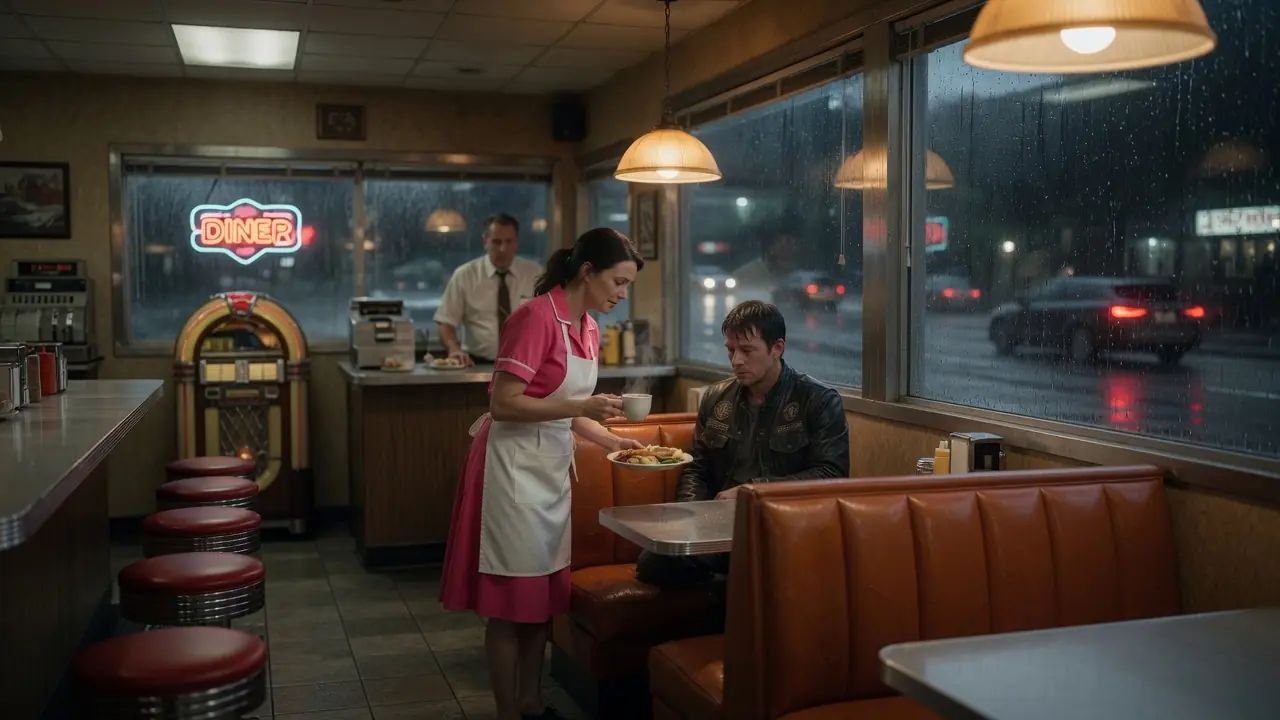
Claire Dawson stood beside the booth in her faded teal waitress uniform, holding a plate of hot meat, potatoes, green beans, and a cup of coffee. She was thirty-four years old, a single mother, and tired in a way sleep could no longer fix. Her apron was stained from the dinner rush, her shoes ached, and inside her purse behind the counter sat exactly five dollars and seventeen cents. That money was supposed to buy milk and bread before she picked up her son from Mrs. Alvarez’s apartment after her shift.
The biker looked like trouble to most people. He had a thick beard, tired eyes, a weathered face, and a soaked leather vest with patches Claire did not recognize. His knuckles were scraped, his cheek was bruised, and his gray hair clung wetly to his forehead. But when Claire looked at him, she did not see danger first.
She saw hunger.
Her manager, Carl Benson, saw something else entirely. He stood behind the counter with a dish towel over one shoulder, watching the booth with disgust. Carl was a broad man with a red face, a short temper, and a habit of speaking to people as if kindness came directly out of his paycheck. “Claire,” he called sharply, “don’t waste food on some dirty biker who can’t pay.”
The biker’s face hardened, but he still did not look up. Claire felt something hot rise in her chest. All night, she had carried plates, refilled coffee, smiled through rude comments, and counted tips that barely covered childcare. She had swallowed enough disrespect for one shift.
She set the plate down in front of the biker.
“Then charge me,” Claire said, turning toward Carl. “Because tonight, this man gets food before your judgment.”
Carl stared at her like she had slapped him. A cook in the back stopped moving. The biker finally looked up, his eyes narrowing with surprise. Claire placed the coffee beside the plate, then pulled the last five-dollar bill from her apron pocket and laid it on the table near the register.
Carl snatched it up. “You’re serious?”
“Yes,” Claire said. “Put it on my tab.”
“You don’t have a tab.”
“Then start one.”
The biker’s voice came quietly. “Ma’am, you don’t have to do that.”
Claire turned back to him. His eyes were tired but careful, as if he was not used to help that did not come with a hook hidden inside it. “Eat first,” she said gently. “Pride can wait.” Then she nodded toward the plate. “Food gets cold faster than hard feelings.”
For the first time, the corner of his mouth almost moved. Not a smile exactly, but the memory of one. “Name’s Mason Cole,” he said.
“Claire Dawson.”
Mason looked at the food again, then down at his hands. “I’ll pay you back.”
“I didn’t ask.”
“I know.” He picked up the fork slowly. “That’s why I will.”
Claire left him to eat and went back to wiping tables. She tried not to watch him too closely, but she noticed the way he took the first bite carefully, as if afraid the food might disappear. He ate like a man who had gone too long without warmth, not just in his stomach, but in his life. Each time she passed the booth, she refilled his coffee without asking.
The diner was called Marlene’s, though Marlene herself had sold it years ago after her husband died. It sat off Route 19 outside a small Pennsylvania town, half-hidden between a truck stop and an abandoned service station. At night, the neon sign buzzed, the windows steamed, and the regulars came in looking for hot coffee, eggs, and a place to be lonely without admitting it. Claire had worked there for almost four years.
She worked nights because days belonged to her son, Noah. He was seven, small for his age, with serious brown eyes and a habit of leaving superhero drawings in her lunch bag. Claire had been raising him alone since her husband, Travis, walked out when Noah was two and came back only when he needed money, sympathy, or someone to blame. She had learned to survive by making herself useful and invisible.
But invisible people still had bills. Rent was late. Her car needed tires. Noah needed new school shoes. And Carl had been cutting her hours ever since she refused to let him take tips from the jar to cover “shift losses” that nobody understood.
At 1:30 in the morning, Mason finished his meal. Claire brought him one last cup of coffee and noticed his hands had steadied. The color had returned slightly to his face.
“You ride alone?” she asked.
“Tonight, yes.”
“Bad night for it.”
“Bad night for a lot of things.”
She did not push. People who came into diners after midnight carried stories that did not always want daylight. Mason reached into his vest and pulled out a small metal coin, worn smooth around the edges. It had a motorcycle engraved on one side and the words Iron Shepherds on the other.
He slid it across the table.
Claire looked at it. “What’s this?”
“A promise,” Mason said. “You ever need help, call the number on the back.”
Claire turned the coin over. A phone number was engraved in tiny numbers. She tried to hand it back. “I’m not taking anything from you.”
“You already gave me something when I had nothing to give back.”
“It was dinner.”
“No,” Mason said, looking at her carefully. “It was dignity.”
The word made Claire look away. She was not used to being seen that clearly. “Just get somewhere dry, Mr. Cole.”
“Mason.”
“Then get somewhere dry, Mason.”
He stood slowly, leaving the booth cleaner than most customers ever did. At the door, he stopped and glanced back. “That boy in the drawing behind the counter yours?”
Claire looked toward Noah’s crayon picture taped near the coffee machine. It showed her in a waitress dress with a crown on her head. “Yes,” she said. “That’s Noah.”
Mason nodded once. “Then he’s got a good mother.”
Before she could answer, he stepped into the rain and disappeared into the dark.
Three days passed.
Claire did not call the number.
She put the coin in the small pocket of her purse and told herself she would return it if Mason ever came back. Men made promises easily, especially men passing through. She had spent too many years learning not to build hope around strangers.
By the third morning, hope felt too expensive anyway.
Carl fired her after breakfast.
It happened in the back hallway beside the supply shelves, where the floor always smelled like bleach and old grease. He held up a printed schedule with her name crossed out in red marker. “You embarrassed me in front of customers,” he said. “You give away food, you talk back, and you act like this diner belongs to you.”
Claire stared at the schedule. “I paid for that meal.”
“With money you probably needed for something else,” Carl said with a sneer. “That’s your problem, Claire. You’re always playing saint when you can’t even keep your own life together.”
The words hit too close. Her rent envelope was still short. Noah’s school had sent a reminder about the field trip payment. Mrs. Alvarez had been kind about childcare, but kindness did not pay her electric bill.
Claire lifted her chin. “So that’s it?”
Carl shrugged. “Pick up your last check Friday. And don’t make a scene.”
She wanted to scream. She wanted to throw her apron on the floor and tell him exactly what kind of man he was. Instead, she untied the apron, folded it, and placed it on the shelf. The dignity of quiet exit was the only thing she could afford.
Then her phone buzzed.
It was a message from her landlord.
Payment due by 5 p.m. or eviction process begins Monday.
Claire sat in her old car behind the diner and gripped the steering wheel until her fingers hurt. Rain had returned, tapping softly against the windshield. She thought of Noah’s shoes, the empty fridge, the rent, the lost job, and the five dollars she had spent on a stranger’s dinner. For one bitter second, she wondered if Carl was right.
Maybe decent people only survived in stories.
She opened her purse to find a tissue and saw Mason’s coin.
The Iron Shepherds.
She held it in her palm for a long time. Then she put it back. She would not call. She would not beg a stranger. She would figure it out the way she always had.
That night, she picked up Noah from Mrs. Alvarez and pretended everything was fine. Noah ate buttered noodles at the kitchen table while Claire counted dollars twice, then three times, as if the numbers might change out of pity. They did not.
“Mom,” Noah said, “why are you quiet?”
Claire looked up quickly. “Just tired, baby.”
“Did the diner people be mean again?”
She smiled, though it hurt. “Something like that.”
Noah slid a folded drawing across the table. It showed a big motorcycle beside their apartment building, with Claire and Noah standing behind a man in a black vest. “That man from your work came in my dream,” Noah said. “He scared the bad guys.”
Claire laughed softly despite herself. “You don’t even know him.”
“He had kind eyes.”
She looked at the drawing for too long. Children had a way of seeing what adults were too guarded to trust. She kissed the top of Noah’s head and told him to get ready for bed.
At 4:43 the next morning, Claire woke to pounding on her apartment door.
Her whole body went cold.
She got out of bed quietly, grabbed her phone, and looked through the peephole. Travis stood in the hallway, unshaven, restless, and angry. Her ex-husband had not visited in six months. He only appeared when trouble had already found him and he needed someone else to pay for it.
“Claire,” he called. “Open the door. I know you’re in there.”
Noah appeared in the bedroom doorway, frightened and rubbing his eyes. Claire put a finger to her lips and pulled him gently behind her. The pounding came again, harder this time.
“I need money,” Travis snapped through the door. “Don’t act like you don’t owe me.”
Claire’s hands shook. She did not owe him anything. Not money, not forgiveness, not fear. But men like Travis believed history was a debt women could never finish paying.
She called the police. The dispatcher said officers were on the way, but rural response times were never quick. Travis kept pounding. Noah began to cry silently into her shirt.
Then Claire remembered the coin.
Her purse was on the kitchen chair. She pulled it open with trembling fingers, found the Iron Shepherds coin, and dialed the number before she could talk herself out of it.
A man answered on the second ring. “Iron Shepherds. This is Mason.”
Claire almost broke at the sound of his voice. “It’s Claire,” she whispered. “From the diner.”
His tone changed immediately. “Where are you?”
She gave him the address, her voice shaking while Travis hit the door again. Mason did not ask for proof. He did not ask what she had done. He only said, “Stay inside. Keep your boy away from the door. Help is coming.”
The line ended.
Claire held the phone to her chest and waited.
The police arrived first, fifteen minutes later. Travis tried to pretend he had only come to talk, but the officers made him leave after Claire showed them old messages and explained the situation. They warned him not to return that night. Travis glared at her over one officer’s shoulder as he walked away.
By sunrise, the deep rumble began.
At first, Claire thought it was thunder.
Then the sound grew, rolling through the street, shaking windows, rising from every direction like a storm made of engines. Noah ran to the window and gasped. Claire stepped beside him and saw motorcycles turning into the apartment lot. Not ten. Not twenty.
Hundreds.
They came in lines, headlights glowing in the gray dawn, black leather vests slick with rain, flags mounted behind seats, engines rumbling low and steady. The first bike stopped near the curb. Mason Cole removed his helmet and looked up at Claire’s window.
Noah whispered, “Mom… is that the man?”
Claire could not speak.
By the time she reached the parking lot, the motorcycles had filled the street. Men and women of every age stood beside them, some with gray hair, some young, some wearing patches, some holding coffee, all facing her apartment building like a wall no fear could easily cross. Mason walked toward Claire slowly, giving her space.
“You called,” he said.
Claire looked around, overwhelmed. “I didn’t mean for all this.”
Mason glanced back at the riders. “I did.”
“Why?”
He looked at her with the same steady eyes from the diner. “Because seventy-two hours ago, you spent your last five dollars feeding a man everybody else wanted to throw away.” His voice softened. “The Iron Shepherds don’t forget mercy.”
Claire’s eyes filled with tears. “I lost my job because of it.”
“I know.”
She blinked. “How?”
Mason turned slightly and nodded toward an older woman stepping forward from the crowd. She wore a dark riding jacket, silver hair, and a face that looked like it had survived enough storms to stop fearing weather.
“This is Ruth Cole,” Mason said. “My sister. She owns three diners across the county.”
Ruth looked Claire up and down, not unkindly. “Heard you feed people before judging them.”
Claire wiped her cheek quickly. “I try.”
“Good,” Ruth said. “I need a manager who remembers that.”
Claire stared at her. “A manager?”
“At my new place off Route 8. Day shift. Better pay. Benefits after sixty days. Bring your boy after school if you need to. We’ve got a booth by the office where homework gets done.”
Claire covered her mouth.
Mason looked toward Noah, who was hiding half behind his mother while staring at the motorcycles in awe. “And the rent?”
Claire stiffened. “No. I can’t take money.”
Mason nodded, as if he expected that. “Then don’t. The club has a family assistance fund. We pay landlords directly when a family is at risk. No cash in your hand. No shame in it. You helped one of ours when he was stranded. Now we help you stand.”
Claire shook her head, crying openly now. “I don’t understand. I gave you one meal.”
Mason’s face grew serious. “You gave me that meal the night I was coming back from burying my brother.”
The world seemed to quiet around her.
Mason looked toward the street, where the riders stood respectfully silent. “He was the founder of our club. We spent our lives helping stranded riders, veterans, widows, kids, anyone who needed a hand on the road. That night, I was soaked, broke because my wallet was in his truck two counties away, and too tired to explain myself to one more person.” He looked back at Claire. “You didn’t ask whether I deserved food. You just fed me.”
Claire pressed a hand to her chest. “I’m sorry about your brother.”
Mason nodded once. “He would’ve liked you.”
Behind them, a motorcycle horn sounded once from the street. Then another. Soon, hundreds of riders raised their hands, not cheering loudly, not making a show, just acknowledging her in a way that made Claire feel seen without being exposed.
Carl Benson came outside the diner half an hour later to find five hundred motorcycles surrounding his parking lot.
Claire had not expected to go back there, but Mason asked if she would come with them. “You should collect your last check,” he said. “And he should hand it to you respectfully.” Claire almost refused. Then she thought of all the nights Carl had spoken down to her, all the tips he had touched, all the fear he had counted on.
So she went.
The convoy did not roar aggressively into the diner lot. It arrived with slow control, engines low, riders parking in neat rows until the little roadside diner looked like the center of a living wall. Customers inside pressed their faces to the windows. Carl stepped out from behind the counter, pale and confused.
Claire walked in with Mason on one side and Ruth on the other. Noah held her hand, his eyes wide. Carl’s face tightened when he saw her.
“You can’t bring these people in here,” he said.
Mason said nothing.
Ruth stepped forward. “This woman’s final check.”
Carl swallowed. “Payroll isn’t ready.”
Ruth looked around the diner. “Then get it ready.”
Claire saw Carl glance toward the riders outside. For once, his voice had no sharpness left. He went to the office, returned with an envelope, and slid it across the counter. Claire opened it and counted. It was short.
She looked up. “My tips.”
Carl’s jaw tightened. “Those were pooled.”
“No,” Claire said, her voice steadier than she felt. “They were taken.”
The cook in the back doorway cleared his throat. “She’s right.”
Another waitress nodded. “He does it to all of us.”
Carl’s face went red. “Watch your mouths.”
Ruth smiled coldly. “That sounds like a labor board conversation.”
Carl added cash to the envelope with shaking fingers. Claire took it, not triumphantly, not cruelly, but with the quiet certainty of someone reclaiming what had been stolen in small pieces for too long.
At the door, she turned back. “You thought kindness made me weak.”
Carl said nothing.
Claire held the envelope against her chest. “It made me remembered.”
Then she walked out.
By noon, the Iron Shepherds had done more than protect her. They filled her refrigerator, paid her rent through the assistance fund, helped change the locks on her apartment, and connected her with a legal advocate for custody and safety concerns. Ruth gave her a written job offer before the day was over. Noah spent the afternoon sitting on Mason’s parked motorcycle while three riders taught him the names of every visible part.
For the first time in months, Claire breathed without calculating the cost of that breath.
The story spread through town by evening. Some people exaggerated it, saying a biker army had stormed the diner. Others said Claire had secretly known Mason was important. Neither version was true. The truth was smaller and better.
A tired woman had fed a tired man.
And the world had answered.
Two weeks later, Claire started at Ruth’s diner. It was cleaner, brighter, and full of staff who spoke to each other like people. On her first day, Ruth handed her a name tag that read Claire — Manager. Claire stared at it until Ruth gently snapped it onto her uniform.
“You earned it,” Ruth said.
“No,” Claire whispered. “I was given a chance.”
Ruth shook her head. “Same thing, if you know what to do with it.”
Claire did.
She ran the diner with fairness sharp enough to cut through old habits. Workers kept their tips. Nobody was mocked for being hungry. A small sign went up near the register: If you cannot pay, ask quietly. Someone here remembers hard days. Ruth approved it. Mason pretended not to get emotional when he saw it, but Claire noticed him look away.
The Iron Shepherds made the diner one of their regular stops. Sometimes ten bikes came. Sometimes fifty. Once, on a clear Saturday afternoon, nearly two hundred riders filled the parking lot for a fundraiser Claire organized for families facing eviction. Noah sold lemonade at a table near the door and proudly told every customer, “My mom is the boss.”
Mason became a steady presence in their lives, though never an intrusive one. He fixed Claire’s car, taught Noah how to check tire pressure, and sat in the corner booth drinking black coffee when the road brought him near. He never acted like Claire owed him anything. That was why she trusted him.
Months later, on a rainy night much like the first one, a young man came into the diner soaked, ashamed, and hungry. He stood near the counter, eyes lowered, and whispered to Claire, “I don’t have money.”
Claire looked at him for a long moment.
Then she picked up a plate.
“Then eat first,” she said gently. “Pride can wait.”
Outside, motorcycles rested beneath the rain-dark sky, their engines quiet for once. Inside, the diner glowed with warm light, coffee steam, and the kind of mercy that does not ask for proof before it helps. Claire set the plate down and thought of the night her last five dollars had felt like the end of everything.
It had not been the end.
It had been the seed.
And seventy-two hours later, five hundred motorcycles had come back to prove that one decent act, given at the right moment, can become louder than fear, stronger than cruelty, and big enough to save a life.