The gas station sat on the edge of Denton, Texas, where the highway widened into four lanes and the summer heat shimmered above the pavement like invisible fire.
It was called Miller’s Stop, though most people in town just called it “the old station.” The sign above the pumps had faded from red to dusty pink. The soda machine near the entrance made a strange coughing sound before dropping cans. The concrete outside was cracked in long crooked lines, and weeds pushed through the edges like they were trying to take the place back from people.
Twelve-year-old Noah Mercer knew every crack in that concrete.
He stopped there almost every afternoon after school.
Not because he had money to waste.
Noah rarely had extra money for anything.
He stopped there because the gas station was halfway between his middle school and the small trailer park where he lived with his mother, Linda. On good days, he bought a seventy-nine-cent fountain drink and stretched it for the rest of the walk home. On bad days, he just stood near the shade of the ice machine, cooled his face for a minute, and kept walking.
That Friday was a bad day.
The Texas sun pressed down hard. Noah’s backpack hung from one shoulder, heavy with schoolbooks and a broken zipper he had repaired twice with safety pins. His sneakers were worn thin at the soles. His dark hair stuck to his forehead. His glasses kept sliding down his nose because one arm was taped where it had cracked the month before.
He was small for twelve, quiet, and careful in a way children should not have to be.
At school, careful meant survival.
At home, careful meant not adding one more worry to his mother’s life.
Linda worked mornings at a laundromat and evenings cleaning offices. She came home most nights with tired feet, sore hands, and a smile she put on for Noah the way some mothers put a blanket over a sleeping child.
Noah knew the smile was often for him, not for herself.
That was why he did not tell her everything.
He did not tell her when boys at school called him “trailer trash.”
He did not tell her when they threw his lunchbox under the bleachers.
He did not tell her when they mocked his glasses, his clothes, his quiet voice, or the way he always checked prices before touching anything in the cafeteria line.
He especially did not tell her about Mason Cole.
Mason was thirteen, broad-shouldered, loud, and rich in the way small towns recognized instantly. His father owned Cole Auto Group, sponsored the baseball team, donated to the school fundraiser, and appeared in smiling photos with people who liked cutting ribbons.
Teachers called Mason “energetic.”
Coaches called him “competitive.”
Other kids called him dangerous when adults were not close enough to hear.
Noah called him nothing.
Calling Mason anything only made things worse.
That afternoon, Noah pushed open the glass door of Miller’s Stop and stepped into the cold blast of air conditioning.
For one beautiful second, the heat disappeared.
The cashier, Mr. Alvarez, looked up from behind the counter.
“Afternoon, Noah.”
“Afternoon, sir.”
“You getting a drink today?”
Noah touched the two quarters and three dimes in his pocket.
“Maybe just water.”
Mr. Alvarez glanced toward the soda machine, then toward Noah’s tired face.
“Machine’s acting strange. Might accidentally give you lemonade if you press water.”
Noah understood.
Mr. Alvarez had a way of helping without making it look like help.
“Thanks,” Noah said quietly.
He filled a cup with lemonade, careful not to take too much, careful not to look too happy. He was placing the lid on when the door opened behind him.
The bell rang.
Noah’s shoulders tightened before he turned.
Mason Cole walked in with two boys behind him, Travis and Blake, both wearing baseball caps backward and grinning like they had already decided something funny was about to happen.
Mason saw Noah immediately.
A slow smile spread across his face.
“Well, look who’s here,” Mason said loudly. “The gas station rat.”
Noah looked down at his drink.
He tried to move toward the counter.
Mason stepped into his path.
“Where you going?”
“Home.”
“With that?” Mason pointed at the lemonade. “You pay for it?”
Noah’s face warmed.
“Yes.”
Mason looked toward Mr. Alvarez.
“You sure about that? My dad says people like him steal little things first.”
Mr. Alvarez’s expression hardened.
“That’s enough, Mason.”
Mason ignored him.
His eyes dropped to Noah’s backpack.
“What’s in there?”
“Books.”
“Books?” Mason laughed. “You carrying books like you’re going somewhere?”
Travis snickered.
Blake leaned against the chip rack, watching.
Noah tried to step around him.
Mason grabbed the strap of his backpack and yanked it off his shoulder.
Noah spun back, panic flashing across his face.
“Give it back.”
Mason held it high.
“What’s wrong? Got treasure in here?”
“Mason, stop.”
The words came from near the coffee station.
They were low, calm, and rough.
Every head turned.
A man sat at the small table by the window, where truckers sometimes drank coffee before getting back on the road.
He was older, maybe late fifties or early sixties, with a gray beard, thick arms, and sun-browned skin. He wore a black leather vest over a plain white T-shirt. The vest had patches on it, not flashy, not new, but worn from years of road and weather.
On the back of the chair beside him sat a motorcycle helmet.
Outside, under pump four, a black Harley rested in the shade, chrome catching the afternoon light.
Noah had noticed the man when he came in.
Everyone noticed a biker like that.
But Noah had looked away quickly, the way people did when they did not want to invite trouble.
Mason looked the man up and down.
“Mind your business, old man.”
The gas station went silent.
Mr. Alvarez froze behind the counter.
The biker took a slow sip of coffee.
Then he set the cup down.
“My business,” he said, “is watching a boy twice another boy’s size put hands on something that isn’t his.”
Mason’s smile turned mean.
“You don’t know anything.”
“I know enough.”
Mason tossed Noah’s backpack to Travis, who caught it and laughed.
Noah reached for it.
Blake stepped in front of him.
Mason moved closer until Noah could smell mint gum and sweat.
“What are you going to do, Noah? Cry? Call your mommy from the laundromat?”
Noah’s hands curled into fists at his sides.
Not because he wanted to fight.
Because he wanted not to break.
The biker stood.
He did not rush.
He did not shout.
But when he rose, the room seemed to shrink around him.
He was tall, broad, and steady in a way that made even Mason pause.
“Hand him the bag,” the biker said.
Mason’s eyes flickered toward the door.
Outside, a white truck pulled up at pump two. A woman got out and began filling gas, unaware of what was happening inside.
Mason regained his nerve.
“Or what?”
The biker looked at him for a long moment.
“Or you will show everyone in this room exactly what kind of young man your father is raising.”
Mason’s face changed.
It was subtle, but Noah saw it.
His father’s name had power in Denton. Usually, people became quieter when they remembered Mason was a Cole.
This biker did not.
Mason stepped closer to Noah, grabbed the cup of lemonade from his hand, and poured it slowly onto the floor.
“There,” Mason said. “Now he has something to clean.”
Travis and Blake laughed.
Noah stared at the spreading puddle.
Something in his chest went hollow.
It was not about the lemonade.
It was about the way Mason wanted everyone to see him lowered.
Small.
Poor.
Powerless.
Mr. Alvarez came from behind the counter.
“Mason, get out.”
Mason turned on him.
“My dad buys gas for every company truck here. You want to lose that account?”
Mr. Alvarez stopped.
That was the problem with people like Mason.
They did not have to own the whole town.
They only had to own enough of it to make decent people afraid.
The biker walked forward.
One step.
Then another.
He stopped beside Noah, not in front of him, not blocking him like a helpless child, but beside him.
That mattered.
“What’s your name, kid?” he asked.
Noah swallowed.
“Noah.”
“Noah what?”
“Noah Mercer.”
The biker nodded.
“I’m Wade Turner. Folks call me Preacher.”
Mason laughed.
“Preacher? What kind of stupid biker name is that?”
Wade did not look at him.
“Because I spent half my life talking men out of doing foolish things after they’d already done them.”
Then he looked at Mason.
“Last chance. Give him back his bag.”
For a moment, nobody moved.
Then Travis, suddenly less amused, tossed the backpack onto the floor near Noah’s feet.
Noah bent to pick it up.
Mason stuck out his foot and kicked the backpack away.
The room went cold.
Not in temperature.
In feeling.
Wade’s face did not change much. But his eyes did.
They became quiet.
Too quiet.
He took out his phone, turned the screen toward Mason, and pressed play.
Mason’s voice filled the gas station.
“What are you going to do, Noah? Cry? Call your mommy from the laundromat?”
Then came the sound of lemonade splashing onto the floor.
Travis’s laugh.
Mason’s threat to Mr. Alvarez.
The whole thing.
Mason’s face drained of color.
“You recorded me?”
Wade put the phone back in his pocket.
“No. The security camera did.”
Mason looked up.
Near the ceiling, above the cold drink coolers, a small black camera pointed directly at them.
Mr. Alvarez crossed his arms.
“It records audio too.”
Mason looked trapped for the first time Noah had ever seen.
Then the door opened again.
A man in a pressed blue shirt came in, talking loudly into his phone.
“I’m telling you, the Henderson account is not moving unless I approve it.”
He stopped when he saw the scene.
Noah knew him from billboards and local ads.
Daniel Cole.
Mason’s father.
He took in the puddle on the floor, Noah’s red face, the biker, Mr. Alvarez, and his son standing too stiffly near the chip rack.
“What happened?” Daniel asked.
Mason immediately pointed at Wade.
“This guy threatened me.”
Wade did not answer.
Mr. Alvarez did.
“Your son was harassing Noah. Took his backpack. Poured his drink on the floor. Threatened my business when I told him to leave.”
Daniel’s expression hardened.
“Mason?”
Mason’s mouth opened.
Before he could lie, Wade spoke calmly.
“Camera has it.”
Daniel looked at the camera.
Then at his son.
For a second, something like annoyance crossed his face, but not the kind Noah expected. It was not moral anger. It was the anger of a powerful man whose problem had become public.
He turned to Wade.
“And you are?”
“Wade Turner.”
Daniel’s eyes narrowed slightly.
“I know that name.”
“You should.”
A silence passed.
Wade continued.
“I run Iron Road Garage on County Line. Your dealership tried to push us off that lot last year.”
Recognition settled over Daniel’s face.
Iron Road Garage was known around town, not because it was fancy, but because Wade hired men other employers ignored. Former addicts in recovery. Older mechanics. Veterans who needed steady work. Young men who had made mistakes and wanted a legal way forward. The garage repaired cars cheaply for single mothers and elderly people when they could.
Daniel Cole had wanted that lot for expansion.
Wade had refused to sell.
Now the two men stood in the middle of a gas station, and Noah realized this was not just about one bully and one backpack.
It was about the same kind of power, wearing a smaller face.
Daniel lowered his voice.
“Let’s not make a scene.”
Wade looked around.
“The scene happened before you walked in.”
Daniel stepped closer.
“Mr. Turner, boys mess around. I’m sure there was no real harm meant.”
Noah stared at the floor.
No real harm.
He had heard that phrase before.
From teachers.
From coaches.
From adults who wanted quiet more than truth.
Wade turned slightly toward Noah.
“Noah,” he said, “did it feel harmless?”
Every eye moved to him.
Noah hated it.
His throat tightened.
Mason stared at him with silent warning.
Daniel watched him with a businessman’s smile.
Mr. Alvarez waited.
Wade stood beside him.
Not pushing.
Just there.
Noah looked at the puddle of lemonade, his backpack, his taped glasses, his worn sneakers.
Then he looked at Mason.
“No,” he said.
His voice was small.
But it was clear.
“It didn’t.”
Daniel’s jaw tightened.
Wade nodded once.
“That settles that.”
Daniel’s smile thinned.
“What exactly do you want?”
Wade pointed toward the backpack.
“Your son apologizes. Out loud. To Noah and to Mr. Alvarez.”
Mason’s eyes widened.
“Dad.”
Daniel said nothing.
Wade continued.
“He pays for the drink he wasted and the cleanup. Then you and I talk about something bigger.”
Daniel looked at him sharply.
“What bigger?”
Wade’s voice lowered.
“My garage has had three surprise inspections in four months. My suppliers have been warned that doing business with me might affect contracts with Cole Auto. The city suddenly has questions about my signs, my parking, my permits. You and I both know where that came from.”
Daniel’s face became still.
Wade reached into his vest and pulled out a folded envelope.
“I’ve got statements. Names. Dates. Emails. A few recordings. I was going to bring them to the city meeting next week.”
Daniel’s eyes flicked toward the envelope.
“But seeing your boy do the same thing to Noah that you’ve been doing to working people across this town made me think maybe today is better.”
The gas station was completely silent now.
Even the soda machine seemed to have stopped coughing.
Daniel looked at Mason.
For the first time, Noah saw fear in the boy’s face.
Not fear of pain.
Fear of consequence.
“Mason,” Daniel said through tight teeth, “apologize.”
Mason stared at his father.
“Now.”
Mason looked at Noah.
His mouth twisted like the words tasted bitter.
“I’m sorry.”
Wade’s voice came immediately.
“For what?”
Mason glared at him.
Daniel snapped, “Mason.”
Mason swallowed.
“I’m sorry I took your backpack. I’m sorry I poured your drink out. I’m sorry I called you names.”
Noah did not know what to say.
He had imagined Mason being stopped before. He had imagined him getting in trouble. He had imagined teachers finally believing him.
But he had never imagined an apology.
Even a forced one felt strange, like seeing a locked door open from the wrong side.
Mason turned to Mr. Alvarez.
“I’m sorry for threatening your business.”
Mr. Alvarez nodded once.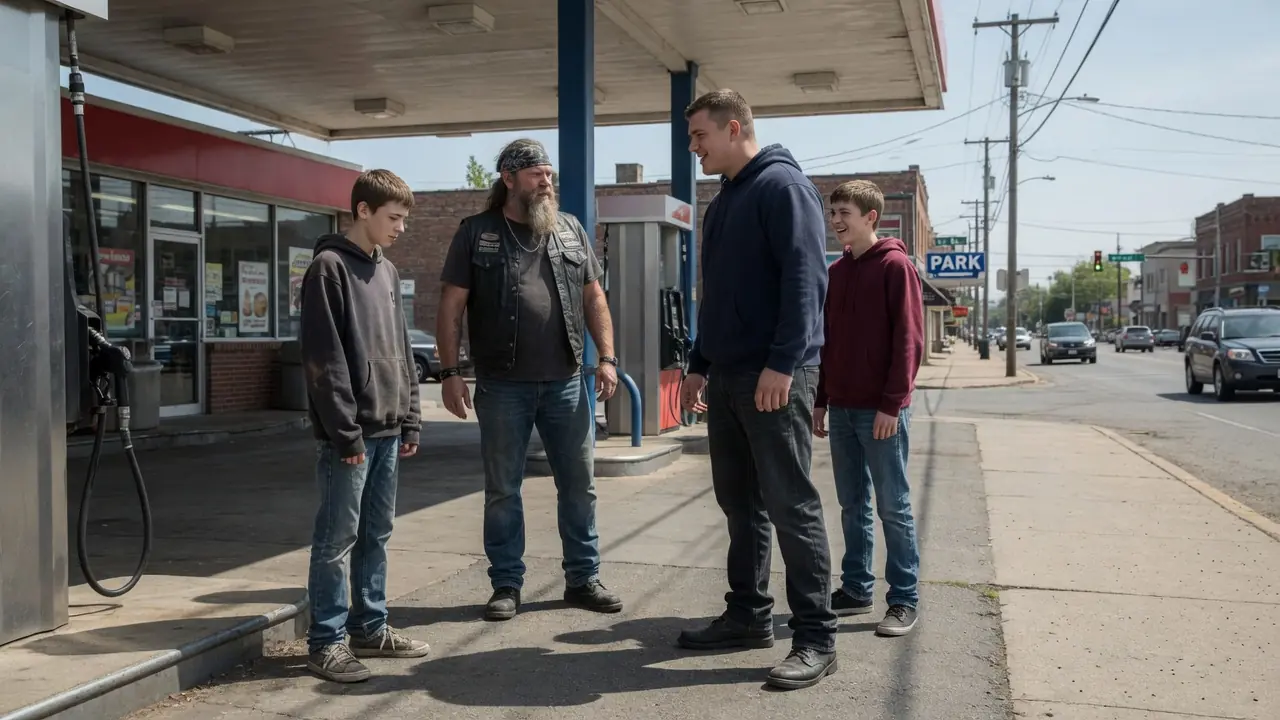
“You can pay for the drink and the mop I’m about to make you use.”
Mason’s head snapped up.
“What?”
Mr. Alvarez pointed behind the counter.
“Mop’s in the closet.”
Daniel looked furious, but Wade was watching him. So was the camera. So were two customers near the door who had begun recording on their phones.
Mason got the mop.
And in front of everyone, Mason Cole cleaned the lemonade from the floor.
Noah watched without smiling.
He did not feel victory exactly.
He felt something heavier.
Like a knot inside him had loosened just enough for air to pass through.
When it was done, Daniel took Mason by the shoulder and pulled him toward the door.
Wade spoke before they left.
“Council meeting. Tuesday. I’ll be there.”
Daniel stopped.
“We can discuss this privately.”
“No,” Wade said. “That’s how men like you keep winning.”
Daniel said nothing.
Then he left with his son and the two silent boys following behind.
The bell above the door rang.
The gas station breathed again.
Mr. Alvarez came around the counter and put a new cup under the lemonade machine.
“Machine is still broken,” he said.
Noah stared at him.
“It keeps giving free refills.”
He handed Noah the cup.
Noah took it with both hands.
“Thank you.”
Mr. Alvarez nodded.
Then Wade crouched slightly so he and Noah were closer to eye level.
“You alright?”
Noah shrugged.
“I guess.”
“That’s an honest answer.”
Noah looked toward the door.
“Is he going to get me later?”
Wade did not lie.
“Maybe he’ll want to. But bullies like Mason count on people staying quiet. Today, a lot of people heard him. That changes things.”
Noah looked down at his backpack.
“My mom can’t know.”
Wade’s expression softened.
“Why not?”
“She already works too much. If she knows, she’ll worry. She’ll think she has to fix it. She’s tired all the time.”
Wade studied him.
“You trying to protect your mother?”
Noah nodded.
Wade sighed.
“Good heart. Bad plan.”
Noah frowned.
Wade continued.
“People who love you are supposed to know when you’re carrying too much.”
“She can’t do anything.”
“She can stand beside you. Sometimes that’s the first thing.”
Noah looked away.
His eyes stung, but he refused to cry.
Wade noticed and looked toward the window, giving him a little privacy.
After a moment, Wade stood.
“You walk home?”
“Yes, sir.”
“Not today.”
Noah stiffened.
“I can.”
“I know you can. You’re still not.”
Wade picked up his helmet.
Outside, the black Harley waited under pump four.
Noah stared.
“You’re giving me a ride?”
“You afraid?”
“A little.”
“Good. Means you’ve got sense. I have a spare helmet.”
Noah hesitated.
Then he looked at Mr. Alvarez, who smiled and nodded.
Ten minutes later, Noah sat behind Wade on the Harley, wearing a helmet slightly too big for him and holding the back of the biker’s vest with nervous fingers.
The engine rumbled beneath him like controlled thunder.
When they pulled out of Miller’s Stop, Noah felt the hot wind rush past his sleeves.
For the first time in a long time, the road home did not feel like something he had to survive alone.
His mother was standing outside their trailer when they arrived.
Linda Mercer had just come home from the laundromat. Her work shirt was wrinkled, her hair pulled back, her face tired. When she saw a biker pull up with her son on the back, fear flashed across her expression.
“Noah?”
Noah climbed off quickly.
“I’m okay, Mom.”
Linda looked at Wade.
Wade removed his helmet respectfully.
“Ma’am. Wade Turner. I own Iron Road Garage.”
“What happened?”
Noah opened his mouth.
No sound came.
Wade did not answer for him.
He simply stood quietly, giving the boy space to tell the truth.
Noah looked at his mother.
He saw the tiredness in her eyes.
He saw the fear.
He saw the love behind both.
And for once, he let himself stop protecting her from his pain.
“Mason Cole has been bothering me,” he said. “At school. And today at the gas station.”
Linda’s face changed.
“Why didn’t you tell me?”
Noah stared at the ground.
“Because you’re already tired.”
That broke her.
Not loudly.
She simply stepped forward and wrapped him in her arms, holding him tightly enough that Noah finally let his own arms come up around her.
“I am never too tired to be your mother,” she whispered.
Wade looked away.
Some moments did not need witnesses staring at them.
After a while, Linda wiped her eyes and turned to Wade.
“Thank you.”
Wade nodded.
“He spoke up today. That was the hard part.”
Linda looked at Noah with pride and sorrow mixed together.
“What happens now?”
Wade pulled the envelope from his vest.
“Now we make sure people hear the whole truth.”
Tuesday came.
The city council meeting was usually boring.
That week, it was packed.
People filled every chair. Others stood along the walls. Mechanics from Iron Road Garage came in clean shirts. Vendors from the east side came. Parents came. Teachers came. Mr. Alvarez came with copies of the gas station footage. Linda came with Noah sitting beside her, nervous but determined.
Daniel Cole sat near the front with a lawyer.
He looked polished.
But not comfortable.
Wade Turner spoke calmly.
He did not shout.
He did not threaten.
He laid out dates, documents, complaints, pressure tactics, sudden inspections, and business owners who had been pushed around quietly for years.
Then Mr. Alvarez played the gas station video.
The room watched Mason take Noah’s backpack, pour out his drink, threaten the station, and mock him.
Noah wanted to disappear.
Linda held his hand under the table.
When the video ended, the room was silent.
Then something happened that Noah never forgot.
One by one, people stood.
A barber talked about being pressured to sell his shop.
A widow talked about repair fees from Cole Auto that changed after she refused to sign a petition.
A vendor talked about losing a permit after criticizing a development plan.
A teacher admitted Mason had been protected too often because the school feared his father.
The truth came out slowly, then all at once.
By the end of the night, Daniel Cole’s face had lost its public smile.
The council voted to delay his development project pending investigation.
The school district announced a review of bullying complaints.
Mr. Alvarez became something of a local hero, though he insisted he had only kept his camera running.
And Noah Mercer, who had once tried to be invisible, walked out of city hall with his mother on one side and Wade Turner on the other.
Outside, several motorcycles waited.
Not thirty.
Only eight.
Men and women from Iron Road Garage and Wade’s riding club. They had not come to scare anyone. They had come to stand there, arms crossed, helmets under their arms, reminding the town that working people had friends too.
Noah looked up at Wade.
“Why did you help me?”
Wade leaned against his bike.
“Because someone should have helped me when I was your age.”
Noah waited.
Wade looked toward the dark street.
“I was small too. Poor too. Angry too, but later. Before angry, I was just scared. There was a boy who made my life miserable. Adults called it teasing. I called it waking up every morning with a rock in my stomach.”
“What happened?”
“I grew. Got strong. Got mean for a while.” Wade glanced at him. “That part I don’t recommend.”
Noah almost smiled.
“Then I learned something. Strength that only protects itself is just another kind of bullying. Real strength stands next to someone who has been standing alone too long.”
Noah looked at the motorcycles.
“Is that what bikers do?”
Wade laughed softly.
“Some do. Some don’t. A vest doesn’t make a man good. Neither does a suit make him honest. You watch what people do when someone smaller needs help. That tells you.”
Noah remembered Mason.
Daniel Cole.
Mr. Alvarez.
His mother.
Wade.
He nodded slowly.
The weeks after that were different.
Not perfect.
Life rarely changes in one dramatic sweep.
Mason was suspended for a while. When he returned to school, he avoided Noah completely. Some kids whispered. Some acted impressed. Some suddenly wanted to be Noah’s friend, which felt almost as strange as being ignored.
But Noah changed too.
He told the school counselor the truth.
He told his mother more.
He stopped walking with his shoulders folded inward.
And every Friday after school, he stopped at Miller’s Stop, bought a lemonade when he had money, accepted one from the “broken machine” when he did not, and sometimes found Wade Turner sitting by the window with coffee.
They did not always talk.
Sometimes Wade showed him how to check tire pressure on the Harley.
Sometimes Noah helped sweep the station floor for Mr. Alvarez.
Sometimes Linda joined them after work, and Wade pretended not to notice when Mr. Alvarez quietly packed dinner for her to take home.
A strange little family began forming around that gas station.
Not by blood.
By showing up.
One afternoon, months later, Noah arrived at Miller’s Stop and found something waiting near pump four.
A bicycle.
Not new.
Better than new.
A restored blue Schwinn with polished chrome, clean tires, and a small black bell on the handlebar. It shone in the afternoon sun like a promise.
Noah stopped walking.
Wade stood beside it, wiping his hands on a rag.
“What is this?”
“Bike.”
“I can see that.”
“Then why ask?”
Noah stepped closer.
His fingers hovered over the handlebars.
“Is it for sale?”
“No.”
Wade tossed him the rag.
“It’s for you.”
Noah’s head snapped up.
“I can’t take that.”
“You can.”
“No, I mean, my mom can’t pay.”
“Didn’t ask her to.”
“I didn’t earn it.”
Wade looked at him steadily.
“You earned it when you told the truth even though your voice was shaking.”
Noah’s throat tightened.
Wade continued.
“Besides, I didn’t do it alone. Mr. Alvarez found the frame. Your mom picked the color. The boys at the garage helped with the tires. I just bossed everyone around and took credit.”
Noah looked through the window.
Mr. Alvarez stood behind the counter smiling.
Linda was beside him, one hand over her mouth, eyes bright.
Noah turned back to the bike.
He touched the bell.
It gave a small clear ring.
For some reason, that tiny sound nearly made him cry.
Wade looked away toward the pumps.
“Go on,” he said. “Try it before I change my mind.”
Noah rode circles around the edge of the parking lot, slow at first, then faster.
The wind lifted his hair.
His backpack bounced against his shoulders.
His mother laughed from the sidewalk.
Wade stood with both arms crossed, pretending not to smile.
From that day on, Noah rode the blue Schwinn everywhere.
To school.
To Miller’s Stop.
To Iron Road Garage, where Wade let him sweep floors after homework and learn the names of tools. Noah discovered he liked machines. He liked how a broken thing could be understood piece by piece. He liked how problems made more sense when someone patient showed you where to look.
Years passed.
Noah grew taller.
His glasses changed.
His voice deepened.
The boy who once stared at the floor became a young man who looked people in the eye.
In high school, he started a peer support group for kids who were being bullied. He did not call it anything dramatic. He called it “The Table,” because everyone met at lunch and nobody sat alone unless they wanted to.
Wade came to speak once.
He looked out at a classroom full of nervous kids and said, “The strongest person in the room is not the one everyone fears. It’s the one who makes the room safer.”
Noah wrote that sentence down.
He never forgot it.
When he graduated, Linda cried so hard that Mr. Alvarez handed her napkins from the gas station counter, even though the ceremony was nowhere near the station. Wade stood in the back, arms crossed, wearing a clean shirt under his leather vest.
After the ceremony, Noah found him outside.
“I got into the technical college,” Noah said.
“I know.”
“You knew?”
“Your mother told everyone.”
Noah laughed.
“I want to study mechanical engineering. Maybe work on engines. Maybe design them.”
Wade nodded like this had always been obvious.
“You were listening to machines before people listened to you.”
Noah looked at him.
“Thank you.”
Wade’s expression shifted.
“For what?”
“For standing beside me.”
The old biker looked away.
“Yeah, well. You were blocking the lemonade machine.”
Noah smiled.
Years later, Miller’s Stop changed.
The faded sign was replaced.
The cracked concrete was repaired.
The old soda machine finally stopped pretending to be broken and was replaced by one that actually worked. Mr. Alvarez retired, though he still came by every morning to complain about the coffee under new management.
The new owner was twenty-six-year-old Noah Mercer.
He had bought the station with help from a small business loan, a lot of overtime work, and advice from Wade, Linda, and Mr. Alvarez. He kept one table by the window, the same table where Wade had been sitting that first day.
Above it, Noah hung a framed photograph.
It showed a twelve-year-old boy on a blue Schwinn, grinning nervously while a gray-bearded biker stood beside him pretending not to be proud.
Under the photograph were the words:
Real strength stands beside the small.
Every Friday afternoon, local kids knew they could come into Miller’s Stop and get a cup of lemonade if they needed one. Officially, the machine had a “community button.” Unofficially, Noah had made sure no child had to stand in that store thirsty and ashamed.
One hot afternoon, a small boy came in with a torn backpack, dusty shoes, and the familiar look of someone trying to stay invisible.
Behind him, two older boys laughed too loudly near the chip rack.
Noah looked up from the counter.
For a second, time folded.
He saw himself.
The old fear.
The old shame.
The old gas station floor with lemonade spreading across it.
Then the bell above the door rang again.
Wade Turner entered slowly, older now, beard fully white, steps heavier, but eyes still sharp. He took his usual seat by the window.
The two older boys noticed him and immediately lowered their voices.
Noah came around the counter and stood beside the small boy.
Not in front of him.
Beside him.
“What’s your name?” Noah asked.
The boy looked up.
“Eli.”
Noah nodded.
“I’m Noah. Lemonade machine acts strange sometimes. Gives free drinks to people who’ve had a rough day.”
Eli blinked.
The older boys slipped quietly out the door.
Wade watched from the table, one hand around his coffee cup.
Noah handed Eli a drink.
The boy took it with both hands.
“Thank you,” he whispered.
Noah smiled gently.
“Drink it before it gets warm.”
Wade’s mouth twitched.
Outside, the highway stretched long and bright beneath the Texas sun.
Inside, the gas station was cool.
Safe.
Watched over.
And the lesson that had started years earlier with one biker, one bullied boy, and one ruined cup of lemonade remained alive.
Power is not proved by making someone afraid.
Respect is not earned by taking what belongs to someone weaker.
And courage is not always loud.
Sometimes courage is a boy telling the truth with a shaking voice.
Sometimes it is a mother listening through tears.
Sometimes it is a gas station owner keeping the camera on.
And sometimes it is an old biker standing beside a small kid and showing an entire town that real strength does not crush the weak.
Real strength protects them.