The Old Man had almost reached the entrance of the roadside bar when the Biker President stepped directly into his path.
Dozens of motorcycles surrounded the dusty Arizona parking lot, chrome flashing beneath the afternoon sun while engines rumbled and men in black leather vests crowded around picnic tables. The Old Man looked painfully out of place among them, eighty-two years old, slightly stooped, his white hair neatly combed and his weathered hands hanging calmly at his sides. What drew everyone’s attention was the faded olive-green jacket covering his thin shoulders.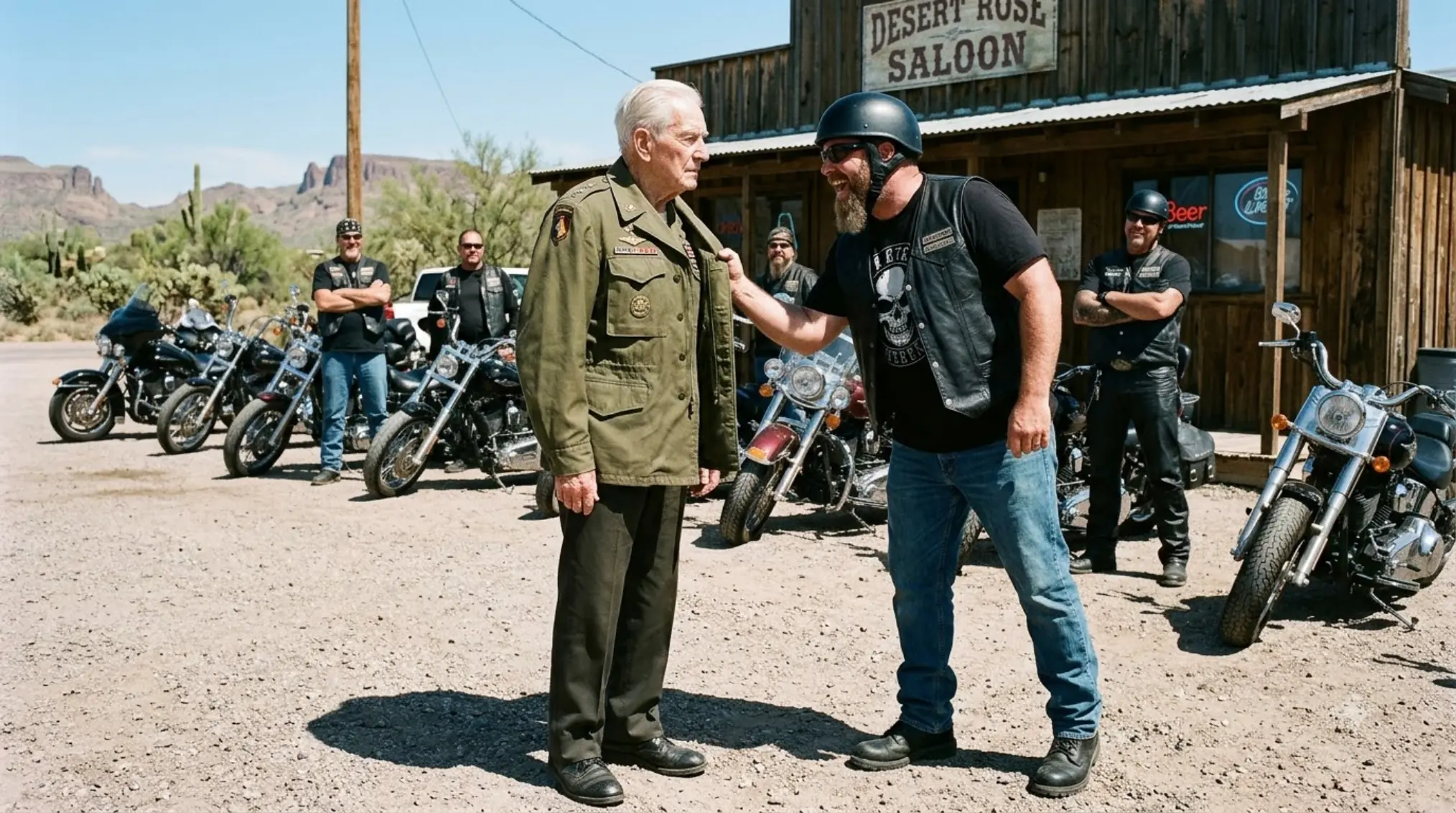
It looked older than half the motorcycles in the lot.
The fabric had been repaired near one elbow. Several patches had lost their original color, and an old brass badge was pinned above the left pocket beside a row of faded service ribbons from his decades in state public safety. He wore dark trousers and black shoes polished more from habit than vanity.
The Biker President looked him up and down.
Then he laughed.
“What museum did you steal that jacket from?”
Several bikers chuckled behind him.
The Old Man stopped.
“I didn’t steal it.”
The Biker President stepped closer, heavy boots grinding against the gravel. He was almost fifty, broad across the shoulders, with a thick beard, black helmet, dark sunglasses, tattooed forearms, and a leather vest covered in club patches.
“Then you bought it at some yard sale.”
The Old Man’s expression did not change.
“No.”
The biker grabbed the front edge of the jacket between two fingers.
“Take this rotten costume off, old man. This lot ain’t for washed-up nobodies.”
The Old Man slapped his hand away.
Hard enough to erase several smiles from the crowd.
“Funny,” he said. “Men like you wear patches to feel important. I earned mine while loud men were still learning how to listen.”
The parking lot went quiet.
The Biker President stared at him.
Then he slammed one fist against the handlebars of the motorcycle beside him.
“You got one breath left to walk away before my whole club puts you flat on this asphalt.”
The Old Man slowly reached toward the brass insignia pinned inside his jacket.
He removed it.
Held it between two fingers.
“Touch this jacket again.”
His voice remained low.
“Then stay right here when the people arriving behind me learn who you put your hands on.”
The Biker President laughed.
“What people?”
The Old Man glanced toward the highway.
“Wait.”
That one word changed the mood.
Nobody knew why.
But something about the way he said it made several bikers turn toward the road.
The Old Man had not come to the gathering looking for trouble.
He had come because of a letter.
It arrived six weeks earlier inside a plain white envelope with no return address.
His daughter had brought his mail into the kitchen and placed it beside his coffee.
“You have another one.”
“Another what?”
“Letter from somebody who thinks you’re still in charge.”
The Old Man smiled.
“I haven’t been in charge of anything for twelve years.”
His daughter gave him a look.
“You reorganized my pantry last week.”
“That pantry was chaos.”
“You alphabetized the canned food.”
“Efficient.”
She laughed and left him alone with the envelope.
The letter inside was handwritten.
Only three paragraphs.
The writer explained that a charity motorcycle rally would be held outside Red Mesa, Arizona, to raise money for families of state troopers, highway rescue crews, firefighters, and emergency dispatchers killed or permanently injured in the line of duty.
The writer had one request.
Please come wearing the old jacket.
The Old Man read that line twice.
The jacket had been stored in a cedar chest since retirement.
He had worn it during his final years as State Public Safety Commissioner, when his office oversaw statewide highway patrol coordination, emergency-response planning, training standards, and major interagency operations.
It was not a regular patrol uniform.
It was a ceremonial commissioner jacket.
Simple.
Functional.
Decorated only with commissioner insignia, state-service ribbons, and a badge issued specifically for his office.
The jacket meant little to people outside law enforcement.
To those who had served under him, it meant something different.
It reminded them of the winter highway collapse when he remained at the command post for thirty-eight hours.
The flood evacuation where he refused to leave until the last trapped family was accounted for.
The budget fight in which he publicly opposed cutting survivor benefits for injured officers.
The highway pursuit policy he changed after two young troopers were killed during unnecessary high-speed chases.
And perhaps most importantly, it reminded people of a man who had spent decades insisting that authority was supposed to make someone more responsible, not more important.
The Old Man almost declined the invitation.
Crowds exhausted him now.
His knees hurt.
His hearing was imperfect.
His wife had died three years earlier, and social events without her still felt strangely incomplete.
Then he noticed the signature.
The letter had been written by a retired dispatcher whose husband died during a winter rescue operation twenty-one years earlier.
The Old Man remembered her.
He remembered standing beside her at the hospital.
Remembered promising that the state would not forget her family.
He had kept that promise.
So he opened the cedar chest.
The jacket still smelled faintly of old fabric and cedar.
He put it on.
His daughter stood in the bedroom doorway.
For a moment she said nothing.
Then she smiled.
“You look like yourself again.”
The Old Man looked in the mirror.
“No.”
He touched the faded sleeve.
“I look like somebody I used to be.”
Red Mesa Roadhouse was already packed when he arrived.
He parked his old sedan near the far end of the lot because he did not want special treatment.
That decision meant nobody saw the small state-issued invitation card lying on his dashboard.
Nobody saw the name printed across it.
He walked alone through rows of motorcycles.
Most people ignored him.
A few stared at the jacket.
Then the Biker President noticed him.
The club had not organized the charity rally.
They were only one of several riding groups invited.
But the Biker President behaved as though the parking lot belonged to him.
He controlled the loudest table.
The largest cluster of bikes.
The most visible section near the entrance.
He had spent the afternoon telling younger riders who could park where.
When the Old Man walked through the middle of his group without asking permission, the biker interpreted calmness as disrespect.
That was how the confrontation started.
And now everyone was waiting.
The Biker President folded his arms.
“You expecting your retirement-home bus?”
Laughter returned.
The Old Man did not react.
A younger biker standing nearby studied the brass insignia in his hand.
Something about it bothered him.
“Boss.”
The Biker President ignored him.
The younger man stepped closer.
“Boss, I think that’s a commissioner badge.”
“Commissioner of what?”
“I don’t know.”
The Biker President laughed.
“Probably bowling.”
The Old Man placed the insignia back on the jacket.
Then the first siren sounded.
Not an emergency siren.
A short ceremonial chirp from somewhere beyond the highway bend.
Heads turned.
A dark state-police cruiser appeared first.
Then another.
Then four motorcycles ridden by uniformed state officers.
Behind them came vehicles from county public safety, highway rescue, emergency communications, and fire services.
Not speeding.
No flashing emergency response.
Just a slow formal procession.
The laughter disappeared.
The Biker President lowered his arms.
The procession turned toward the roadhouse.
One cruiser stopped near the entrance.
A State Police Captain stepped out.
He was gray-haired, perhaps sixty.
He saw the Old Man immediately.
His entire face changed.
The Captain walked across the gravel.
The Biker President stepped aside without realizing he was doing it.
The Captain stopped in front of the Old Man.
“Commissioner.”
The Old Man smiled.
“Captain.”
The Captain extended his hand.
Instead of taking it normally, the Old Man pulled him into a brief embrace.
“You still working?”
“Two months until retirement.”
“Then don’t ruin it now.”
The Captain laughed.
Several officers approached.
One after another, they greeted the Old Man.
“Sir.”
“Commissioner.”
“Good to see you.”
A younger officer looked almost nervous.
“My father worked highway patrol under you.”
The Old Man asked his father’s name.
The officer answered.
The Old Man remembered him.
“Your father broke his wrist jumping a drainage ditch outside Flagstaff.”
The young officer stared.
“You remember that?”
“He complained about hospital coffee for three days.”
The officer laughed.
“Yes, sir. That sounds exactly like him.”
The Biker President’s expression had become unreadable.
The Old Man noticed.
He did not enjoy the moment as much as everyone expected him to.
Power reversals could be satisfying.
But humiliation rarely taught much.
So he said nothing.
The Captain looked toward the biker.
“Problem?”
The Old Man answered first.
“No.”
The Biker President looked surprised.
The Captain glanced between them.
“Sure?”
“Yes.”
The Old Man adjusted his jacket.
“Just a misunderstanding.”
He started toward the roadhouse.
Then the Biker President spoke.
“Wait.”
The Old Man stopped.
The biker removed his sunglasses.
For the first time, everyone could see uncertainty in his eyes.
“Who are you?”
The Old Man turned.
“Retired.”
“That’s not what I asked.”
The Captain almost answered.
The Old Man raised one hand.
“I spent thirty-seven years in state public safety.”
The biker looked at the jacket.
“You were really commissioner?”
“For twelve years.”
Silence.
The Biker President glanced at the officers.
Then at the crowd.
He seemed suddenly aware of every person watching.
“I didn't know.”
The Old Man nodded.
“I noticed.”
Inside the roadhouse, the event organizer nearly cried when she saw him.
“You came.”
“I said I would.”
“You never answered the RSVP.”
“I’m eighty-two. Paperwork moves slower now.”
She laughed and hugged him.
A table near the small stage had been reserved.
The Old Man refused it.
“I’ll sit wherever there’s coffee.”
Someone found him coffee.
Black.
No sugar.
Exactly the way he liked it.
The Biker President remained outside for nearly ten minutes.
His men waited.
Finally one asked, “You coming in?”
The biker looked through the doorway.
The Old Man sat at a table speaking with the widow who had sent the invitation.
Around him stood officers, dispatchers, retired investigators, highway workers, and families.
Nobody treated him like a celebrity.
That was what disturbed the biker most.
They treated him like family.
The Biker President removed his helmet.
“Give me a minute.”
He walked inside alone.
The conversation near the Old Man’s table slowed when people saw him approaching.
The biker stopped.
The Old Man looked up.
“What can I do for you?”
The Biker President scratched his beard.
“I owe you an apology.”
The Old Man waited.
“I put my hand on your jacket.”
“Yes.”
“I shouldn't have.”
“No.”
“I thought you were pretending to be something.”
The Old Man leaned back.
“What?”
The biker hesitated.
“Important.”
Several people nearby looked away to hide smiles.
The Old Man nodded.
“That jacket doesn't make me important.”
The biker looked confused.
“Half the parking lot stood up when they saw it.”
“They didn't stand for cloth.”
“Then what?”
The Old Man looked toward the stage.
Beside it was a wall of photographs.
Faces of people lost during public-safety service.
Dispatchers.
Troopers.
Emergency responders.
Firefighters.
The Old Man pointed.
“They stood because that jacket reminds them of people who didn't come home.”
The Biker President followed his gaze.
His expression softened.
“My brother was a firefighter.”
The Old Man looked back.
“Where?”
“Yuma County.”
“Name?”
The biker told him.
The Old Man’s eyes narrowed.
Then recognition appeared.
“Warehouse fire.”
The Biker President froze.
“You knew about that?”
“I signed the state commendation.”
The biker stared.
“My mother still has it.”
The Old Man nodded.
“She should.”
Something broke inside the biker’s expression.
Not dramatically.
Just enough.
He pulled out the empty chair.
“Can I sit?”
“You already are.”
The biker laughed quietly.
Then sat.
The fundraiser began at five.
The organizer stood on the stage and announced that the event had already raised eighty-three thousand dollars.
Cheers filled the room.
Then she introduced the Old Man.
He resisted until the audience began chanting.
Finally he stood.
Walked slowly toward the microphone.
The jacket looked even older beneath the stage lights.
He waited for the room to settle.
“I was told this was supposed to be about families.”
Nobody spoke.
“So I’m going to disappoint anyone expecting a speech about me.”
A few people laughed.
He looked toward the photograph wall.
“When someone serves the public, the uniform eventually comes off.”
He touched the jacket.
“Titles disappear.”
Then he pointed toward the families.
“But the consequences stay with the people who wait at home.”
The room became completely silent.
“So if you have money to give tonight, give it.”
“If you have time, give that.”
“If you know a family carrying something heavy, help carry it.”
He paused.
“And if you see an old man wearing a jacket you don’t recognize…”
The entire room laughed.
The Biker President covered his face.
The Old Man smiled.
“…maybe ask before grabbing it.”
Even the biker laughed.
That was all.
No grand lecture.
No story about achievements.
No reminder that he had once commanded statewide operations.
He returned to his chair.
The fundraiser continued.
Near sunset, the Biker President approached again.
This time he carried his leather vest.
He placed it on the table.
“Would you sign something?”
The Old Man looked at the vest.
“No.”
The biker blinked.
“Why?”
“Because I don't sign people’s clothes.”
The biker laughed.
“Fair.”
Then he took something else from his pocket.
A photograph.
His older brother.
Fire department uniform.
Standing beside a rescue truck.
The Old Man studied it.
“Now that I’ll sign.”
He turned the photograph over.
Wrote:
Your service was remembered long before today.
Then his initials.
The biker read it.
His eyes remained on the words.
“Thank you.”
The Old Man nodded.
Then the biker asked a question.
“Why didn't you tell that Captain what happened outside?”
The Old Man took another sip of coffee.
“What would that accomplish?”
“I threatened you.”
“Yes.”
“I grabbed you.”
“Yes.”
“You could've had me thrown out.”
“Probably.”
“Why didn't you?”
The Old Man studied him.
“Because sometimes embarrassment is enough.”
The biker looked down.
“And sometimes?”
“It isn't.”
The Old Man leaned closer.
“Don't make me regret deciding which one you were.”
The Biker President nodded slowly.
“I won't.”
The rally ended after dark.
Motorcycles began leaving in groups.
The Biker President remained until most of the parking lot was empty.
He helped workers fold tables.
Loaded cases of bottled water.
Carried trash bags.
One of his men asked why.
He answered simply.
“Because we acted like idiots.”
Nobody argued.
The Old Man walked toward his sedan.
His knees were hurting badly now.
The Biker President jogged after him.
“Commissioner.”
The Old Man stopped.
“Still not my name.”
The biker smiled.
“Old Man, then.”
“That’s accurate.”
He opened the sedan door.
The biker looked at the jacket one final time.
“I really thought that thing was junk.”
The Old Man touched the worn sleeve.
“So did my daughter.”
The biker laughed.
Then the Old Man became serious.
“Clothes confuse people.”
“What do you mean?”
“You looked at an old jacket and saw weakness.”
He pointed toward the biker’s leather vest.
“Other people look at yours and see danger.”
The biker glanced down.
“Maybe both are wrong.”
The Old Man nodded.
“Usually.”
He climbed into the car.
Before closing the door, he said, “Take care of your people.”
The Biker President answered, “You too.”
The Old Man smiled.
“I spent most of my life doing that.”
Then he drove away.
Months later, the Biker President received another letter.
This one came from the charity foundation.
Inside was a photograph from the rally.
The Old Man stood beside the motorcycle line in his faded jacket.
The Biker President stood several feet away.
On the back someone had written:
First impressions are cheap. Respect costs attention.
He framed it.
Hung it inside the clubhouse.
His men teased him.
He let them.
Because something had changed after that afternoon.
Not dramatically.
The club remained loud.
Motorcycles remained louder.
Arguments still happened.
But whenever someone unfamiliar arrived at one of their gatherings, the Biker President stopped his younger members from immediately deciding who belonged.
“Ask first.”
That became his rule.
One rider once asked why.
The Biker President pointed toward the photograph.
“Because I once grabbed an old man’s jacket and almost became the dumbest story in Arizona.”
Everyone laughed.
Then he added:
“And because I was wrong about him before he ever opened his mouth.”
That part mattered more.
The Old Man died three years later.
Quietly.
At home.
His daughter found the jacket folded over the back of a chair beside the cedar chest.
Inside one pocket was a program from the Red Mesa charity rally.
Inside another was the photograph of the Biker President’s brother.
A copy.
The original had gone home with the biker.
The daughter contacted the charity organizers.
News traveled.
On the morning of the memorial, motorcycles began arriving before sunrise.
Ten.
Twenty.
Fifty.
Then more.
State officers came too.
Retired commissioners.
Dispatchers.
Fire crews.
Highway rescue personnel.
Families.
No one had organized a parade.
It simply happened.
The Biker President arrived wearing the same leather vest.
He stood near the back.
When the ceremony ended, the Old Man’s daughter approached him.
“You’re the one from the parking lot.”
The biker looked embarrassed.
“He told you?”
“He thought it was funny.”
The biker smiled.
“Of course he did.”
She handed him a small box.
Inside was the brass commissioner insignia from the jacket.
The biker stared.
“I can't take this.”
“He left instructions.”
“What instructions?”
She handed him a folded note.
The handwriting was shaky.
For the man who learned to ask before judging. Keep teaching it.
The Biker President read it twice.
Then closed the box.
For the first time that day, his eyes filled.
He did not put the insignia on his vest.
He never would.
It had not been earned by him.
Instead, he placed it inside a glass case at the clubhouse beside the photograph.
Underneath, he added one sentence.
THE JACKET WAS NEVER THE POINT.
And that became the story everyone remembered.
Not because an old man had once held a powerful title.
Not because officers recognized him.
Not because a biker threatened the wrong stranger.
But because two men wearing completely different uniforms had made the exact same mistake people make every day.
They judged the outside first.
One saw an old jacket and assumed weakness.
Others saw black leather and assumed menace.
The Old Man understood something the Biker President learned later:
A patch can tell you where someone has been.
A badge can tell you what authority they once held.
A jacket can carry history.
But none of those things can tell you who the person standing inside it has chosen to become.
That part requires something harder.
You have to ask.