Morning sunlight poured through the wide windows of Miller’s Highway Diner in Maple Ridge, Tennessee, turning the chrome counter and red vinyl stools bright enough to expose every stain, scratch, and uncomfortable glance. Mara Bennett stood behind the counter holding a glass coffee pot with both trembling hands, her light-brown hair twisted into a neat bun and her gray cardigan buttoned over a cream floral uniform. Foundation covered most of the bruise spreading along her jaw, but it could not hide her split lower lip or the way she flinched whenever the kitchen door swung open. Directly across from her stood Rex Malone, a forty-seven-year-old biker-club leader with tattooed arms, a black leather vest, long dark hair tied low, and eyes that had stopped looking at the coffee the moment he noticed her face.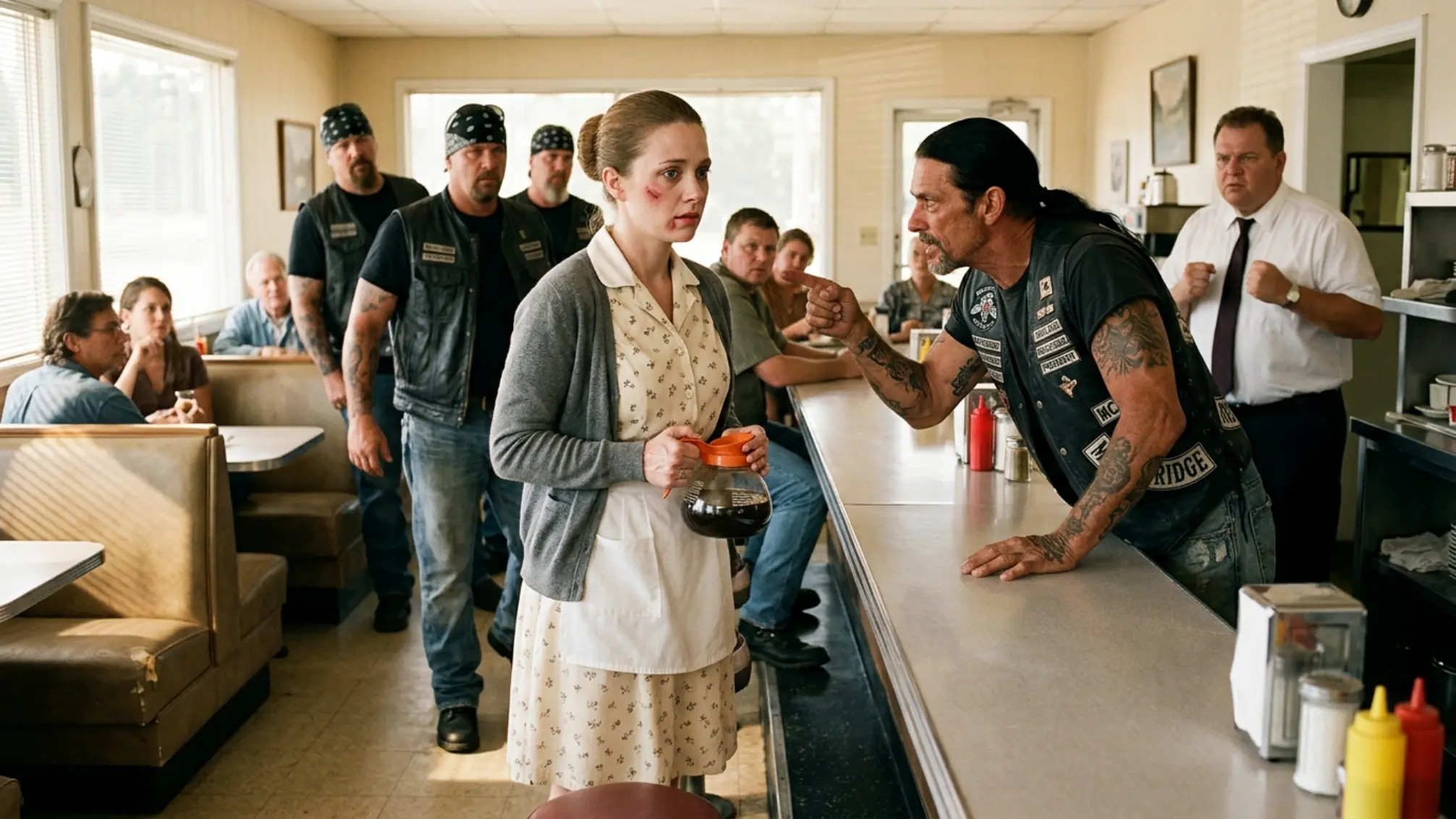
The diner went silent.
Three bikers rose from the stools behind Rex, their leather vests creaking as they straightened. Moose Carter was six feet five and built like a concrete wall, with a black bandana tied over his shaved head. Dean Holloway, a former Army medic, lowered his coffee cup without taking his eyes off the manager. The third rider, Luis Ortega, remained near the door, quietly blocking the easiest path outside.
The manager stopped beside the register.
His name was Wade Keller. He was forty-six, thick through the shoulders, with thinning dark hair and the permanently irritated expression of a man who believed every room belonged to him. He wore a white shirt with the sleeves rolled up, a grease-stained apron, and a heavy ring on his right hand.
That ring had left the small cut on Mara’s lip.
Wade looked at the bikers, then at the customers sitting in the booths. Several had seen him shout at Mara before. One elderly couple had watched him grip her wrist near the coffee station two days earlier. A truck driver seated by the window had noticed her crying beside the dumpster the previous week.
None of them had said anything.
Wade pointed toward Rex. “You don’t come into my diner and threaten me.”
Rex did not move closer. “I didn’t threaten you.”
“You said your men would come after me.”
“I said they would witness what you did.”
Mara placed the coffee pot on the warmer before her shaking hands dropped it. She kept her gaze on the counter, hoping the confrontation would disappear if she stayed still enough. Wade had taught her that attention always made things worse.
“Mara,” he said sharply, “tell these clowns you walked into a cabinet.”
She swallowed.
Rex turned his head slightly, but he did not pressure her. “You don’t have to tell us anything.”
Wade laughed. “There. You heard him. He doesn’t know anything.”
“I know fear when I see it,” Rex said.
The words changed the room.
Rex had recognized Mara’s expression because he had seen it on his younger sister twenty-one years earlier. Claire Malone had married a man who apologized beautifully after hurting her. Every bruise came with flowers, promises, and explanations that made other people uncomfortable enough to accept them.
Rex had accepted them too.
He had been twenty-six then, angry at the world and convinced Claire would call if she truly needed help. She never called. Her husband controlled the phone, the money, the car, and every person allowed near their home.
By the time Rex understood, Claire was already dead.
Her husband went to prison, but no sentence could erase the question Rex carried through every mile he rode afterward: Why had he waited for her to ask?
He had promised himself he would never make that mistake again.
Wade stepped around the end of the counter. “All of you need to leave.”
Rex remained where he was. “We’ll finish our breakfast.”
“You’re finished now.”
“Then bring the check.”
Mara reached for the receipt pad.
Wade slapped it from her hand.
The sharp sound made her recoil. Rex’s fingers curled, but he kept his voice low.
“Pick it up.”
Wade stared at him. “What?”
“The pad. Pick it up.”
“This is my business.”
“And she is your employee, not your property.”
Wade took another step. Moose shifted behind Rex, but Rex raised one hand, keeping his men in place.
No one touched Wade.
That mattered.
Rex knew men like Wade survived by turning every confrontation into proof that they were the victim. If one biker shoved him, he would forget the bruise on Mara’s face and tell the town an outlaw gang had attacked an honest businessman.
Rex would not give him that escape.
Mara bent to retrieve the pad herself. As she rose, Wade seized her upper arm.
She gasped.
Rex took one step forward.
“Release her.”
Wade tightened his grip. “She works for me.”
“Release her.”
Dean quietly removed his phone and began recording.
The elderly man in the nearest booth did the same.
Wade noticed the cameras. His hand opened.
Mara pulled away and moved behind Rex without seeming to realize she had done it. Wade looked around the diner and finally understood that the room had changed sides.
“You’re all trespassing,” he said. “I’m calling the sheriff.”
Rex nodded. “Make the call.”
Wade expected resistance. Instead, Rex returned to his stool and sat down. Moose, Dean, and Luis followed his example, leaving Wade standing alone with his phone in his hand.
The customers began whispering.
Mara remained behind the counter, one hand covering the place where Wade had grabbed her. Rex looked at her carefully.
“Is there somewhere safe you can go?”
She shook her head.
“Family?”
“My mother died. My father’s in Ohio.”
“Friends?”
Wade answered from across the room. “She doesn’t have any.”
Mara lowered her eyes.
That sentence told Rex more than Wade intended.
Isolation was not an accident. Wade had hired Mara three years earlier when she moved to Maple Ridge after a divorce. At first, he acted generous. He gave her extra shifts, helped replace a flat tire, and offered a small room above his detached garage when her apartment lease ended.
Then the generosity became leverage.
Wade controlled her work schedule, housing, transportation, and most of her paycheck through invented deductions. If she refused a late shift, he threatened eviction. If she spoke with customers too long, he accused her of embarrassing him.
The first time he hit her, he apologized before she reached the floor.
Afterward, he bought her flowers and told her she had provoked him. The second time, he stopped apologizing. By the sixth, Mara had learned to apply foundation under fluorescent bathroom lights before opening the diner.
The county deputy arrived twelve minutes later.
Deputy Sarah Collins entered expecting a complaint about disorderly bikers. She found four men seated calmly, several customers holding phones, Mara crying silently, and Wade shouting before the deputy could ask a question.
“These men threatened me and disrupted my business.”
Collins looked toward Rex. “Did anyone threaten him?”
“I told him not to touch his waitress again.”
Wade pointed toward Dean’s phone. “They’re recording illegally.”
“This is a public dining area,” Collins said.
“He grabbed her,” an elderly woman called from a booth.
“So did I,” said the truck driver. “Saw him do it.”
Dean handed Collins his phone. The recording showed Wade striking the receipt pad away, grabbing Mara’s arm, and refusing to release her until Rex intervened.
Collins turned toward Mara. “May I speak with you outside?”
Wade moved immediately. “She is working.”
Collins looked at him. “Not for the next few minutes.”
Mara hesitated.
Rex stepped aside, leaving a clear path toward the door. “You decide.”
That phrase reached her more deeply than any command could have.
You decide.
For three years, every choice had belonged to Wade. He chose her hours, her clothes, when she could use the car, whether she was allowed to visit the pharmacy, and how long she could stand outside after work.
Mara walked toward the deputy.
Outside, the morning air felt colder than it should have. Motorcycles lined the gravel lot, their chrome reflecting a clean blue sky. Collins guided Mara beside her patrol car, far enough from the diner windows that Wade could not hear them.
“Did he cause the injuries on your face?”
Mara stared at the pavement.
Collins did not rush her.
“He said nobody would believe me,” Mara whispered.
“I believe what I can document, and several people recorded him grabbing you.”
“That’s not the worst.”
Collins remained still. “Tell me what is.”
Mara finally looked up. “He keeps a gun in the office. He says if I leave, he’ll find me before I reach the county line.”
The deputy’s expression hardened.
“Has he used it against you?”
“He put it on the kitchen table last night.”
“Did he point it?”
“No. He didn’t have to.”
Collins called for another unit.
Inside, Wade continued talking loudly about his rights while Rex finished his coffee. The more nervous Wade became, the more authoritative he tried to sound.
“You think because you wear leather, people are afraid of you?”
Rex set the cup down. “People were afraid of you.”
Wade’s mouth tightened.
“That’s ending today,” Rex continued.
“You don’t know her.”
“Neither do you.”
“I gave her a job and a place to live.”
“You built a cage and called it help.”
Wade leaned across the counter. “You want to be a hero?”
“No.”
“Then what do you want?”
Rex looked toward the window where Mara stood beside Deputy Collins.
“I want her to make one decision without checking your face first.”
The second patrol car arrived.
Two deputies entered through the front while Collins remained outside with Mara. Wade’s confidence finally cracked when they asked him to turn around.
“You cannot arrest me in my own business.”
“We are detaining you while we investigate an assault and a possible firearm threat,” one deputy said.
“This is because of them.”
“No,” Rex replied. “It’s because of you.”
Wade tried to pull away when the deputies took his arms. The movement gave them reason to secure him in handcuffs.
As they led him past the counter, he looked directly at Mara through the window.
“You’ll have nowhere to go.”
She flinched.
Rex heard him.
He stood and followed the deputies outside, keeping several feet between himself and Wade.
“She has somewhere,” Rex said.
Wade laughed bitterly. “With a biker gang?”
Rex looked toward his brothers.
“With witnesses.”
The deputies transported Wade to the county station. He was not immediately charged with every allegation Mara described, because real accountability required more than anger. Collins arranged for a domestic-violence advocate to meet Mara, photographed her injuries, collected the diner recordings, and requested a search warrant for Wade’s office and residence.
The investigation found the handgun in the office desk.
It also found a notebook Wade used to track deductions from Mara’s wages, including rent, transportation, broken dishes, food, uniforms, and “attitude penalties.” Some weeks, the deductions reduced her paycheck below the legal minimum.
Receipts showed he had charged personal expenses to the diner while withholding Mara’s wages. Security footage from the kitchen captured multiple incidents of intimidation. One recording showed Wade shoving her into a storage shelf.
The evidence turned a frightening morning into a criminal case.
Mara spent that afternoon at a women’s shelter twenty miles away. She arrived carrying one plastic grocery bag containing a change of clothes, her mother’s photograph, and a toothbrush supplied by Deputy Collins.
The biker club did not follow her.
Rex understood that protection could become another form of control if the protected person had no choice in how it happened. He left his phone number with the advocate and asked her to tell Mara that assistance was available only if she requested it.
Three days passed.
On the fourth morning, Mara called.
“I need to get my belongings from the garage apartment.”
Rex sat inside the Iron Saints clubhouse when the phone rang. “Do you want us there?”
There was a long pause.
“Yes.”
“How many?”
“Not all of you.”
Rex smiled faintly. “That’s a smart answer.”
He brought Moose and Dean, along with Deputy Collins and the shelter advocate. Wade remained in custody after violating a no-contact condition through a message sent from another person’s phone.
The garage apartment was smaller than Rex expected. A mattress lay on the floor beside a plastic dresser. Wade had removed the inside lock from the door. There was no stove, and the refrigerator contained only bottled water, yogurt, and two apples.
Mara packed her clothes into borrowed boxes.
Moose carried them without comment. Dean found a cracked photograph beneath the bed and carefully placed it in bubble wrap. Rex remained near the doorway, giving Mara space.
She stopped beside a small toolbox.
“My father’s,” she said.
Rex lifted it. “This comes first.”
At the shelter, Mara began rebuilding a life in pieces. She obtained a protective order, opened a bank account Wade could not access, and met with an attorney about unpaid wages. The diner closed temporarily because Wade owned the business and no manager remained.
Maple Ridge divided into two groups.
One group defended Wade. They said he had always served large portions, donated pies to church fundraisers, and helped sponsor the high-school baseball team. They argued that private relationships were complicated and complained that outsiders had destroyed a local business.
The other group had watched Mara flinch for years.
Their guilt became impossible to ignore.
The elderly couple from the diner visited the shelter office with an envelope containing three hundred dollars. The truck driver gave a written statement describing Wade’s behavior. Two former waitresses came forward with their own stories of harassment and withheld wages.
Rex did not speak publicly until a local reporter asked whether the Iron Saints intended to take control of the diner.
“We don’t want the diner,” he said. “We want the woman who worked there to have choices.”
“What will your club do if Wade is released?”
“Exactly what the law allows.”
The reporter appeared disappointed. She expected threats.
Rex had learned that dramatic promises were less useful than dependable action.
The Iron Saints began organizing weekly rides to support regional women’s shelters. They delivered hygiene products, children’s clothes, grocery cards, and emergency transportation funds. The club’s members included electricians, carpenters, mechanics, lawyers, and veterans. Instead of surrounding shelters with motorcycles, they asked administrators what was actually needed.
Sometimes the answer was plumbing.
Sometimes it was school supplies.
Sometimes it was enough money for a woman to stay in a motel while waiting for a safe bed.
Mara remained at the shelter for six weeks. During that time, she completed a food-safety certification and began helping in the communal kitchen. She discovered she enjoyed planning meals, organizing supplies, and teaching other residents how to prepare inexpensive food without making it feel like punishment.
One evening, the shelter director asked what Mara would do if fear no longer made her decisions.
“I’d run a place where nobody gets humiliated for being hungry,” she answered.
The abandoned diner sat closed beside the highway.
Its owner was facing assault, unlawful wage deductions, intimidation, and weapons-related charges. Financial records revealed substantial debt, and the bank moved to repossess the property.
Rex learned about the sale from Luis, whose cousin worked at the county courthouse.
He called Mara.
“The diner is going to auction.”
She went quiet.
“I thought you should know.”
“Are you buying it?”
“Do you want me to?”
“No.”
“Then I won’t.”
Another pause followed.
“What if I wanted to?”
Rex leaned back in his chair. “Then we talk about how.”
Mara had no savings and poor credit because Wade used her information to open two utility accounts she had not known existed. Purchasing a commercial property seemed impossible.
The Iron Saints did not hand her the diner.
Instead, they helped her form a realistic plan.
A retired accountant in the club reviewed the operating records. A restaurant owner from Knoxville examined the kitchen. The shelter’s attorney helped Mara address the fraudulent accounts. Deputy Collins connected her with a county small-business program designed for abuse survivors.
The club offered a loan at zero interest, documented through a formal contract that gave Mara full ownership and protected her from hidden obligations. She accepted only after her attorney reviewed every page.
The diner reopened four months later under a new name.
MARA’S ROADHOUSE.
She kept the red stools, polished the chrome counter, repainted the walls, and removed Wade’s office door entirely. Above the register, she hung a wooden sign:
NO ONE EATS IN FEAR HERE.
The first morning drew half the town.
Some came to support her. Others came because curiosity was stronger than loyalty to Wade. The Iron Saints arrived last, parking neatly along the outer edge of the gravel lot so ordinary customers would not feel surrounded.
Rex entered alone.
Mara stood behind the counter wearing a clean white apron over a blue dress. The bruise was gone. Her hair remained tied back, but nothing about her posture appeared small.
She poured him coffee.
“You still watch every doorway,” he said gently.
“I know.”
“It takes time.”
She placed the cup before him. “You still watch everyone’s hands.”
Rex looked down and smiled. “Fair point.”
Breakfast moved quickly. Mara hired two former waitresses who had testified against Wade. She paid legal wages, displayed the tip policy openly, and gave employees written schedules.
A shelf near the entrance held prepaid meal tickets. Customers could purchase one for someone who could not afford breakfast. No questions were asked when a ticket was used.
The Iron Saints filled the first month’s board.
Wade eventually accepted a plea agreement after the security recordings, financial evidence, and witness statements made denial impossible. He received jail time, probation, mandatory intervention treatment, and an order to pay restitution for stolen wages. The protective order remained in place.
His defenders stopped mentioning the baseball sponsorship.
Mara did not attend every hearing. She chose the ones that mattered to her and allowed her attorney to handle the rest. Learning that she did not have to witness every consequence became part of reclaiming control.
One year after the confrontation, Mara closed the diner early for a charity dinner benefiting the shelter that had protected her. Motorcycles filled the lot, but so did family cars, pickup trucks, police cruisers, and the shelter’s passenger van.
Deputy Collins sat near the window with her husband. Moose wore an apron over his leather vest and carried trays of biscuits from the kitchen. Dean checked blood-pressure readings at a free health table outside.
Rex stood near the same counter where he had first seen Mara’s bruise.
She approached with two cups of coffee.
“You look worried,” she said.
“I’m thinking.”
“That is usually dangerous.”
He laughed.
Mara leaned against the counter. “About Claire?”
Rex had eventually told her about his sister. Not on the first day or even the first month. He shared the story after Mara asked why he had recognized her fear so quickly.
“I spent years believing I failed because I didn’t save her,” he said.
“You were her brother, not a mind reader.”
“I should have known.”
“Maybe.”
The honesty surprised him.
Mara continued. “But if guilt made you notice me, then let what you did afterward honor her. Don’t use her memory only to punish yourself.”
Rex looked toward the shelter donation board. The event had already raised more than twenty thousand dollars.
“You became difficult to argue with.”
“I learned from bikers.”
Near sunset, Mara stepped outside. The highway stretched west beneath an orange sky, and engines reflected the final light. A year earlier, the sound of Wade’s footsteps had controlled her breathing.
Now thirty riders waited for her signal before starting a memorial ride for Claire and every person lost to hidden violence.
Rex handed Mara a helmet.
“You don’t have to ride.”
She accepted it. “I know.”
That was why she climbed onto the motorcycle behind him.
The engines started one by one, not like a threat, but like a promise made loud enough for an entire town to hear. Mara looked back at the diner bearing her name, the employees waving from the doorway, and the wooden sign above the register.
Nobody had rescued her in a single dramatic moment.
Deputy Collins documented the truth. The shelter gave her safety. Witnesses finally spoke. Lawyers built the case. The community offered resources. Rex and his brothers stood close enough that she did not have to face the first step alone.
But Mara had chosen each step.
She had walked outside with the deputy.
She had asked the bikers to help retrieve her belongings.
She had accepted support without surrendering control.
She had stood behind the same counter where Wade once silenced her and created a place where fear no longer decided who deserved dignity.
Rex raised one hand.
The motorcycles rolled onto the highway.
Mara felt the evening wind move across her face, clean and cool, touching skin that no longer carried the mark Wade believed would keep her obedient. Behind them, the Roadhouse lights came on one window at a time.
Maple Ridge remembered the bikers for their leather, engines, tattoos, and intimidating silence.
Mara remembered something else.
When the entire diner had trained itself not to see her pain, one rough-looking stranger looked directly at the bruise and refused to look away.