Emma Calloway had exactly three seconds to decide whether the biker riding beside the black SUV would notice her hand. She pressed her palm harder against the rear window, forcing herself not to wave, not to shout, not to look toward the two men sitting in the front seats. A red circle drawn with a cheap marker covered the center of her trembling palm, already beginning to smear beneath the Arizona heat. Outside, the muscular biker in the black helmet glanced toward the glass, saw her face, dropped his eyes to the circle, and suddenly stopped looking like a stranger simply passing on Highway 40.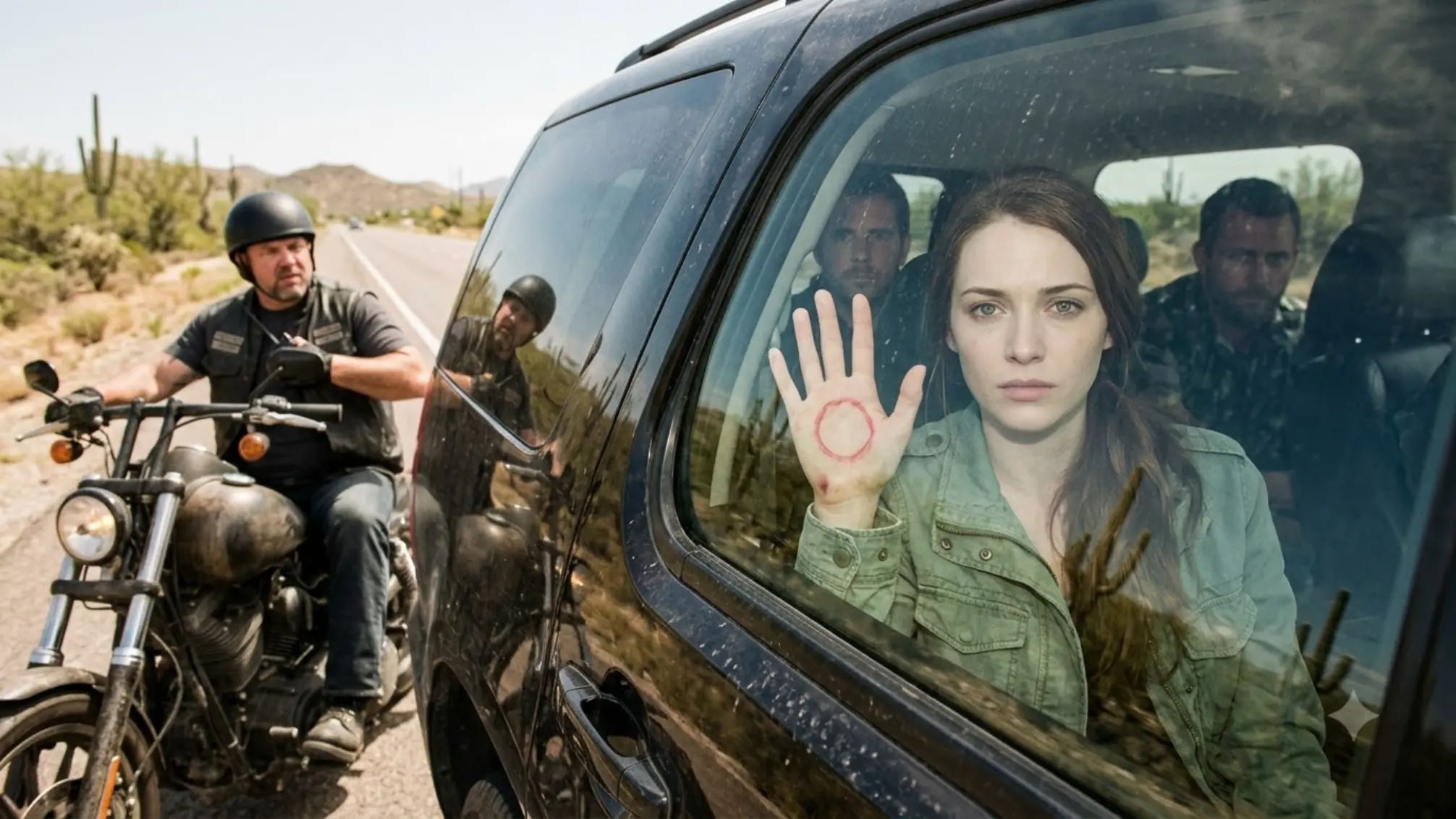
Emma was twenty-four and strikingly beautiful, with fair skin, hazel-green eyes, delicate features, and long chestnut-brown hair that had partly escaped the loose tie behind her shoulders. Her faded sage-green utility jacket covered a cream shirt, and she had spent the previous forty minutes trying to make herself look smaller than she felt. The driver had checked the mirror several times, while the broad man in the passenger seat remained almost completely silent. Neither of them had seen the red marker move beneath Emma’s jacket when she quietly drew the circle.
The biker saw it.
That was all Emma knew.
His motorcycle moved past the SUV, disappearing ahead as though nothing had happened. Emma lowered her hand immediately and pressed both palms against her thighs, forcing herself to breathe normally. She wanted to believe the change she had seen in the biker’s eyes meant something, but the highway continued unfolding exactly as it had before.
The man in the passenger seat adjusted the side mirror.
Emma looked toward the desert.
Dry mountains stretched beneath a hard blue sky. Cars passed in both directions, occupied by people going to work, buying groceries, heading toward vacations, living ordinary Tuesday mornings without realizing a desperate woman was only a few feet away.
Emma counted the exits.
She had started counting because training had taught her that panic became harder to control when the mind had nothing concrete to hold.
Exit twelve.
Exit thirteen.
Exit fourteen.
She thought about Sandra Reyes standing inside the cramped Safe Road office six months earlier, holding up a red marker in front of fifteen volunteers.
“If someone cannot call for help,” Sandra had explained, “we give them something simple enough to remember under stress.”
She drew a red circle on her palm.
“Palm against the glass. Do not wave wildly. Do not provoke anyone. Make eye contact if you safely can.”
Emma had practiced seventeen times.
At the time it had felt excessive.
Now she wished she had practiced a hundred.
She glanced behind the SUV.
Nothing unusual.
Then a motorcycle appeared in the next lane.
Not the biker who had seen her.
Another one.
The rider wore a black vest and remained several car lengths back.
Emma’s heartbeat accelerated.
She looked forward again.
Thirty seconds later another motorcycle entered the highway from an on-ramp.
Then another.
The passenger shifted.
Emma immediately lowered her eyes.
“Think we got company?” he asked.
The driver checked the rearview mirror.
“Just bikes.”
His voice was flat.
But his hands tightened around the steering wheel.
Emma noticed.
So did Ray “Hawk” Mason.
Hawk had been riding Highway 40 for more than twenty years. At forty-three, he knew the road well enough that mile markers, fuel stops, crosswinds, and bad pavement existed in his memory like rooms in his own house. He had ridden motorcycles before smartphones could guide anyone through the desert and had spent enough mornings alone on the highway to recognize when something felt wrong.
Emma’s face had felt wrong.
Not theatrical fear.
Not confusion.
She had looked at him with the focused stillness of someone deliberately asking a stranger to understand something without drawing attention.
Then Hawk saw the red circle.
Three years earlier, Sandra Reyes had walked into his motorcycle clubhouse carrying a photograph of a missing teenage girl and a sheet of paper containing that exact symbol.
Hawk still remembered her words.
“If you ever see this on the road, don’t assume someone else will handle it.”
Hawk had taken the sheet.
Then called every chapter member into the room.
By the end of that meeting, fifty bikers knew the signal.
Now Hawk pressed the communication button attached near his vest.
“Phoenix.”
A calm voice answered.
“What’s up?”
“Black SUV, eastbound Highway 40. Two males up front. Young woman in the rear.”
A pause.
“She showed the circle.”
The voice changed immediately.
“You sure?”
“I saw her face.”
Another pause.
“How many?”
Hawk looked into his mirror.
The SUV remained behind him.
“All available.”
Phoenix disconnected.
Hawk did not turn around dramatically.
He simply reduced speed until the SUV passed him again, then moved several cars behind it.
The driver did not need to know what was happening yet.
Fourteen minutes later, Highway 40 began changing.
Motorcycles entered from different ramps.
One from a gas station.
Two from a rest area.
Three from a frontage road.
They never arrived as a single roaring group. That would have frightened the men inside the SUV too early.
They blended into traffic.
Emma noticed first.
She saw a biker two lanes away.
Then another.
Then three ahead.
Her fingers slowly curled around the fading red circle.
Someone had looked.
More importantly, someone had understood.
The driver realized it several minutes later.
“Why are there so many bikes?”
The passenger looked through the side window.
“Club ride.”
“No.”
The driver glanced into the mirror again.
The motorcycles were positioned too evenly.
One maintained the right lane.
Another remained to the left.
Two stayed behind.
Hawk rode ahead.
The SUV changed lanes.
A motorcycle was already there.
The driver returned to the center.
Another biker settled beside him without even looking over.
Emma watched the driver’s shoulders stiffen.
“Something’s wrong.”
The passenger finally turned halfway toward her.
Emma immediately looked down.
“What did you do?”
“Nothing.”
He stared at her.
Emma forced herself not to touch her palm.
“You call someone?”
“They took my phone.”
The passenger faced forward again.
The driver accelerated.
The SUV moved faster.
The motorcycles accelerated too.
No one came dangerously close.
No one made sudden gestures.
They simply remained present.
Every direction the driver considered already contained someone watching.
Hawk pressed his radio.
“He knows.”
Phoenix responded.
“Contain until state patrol arrives?”
“Exactly.”
Hawk had no interest in turning the highway into a battlefield.
He wanted the SUV slowed, identified, and preserved until police arrived.
The woman came first.
Everything else could wait.
He called emergency dispatch.
“Highway 40 eastbound, approaching Exit 19. Black SUV. Possible distressed passenger. Multiple witnesses. We’re maintaining visual contact.”
The dispatcher asked for the plate.
Hawk gave it.
“Do not confront the occupants,” she warned.
“We’re not.”
“Units are responding.”
Hawk ended the call.
The driver inside the SUV saw the exit.
His eyes narrowed.
He shifted suddenly toward the right lane.
A biker maintained position there.
The driver eased back.
Emma gripped the seat.
“Stop following us,” the passenger muttered toward the motorcycles as though they could hear him.
Hawk moved ahead of the SUV and gradually reduced speed.
The traffic pattern tightened naturally.
Other vehicles slowed as motorcycles occupied more of the surrounding lanes.
No one stopped completely.
Not yet.
But the SUV lost options.
The driver cursed.
Emma stared through the rear window.
Hawk looked back once.
Their eyes met.
He raised one gloved hand slightly.
Not waving.
A simple signal.
I saw you.
Emma’s eyes filled immediately.
She looked down before the men in front noticed.
Within minutes, flashing lights appeared far behind them.
State patrol.
The passenger saw them first.
“Cops.”
The driver’s face changed.
Hawk saw the reaction through the windshield reflection.
The SUV slowed.
The motorcycles gave it space while still maintaining visual coverage.
Police vehicles moved forward.
One cruiser pulled ahead and illuminated its lights directly in front.
Another positioned behind.
A third moved alongside.
The driver finally signaled and guided the SUV onto the broad shoulder near Exit 20.
Hawk slowed his motorcycle.
The other bikers did the same.
Engines settled into low idle.
For the first time since Emma had entered that vehicle, everything stopped moving.
The desert became strangely quiet.
A female state trooper named Elena Torres stepped from the lead cruiser.
She had twelve years on highway patrol and the steady expression of someone who had learned never to make assumptions based on the first thirty seconds of a scene.
“Driver, stay where you are.”
The driver obeyed.
Torres approached carefully.
A second trooper moved toward the passenger side.
Hawk remained twenty yards away.
He did not interfere.
Emma stared toward the officers.
Torres looked into the rear seat.
“You okay back there?”
Emma’s mouth opened.
No sound came out.
Torres softened her voice.
“Ma’am, if you want to step out, we can help you do that.”
The passenger turned.
“She’s fine.”
Torres did not look at him.
“I asked her.”
Emma looked toward Hawk.
He stood beside his motorcycle, helmet still on, arms relaxed at his sides.
Then she looked at her palm.
The red circle had almost disappeared.
“Yes,” she whispered.
Torres leaned slightly closer.
“Yes, you’re okay?”
“No.”
Everything changed with that one word.
The two men were instructed to remain still while officers separated everyone safely.
Emma opened the rear door herself.
Her legs felt strangely strong when her shoes touched the asphalt.
She stepped onto Highway 40 beneath the enormous Arizona sky and took the first breath that felt like her own in nearly an hour.
Hawk stayed where he was.
He did not rush toward her.
Emma appreciated that immediately.
Too many people assumed helping someone meant taking control.
Hawk understood that what Emma needed most was control returned to her.
Trooper Torres guided her toward the cruiser.
“Do you need medical attention?”
“I don’t think so.”
“Do you know these men?”
Emma shook her head.
Then corrected herself.
“I met one this morning.”
Torres listened.
Emma explained slowly.
She volunteered with Safe Road, a nonprofit organization that taught civilians to recognize signs of exploitation and assist vulnerable people by contacting trained authorities. Earlier that morning, Emma had received a call from a woman identifying herself as Carol.
Carol said she needed help.
Emma made the mistake of going alone.
She knew the rules.
She knew she should have waited for her supervisor.
But the woman’s voice had sounded terrified.
When Emma reached the address, a man answered the door already knowing her name.
That was when she realized something was wrong.
“They took my phone.”
Torres continued writing.
“Did they tell you where you were going?”
“No.”
“Did they threaten you?”
Emma hesitated.
“Not directly.”
That answer interested Torres.
“They kept saying I should cooperate and everything would be easier.”
Torres nodded.
Control did not always require shouting.
Sometimes certainty was enough.
The men had apparently assumed Emma would remain quiet because they remained calm.
What they had not known was that Safe Road volunteers carried an emergency signal.
And Emma had happened to have a red marker in her jacket pocket.
Torres looked toward Hawk.
“You trained bikers on that?”
Emma nodded.
“Safe Road did.”
Torres almost smiled.
“That explains a lot.”
Hawk eventually approached after Torres waved him over.
“Mr. Mason?”
“Hawk is fine.”
Torres glanced toward the motorcycles lined along the shoulder.
“You called this in?”
“Yes.”
“You were the first person who saw the signal?”
“Yes.”
Emma turned toward him.
For several seconds neither spoke.
Then she lifted her hand.
The red circle was barely visible.
“You saw this from a motorcycle?”
Hawk nodded.
“You made it easy.”
Emma laughed weakly.
“My hand was shaking.”
“Didn’t matter.”
“How did you know I wasn’t just drawing on my palm?”
Hawk looked at her face.
“I didn’t know.”
Emma waited.
“But I knew your face wasn’t asking me to ignore it.”
That answer broke something open inside her.
She turned away and covered her mouth.
Torres gave her a moment.
Hawk looked toward the mountains.
Eventually Emma spoke again.
“I thought you passed me.”
“I did.”
“I thought maybe you didn’t understand.”
“I needed space to make the call.”
Emma nodded.
“How many came?”
Hawk looked behind him.
Motorcycles lined the shoulder farther than Emma could count.
“Enough.”
She laughed through the tears.
The two men were questioned separately.
The SUV was searched under proper legal procedures after investigators developed sufficient grounds.
Police discovered multiple phones, identification documents belonging to other people, handwritten addresses, and information connecting the vehicle to an ongoing trafficking investigation.
The case immediately became larger than Emma.
She learned later that “Carol” was not a random caller.
Her name had been taken from a woman whom Safe Road had previously assisted.
Someone had deliberately targeted volunteers.
Emma’s stomach turned when investigators explained it.
The call had been bait.
Someone knew Safe Road’s mission.
They expected compassion to override protocol.
With Emma, it had worked.
Sandra Reyes arrived at the station three hours later.
She did not hug Emma immediately.
She walked into the interview room, closed the door, and looked at her for several seconds.
Then she said:
“You broke every rule I taught you.”
Emma lowered her eyes.
“I know.”
Sandra sat beside her.
“You went alone.”
“Yes.”
“You didn’t wait for backup.”
“No.”
“You walked into an unknown house.”
“Yes.”
Sandra’s voice softened.
“And then you remembered the one rule that mattered when everything else went wrong.”
Emma looked up.
“Find a way to be seen.”
Sandra finally hugged her.
Emma cried against her shoulder.
Outside the station, Hawk waited beside his motorcycle.
Phoenix approached carrying two coffees.
“You staying?”
“Until she leaves.”
Phoenix handed him one.
“You know police got this.”
“I know.”
“Then why?”
Hawk stared toward the station doors.
“Because someone should still be standing here when she walks out.”
Phoenix nodded.
No further explanation was necessary.
Two hours later, Emma emerged with Sandra.
She looked exhausted but steady.
Hawk stood.
Emma walked toward him.
“I heard one of your riders almost missed work because of me.”
Hawk shrugged.
“He hates his job.”
She smiled.
“And fifty bikers really came because of one radio call?”
“Forty-seven.”
“That’s supposed to make it less crazy?”
“A little.”
Emma laughed.
Then she looked at his vest.
“I always thought guys in clubs like yours were…”
She stopped.
Hawk raised an eyebrow.
“Go ahead.”
“Scary.”
“Some are.”
Emma smiled.
“You?”
“Depends who’s asking.”
For the first time that day, her smile reached her eyes.
Six weeks later, Safe Road held another training session.
This one was different.
The classroom could barely fit everyone.
Emma’s story had spread through local media after authorities confirmed the rescue and Safe Road’s role. The organization avoided sensational details, focusing instead on awareness, safe reporting, and the importance of not personally confronting dangerous situations.
Sandra stood before thirty-two new volunteers.
Then stepped aside.
Emma walked forward holding a red marker.
Her hair had grown slightly longer.
The sage-green jacket remained hanging on the back of her chair.
She looked toward the room.
“This signal is not magic.”
Everyone listened.
“It doesn’t guarantee someone sees you.”
She uncapped the marker.
“It doesn’t replace calling police.”
She drew the circle.
“And it absolutely does not mean you should put yourself in danger trying to rescue someone.”
The circle closed.
“But sometimes, when every normal option disappears, one small thing can give another person enough information to look closer.”
Emma pressed her palm forward.
Several volunteers leaned toward it.
“You practice until your hand can do it while your brain is panicking.”
A man in the back asked:
“How many times?”
Emma smiled.
“Seventeen minimum.”
After training, she stepped outside.
A motorcycle waited beside the curb.
Hawk leaned against it.
“You stalking my classes now?”
“No.”
“You're terrible at lying.”
He held out a small object.
A red marker.
Emma laughed.
“You’re giving me another one?”
“Lost the first?”
“No.”
“Then now you’ve got two.”
She accepted it.
“You carry one?”
Hawk reached inside his vest.
A red marker appeared.
Emma stared.
“You actually do.”
“Every ride.”
She looked toward the road.
“Do the others?”
“All of them.”
For a moment she could not speak.
Then she asked:
“Why?”
Hawk looked toward Highway 40 beyond the city.
“Because maybe nobody needs it.”
Emma waited.
“That’s the best outcome.”
“And if someone does?”
He slipped the marker back into his vest.
“Then I’d rather already have it.”
Months later, the criminal investigation involving the black SUV expanded across several states.
Emma testified.
So did Hawk.
Other victims were identified.
Some came home.
Some cases remained unresolved.
Emma learned quickly that real investigations did not end as neatly as stories.
There was paperwork.
Delays.
Court hearings.
Unanswered questions.
People who carried consequences long after cameras disappeared.
What mattered most to Emma was not revenge against the men from the SUV.
It was preventing another person from becoming invisible.
Safe Road expanded its training.
Truck drivers joined.
Rideshare drivers joined.
Motorcycle groups joined.
Gas-station employees attended sessions.
Community organizations began teaching how to recognize distress without encouraging reckless intervention.
Hawk’s chapter became one of Safe Road’s largest volunteer highway-observation networks.
They still rode.
They still argued about bikes, barbecue, football, and who had ruined the clubhouse coffee machine.
But now every member also knew one small symbol.
Red circle.
Palm.
Window.
Look twice.
One year after the rescue, Emma returned to Highway 40.
Not because she had to.
Because avoiding it had begun to feel like letting fear keep one piece of her.
Sandra offered to drive with her.
Emma declined.
She wanted to do it alone.
She took the same route.
Passed Exit 14.
Exit 15.
Then 19.
Her hands remained steady on the steering wheel.
A motorcycle appeared behind her.
For one terrible second, her chest tightened.
Then the biker pulled alongside.
Black helmet.
Weathered beard.
Hawk.
Emma laughed.
He tapped two fingers against his helmet.
She shook her head.
Of course he had known.
He rode beside her for several miles.
No dramatic convoy.
No emergency.
Just two people moving through open desert.
Emma reached toward the passenger seat.
A red marker rested there.
She picked it up at a stoplight near the highway exit.
Then drew a small circle on her palm.
When Hawk looked over, she pressed it jokingly against the window.
He stared.
Then shook his head.
Emma laughed so hard she nearly cried.
Hawk pointed at her.
Then at his radio.
She quickly lowered her hand.
“No, no, no!”
He could not hear her through the glass.
But he understood.
The light turned green.
They continued.
This time, the red circle meant something different.
Not fear.
Not danger.
Memory.
A reminder that one ordinary object and three seconds of attention had changed the direction of her life.
Emma never called Hawk a hero.
He hated the word.
Hawk never called Emma brave.
She disliked that one too.
She had been terrified.
She had made mistakes.
She had simply remembered what to do when fear tried to take away her ability to think.
Years later, when volunteers asked Emma what she remembered most from that morning, they expected her to mention the motorcycles surrounding the SUV or the police lights appearing behind them.
She never did.
She remembered Hawk’s eyes.
The instant they moved from her face to her palm.
The tiny change in his expression.
Recognition.
That was the moment everything shifted.
Before it, Emma was a frightened woman behind tinted glass surrounded by thousands of strangers who had no reason to know anything was wrong.
After it, one stranger knew.
Then another.
Then dozens.
Then police.
A crisis that depended on invisibility suddenly had witnesses.
That was why Emma continued teaching the red circle.
Not because she believed a symbol could save anyone by itself.
Ink could not stop a car.
A marker could not make a road safe.
A circle could not guarantee rescue.
What mattered was the person on the other side of the glass.
Someone who had learned what to look for.
Someone willing to take a second look instead of continuing down the road.
On that Tuesday morning, Hawk Mason had exactly three seconds.
He could have looked back at the highway.
He could have assumed Emma was waving.
He could have told himself somebody else would help.
Instead, he looked twice.
And sometimes, that is where rescue begins.