The Storm Riders clubhouse was not the kind of place an eleven-year-old boy usually entered alone.
It sat at the edge of town behind a gravel lot lined with motorcycles, old pickup trucks, and a faded sign that creaked whenever the wind came hard from the west.
Inside, the air smelled of grilled onions, motor oil, coffee, and the strong lemon soap Mama Joy used to wipe down the counters every afternoon.
Men argued over engines and card games with the same fierce loyalty, voices rising and falling over the low rumble of music from an old speaker in the corner.
That was why the room went strangely quiet when the front door opened and a boy stepped inside.
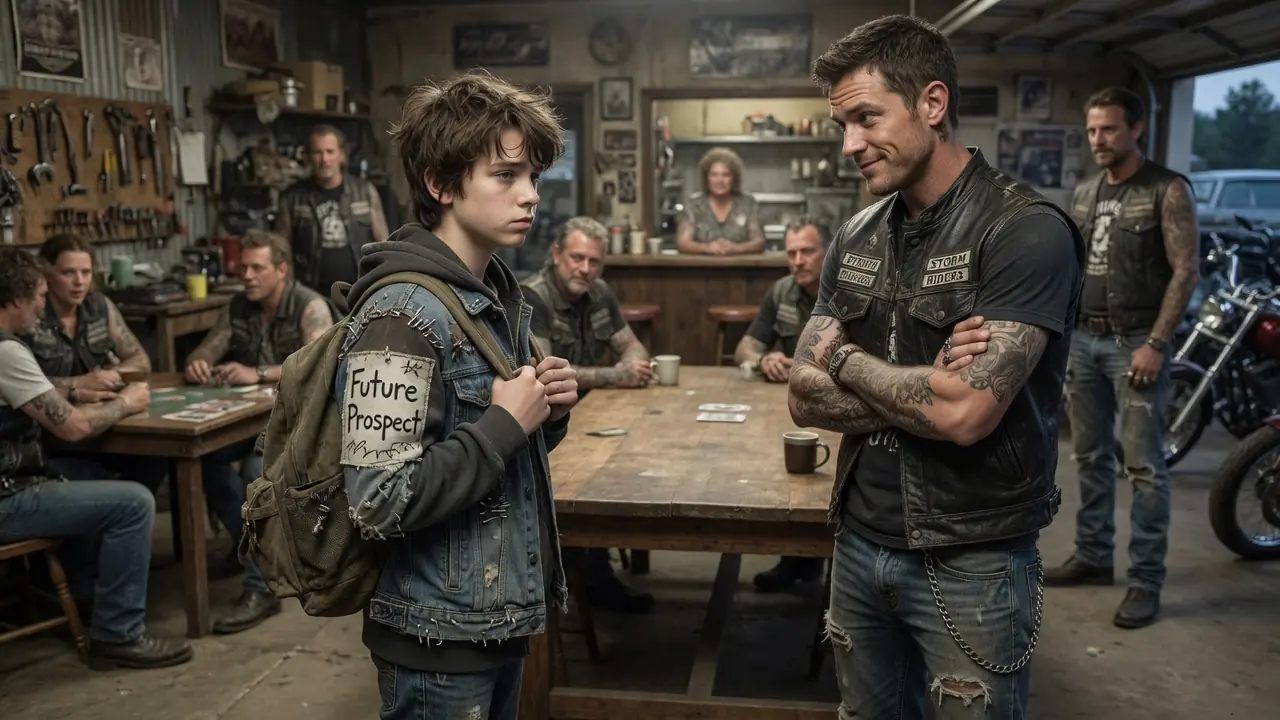
He was small for his age, thin in the shoulders, and wearing a denim vest so oversized it nearly swallowed him. Three safety pins held the front together. On the back, in black permanent marker, he had drawn a crooked patch that read Future Prospect.
At first, a few men laughed.
Not cruelly, exactly, but with the stunned amusement of men seeing something they did not know how to understand. Kids sometimes came by for charity rides, cookouts, or school fundraisers, but no child had ever walked in alone wearing a homemade club vest like he had practiced the moment in a mirror.
A large man named Thomas set down the wrench in his hand and walked toward him.
Thomas was the road captain of the Storm Riders, broad across the chest, calm in the eyes, and patient in a way that made people feel steadier just standing near him. He stopped a few feet away from the boy and crouched so they were closer to eye level.
“What’s your name, kid?”
The boy swallowed. “Milo.”
“Milo what?”
“Milo Reed.”
Thomas glanced at the vest. “Where’d you get that?”
“Found it.”
He offered nothing else.
From the back of the room, Dennis Gray crossed his arms. He was tall, quiet, and built like someone who could block a doorway without trying. William Hart, the club president, leaned back in his chair and watched without interrupting.
Mama Joy, who ran the clubhouse kitchen and had fed half the town at one point or another, looked through the serving window with a towel in her hand.
Thomas kept his voice gentle. “You lost?”
“No.”
“What are you doing here, then?”
Milo lifted his chin a little. “I want to join.”
The room gave another small wave of laughter, but this time it faded quickly.
Thomas did not smile.
“You’re a little young for that.”
The words were steady, but too rehearsed. That was what caught Thomas first. Not the vest, not the marker patch, not even the boy’s thin frame.
It was the way Milo sounded like he had prepared for rejection before he ever opened the door.
Thomas studied him more carefully. There was a faint yellow-purple mark along one cheekbone, half hidden under the shadow of his hood. His hands stayed shoved in his pockets, but the knuckles visible at the edges looked scraped and dry. His sneakers were held together with duct tape.
“You eat today?” Thomas asked.
Milo hesitated.
“Ketchup counts,” he said.
The whole room changed.
A card dropped against the table. Someone’s chair creaked. Dennis uncrossed his arms.
Mama Joy pushed the kitchen door open fully. “Ketchup counts as what?”
Milo looked at the floor. “Dinner.”
No one laughed now.
Thomas stayed crouched in front of him. His voice dropped lower.
“Where do you live, Milo?”
The boy’s face tightened.
It was the question he had hoped no one would ask.
“Library,” he said.
Thomas was silent for a moment. “You mean near the library?”
Milo shook his head. “Inside. But only until closing. Then behind it.”
Mama Joy’s hand went to her chest.
William stood slowly.
“Who’s supposed to be taking care of you?” he asked.
“My mom’s away,” Milo said. “Grandpa was helping me.”
“Where’s your grandfather now?” Dennis asked.
Milo did not flinch. “Heart attack. Three days ago.”
The clubhouse seemed to hold its breath.
No one rushed to say they were sorry. No one smothered him with soft words that would have made him retreat behind that hard little wall he had built around himself. The Storm Riders were not built that way.
Instead, Mama Joy stepped forward and held out a hand.
“Come to the kitchen, sweetheart.”
Milo hesitated.
Then he followed her.
She sat him on a stool and placed a plate in front of him, the kind of plate grown riders usually fought over when she made dinner. Eggs, toast, sausage, potatoes, and a tall glass of milk. Milo stared at it for a moment as if trying to decide whether it was real.
“Eat,” Mama Joy said.
He ate slowly at first, then faster, though he tried hard not to look hungry. One hand stayed wrapped around the strap of his backpack. Every few bites, his eyes flicked toward the door.
Thomas sat beside him.
“How long have you been sleeping at the library?”
“Two weeks.”
“You go to school?”
“Most days.”
“Does anyone there know?”
Milo shrugged. “People don’t ask if you don’t make noise.”
Dennis turned away and stared at the wall for a second.
William watched Milo the way a mechanic might watch a damaged engine, not to judge it, but to find where the break had started.
“You got anyone else?” William asked.
Milo shook his head.
Mama Joy put another piece of toast on his plate without asking.
After he finished, Milo reached for his backpack. “I can go now. I didn’t mean to bother anybody.”
Thomas stopped him with one hand on the table.
“Kid, you’re not walking back to a library tonight.”
Milo froze. “I don’t want trouble.”
“You don’t have trouble,” William said. “You have people who finally noticed.”
Milo looked at him uncertainly.
William walked to a drawer behind the bar and pulled out a small embroidered patch. It was plain, dark blue with white letters.
Protected.
He held it out to Milo.
“You came in wearing a patch,” William said. “So let’s give you one that means something.”
Milo stared at it. “What does it mean?”
“It means you’re under our roof now,” William said. “A plate, a cot, a ride to school, and people who notice when you walk into a room.”
Milo’s face shifted.
For one second, the hard expression cracked, and beneath it was something much younger than eleven. Relief, fear, confusion, and the dangerous hope of a child who had learned not to trust good things too quickly.
Mama Joy laid a warm hand on his back.
Dennis stood behind him like a wall.
That night, the Storm Riders changed their plans without needing a vote. Someone found a spare cot. Someone brought clean blankets. Someone called the school to ask about attendance records. Someone else started a list of clothes, shoes, notebooks, and whatever else a boy needed when he had been surviving on ketchup and library corners.
Milo lay awake long after the lights dimmed.
The clubhouse was not silent. It groaned and settled. Men moved through the halls. Engines cooled outside. Someone laughed softly near the back door.
But for the first time in weeks, the dark did not feel empty.
It felt guarded.
The next morning, Milo woke to the smell of bacon and the low rumble of motorcycles warming in the lot.
For a few seconds, he did not know where he was. There was no cold library carpet beneath him. No fluorescent ceiling lights humming above his face. No need to pack before sunrise so the security guard would not find him.
Then Mama Joy poked her head into the room.
“Breakfast is ready, sweetheart.”
Something in Milo’s chest tightened and loosened at the same time.
By the time he shuffled into the main room, the riders were already scattered around the clubhouse. Some cleaned chrome. Some argued over a parts catalog. Some drank coffee as if it were medicine.
Thomas waved him over to an empty stool.
Milo hesitated, still unsure how to move inside a place that had suddenly made room for him.
Dennis nudged the stool with two fingers. “Food doesn’t eat itself.”
Milo sat.
He ate quietly, not used to plates that stayed full. He was not used to adults asking if he wanted more. He was definitely not used to anyone noticing when he answered too fast, too softly, or not at all.
Thomas sat across from him.
“What’s school like?”
Milo shrugged. “School.”
“You late a lot?”
“Sometimes.”
“Need a ride?”
Milo looked up quickly.
Dennis stood before anyone else could speak. “I’ll drive him.”
Milo blinked. “Every morning?”
Dennis said it as if it were the simplest thing in the world. “Every morning.”
That became the start of a new routine.
Dennis drove him in an old blue pickup truck that smelled like pine, engine grease, and sun-warmed paper. He always waited in the parking lot until Milo reached the school doors. He never waved big or made a scene, just gave one small nod so Milo knew someone had seen him arrive.
After school, Milo returned to the clubhouse.
Mama Joy helped him with reading when the words blurred together. Howell, a grumbling mechanic with hands like steel pipes, explained fractions using metal washers and bolts. Thomas helped with history, and William pretended not to listen while correcting dates from three tables away.
At first, Milo stayed near the walls.
He kept an eye on exits. He kept his backpack close. He flinched when doors slammed, then looked embarrassed that anyone had noticed.
But as days passed, he began sitting closer to the group tables. He listened to the men talk about routes, repairs, road stories, dumb mistakes, and old grief disguised as jokes. He did not join often, but he absorbed the sound of belonging like warmth through a window.
Then came the paperwork.
One Thursday morning, Dennis returned from the school office with a tight jaw. He called William and Thomas outside. Milo watched them through the window, his stomach twisting as their conversation stretched longer and longer.
When they came back in, Dennis crouched in front of him.
“Kid, somebody finally noticed your absences. A caseworker’s coming tomorrow.”
Milo’s face went pale.
Caseworkers meant rooms with bunk beds, strangers with name tags, and locked routines where no one asked what you wanted. He had seen friends disappear into the system and come back quieter, angrier, or not at all.
“I can’t go,” he whispered. “I don’t want to leave.”
William placed a steady hand on his shoulder.
“No one is sending you anywhere without a fight.”
But there was more.
The caseworker had the authority to remove Milo immediately if she believed the clubhouse was unsafe. The Storm Riders were not a traditional foster home. They were bikers with a clubhouse, a kitchen, a garage, and hearts bigger than their paperwork.
So they prepared.
Mama Joy scrubbed the kitchen until the counters shined. Howell fixed the back railing, even though no one had mentioned it. Dennis typed out Milo’s daily routine. Thomas gathered school notes and attendance details. William called the club lawyer, a serious woman named Nadine Porter who arrived that evening with a briefcase and no patience for vague answers.
“This isn’t about proving you’re good people,” Nadine said, looking around the table. “It’s about proving you can provide stability, safety, and accountability. Feelings are not enough in court. Documentation is.”
“Then we document everything,” William said.
The caseworker arrived the next afternoon.
Her name was Ms. Alvarez. She was professional, careful, and tired in the way people become tired after seeing too many children treated like problems to be moved around. Her eyes swept the clubhouse, the kitchen, the cot, the clean blankets, the drawer where Milo’s new clothes were folded, and the small shelf where his schoolbooks already sat.
She asked to speak with Milo alone.
The riders stepped back, though none went far.
Milo sat across from her at the kitchen table with both feet barely touching the floor.
“Do you feel safe here?” she asked.
He nodded.
“Do they feed you?”
Another nod.
“How do they treat you when no one else is watching?”
Milo thought about that.
“They notice,” he said.
Ms. Alvarez looked up from her form. “What do you mean?”
“If I’m tired, Mama Joy knows. If I don’t understand homework, Howell explains it with bolts. Dennis waits until I get inside school. Thomas doesn’t ask questions like he’s trying to trap me. William talks to me like I’m a person.”
Ms. Alvarez wrote something down.
“Milo, do you understand that you need a legal guardian?”
He swallowed. “I want to stay here.”
She did not smile, but her eyes softened.
“I know.”
After she left, the clubhouse held its tension like a storm trapped indoors.
Later that evening, Thomas found Milo sitting on the back steps with his old hand-drawn patch folded in his lap.
“You think she’s taking me?” Milo asked.
Thomas sat beside him. “Not if we can stop it.”
“Why do you care?”
Thomas looked out over the gravel lot, where the last light of evening glinted along motorcycle tanks.
“Because someone cared about me when I didn’t expect it,” he said. “And because you walked in here asking for nothing but a place to stand. That means something.”
For a few days, the clubhouse settled into watchful routine.
Then trouble noticed.
It started small.
A dark SUV parked across from the school two afternoons in a row. A man in an Iron Fangs jacket stood in the gas station pretending to browse snacks while watching Milo’s reflection in the cooler door. Dennis noticed both times and said nothing in front of the boy, but his grip on the steering wheel tightened.
The Iron Fangs were a rival club, not as strong as they used to be, losing members and money. Rumors said their leadership had grown desperate for leverage against the Storm Riders. And leverage, in the wrong hands, often meant anyone vulnerable enough to be used.
On Friday afternoon, the danger stepped out into the open.
Milo left school a few minutes later than usual, holding his worksheets against his chest. Dennis’s blue pickup was not in its usual spot. Instead, at the far end of the parking lot, two men leaned against a rusted van.
One pretended to smoke.
The other pretended to check his phone.
Both watched Milo.
He recognized the feeling before he understood the plan. His grandfather had once told him, “If someone looks at you like you’re a job, don’t wait to find out what kind.”
Milo kept walking.
He did not run. Running would make them move faster. He slipped between two parked cars, crouched low, and ducked behind a dumpster near the maintenance building.
His heart pounded so hard he thought they would hear it.
Footsteps came closer.
“Kid couldn’t have gone far,” one man muttered.
Then an engine growled at the entrance of the lot.
Another followed.
Then a third.
Three motorcycles rolled in with slow precision. Thomas came first. William behind him. Dennis last, his face colder than Milo had ever seen it.
They parked in a line blocking the exit.
No shouting. No threats. No wild movement.
Just presence.
The two men stiffened.
Thomas stepped forward. “You boys lost?”
One of them swallowed. “Waiting for a friend.”
“Kid-sized friend?” William asked.
No answer.
That was enough.
The men retreated fast, trying not to look like they were retreating.
When they were gone, Thomas turned toward the dumpster.
“Milo,” he called. “It’s clear.”
Milo stepped out trembling, but upright.
Dennis came to him first and checked him over quietly.
“You did good,” Dennis said. “Smart hiding spot.”
Milo tried to answer, but his voice did not come.
They did not go straight back to the clubhouse. William made calls. Thomas checked routes. Dennis drove Milo in the pickup while watching every mirror.
Within an hour, the Iron Fangs received a clear message through proper channels and witnesses who could repeat it if needed.
Do not touch the boy.
Back at the clubhouse, Mama Joy’s hands shook when she saw Milo, but she hid it behind a plate of food. Howell cursed under his breath, half at the Fangs and half at a world that could look at a child and see leverage.
Milo did not eat much.
He sat between Thomas and Dennis with his fingers hooked through the protected patch.
William crouched in front of him.
“Listen carefully,” he said. “What happened today was not your fault. You didn’t bring trouble here. Trouble saw something good and tried to steal it.”
Milo blinked hard. “Are they coming back?”
“No,” Thomas said. “They wanted leverage. They got a warning.”
Dennis added, “And you’re not going anywhere. Not now. Not later.”
That night, the clubhouse felt smaller, but not cramped. It felt enclosed, guarded, as if every wall and every engine outside leaned inward to shield the boy sleeping inside.
Two days later, the hearing was scheduled.
The courthouse felt colder than the clubhouse, too clean and too quiet. Milo sat between Mama Joy and Dennis wearing the denim vest William had given him. The old hand-drawn patch was folded in his pocket, but the protected patch was sewn firmly on the front.
The judge reviewed the reports.
Ms. Alvarez testified. She described the clubhouse as unconventional, but structured, safe, and emotionally stable. She listed Milo’s improved attendance, regular meals, clean clothing, homework routine, and the number of adults who had stepped into clear roles without being asked.
Nadine Porter presented the paperwork.
Mama Joy spoke about meals, school nights, and the way Milo still woke up sometimes thinking he had to leave before sunrise. Dennis spoke about transportation, appointments, and supervision. William spoke last, plainly and without decoration.
“We are not perfect people,” he said. “But we are present people. That boy came to us because every other door had failed him. We opened ours. We are asking the court to let us keep it open.”
The judge looked at Milo.
“Milo, would you like to say anything?”
No one had warned him that might happen.
Milo swallowed.
His hands trembled on his knees until Dennis rested one palm lightly against his back, grounding him.
“I don’t want to move again,” Milo said. “The Storm Riders don’t treat me like a problem. They treat me like someone who has a place.”
The room went quiet.
The judge took off his glasses and cleaned them slowly.
Then he approved joint guardianship to Mama Joy and Dennis, with placement under the structured supervision plan the Storm Riders had created.
Milo did not understand every legal word.
But he understood enough.
He was staying.
Outside the courthouse, the riders waited on the sidewalk. Not all of them, just enough to make the place feel less cold. Thomas crossed his arms with a rare smile. Howell muttered, “About time,” though his eyes were bright.
William placed a hand on Milo’s shoulder.
“Let’s get you home,” he said. “You’ve got things to unpack.”
Back at the clubhouse, they had prepared something.
A box sat on the dining table. Mama Joy guided Milo toward it, and William lifted the lid.
Inside was a new denim vest.
It fit properly this time. On the left front was the protected patch. On the back was a blank space, ready for whatever Milo became one day.
But what mattered most was the right front pocket.
They had stitched his hand-drawn Future Prospect patch onto it, crooked letters and all.
Milo touched the permanent marker carefully.
“You kept it,” he whispered.
Thomas nodded. “That little patch walked you through the door. That’s part of your story.”
The evening rolled into laughter, Mama Joy’s cooking, the clatter of forks, and the soft rumble of motorcycles cooling outside. Milo ate surrounded by people who did not flinch from responsibility, people who did not look at him like a burden, people who seemed ready to stand in his corner long after the hard part stopped being interesting.
Later, when the lights dimmed and the clubhouse settled, Milo lay on his cot with the new vest folded beside him.
He no longer pictured the cold library carpet. The taste of ketchup for dinner had already begun to fade into something distant, something from another life. Even the fear of the Iron Fangs felt smaller now, pushed back by the steady knowledge that if something came for him, it would have to get through everyone else first.
Near his cot, the door stayed open.
Someone passed by every so often. A shadow, a soft footstep, a quiet cough, proof that the world had not forgotten he was there.
Milo closed his eyes.
For the first time in a long time, the darkness did not feel like a place to survive.
It felt like home.
And all because one hungry boy walked into a biker clubhouse wearing a vest held together by safety pins and asked for nothing but a place to stand.
The men had laughed at first.
Then they listened.
Then they made room.
And sometimes, that is how family begins.