The old roadside diner sat alone beside a two-lane highway in the American Southwest, where the desert stretched wide and empty beneath the afternoon sun.
Its chrome sign flashed red and silver above the gravel parking lot.
MABEL’S DESERT DINER
COFFEE • PIE • COLD WATER
On Saturdays, the place belonged to riders.
Motorcycles lined the lot in long rows, their polished tanks catching the light, their engines ticking as they cooled. Men and women in leather jackets leaned against bikes, drinking coffee from paper cups, telling road stories, laughing loud enough for the sound to carry across the highway.
Some came from Arizona.
Some from New Mexico.
Some were just passing through.
But they all knew Mabel’s.
It was the kind of place where riders stopped not because the food was famous, but because the road had decided it should matter.
Inside, the diner smelled of coffee, fried onions, dust, and hot oil. Ceiling fans turned lazily overhead. The booths were cracked red vinyl, the walls covered with sun-faded photographs of motorcycles, desert rides, and old rally posters from decades before.
Near the counter, three older riders sat with their mugs, arguing about carburetors.
By the window, a younger group in shiny new jackets laughed over burgers and fries.
Outside, under the shade of the awning, a broad-shouldered man named Vince Carrow leaned against his bike with his arms folded. He was in his late fifties, thick around the middle, with a gray beard, mirrored sunglasses, and the proud, loud voice of a man who liked being heard.
He had been riding for years.
He made sure everyone knew it.
That was why he noticed when the old pickup truck pulled into the lot.
It was a faded blue Ford with rust along the doors and a small trailer hitched behind it. The truck rolled slowly over the gravel, stopped near the edge of the lot, and coughed once before the engine shut off.
Nobody paid much attention at first.
Then the passenger door opened.
A teenage girl stepped out.
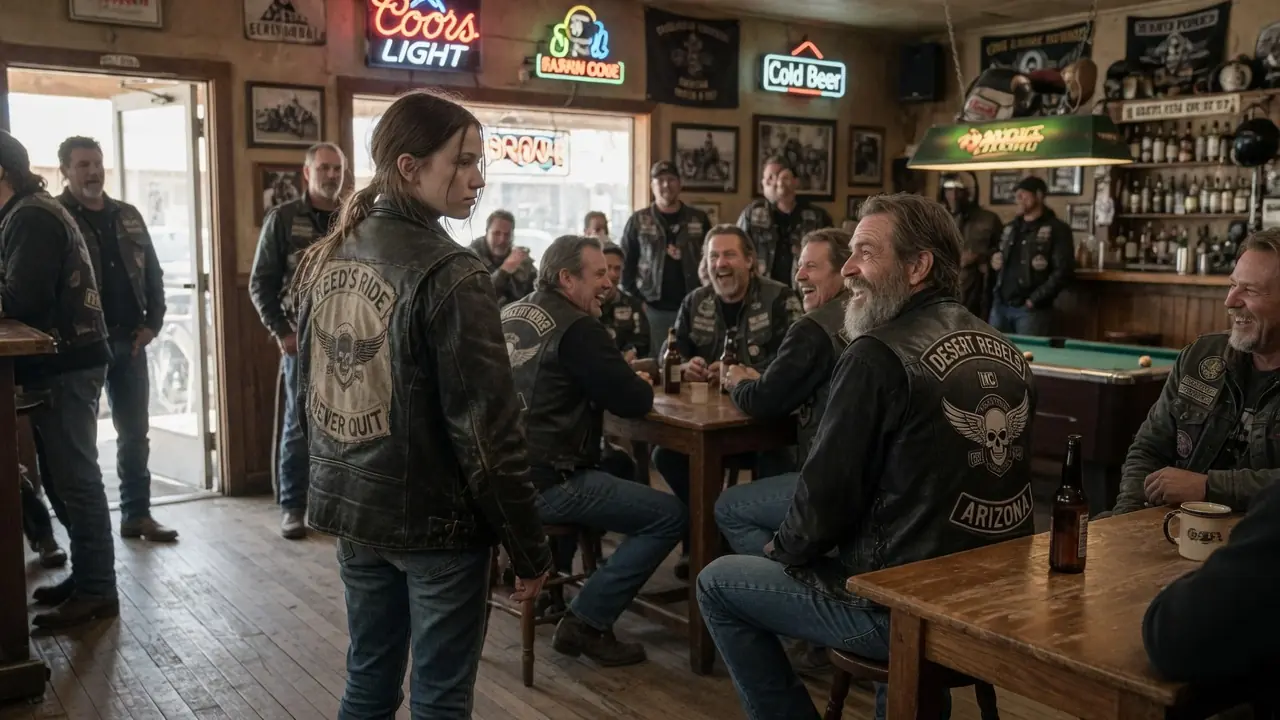
She looked about sixteen, maybe seventeen, skinny in the way grief can make someone skinny. She wore simple jeans, worn brown boots, and a white T-shirt tucked beneath a dark leather biker jacket that was far too large for her frame.
The sleeves nearly swallowed her hands.
The shoulders hung broad.
The jacket looked old, heavy, and real.
Not the kind bought new from a mall store.
The kind that had survived rain, sun, road dust, and years of being worn by someone who had earned every crease.
The girl closed the truck door gently and looked around the lot.
Her name was June Mercer.
Her mother, Allison, stepped out from the driver’s side a moment later, tired from the long drive and nervous in a way she tried to hide.
“You sure?” Allison asked quietly.
June nodded.
“I’m sure.”
Behind them, strapped carefully to the trailer, sat an old motorcycle under a canvas cover.
Vince saw the bike.
Then he saw the jacket.
Then he smirked.
“Well, look at that,” he said loudly. “Somebody raided her grandpa’s closet.”
A couple of younger riders laughed.
June heard him.
She did not react.
She adjusted the strap of the small canvas bag on her shoulder and started walking toward the diner.
Another rider near Vince, a man in a brand-new vest with a patch too clean to have much history, called out, “That jacket’s older than she is.”
More laughter.
June kept walking.
“Guess social media made everybody a biker now,” Vince added.
This time, the laughter was louder.
June stopped.
Her mother’s face tightened.
“June,” Allison said softly, “we can leave.”
But June turned slowly.
She faced the men by the awning.
She did not look angry.
If anything, she looked tired.
Vince pushed away from his bike.
“So,” he said, smiling like he had already won something, “what club are you pretending to belong to?”
The lot went quieter.
Not silent.
Just interested.
People liked a scene, even when they pretended they did not.
June looked down at the jacket.
Then back at Vince.
“I’m not pretending.”
A few riders laughed again.
Vince tilted his head.
“That so?”
June said nothing.
She turned to continue toward the diner.
That was when an older rider sitting near the window inside the diner stood up so suddenly his chair scraped against the floor.
His name was Hank Boone.
He was seventy-one years old, lean as wire, with silver hair pulled back at the neck and hands scarred from a lifetime of working on engines. He did not speak much anymore, but when he did, people listened.
He had been watching the exchange through the glass.
At first, he had only seen a young girl in a jacket too large for her.
Then she turned.
And Hank saw the back patch.
The emblem was faded nearly pale from years of sun: a desert hawk stitched above two crossed wrenches and a road line curving toward a sunrise.
Below it, in small hand-stitched letters, were the words:
FOUNDING RIDE
1974
Hank’s face changed.
All the dry humor left it.
The mug in his hand lowered slowly to the table.
Pete Alvarez, another old rider beside him, followed his gaze.
At first, Pete frowned.
Then he saw the patch too.
He stopped chewing.
“My God,” he whispered.
Hank moved toward the door.
By then, June had nearly reached the entrance.
The diner door opened before she could touch the handle.
Hank stepped out into the sun.
The mocking laughter faded when people saw his expression.
Vince glanced at him.
“What’s wrong with you, Boone?”
Hank ignored him.
His eyes stayed on the patch.
He walked toward June slowly, as if approaching something fragile and holy.
“Girl,” he said, and his voice was rougher than he expected. “Where did you get that jacket?”
June pulled the oversized sleeves back from her hands.
“It was my grandfather’s.”
“What was his name?”
June hesitated.
She had been asked that question many times since he died.
Usually by nurses.
A funeral director.
A woman from the county office.
Never by a man whose voice shook around it.
“Caleb Mercer,” she said. “Most people called him Cal.”
The parking lot seemed to empty of sound.
Hank stared at her.
Behind him, Pete stepped out of the diner.
Then another rider.
Then another.
Someone near the gas pumps removed his sunglasses.
Vince’s smile vanished.
June looked from face to face, suddenly unsure.
“My grandpa died in March,” she said quietly. “I didn’t know if anybody around here remembered him.”
Hank’s jaw tightened.
“Remembered him?”
He looked at the jacket again, then back at her.
“Kid, half the people standing in this parking lot are alive because of something Cal Mercer did.”
June’s eyes widened.
Her mother put a hand over her mouth.
Vince shifted uncomfortably.
Nobody laughed now.
Hank turned toward the crowd.
“This is Cal Mercer’s granddaughter.”
The words moved through the lot like wind over dry grass.
Cal Mercer.
Some of the younger riders looked confused.
But the older ones reacted instantly.
Cal Mercer was not a famous man in any way the world measured fame.
No magazine covers.
No television interviews.
No big money.
No grand speeches.
But among the old road riders of the Southwest, his name carried weight.
He had run a garage for nearly forty years outside a desert town called Mesa Ridge. The place had no fancy sign, just a hand-painted board that read:
MERCER REPAIR
BIKES FIXED FAIR
COFFEE FREE IF YOU’RE BROKE
Riders knew it as Cal’s.
If your chain snapped at midnight, Cal opened the garage.
If your tire blew out on a Sunday, Cal came with the trailer.
If you lost your wallet and needed gas money to get home, Cal gave it and pretended he forgot later.
If you crashed and your family could not afford the hospital bills, Cal passed a coffee can around until the money appeared.
If you were running from a bad life and needed a place to sleep, Cal let you use the old cot behind the tool chest.
He did not call it charity.
He called it road manners.
June knew parts of him.
She knew the grandfather who made pancakes shaped like lopsided stars.
The man who taught her how to hold a wrench before she learned long division.
The man who smelled like motor oil, peppermint candy, and coffee.
The man who kept a motorcycle under a tarp in his garage and told her, “This one’s not for speed, Junebug. It’s for remembering.”
But she had not known this.
She had not known that strangers carried his name like a debt of honor.
Hank looked at Vince.
“You were laughing at her.”
Vince’s face hardened out of reflex.
“I didn’t know.”
“That’s usually the problem.”
Vince said nothing.
Hank turned back to June.
“Come inside.”
June glanced at her mother.
Allison nodded, still wiping her eyes.
June followed Hank into the diner.
The whole place made room.
Men and women who had filled booths minutes before shifted, stood, pulled chairs aside. The loud young riders by the window stopped laughing and stared at the jacket with new caution.
Hank led June to the large round table near the back.
“This was where Cal sat when he came through,” he said.
June touched the back of the chair.
“He came here?”
“Every summer for years.”
“I thought he mostly stayed near Mesa Ridge.”
Pete smiled sadly.
“Your grandfather went a lot of places he never bragged about.”
Mabel, the owner, came out from behind the counter. She was a heavyset woman with sharp eyes and white hair tied in a red scarf.
“Well,” she said, looking at June, “I should have known. Same stubborn chin.”
June blinked.
“You knew him too?”
“Honey, I still have a blender because of him.”
June looked confused.
Mabel pointed toward the counter.
“Twenty years ago, that blender died during the lunch rush. I was about ready to throw it into the highway. Your grandpa took it apart right there beside the pie case and had it running in ten minutes. Wouldn’t take a dime. Said a diner without milkshakes was a threat to public morale.”
A laugh moved through the room.
Gentle this time.
June smiled before she could stop herself.
“That sounds like him.”
Mabel poured coffee for the riders and set a lemonade in front of June.
“On the house.”
June reached into her pocket.
“I can pay.”
Mabel gave her a look.
“Not in that jacket, you can’t.”
June sat.
And then the stories began.
Pete went first.
“I was twenty-three when I met him,” he said. “Thought I knew everything. Blew a tire outside Mesa Ridge in August. No water. No shade. No sense. Your grandfather showed up with a spare, a jug of water, and a lecture that lasted longer than the repair.”
“What did he say?” June asked.
“That a man too proud to carry water in the desert deserved to be thirsty, but not dead.”
The table laughed.
Pete smiled.
“He fixed my bike for free. Made me call my mother because he said she probably worried about me more than I deserved. He was right.”
A woman named Rita leaned forward.
“Your grandfather helped my brother after a crash near Gallup. Rode three hours with a trailer, got the bike, drove my brother’s wife to the hospital, then stayed overnight because she was scared. My family never forgot that.”
Another rider pulled a small photograph from his wallet.
“This is Cal in 1982.”
June took it carefully.
In the photo, her grandfather was young and broad-shouldered, standing beside a row of motorcycles with that same jacket hanging open over a white shirt. He was smiling with his whole face.
June stared until her eyes burned.
“I’ve only seen him old,” she whispered.
Hank nodded.
“He was old even young. Some men are born with old souls and bad knees.”
June laughed through the lump in her throat.
The room listened.
The girl in the oversized jacket, who had walked in as something to mock, was now the center of a circle of memory.
Each story placed another piece of her grandfather in her hands.
Cal paying for a stranger’s motel room.
Cal rebuilding an engine with parts from three different bikes.
Cal riding through a dust storm to bring insulin to a rider’s wife stranded at a campground.
Cal organizing a fundraiser after a mechanic lost his shop to a fire.
Cal refusing praise every single time.
“He used to say,” Rita said, “‘If you’re doing it to be thanked, you’re charging the wrong price.’”
June wiped her cheek with the heel of her hand.
“He never told us any of this.”
Hank’s voice softened.
“He wouldn’t.”
“Why?”
“Because real ones don’t keep score.”
June looked down at the sleeves swallowing her hands.
“I wore it because I missed him,” she said. “Not because I thought it meant anything.”
“It means plenty,” Pete said.
Vince stood near the counter, silent.
He had not sat down.
He had not left either.
Finally, he stepped forward.
The room noticed.
June looked up.
Vince removed his sunglasses.
Up close, he seemed older than he had under the awning. More tired. Less certain.
“I owe you an apology,” he said.
June said nothing.
“I ran my mouth before I knew anything.”
Hank made a low sound.
Vince glanced at him.
“I know.”
Then he looked back at June.
“I’m sorry. That jacket deserved respect before I understood why. So did you.”
June held his gaze.
“My grandpa used to say apologies only matter if your next choice is better.”
A few older riders smiled.
Hank’s eyes warmed.
Vince nodded slowly.
“Then I’ll make the next choice better.”
He reached into his vest pocket and pulled out a folded twenty-dollar bill.
“Lunch is on me.”
June shook her head.
“I’m not hungry.”
Mabel snorted from the counter.
“Girl, everybody is hungry at Mabel’s. That is not up for debate.”
The room laughed again.
This time, June laughed too.
They ate together.
Burgers.
Fries.
Pie.
Coffee for everyone except June, who was given a second lemonade by Mabel with the instruction that “growing girls don’t need bitter old man water.”
For the first time since the funeral, June felt her grief change shape.
It did not vanish.
It never would.
But it widened, making room for pride.
After lunch, Hank nodded toward the window.
“That old bike on the trailer. That Cal’s?”
June’s expression tightened.
“Yes.”
“What is it?”
“1976 Harley FLH. He rebuilt it himself. He left it to me.”
Pete let out a low whistle.
“She run?”
June nodded.
“My mom and I worked on it for three months after he died. Grandpa taught me enough to get her started.”
Hank studied her.
“You ride?”
“A little.”
Allison spoke up quickly.
“She has her permit. She’s careful.”
“I didn’t ask if she was reckless,” Hank said gently. “I asked if she rides.”
June looked at her mother.
Then back at Hank.
“I ride.”
Hank checked his watch.
The sun was still high but leaning west.
“Two hours to sunset.”
Pete grinned.
Rita understood first.
Then Mabel did.
“Oh,” Mabel said softly. “You’re going to do it.”
Hank stood.
“Cal never liked speeches. But he liked rides.”
June’s heart began pounding.
“What do you mean?”
Hank looked around the diner.
“Anybody here got somewhere more important to be?”
No one moved.
Outside, engines began starting.
One.
Then another.
Then another.
The sound filled the parking lot, deep and alive, rolling out across the desert like thunder that had chosen a direction.
June stood beside the trailer while Allison unstrapped the old motorcycle with trembling hands.
The bike was faded, not polished. The paint had chips. The leather seat was worn. One mirror had a scratch across it. But to June, it was the most beautiful machine in the world.
Her grandfather’s hands had built it.
Her grandfather’s boots had rested on those pegs.
Her grandfather’s laughter lived somewhere inside the engine.
Hank walked up beside her.
“Nervous?”
“Yes.”
“Good. Means you’re awake.”
“I’ve never ridden with a group.”
“You won’t be riding with a group.”
June looked at him.
He smiled faintly.
“You’ll be leading one.”
Her eyes widened.
“No. I can’t.”
“Yes, you can.”
“I’m sixteen.”
“You’re Cal Mercer’s granddaughter.”
“That doesn’t mean I know what I’m doing.”
Hank nodded.
“Good answer.”
Then he pointed to the jacket.
“That patch gets you introduced. It does not make you worthy.”
June swallowed.
Behind Hank, dozens of riders watched in respectful silence.
“But today,” he continued, “we ride for Cal. And blood leads the memorial ride.”
June looked at her mother.
Allison was crying quietly, but she nodded.
“Your grandpa would want you to go,” she said.
June climbed onto the bike.
Her hands shook as she took the grips.
Hank rolled his motorcycle beside her.
“I’ll stay at your right. Pete on your left. Nobody passes you. Nobody crowds you. You ride the speed you can handle.”
June nodded.
“What if I mess up?”
“Then we slow down.”
“What if I stall?”
“Then we wait.”
“What if I cry?”
Hank looked toward the highway.
“Then you’ll fit right in.”
June started the engine.
The old Harley coughed once.
Then roared to life.
The sound hit her chest so hard she almost sobbed.
Behind her, the riders formed lines.
Vince waited near the back.
Not because anyone told him to.
Because he understood.
Mabel stood outside the diner with a towel over one shoulder, watching with one hand pressed to her heart.
June eased the motorcycle forward.
The gravel crunched beneath the tires.
For a few seconds, she thought she might fail.
Then the bike steadied beneath her.
Hank rode beside her.
Pete on the other side.
The group followed.
They pulled out onto the highway as the desert opened around them, wide and gold under the lowering sun.
People at gas stations turned to watch.
Cars slowed.
A rancher standing near a fence lifted his hat as they passed.
June rode at the front, too overwhelmed to smile, too proud to stop.
The jacket tugged at her shoulders in the wind.
For the first time, it did not feel too large.
It felt like something she was growing into.
They rode past mesas painted red by the sun.
Past dry riverbeds and fields of scrub grass.
Past the old water tower where Hank said Cal once fixed three bikes in one afternoon with baling wire and profanity.
Past a roadside cross where every rider slowed without being asked.
June did not know whose cross it was, but she understood respect when she felt it.
At last, the group climbed a hill overlooking the valley.
The sun had begun to sink behind the mountains, turning the sky orange, pink, and violet.
June stopped at the top.
One by one, the motorcycles quieted behind her.
The silence after the engines felt sacred.
Hank dismounted and walked to the edge of the overlook.
The others followed.
June stayed beside her grandfather’s bike, her hands still resting on the grips.
Hank looked out over the valley.
“This was Cal’s favorite view,” he said.
June stepped closer.
“He brought you here?”
“A long time ago.”
“Why?”
“He said every rider needs a place to remember they’re small.”
June looked at the endless desert.
“He never brought me.”
“He probably thought he had more time.”
Those words hurt.
But not cruelly.
Truth often hurt without meaning to.
June nodded.
“I thought he’d teach me more.”
Hank looked at her.
“Then learn anyway.”
Pete stepped forward and handed Hank something small.
Hank turned to June.
“I’ve got something for you.”
He held out a patch.
It was new, simple, stitched on dark cloth.
Two words:
RIDE FORWARD
June took it carefully.
“What is this?”
“Not a club patch,” Hank said. “Not a legacy patch. Not something you get because of Cal.”
She looked up.
“Then why give it to me?”
“Because your grandfather believed respect is not inherited. Only opportunity is.”
He nodded toward the old faded patch on her back.
“That one tells us who introduced you to the road. This one is for who you choose to become on it.”
June ran her thumb over the stitched letters.
“Do I have to earn it?”
Hank smiled.
“Every day.”
No one clapped.
No one cheered.
That would have made it smaller.
The riders simply stood with her in the desert wind while the sun slipped lower and the sky deepened around them.
June looked down at the patch in her hand.
Then at the jacket.
Then at the riders who had mocked her, honored her, taught her, corrected her, and carried her grandfather’s memory farther than she ever knew it had gone.
“I thought people forgot him,” she said.
Hank shook his head.
“People forget noise. They remember respect.”
June’s eyes filled again.
“I don’t know if I can be like him.”
“You shouldn’t try to be him.”
She looked surprised.
Hank’s voice gentled.
“You be June Mercer. That’s enough work for one life.”
The ride back to Mabel’s happened under the first stars.
June did not lead this time.
She rode in the middle, surrounded.
Protected, but not carried.
When they returned, Mabel had coffee ready, and someone had found a needle and heavy thread from a travel repair kit.
June sat at a booth while Rita helped sew the new patch onto the front of the old jacket.
Not on the back.
Not beside the founding ride patch.
Near the heart.
“Good place for it,” Rita said.
June touched it when it was done.
Ride Forward.
Outside, Vince stood near his bike, speaking quietly to a younger rider who had laughed earlier.
June could not hear the whole conversation, but she heard enough.
“Next time,” Vince said, “we ask before we judge.”
The younger rider nodded.
June looked away, not because she wanted to punish them, but because her grandfather had taught her that people deserved room to become better after being wrong.
Later, as the lot began to empty and the desert night cooled around them, Hank gave June one final thing.
A small metal key.
She frowned.
“What’s this?”
“Cal left a toolbox at my place years ago. Said if his granddaughter ever came looking for the road, I was to give it to her.”
June’s breath caught.
“He said that?”
Hank nodded.
“He talked about you, Junebug.”
The nickname broke her.
She covered her mouth with one hand.
Allison stepped close and wrapped an arm around her shoulders.
Hank waited until June could breathe again.
“He said you had steady hands and a stubborn head.”
June laughed through tears.
“That sounds like him.”
“He said if you ever wore that jacket, it meant you were ready to carry more than grief.”
June touched the old leather sleeve.
“What else is there?”
Hank looked toward the line of motorcycles under the stars.
“Memory. Respect. Road manners. And the understanding that being part of something means you look after people who can’t repay you.”
June nodded slowly.
That, she understood.
Her grandfather had taught her that without explaining it.
He had taught her when he fixed neighbors’ cars for half price.
When he fed stray dogs behind the garage.
When he stopped on the highway to help a family with a flat tire even though they had no money.
When he told June, “Never pass trouble too fast to see if you’re needed.”
She had thought those were just things he did.
Now she understood they were who he was.
And maybe, if she chose carefully, they could become part of who she was too.
Years later, riders would still talk about the day a skinny teenage girl walked into Mabel’s Desert Diner wearing a jacket too large for her.
They would talk about the fools who laughed.
They would talk about Hank Boone going pale when he saw the patch.
They would talk about the memorial ride at sunset, when Cal Mercer’s granddaughter led forty-seven motorcycles across the desert on an old Harley that sounded like memory itself.
But June remembered quieter things.
The way Mabel set lemonade in front of her without asking.
The way Pete’s hands shook when he gave her the old photograph.
The way Vince apologized and then learned to do better.
The way Hank told her not to become her grandfather, but to become herself.
The way the jacket felt heavy in the morning and lighter by night.
The way the new patch sat near her heart.
Ride Forward.
June did.
She learned mechanics properly, not just from memories, but from people who had known Cal and showed up when she asked.
She finished high school.
She reopened part of her grandfather’s old garage with her mother’s help, first as a weekend repair space, then as a real shop.
Above the door, she hung a hand-painted sign:
MERCER ROAD HELP
BIKES FIXED FAIR
COFFEE FREE IF YOU’RE BROKE
Some riders came because they remembered Cal.
Some came because they had heard about June.
Some came because they had nowhere else to go.
June treated them all the same.
And every year, on the first Saturday of October, riders gathered at Mabel’s Desert Diner for the Mercer Memorial Ride.
June always wore the old jacket.
The founding patch stayed on the back, faded but strong.
The Ride Forward patch stayed near her heart.
And every year, some young rider would ask why everyone got so quiet when she walked in.
Hank, older each year but still sharp-eyed, would look at the road and smile.
“Because some names don’t disappear,” he would say.
Then the engines would start.
The road would open.
And June Mercer would ride forward.