“What’s a fossil like you doing in a place like this?”
The voice was a low growl, thick with cheap beer and unearned arrogance. It belonged to a mountain of a man in a leather vest stitched with the snarling wolf emblem of the Road Vultures.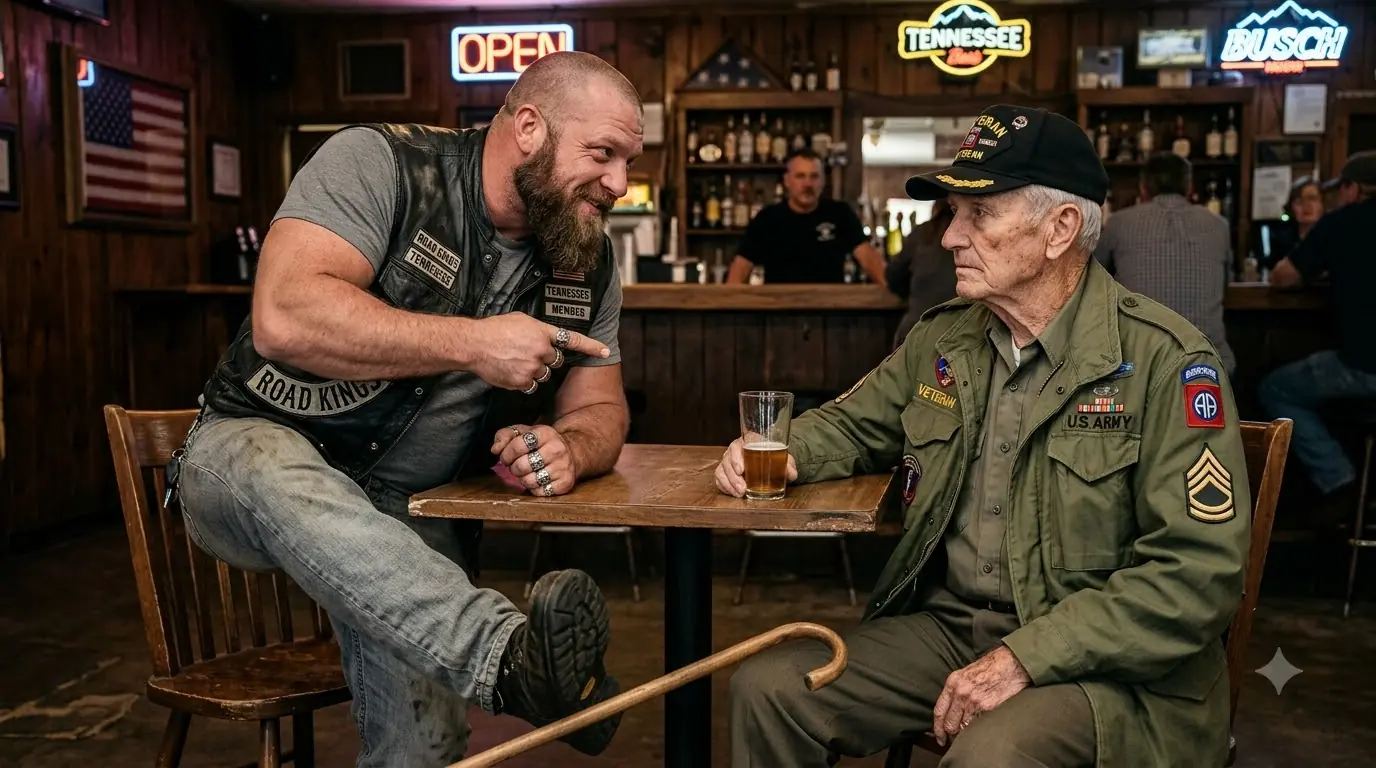
He stood over the small corner table, his shadow swallowing the old man sitting there. Terry Harmon did not look up.
He was 78 years old, with a constellation of liver spots on his hands and a weariness in his bones that had nothing to do with age. He slowly brought a glass of water to his lips, his hands steady.
The slight tremor that sometimes plagued him was, for the moment, absent. He was focused on the condensation trailing down the glass, a tiny cold river in the humid, stale air of the Salty Dog Tavern.
The bar was a dive in the truest sense of the word. The floor was permanently sticky, the air was a cocktail of spilled whiskey and regret, and the neon beer signs in the window cast a jaundiced, flickering glow on the patrons.
It was a place for ghosts, and Terry was just another one, hoping to sit with his memories in peace.
“Hey, I’m talking to you, Grandpa.”
The biker, whose patch identified him as Scab, leaned forward and planted his meaty fists on the table. The wood groaned in protest.
“This is our place. We don’t like strangers, especially not broken-down old ones.”
He gestured with his chin toward the cane leaning against Terry’s chair.
Terry finished his water and set the glass down with a soft click. He finally raised his eyes.
They were a pale, washed-out blue, but they held a depth that was unsettling. They were not angry or fearful, only observant.
They took in Scab, the two other bikers who had flanked him, and the nervous energy rippling through the bar.
“I’m not a stranger here,” Terry said, his voice a quiet rasp. “I’ve been coming here longer than that vest of yours has been on your back.”
Scab chuckled, a dry, ugly sound.
“Oh, a real comedian. You’ve got a lot of mouth for a guy who looks one strong breeze away from turning to dust.”
“You going to pick that up, or do you need one of your nurses to help you?”
His cronies laughed, loud and obnoxious in the suddenly quiet bar. The jukebox, which had been playing a mournful country song, seemed to disappear beneath the tension.
Other patrons hunched over their drinks, their gazes fixed on the scuffed tops of their tables. They wanted no part of the confrontation.
The only person who seemed to be watching closely was Maria, the bartender. She stood behind the bar polishing a glass with a little too much force, her knuckles white.
Terry Harmon bent down. It was a slow, pained movement that testified to old injuries.
His hip protested with a dull ache, and his knee, a road map of surgical scars, sent a sharp complaint up his thigh. He ignored it.
Pain was an old companion.
He gripped the smooth, worn wood of the cane’s handle, his fingers finding their familiar grooves. As he straightened, the effort was visible in the slight sheen of sweat on his brow.
Scab saw the struggle and grinned wider, revealing stained teeth. This was the weakness he had been looking for, the confirmation of his own imagined superiority.
He saw a frail, disabled old man, an easy target for an evening’s cruel entertainment. He could not see the steel underneath the fragile exterior, the discipline forged in places he could not imagine.
“See? Pathetic,” Scab sneered, his voice carrying across the room.
“You should be at home in your rocking chair, not taking up space in a real man’s bar.”
“This bar is for anyone who wants a quiet drink,” Terry said evenly.
He placed the cane deliberately beside his chair again. He was not engaging; he was enduring.
He had endured far worse than the loud posturing of a barroom bully. He had endured suffocating jungle heat, bitter high-altitude nights, ambushes that came without warning, and the aching loss of men whose voices still returned to him in quiet rooms.
There had been years when danger was not an interruption to life but the condition of it. Compared with those memories, the insults of a man like Scab were stones thrown into an ocean, making a small splash before disappearing beneath the surface.
But Scab was not used to being ignored. His frustration began to curdle into genuine anger.
He needed a reaction. He needed to prove his dominance not only to the old man, but to his crew and the rest of the bar.
His gaze fell on Terry’s simple, worn red shirt.
“What are you hiding under that thing, old-timer?” he growled, reaching out.
“A bag? Some medical contraption?”
His friends snickered.
Terry’s eyes hardened just a fraction. A flicker of something cold and dangerous sparked in their blue depths before being extinguished.
“Don’t,” Terry said.
The word was not a plea. It was a command spoken with an authority that felt utterly out of place coming from the frail man in the corner.
The quiet command only enraged Scab further. Who was this old man to tell him what to do?
In a swift, violent motion, he grabbed the front of Terry’s shirt with both hands.
“I’ll do what I want.”
With a harsh tearing sound, the cheap cotton fabric ripped down the middle. Buttons popped and scattered across the sticky floor.
The shirt fell open, exposing the thin, pale chest of an old man and something else.
On his right bicep, faded by decades of sun and age but still unmistakably clear, was a tattoo. It was not a skull, a pinup girl, or any of the usual designs.
It was an eagle with spread wings clutching an anchor, a trident, and a flintlock pistol: a Navy SEAL trident.
For a moment, the bar was utterly silent.
Scab stared at the ink, his brows furrowed in confusion. He did not recognize the symbol, but he recognized the aura around it.
It felt official. It did not fit the image of the weak old man he had created in his head.
As Scab’s fingers brushed the faded tattoo, the stale air of the bar seemed to dissolve for Terry.
The smell of beer and disinfectant became salt, sweat, and gun oil. The low murmur of patrons faded beneath the remembered rhythm of helicopter rotors.
He was no longer in the Salty Dog. He was twenty years old, sitting on an overturned ammo crate in a sweltering tent somewhere in Southeast Asia.
A wiry man with a cigarette dangling from his lips was hunched over Terry’s arm, a homemade tattoo gun buzzing like an angry hornet. The needle felt like a thousand tiny stings as it traced the pattern into his skin.
He did not flinch.
He looked at the faces of his teammates around him, all of them young, hard, and convinced they were immortal. They were all getting the same mark.
It was a symbol of brotherhood forged in secrecy and shared hardship. More than ink, it was a covenant, a silent promise that they were part of something bigger than themselves and that no man in that circle would ever be forgotten.
Terry remembered the young faces around the tent, faces untouched by age because some of them would never live long enough to grow old. The memory vanished as quickly as it came, leaving an ache of nostalgia behind.
Terry was back in the bar, the torn halves of his shirt hanging loose. Scab was still staring at the trident, his drunken mind trying to process what he was seeing.
Then he laughed, a forced, dismissive sound.
“What’s that? You get that out of a Cracker Jack box, trying to pretend you were some kind of big shot, old man?”
He poked the tattoo with a grimy finger.
“You’re no soldier. You’re just a sad old man playing make-believe.”
The public humiliation was complete. Terry’s history, identity, and the memory of men he had lost were being mocked by someone who could not begin to understand what the symbol meant to him.
Behind the bar, Maria had seen enough. The torn shirt, the exposed tattoo, and the final insult crossed a line.
Her loyalty to Terry, her quiet regular who always asked how her son was doing and never caused trouble, hardened into resolve.
She remembered a promise made almost ten years earlier, when Terry had first started coming in looking older and more worn than he should have.
He had given her a small laminated card with a single phone number on it.
“If I’m ever in here and it looks like real trouble,” he had told her quietly, “and I mean the kind of trouble you can’t just call the local police for, call this number.”
“Tell them my name. Terry Harmon.”
“That’s all you have to do.”
She had tucked it away, thinking it was simply the precaution of an old veteran. She had never imagined she would use it.
Tonight was different. This was not a simple bar argument anymore.
Her movements went unnoticed by the bikers, who were still focused on Terry. She slipped into the small, cluttered back office and closed the door until only a crack remained.
Her hands were shaking, not only from fear, but from anger. She fumbled in the cash drawer until her fingers found the cool edges of the laminated card beneath a stack of one-dollar bills.
She dialed the number on her cell phone. It rang only once before a man answered.
“Operations.”
“Hello, my name is Maria,” she whispered, her voice tight with urgency.
“I’m at the Salty Dog Tavern on Route 4. I’m calling about Terry Harmon.”
There was a brief pause on the other end. It was not confusion, but sudden focus.
“Is he okay?” the voice asked.
“No,” Maria said, tears gathering in her eyes as another burst of laughter came from the bar.
“There’s a group of bikers here. They ripped his shirt.”
“They’re mocking him. Please, he told me to call if there was real trouble.”
“Understood, Maria,” the voice replied, still calm. “We have your location.”
“Help is on the way. Stay on the line and keep your head down.”
The line did not go dead. Maria heard muffled commands being issued in the background and heard Harmon’s name repeated.
She caught phrases she did not fully understand, including ‘code trident,’ ‘active asset under duress,’ and an order to notify a quick reaction team while local authorities were contacted. Whatever the number connected to, it had taken Terry’s name with immediate and unmistakable seriousness.
Miles away, inside the cool blue light of a naval special warfare command center, Master Chief Petty Officer Ryan Thompson stood up from his desk so quickly that his chair rolled backward into the wall. The name Terry Harmon had acted like an electric shock.
The name Terry Harmon hit the room like an electric shock.
To the men there, Harmon was not simply an old veteran. He was one of the early figures whose missions and methods had become part of institutional history, a man younger personnel knew from heavily redacted files, training references, and stories passed down by men who had known him personally.
Some called him a plank owner from the early days of the modern teams. Others simply called him Master Chief Harmon, the kind of name that required no explanation once spoken in the right room.
“Sir,” Thompson said to the watch commander, Lieutenant Commander Evans, “we have a code trident. The call is about Master Chief Harmon.”
Evans was on his feet immediately.
The atmosphere changed. Quiet keystrokes and routine work gave way to focused activity as they confirmed the location and contacted the local sheriff’s department.
Evans moved toward the operations map and asked for the exact location, the witness status, and whether local law enforcement had already entered. When Thompson explained that Maria had followed Terry’s old instructions and called them first, Evans ordered a direct line to the sheriff’s department.
The local deputies were told to establish a perimeter, keep civilians safe, and avoid turning the tavern into a chaotic confrontation before the incoming personnel could identify Terry and assess his condition. A nearby quick reaction element was dispatched at the same time, with Thompson already moving before Evans finished the order.
Back at the Salty Dog, Scab was running out of patience.
Terry’s refusal to give him the satisfaction of fear was infuriating. The old man simply stood there with his torn shirt, his gaze unwavering.
Scab needed a finale. He needed to feel that he had won.
“All right, that’s it. You’re done,” he snarled.
He grabbed Terry firmly by the tattooed arm. The old man winced, more from indignity than pressure.
“You’re coming with us. We’re going to teach you some respect.”
The threat was no longer verbal. Scab began hauling Terry toward the door while his two companions moved around them.
Terry did not fight back. He allowed himself to be pulled, his limp more pronounced, his cane left behind on the floor.
He kept his eyes on Scab, not with fear, but with profound disappointment. He had seen ugliness in the world before, but there was something especially hollow about cruelty committed simply because someone appeared weak.
Just as they reached the tavern doors, a low, powerful rumble began outside.
It was not the sound of a single passing truck. Several engines approached together, then stopped.
Bright headlights washed across the front windows of the bar.
Three dark SUVs had pulled into the lot in a tight formation, followed closely by local sheriff’s vehicles. Powerful white headlights filled the tavern windows while the scene outside changed in seconds from a quiet roadside bar to a controlled response.
The SUV doors opened almost together and a dozen uniformed naval personnel stepped out with deliberate calm while deputies moved to secure the parking area. Their navy operational uniforms were crisp, their gear organized, and their movements economical rather than theatrical.
No one rushed the building or brandished weapons. They simply fanned out, created space around the entrance, and moved with the quiet discipline of people who had trained for tense situations until precision had become habit.
Lieutenant Commander Evans entered the tavern with two senior personnel beside him. His eyes swept the room and locked immediately onto Terry Harmon, still standing in Scab’s grasp.
Evans crossed the room without looking at the bikers first. He stopped in front of Terry and came to attention.
“Master Chief Harmon,” he said, his voice carrying through the silent bar. “Lieutenant Commander Evans.”
“We received a call. Are you all right, sir?”
Scab’s hand fell away from Terry’s arm as if he had touched a hot stove.
Terry raised one weary hand and returned the salute in a slow, tired motion.
“I’m fine, Commander. Just a slight misunderstanding.”
Evans kept his attention on Terry for another moment, making sure he was steady on his feet. Only then did he turn toward the bikers.
His tone remained controlled.
“Master Chief Petty Officer Terry Harmon enlisted in 1961 and became part of the early generation of naval special warfare personnel. He served multiple tours in Southeast Asia and spent years in assignments that most people in this room will never know anything about.”
The bikers’ smirks disappeared.
Evans continued, not theatrically, but with the bluntness of someone correcting a dangerous false assumption.
“He was decorated for valor after actions in which he remained with wounded teammates despite serious injuries of his own. His record includes some of the Navy’s highest combat decorations, but what mattered more to the men who served after him was that his methods and lessons became part of how later generations were trained to survive.”
He pointed only with his eyes toward the faded tattoo.
“The symbol you were mocking is a SEAL trident. To him, it represents service, sacrifice, and men who never came home.”
“He did not buy it, borrow it, or invent it for attention.”
Maria covered her mouth behind the bar, tears slipping down her face. Several patrons finally lifted their eyes from their tables.
Scab stared at Terry as though seeing him for the first time.
Evans looked directly at him.
“You put your hands on an elderly man, tore his clothing, insulted him, and attempted to force him out of this building. His past does not make those actions more wrong than they already were, but perhaps now you understand how badly you misjudged the person in front of you.”
Scab’s face had gone pale.
Terry was the one who broke the silence. His voice remained soft.
“The uniform, the medals, the stories, they’re just things,” Terry said. “What matters is what you do when no one is looking and the promises you keep.”
He gestured toward the faded tattoo on his arm.
“That ink wasn’t for you. It was for the ones who didn’t come home.”
“It’s a promise to remember.”
He looked across the frightened bikers.
“Respect is something you give freely. You can’t beat it out of somebody.”
As he spoke, Terry glanced down at the leg that caused his limp.
For a moment, another memory surfaced: mud beneath him, the metallic smell of battle, the confusion of men shouting over one another, and the blinding pain of a severe leg injury. Beside him had been a young radio operator who was badly wounded and fading fast.
Terry remembered forcing himself to move anyway, covering the withdrawal and helping drag the younger man toward extraction despite the injury that would follow him for the rest of his life. The memory had blurred around the edges with age, but its meaning had never changed.
The limp was not a weakness to him. It was a receipt, proof of the cost paid to bring another man home alive.
The wail of an approaching siren broke the silence as additional deputies arrived.
The local officers found a dive bar full of shaken witnesses, three subdued bikers, and naval personnel calmly explaining what had happened. There was no retaliation and no vigilante violence.
Statements were taken from Maria, Terry, the other patrons, and the naval personnel who arrived afterward. The bikers were arrested on charges arising from the assault, damaged clothing, threats, and the attempt to force Terry from the tavern.
The naval personnel never laid a hand on them. The consequences came through witnesses, reports, and the local deputies who now had a room full of people willing to say exactly what they had seen.
Word traveled quickly within the Road Vultures organization. Once the national leadership learned that chapter members had assaulted an elderly former Master Chief and publicly mocked his service, the chapter became an embarrassment even to its own organization.
Scab and the men who had been with him were expelled and cut loose from the group whose colors they had worn so proudly that night. The patches that had made them feel untouchable no longer protected them from anything.
Months passed.
The Salty Dog became quieter. Terry still came in for his glass of water, usually wearing a new flannel shirt buttoned high on his chest.
One afternoon, as he was leaving, he noticed a man sweeping the parking lot of the grocery store next door.
It was Scab.
He was thinner, his face drawn. The arrogant swagger was gone, replaced by the stoop of a man who had been thoroughly and publicly humbled.
Their eyes met across the asphalt.
Scab froze with the broom still in his hands. Fear crossed his face first, followed by shame.
He gave Terry a short, awkward nod. It was not much, but it was the closest thing to an apology he seemed capable of offering.
Terry looked at him for a long moment.
Then the old man raised one hand and gave a slow, deliberate nod in return. It was acknowledgment more than absolution, but there was forgiveness in it too.
Terry climbed into his old pickup truck and drove away.
Scab remained behind with the broom, the quiet parking lot, and the consequences of the man he had once chosen to be.