The five massive Sovereign Riders circled Marcus Jackson in the main room of the Riverdale Community Center, their leather vests creaking, their boots heavy against the old wooden floor, their faces twisted with contempt.
The children’s tutoring tables stood behind him.
A few pencils had rolled onto the floor.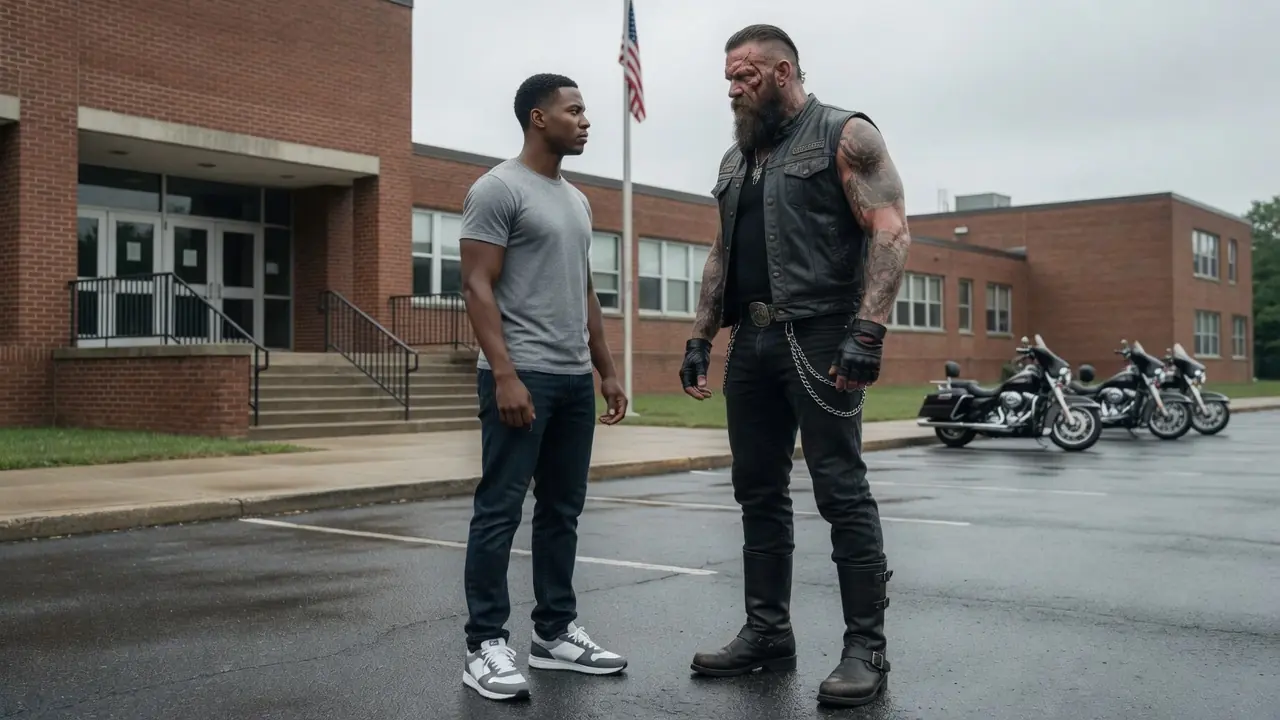
A paper cup of crayons had tipped over, scattering red, blue, yellow, and green across the scratched boards.
Near Marcus’s feet, a small plastic donation jar lay on its side, its coins spilled in a glittering mess across the floor after one of the bikers had knocked it from the sign-in table.
Ray Mercer, the leader of the Sovereign Riders, stepped close enough that Marcus could smell tobacco, leather, and old coffee on his breath.
“This center isn’t for your kind,” Ray said.
His voice was low, but it carried across the room.
“Know your place.”
Marcus did not step back.
He did not lift his hands.
He did not answer quickly.
He controlled his breathing the way his father had taught him when he was ten years old and cornered by boys behind another school in another town.
Four counts in.
Four counts hold.
Four counts out.
Ray Mercer mistook the stillness for fear.
That was his first mistake.
The biker laughed and shoved Marcus in the chest with both hands.
Marcus absorbed the force, letting his weight settle through his legs, moving only half a step to protect the children behind him.
Ray’s smile widened.
“What’s a boy like you going to do now?” he mocked.
Then he ground his boot heel into the scattered coins as if he were crushing something more than nickels and quarters.
He had no idea this moment would echo through Riverdale forever.
He had no idea that, by trying to humiliate a young man in front of frightened children, he was about to expose the deepest sickness in the town.
He had no idea that the quiet volunteer standing in front of him had been raised by a father who believed strength was useless without restraint.
Most of all, he had no idea that Marcus Jackson had spent his whole life preparing for the exact kind of man Ray Mercer was.
Riverdale’s community center had once been a forgotten municipal building at the edge of a cracked parking lot behind the old pharmacy.
For years, people drove past it without looking.
The white paint had peeled in long strips from the siding. Two windows were cracked. One gutter hung loose from the corner like a broken arm. The front sign had faded until the words Riverdale Community Center looked more like a memory than a promise.
Inside, the building smelled of dust, old heating vents, and rainwater that had once leaked through the roof before anyone cared enough to fix it.
But in the last year, something had changed.
The walls had been repainted a hopeful blue.
The broken windows had been replaced.
The main activity room had folding tables, donated bookshelves, a repaired basketball hoop out back, and a bulletin board covered in drawings, tutoring schedules, job workshop flyers, and a handwritten sign that said:
You belong here.
Every weekday afternoon, children filled its rooms with laughter, arguments over homework, squeaking sneakers, and the determined scratching of pencils on paper.
For many of Riverdale’s vulnerable kids, it was the only safe place between school and home.
At the center of that transformation stood Marcus Jackson, though he never claimed credit himself.
He was twenty-two, tall and lean, with quiet eyes and a calm that made people underestimate him until they needed him. His father had moved them to Riverdale three years earlier after retiring from military service, and Marcus had arrived with the careful reserve of someone used to being called an outsider before he even unpacked.
He had not planned to become the community center’s unofficial director.
At first, he had only come to repair a broken table.
Then he stayed to help a boy with multiplication.
Then he came back the next day because the boy had asked whether he would.
Then one day became a week, and one week became a year.
Now Marcus volunteered twenty hours a week, sometimes more, organizing tutoring sessions, coaching basketball, helping teenagers write resumes, carrying donated food boxes, cleaning bathrooms, fixing lights, breaking up arguments, and, most importantly, creating a place where kids from Riverdale’s struggling neighborhoods could feel valued.
He was not paid for most of it.
When the town council gave him a small stipend from the youth services budget, he used half of it to buy school supplies and never told anyone.
“Great job, Deshawn,” Marcus said that Wednesday afternoon, pointing to the next problem on the worksheet. “You’re getting these fractions down perfectly.”
Ten-year-old Deshawn Garcia looked at the page as if he had just discovered a secret door in the world.
“I used to hate these,” he said.
“That’s because nobody explained them right.”
“My teacher tried.”
“Your teacher has twenty-eight kids and forty-five minutes,” Marcus replied. “You’ve got me and no escape route.”
Deshawn grinned.
It was a rare expression for a child whose home life left him little to smile about. His mother, Elena Garcia, worked double shifts at Mercy General Hospital as a nursing assistant. His father had been gone since he was four. Deshawn had learned early to be quiet, helpful, and invisible, because children in tired households often mistake not needing anything for being good.
Marcus understood that.
He had been a quiet child too.
Not because he had lacked love, but because his father’s world had always carried shadows.
Michael Washington, Marcus’s father, had been a decorated Special Forces captain before a roadside accident ended his career and took Marcus’s mother. He had returned from war with discipline in his bones and grief in his hands. After Sarah Washington died, Michael raised Marcus with fierce tenderness and strict rules about character.
Never strike because you are angry.
Never mistake fear for respect.
Never shame a person because you can.
Never start a fight to prove strength.
Never walk away when the vulnerable are behind you.
Marcus checked his watch.
5:00.
Time to start closing up.
Most of the children had already left, picked up by parents, older siblings, or neighbors. Only Deshawn and two others remained in the main activity room.
“Miss Garcia running late again?” Marcus asked, though he already knew the answer.
Deshawn stacked his papers neatly, something Marcus had taught him.
“Yeah. She said she’d be here by five-thirty.”
“Can we shoot some hoops while we wait?” one of the other boys asked.
“Let me lock up the front first, then we’ll see.”
Marcus had just reached for the clipboard near the door when the front door crashed open.
The sound slammed through the building.
Every child turned.
Five men strode in, leather boots heavy against the floor.
The Sovereign Riders.
Everybody in Riverdale knew them.
They were not the largest biker group in the region, nor the most dangerous by reputation, but inside Riverdale they moved like they owned the streets. Their leader, Ray Mercer, ran Mercer’s Auto and Towing, controlled several local contracts, had cousins in city offices, drank with police officers on weekends, and had spent thirty years teaching people that disagreeing with him was more trouble than it was worth.
Ray surveyed the room with thinly veiled disgust.
He was broad and thick-necked, in his early forties, with a gray-streaked beard, heavy rings, and eyes that seemed always to be measuring weakness. His leather vest was covered in patches and polished with care. He wore intimidation like a uniform.
Marcus moved before the children fully understood they were afraid.
He positioned himself between the bikers and the tables.
“We’re closing soon,” he said. “Can I help you with something?”
Ray ignored the question.
He walked slowly around the room, dragging his fingers across tabletops, looking at the donated books, the sign-in sheets, the children’s artwork, the modest computer station in the corner.
“So,” Ray said. “This is where all the city council’s money is going these days.”
One of the bikers snorted.
“Interesting priorities.”
The other men spread out, filling the space. Their presence changed the air. The children instinctively moved closer to Marcus.
“The center operates mostly on donations,” Marcus explained, keeping his voice even. “Private citizens who care about the community’s future.”
Ray laughed.
“That so? Heard differently. Heard my tax dollars are funding this place instead of fixing the roads my business depends on.”
He picked up a children’s book from a table, flipped through it dismissively, then dropped it on the floor.
Marcus felt anger flash hot through his chest.
He did not let it reach his face.
His father’s first lesson after breathing:
Never let them see what moves you until you choose to move.
“Mr. Mercer,” Marcus said, stepping forward to retrieve the book, “if you have concerns about the town budget, council meetings are every Tuesday evening. I’d be happy to help you find the reports.”
“You’d be happy to what exactly?”
Ray stepped into his path.
“Tell me how things work in my own town? I’ve lived here thirty years, boy. My father before me.”
The word boy landed with weight.
Not accidental.
Not careless.
Chosen.
The children heard it. Marcus could feel that too.
“I’m not here to tell you how your town works,” Marcus said. “I’m here to close the center.”
Ray moved closer.
“Funny. Don’t remember seeing your face around here growing up. Where’d you come from exactly?”
Marcus recognized the implication.
He had faced versions of that question his entire life.
In schools.
Stores.
Church basements.
Neighborhood meetings.
Every place where someone wanted to remind him that belonging was not automatic.
“I’ve lived in Riverdale for three years,” Marcus said. “My father moved us here after he retired.”
“Retired from what?” one of the bikers asked. “Welfare office?”
A few of them snickered.
Marcus did not rise to the bait.
“Military,” he said. “Special Forces.”
Something flickered across Ray’s face.
Uncertainty, perhaps.
It vanished quickly.
“Well, that’s perfect,” Ray said. “A military brat running the community center. Does the council know you’re letting these kids run wild here?”
From across the room, Deshawn spoke up before Marcus could stop him.
“Marcus doesn’t let us run wild. He helps us with homework and teaches us respect.”
Ray’s head snapped toward the boy.
“Nobody asked you, kid.”
Deshawn shrank back.
Marcus’s eyes hardened.
“Deshawn,” he said gently, without turning away from Ray, “wait for your mom in the office.”
“But—”
“Now.”
Deshawn obeyed reluctantly, gathering his worksheet and backpack with trembling fingers.
The remaining two children were picked up moments later by Mrs. Washington, a volunteer who stood in the doorway visibly nervous at the tension in the room.
“Take them out the side door, please,” Marcus said.
She did.
The room became quieter.
Now only Deshawn remained in the office, and Marcus could hear him shifting behind the half-closed door.
“This is a community space,” Marcus said. “Everyone is welcome during operating hours, but we are closing now.”
“Everyone is welcome,” Ray repeated.
He took one more step.
“That right?”
The other bikers formed a loose semicircle.
Marcus knew the formation. Not trained, but instinctive. Crowd pressure. Intimidation. Isolation.
Ray smiled.
“See, that’s the problem with boys like you. You show up somewhere, learn a few big words, get praised by people who like feeling generous, and suddenly you think you can run things.”
“My work here is with the children.”
“Your work is whatever this town allows it to be.”
Marcus’s breathing stayed even.
Four counts in.
Four hold.
Four out.
Ray leaned closer.
“This center isn’t for your kind.”
The words changed the room.
They made the air colder.
They reached the office where Deshawn was hiding.
Marcus felt the boy hear them.
That mattered.
“Know your place,” Ray said.
Marcus did not answer.
Ray shoved him.
The force rocked him back half a step.
The bikers laughed.
Ray shoved him again, harder.
“What’s a boy like you going to do now?”
Marcus looked down.
Ray’s boot heel ground into the spilled donation coins.
The sight of it, more than the shove, made something in Marcus shift.
Those coins had come from children, parents, retirees, church ladies, minimum-wage workers, and teenagers who gave what they could because they believed in the center.
Ray was not stepping on money.
He was stepping on faith.
Marcus lowered his voice.
“Move your foot.”
Ray’s smile widened.
“What?”
“Move your foot off the donations.”
The stillness in Marcus’s voice made one of the bikers glance at another.
Ray did not notice.
Or he noticed and refused to understand.
Instead, he pressed harder, scraping the coins against the floor.
Marcus stepped forward.
Not fast.
Not aggressively.
Just enough.
Ray’s instinct told him something had changed, and for the first time since entering the building, his body reacted before his pride did. He shifted back half an inch.
That was all.
But Marcus saw it.
Ray saw Marcus see it.
The humiliation of that small retreat enraged him.
“You think standing straight makes you brave?” Ray snapped.
“No,” Marcus said. “I think frightening children makes you weak.”
One biker muttered, “Careful.”
Ray raised one hand, silencing him.
Outside the front windows, people had begun to gather.
A few parents.
A man from the hardware store.
Two teenagers.
They watched.
No one came in.
No one ever did when the Sovereign Riders were involved.
Ray’s influence extended beyond his club. It reached businesses, police friendships, council members, old family loyalties, and the unspoken rule that peace in Riverdale often meant letting Ray Mercer have his way.
Marcus glanced toward the windows.
He saw the fear in their faces.
Then he looked back at Ray.
“My father always said fighting should be the last option, not the first impulse,” Marcus said. “There’s nothing to be gained here.”
“Your father,” Ray mocked. “Tell me, what else did Daddy teach you? How to take over spaces that aren’t yours?”
The bikers laughed.
Marcus remained still, but something in his eyes changed.
A flicker of steel beneath the calm.
“This center is the only safe place some of these kids have,” Marcus said. “I can’t walk away and let you intimidate them.”
Ray stepped back, sizing him up.
“You talk big for someone standing alone. Where are all your supporters now?”
Marcus glanced outside again.
Several regulars stood watching.
Parents of children who came to the center.
Elderly neighbors who attended art classes.
Teenagers who had found purpose as volunteers.
But they remained beyond the glass, fear evident in every posture.
“They’re good people,” Marcus said. “They’re just afraid.”
“As they should be.” Ray smirked. “That’s the difference between you and me. I understand this town. People here know their place.”
“And what place is that exactly?”
Ray’s eyes narrowed.
“The natural order. People like me built this town. People like you—”
He let the sentence hang.
Marcus took one measured breath.
“The children who come here deserve better than fear,” he said. “They deserve a chance to grow without limits someone else put on them.”
Ray laughed.
But there was something uncertain in it now.
The young man before him showed none of the fear he was accustomed to inspiring.
“Big words,” Ray said finally. “But words are cheap.”
At that moment, Elena Garcia arrived to pick up Deshawn. She had come straight from the hospital, still wearing her scrubs under a winter coat, exhaustion written across her face.
She saw the bikers.
She saw Marcus.
She saw her son standing in the office doorway, pale and frightened.
“What is going on?” she demanded.
Ray turned with a smile.
“Nothing, ma’am. Just discussing community priorities.”
Deshawn ran to his mother.
Marcus did not take his eyes off Ray.
“This discussion is over,” he said.
Ray looked around the room, then toward the faces outside the windows.
He knew when an audience had reached its limit.
For now.
He leaned close to Marcus one last time.
“This isn’t finished.”
Then he turned and walked out, his men following.
The door closed behind them.
For a moment, no one moved.
Then Deshawn’s voice broke the silence.
“Marcus?”
Marcus turned.
The boy was staring at him with wet eyes.
“Are they going to come back?”
Marcus crouched so they were eye level.
“I don’t know,” he said, because children deserved truth when truth could be given gently. “But if they do, we handle it together.”
Deshawn looked toward the door.
“You weren’t scared.”
Marcus paused.
“Yes, I was.”
Deshawn frowned.
“You didn’t look scared.”
“That’s different.”
Elena Garcia stood behind her son, looking at Marcus with gratitude and fear mixed together.
“You should report this,” she said.
“I will.”
Her face tightened.
“You know who Ray is.”
“Yes.”
“You know people report Ray and nothing happens.”
Marcus stood.
“Then we start by making sure everyone knows what happened.”
Riverdale knew by nightfall.
Small towns do not need newspapers when fear and gossip can run faster than ink.
By morning, the story had already split into versions.
Ray Mercer went to the center to ask about funding.
Marcus disrespected him.
The bikers scared children.
Marcus stood up to them.
Ray said something ugly.
Marcus threatened him.
The center had become political.
The center had always been political.
People repeated what fit the shape of what they already believed.
Three days later, the community center bustled with unusual activity.
The annual fundraiser was usually modest. Homemade cookies. A silent auction. A raffle basket from the grocery store. A folding table where Mrs. Wilson, the elderly treasurer, guarded the cash box like a bank vault.
That year, a larger crowd came.
Curiosity pulled some in.
Concern brought others.
A few came because they wanted to see whether Marcus would look different after being publicly challenged by Ray Mercer.
He did not.
Marcus moved efficiently between tables, helping volunteers arrange donated items. He wore dark jeans, a clean shirt, and the same calm expression. Inside, however, he tracked every door, every window, every change in tone.
Despite the increased attendance, he noticed many familiar faces missing.
Families who benefited from the center but now feared association might bring unwanted attention.
That hurt more than open opposition.
“We’ve already raised three hundred more than last year,” Mrs. Wilson reported, beaming with pride despite the strain around her eyes. “People are showing up who’ve never set foot in here before.”
Marcus nodded.
“Let’s make sure they see the good work happening here.”
A display board showcased photographs of the center’s programs. Reading circles for elementary students. Job application workshops for teens. English classes for immigrant families. Basketball practice. Art projects. Math tutoring. A photo of Deshawn holding up a certificate for improved reading scores.
Each image represented lives being changed in small but significant ways.
Then the main door swung open with deliberate force.
Conversations faltered.
Ray Mercer entered, flanked by his usual entourage, plus several others Marcus did not recognize. The bikers’ leather vests stood in stark contrast to the casual clothing of the parents, teachers, and retirees filling the room.
Ray surveyed the center slowly, his gaze finally landing on Marcus.
A smile spread across his face.
Not friendly.
Satisfied.
Predatory.
“Well, look at this,” Ray announced. “Quite the operation you’ve got here.”
Marcus set down the box he was carrying and approached.
“Welcome to our fundraiser, Mr. Mercer. Donations are completely voluntary.”
Ray laughed.
“Oh, I’m not here to donate. I’m here to observe. Public space, right? Funded by taxpayers like me.”
“As I mentioned before,” Marcus said, “most of our funding comes from private donations. Feel free to look around, but please respect our guests.”
“Your guests, huh?” Ray stepped closer. “Interesting how you talk like you own this place.”
He raised his voice, addressing the room.
“How many of you know that your community center is being run by someone who’s barely old enough to drive? Someone with no connection to Riverdale’s history?”
A few uncomfortable glances passed among the attendees.
Most avoided eye contact.
“Marcus has done more for this community in one year than most do in a lifetime,” Mrs. Wilson said.
Her voice shook slightly.
But she said it.
Ray turned to her with exaggerated politeness.
“With all due respect, ma’am, good intentions don’t equal qualifications. This town has real problems that need real solutions, not feel-good projects that drain resources.”
“The center operates on a balanced budget,” Marcus stated calmly. “Every dollar is accounted for. The books are open for any resident to review.”
“Books can be made to say anything,” Ray replied. “But actions speak louder. Tell me, what actual skills do you bring to this community? What life experience qualifies you to shape these kids’ futures?”
The question hung in the air.
Several attendees shifted uncomfortably.
Marcus took a measured breath.
“I bring dedication, consistency, and a belief that every person deserves respect regardless of circumstance.”
“Pretty words,” Ray smirked. “But this town wasn’t built on pretty words. It was built on hard work and proven ability.”
He turned to address the room again.
“Folks, I’m not against community programs. I’m against unqualified leadership. I’m against outsiders who don’t understand our ways.”
An older man stepped forward.
Mr. Collins, who rarely spoke at public events.
“Ray, you’ve made your point. This is supposed to be a fundraiser.”
“Have I made my point?” Ray’s attention snapped back to Marcus. “I don’t think our young friend here gets it yet. He talks about respect, but does he respect our traditions, our way of doing things?”
Marcus looked around the room.
He saw worry.
Doubt.
Fatigue.
A community so used to being intimidated that even good people paused before defending what they knew was right.
“If you have specific concerns about the center’s programs,” Marcus said, “I’m happy to discuss them professionally.”
Ray’s eyes narrowed.
“Professional, huh? Let’s talk professional then.”
He pointed toward Marcus.
“You claim to teach these kids discipline and respect. What do you actually know about those things?”
“More than you might think,” Marcus replied quietly.
“Prove it.”
The word cut through the room.
“Show us all what you’re made of. Tomorrow. The old factory lot. A simple contest. Physical fitness. Leadership skills. Let the town see what their community center director is really capable of.”
Murmurs rippled through the crowd.
Marcus felt the trap immediately.
Refuse the challenge and appear weak, unworthy, afraid.
Accept it and validate Ray’s authority to make such demands.
“I don’t need to prove anything to you,” Marcus said. “These kids and their families know who I am.”
“Do they?” Ray looked around the room. “Or do they only know what you want them to see? A real leader doesn’t hide from challenges.”
An elderly woman from the reading program spoke up.
“Marcus, don’t listen to him. This is ridiculous.”
Ray turned toward her.
“Ma’am, with respect, don’t you think people entrusted with our children should be tested? Or should we just hand responsibility to anyone who walks through the door?”
The woman fell silent, uncertainty crossing her face.
Ray smiled.
He knew how to plant doubt.
Marcus stood very still.
The fundraiser had stopped completely. Children held cupcakes mid-bite. Parents stood with crossed arms. Volunteers looked at him with anxious eyes.
He thought of Deshawn hiding in the office.
He thought of Ray’s boot grinding into coins.
He thought of the sign on the wall.
You belong here.
“The center is not about me,” Marcus said firmly. “It is about providing opportunities to people who need them.”
“Convenient dodge.”
Ray stepped close enough that only Marcus could hear his next words.
“Afraid people might see you’re not what you pretend to be?”
Marcus held his gaze.
Something shifted in his posture, a subtle recalibration that most people would not notice. His father would have noticed instantly.
“If it’s so important to you,” Marcus said finally, “I’ll be there. But this ends tomorrow, one way or another.”
Ray’s smile widened.
“Looking forward to it.”
He turned to leave, then paused, addressing the room once more.
“Folks, come see for yourselves tomorrow at noon. Old factory lot. See who’s really qualified to lead your community center.”
When the bikers departed, conversation erupted throughout the room.
Some people approached Marcus with concern. Others kept their distance, watching him with the anxious curiosity people reserve for a man walking toward a storm.
Mrs. Wilson touched his arm.
“You didn’t have to accept that, Marcus. Nobody would have blamed you for walking away.”
Marcus watched the door where Ray had exited.
“Sometimes walking away causes more harm than standing your ground.”
The fundraiser ended with mixed success.
They raised more money than expected, but the atmosphere never fully recovered. As Marcus helped the last volunteers clean up, he felt the weight of tomorrow settling across his shoulders.
“You should call this off,” Mrs. Wilson said while methodically counting the day’s proceeds. “Nothing good will come from entertaining Ray’s nonsense.”
“If I back out now, he wins,” Marcus replied, stacking folding chairs against the wall. “And he’ll keep coming back, making the center his personal battleground.”
“This isn’t about winning or losing. It’s about safety.”
She lowered her voice.
“Ray Mercer has connections. The mayor’s his second cousin. Two police officers ride with his group on weekends.”
“I know.”
“Then you know this isn’t fair. The deck is stacked against you.”
A ghost of a smile crossed Marcus’s face.
“Wouldn’t be the first time.”
After the final volunteer left, Marcus locked the community center doors and walked to his truck, a modest ten-year-old Ford his father had helped him purchase.
The evening air carried the scent of approaching rain.
He was halfway home when his phone rang. The truck’s Bluetooth displayed:
Dad.
“Hey, Dad.”
“You’re late,” Michael Washington said.
No accusation.
Only observation.
“Fundraiser ran long.”
“Something like that.”
Marcus paused at a stop sign.
“Actually, we had some visitors. The Sovereign Riders.”
A brief silence.
“Ray Mercer’s group.”
“You know them?”
“I know of them.”
Another pause.
“What happened?”
Marcus recounted the confrontation, choosing his words carefully.
He did not need to explain the racial undertones. His father would understand without needing them translated.
“And now you’ve agreed to this demonstration,” Michael said.
“Yes, sir.”
“Why?”
The simple question hung in the cab.
Marcus turned onto their street before answering.
“Because walking away would hurt the center more than standing ground. The kids would see it. The volunteers too.”
“When this is over, everyone will know exactly who you really are,” Michael said quietly. “And who you are not. Are you prepared for that?”
Marcus pulled into the driveway of their modest ranch-style home at the edge of town.
“Dad, remember what you taught me about unavoidable engagements?”
“Yes.”
“I think I’m in one.”
Michael was waiting at the kitchen table when Marcus entered.
Two steaming mugs of coffee sat on the worn oak surface, positioned precisely across from each other.
Michael Washington cut an impressive figure despite the cane resting against his chair. Broad shoulders. Straight back. Close-cropped gray hair. Calm eyes that had seen too much and still refused to become cruel.
His military bearing showed in every measured movement.
“Couldn’t sleep?” Marcus asked, taking the seat across from him.
“Old habits,” Michael said. “You know I’ve never needed more than four hours.”
They sat in silence for a while, the kind of silence only people who love each other deeply can share without needing to fill it.
Through the kitchen window, the outline of their backyard was barely visible. A small vegetable garden. A workbench where Michael spent hours refurbishing furniture. A wooden training post Marcus had used since they moved to Riverdale.
“You’re thinking too loud,” Michael finally said.
Marcus smiled.
“Sorry, sir.”
“Don’t apologize. Tell me what’s on your mind.”
Marcus stared into his coffee.
“I keep wondering if I’m making this worse. If accepting Ray’s challenge is just playing into his hands.”
Michael set his mug down with deliberate precision.
“Walk me through what you see happening tomorrow.”
Marcus closed his eyes briefly.
“Ray will bring a crowd. Make it a spectacle. He’ll try to humiliate me publicly to prove his point about outsiders.”
“And how will you respond?”
“With control. Discipline.”
Marcus opened his eyes.
“The way you taught me.”
Michael nodded slowly.
“The physical challenge isn’t what concerns you. It’s the public nature of it.”
Marcus’s jaw tightened.
“Three years in Riverdale, and some people still look at me like I arrived yesterday. No matter what I do for the center, for the kids, I’m still temporary to them. Still someone who needs permission to care.”
“Son.”
Michael’s voice sharpened slightly.
Marcus looked up.
“That battle is not won with fists or demonstrations,” Michael said. “That battle is won with time and consistency.”
“But tomorrow isn’t about time. It’s about now. About showing people—”
“What exactly do you want to show them?” Michael interrupted. “That you can outperform Ray Mercer physically? What does that prove?”
The question hung between them.
Marcus had no immediate answer.
Michael’s expression softened.
“Your mother faced similar challenges when she started the literacy program in our old town. People questioned her qualifications, her motives, her place.”
The mention of Sarah Washington sent a familiar ache through Marcus’s chest.
His mother had died five years earlier in a car accident on a rainy night. A drunk driver crossed the center line. The same accident left Michael with a permanent limp and ended his military career for good.
“I remember,” Marcus said quietly. “She never backed down.”
“No, she didn’t. But she also never made it about proving herself. She made it about the work. About the people she was serving.”
Michael stood carefully, balancing without his cane for a moment, then walked to the bookshelf in the living room. He returned with a small wooden box, weathered with age and careful handling.
He placed it on the table.
“Your mother built that literacy center from nothing,” he said. “And when people tried to turn her work into a fight, she kept asking one question.”
Marcus looked at him.
“What serves the mission?”
Michael opened the box.
Inside were photographs, medals, a folded flag, old unit patches, and a worn journal.
He removed a photograph and handed it to Marcus.
The image showed a younger Michael in uniform standing beside other soldiers in a desert landscape. Their faces were streaked with dust, but they were smiling with the weary satisfaction of a mission completed.
“Fallujah, 2004,” Michael said. “Second deployment. We extracted a family targeted by insurgents.”
Marcus had seen the photo before, but his father had never discussed the details.
“We went in expecting a firefight,” Michael continued. “Intelligence said the compound was heavily guarded. But when we arrived, I made a different call. Instead of a direct assault, I approached alone. Unarmed.”
Marcus looked up in surprise.
“You never told me that part.”
“It’s not the kind of story that makes good military legends.” Michael smiled faintly. “I spoke with the local elder. Explained our purpose. Turned out the guards were family members protecting their loved ones. They were as afraid of us as we were suspicious of them.”
He tapped the photograph.
“We completed the extraction without firing a shot. My commanding officer was furious that I had broken protocol until he saw the result.”
Michael returned the photo to the box and removed something else.
A small bronze medallion on a chain.
“Your grandfather’s,” he explained, placing it in Marcus’s palm. “He carried it through two tours in Vietnam. Said it reminded him of his humanity when the world seemed determined to strip it away.”
The medallion was simple.
A compass rose on one side.
On the reverse, an inscription.
Not all strength wears a uniform.
Marcus closed his fingers around it, feeling the weight of family history.
“Power is not about showing strength,” Michael said quietly. “It is about knowing exactly when and how to use it.”
His words settled into Marcus’s mind, connecting with lessons taught over years of training.
The physical techniques had always been secondary to the ethical framework.
Control mattered more than victory.
Protection mattered more than pride.
Restraint mattered more than dominance.
“Ray expects a certain response from you tomorrow,” Michael continued. “He is counting on it.”
Marcus nodded slowly.
“The question is,” Michael said, “what response serves your purpose rather than his?”
The Washington household stirred before dawn.
Marcus slept only a little, but when he woke, his mind was clear.
He ran five miles before sunrise, not because he needed conditioning for the challenge, but because motion settled him. He returned, showered, ate eggs and toast, and sat with his father in the kitchen while the morning light slowly filled the room.
They did not discuss strategy.
They did not need to.
Before Marcus left, Michael stood near the door.
“When this becomes ugly,” he said, “and it will, remember that every child at that center will hear the story of how you responded.”
Marcus touched the medallion in his pocket.
“I know.”
“Then give them a story that teaches something worth learning.”
By eleven-thirty, the old factory lot had transformed from an abandoned industrial space into something resembling a crude arena.
Cars and motorcycles lined the perimeter. Nearly one hundred people had gathered in loose clusters. Word had spread beyond expectations. Half of Riverdale seemed to have come to witness the confrontation.
The Sovereign Riders had established a clear presence. Their motorcycles were parked prominently near a flatbed truck that would serve as a makeshift stage. Their supporters gathered around them with folded arms and expectant faces.
Marcus parked his truck at the far edge of the lot.
He sat motionless for a moment, observing through the windshield.
He saw Mrs. Wilson near the front, arms crossed, worry carved into her face.
He saw Elena Garcia and Deshawn near the back, Deshawn bouncing on his toes to see better.
He saw Mr. Collins.
Bill Henderson from the hardware store.
Several teenagers from the center.
A few people who had criticized him online.
A few parents who had privately supported him but never publicly challenged Ray.
He took one deliberate breath.
Four counts in.
Four hold.
Four out.
Then he stepped out wearing jeans, a plain gray T-shirt, and running shoes.
No special gear.
No performance.
Nothing to suggest preparation beyond what any ordinary person might wear.
He carried nothing but his keys and the bronze medallion in his pocket.
Conversations quieted as he walked through the crowd.
Some people nodded. Others looked away.
Ray Mercer stood on the flatbed truck, holding court among his followers. He wore his leather vest over a black shirt, heavy boots lending him additional height.
When he spotted Marcus, a smile spread across his face.
“Right on time,” Ray announced loudly. “Wasn’t sure you’d show.”
Marcus approached the truck, stopping a few feet away.
“I said I would be here.”
“So you did.”
Ray jumped down from the flatbed with theatrical flourish.
“Folks, for those who don’t know, this young man has been running our community center for the past year. Today, he’s going to demonstrate whether he’s actually qualified for that responsibility.”
Murmurs rippled through the crowd.
Marcus remained still, posture relaxed but alert.
“We’ll keep this simple,” Ray continued. “Three challenges. Strength, endurance, and leadership.”
He gestured toward a series of concrete blocks stacked nearby, remnants of the old factory’s foundation work.
“First one’s basic physical fitness. Fifty push-ups followed by moving those blocks from point A to point B. Timed exercise.”
Marcus understood immediately.
The challenge was designed for show.
Ray, physically imposing, had selected tests that highlighted raw strength and power over technique and efficiency.
“After you,” Marcus said.
Ray grinned and dropped to the ground.
He executed fifty push-ups with practiced force, his supporters counting loudly. Rising to his feet, he moved to the concrete blocks, hoisting each one with a grunt and carrying it the designated twenty yards.
When he finished, one of his companions stopped a timer.
“Four minutes, twelve seconds.”
Ray turned to Marcus, barely winded.
“Your turn.”
Marcus took his position.
As he lowered himself for the push-ups, he maintained perfect form. Back straight. Breathing steady. Movements controlled. He did not rush. Each repetition was identical to the last.
The crowd counted along, their voices creating a rhythm.
When he rose for the block portion, Marcus approached the task differently.
Where Ray had muscled through, Marcus analyzed. He tested each block’s weight distribution before lifting, found the optimal carrying position, shifted his hips instead of straining his back, and moved with economy rather than aggression.
“Three minutes, forty-seven seconds,” Mrs. Wilson announced.
She had appointed herself timekeeper for Marcus without asking anyone.
A murmur of surprise moved through the spectators.
Ray’s confident expression faltered.
“Beginner’s luck,” he said quickly. “Next challenge tests endurance.”
The second challenge involved a timed run around the factory perimeter while carrying a weighted bag.
Again, Ray demonstrated first, setting a punishing pace. He ran like he fought, hard and forceful, spending energy to prove he had it.
Marcus followed with measured strides. His breathing remained controlled. His pace did not fluctuate. He did not look impressive at first, not in the way Ray did, but halfway through the route the difference became obvious.
Ray had attacked the run.
Marcus managed it.
He finished seconds faster, showing minimal signs of exertion.
The crowd’s energy shifted.
People leaned forward.
What had begun as spectacle was becoming something else.
Ray’s jaw tightened.
“Final challenge,” he announced. “Leadership isn’t just physical. It’s about commanding respect and making quick decisions under pressure.”
He gestured toward a rusted factory ladder attached to an old water tower.
“Climb to the platform. Retrieve the flag placed there. Simple enough.”
Marcus examined the ladder.
Several rungs were missing. Rust had eaten through the side braces. The platform stood about thirty feet above the ground, not high enough to guarantee death from a fall, but high enough to shatter bones.
“You want us to climb that?” Marcus asked.
“It’s a leadership test.”
“It’s unsafe.”
Ray smiled.
“Worried?”
Marcus turned to the crowd.
“In the military,” he said, letting his voice carry, “we were taught that unnecessary risks endanger the mission. A leader’s first responsibility is to assess reality accurately.”
He approached the ladder and tested the lower rung with one foot.
The metal groaned.
He stepped back.
“This structure won’t safely hold an adult’s weight,” he said. “The responsible decision is to secure it before anyone climbs.”
Ray laughed.
“Convenient excuse. Looks like we have our answer about leadership, folks. When faced with a challenge, our community center director backs down.”
“There is a difference between courage and recklessness,” Marcus replied. “I wouldn’t send any of these kids up that ladder. Why would I consider it acceptable for adults?”
A few people nodded.
An older construction worker spoke up.
“He’s right. That ladder’s not up to code. Accident waiting to happen.”
Ray’s expression hardened.
“Fine. We’ll modify the challenge.”
What followed was a series of increasingly desperate tests.
A mock debate about community priorities.
A challenge to recruit volunteers from the crowd for a hypothetical cleanup project.
A timed problem-solving task involving limited materials and a broken wheelbarrow.
Each time, Marcus responded with composure and thoughtfulness that contrasted sharply with Ray’s growing frustration.
During the volunteer challenge, Ray barked orders and got three of his men to step forward.
Marcus simply turned to the crowd and said, “I need five people willing to give one Saturday morning to repair the community center playground. No speeches. Just work.”
Twelve people raised their hands.
Ray saw it.
Everyone saw him see it.
“This is ridiculous,” Ray finally snapped. “We’re not getting anywhere with these Boy Scout challenges.”
He stepped directly into Marcus’s space.
“Let’s cut to the chase.”
He shoved Marcus hard, forcing him back one step.
The crowd fell silent.
The line had been crossed.
Marcus regained balance instantly, his body automatically settling into a defensive stance almost too subtle to recognize.
Weight centered.
Hands relaxed.
Eyes focused.
“Don’t do this, Mr. Mercer,” he said quietly.
“Do what?”
“This.”
Ray shoved him again, harder.
Marcus absorbed the force without yielding ground.
“You think you’re tough because you can do some push-ups?” Ray’s voice rose. “Real leadership in this town has always been about strength. About putting people in their place when they step out of line.”
“Is that what you’re doing?” Marcus asked. “Putting me in my place?”
“Someone has to.”
Ray swung suddenly, a heavy right hook aimed at Marcus’s jaw.
The crowd gasped.
Several people stepped forward in alarm, but the blow never landed.
With a movement so fluid it appeared almost casual, Marcus shifted slightly. Ray’s fist passed through empty air, the momentum pulling him off balance.
Marcus had not struck back.
He had not grabbed Ray’s arm.
He had simply not been where the punch was aimed.
Ray stumbled, recovered, and flushed with anger.
“Lucky dodge.”
He swung again.
And again.
Each time, Marcus moved with minimal effort, evading the attacks with precision that began to look less like luck and more like extraordinary training.
“Stand still and fight,” Ray demanded, his composure cracking.
“This isn’t a fight,” Marcus replied calmly. “This is a demonstration. You’re demonstrating exactly what kind of leader you are.”
The crowd had gone completely silent.
It was not just Marcus’s physical ability that commanded attention.
It was the contrast.
Ray’s rage.
Marcus’s restraint.
Raw aggression against controlled response.
Dominance against discipline.
“You think this is a game?” Ray snarled. “This is my town. My rules.”
The declaration hung in the air, revealing more than Ray intended.
His next attack came with full force, a wild combination of punches followed by an attempt to tackle Marcus to the ground.
The crowd backed away, creating a wider circle.
Marcus redirected momentum rather than opposing it directly. He moved with an economy that seemed almost impossible, small adjustments keeping him perpetually beyond Ray’s reach.
Not once did Marcus strike back.
Not once did he grab or punish.
His hands remained open.
To the casual observer, Ray simply could not connect.
To trained eyes, it was obvious.
Marcus was choosing not to hurt him.
“Fight back!” Ray shouted, sweat pouring down his face. “Stop dancing and fight me!”
Marcus remained silent.
His breathing stayed even.
Ray was tiring now. His attacks became sloppy, desperate, fueled less by strategy than humiliation.
Finally, Marcus spoke.
“There’s nothing to be gained here,” he said. “You’ve made your point. I’ve made mine. Let’s end this before someone gets hurt.”
“Don’t you dare talk down to me.”
Ray lunged one last time.
This time, Marcus moved differently.
Instead of simply evading, he stepped forward at the exact moment Ray committed his full weight. Marcus’s hand connected lightly with Ray’s shoulder. Not a strike. Not a shove. A precise redirection.
Ray’s own force carried him forward and downward.
He stumbled, lost balance, and fell hard into the dirt.
A collective gasp rose from the spectators.
Ray had not been thrown.
He had not been punched.
He had been guided into defeating himself.
Marcus immediately stepped back, hands open in a nonthreatening gesture.
“Are you all right, Mr. Mercer?”
Ray lay in the dirt, the wind knocked from his lungs, his composure shattered.
The invincible leader of the Sovereign Riders had been humbled without a single punch thrown against him.
“Who the hell are you?” Ray gasped.
Marcus extended a hand.
“The same person I was yesterday. Someone who cares about this community.”
Ray stared at the offered hand.
Pride warred with the undeniable reality of what had just happened.
“A real leader protects people,” Marcus continued, hand still extended. “Even those who do not deserve it. That is what my father taught me.”
The phrase carried weight beyond its simple meaning.
Several older spectators exchanged glances, something like recognition dawning in their faces.
Ray ignored the hand and pushed himself to his feet.
Dust covered his leather vest.
The crowd waited for his rage.
Instead, Ray stood breathing heavily, looking at Marcus with new eyes.
Anger remained.
But something else had emerged alongside it.
Reluctant reassessment.
“This isn’t over,” Ray said finally.
But the words lacked conviction.
Marcus nodded once.
“You’re right. It isn’t over. There is still a community center that needs support. Still children who need a safe place. That work continues regardless of today.”
The simple truth hung in the air.
Ray had come to humiliate an outsider.
Instead, he had unintentionally showcased the very qualities that made Marcus a leader.
Without another word, Ray turned toward his motorcycle.
His followers hesitated.
The pattern had been broken.
The expected outcome disrupted.
The community of Riverdale had witnessed something it would not easily forget.
Then, through the silence, came the distinct sound of a cane striking concrete.
Heads turned as Michael Washington made his way through the crowd.
He wore no uniform, just civilian clothes, but his military bearing was unmistakable. The limp slowed him but did not diminish him. His presence commanded attention without asking for it.
“Dad,” Marcus said quietly.
Michael nodded once, then looked around.
“Seems I missed quite a show.”
An older man stepped forward.
Bill Henderson, who owned the hardware store downtown.
His eyes widened.
“Wait a minute. Washington. Michael Washington?”
Michael’s expression remained neutral.
“Hello, Bill.”
Henderson looked between father and son.
“Fifth Special Forces Group. Captain Michael Washington.”
A murmur spread through the crowd.
Michael lifted one hand slightly.
“That was a long time ago.”
Henderson turned to the others, his voice carrying.
“Do you people realize who this is? Captain Michael Washington. The Ghost of Fallujah. His unit saved my nephew’s entire platoon back in ’04.”
Whispers rippled through the gathering.
Several veterans straightened instinctively.
Ray had paused by his motorcycle, listening now, his face shifting between disbelief and dawning comprehension.
“The training program you developed is still used today,” Henderson continued. “My nephew said you were the most respected officer in the region.”
Michael’s discomfort became visible.
“That is all in the past. We came to Riverdale for a quieter life.”
“And you kept quiet all right,” Henderson said. “Three years in town and you never mentioned any of this.”
“There was no need,” Michael replied. “A man should not be judged by his title or his past.”
His gaze moved over the crowd.
“He should be judged by what he does when someone vulnerable is standing behind him.”
The implication settled over the factory lot.
Marcus had not received ordinary self-defense lessons.
He had been raised by a man whose discipline had been shaped by war and refined by grief.
Ray pushed through the crowd and stopped several feet from Marcus and Michael.
His earlier bravado had vanished.
“You could have taken me apart at any point,” he said to Marcus.
His voice was rough.
“Why didn’t you?”
Marcus reached into his pocket and removed the bronze medallion his father had given him that morning. He held it up, letting sunlight catch the inscription.
Not all strength wears a uniform.
“The uniform does not make the soldier,” Marcus said. “The character does. Same goes for any person.”
Ray stared at the medallion.
Marcus continued, his voice carrying across the silent lot.
“My father taught me that when you stand up for others, you never truly stand alone, even when it looks that way. The community center is not about me. It is about creating a place where everyone belongs and everyone has value.”
Ray’s gaze dropped.
Then rose again.
“Look,” he said, struggling with the words, “I still think this town has priorities that need fixing. Roads. Infrastructure. Businesses closing.”
“Then come to the city council meetings,” Marcus said. “Bring your concerns formally. Better yet, volunteer some time at the center. See what we are actually doing before deciding it is not worthwhile.”
A woman’s voice called from the crowd.
Elena Garcia.
“The center helped my son improve two grade levels in reading this year,” she said. “He is talking about college now. That is infrastructure too. Building futures.”
Another voice joined.
“My daughter got her first job because of the resume workshop.”
Then another.
“My grandson stopped getting in trouble after Marcus gave him responsibility here.”
“My mother takes the English class.”
“My nephew eats here after school because sometimes there isn’t food at home.”
The testimonials were not loud or polished.
They were simple truths.
One by one, they filled the space Ray had tried to dominate.
Ray listened.
The public confrontation had backfired, forcing him to witness the community’s actual values instead of the divisions he had tried to exploit.
“Maybe we’ve all been fighting the wrong battles,” Ray finally said.
The words seemed to surprise even him.
Marcus extended his hand again.
“The center’s doors are open to everyone. Including you and your friends.”
This time, after a long hesitation, Ray accepted the handshake.
It was not friendship.
Not forgiveness.
Too much had happened for that.
But it was acknowledgment.
A beginning.
As the crowd began to disperse, conversations buzzing with the day’s events, Marcus found himself surrounded by community center regulars.
Mrs. Wilson hugged him tightly.
Deshawn looked up with admiration so bright it nearly broke Marcus’s heart.
“Will you teach us those moves?” the boy asked.
Marcus smiled.
“What I’d rather teach you is when not to use them. That is the harder lesson.”
In the days that followed, Riverdale changed in small but significant ways.
Attendance at the community center increased.
Some came because they wanted tutoring.
Some came because they wanted to volunteer.
Some came because, for the first time, they believed Ray Mercer could be opposed without the world ending.
At the next city council meeting, Marcus presented a proposal for expanded center services.
Michael sat in the audience, quiet pride evident in his expression.
“The proposal includes vocational training,” Marcus explained. “We have community members with valuable skills to share. Construction. Mechanics. Business management. Basic home repair. Financial literacy.”
He glanced toward the back of the room.
Ray Mercer stood there in a plain work shirt instead of his leather vest.
“And motorcycle maintenance workshops for teens interested in transportation careers.”
A slight nod from Ray acknowledged the olive branch.
The council approved the funding unanimously.
After the meeting, Michael walked beside Marcus to the truck.
“Your mother would be proud,” he said. “Not because you won a fight. Because you found a way to build bridges instead of walls.”
Marcus touched the bronze medallion in his pocket.
“True strength isn’t about dominating others,” he said. “It’s about having the discipline to protect what matters without becoming what you’re fighting against.”
Michael smiled faintly.
“You were listening.”
“I always was.”
Around them, Riverdale continued its daily rhythms.
But something fundamental had changed.
The invisible barriers that divided the community had not disappeared. Such transformations never happened overnight. Fear did not vanish in one public afternoon. Prejudice did not dissolve because one angry man fell in the dirt.
But the barriers had weakened.
There was a crack now.
And through that crack, something better began to grow.
At the community center the following week, a surprising visitor arrived during the afternoon homework session.
Ray Mercer stood awkwardly in the doorway, leather vest exchanged for a plain work shirt.
The room went quiet.
Deshawn looked at Marcus.
Marcus looked at Ray.
Ray cleared his throat.
“Heard you might need someone to fix that basketball hoop out back,” he said gruffly. “Thought I’d take a look.”
Marcus walked toward him.
For one second, everyone waited.
Then Marcus picked up the tool box from under the sign-in table and handed it to Ray.
“We’d appreciate that,” he said. “The kids have been asking when it will be working again.”
Ray took the box.
His hand paused on the handle.
“I was wrong,” he said, not loudly, not fully, but enough for the room to hear. “About some things.”
Marcus nodded.
“That is a place to start.”
Ray walked toward the back door.
Deshawn watched him go, then whispered, “Is he good now?”
Marcus looked at the man who had once tried to frighten children and was now carrying a tool box toward a broken basketball hoop.
“No,” Marcus said gently. “People don’t become good in one day.”
Deshawn frowned.
“Then what is he?”
Marcus thought about that.
“Trying,” he said. “And sometimes that is the first honest thing a person does.”
Months later, the old factory lot became part of the town’s memory.
People told the story in different ways.
Some exaggerated the fight, though Marcus corrected them every time.
“There was no fight,” he would say. “That was the point.”
Some told it as the day Ray Mercer was defeated.
Marcus disagreed with that too.
Ray had not been defeated.
He had been confronted with a version of strength he did not understand.
And because some piece of him had not yet died, he eventually chose to learn from it.
The Sovereign Riders never became saints.
They still rode loud, argued too much, and made Mrs. Wilson nervous when three of them showed up at once. But they also repaired the center’s fence, donated used tools for the vocational program, and taught a small engine workshop that became unexpectedly popular among teenagers who had never been told they were good with their hands.
Ray came every Thursday afternoon.
At first, the children watched him carefully.
So did Marcus.
Trust, like strength, had to be built through repetition.
One day, Deshawn brought in a broken bicycle chain.
Ray fixed it without charging him.
The next week, Ray showed him how.
The week after that, Deshawn helped another boy fix his.
That was how change worked in Riverdale.
Not through speeches.
Not through one public victory.
Through hands, work, time, and the stubborn decision to keep showing up differently than before.
A year after the confrontation, the community center held another fundraiser.
This time, the building was full before the event officially started.
The display board had doubled in size. There were photos from reading programs, basketball leagues, job workshops, English classes, and the new mechanical skills program. One photo showed Ray Mercer kneeling beside a group of teenagers around a dismantled motorcycle engine, pointing to a part while Deshawn held a wrench.
Another showed Marcus standing beside Michael, Mrs. Wilson, Elena Garcia, Ray Mercer, and half the city council beneath the sign that read:
You belong here.
During the speeches, Mrs. Wilson became emotional and forgot half her prepared remarks.
Ray refused to speak at first, then finally stood and said, “I used to think a town was built by the people who had been here the longest. I was wrong. A town is built by whoever shows up to do the work.”
He looked at Marcus.
“Some folks show up later and do more than the rest of us ever did.”
The room fell silent.
Marcus nodded once.
It was enough.
Later that night, after the last chairs were stacked and the last donation envelope locked away, Marcus stood alone in the main activity room.
The floor had been cleaned.
The donation jar sat upright on the sign-in table.
He looked at the spot where Ray’s boot had once ground coins into the floor.
The mark was gone.
But he remembered.
Michael came in quietly behind him.
“You all right?”
Marcus nodded.
“Just thinking.”
“About?”
Marcus looked around the center.
The bookshelves.
The tables.
The children’s drawings.
The basketballs stacked near the door.
The bulletin board crowded with schedules and thank-you notes.
“The first day Ray came in here,” Marcus said, “I thought the point was to stop him.”
“And now?”
“Now I think the point was to stop becoming him.”
Michael smiled.
“That is the harder victory.”
Marcus reached into his pocket and touched the bronze medallion.
Not all strength wears a uniform.
Outside, Riverdale settled into evening.
Cars passed.
A dog barked somewhere down the street.
The community center lights glowed through the windows, warm and steady against the dark.
It had once been a forgotten building.
Then it became a safe place.
Then it became a battleground.
Now it was something stronger than all of those things.
It was proof.
Proof that fear could be answered without hatred.
Proof that strength could stand still.
Proof that an outsider could belong through service.
Proof that children watching from behind tables could learn a different kind of courage than the one angry men tried to teach.
Marcus locked the front door and stepped outside with his father.
Across the parking lot, Ray Mercer was waiting beside his motorcycle. He had finished replacing the center’s broken gate latch and was wiping his hands on a rag.
“Gate’s fixed,” Ray said.
Marcus nodded.
“Thank you.”
Ray looked uncomfortable with gratitude, as if it were a jacket that did not fit yet.
“Yeah,” he said. “Well. Kids shouldn’t have to fight with a busted gate.”
Marcus smiled faintly.
“No. They shouldn’t.”
Ray climbed onto his motorcycle, then paused.
“Thursday still good for the engine class?”
“Thursday is good.”
Ray nodded and rode away.
Michael watched the taillight disappear down the street.
“Interesting town,” he said.
Marcus laughed softly.
“That’s one word for it.”
They walked to the truck together.
And for the first time in a long time, Marcus felt no need to prove he belonged in Riverdale.
He had stood his ground.
He had protected the children.
He had refused to become cruel in order to defeat cruelty.
That was enough.
The next afternoon, Deshawn arrived early with his backpack bouncing against his shoulders and a math worksheet in his hand.
“Marcus,” he said, breathless, “I got an eighty-eight.”
Marcus looked at the paper and smiled.
“Fractions?”
“Fractions.”
“See? I told you.”
Deshawn grinned, then glanced toward the back room where Ray was setting out tools for the workshop.
“Do you think people can really change?” the boy asked.
Marcus looked at him carefully.
“Yes,” he said. “But only if they stop pretending they were never wrong.”
Deshawn thought about that.
Then he nodded as if filing it away.
“Can we do decimals next?”
Marcus laughed.
“One battle at a time.”
The room filled slowly with children.
Pencils scratched.
Chairs scraped.
Someone argued about basketball.
Someone else asked for help spelling precipitation.
In the back room, Ray Mercer explained the difference between a spark plug and a fuel line to three teenagers who listened with open interest.
Mrs. Wilson counted donations.
Elena Garcia dropped off sandwiches from the hospital cafeteria.
Michael Washington arrived with a box of old books and pretended not to be pleased when three boys asked him about his cane.
Riverdale was not fixed.
No town was fixed that easily.
But something in it had shifted.
And sometimes that was how transformation began.
Not with a speech.
Not with a punch.
Not with one man proving he was stronger than another.
But with a young volunteer standing between frightened children and five angry bikers, breathing through the fear, refusing to move, and teaching an entire town that real strength does not always raise its fist.
Sometimes it opens its hand.
Sometimes it protects.
Sometimes it waits.
And sometimes, when the whole world expects violence, it chooses restraint so powerfully that even the man who came to destroy it has to stop and reconsider who he has become.