Olivia Harrington walked into the café on West Monroe Street with a coffee already cooling in her hand and a smile she had forgotten how to remove from her face. Outside, downtown Chicago glowed under wet evening lights, the sidewalks shining after a long winter rain. She had just left a charity reception where hundreds of people applauded her name, praised her generosity, and thanked her for being the face of Harrington Hope Foundation. Yet the moment she stepped away from the cameras, all she felt was tired.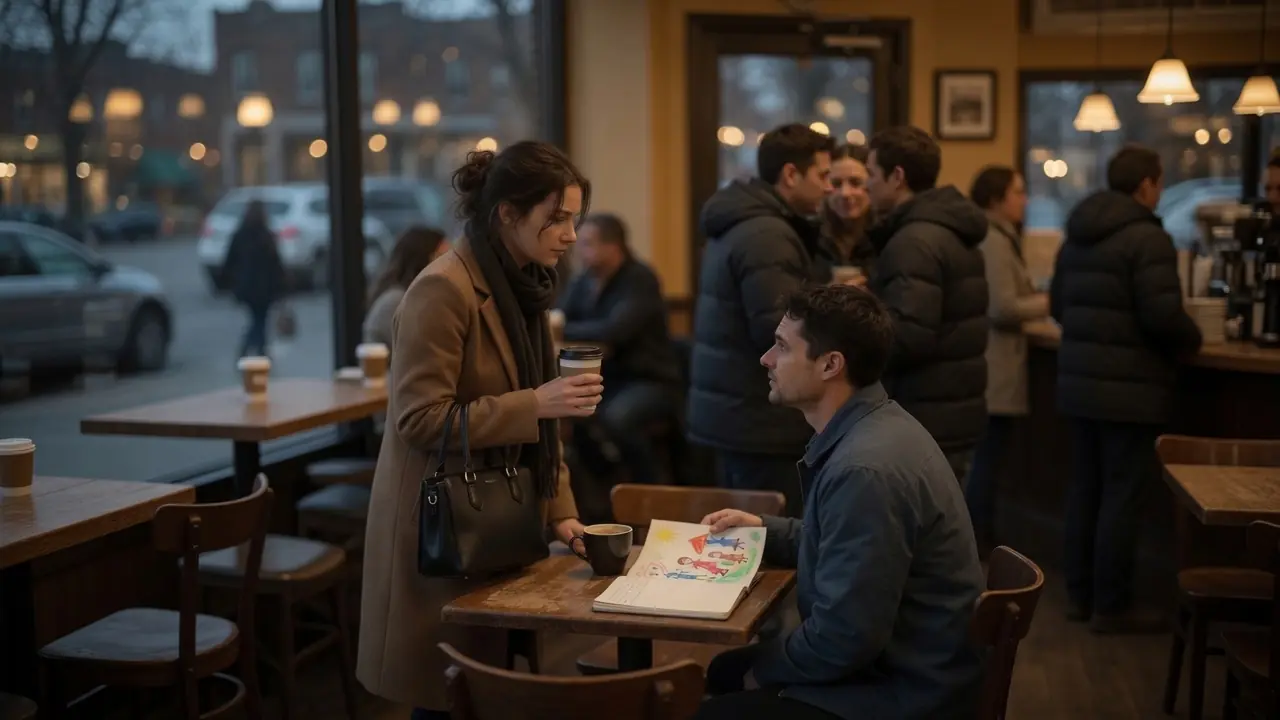
Her driver had texted that the car would be fifteen minutes late because traffic around the financial district had frozen after an event nearby. Olivia could have waited inside the hotel lobby, but people had already started recognizing her there. A woman asked for a selfie while Olivia was trying to breathe. A man with perfect teeth handed her a business card and said his fund “aligned with her mission,” though he never once asked what the mission was.
So she crossed the street and entered the nearest café, hoping the crowd would hide her better than marble and chandeliers ever did. The café was warm, small, and full of people escaping the rain. Students leaned over laptops, office workers crowded around tiny tables, and the smell of espresso mixed with cinnamon rolls and damp coats. Olivia stood near the counter with her black handbag over one shoulder, searching for an empty seat.
There were none.
Then she saw the window table.
A man sat alone there, maybe in his early forties, wearing a simple blue jacket and a white shirt with the sleeves rolled up. He had a half-finished coffee, an open notebook, and a child’s crayon drawing tucked carefully between the pages. He did not look up when she entered. He did not whisper to anyone, point at her, or reach for his phone.
Olivia hesitated beside his table. “Can I sit here?” she asked softly. “My car is late, and people by the door keep staring.”
The man looked up then. His eyes were calm, tired, and kind in a way that did not feel polished for effect. He glanced toward the entrance, where two women had already begun whispering and pretending not to look at Olivia. Without asking her name, he moved his notebook aside.
“Of course,” he said. “Take the seat.”
Olivia sat down across from him, grateful in a way that embarrassed her. “Thank you. I just needed one quiet corner.”
The man gave a faint smile. “Then stay here. Nobody has to perform at my table.”
The sentence reached something inside her so unexpectedly that she looked away toward the rain-streaked window. All evening she had performed. She had performed gratitude, strength, grace, leadership, wealth, and certainty. She had stood on a stage beneath warm lights and spoken about families in crisis while knowing half the donors in the room cared more about having their names engraved on plaques than about the people the foundation served.
“I’m Daniel,” the man said after a moment.
“Olivia,” she replied.
He nodded like the name meant nothing to him, or like he was kind enough to pretend it did not. “Long evening?”
She laughed softly. “You could say that.”
“Fundraiser?”
Olivia looked at him more carefully. “What makes you say that?”
“You’re dressed like someone who had to shake too many hands,” Daniel said. “And you look like every person you met tonight wanted something from you.”
For the first time that night, Olivia smiled honestly. “That is painfully accurate.”
Daniel closed his notebook. “Then I’m sorry.”
“Why?”
“Because that kind of evening leaves a person lonely in a room full of praise.”
Olivia stared at him.
People around her usually spoke to impress her, convince her, flatter her, or position themselves near her. Daniel spoke as if he had no interest in gaining anything. He was simply observing what was true. That made his kindness feel almost dangerous.
“What were you writing?” she asked, nodding toward the notebook.
“Budget notes,” he said. “And a grocery list my daughter corrected because she thinks I buy the wrong cereal.”
Olivia’s eyes dropped to the drawing tucked inside the notebook. It showed a stick-figure man and a little girl standing beside a crooked yellow sun. “How old is she?”
“Eight. Her name is Emma.”
“Does she always put drawings in your notebook?”
“Only when she thinks I need supervision.”
Olivia laughed again, a small sound that surprised her. Daniel’s expression warmed, but he did not push. He took a sip of coffee and looked out the window as if giving her permission to breathe without being watched.
She should have checked her phone. Her assistant had already sent three updates about the delayed car, two donor follow-ups, and a message marked urgent from the foundation’s communications director. Olivia ignored all of them. For once, the world could wait ten minutes.
“You have the look of someone who used to be very important,” she said.
Daniel’s hand paused around his coffee cup. “Used to be?”
“I’m sorry,” Olivia said quickly. “That sounded rude.”
“No,” he said. “It sounded accurate.”
Something passed across his face, too quick for her to name. Pain, perhaps. Or memory. He looked down at the notebook, closed it fully, and rested one hand on top of it.
“I ran something once,” he said.
“A company?”
“A nonprofit.”
Olivia leaned forward slightly. “What happened?”
Daniel’s eyes lifted to hers. “Life happened. Then politics. Then a story got told loudly enough that the truth stopped mattering.”
She knew that sentence too well. Foundations looked gentle from the outside, but inside they could be as sharp as any corporation. Power still wanted control. Money still wanted obedience. Reputation still mattered more than people unless someone fought to make it otherwise.
“I’m sorry,” she said.
Daniel shrugged. “It was years ago.”
“That doesn’t mean it stopped hurting.”
He looked at her then, truly looked at her, and for one second Olivia felt like he saw through the expensive coat, the perfect makeup, the public name, and the practiced composure. She was not used to being seen without being assessed. It made her want to tell the truth.
“I stood on a stage tonight,” she said quietly, “and talked about hope. Then I looked at the room and realized I didn’t know how much of it was real anymore.”
Daniel did not interrupt.
“My family started Harrington Hope Foundation after my mother died,” Olivia continued. “At least that is the public version. The truth is, other people built most of its heart before I understood what they were doing. Now I’m the face of it, and everyone keeps telling me how meaningful it is. But lately, I keep wondering who paid the price for making it look so clean.”
Daniel’s face changed, almost invisibly.
Olivia noticed. “Do you know it?”
“I’ve heard of it.”
Most people would have said more. They would have praised the foundation, mentioned the gala, asked for a contact, or told her about a cousin who needed help. Daniel said nothing. His silence felt careful.
Before Olivia could ask why, her phone buzzed again. The driver was outside. The quiet corner was over.
She stood reluctantly. “Thank you for sharing your table.”
Daniel nodded. “I hope the rest of your night asks less of you.”
“That may be the kindest thing anyone has said to me today.”
He smiled, but there was sadness behind it. “Then today set the bar too low.”
Olivia walked to the door, then stopped and turned back. Daniel had reopened the notebook, but he was not writing. He was looking at the child’s drawing as if it reminded him why he had to keep going. Olivia almost asked for his last name.
She did not.
Three days later, Olivia heard the name Daniel Carter for the first time in years.
It happened inside the Harrington Hope Foundation archive room, where old records were kept in white boxes no one opened unless auditors forced them to. Olivia had ordered a full internal review after the gala because Daniel’s words had followed her home. A story got told loudly enough that the truth stopped mattering. The sentence kept echoing every time she looked at the foundation’s polished annual report.
Her chief of staff, Marissa, stood beside her with a tablet. “You asked for early leadership records. The first executive director was Judith Vale. Before her, there was an interim operating officer named Daniel Carter.”
Olivia looked up sharply. “Daniel Carter?”
“Yes. Former CEO, technically. It was a short tenure, but important. He designed the emergency family assistance program.”
Olivia felt a strange tightening in her chest. “What happened to him?”
Marissa hesitated. “Officially, he resigned after a misallocation scandal.”
“What kind of misallocation?”
“Emergency funds were sent outside the approved vendor network. The board claimed he bypassed controls.”
Olivia frowned. “Was money stolen?”
“No record of personal gain.”
“Then why was it a scandal?”
Marissa scrolled through the file. “The board said he acted recklessly and damaged donor confidence. He left. Judith Vale took over. The program was later relaunched under the Harrington family brand.”
Olivia slowly sat down at the archive table. “Show me his photo.”
Marissa tapped the screen and turned it toward her.
The man in the old staff profile was younger, clean-shaven, wearing a gray suit and a hopeful expression. But the eyes were the same. Calm, tired, kind. The man from the café.
Olivia stared at the photo. “That’s him.”
Marissa looked confused. “You know him?”
“I met him three nights ago.”
The room seemed suddenly too small. Olivia pulled the nearest file box toward her and began reading. Daniel Carter had joined the foundation fourteen years earlier after working in disaster relief and housing support. He had created the emergency family assistance program after discovering that families facing eviction, medical bills, or sudden loss often needed immediate small grants more than long-term promises. Under his leadership, thousands of families received rent support, food vouchers, emergency childcare, and temporary shelter.
Then came the crisis.
A winter storm hit Illinois, and hundreds of families were displaced after heating failures and building closures. Daniel authorized emergency payments to local churches, motels, clinics, and independent providers before they were formally approved. The money reached families within hours. The paperwork came later.
The board called it a governance failure.
Olivia kept reading, her anger growing with every page. The same people who later praised the program’s impact had punished the man who made it work when lives were cold, hungry, and desperate. Worse, the documents suggested Daniel had warned the board that the approved vendor network was too slow. His warnings had been ignored.
“Who chaired the board then?” Olivia asked.
Marissa was silent.
Olivia looked up. “Who?”
“Your father.”
The answer landed heavily.
Arthur Harrington had built the public image of the foundation after Olivia’s mother died. He was charming, wealthy, generous when cameras were present, and merciless when control was threatened. Olivia had loved him once with the complicated loyalty children give powerful parents. After his death, she had inherited his foundation, his reputation, and apparently some of his buried mistakes.
She turned another page and found a letter from Daniel Carter to the board.
Families are not freezing because we lack compassion. They are freezing because our compassion requires twelve signatures before it becomes heat.
Olivia read the sentence three times.
That night, she returned to the café.
Daniel was not there.
She came back the next evening, then the next. On the fourth night, she found him at the same window table with Emma sitting across from him, coloring a paper menu. Emma had curly brown hair, bright eyes, and purple glasses that slid down her nose when she leaned too close to her crayons. Daniel looked up when Olivia approached, and the guarded look returned immediately.
“You found the quiet corner again,” he said.
“I found your name.”
Emma looked up. “Dad, is she from work?”
Daniel closed his notebook. “No, sweetheart.”
Olivia knelt slightly beside the table. “Hi, Emma. I’m Olivia.”
Emma looked at her carefully. “Are you famous?”
Daniel sighed. “Emma.”
“What? She looks famous.”
Olivia smiled. “A little, but mostly because people exaggerate.”
Emma seemed to accept that. “Dad says famous people still have to clean their own coffee spills.”
“That is excellent advice.”
Daniel’s face softened despite himself, then hardened again when Olivia looked at him. “What do you want?”
The question hurt, but she had earned it by arriving from the world that hurt him.
“I want to know the truth,” Olivia said.
“No,” Daniel replied quietly. “You want absolution. People with inherited guilt usually do.”
Olivia absorbed that. “Maybe. But I still want the truth.”
Emma looked between them, sensing adult weather. Daniel touched her menu gently. “Can you ask Rosa for a refill on your hot chocolate?”
Emma frowned. “But I’m not done listening.”
“Emma.”
“Fine.”
She slid from the booth and walked toward the counter, glancing back twice.
Olivia sat across from Daniel only after he nodded. The table felt different now. Less like shelter, more like a courtroom built from coffee cups and old pain.
“I read the files,” she said.
“Then you read the version they kept.”
“I read your letters too.”
Daniel looked away.
“You warned them the emergency process was too slow,” Olivia said. “You told them people needed help immediately.”
“They knew.”
“You used local providers because the approved vendors couldn’t respond fast enough.”
“Yes.”
“And families survived because of it.”
His jaw tightened. “Some did.”
“Then why did they force you out?”
Daniel looked at her again, and this time the kindness was gone. Not replaced by cruelty, but by exhaustion. “Because your father needed a scandal small enough to control and useful enough to remove me.”
Olivia’s throat tightened. “Why?”
“I refused to let the foundation become a branding machine.”
The words struck too close to her own fear.
Daniel continued. “Your father wanted clean metrics, donor dinners, naming rights, and stories that photographed well. I wanted cash moving fast enough to keep families housed. We disagreed. Then the storm gave him leverage.”
Olivia looked down at the table. “I was twenty-two then. I was in London.”
“I know.”
“You know?”
He gave a faint bitter smile. “You sent a video message after the relaunch. You thanked the leadership team for ‘modernizing compassion.’”
Olivia closed her eyes. She remembered that video vaguely, a script written by someone else, a black dress, a bright office, her father telling her it would mean a lot if she participated. She had never asked who had been erased before the relaunch.
“I didn’t know,” she whispered.
Daniel’s voice softened, but only slightly. “No. You didn’t.”
“What happened after you left?”
He looked toward Emma at the counter. “I had a wife then. Lauren. She was pregnant. After the headlines, nobody in the nonprofit world would touch me. Consulting offers disappeared. Friends stopped answering. Lauren tried to be strong, but fear makes people lonely even when they share a house.”
Olivia listened without moving.
“When Emma was two, Lauren left,” Daniel said. “Not because she was cruel. Because we were drowning, and she chose air somewhere else.”
“I’m sorry.”
“Don’t apologize for all of it. You’ll run out of breath.”
Olivia almost cried, but she held it back. Daniel did not need her tears to become another demand.
Emma returned with hot chocolate and climbed into the booth. “Are you done being serious?”
Daniel smiled at her. “For now.”
Olivia stood. “I won’t take more of your evening.”
Daniel looked surprised. “That’s it?”
“No. But I don’t want to keep sitting at your table asking you to bleed neatly so I can understand the stain.”
For a moment, Daniel’s face changed. Respect, maybe. Or the beginning of it.
Olivia took a small card from her bag and placed it on the table. “That is my personal number. Use it only if you want to. I won’t send assistants. I won’t send lawyers. And I won’t ask for forgiveness.”
Daniel did not touch the card.
Emma picked it up first. “This card is very thick.”
Daniel sighed. “Emma.”
Olivia smiled gently. “She can keep it if she wants.”
Emma looked at the name. “Olivia Harrington.” Her eyes widened. “Wait. Dad, is she the foundation lady from the bus poster?”
Daniel looked tired. “Yes.”
Emma turned to Olivia with sudden seriousness. “Did your foundation help my friend Ava when her apartment flooded?”
Olivia blinked. “Maybe.”
“Her mom said Harrington Hope paid for their motel.”
Olivia looked at Daniel, then back at Emma. “I’m glad.”
Emma nodded. “Then it did something good.”
Daniel closed his eyes briefly.
Olivia left before she could cry.
The next month changed everything.
Olivia ordered an independent review of Daniel Carter’s removal, not through the same board that had buried it, but through outside counsel and former emergency aid administrators. She interviewed families from the winter storm. She found motel owners, pastors, clinic managers, and social workers who remembered Daniel by name. Many said the same thing: he answered the phone when no one else did.
One woman told Olivia that Daniel’s emergency payment kept her and her children from sleeping in a car during the coldest week of the year. Another said he approved a repair bill that restored heat to an entire building of elderly tenants. A church director said Daniel showed up in person with blankets and refused to leave until every family had a room.
The misallocation scandal became harder to read as anything but punishment.
At the next board meeting, Olivia placed Daniel’s original letter on the screen.
Families are not freezing because we lack compassion. They are freezing because our compassion requires twelve signatures before it becomes heat.
The room went quiet.
Judith Vale, now a senior advisor, shifted in her chair. “Daniel Carter’s actions were not compliant with foundation procedure.”
Olivia looked at her. “The procedure was the problem.”
Judith’s expression tightened. “With respect, Olivia, you were not involved then.”
“No,” Olivia said. “And that is why I am asking questions now.”
A board member cleared his throat. “Reopening old matters could damage the foundation’s reputation.”
Olivia turned toward him. “If the reputation depends on leaving the truth buried, then it deserves damage.”
By the end of the meeting, she had enough votes to release a formal review. Judith resigned two days later. Three archived nondisclosure agreements were voluntarily voided. Former staff began speaking.
Daniel heard about it before Olivia called him.
He appeared at her office one rainy afternoon with Emma beside him, both soaked because he refused to use the private entrance and somehow got caught between buildings without an umbrella. Olivia came out of the conference room and found him standing near reception, holding a folder, looking like a man trying not to hope.
“You’re really doing it,” he said.
“Yes.”
“Why?”
Olivia looked at Emma, then at him. “Because you built the heart of my foundation, and my family took the credit after breaking yours.”
Daniel’s face tightened. “That’s a hard sentence.”
“It should be.”
Emma tugged his sleeve. “Dad, this office has free apples.”
Olivia smiled. “You can take two.”
Emma looked delighted. “Rich people apples.”
Daniel muttered, “They’re just apples.”
“Not if they’re in a glass bowl,” Emma said.
Olivia invited them into a small conference room. She did not sit at the head of the table. She sat across from Daniel, as she had in the café, with no stage between them. Then she slid a document toward him.
“What is this?” he asked.
“A draft public statement.”
He read it slowly. Olivia watched the anger, grief, and disbelief move across his face. The statement acknowledged that Daniel Carter had been wrongly blamed for procedural failures during an emergency response. It credited him as the original architect of the emergency family assistance program. It committed the foundation to restoring his professional record and renaming the program in a way that honored its true history.
Daniel stopped reading. “No.”
Olivia froze. “No?”
“Do not name it after me.”
“Daniel—”
“No.” His voice was firm, not angry. “The program was never supposed to be about me. That was the whole fight.”
Olivia sat back.
He tapped the page. “Name it after the families. Name it after heat, shelter, groceries, rent, whatever you want. But don’t turn me into a statue to clean up guilt.”
The words stung because they were fair.
Emma looked up from her apple. “Dad hates plaques.”
“I do not hate plaques,” Daniel said.
“You said plaques are where rich people put feelings they don’t want to act on.”
Olivia covered her mouth, almost laughing.
Daniel looked embarrassed. “I may have said that once.”
Olivia pulled the document back. “Then we rewrite it.”
He looked at her, surprised again.
“We credit you,” she said. “Clearly. Publicly. But we make the reform bigger than your name.”
Daniel’s eyes searched hers. “You would do that?”
“I’m learning not to mistake recognition for repair.”
For the first time, his expression softened without disappearing behind caution.
The public statement came out two weeks later.
It did not erase what Daniel had lost. It did not return the years, the career, the marriage, or the nights he sat awake wondering if doing the right thing had ruined his daughter’s life. But it told the truth in language clear enough that no one could pretend it was only a misunderstanding. Harrington Hope Foundation acknowledged its failure and restored Daniel Carter as the founding architect of its emergency family assistance program.
The media wanted interviews.
Daniel refused most of them.
He agreed to one small conversation on a local morning show because Emma said people should know he was not “the bad guy from the internet archives.” He wore his blue jacket, looked uncomfortable under studio lights, and spoke only about the importance of fast aid for families in crisis. When asked whether he forgave the foundation, he said, “Forgiveness is personal. Accountability is public. I’m here for the second.”
Olivia watched from her office and whispered, “Good answer.”
Months later, the foundation held a relaunch for the emergency family assistance program. This time, the event was smaller, with social workers, former recipients, community partners, and staff who actually understood the work. Olivia stood on stage with no chandelier, no celebrity host, and no donor wall behind her.
Daniel sat in the third row with Emma.
Olivia looked at him once before speaking.
“For years,” she said, “this foundation told a story about itself that was incomplete. Today we correct it. The emergency family assistance program did not begin as a branding initiative. It began because a leader named Daniel Carter believed help that arrives too late is not help.”
Daniel lowered his eyes.
Emma grabbed his hand.
Olivia continued, “We cannot undo the harm caused when that truth was buried. But we can build differently now. Faster aid. Fewer barriers. Direct local response. And a promise that no family in crisis will be made to wait for compassion to finish its paperwork.”
The room rose in applause.
Daniel did not stand at first. Then Emma tugged him up, and he stood because daughters are stronger than pride when they want to be. Olivia looked at him from the stage, and for the first time, he did not look away.
After the event, Olivia found him near the coffee table.
“No plaque,” she said.
He smiled faintly. “I noticed.”
“Emma checked the walls?”
“Twice.”
Emma appeared behind him with a cookie. “No plaques. But there are tiny sandwiches.”
Olivia laughed. “That was the compromise.”
Daniel looked around the room at social workers talking to donors, former recipients hugging staff, and community leaders exchanging direct phone numbers instead of business cards. “This feels closer,” he said.
“To what?”
“To what it was supposed to be.”
Olivia felt the sentence like a gift.
Their friendship grew slowly after that, though neither called it friendship at first. Daniel still met her at the café sometimes, usually with Emma doing homework beside him. Olivia stopped arriving like a billionaire hiding from cameras and started arriving like a tired person who had found a table where performance was unnecessary. Daniel still challenged her when she slipped into polished language, and she learned to value that more than praise.
One evening, Olivia asked him if he ever wanted to lead again.
Daniel looked at Emma, who was drawing planets in the margins of her worksheet. “I lead a household with an eight-year-old who negotiates bedtime like a union attorney. I’m already outmatched.”
“I mean professionally.”
He took a long breath. “Maybe. But not if leadership means losing the right to be human.”
“It shouldn’t.”
“No,” he said. “But it often does.”
Olivia nodded. “Then help me build something where it doesn’t.”
Daniel looked at her sharply. “Is that a job offer?”
“It can be. Or an advisory role. Or just a conversation. You get to choose.”
He studied her. “You’re careful now.”
“I’m trying to be respectful.”
“There’s a difference.”
“I know.”
He smiled faintly. “Good.”
Daniel eventually accepted a part-time advisory role, with conditions written mostly by Emma in crayon before lawyers turned them into professional language. Flexible schedule. No unnecessary gala appearances. No donor theater. Direct authority over emergency response design. Olivia accepted every condition.
The first time he walked back into Harrington Hope Foundation as an advisor, older staff members who remembered him went silent. One woman began crying at her desk. Another walked straight to him and said, “We should have defended you.” Daniel nodded and answered, “Yes, you should have.”
It was not cruel.
It was true.
And truth, Olivia had learned, was kinder than silence pretending to be peace.
A year after they first shared the café table, Olivia and Daniel returned to the same window seat. Emma was with a friend, the rain was falling again, and Daniel had his notebook open. Olivia set two coffees on the table and sat across from him without asking this time.
Daniel looked up. “You’ve become comfortable stealing my quiet corner.”
“You said nobody has to perform at your table.”
“I did say that.”
“I took it seriously.”
He smiled.
For a while, they watched the rain streak the window. Olivia thought of the first night, how tired she had been, how gently he had made space for her without knowing what it would reopen. Daniel thought of how close he had come to leaving before she walked in, how easy it would have been for the past to remain buried under official language and old pain.
“Do you ever wish I hadn’t found out?” Olivia asked.
Daniel considered it. “Some days.”
She looked at him.
“Truth is disruptive,” he said. “Even when it heals.”
“And today?”
He looked at the child’s drawing tucked again inside his notebook, then at her. “Today I’m glad you asked to sit down.”
Olivia’s eyes softened. “So am I.”
Outside, the city moved through rain and traffic, full of people rushing past one another with names, histories, wounds, and stories no one could see at first glance. Inside, at a small table by the window, a billionaire charity founder and the former CEO her family had erased sat quietly over coffee.
No cameras.
No applause.
No performance.
Just two people learning that sometimes repair begins with a stranger moving his notebook aside and saying, “Take the seat.”