“Who let this nobody into my boardroom?”
Richard Vance did not ask the question quietly.
He wanted everyone to hear it.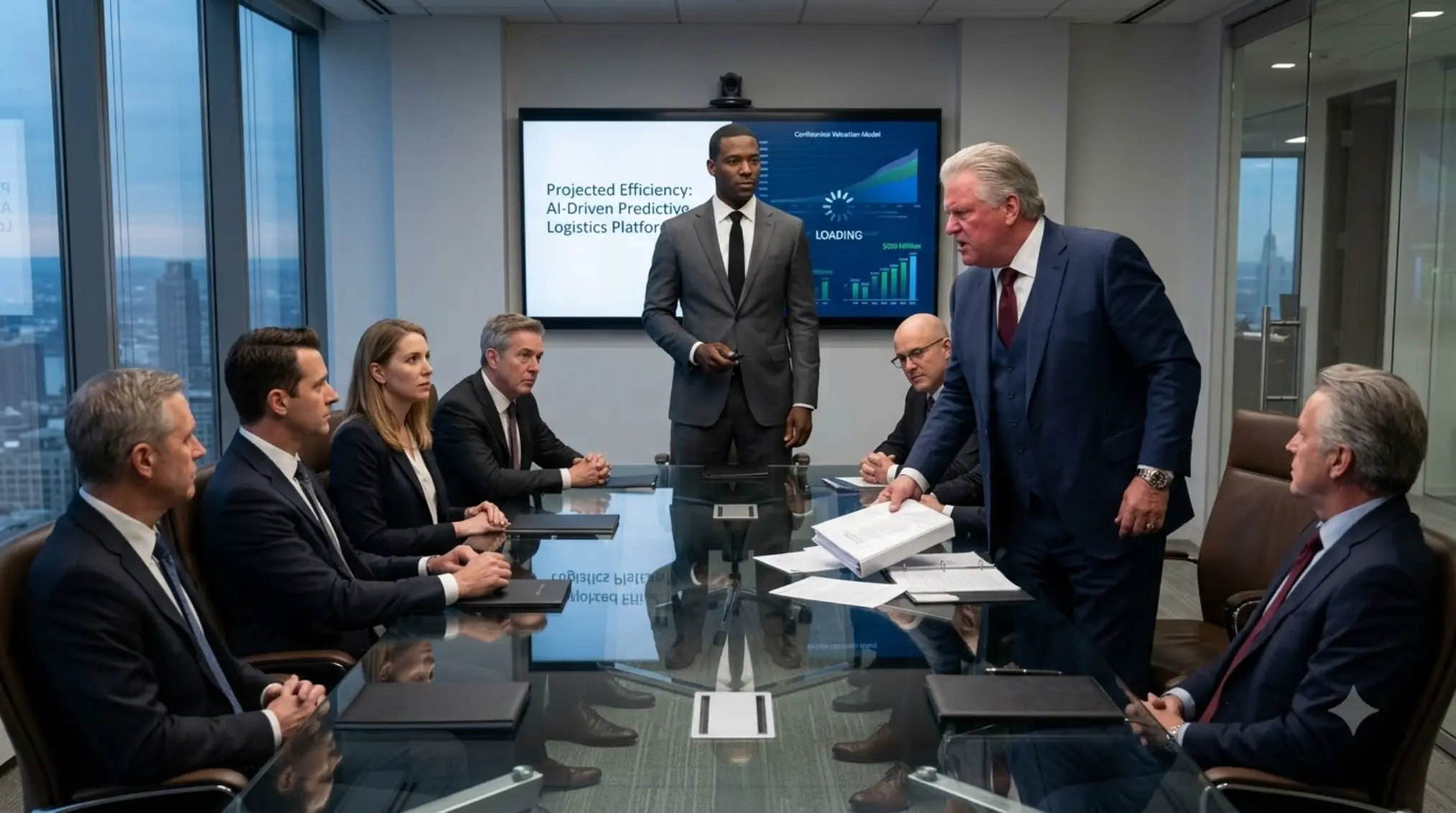
Eight executives sat around a twenty-foot glass conference table on the forty-eighth floor of Vance Global Technologies in Manhattan. Behind them, the city stretched through floor-to-ceiling windows beneath a gray morning sky. Financial reports, leather notebooks, tablets, and untouched glasses of water were arranged in front of men who had spent most of their careers learning how to look calm while judging one another.
At the far end of the room stood Malcolm Reed.
Thirty-nine years old.
Six feet two.
Athletic without looking like he spent his life in a gym.
Deep-brown skin.
Close-cropped black hair.
Perfectly clean-shaven face.
Charcoal suit.
White shirt.
Black tie.
No expensive watch.
No visible cuff links.
No assistant waiting outside.
No security escort.
Nothing that told Richard Vance that the man in front of him had personally built one of the fastest-growing enterprise software companies in America.
Malcolm simply held a small presentation remote in one hand.
Richard pointed toward him.
“I asked a question.”
No one answered.
One director looked down at the proposal Malcolm had submitted.
Another adjusted his glasses.
Malcolm remained still.
Richard pushed himself out of his leather chair.
At sixty-one, he was still physically imposing. He had thick silver hair swept back from his forehead, broad shoulders beneath an expensive navy suit, and the hard expression of a man who had spent thirty years discovering that money made most confrontations end quickly.
His company was worth nearly twelve billion dollars.
Richard had built it through acquisitions, aggressive contracts, and a personal philosophy he repeated so often that senior executives could quote it word for word.
Ideas are worthless until powerful people decide to use them.
Malcolm disagreed.
That was one reason he was standing there.
Richard snatched Malcolm’s printed proposal from the table.
“Predictive rerouting.”
He laughed.
“Inventory anticipation.”
Another page.
“Supplier-failure forecasting.”
He tossed the pages back down.
“You dressed up a bunch of obvious ideas with algorithms and decided we should rebuild our logistics operation around them?”
Malcolm answered calmly.
“I suggested a controlled pilot across three distribution regions.”
Richard looked toward the board.
“Did everyone hear that?”
A few executives shifted uncomfortably.
“A pilot.”
Richard turned back.
“Do you know what our logistics network costs?”
“Yes.”
Richard smirked.
“How much?”
“Approximately $3.8 billion annually across procurement, transportation, warehouse handling, emergency sourcing, and inventory carrying costs.”
The room became a little quieter.
Richard’s smile disappeared.
Malcolm continued.
“Your emergency freight costs rose twenty-one percent last year.”
A supply-chain executive looked up sharply.
“Your Midwest distribution group lost approximately forty-three million dollars from three shortages that internal forecasting failed to identify early enough.”
Now several executives were looking at Malcolm differently.
Richard was not.
He slapped both palms onto the glass table.
“You memorized our annual report.”
“Some of it.”
Richard leaned closer.
“That doesn’t make you qualified to redesign my company.”
Malcolm looked at the wall display behind him.
“It doesn’t.”
“Good.”
“What qualifies the proposal is the performance data.”
Richard laughed again.
“What performance data?”
Malcolm pressed the remote.
The screen changed.
A network diagram appeared across the wall.
Factories.
Ports.
Warehouses.
Distribution centers.
Supplier routes.
Thousands of connections represented by colored lines.
On the right side of the screen was a small set of metrics.
Richard barely glanced at them.
Malcolm began.
“Six months ago, a private manufacturing group gave my team access to a limited portion of its logistics network.”
Richard interrupted.
“Your team?”
“Yes.”
“What company?”
“Confidential.”
Richard rolled his eyes.
“Convenient.”
“We modeled supplier delays, transportation congestion, seasonal demand shifts, inventory movement, regional weather disruption, and historical purchase patterns.”
One director leaned forward.
Malcolm continued.
“The platform identified eighty-three percent of supply interruptions before the client’s existing systems.”
“How early?” someone asked.
Malcolm looked toward the speaker.
“Between nineteen hours and eleven days, depending on the disruption.”
The director’s eyebrows rose.
Richard waved a hand.
“Forecasting.”
“Not only forecasting.”
Malcolm changed slides.
A warehouse map appeared.
“The system does not simply identify a problem. It calculates the lowest-cost available response before the disruption reaches operations.”
He pointed toward three warehouse locations.
“For example, if a component shortage is expected in Ohio, traditional software alerts the purchasing department.”
Richard crossed his arms.
Malcolm continued.
“Our platform checks whether that component is already overstocked elsewhere.”
Another warehouse lit green.
“It then considers shipping time, labor availability, transportation contracts, downstream demand, production schedules, customer penalties, and alternative suppliers.”
A route appeared on the screen.
“It can recommend moving existing inventory before anyone pays for emergency procurement.”
One of the board members asked, “Automatically?”
“Recommendation first. Automated execution only after approval.”
Richard scoffed.
“So you built software that tells people to move boxes.”
Malcolm looked at him.
“I built software that knows which boxes matter before your executives do.”
The room went silent.
Richard’s face hardened.
Malcolm had learned early in life that some men did not become calmer when challenged with facts.
They became more dangerous.
Richard Vance was one of those men.
He walked around the table.
“You know what I think?”
Malcolm waited.
“I think some consultant convinced you that throwing around words like predictive and machine learning makes ordinary logistics sound revolutionary.”
Malcolm said nothing.
Richard pointed toward the door.
“And I think somebody in this building embarrassed me by giving you access to this boardroom.”
A senior vice president cleared his throat.
“Richard, Malcolm was invited by—”
Richard raised one hand.
“I don’t care.”
He turned back toward Malcolm.
“Take your stupid idea and sell it to some desperate startup.”
Malcolm’s expression remained controlled.
Richard stepped closer.
“You understand?”
“Yes.”
“Then why are you still standing there?”
Malcolm looked at him for another second.
Then he placed the remote on the table.
“My presentation was scheduled for thirty minutes.”
Richard laughed.
“You got twelve.”
“That should be enough.”
“For what?”
“For me to understand how you make decisions.”
Several executives looked at one another.
Richard’s jaw tightened.
“You came here to evaluate me?”
Malcolm picked up his notebook.
“In part.”
Richard stared at him.
Then he laughed so loudly that two assistants outside the glass wall looked toward the room.
“You?”
He pointed at Malcolm’s plain charcoal suit.
“You’re evaluating me?”
Malcolm did not answer.
Richard slapped the proposal.
“You want some advice?”
“No.”
That irritated Richard even more.
“You should take it anyway.”
He leaned across the table.
“In rooms like this, nobody cares how clever you think you are.”
Malcolm met his eyes.
Richard continued.
“Money gets ideas heard.”
Malcolm looked around the boardroom.
Then back at him.
“That explains why nobody told you the truth about your logistics operation.”
No one moved.
Richard’s face reddened.
One board member quietly closed his notebook.
Another looked toward the floor.
Richard pointed toward the door again.
“Get out.”
Malcolm picked up his remote.
Richard slammed his fist against the table.
“I said get out before I call security.”
Malcolm slipped the remote into his pocket.
“Call them.”
Richard stared.
Malcolm continued.
“Then explain why the company buying your technology already belongs to me.”
The silence that followed was different.
Richard blinked once.
“What?”
Malcolm adjusted his jacket.
“Thank you for your time.”
Then he left.
No explanation.
No reveal.
No dramatic announcement.
He simply walked through the glass door and disappeared into the executive hallway.
Richard stood frozen.
One board member finally spoke.
“What did he mean?”
Richard looked at him.
“I have no idea.”
But three floors below, Malcolm stepped into an elevator and pulled out his phone.
There was one missed call.
His daughter.
He smiled before calling back.
Eight-year-old Lily Reed answered immediately.
“Daddy?”
“Hey, bug.”
“Did the meeting go good?”
Malcolm leaned against the elevator wall.
“That depends.”
“Did they like your idea?”
He looked toward the descending floor numbers.
“No.”
A pause.
“Are they dumb?”
Malcolm laughed.
“Lily.”
“What?”
“You can’t call people dumb because they disagree with you.”
“What if they are?”
Malcolm laughed harder.
The elevator doors opened.
He walked into the lobby.
“I’ll pick you up after school.”
“Promise?”
“Promise.”
“Pizza?”
“Vegetables.”
“Pizza has tomato.”
“That argument stopped working when you were six.”
“It might work again.”
Malcolm smiled.
“I love you.”
“Love you too.”
The call ended.
That was Malcolm Reed’s real life.
Not Wall Street.
Not boardrooms.
Not magazine profiles.
At 3:15 every weekday he could manage, he stood outside a private elementary school in Brooklyn waiting for a little girl with two braids, an oversized backpack, and enough questions to exhaust an entire university.
Lily’s mother, Danielle, had died from complications following a sudden illness when Lily was four.
Malcolm had been thirty-five.
Reed Dynamics was barely three years old.
He had investors calling every day.
Employees depending on him.
Contracts under negotiation.