“Get out—the catering entrance is for people who actually belong here.”
Harrison Blackwood’s finger stopped inches from Dorothy Washington’s face beneath the largest chandelier in the Four Seasons Grand Ballroom. Two hundred donors, executives, physicians, investors, and society families were scattered around the Metropolitan Children’s Hospital annual gala, but conversations near the center of the room had already stopped. Dorothy stood perfectly still in a navy silk dress and matching satin jacket, a wide-brimmed navy hat framing her composed face while a pearl necklace rested neatly against her collar.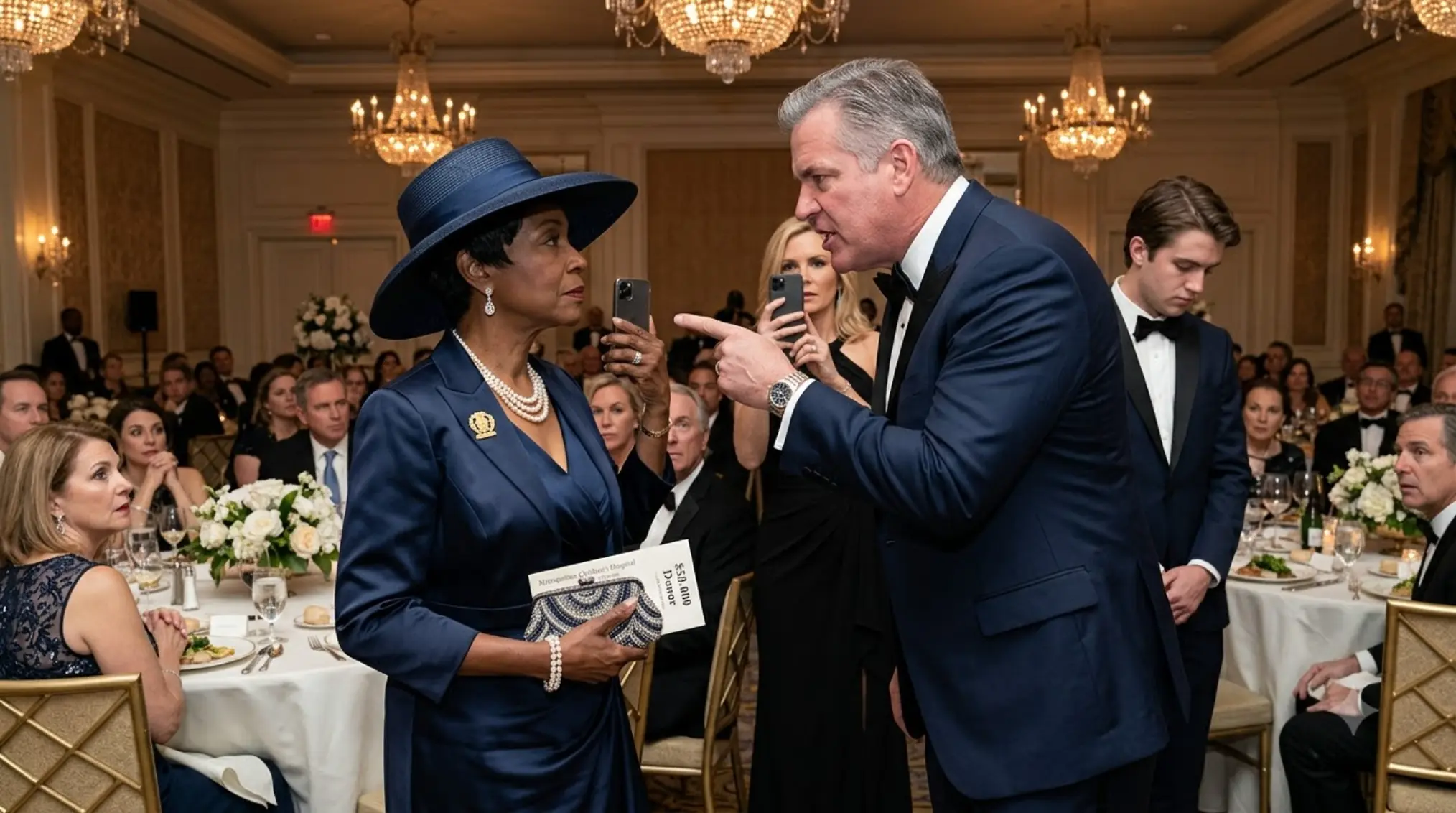
Harrison looked exactly like a man accustomed to having rooms move when he entered them. At fifty-five, he had built Blackwood Tech into one of the country’s most aggressive smart-building companies, and his midnight-blue tuxedo, immaculate shoes, and expensive watch seemed selected to remind anyone nearby that he was not simply wealthy but accustomed to influence. His wife Catherine stood several feet behind him in an elegant white gown, holding her phone at chest level while recording, and their nineteen-year-old son Preston watched with growing discomfort. What Harrison failed to notice was the small hospital board pin fixed to Dorothy’s jacket or the embossed donor invitation visible beside the edge of her beaded clutch.
Dorothy finally lifted the invitation between two fingers.
“You judged my face before checking the name funding this room.”
Harrison gave a humorless laugh, brushed his hand toward the invitation, and stepped closer. “I know every important donor here, and you are nobody.”
Dorothy’s eyes did not leave his. “Then tell my son that when he reviews your forty-seven-million-dollar contract tonight.”
The sentence was delivered so calmly that several guests did not immediately understand it. Harrison certainly did not, because his expression remained almost amused as he looked toward the nearby security post and motioned impatiently for someone to come over. Catherine zoomed in with her phone, apparently believing she was capturing another example of her husband protecting an exclusive charity function from an unwanted guest. Preston, however, looked at Dorothy’s board pin and felt the first quiet warning that something had gone badly wrong.
The evening had begun thirteen minutes before the hospital’s scheduled charity auction. A string quartet played near the arched windows, champagne moved around the ballroom on silver trays, and the tables glittered with crystal beneath warm chandelier light. Dorothy had arrived alone because her son, Jamal Washington, was finishing a downtown board meeting and intended to join her later. She had planned to spend the first part of the evening reviewing the pediatric oncology presentation and greeting several longtime foundation partners.
She never reached her table.
Harrison saw her near the crystal fountain and intercepted her before she had crossed half the ballroom. His first question had not been her name, her invitation, or whether she needed assistance. He simply looked at the older Black woman in the navy formal hat and said, “Excuse me, did you get lost? Catering uses the rear entrance.”
Dorothy had survived enough rooms like this to recognize the choice placed in front of her. She could become visibly angry and allow Harrison to tell everyone that her anger justified his suspicion, or she could remain calm long enough for his assumptions to expose themselves without her assistance. At sixty-eight, Dorothy no longer confused silence with surrender. She had learned that sometimes the strongest response was letting an arrogant person continue talking until the entire room could hear exactly what he believed.
“My name is Dorothy Washington,” she told him. “I’m a member of the hospital board.”
Harrison laughed.
“Board member? I golf with half that board every Thursday.”
Catherine leaned toward two nearby women and whispered loudly enough to be heard. “People will say anything once they get inside one of these events.”
That was when more phones began appearing.
Their seventeen-year-old daughter Madison had already started recording from farther back in the ballroom. She had arrived expecting a glamorous charity evening she could package for her social media audience, and a confrontation involving her family seemed far more interesting than speeches about hospital construction. She posted a short clip suggesting that a random woman had crashed the gala, and within minutes the video began circulating beyond her normal followers.
Not all the reactions were what Madison expected.
Some viewers laughed.
Others asked why nobody had checked Dorothy’s invitation.
Several pointed out that the woman being accused of sneaking inside appeared calmer and more appropriately dressed than most people surrounding her.
Madison ignored those comments and continued filming.
Hotel security supervisor Robert Kim arrived next. He had spent years managing high-profile events and knew the Blackwood family well enough to recognize the special notes attached to their reservations, donations, and private functions. Dorothy Washington’s name did not immediately register in his memory, and that imbalance of familiarity pushed him toward the wrong conclusion before he had verified anything. “Ma’am, perhaps we could step aside while we confirm your invitation.”
Dorothy turned toward him.
“Will Mr. Blackwood be stepping aside with us?”
Kim hesitated.
Harrison answered for him.
“I’m not the one who wandered into the wrong ballroom.”
A few guests laughed.
Dorothy looked around slowly, letting herself register their faces. Some looked entertained, some uncomfortable, some openly approving, and several appeared to know that the situation was wrong but had not decided whether speaking would cost them socially. Dorothy had seen that look many times during her life—the private recognition of unfairness competing with the public convenience of silence.
“I am exactly where my invitation tells me to be,” she said.
Event coordinator Angela Price hurried toward them with a tablet pressed against her chest. Twenty years of organizing expensive fundraisers had taught her to handle lost guests, intoxicated donors, seating disputes, security failures, celebrity demands, and last-minute disasters, but this confrontation carried a different kind of danger. Harrison Blackwood’s family donated roughly two million dollars a year across hospital programs, and unhappy major donors could make entire fundraising departments nervous. Angela instinctively opened the VIP database and searched Dorothy’s name.
Nothing appeared immediately.
That was because Dorothy’s registration was not filed beneath the ordinary guest system.
The Washington Family Foundation was listed through the hospital’s founding-benefactor office, an older donor structure maintained separately from the main gala database. Angela did not know that yet. What she saw was a screen where Blackwood appeared instantly and Washington did not, and in the pressure of the moment she mistook database design for evidence.
“Mrs. Washington,” Angela began carefully, “I’m sure we can sort this out.”
Dorothy gave a small nod.
“I’m sure you can.”
Harrison leaned closer to Angela.
“Sort out how she got past the door.”
Dorothy opened her clutch.
Inside rested a formal invitation documenting a fifty-thousand-dollar contribution tied to that evening’s program, her current hospital board credential, and several handwritten notes concerning the hospital expansion. She removed the identification card and handed it to Angela. The photograph matched, the board status was current, and the credential contained the security markings Angela had been trained to recognize.
Angela’s face tightened.
Harrison immediately dismissed it.
“Anyone can fake cards now.”
Dorothy looked at him.
“Do you usually accuse hospital board members of forgery before dinner?”
The question drew several quiet reactions from the crowd.
Harrison did not retreat.
“I know who belongs in these rooms.”
Dorothy’s expression changed slightly then.
Not anger.
Recognition.
There it was.
Not a concern about credentials.
Not a concern about security.
A declaration about belonging.
Across the ballroom, Dr. Maria Santos, the hospital’s chief executive officer, noticed the gathering crowd. She had been preparing for the auction’s opening remarks when an assistant informed her that a conflict involving Harrison Blackwood had become serious enough to attract security. Maria moved quickly between tables, apologizing to donors as she passed, then reached the center just as Harrison was insisting that the board card be verified again.
“Is everything all right?”
Harrison turned toward her as though reinforcements had arrived.
“Dr. Santos, thank God. This woman is claiming to be one of your board members.”
Maria looked at Dorothy.
Dorothy extended her hand.
“Dorothy Washington.”
Maria accepted it.
Something about the name caught in her mind.
“I don’t believe we’ve met personally.”
“No, but I’ve followed your work closely.”
Dorothy smiled politely.
“Especially the pediatric wing expansion.”
Maria’s expression changed.
The pediatric wing was not casual gala knowledge.
The new medical complex was the largest expansion Metropolitan Children’s Hospital had attempted in its history, and detailed discussions were restricted mostly to leadership, principal contractors, board members, and funding partners. Dorothy mentioned the project with the familiarity of someone who had read more than a brochure.
Harrison interrupted.
“That proves nothing. It’s been in the newspapers.”
Dorothy turned toward him.
“The oncology wing’s revised structural package hasn’t.”
Maria’s eyes widened.
Preston noticed.
His father did not.
The young man had been preparing to begin business studies and had spent the previous months reading far more about corporate ethics than his parents realized. He knew enough to understand that confident authority could become dangerous when it stopped checking itself against evidence. Standing behind his father, Preston could see three separate things Harrison refused to see: Dorothy’s valid credential, Dr. Santos’s growing recognition, and the way Harrison’s original certainty now depended entirely on denying every new fact.
“Dad,” Preston said quietly.
Harrison did not turn.
“Not now.”
“I think we should stop.”
That finally got his attention.
Harrison looked at his son.
“Excuse me?”
Preston swallowed.
“She has a board card.”
“Which may not be legitimate.”
“Dr. Santos seems to recognize the project details.”
“She recognizes gossip.”
Dorothy watched the exchange without interfering.
Preston’s face reddened.
He fell silent again.
Later, that silence would bother him more than anything he had said.
The auction clock showed eight minutes remaining.
Dorothy’s phone buzzed.
She glanced down.
Mom, finishing board meeting. See you soon. — Jay
Her expression softened immediately.
Looking forward to it, sweetheart. Interesting evening so far.
She slipped the phone back into her hand.
Harrison saw the movement and smirked.
“Calling someone to rescue you?”
“No.”
Dorothy looked at him.
“My son is coming.”
Harrison spread his hands theatrically toward the crowd.
“Wonderful. Maybe he can explain how his mother entered a donor gala without being properly registered.”
Dorothy’s smile disappeared.
“He probably can.”
Around them, Madison’s video was spreading fast. The comments had shifted sharply because viewers outside the ballroom lacked the social pressure influencing the people inside it. Strangers were asking why a credentialed older woman was being treated as guilty after showing identification, why the billionaire donor had appointed himself gatekeeper, and why security had still not contacted the board office.
Society photographer James Brooks quietly focused his camera on Dorothy’s jacket.
The engraving on the pin became visible through his lens.
FOUNDING BENEFACTOR — WASHINGTON FAMILY FOUNDATION
James lowered the camera.
He remembered the name.
Washington.
He had photographed the groundbreaking announcement six months earlier.
Dr. Maria Santos stood beside Jamal Washington on the stage.
Washington Enterprises.
James looked from the pin to Dorothy.
Then toward Harrison.
“Oh no,” he whispered.
Reporter Michelle Torres, standing beside him, heard.
“What?”
James nodded subtly toward Dorothy.
“Look at the pin.”
Michelle read it.
Her expression changed.
“Harrison has no idea.”
“No.”
“Does she?”
James almost laughed.
“She knows exactly what she’s doing.”
At 8:57, Dorothy’s phone rang.
She looked at the screen.
Then lifted it calmly.
“Hello, Jamal.”
Harrison stopped moving.
The name hit him first as familiarity without context.
Then context arrived.
Jamal Washington.
Washington Enterprises.
The man whose company held the prime construction agreement for Metropolitan Children’s new medical complex.
The man Harrison had spent the previous six months trying to impress.
Dorothy placed the phone against her ear.
“Yes, sweetheart. It’s Mom.”
The ballroom became unnaturally quiet.
Catherine kept recording, but the confidence had disappeared from her face.
Dorothy continued.
“I’m at the hospital gala with the Blackwood family.”
Harrison’s mouth opened.
Nothing came out.
“They’re very passionate about event security.”
Preston closed his eyes.
Jamal’s voice came faintly through the phone.
“Is everything all right?”
Dorothy glanced at Harrison.
“The Blackwoods have some concerns about whether our family is appropriate for this kind of event.”
Harrison’s phone slipped from his hand.
It struck the marble floor.
The sound echoed through the silence.