The beautiful seven-year-old American girl stood in the center of the mansion’s woodworking room, clutching a worn stuffed rabbit against her white dress. Her large brown eyes remained fixed on her mother, and the small word she had just spoken seemed to hang in the air longer than any sound the enormous house had ever contained. The Billionaire Mother did not move at first. After seven years of watching specialists examine, test, and pressure her daughter, she was terrified that one sudden movement might make the voice disappear again.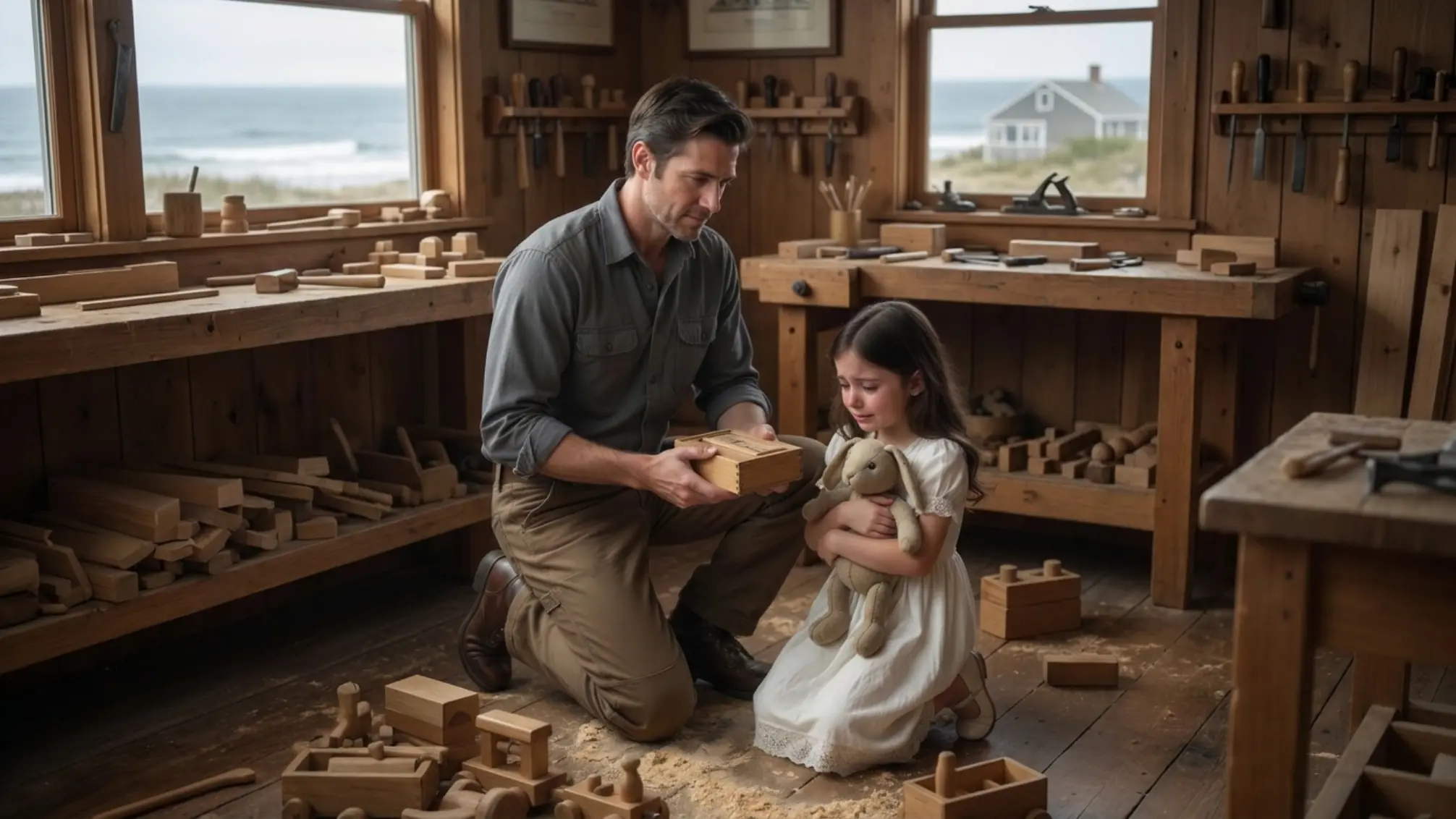
The handsome American Single Dad knelt a few feet away, holding the unfinished wooden box the girl had spent three afternoons building. Sawdust rested on his fitted gray work shirt, and a thin line of wood stain marked one of his strong hands. He did not smile too widely or rush to congratulate her. He had learned from his own son that a frightened child did not need an audience celebrating a breakthrough; she needed someone calm enough to prove that nothing dangerous would happen after she used her voice.
The Billionaire’s Daughter looked down at her rabbit. Her lips trembled as if another word was pressing against them, but fear still held it back. The Single Dad gently placed the wooden box on the floor and shifted away, giving her a clear path to her mother. The Billionaire Mother slowly lowered herself to her knees, no longer caring about the expensive cream dress touching the sawdust.
“You can take your time,” the Single Dad said.
The girl looked at him, then back at her mother. “You… left me.”
The Billionaire Mother’s face broke.
She had expected questions about the accident, the specialists, or the years of silence. She had never expected those three words. Her daughter’s father had died in a highway crash when the girl was two, and the Billionaire Mother had not been inside the car. Yet in the confused mind of a terrified child, her mother’s absence had become part of the trauma.
“I didn’t leave you,” the Billionaire Mother whispered. “But I understand why it felt that way.”
The girl’s grip tightened around the rabbit. “He didn’t come back.”
“No,” her mother said, tears rolling freely now. “Your father couldn’t come back. And I was so afraid of losing you too that I kept bringing strangers into your life and asking them to change you.”
The Single Dad lowered his eyes. This moment belonged to them. He had not come to the estate to make a child speak, and he did not want credit for the first words. He had come six weeks earlier to restore a damaged mahogany staircase, repair library shelves, and rebuild sections of molding ruined by a leaking roof.
The American coastal mansion overlooked Massachusetts Bay from a hill lined with old trees and stone walls. It was beautiful enough to appear in magazines, but the Single Dad had sensed its sadness before he ever met the child. Every hallway was polished, every flower arrangement perfect, and every room strangely quiet. Staff members spoke in low voices, as if the entire estate had been trained not to disturb a wound no one knew how to heal.
The Head Housekeeper had warned him about the Billionaire’s Daughter on his first morning. She explained that the child had not spoken since early childhood and rarely interacted with people outside a carefully controlled routine. The best specialists money could buy had visited the estate. Some had stayed for months, others only days, but none had heard a word.
“Do not ask her questions,” the Head Housekeeper said. “Do not mention her silence. And do not take it personally if she watches you.”
The Single Dad had nodded and returned to the damaged staircase.
Two hours later, he felt someone observing him. When he turned, the girl stood beneath the archway with her stuffed rabbit pressed against her chest. She was a beautiful child with long glossy dark-brown hair, delicate features, and an expression far older than seven. Her eyes followed the movement of his sanding block with complete concentration.
He did not say hello.
Instead, he looked back at the staircase and spoke to the wood.
“This section looks smooth,” he said quietly, “but the damage runs beneath the surface. Sanding too hard would remove the good part with the damaged part, so we go slowly.”
The girl did not move.
“Wood tells you when it’s ready,” he continued. “You just have to stop trying to force it.”
She stayed in the doorway for nearly an hour.
The next morning, she returned before he arrived. A small chair had been placed near the wall, but she ignored it and sat on the carpet instead. The Single Dad worked without looking directly at her. He explained why certain pieces of mahogany required different pressure, how old wood could split if treated too aggressively, and why patience often repaired more than strength.
By the third day, the girl had moved several feet closer.
The Billionaire Mother called him into her office that evening. She was a striking American woman in her early forties with elegant blonde hair, clear blue eyes, and the controlled posture of someone accustomed to leading companies and commanding rooms. She had inherited part of her fortune but multiplied it through a national healthcare technology business. Her office contained awards, financial magazines, and photographs of her daughter at every age.
“My daughter has watched you work for three days,” she said. “She does not normally tolerate unfamiliar people.”
“I didn’t approach her.”
“I know. The security cameras confirm that.”
The Single Dad glanced toward the camera in the corner. “Then what are you asking me?”
“I want to know what you are doing differently.”
“I’m repairing your staircase.”
The Billionaire Mother’s jaw tightened. She was not used to answers that refused to become more complicated merely because she wanted them to. “My daughter has seen dozens of professionals. They all attempted to engage her.”
“That may be the difference.”
The Billionaire Mother studied him. “Explain.”
“They wanted something from her. A response, eye contact, a gesture, a word. I don’t.”
Her expression cooled. “You believe you understand my daughter after watching her for three days?”
“No. I believe she understands when someone is waiting for her to perform.”
The Billionaire Mother stood from behind her desk. “Be careful.”
The warning in her voice would have frightened most contractors. The Single Dad had spent years negotiating with customers who believed money purchased authority over human dignity. He remained calm.
“My son stopped speaking after his mother died,” he said. “Not for seven years, but long enough for people to start treating him like a problem instead of a grieving child.”
The Billionaire Mother’s anger faltered.
“What helped him?” she asked.
“Time. Safety. Building things with me. And knowing I loved him whether he spoke again or not.”
The Billionaire Mother looked toward a photograph of her daughter sitting beside her late father. “The specialists say consistency is essential.”
“Consistency can mean showing up. It doesn’t have to mean demanding the same result every day.”
She dismissed him without agreeing, but the next morning the girl was allowed to return to the staircase.
A week later, the Single Dad’s six-year-old son arrived after school because his babysitter had canceled. The boy was a handsome American child with bright blue eyes, neatly cut brown hair, and an easy smile that had slowly returned after his mother’s death. He carried a backpack containing an unfinished wooden horse made from scrap pine.
The Billionaire’s Daughter appeared almost immediately.
The boy noticed her, but he did not ask why she was silent. He removed the wooden horse from his bag, walked halfway across the room, and placed it on the floor between them.
“It still needs ears,” he said. “You can hold it if you want.”
Then he returned to his father.
The girl waited several minutes before moving. She crossed the room, picked up the horse, and examined every rough edge. When the boy began sanding a second piece of wood, she sat beside him, still holding both the horse and her rabbit.
For the first time, the Single Dad saw curiosity overpower caution in her face.
The children developed a routine. The boy came after school whenever the Single Dad worked late, and the girl waited near the staircase. He showed her small objects without demanding that she touch them. She watched him build wheels, smooth corners, and fit pieces together. When he made mistakes, he laughed instead of hiding them.
One afternoon, he rolled a wooden car toward her. It stopped near the edge of her white shoe.
She stared at it.
“You’re supposed to roll it back,” he said.
The Single Dad almost corrected him, worried the direct request might create pressure. Before he could speak, the girl sat on the floor and pushed the car toward the boy. It rolled too far and struck his knee.
He laughed. “You’re strong.”
The smallest smile appeared on her face.
The Billionaire Mother watched from the doorway. She covered her mouth with one hand, but she did not enter. The Single Dad noticed her and gave a subtle shake of his head. The moment was working because the girl did not feel observed. Her mother stayed outside.
Later that evening, she confronted him again.
“She smiled.”
“Yes.”
“She has not smiled at another child since her father died.”
“He wasn’t trying to make her smile.”
The Billionaire Mother looked through the open doorway at the wooden car. “What are you suggesting?”
“Stop measuring every moment. Let some moments belong to her.”
The advice offended her because it was simple. She had built a career solving complex problems through data, expert teams, and aggressive intervention. Yet nothing she purchased had produced what a child with a wooden car had achieved without effort.
A new Specialist arrived at the estate the following week. The Billionaire Mother had scheduled the appointment months earlier and felt obligated to continue. The Specialist was a polished American woman from an elite private center. She reviewed the girl’s records and immediately criticized the unstructured time spent around the Single Dad.
“Unqualified interactions can reinforce avoidance,” she said. “Your daughter must understand that silence will not control the environment.”
During the first session, the Specialist attempted to remove the stuffed rabbit. She described it as an unhealthy emotional dependency and insisted that the girl ask for it back using her voice. The Billionaire’s Daughter panicked. She scratched at the door, knocked over a chair, and retreated to her bedroom after the rabbit was finally returned.
The Billionaire Mother canceled the Single Dad’s access to the east wing the next morning.
He was told to finish the library shelves on the floor below and avoid all contact with the child. He did not argue. The mansion belonged to the Billionaire Mother, and the girl was her daughter.
Yet while he worked in the library, he spoke aloud as he always had.
“This shelf was forced into place years ago,” he said as he loosened a warped board. “That’s why it cracked. Someone thought pressure would solve the problem.”
Soft footsteps stopped in the hallway.
The Single Dad continued. “Sometimes you have to remove the pressure before you can see what still fits.”
The Billionaire’s Daughter appeared at the doorway, holding the rabbit. Her eyes were swollen from crying.
He did not call her closer. He placed a square of sandpaper and a small piece of pine near the entrance, then returned to the shelf. Ten minutes passed before he heard the quiet scrape of sandpaper against wood.
They worked without speaking for the rest of the afternoon.
The Billionaire Mother found them there.
Her first reaction was anger. She accused the Single Dad of deliberately ignoring her instructions, but the Head Housekeeper reminded her that the library was his assigned work area. The girl had chosen to enter.
The Single Dad stood between the mother and daughter, not as a challenge but to keep the child from feeling surrounded.
“You think I’m hurting her,” the Billionaire Mother said.
“I think you’re terrified.”
Her face tightened.
“You’re afraid silence means she’s gone somewhere you can’t reach,” he continued. “So every specialist promises a method, and you keep choosing methods because doing nothing feels like abandoning her.”
The Billionaire Mother’s eyes filled with tears. “Do you know what it is like to wonder whether your child will ever say she loves you?”
“Yes.”
The answer stopped her.
The Single Dad told her about the night his wife died. His son had been inside the car and survived with minor injuries, but afterward the boy stopped speaking. Therapists asked questions, relatives made promises, and teachers rewarded every sound. The more everyone wanted words, the deeper the child disappeared into silence.
“One night, I stopped asking,” the Single Dad said. “I sat beside him and built a wooden truck. The next evening, he sat beside me. It took months before he spoke, but we became father and son again before that happened.”
The Billionaire Mother sat on the library floor in her expensive dress. “I don’t know how to sit with silence.”
“Learn.”
She looked toward her daughter. “What if she never speaks?”
“Then love her without making speech the price of being understood.”
The Billionaire Mother canceled the Specialist’s remaining appointments that evening.
The following afternoon, she entered the woodworking room wearing simple trousers and a pale blouse. The Single Dad handed her sandpaper and showed her how to smooth a board. Her movements were stiff and impatient. She pressed too hard, leaving uneven marks.
“Lighter,” he said. “The wood will take what it needs.”
The Billionaire’s Daughter watched her mother fail, correct herself, and try again. This was different from watching experts arrive with prepared answers. Her mother had entered the room without control and allowed herself to look uncertain.
After several days, the girl moved closer.
The Single Dad introduced a small wooden box project. He laid out four sides, a base, a lid, and simple corner joints. His son began building one. The girl arranged her own pieces in the correct order without being asked.
When one corner refused to fit, frustration appeared on her face. She pushed harder, but the wood would not move. The Single Dad sat near her without touching the pieces.
“Turn the side slightly.”
She did.
The joint clicked into place.
Her eyes widened, and the Single Dad smiled. “You solved it.”
The Billionaire Mother sat across from them, sanding another piece. She did not clap or call anyone into the room. She simply continued working.
The boxes required three afternoons. On the final day, the Single Dad’s son asked what the girl planned to keep inside hers. She looked at the box, her rabbit, and then her mother.
Her mouth opened.
No sound came.
The Single Dad’s son shrugged gently. “You can tell me later.”
Relief moved across her face. The failed attempt had not disappointed him. Nothing had been taken away because words did not come.
The next Saturday, the four of them began building a bookshelf for the girl’s bedroom. The Single Dad refused payment for the day. He told the Billionaire Mother that if he and his son came, they would come as friends.
The Billionaire Mother accepted.
Throughout the summer, the projects grew larger. They built a child-sized workbench, small shelves, wooden animals, and finally a playhouse in the garden. The Billionaire’s Daughter began humming while she worked. She laughed once when her mother spilled paint on an expensive shoe.
Each sound arrived naturally and disappeared without being examined.
One afternoon, the Single Dad’s son asked why she did not use words.
The adults froze, but the boy’s tone contained no judgment. The girl opened her sketchbook and drew a car, broken glass, her father in the driver’s seat, and herself trapped behind thick black lines. She drew her mother outside the picture.
The Single Dad’s son studied the drawing. “You were scared.”
The girl nodded.
“My mom died in a car too,” he said. “I stopped talking because every word made it feel real.”
The girl stared at him.
“You don’t have to talk,” he continued. “But no one here is going to take anything away if you do.”
Her breathing became uneven. The Single Dad moved closer but did not touch her. The Billionaire Mother lowered herself beside the workbench.
The girl looked at the rabbit, the wooden box, the boy, and finally her mother.
“Mom,” she whispered.
The Billionaire Mother’s entire body trembled.
“I was scared,” the girl said.
The Single Dad spoke before the mother’s shock could fill the room with pressure. “She was never broken. She only needed to feel safe.”
The Billionaire Mother began crying. “I’ve waited seven years to hear your voice.”
Then she opened her arms.
“Come to me, sweetheart—tell me what you’ve been afraid to say.”
The girl crossed the room and fell against her mother’s chest.
Words arrived slowly. Some were incomplete. Some came between long stretches of silence. She said she remembered the sound of the crash, the rain against the broken window, and her father not answering her. She said every specialist’s office reminded her of strangers asking questions after the accident.
She admitted that when her mother left the room during difficult sessions, she believed her mother was leaving her the way her father had.
The Billionaire Mother held her tighter. “I thought leaving gave the specialists room to help.”
“I wanted you.”
“I know now.”
The girl pulled back and touched her mother’s face. “Not broken?”
“Never,” her mother said. “Not for one second.”
The girl still had quiet days after that. Her voice did not suddenly become effortless, and the Single Dad warned everyone not to treat speaking as a performance. Some mornings she used sentences. On other days she communicated through drawings, gestures, or silence.
Her mother learned to listen to all of them.
The prestigious center that had recommended coercive treatment attempted to blame the family for ending the program. The Billionaire Mother reviewed session recordings and discovered that several children had been subjected to forced separation from comfort objects, isolation, and reward systems that treated speech as obedience.
She withdrew her company’s funding.
Instead, she converted the mansion’s east wing into a free creative workshop for American children processing grief and trauma. The Single Dad helped design worktables, quiet corners, art spaces, and rooms where children could build without being questioned. Licensed professionals were invited, but every specialist had to agree that communication could take many forms.
The Billionaire’s Daughter chose the first words painted above the entrance:
YOU DO NOT HAVE TO SPEAK TO BE HEARD.
The Single Dad continued restoring homes and caring for his son. He accepted a paid role overseeing the workshop two Saturdays each month, but he refused to let the program interfere with his son’s childhood. The Billionaire Mother respected that boundary because he had taught her that presence mattered more than impressive promises.
A year after the first word, the Billionaire’s Daughter stood inside the completed playhouse with her mother, the Single Dad, and his son. Her wooden box rested on a shelf beside the repaired stuffed rabbit.
“What did you finally put inside it?” the boy asked.
She opened the lid.
Inside were four small objects: a photograph of her father, a piece of sandpaper, the first wooden car they had rolled across the floor, and a note written in careful handwriting.
The Single Dad unfolded it.
“You didn’t make me talk,” he read. “You made it safe for me to want to.”
The Billionaire Mother placed one hand over her mouth. The Single Dad looked toward the beautiful girl who had once stood silently in a doorway watching him repair damaged wood.
He handed the note back to her.
“You built this,” he said.
She shook her head. “We built it.”
Outside, children and parents entered the new workshop without cameras, interviews, or promises of miraculous results. Some children spoke constantly. Some communicated through signs or drawings. Others sat quietly beside a block of wood until they felt ready to touch it.
No one asked them to become different before they were welcomed.
The Billionaire Mother watched her daughter help a quiet child choose a piece of sandpaper. She no longer measured progress by the number of words spoken in a day. She measured it by whether her daughter felt safe enough to laugh, build, rest, speak, or remain silent without fear.
The Single Dad had entered the mansion to restore a staircase.
Instead, he showed a powerful mother that healing did not begin when a frightened child finally spoke.
It began when everyone else finally learned to listen.