“Everyone, lock everything. There is a burglar inside my house.”
Katherine Whitmore’s gaze fixed on Frederick Grant, a man wearing a gray janitor’s uniform.
“Do not move. Put your hands up immediately.”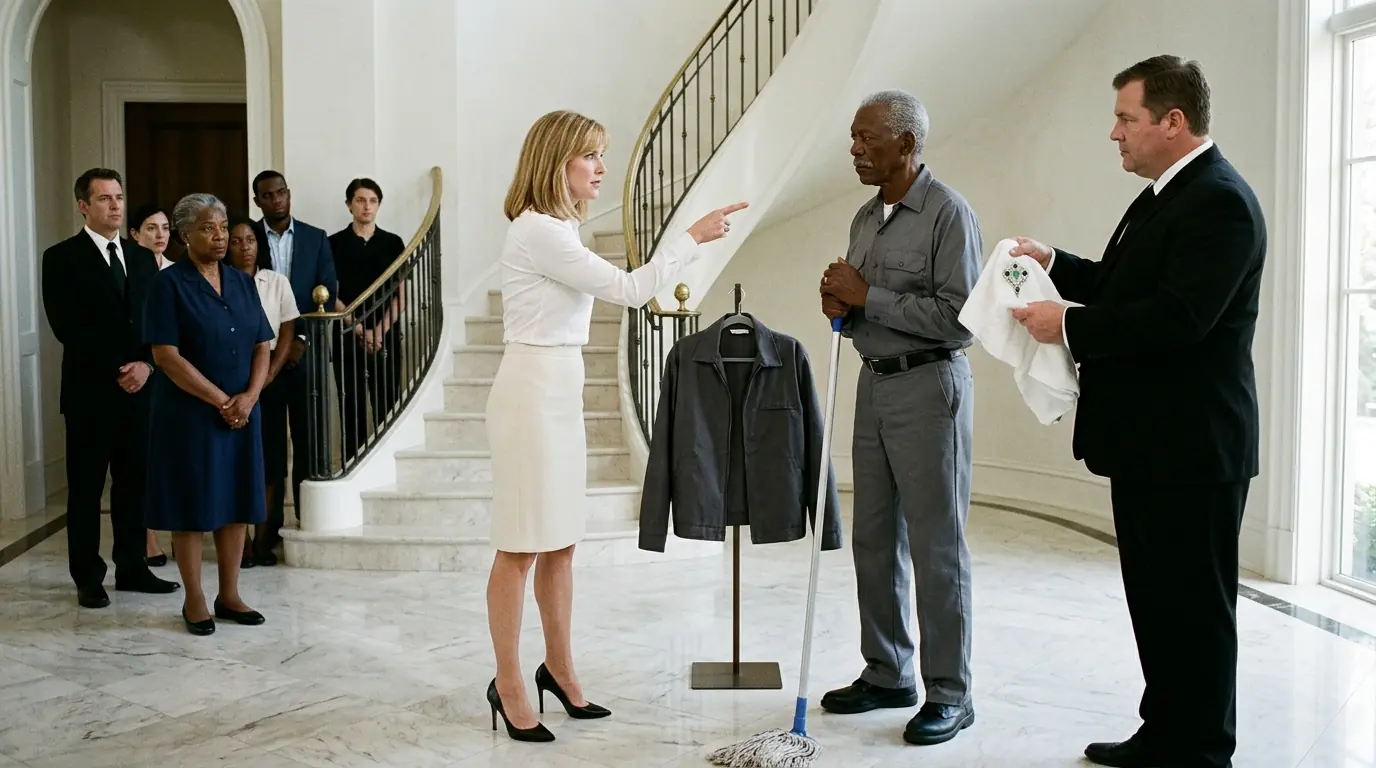
She descended the staircase, each strike of her high heels against the marble sounding like a gunshot.
“I know what kind of man you are,” she said. “A stray dog staring at my diamonds.”
“Madam, I am here to work,” Frederick replied.
“Be quiet. You are a thief. Search him before he leaves. People like him will steal anything they can touch.”
Frederick said nothing.
He remained silent and composed while Katherine treated him like a criminal and humiliated him before the entire household staff.
Then she went even further.
She set a trap for him.
That was her mistake.
What Frederick eventually pulled from his coat did more than prove his innocence. It began the destruction of Katherine Whitmore’s entire world.
To understand how it happened, it was necessary to return to the beginning.
Frederick Grant woke every morning at 4:45 without an alarm.
His body simply knew the time.
The house he shared with his wife was small, clean, and modest. It was a two-bedroom home in a quiet neighborhood outside Richmond, Virginia, the kind of place where the porch light remained on at night and the lawn was mowed every Sunday.
The hallway told a story to anyone who looked carefully.
There were old photographs of a younger Frederick in a dark suit, shaking hands with officials inside government buildings. Another photograph showed him standing with twelve people wearing matching jackets.
A framed letter bearing an official seal was partially hidden behind the coat rack.
None of those objects announced anything.
Together, they whispered that Frederick Grant had lived another life before he began cleaning floors.
His wife, Denise, stood in the kitchen pouring coffee into a steel thermos.
“You could be teaching at Quantico,” she said. “Instead, you are mopping floors for people who do not even know your name.”
Frederick smiled.
“That is the point, D. Nobody knowing my name is the first real vacation I have had in thirty years.”
He kissed her forehead and stepped outside.
The morning air smelled of damp grass and engine oil. Frederick’s old pickup truck groaned when he opened the driver’s door, and a talk-radio host murmured through the speakers as he started the engine.
He drove for twenty-six minutes along nearly empty roads until the Whitmore estate appeared above the James River.
The property contained fourteen thousand square feet of stone, glass, polished wood, and wealth.
Frederick parked in the staff lot, choosing the space farthest from the entrance. He carried his own cleaning supplies inside and began another shift of mopping, scrubbing, dusting, and polishing.
He had worked at the estate for eight months.
The labor was simple.
It was quiet and largely invisible.
Frederick, however, was not a simple man.
He noticed details other people missed.
A security camera with a blinking red indicator was active.
Another camera with no visible light appeared disconnected.
A vase had been moved half an inch from its usual position. A fresh mark ran along a baseboard that had been clean the previous evening.
Frederick’s eyes moved as though he were cataloging evidence.
For twenty-two years, that was precisely what he had been trained to do.
Harrison Whitmore owned the estate.
He was a billionaire real estate developer who traveled constantly and controlled nearly every dollar connected to the family.
Katherine controlled the house.
She operated it like a kingdom built on fear.
She inspected rooms while wearing white gloves. She timed how long housekeepers took to fold sheets, measured the alignment of table settings, and fired employees with the casual speed other people used to change clothes.
During three years, nine members of staff had been dismissed.
Six were people of color.
The explanations were always vague.
Poor attitude.
Carelessness.
Missing household property.
The accusations were never specific enough to examine and rarely supported by evidence.
Every terminated employee received the same visit from the family attorney, Gerald Ashford.
He arrived with a check and a nondisclosure agreement.
Sign the document.
Accept the money.
Disappear.
No one challenged the arrangement.
Most could not afford to.
The head housekeeper, Alma Johnson, had survived fifteen years by keeping her head down and her opinions private.
She was sixty-three, with white hair and an exhaustion no amount of sleep could cure.
Alma also kept a secret.
Inside her locker, hidden behind a stack of folded aprons, was a notebook worn soft at the edges.
It contained fifteen years of entries.
Dates.
Names.
Exact quotations.
Every humiliation Alma witnessed.
Every questionable dismissal.
Every occasion on which a person of color was treated as though they did not belong in the house where they worked.
Alma had never shown the notebook to anyone.
She had never thrown it away either.
On Frederick’s first day, Alma pulled him aside.
“Keep your head down around Mrs. Whitmore,” she warned. “Do not make eye contact when she is in one of her moods.”
Her voice became quieter.
“And whatever you do, never be the last employee inside the house when something goes wrong.”
Frederick nodded.
Something in his eyes told Alma that he was not the kind of man who would keep his head lowered forever.
The diamond and emerald brooch would become important.
Katherine owned the family heirloom, which had belonged to Harrison’s mother and was valued at approximately two hundred fifty thousand dollars.
She wore it to galas, charity dinners, and formal receptions.
Between events, she left it wherever she pleased.
Sometimes it rested on the vanity in her bedroom. On other days, it sat on a bathroom counter or beside a fruit bowl on the kitchen island.
It was rarely locked away.
Two weeks before everything collapsed, she addressed the employees during a staff meeting.
“I want improved locks installed throughout the east wing,” she said. “I do not trust the night staff.”
She looked directly at Frederick while speaking.
Alma noticed.
That evening, she opened the notebook and recorded the exact words.
The brooch and the cameras Frederick noticed during his first week would soon become the two most important pieces of evidence in the case.
Everything began with a telephone call.
On the night before the accusation, Katherine was alone in her bedroom.
Harrison was in London.
The house was quiet except for the low hum of the air-conditioning system and the distant movement of Frederick’s mop along the east-wing corridor two floors below.
At 10:41 p.m., Harrison called.
Katherine answered on the second ring.
What followed was not a conversation.
It was a detonation.
Harrison told her he was reconsidering the financial terms of their marriage.
He intended to reduce her monthly allowance from two hundred thousand dollars to fifty thousand.
He called it restructuring.
Katherine heard the word cage.
She shouted.
She pleaded.
She threatened to contact his attorneys, business partners, and members of the press.
Harrison listened without responding for ten seconds.
Then he said, “Good night, Katherine.”
The call ended.
Katherine sat on the edge of the bed with her hands trembling.
Her breathing came in short, shallow bursts.
The silk sheets felt cold beneath her fingers.
Her reflection stared back from the vanity mirror.
Mascara was smudged beneath her eyes, and her jaw was locked.
Beside the mirror, the diamond and emerald brooch rested in its open velvet case.
It glittered beneath the bedroom lights like a silent witness.
That was when the idea came to her.
Katherine could not overpower Harrison.
He controlled the money, the attorneys, and nearly every meaningful source of influence inside their marriage.
She could, however, direct her anger toward someone with less power.
Someone she believed could not fight back.
Someone she assumed the authorities would not believe, regardless of how loudly he told the truth.
Frederick Grant.
Katherine picked up her telephone and sent a message to Holloway, the estate’s security supervisor.
“Make sure the east-wing cameras remain off. We discussed this.”
Holloway replied fourteen seconds later.
“Done.”
Neither of them knew that Sentinel Guard Systems, the external company managing the estate’s security network, had conducted a routine firmware update three weeks earlier.
The update automatically reactivated every camera in the east wing.
Every hallway.
Every angle.
Every lens.
The recordings were transferred to an external server Katherine could not access.
One camera pointed directly at the supply closet door.
At 11:12 p.m., Katherine left her bedroom.
She wore a silk robe and carried the brooch wrapped inside a white hand towel taken from the upstairs guest bathroom.
She descended the rear staircase barefoot.
Her steps made no sound against the cold marble.
At 11:14 p.m., she entered the supply closet on the ground floor.
Frederick’s spare work jacket hung on a hook near the door.
His name was stitched above the chest pocket.
Katherine placed the wrapped brooch inside the right pocket.
She moved slowly and deliberately, then adjusted the pocket flap so nothing was visible from outside.
She studied the jacket once more before turning away.
At 11:18 p.m., Katherine returned to her bedroom.
She poured herself a glass of red wine, sat on the edge of the bed, and smiled.
It was a slow, satisfied smile.
The trap was ready.
Frederick had completed his shift long before Katherine left her bedroom.
The electronic log recorded him leaving the estate at 10:05 p.m.
He reached home at 10:40, thirty-four minutes before Katherine touched his jacket.
He was asleep beside Denise when the brooch was planted.
Frederick had no idea what would be waiting for him in the morning.
At seven o’clock, twelve staff members assembled in the foyer for the daily briefing.
Housekeepers, cooks, groundskeepers, maintenance employees, and security staff stood in pressed uniforms beneath the large chandelier.
Frederick waited near the rear with his mop in one hand.
Katherine appeared at the top of the staircase.
Her hair was perfect.
Her makeup was flawless.
A white blouse was buttoned tightly to the collar.
Her expression was sharp, controlled, and ready to strike.
“My brooch is missing.”
The room became still.
“The diamond and emerald brooch valued at two hundred fifty thousand dollars was on my vanity last night. It is not there this morning.”
Katherine allowed the silence to stretch.
Five seconds.
Then ten.
Long enough for everyone to feel the weight of what was coming.
She raised one hand and pointed directly at Frederick.
“The only employee with unsupervised access to the east wing last night was him.”
Every face turned toward Frederick.
He placed the mop gently against the wall.
“Ma’am, I completed the east wing at 9:48 last night. I left the property at 10:05. The entry records will confirm that.”
“I did not ask for your story.”
Katherine’s voice was cold.
She looked toward Holloway.
“Search his locker, jacket, bag, and everything else he owns.”
Holloway moved immediately.
Too immediately.
His actions looked rehearsed, as though he already knew every step of the performance.
He opened Frederick’s locker.
Nothing.
He searched the duffel bag.
Nothing.
Then he reached for the spare jacket hanging beside the supply-room entrance.
Holloway placed one hand inside the right pocket and removed a small object wrapped in a white towel.
He opened the cloth slowly and held the item high enough for everyone to see.
The brooch caught the fluorescent light.
Diamonds and emeralds glittered against the white fabric like small green and colorless flames.
The foyer became completely silent.
Twelve people stared.
No one moved.
No one seemed to breathe.
Katherine’s expression changed.
The theatrical anger disappeared.
Triumph replaced it.
Cold.
Polished.
Rehearsed.
It was the face of a woman watching her plan land exactly where she intended.
“There it is,” she said. “Inside his jacket, in front of every one of you.”
She paused.
“I told you what kind of man he was.”
Frederick studied the brooch.
His eyes narrowed, not from fear or panic, but recognition.
Twenty-two years of investigating planted evidence had taught him exactly what he was seeing.
The towel came from an upstairs bathroom, not the supply area.
His spare jacket hung in an open section accessible to anyone after hours.
Most importantly, Frederick knew with the certainty of a man who had built federal cases from smaller details that he had never touched the brooch.
“I did not take that,” he said calmly. “Someone placed it in my pocket.”
Katherine moved closer.
Her perfume filled the space between them, heavy and sweet.
“Of course you would say that. Every thief has an excuse.”
The word thief struck the room like a hammer against glass.
Alma stood near the hallway entrance.
She closed her eyes, and her fingers moved into the apron pocket where she usually carried a pen for the notebook.
Katherine turned toward Holloway.
“Call the police.”
She did not wait for him to act.
Instead, Katherine removed her own telephone and called Gerald Ashford first.
“Gerald, the janitor stole my brooch. I want him arrested today.”
She paced near the foot of the staircase.
“Felony charges. A civil lawsuit. I want to make an example of him.”
Katherine ended the call.
Then she dialed 911.
Her voice transformed the moment an operator answered.
The cold authority disappeared.
It was replaced by a breathless, trembling whisper.
“Hello, I need help. There has been a theft inside my home.”
She looked at Frederick while speaking.
“A very valuable item was taken. The man who stole it is still here.”
Her performance became more intense.
“I do not feel safe. Please hurry.”
Frederick stood fifteen feet away.
He had not raised his voice, moved toward her, or made a single threatening gesture.
On the emergency recording, Katherine sounded like a woman fearing for her life.
Two officers arrived eighteen minutes later.
Officer Wade Tillman entered first.
He had wide shoulders, loud boots, and one hand resting on his duty belt as though he had already decided who was guilty.
Officer Scott Byers followed with a clipboard.
His eyes remained lowered.
Tillman examined the room.
First, he looked at the staff.
Then Katherine, who now wore a designer dress and held a tissue beneath the chandelier while tears glistened beneath her eyes.
Finally, he looked at Frederick.
“You are the janitor?”
“Yes, sir.”
“We received a report involving a major theft. A valuable brooch was discovered in your jacket.”
Tillman stepped forward.
His boots echoed across the marble.
“Do you want to explain how that happened?”
“Someone planted it,” Frederick answered. “I would like the estate’s security recordings reviewed before any conclusion is reached.”
Tillman did not pause.
He did not consider the request.
“Turn around and put your hands behind your back.”
“Officer, the cameras will show what happened.”
“I said turn around.”
Frederick moved slowly.
The cold metal handcuffs closed around his wrists.
The sound echoed through the foyer.
Sharp.
Final.
Like a sentence delivered before a trial.
Twelve employees watched.
Alma gripped the edge of a side table until her knuckles became white.
A young housekeeper near the kitchen covered her mouth with both hands.
Nobody stepped forward.
Nobody challenged Katherine.
Nobody said a word.
Katherine stood at the bottom of the staircase with her arms folded and chin raised.
She watched Frederick being led toward the entrance.
Not the employee exit.
Katherine insisted that the officers use the front door.
She wanted everyone outside to see.
The gardeners stopped working along the driveway.
A woman living across the road stepped onto her porch with a coffee mug in her hand.
She watched a man in handcuffs being guided into the rear seat of a police cruiser on a bright Tuesday morning.
The neighbor slowly shook her head.
It was not sympathy.
It looked more like confirmation, as though she had accepted the accusation before hearing a single piece of evidence.
Frederick sat upright in the rear of the patrol vehicle.
His hands remained restrained behind him.
The seat smelled of perspiration and disinfectant.
The metal partition was scratched and dented, marked by the hands of countless people who had occupied the same space.
Through the window, Frederick saw Katherine standing on the front steps.
Gerald Ashford had arrived in a Mercedes before the officers drove away.
Katherine spoke to him with a smile on her face.
The gardeners leaned against their tools while watching the cruiser descend the driveway.
A woman walking her dog slowed, stared, and removed her telephone from a pocket.
Tillman drove.
Byers remained in the passenger seat, looking at the clipboard.
Then Tillman began speaking.
“You know what bothers me?”
He did not look into the rearview mirror.
He spoke as though Frederick were an object secured behind the cage rather than a person.
“You give people like this a job. You allow them inside your home and your life.”
Tillman shook his head.
“Then this happens.”
Byers said nothing.
He shifted in his seat, and the pen in his hand stopped moving.
Frederick’s jaw tightened.
It was the first visible break in his composure.
Not because the remark surprised him.
He had heard worse language from more dangerous people during his career.
The difference was the badge.
Tillman was legally obligated to protect people equally.
He had decided Frederick was guilty before asking a meaningful question.
Frederick remained silent.
He closed his eyes and breathed.
At the station, the situation became worse.
Frederick was not taken to an ordinary interview room.
He was placed inside an interrogation room with bare walls, a concrete floor, and a metal table bolted to the ground.
A single fluorescent fixture buzzed overhead.
A one-way mirror covered the left wall.
Its dark surface reflected Frederick’s face back at him.
Tillman sat across from him.
No attorney was present.
No proper rights warning had been given.
Tillman attempted to frame the questioning as a voluntary conversation, a procedural trick Frederick recognized immediately.
He had spent years teaching investigators to identify and avoid precisely that kind of misconduct.
Tillman leaned back and crossed his arms.
“Let me make this easy for you.”
Frederick waited.
“I understand how it happens. You are inside that house every night, surrounded by things you could never afford.”
He gestured toward Frederick’s uniform.
“Jewelry worth more than every house on your street. That becomes tempting.”
Frederick’s expression did not change.
“Tell me what happened. Tell me where the rest of the property is.”
Tillman leaned forward.
“Maybe we reduce the charge. Maybe you walk out tonight. But you need to cooperate.”
Frederick spoke evenly.
“I am invoking my right to an attorney. I also request that the east-wing security footage be reviewed before charges are filed.”
Tillman gave a short, hard laugh.
“Security footage?”
He shook his head.
“The woman who owns the house said those cameras have been out of service for weeks. Maintenance problem.”
Tillman rested his arms on the table.
“There is no footage. It is your word against hers.”
His voice became quieter.
“Between you and me, that is not a fight you are going to win.”
Frederick looked at him.
A slight smile appeared at the corners of his mouth.
He knew something Tillman did not.
The east-wing cameras were not disabled.
Frederick had seen their red indicators blinking every night while cleaning the corridor.
For eight months, those cameras had been recording.
Whatever they captured was stored somewhere beyond Katherine’s control.
Frederick did not reveal that knowledge.
Not yet.
He folded his restrained hands on the metal table and waited.
Twenty-six minutes away, four officers arrived at Frederick and Denise Grant’s home.
Gerald Ashford had used the Whitmore family’s connections to obtain an emergency search warrant in less than two hours.
That speed was highly unusual.
Emergency warrants required specific evidence and careful judicial review.
The judge who authorized this warrant belonged to the same country club as Harrison Whitmore.
Four years earlier, the two men had invested together in a commercial real estate development.
Those connections would not become public until later.
Denise opened the front door wearing her housecoat.
Her eyes were swollen from crying since Frederick’s brief call from the station.
The officers did not wait for her to move fully aside.
The first one entering struck her shoulder and continued without apologizing.
What followed was forty minutes of destruction presented as official procedure.
Books were pulled from shelves and allowed to fall onto the hardwood floor.
Bindings cracked.
Pages bent.
Dresser drawers were emptied across the bed.
Underclothes, socks, reading glasses, and prescription medication were thrown into the same pile.
The officers opened the hall closet and located a box on the top shelf.
It belonged to Frederick.
Inside were twenty-two years of commendations, certificates, photographs, and a folded American flag from a ceremony at FBI headquarters.
One officer searched the box with a single hand.
He picked up Frederick’s FBI Distinguished Service Medal, presented personally by the director in 2014.
The officer glanced at it for less than a second.
Then he threw it back into the box like a bottle cap.
The medal struck the edge and fell onto the floor.
The officer did not look down.
He continued into the next room.
They inspected the toilet tank.
They lifted one corner of the living-room carpet.
Every kitchen cabinet was opened and left hanging like a row of broken jaws.
Outside, neighbors gathered.
First one.
Then three.
Then six.
They stood on porches and sidewalks while police carried boxes from the Grants’ home.
These were the same neighbors who waved each morning.
They borrowed Frederick’s lawn mower during the summer.
They brought Denise banana bread at Christmas.
Now they stood with folded arms and whispered.
Denise remained in the center of the destroyed living room.
Her hands trembled.
She looked at the books on the floor, the emptied drawers, and the open cabinet doors.
Then she saw the medal lying facedown on the hardwood.
The gold edge was scratched.
Denise knelt.
She picked it up with both hands and pressed it against her chest.
“Thirty-four years of marriage,” she whispered. “Not one blemish. Not one.”
The officers found nothing.
No stolen jewelry.
No missing household property.
Nothing suspicious in the entire home.
It did not matter.
Gerald Ashford pressured the district attorney’s office to file felony grand larceny charges.
His argument was direct.
The brooch had been discovered inside Frederick’s jacket.
Its value exceeded two hundred thousand dollars.
Frederick was formally charged.
He was fingerprinted and photographed from the front and side.
Under fluorescent lighting that made his skin look gray and his eyes appear hollow, he held a booking number in front of his chest.
Frederick posted fifteen thousand dollars in bail using his retirement savings.
He and Denise had been preserving that money for a trip they had planned for three years.
When Frederick left the station, Denise waited beside the pickup.
At first, she said nothing.
She wrapped both arms around him.
Then she pulled back and looked into his eyes.
“They stepped on your medal, Frederick.”
Her voice broke.
“They stepped on it and did not even look down.”
That night, Frederick sat alone at the kitchen table.
The house was dark.
Denise had gone to bed.
The rooms remained damaged from the search.
Books still covered the floor.
The drawers had not been replaced.
Cabinet doors remained open.
Neither Frederick nor Denise had the energy to clean.
The kitchen smelled of cold coffee and silence.
Frederick opened the lowest drawer of his desk.
Beneath old case files and a stack of yellowing legal pads was a worn leather case.
He placed it on the table and opened it slowly.
Inside rested a gold shield.
The FBI insignia was engraved on the reverse.
“SSA Frederick R. Grant.”
He held the badge beneath the kitchen light.
Frederick turned it over in his hands and moved one thumb across the letters of his name.
“I did not want to do this,” he whispered. “I was finished.”
The refrigerator hummed.
Frederick remained silent for several seconds.
“However, you did not leave me a choice, Mrs. Whitmore.”
He picked up the telephone and dialed from memory.
There was no search through a contact list.
Only ten digits Frederick had known for twenty years.
The call rang three times.
A deep, familiar voice answered.
“Frederick Grant. Twenty-two years, and you have never called me this late. What happened?”
“I need a favor, Nathan. I need it quickly.”
The line remained silent for a moment.
“Tell me everything.”
Frederick did.
What occurred during the following forty-eight hours turned Katherine Whitmore’s world to ash.
The man on the other end of the call was Nathan Coleman.
Twenty years earlier, Nathan had been a junior FBI agent, nervous and recently graduated from the academy.
Frederick trained him.
He guided Nathan through his first federal investigation and remained on the telephone with him at two in the morning when that case nearly broke him.
Nathan was now a senior official with the FBI’s Civil Rights Division in Washington, D.C.
He had become one of the most influential people in federal law enforcement.
Frederick told him everything.
Nathan was quiet for a long time.
“Let me make certain I understand,” he finally said. “A billionaire’s wife planted evidence on a retired supervisory special agent.”
He continued.
“She filed a false felony report. Police searched his home, booked him, and photographed him.”
Nathan’s voice hardened.
“The entire system accepted the accusation without verifying the evidence.”
“That is what I am telling you.”
“Give me twenty-four hours.”
Nathan needed fewer than twelve.
He first contacted Sentinel Guard Systems, the company responsible for the Whitmore estate’s camera infrastructure.
A federal subpoena was obtained for all recordings from the previous seventy-two hours.
Every camera.
Every angle.
Every timestamp.
The files arrived within six hours.
What they showed was devastating.
The east-wing cameras had been functioning.
They recorded the entire night.
Katherine had lied.
Holloway had lied.
At 11:12 p.m., Katherine was recorded leaving her bedroom in a silk robe with an object wrapped in a white hand towel.
At 11:14, she entered the supply closet.
The footage showed her opening the right pocket of Frederick’s spare jacket and placing the wrapped brooch inside.
At 11:18, she returned to her bedroom, poured a glass of wine, sat on the bed, and smiled.
Then investigators obtained the text messages from Holloway’s telephone records.
Katherine’s message at 10:58 p.m. read:
“Make sure those cameras remain off. We discussed this.”
Holloway responded one minute later.
“Done.”
Premeditation.
Coordination.
Knowledge of wrongdoing.
Every part of the plan existed in high-definition video and written communication.
Nathan called Frederick that evening.
“Brother, the camera captured everything clearly.”
He paused.
“It is worse for her than a false report. This appears to be a racially motivated frame-up connected to a documented pattern of prior conduct.”
Nathan continued.
“We are examining federal civil rights charges. Two agents from the Richmond field office are being assigned.”
He added one more detail.
“Detective Brenda Sullivan with the Richmond Police Department has already been informed.”
Frederick ended the call.
He remained at the kitchen table for a long time with the badge between both hands.
Then he stood and opened the bedroom closet.
Frederick removed a dark navy suit he had not worn for three years.
On the third morning, at 8:15, a SUV stopped outside the gates of the Whitmore estate.
Sunlight reflected against the windshield, preventing the security guard from seeing who was inside.
He called the house.
Katherine came to the front entrance wearing a silk robe.
Her hair was pulled back, and she held a cup of coffee.
She was not expecting visitors.
The doors of the SUV opened.
Frederick stepped out first.
He was not wearing his gray janitor’s uniform.
He wore a dark navy suit with a white shirt and no tie.
His posture was straight.
His shoulders were squared.
Clipped to his belt, reflecting the morning light like a small golden sun, was his retired FBI badge.
Detective Brenda Sullivan stepped out behind him.
Two agents from the FBI’s Richmond field office joined her.
All three wore dark suits and displayed their credentials.
Katherine froze in the doorway.
The coffee cup stopped halfway to her mouth.
She saw Frederick.
Confusion appeared first.
Then recognition.
Then anger.
“I have a restraining order pending against you,” she said. “Leave my property before I…”
Frederick stepped forward.
He removed the badge from his belt and held it where she could see it.
The gold shield caught the sunlight and reflected it across the porch.
His voice was quiet and controlled.
“Ma’am, my name is Supervisory Special Agent Frederick R. Grant, retired, Federal Bureau of Investigation, Civil Rights Division.”
Katherine’s lips separated.
No sound came out.
“I spent twenty-two years investigating people who committed precisely the kind of act you committed three nights ago.”
Frederick held her gaze.
“Before Detective Sullivan advises you of your rights, you should know that we obtained the security footage.”
Katherine’s fingers tightened around the cup.
“All of it,” Frederick continued. “Including the recording from 11:14 p.m. showing you enter the supply closet and place your brooch inside my jacket.”
The coffee cup slipped.
Katherine caught it with both hands, but coffee spilled over the rim and stained the front of her white robe.
She did not notice.
Every trace of color disappeared from her face.
Detective Sullivan stepped forward.
“Katherine Whitmore, you are under arrest for filing a false police report, obstruction of justice, tampering with evidence, and conspiracy to deprive an individual of civil rights under federal law.”
She began reading the required warning.
“You have the right to remain silent. Anything you say may be used against you in court.”
Katherine grabbed the doorframe.
Her knees weakened.
“I want my attorney. Call Gerald.”
Frederick remained on the porch with the same composure he had shown when she called him a thief in front of the staff.
This time, the handcuffs were not placed around his wrists.
As Sullivan moved Katherine toward the vehicle, Frederick spoke quietly enough for only her to hear.
“You chose the wrong janitor, Mrs. Whitmore.”
At the station, Katherine attempted several defenses.
First came the medical explanation.
“I was sleepwalking. I have a condition. I did not know what I was doing.”
Detective Sullivan obtained her medical records.
Katherine had no history of sleepwalking, no related diagnosis, and no relevant prescriptions.
The explanation failed.
Next came the memory defense.
“I was moving the brooch somewhere safe. I forgot where I placed it. This is a misunderstanding.”
Sullivan slid a printed copy of the text message across the table.
“Make sure those cameras remain off. We discussed this.”
She pointed to the timestamp.
“You did not send this message to your security supervisor because you forgot where you placed the brooch.”
That explanation also failed.
Then Katherine attempted to present herself as a frightened victim.
“Frederick threatened me. I was afraid. I did not know what else to do.”
Sullivan asked her to describe the threat.
Katherine stumbled through the answer.
She changed the story twice within forty seconds.
No previous complaint against Frederick existed.
Fourteen members of the estate staff gave statements describing him as respectful, quiet, and professional.
The victim defense failed.
Finally, Katherine used the argument she trusted most.
Power.
She sat upright, wiped her eyes, and spoke with renewed certainty.
“Do you have any idea who my husband is? Do you understand what this family has done for Richmond?”
Sullivan studied her.
“Ma’am, that statement makes the situation worse, not better.”
Katherine was fingerprinted and photographed.
She stood beneath the same fluorescent lights that had made Frederick’s face look gray two days earlier.
This time, the person holding a booking number wore a silk robe stained with coffee.
Katherine remained in custody overnight pending a bail hearing.
Her cell contained a concrete bench, a steel toilet, and a coarse blanket smelling of industrial detergent.
She had rarely been denied anything during her adult life.
One night inside that room struck her with the force of a freight train.
Holloway was arrested that evening.
Two FBI agents knocked on his apartment door at 9:15.
He answered in sweatpants and a T-shirt while holding a beer.
The bottle remained in his hand when the agents read him his rights.
Holloway lasted ninety minutes during questioning.
Then he confessed.
Katherine instructed him to tell the police that the east-wing cameras were not functioning.
She also told him to locate something incriminating among Frederick’s belongings, although Holloway claimed he did not know Katherine had already planted the brooch.
Then he revealed the information that expanded the case.
It was not the first time Holloway had helped Katherine manufacture accusations against employees.
He named two previous workers.
Terrence, a groundskeeper.
Estella, a Latina cook.
In both cases, allegedly stolen items were discovered among their possessions after Katherine gained access to the storage areas where those belongings were kept.
In each case, Gerald Ashford arrived within hours carrying a nondisclosure agreement and a check.
Investigators recorded every word of Holloway’s confession.
It became the foundation for an expanded federal investigation extending far beyond Frederick’s case.
The walls around the Whitmore estate began closing from every direction.
The following morning, Alma Johnson entered the Richmond police station carrying the worn notebook.
Fifteen years of entries filled its pages.
Dates.
Names.
Direct quotations.
Humiliations.
Wrongful dismissals.
Every occasion on which a person of color was treated like a suspect inside the workplace.
Alma placed the notebook on Brenda Sullivan’s desk.
“I should have brought this forward years ago,” she said. “I was afraid.”
She drew a breath.
“I am not afraid anymore.”
Investigators contacted three former employees during the following week.
Terrence.
Estella.
Dorothy, a housekeeper fired two years earlier after a silver tray was allegedly misplaced.
All three agreed to testify.
The nondisclosure agreements were challenged as contracts obtained under duress and used to advance fraud.
A judge invalidated every one of them.
The neighbors also learned the truth.
These were the same people who had stood on their porches while police removed boxes from the Grants’ home.
Several returned later with flowers and handwritten apologies.
An elderly white man who had silently watched the search knocked on Frederick’s door.
He stood on the porch holding his hat in both hands.
His eyes were wet.
“I watched the officers enter your house,” he said. “I did not say a thing.”
The man lowered his head.
“That belongs to me. I am sorry.”
Frederick studied him for a long moment.
Then he extended his hand.
“It is never too late to do what is right.”
What began as one woman’s false accusation became Virginia’s largest civil rights case of that year.
The FBI opened a full investigation into Katherine Whitmore’s treatment of employees.
Investigators reviewed every termination from the estate during the previous three years, focusing on the six employees of color removed under vague accusations.
Four were located.
Terrence described being accused of stealing silverware he had never handled.
Holloway searched him before two other employees.
Gerald Ashford arrived before the end of the day with a nondisclosure agreement and a check.
Terrence signed because he had a daughter in middle school and no money for an attorney.
Estella described an almost identical experience.
She was accused of removing kitchen supplies.
No meaningful investigation was conducted.
No reliable evidence was produced.
Ashford arrived with a check and a contract.
Estella signed the agreement while crying at her kitchen table.
Dorothy described something worse.
During a private confrontation inside the laundry room, Katherine directed a racial insult toward her.
Dorothy reported the incident to Holloway.
She was dismissed the following morning for alleged insubordination.
Gerald Ashford arrived before noon.
The pattern had become impossible to deny.
It was exposed.
Documented.
Federal.
Ashford’s conduct also attracted scrutiny.
He had not merely drafted nondisclosure agreements.
Investigators alleged that he actively suppressed complaints, intimidated financially vulnerable employees, and used the Whitmore family’s wealth to silence anyone who threatened to expose Katherine’s behavior.
The matter was referred to the Virginia State Bar.
Ashford’s law license was suspended pending a full emergency ethics investigation.
The judge who approved the search warrant for Frederick’s home was investigated as well.
The Virginia Judicial Conduct Commission examined why he authorized an extraordinary warrant in less than two hours.
Records confirmed that the judge and Harrison Whitmore belonged to the same country club.
They had also co-invested in a commercial property four years earlier.
The search warrant was ruled procedurally invalid.
The judge was removed from active duty pending further proceedings.
One by one, every institution supporting Katherine Whitmore’s power began collapsing.
Then the media arrived.
Carolyn Moore, an investigative reporter from Richmond’s largest television station, developed a three-part series that aired on consecutive evenings.
The first installment covered Frederick’s accusation, arrest, the planted brooch, and the recovered security footage.
Its central image became the defining visual of the scandal.
On one side was Frederick wearing his gray janitor’s uniform and holding a mop.
On the other was his official FBI commendation portrait.
Dark suit.
Gold badge.
American flag in the background.
The same man.
Two worlds.
The image spread rapidly online.
The second installment told the stories of Terrence, Estella, Dorothy, and two additional former employees who came forward after the first broadcast.
Their experiences followed the same pattern.
Accused without credible evidence.
Dismissed without a fair process.
Silenced because they lacked the financial means to resist.
The third installment exposed the system around Katherine.
The Whitmore fortune.
Ashford’s legal machinery.
The compromised judge.
Holloway’s cooperation.
Carolyn explained the structure of influence that allowed Katherine to damage people’s lives without facing consequences.
Katherine’s booking photograph was published nationally.
Cable news programs covered the case.
Legal commentators analyzed the footage and evidence across multiple platforms.
Civil rights organizations issued public statements.
The story remained one of the most discussed national topics for six consecutive days.
Harrison Whitmore acted quickly.
Through a new attorney, not Gerald Ashford, he released a public statement.
“I am deeply disturbed by the conduct attributed to my wife. I had no knowledge of these incidents and will cooperate fully with investigators.”
Within ten days, Harrison filed for divorce.
His official argument cited an irretrievable breakdown of the marriage.
The timing also distanced him from an estimated 4.2 million dollars in potential civil liability.
Katherine’s trial took place in federal court in Richmond.
Judge Eleanor Davis presided.
The courtroom was filled beyond capacity.
Carolyn Moore sat in the press gallery.
Frederick and Denise occupied the front row, seated side by side with their hands folded.
The charges included filing a false report, obstruction of justice, tampering with evidence, and conspiracy to violate civil rights under federal law.
Frederick was called to testify.
He spoke as he had conducted himself throughout the entire case.
Calmly.
Clearly.
Without raising his voice.
Every sentence carried weight.
He described Katherine’s public accusation.
“She called me a thief in front of twelve people with whom I worked every day.”
He described the handcuffs.
“I spent twenty-two years placing restraints on individuals accused of serious crimes.”
Frederick paused.
“I never imagined feeling them close around my own wrists for something I did not do.”
Then he described the search of his home.
“My wife stood inside our living room while strangers emptied our life onto the floor.”
His voice remained steady.
“One officer picked up my Distinguished Service Medal. The director of the FBI presented it to me personally.”
Frederick looked toward the jury.
“The officer threw it toward a box as though it were trash. It struck the floor.”
He paused again.
“He did not even look down.”
The courtroom was silent.
“Denise did not sleep for three nights,” Frederick continued. “She sat in darkness and cried.”
His gaze moved briefly toward his wife.
“Not because she feared for me. She knows I can defend myself.”
Frederick returned his attention to the jury.
“She cried because she believed this country had moved beyond moments like that. She discovered it had not.”
Two jurors wiped their eyes.
A woman in the gallery pressed a tissue to her mouth.
The jury deliberated for four hours.
The verdict was guilty on all four counts.
Judge Davis sentenced Katherine to five years in federal prison for conspiracy to violate civil rights.
She also received three years on state obstruction and evidence-tampering charges, to be served concurrently.
The court imposed seven hundred fifty thousand dollars in fines.
Upon release, Katherine would be required to complete three hundred hours of community service with approved civil rights organizations.
She was permanently prohibited from employing domestic workers directly.
She was also ordered to pay restitution to every identified victim.
Katherine remained motionless while the sentence was read.
She did not cry.
She did not speak.
She stared straight ahead as though watching her life collapse slowly and realizing there was no longer anyone powerful enough to call.
Holloway’s case was resolved separately.
He pleaded guilty to obstruction and accessory charges.
The court sentenced him to two years of supervised probation and imposed a fifty-thousand-dollar fine.
His Virginia security license was permanently revoked.
Outside the courthouse, Holloway read a public statement.
“I followed instructions I knew were wrong because I feared losing my job.”
He looked down at the paper.
“That is not an excuse.”
His voice trembled.
“Frederick Grant deserved better. Every employee Mrs. Whitmore targeted deserved better. I am sorry.”
Gerald Ashford permanently lost his law license after the Virginia State Bar completed its investigation.
A separate criminal inquiry examined his role in using nondisclosure agreements to suppress evidence of Katherine’s conduct.
The compromised judge received a formal censure and was permanently removed from the bench.
Every person who had helped Katherine harm innocent employees faced consequences.
Three weeks after the verdict, Frederick stood behind a podium inside Richmond Police Department headquarters.
The police chief stood beside him.
Cameras flashed.
Microphones crowded the front of the table.
Every seat was occupied by reporters.
The chief spoke first.
His voice was controlled but heavy with shame.
“We failed Mr. Grant,” he said. “We failed the principles he spent his career defending.”
He looked toward Frederick.
“The officers responding to the complaint did not verify basic facts. They did not review accessible security footage.”
The chief continued.
“They accepted one person’s accusation over another’s because of assumptions that have no place in law enforcement.”
He announced immediate departmental reforms.
Officer Wade Tillman, who handcuffed Frederick, mocked him in the cruiser, and refused to investigate the cameras, was placed on unpaid administrative leave.
Two weeks later, he resigned.
Tillman never made a public statement.
Officer Scott Byers received a formal reprimand for failing to intervene.
He remained employed but was reassigned to administrative desk duties.
Frederick and Denise resolved their civil claims through an out-of-court settlement.
Harrison Whitmore’s attorneys issued a payment of 2.8 million dollars.
Frederick did not celebrate.
He did not purchase a larger house or a luxury vehicle.
He and Denise sat at their kitchen table and developed a plan.
They used the settlement to establish the Grant Foundation.
Its purpose was to provide legal assistance to domestic workers and service employees facing false accusations, racial profiling, or retaliation from employers.
Volunteer attorneys.
Case support.
Public advocacy.
A telephone number someone like Terrence, Estella, or Dorothy could call and hear another person say:
“We believe you, and we are going to help.”
Frederick received invitations to speak at the FBI National Academy, a national law-enforcement conference on racial bias, and three universities.
He accepted every invitation.
The consequences continued spreading.
The Katherine Whitmore case became a central example in civil rights training used by police departments across Virginia and eventually throughout the country.
Instructors examined the camera footage, written timeline, and text messages as a case study in the way institutional influence could enable racial targeting.
The Virginia General Assembly introduced legislation widely referred to as the Grant Act.
It increased penalties for racially motivated false police reports.
It also created an independent review process for search warrants involving accusations against domestic employees.
The measure passed unanimously.
Not one legislator voted against it.
Terrence used his share of the civil settlement to establish a landscaping company.
Estella opened a catering business.
Carolyn Moore interviewed them in a follow-up report titled:
“After the Whitmore Estate: The People Katherine Whitmore Tried to Erase.”
Alma Johnson retired from domestic work that same month.
She began volunteering at the Grant Foundation three days each week.
Carolyn asked why she had joined.
Alma smiled.
She looked tired, relieved, and finally free.
“I kept that notebook for fifteen years because I was too frightened to speak,” she said. “Frederick gave me the courage to open it.”
The final scene unfolded beneath morning light inside a small kitchen outside Richmond.
Coffee filled a steel thermos.
Denise sat across the table reading the newspaper.
She looked over the top of her glasses.
“So, no more janitor jobs?”
Frederick laughed.
It was a real laugh.
Warm.
Deep.
The first unguarded laugh he had allowed himself since the accusation.
“I do not know, D. I actually enjoyed the mopping.”
He lifted his coffee.
“It was some of the people who needed work.”
Denise smiled and returned to the newspaper.
The badge had not saved Frederick.
The truth saved him.
The security footage saved him.
The notebook, the witnesses, the text messages, and the people who finally chose to speak saved him.
The badge only forced powerful institutions to listen sooner.
Katherine had placed an object in an innocent man’s pocket and believed money, influence, and prejudice would ensure that nobody questioned her account.
For a time, she was correct.
The police believed her.
A connected attorney supported her.
A compromised judge approved the invasion of Frederick’s home.
Neighbors watched without speaking.
The system moved against him before anyone looked for the truth.
Katherine could plant the brooch.
She could make the call.
She could smile as an innocent man was placed in handcuffs.
She could use wealth to convince others that her version of events mattered more than his.
What she could not control was the silent camera above the supply-room door.
The truth had been waiting there the entire time.
Patient.
Precise.
Uninterested in her money or name.
When it finally emerged, no amount of influence could place it back into darkness.