Wren Callaway had rehearsed every argument.
The opening offer was $4.2 million. Two attorneys waited inside the vehicle, and a five-minute presentation sat memorized behind her teeth.
She crossed the threshold of the cedar house at Lake Lure with a polite good afternoon already forming on her lips.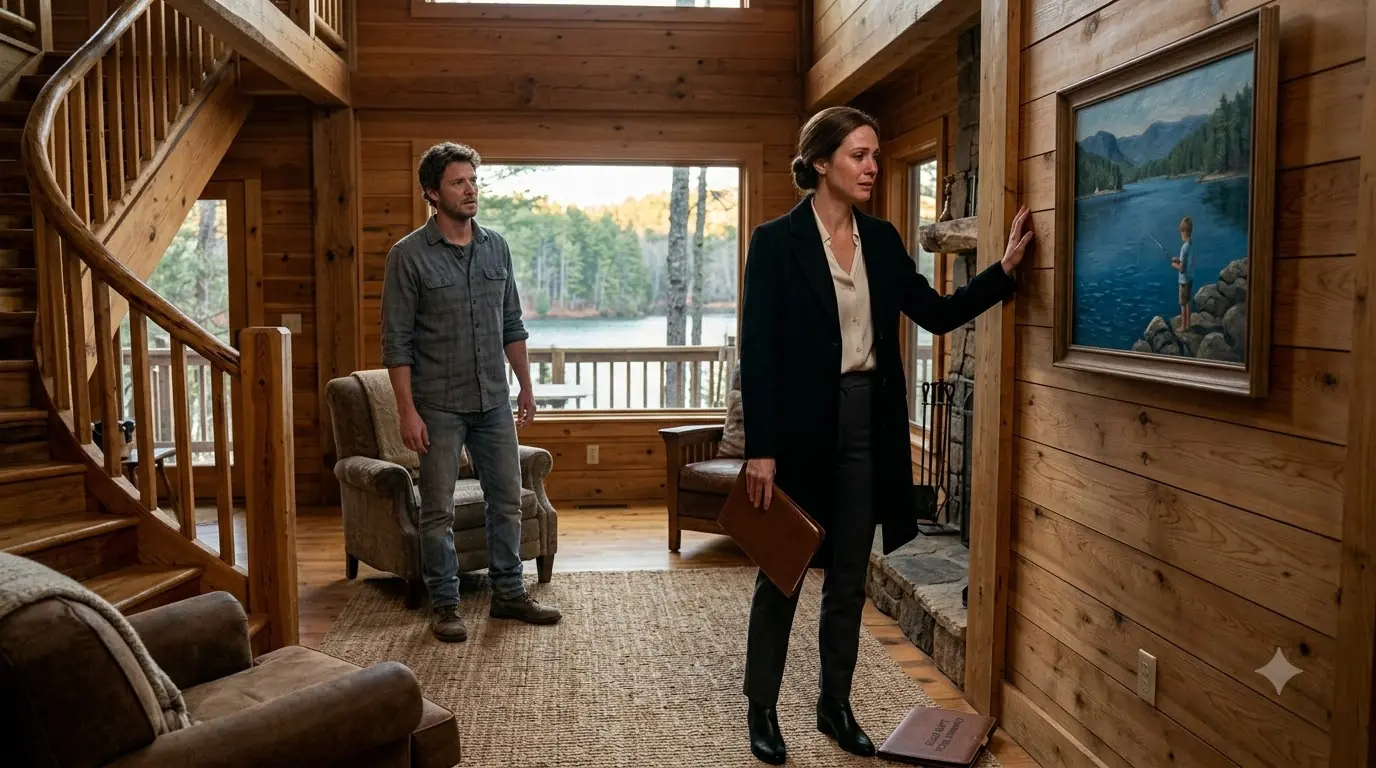
The greeting never came out.
On the wall opposite the entrance, inside a plain wooden frame, hung the oil painting she had spent eleven years searching for. It showed Lake Lure in deep blue, with a small boy fishing near the shore. In the lower right corner was a painted signature written in a childlike hand.
Cole C.
Summer 2013.
Wren sank to her knees in the living room of a stranger and broke apart.
Three weeks earlier, on the twenty-second floor of the Callaway Health Foundation in Charlotte, Wren stood at the head of a polished walnut table and guided her board through the same project for the seventh consecutive quarter.
The Cole Callaway Children’s Mental Health Center.
Eighty beds.
Six years of planning.
Three years of waiting.
A map of the proposed site appeared on the screen behind her. The project required four adjoining parcels along the western shore of Lake Lure, North Carolina. The water was quiet, the trees were old-growth pine, and nearly every clinical study Wren had reviewed indicated that the landscape was ideal for helping traumatized children recover.
Three property owners had signed.
One had refused.
“Vance is still a no,” Wren’s assistant, Nia, said from the side of the room.
“Read it again.”
Nia opened the latest correspondence.
“Fourteen months, seven offers, beginning at $1.8 million and ending at $4.2 million. Every refusal contains the same sentence.”
She looked at the paper.
“‘The land is not for sale. Respectfully, A. Vance.’ That is the entire letter, ma’am. Every time.”
Wren did not sit.
She had not sat during a board presentation in nine years.
“I will go see him.”
One of the attorneys leaned forward.
“Ma’am, our counsel has advised that direct contact could complicate the negotiation.”
“I will go see him.”
That settled it.
Two hundred twenty miles west, during the same hour, Adrian Vance was already drinking his second cup of coffee.
Five in the morning at Lake Lure looked like dark blue ink poured across a sheet of glass. Adrian walked from the cedar house toward the boat shed his father had built in 1971. He switched on the lamps and ran one thumb along the curved rib of a half-finished canoe.
His nine-year-old daughter, June, slept upstairs in the house with her sketchbook tucked beneath her cheek the way other children held stuffed animals.
Adrian’s mother, Eleanor, had been gone for two years. The final thing she had said about the property was simple.
“This house does not sell, son. Not for gold.”
At seven, Adrian walked down the gravel drive to the mailbox beside the gate.
Inside was one envelope from the town hall.
Property tax reassessment.
Increase: 340 percent.
Signed by Brock Halliman, Mayor.
Adrian stood in the cool morning air for thirty seconds. Then he folded the notice carefully and walked back toward the house.
At noon, he met Coraline Beach inside the only coffee shop in town.
Coraline was seventy-one, narrow-shouldered, and kind-eyed. She removed the tax notice from its envelope and read it twice before looking at Adrian.
“I do not want to say this, but if this amount is not paid within sixty days, the county can take the property.”
“I know.”
“You need to think seriously about the foundation’s offer again.”
“You know why I will not sell.”
Coraline remained quiet for a long time.
“I do,” she said. “But Maren would want June to have a roof over her head, even if it was not this one.”
Adrian did not respond.
That evening, June sat at the kitchen table drawing while her father peeled apples.
She paused with the pencil between her fingers.
“Daddy, the painting in the living room. Was the person who made it your friend a long time ago?”
“A friend from summer camp.”
“A long time ago?”
“Yes.”
“He was really good.”
Adrian glanced toward the living room.
“He was very good.”
In Charlotte at nine that night, Wren sat alone inside her office.
On her desk was a photograph of Cole at seventeen.
She turned it facedown.
It was the gesture she had made before every painful decision for eleven years.
“I will get this parcel, Cole,” she said into the empty room. “For you.”
On Thursday morning, a black Range Rover traveled up the gravel drive at Lake Lure and stopped before the wooden gate.
Wren stepped out alone.
“Remain in the vehicle,” she told the two attorneys. “I will go in first.”
Adrian opened the front door before she knocked.
He wore a gray-blue flannel shirt. A streak of linseed oil crossed the back of one hand.
He did not look surprised. Nia had sent a courteous letter informing him of Wren’s visit.
He did not invite her inside.
“Mrs. Callaway, you traveled a long distance to waste your afternoon.”
“Ms. Callaway, and I do not waste afternoons. Ten minutes, Mr. Vance.”
Adrian studied her for a long moment.
Then he stepped aside.
“Ten.”
Wren entered.
She had prepared for every possible argument except the house itself.
The ceiling rose at an angle she had previously seen only in carefully designed concert halls. North-facing windows drew soft, even light into the room, the kind artists preferred because it changed very little throughout the day.
The stairs were intentionally uneven. The lower treads were narrower, arranged in a way that would reduce strain on aging knees. The banister had been sanded so smoothly it resembled polished bone.
This was not merely the home of a man who built boats.
Wren stopped on the rug.
Recognition arrived all at once.
In 2018, she had stood beneath the same proportions during a fundraiser inside the Boston Children’s Cancer Wing.
“You designed the Boston Children’s Cancer Wing.”
It was not a question.
Adrian froze for half a second.
“You have the wrong person.”
“Vance and Holloway.”
He said nothing.
“You are the Vance.”
He neither confirmed nor denied it.
“You came to discuss the land, ma’am, not me. You have nine minutes remaining.”
Wren allowed the subject to drop.
She sat in the armchair and began her presentation.
Eighty beds.
The western shoreline.
Trees and water.
Jobs for the community.
Nia had prepared three versions of the pitch.
Wren used the warmest one.
When she spoke the name Cole Callaway, Adrian tilted his head slightly.
“Your brother?”
“Eleven years ago.”
“How old was he?”
“Seventeen.”
Adrian was silent for a long time.
“I am sorry.”
Wren had heard that sentence from thousands of people.
She did not answer.
Footsteps sounded from the staircase.
“Daddy, I finished the loon.”
A small girl appeared, holding a sketchbook against her chest.
She saw Wren and stopped.
“Oh. I am sorry, ma’am.”
Wren produced the smile she normally used for donors.
June studied her with the open and unhurried curiosity of a child raised around quiet adults.
“Would you like to see the loon?”
“June, the lady is working,” Adrian said gently.
Wren surprised herself.
“I would like to see it.”
June came down the remaining steps and turned the sketchbook around.
A loon floated across Lake Lure in colored pencil. The line work was confident but restrained. The water was suggested rather than fully drawn.
Wren’s hand moved before she consciously decided to reach.
Her fingers brushed the edge of the page.
She knew that line.
Wren lifted her eyes from the sketchbook.
For the first time since entering the house, she looked fully across the room.
Her gaze landed on the opposite wall.
Wren stood slowly.
Her body moved before her mind understood why.
She crossed the rug in two steps.
Adrian did not yet understand.
June remained on the lowest stair, sensing something heavy without being able to name it.
The painting showed Lake Lure in deep blue.
A small boy sat fishing near the water, appearing to be nine or ten years old. In the lower right corner was the same controlled hand Wren had just seen inside June’s sketchbook.
Cole C.
Summer 2013.
Wren touched the wooden frame.
Her finger trembled against it.
“This is my brother’s painting.”
Adrian moved beside her and looked at the artwork he had displayed inside the same room for eleven years.
“Cole Callaway?”
He spoke the name as a question.
“Cole was my brother.”
Wren’s voice broke in the middle.
“Cole gave this painting to someone at the Lake Lure Arts Camp during the summer of 2013. I have been looking for it for eleven years.”
She tried to breathe.
“My mother destroyed almost everything that belonged to him after he…”
Wren could not finish the sentence.
“I could not save a single canvas. I contacted every camper from that summer. Nobody remembered this painting. Nobody knew who had it.”
Her fingers remained against the frame.
“I stopped searching five years ago.”
Adrian lowered himself into the armchair behind him.
He did not look at Wren.
He looked at the painting.
“I shared a cabin with Cole that summer. He was seventeen. I was twenty-one and working as a counselor.”
Adrian spoke slowly, recovering details as he went.
“He painted this during the final week. He told me, ‘You keep it. You are the only person here who actually takes fishing seriously.’”
Wren stared at him.
“I hung it in my dormitory at Yale. Later, I hung it inside my apartment in Boston.”
He looked around the cedar house.
“Then I brought it here.”
Wren went down to the rug.
There was nothing graceful about it.
She dropped to her knees, folded forward, and wept the way grief wept after being postponed for eleven years.
Adrian froze.
He had not seen a woman cry like that since Maren’s funeral.
June moved first.
She did not ask what was wrong.
She took the linen tea towel from the back of a chair and placed it carefully into Wren’s hand. Then she sat on the floor approximately half a meter away.
She did not touch Wren.
She simply waited.
Adrian eventually lowered himself to the floor beside them.
“I did not know,” he said. “I did not know he was…”
He could not finish either.
Wren wiped her face with the towel.
“Did he laugh that summer?”
Adrian thought for a long time before answering.
“He laughed often. He was good that summer.”
His eyes shifted toward the painting.
“That was the part I could not understand when I heard what happened six months later.”
Wren covered her face with both hands.
Adrian did not touch her shoulder.
He placed his palm flat against the cedar floorboards near her, leaving one hand close enough for her to see but not touching.
Outside, the phone inside Wren’s coat vibrated.
After a long minute, she answered without checking the screen.
It was Nia.
“Ma’am, your ten-minute meeting is now forty-five minutes. Are we all right?”
Wren released a slow breath.
“Cancel the remainder of the trip.”
“Ma’am?”
“I am staying at Lake Lure tonight.”
At dusk, Adrian led Wren through the long grass toward the dock behind the house.
The lake in late October had taken on the same deep blue as Cole’s painting.
June remained inside warming soup. She had been raised by quiet people and understood that adults occasionally needed distance.
Adrian and Wren sat on the cedar planks.
They did not touch.
Approximately one meter remained between them.
Adrian spoke first.
He told her about the summer of 2013.
Cole had been seventeen, sent from Charlotte because his parents believed camp might help him. He rarely spoke during the first several days, but he painted constantly.
He enjoyed listening to Adrian talk about architecture school.
One afternoon, on that same dock, Cole had spoken with unusual certainty.
“I want to draw a hospital where children are not afraid.”
Wren became perfectly still.
“Cole said that?”
“You did not know?”
“Cole never told our family what he wanted to become. He only painted, usually alone inside his room.”
“He talked often at camp,” Adrian said. “At least with me.”
The silence lasted a long time.
Somewhere across the lake, a loon called and answered itself.
“My foundation is building a children’s psychiatric hospital on this land,” Wren said.
Adrian looked toward her.
“That was supposed to be the project Cole would have created if he had lived. I did not know he already had the idea.”
A small and bitter laugh escaped her.
“He has been living in your mind for eleven years while I believed I had lost him completely.”
Adrian remained quiet.
Then he said, “He did not disappear, Wren. He is inside that room every morning when I make coffee.”
Wren looked sideways at him.
It was the first time he had used her name.
Adrian kept his gaze on the water.
“I am not going to sell this land to your foundation.”
Wren felt her stomach drop before she had time to think.
“I am going to give it to you.”
She stared at him.
“All four acres, for the Cole Callaway Center.”
Adrian paused.
“On one condition.”
“What condition?”
“Let me design it without accepting payment. I need to do this for him.”
Wren did not answer for a long time.
She looked across the lake, the trees, and the curve of shoreline she would soon ask engineers to protect.
Then she nodded.
From the house, June called through the screen door.
“Supper is ready.”
Adrian and Wren walked up the slope together.
For the first time in eleven years, Wren sat down for a family meal at another person’s table.
On Friday morning at Lake Lure Town Hall, Brock Halliman’s assistant placed a folded note on his desk and left without speaking.
The note read:
Range Rover at the Vance property overnight. Still there at 7:00 a.m.
Halliman read it twice.
Then he picked up the telephone.
“Trent, we have a problem.”
On the other end of the line, Trent Sutherland of Sutherland Resorts gave one instruction.
“Stop it. By any means.”
Halliman called an emergency town council meeting for that afternoon.
He arrived carrying a folder he had been keeping for two years.
The western shoreline, his report stated, was zoned residential. A commercial medical facility would require a review lasting at least eighteen months.
Half the council members were Halliman’s political allies.
They nodded.
During the same hour, Halliman signed another document.
Building Permit Denial.
Vance Boat Shed.
Unsafe Structure.
Demolition required within thirty days.
By noon, the order reached Adrian through a county inspector who had the decency to look ashamed.
Adrian read it while standing in the doorway of the shed his father built in 1971.
He did not speak.
He folded the paper, placed it inside his back pocket, and sat on the step facing the lake.
June came outside one minute later.
She sat beside him without asking what had happened and placed her head against his shoulder.
“Daddy, is Ms. Wren staying?”
“I do not know, sweetheart.”
“I like her.”
“I know.”
Inside the only coffee shop in town, Wren worked through emails on her laptop when a flagged message arrived from Nia.
Unusual activity at Lake Lure Town Hall. Halliman has blocked the zoning application.
Wren closed her laptop.
She did not raise her voice.
She called the foundation’s general counsel.
“Get on the road. Bring the complete team.”
She looked toward the window.
“I want everything we have on Brock Halliman within forty-eight hours.”
Wren then drove to Adrian’s boat shed.
She found him sitting on the step with June.
Adrian stood when he saw the Range Rover.
He handed her the demolition order without speaking.
Wren read it.
“Halliman has wanted this land for Sutherland Resorts for two years,” Adrian said. “I have been the only thing standing in the way.”
He looked toward the shed.
“Now he is afraid we will secure the zoning, so he intends to destroy the shed and bankrupt me before the project clears.”
Wren folded the order.
“Do you want me to handle this?”
“You are the foundation’s chief executive. You can handle it.”
“I need you to say yes or no, Adrian.”
He looked at the lake for a long time.
June had quietly returned to the house.
“Yes,” Adrian said. “But not for me.”
Wren waited.
“For Cole’s center.”
She nodded.
Wren walked back to the Range Rover, opened the door, and called Nia.
“Advance the Halliman investigation. Everything within forty-eight hours.”
She entered the vehicle.
“And schedule a meeting with the chief executive of Sutherland Resorts.”
On Saturday morning, Coraline Beach arrived at the cedar house without calling.
She carried a damaged cardboard box in both arms. Her gray hair was pinned at the back of her neck.
“Adrian, I heard in town that the Callaway woman is here. Cole’s sister.”
Adrian nodded.
“I need to speak with her.”
Coraline looked down at the box.
“I have kept this since 2013.”
Wren was called from the small inn where she had spent the night.
The three adults sat at Adrian’s kitchen table.
Coraline placed the box on the cedar planks and opened it carefully.
Inside was the complete file from Lake Lure Arts Camp, summer of 2013.
A thick folder had been labeled:
Cole Callaway. Cabin Seven.
Coraline removed three things.
The first was Cole’s intake form, completed in his own handwriting.
At the bottom was a question.
What do you hope to become?
Cole had written:
An architect who designs hospitals where children are not afraid.
The second item was a stack of eight pencil drawings on inexpensive camp paper.
Every page showed a version of the same small hospital beside a lake.
Curved corridors.
Wide windows.
A painting room.
A quiet room.
A south-facing therapy garden.
The third item was a letter folded into thirds.
It was addressed to Wren.
She opened it carefully.
I tore up my first letter because I was afraid you would not understand. I will write again after I return home. I want to tell you my idea. I think I will be all right if I have something to build.
Coraline spoke softly.
“Cole never returned home to write another letter. But he trusted you. You were the person he wanted to tell.”
Wren read the letter without crying.
She read it twice.
Then she placed it on the table.
Her face became completely still.
“Why did you keep this instead of sending it to me eleven years ago?”
“I tried.”
Coraline folded her hands.
“In 2014, your family refused every package containing Cole’s name. Your mother returned the entire box marked unopened.”
Wren closed her eyes.
“I kept it,” Coraline continued. “I waited because I believed there would eventually be a reason.”
Wren looked at Adrian.
“Did you know Cole wanted to design hospitals?”
“He told me. I thought it was the dream of a seventeen-year-old. I did not know he had drawn them.”
Wren picked up the eight sketches and spread them across the table like cards.
“Adrian, I want you to design Cole’s center.”
He looked at her.
“Not from your own ideas. From these.”
Wren touched one of the drawings.
“From his.”
She held his gaze.
“Are you good enough to turn a seventeen-year-old’s sketches into a real building?”
Adrian studied the drawings for a long time.
He placed one down, picked up another, and held it toward the window.
“Good enough,” he said.
Coraline left the box with them.
Wren and Adrian remained at the kitchen table with Cole’s eight sketches spread between them.
June wandered into the room and leaned across the table.
“They are pretty. Who drew them, Daddy?”
Adrian placed one hand against the back of her head.
“A very good friend of mine.”
He looked toward Wren.
“And Ms. Wren’s brother.”
On Tuesday of the following week, the conference room on the top floor of the Callaway Health Foundation in Charlotte filled at precisely two in the afternoon.
Wren sat at the head of the table.
Two attorneys and Nia sat to her right.
Adrian sat to her left wearing a plain charcoal jacket.
It was the first jacket he had worn in three years.
He had not worn it to impress anyone.
He wore it because Wren had asked him to.
Across the table sat Trent Sutherland and Brock Halliman.
Wren did not greet them.
She opened a folder.
“I will be brief. My foundation has received a donation of four acres along the western shoreline of Lake Lure from Mr. Vance.”
Halliman shifted in his chair.
“Effective Monday, we will begin the process of building the Cole Callaway Children’s Mental Health Center on that land.”
She turned one page.
“Mr. Halliman, you blocked our application based on the property’s residential designation.”
Wren looked directly at him.
“We have filed for state-level rezoning through the North Carolina Department of Health, bypassing municipal authority. Healthcare foundations have held that right since 2009.”
She closed the first section of the folder.
“Our application is expected to clear within six weeks. You no longer have jurisdiction over the project.”
The color drained from Halliman’s face.
Wren opened the second half of the folder.
“I also have records of three wire transfers from Sutherland Resorts to a political action committee controlled by Mr. Halliman.”
Trent Sutherland stopped moving.
“The transfers occurred in 2024 and total $312,000. They were not properly declared.”
Wren placed three copies on the table.
“I have meeting records showing that Mr. Sutherland and Mr. Halliman met fourteen times during the previous eighteen months.”
She placed another paper beside the transfers.
“I also have an email from Mr. Halliman to Mr. Sutherland containing the sentence, ‘Vance will break within six months.’”
Neither man spoke.
“Mr. Sutherland. Mr. Halliman. You have twenty-four hours.”
Wren lifted one finger.
“First, Mr. Halliman resigns from the mayor’s office.”
A second finger.
“Second, Sutherland Resorts withdraws from every western Lake Lure development proposal for the next ten years.”
She closed the folder.
“Otherwise, this file is delivered to the North Carolina State Ethics Commission tomorrow at nine in the morning.”
Sutherland rose from his chair.
“Ms. Callaway, there is no reason to escalate the situation.”
Halliman leaned forward.
“You do not have the authority to dictate municipal leadership.”
Wren did not react.
“I control $2.4 billion in assets and a statewide healthcare foundation.”
Her voice contained no heat.
“I have all the authority I require.”
She looked at the clock.
“You have twenty seconds remaining.”
They left.
The conference room became still.
The attorneys closed their files and quietly exited.
Nia followed them.
Only Adrian and Wren remained.
Adrian had not spoken during the entire meeting.
He turned toward her.
“You are frightening.”
Wren did not smile.
“Cole deserved someone frightening enough to fight for him.”
Adrian studied her for a long time.
“Maren would have liked you.”
It was the first time he had spoken his wife’s name in Wren’s presence.
She understood the weight of it.
Wren did not answer verbally.
She placed her open hand on one of Cole’s sketches resting between them.
She did not touch Adrian’s hand.
She left her palm close enough for him to see.
That evening, inside her Charlotte penthouse, Wren opened Coraline’s box and arranged the eight sketches across her desk again.
On the bookshelf behind her stood the photograph of Cole at seventeen.
For the first time in eleven years, Wren turned it upright so that it faced the room.
Three months later, in early October, the groundbreaking ceremony for the Cole Callaway Children’s Mental Health Center took place beneath a clear and cold sky.
Halliman had resigned.
The new mayor approved the rezoning one day after taking office.
Sutherland Resorts withdrew.
Adrian spent six weeks in Charlotte working beside the engineering firm.
Wren gave him a small office two doors from her own.
He returned to Lake Lure every weekend.
During the weeks Adrian remained in Charlotte, June stayed with Maren’s mother in Asheville.
Wren and Adrian had not gone on a date.
They had not held hands.
Neither had said anything explicit.
Still, every morning Adrian was in Charlotte, he stopped at the coffee shop inside the foundation’s lobby, purchased a black coffee, and left it on Wren’s desk before she arrived.
One Friday evening in late October, the first true autumn rain fell across the city.
Wren worked late.
When she finally entered the lobby, Adrian stood beside the revolving door holding two folded rain shells.
“Where are we going?”
“Lake Lure for the weekend.”
Wren waited.
“June misses you.”
She had not intended to go.
She went.
They reached the cedar house at eleven that night.
June was asleep.
Adrian led Wren through the wet grass toward the dock, the same place where they had sat in silence on her first evening.
On the cedar planks, he had placed an object beneath a canvas cloth.
Adrian removed the covering.
It was a small architectural model made from cedar.
Cole Callaway Children’s Mental Health Center.
Scale: 1 to 200.
Adrian had built it by hand over six weeks, working late each night inside the boat shed.
Wren lowered herself to her knees before it.
She touched each miniature window with the tip of one finger.
“When did you build this?”
“At night. I do not sleep very much.”
“Why cedar?”
Adrian looked at the model.
“Cole said something at camp.”
Wren waited.
“He told me, ‘I want to walk into a building that smells like real wood. Hospitals always smell like plastic.’”
Wren placed the model on the dock between them.
For the first time, she put her hand over Adrian’s.
Her palm remained there against the cedar plank for five seconds.
Then she lifted it.
The screen door of the house opened behind them.
June appeared on the back porch wearing pajamas, warm from sleep, with her sketchbook beneath one arm.
“Ms. Wren, you came.”
She ran down the slope and wrapped both arms around Wren’s waist from behind.
“I drew you this week. I will show you tomorrow.”
Saturday morning arrived slowly.
They ate breakfast on the back porch.
October had turned the maple trees along the far shore gold. The lake remained perfectly still.
June ate her pancakes and told a long story about a substitute teacher.
Then she climbed down from her chair and ran around the side of the house to feed the chickens.
Adrian and Wren remained on the porch with their coffee.
Wren spoke first.
“I do not know what this is.”
“I do not either.”
“I had not considered meeting anyone after Cole. The foundation was everything I had for eleven years.”
Adrian looked toward the lake.
“I had not considered meeting anyone after Maren. June was everything I had for three.”
The silence stretched between them.
A small wind moved through the dry leaves at the edge of the porch.
Adrian continued looking at the water.
“Maren died on Route 26. A truck lost its brakes during the descent.”
Wren did not move.
“I was in Boston giving a presentation. I received the call while standing at the lectern.”
He took a drink of coffee.
“I flew home, but I did not arrive in time. June was six. She had been at my mother’s house that afternoon.”
Adrian looked down at the cup in his hands.
“I blamed myself for attending the presentation. I resigned from the firm two weeks later.”
He gestured toward the boat shed.
“I brought June here and began building boats because my hands needed something to do that was not drafting.”
Wren watched one yellow leaf fall vertically beyond the porch rail.
“Cole was seven years younger than I was. I raised him more than our mother did.”
Adrian listened.
“By the time he reached seventeen, he appeared to be improving. I began my MBA at Wharton that autumn.”
Wren swallowed.
“I was not home during the summer he attended camp. I was not home during the six months after he returned.”
Adrian remained quiet for a long time.
Then he said, “Maren would tell me, ‘Adrian, do not make this difficult for her. She is frightened in exactly the same way you are.’”
Wren laughed softly.
It was a small sound, but it was a genuine laugh.
“Cole would tell me, ‘Wren, breathe.’”
They laughed together for the first time.
June came around the corner with a feather attached to one sleeve.
“Daddy, Ms. Wren, did you know one of the chickens laid an egg with two yolks?”
“I did know that was possible, sweetheart,” Adrian said.
June looked at Wren.
“Ms. Wren, are you staying until Sunday?”
Wren looked at Adrian.
He did not speak.
He did not need to.
“I am staying.”
Eighteen months later, in early May, the ribbon was cut at the Cole Callaway Children’s Mental Health Center.
The building stretched low and long beside the western shoreline.
It had cedar siding, a pitched roof drawn from Cole’s final sketch, and broad windows facing the lake. A curved central corridor guided children gently through the facility, while a south-facing therapy garden held young lavender and rosemary plants still establishing their roots.
The entire building smelled like real wood.
Three hundred guests sat in folding chairs across the lawn.
Reporters had traveled from Raleigh and Asheville. The North Carolina Secretary of Health attended, and Coraline Beach sat in the front row wearing the finest linen blouse she owned.
Wren approached the podium without notes.
“My brother Cole died when he was seventeen.”
The lawn became quiet.
“For eleven years, I believed he left nothing behind.”
She looked toward the building.
“I was wrong.”
Wren rested both hands against the podium.
“He left eight pencil sketches inside a cardboard box at Lake Lure. He left a painting on the wall of a stranger’s house.”
She paused.
“He also left one sentence.”
Wren looked at Adrian.
“‘I want to draw a hospital where children are not afraid.’”
Nobody moved.
“This building belongs to Cole. It does not belong to me or to the foundation.”
She turned slightly.
“It belongs to Cole and to the man who kept his painting on the wall for eleven years.”
Adrian lowered his eyes.
“Adrian Vance turned eight pencil sketches into a real building.”
Wren stepped away from the podium.
The applause continued for a long time.
After the ceremony, the guests moved toward the reception inside the south garden.
Wren went in the opposite direction.
She found Adrian at the far end of the central corridor, standing before a long interior wall.
The original oil painting had been reframed using museum-quality mounting and illuminated from above with the soft track lighting used by curators.
June stood beside him.
She was eleven now, taller but still carrying a sketchbook.
June turned and saw Wren approaching.
“Ms. Wren, I drew something for you last week.”
She opened the sketchbook to its newest page.
It was a pencil drawing of Adrian and Wren standing on the dock at Lake Lure, looking toward the water.
The small cedar model sat between them.
June carefully tore out the page and held it forward.
“It is for you.”
Wren accepted the drawing.
She placed her free hand on June’s shoulder.
Then, for the first time in front of June and the first time in front of anyone, Wren placed her other hand over Adrian’s on the wooden rail.
She did not interlace her fingers with his.
She simply rested her palm on the back of his hand.
Adrian did not move away.
The three of them stood that way for half a minute, facing Cole’s painting.
Eleven years earlier, Cole had drawn a house without knowing who would someday live inside it.
At last, that house had been found.